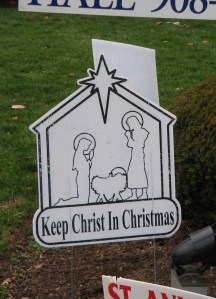
Palms and Thorns

“Holy Week” affects only some. That thought may be disturbing to those who still think of religions as a one-size-fits-all phenomenon. So, although today is Palm Sunday for many, for others it’s just Sunday. Not even all Christians recognize the same Palm Sunday. The question that interests me, though, is the one regarding which religion is the right one. I personally suspect this is the behind the rise of the Nones, but I’m getting ahead of my story. How did we come to this impasse? How did we come to believe that only one winner takes it all, spiritually speaking? The answer may lie in evolution.

I don’t mean biological evolution. Borrowing a principal for how this factual occurrence works, however, may help to understand the diversity of religions. For species to differentiate, they must be isolated from each other somehow. Groups that are available for interbreeding will do precisely that. When populations are separated, subtle changes add up over the passage of time so that when they come together down the road mating’s simply an impossibility. Religions behave the same way. The difference, apart from biology, is that many religions allow multiple gods. They aren’t so different from each other. In fact, we’re not even sure if gods are sufficient to define “religion.” People from diverse cultures in ancient times, the evidence seems to indicate, tried to match up their gods. Your Zeus is our Odin kind of thing. Monotheism—the main form of religion that has a problem with evolution—is the ultimate exceptionalist belief system. Our one deity is the only deity and everybody else is wrong. When populations come together we can’t even agree that the God who’s historically the same is in reality the same. Ours is slightly better.

Amid all the chaos created by religions, academics have decided they’re a phenomenon not worth studying. Academics often lose sight of the larger picture. What happens outside the classroom or laboratory is real life too. And outside the walls of the ivory tower the faithful are gathering. Some today are doing it with palm branches in hand. Others are looking on, bemused. The important thing is we don’t talk about it because talking might lead to understanding. And understanding might make us concede that others have some good points to make with their religion as well. How can you feel special in the eyes of your own god when other people suggest other truths might also apply? No wonder someone will end up crucified by the end of the week.

Rising of the Sun

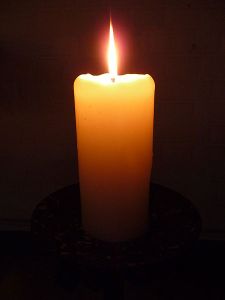
“When the trumpet of the Lord shall sound,” the old hymn goes, “and time shall be no more…” Before Trump’s election I always supposed this might have something to do with the useless ritual of setting our clocks ahead. Apart from the fact that we’re all a bit cranky because, well, we lost an hour of sleep last night, this day is a fine illustration of how rituals form. Daylight Saving Time was a wartime initiative to help keep things going during the darker months of the year. Since things seem pretty dark all the time now I’m not sure that changing the clocks will do any good, but it does call to mind many religious rituals that started out for practical purposes and accreted symbolic meaning over time. One of my favorites is the use of candles.

Photo credit: 4028mdk09, Wikimedia Commons

In the days before electricity, sanctuaries (which were sometimes devoid of windows) required a source of light. The menorah in Jerusalem is perhaps the most famous example, but by no means the only one, of a necessary piece of furniture that grew religious significance. Oil lamps were widely used before candles were invented and they work on the same principle. It didn’t require any special illumination to realize that light is symbolic for creatures that rely heavily upon sight. If you see something, say something. And before you know it candles themselves acquire religious meaning. Just last month some Christians celebrated Candlemas where the title of the day appears to suggest the candles themselves are somehow sacred. Ritual begets ritual. We are meaning-making beings.

Now that we’ve somewhat ironically set the clocks ahead under Trump it might be a good time to reassess. “Rage,” Dylan Thomas wrote in a more modern hymn, “rage against the dying of the light.” Even though Thomas’ light itself extinguished prematurely his message lives on. We’ve lost a month’s worth of morning light. When I step outside this morning it will be darker than it was this time yesterday. But humans habitually look ahead. If I allow myself that luxury as the roll’s being called up yonder, I can perhaps make my way home in the light now that time’s changed. Nature took the light and is now giving it back. Maybe this isn’t the final trump after all. In my more optimistic moments I do believe that candles can be magical in their own right. That’s the power of ritual.


Lunar New Years

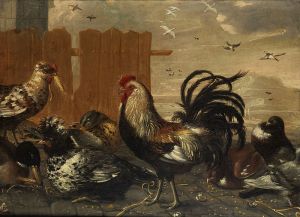
Celebrating the New Year in the middle of winter is a strange idea, at first glance. As I have discussed before, January 1 is “Circumcision-style New Year,” based on the projected date of Jesus’ circumcision after the church had settled on December 25 as his birthday. In actuality, a winter New Year date is due to its proximity to the winter solstice, and the other popular contenders for the honor of the head of the year, historically, have been the spring and autumnal equinoxes. The matter gets more complicated when a culture has a lunar calendar since the sun and moon don’t see eye-to-eye when it comes to their timing. That accounts, obviously, for a shortened February, but also for why a full moon doesn’t occur on the same day of each month. Now, I know little of Chinese culture, but I do know that Chinese New Year fell on January 28 this year, initiating the year of the rooster. Considering what had happened only eight days prior, this feels incredibly apt to me.

800px-hahn_im_huhnerhof_flamisch_17jh

Cultural diversity is a wonderful thing, and this nation is rich in it. You can, to pick a trite example, sample cuisines from around the world in a moderately sized town. Here in New Jersey getting onto a public transit bus will almost guarantee that you’ll hear at least one non-English conversation going on. Nevertheless I do have to confess that I don’t know what the year of the rooster represents in a Chinese context. As concepts cross borders they take on new associations and those who assign those new associations don’t represent those from the original land. So let it be here. Not knowing what the rooster symbolizes in China, I turn to its American expression—the cock. This is its year. The newspaper headlines read like a fortune cookie, in this distorted view of things.

To shift this metaphor to yet another cultural context—originally Jewish, but now appropriated by Christians around the world—think of Passover. For Jesus a night of betrayal. Peter, arguably Jesus’ best friend, denied three times in one night that he even knew his BFF. Cursing and swearing, according to the Gospels, he said, “I don’t know that man.” The cock crowed. It was around the spring equinox. A new year had begun. Within 24 hours, according to the story, Jesus was dead. We have much to learn from other cultures. The concepts change, however, when they’re stopped at the border.


Ash Monday

I was traveling abroad with a friend. We’d just arrived back in the United States and were making our way through customs. Since he was from another country we were separated. The border agent told me I couldn’t come back into the country unless I demonstrated that I was a racist. Only racists were permitted. He began to pressure me, even offering to help. Should I comply? I awoke in a panic. As someone who suffered frequent childhood nightmares, this was something new. In the past it was merely a monster chasing me, or my alcoholic father. Now I’m having nightmares about the government of my own country. And here it is, Presidents’ Day. Like U2’s early “New Year’s Day” or Bruce Springsteen’s “Independence Day,” there’s a decidedly poignant tone to this holiday. Looking towards DC I see nothing to celebrate. I see a government putting the mock in democracy.

This Presidents’ Day, I have a modest suggestion. It could fix democracy. When an election (I’m thinking Brexit as well as 11/9) squeaks out a victory because people don’t vote or don’t understand the issues, a true democracy would then hold a follow-up, “what I really want” vote. If we insist on keeping such arcane tools as the Electoral College in place, this is the only way for democracy to actually work. It wouldn’t be necessary in the case of a candidate winning both the electoral and popular vote. When that happens it’s pretty clear someone won. When the two are divided, however, that’s also a clear signal. Only unthinking automatons would declare that a landslide defeat is actually a win, based purely on political casuistry. Is there an ethicist in the house?

dscn6820

This Presidents’ Day feels more like Ash Wednesday to me. Ash Wednesday is for public mourning. It is a realization and confession that we have sinned. We wear ashes to make it conspicuous. This year no ashes are required. Perhaps we should wear black bands on our arms. I would, only arm bands seem to have a way of becoming bright red and appropriating ancient religious symbols. We have sinned, and we have sinned boldly. The miasma of Foggy Bottom is as clear a condemnation as is devoutly to be wished. When I start waking up in a panic, in a body-sock of sweat, my childhood monsters have become real. It’s Presidents’ Day 2017.


Women and Men

I’m going to the Women’s March in Washington, DC next weekend. At an organizing meeting yesterday it occurred to me that someone might ask me why. Why would a white, male, straight, employed-with-health-insurance person bother to go through the disruption, effort, and hassle of getting to the capital to protest when I personally stand to lose little? That question has stayed with me and although I haven’t articulated an answer, I’ve never questioned the decision either. So why am I going to a women’s event?

I am a son, a husband, and a father. The son of a mother, the husband of a wife, and the father of a daughter. Having been largely raised by a woman on her own, I came to realize early on that all the good I experienced in life was because of the effort of one woman fiercely determined to help her boys get ahead in life. Without the help of a man.

I am married to a woman who has had to face prolonged periods of my unemployment because an institution run by men dismissed me for standing up for minorities. As I have struggled with my career since then, often she has earned the lioness’s share of our household income. When I couldn’t find full-time work we relied on her steadiness to provide our healthcare.

I am the father of a daughter. She is part of the future and I can’t sleep at night if I don’t do everything within my power to ensure that her world is better than mine. A world where women share completely equal rights with men. Get paid the same as men for the same work. Aren’t forced to be biological slaves because men often act without thought of consequences.

IMG_0969

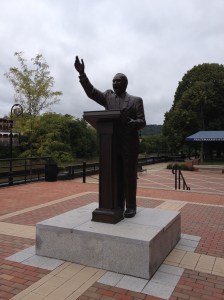
Today is Martin Luther King Day. I’m not an African American, but I believe the same truth applies. All human beings deserve equal rights. If those of us who personally stand to loose nothing do nothing one thing is certain—everyone loses. A friend implied, back in November, that this election was simply a matter of fiscal conservatism. That wasn’t the ticket on which the rails to electoral success were greased. It was a ticket of racial and gender superiority. A message of entitlement. Pulled by a locomotive of caucasian testosterone. Why am I going to Washington next weekend? Because I believe that the only way to be truly human is to recognize, respect, and resist any efforts to relinquish the rights of any person who calls this nation home.


Undiscovered Countries

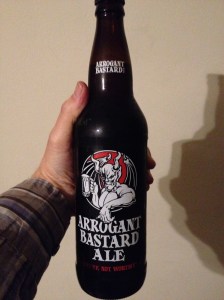
My friend Marvin always amuses me with what he’s got in his refrigerator. He likes to buy products that he considers appropriate to the season. On a recent visit he pulled out a bottle of Arrogant Bastard Ale. He said it was prophetic, in the sense that later this month we’d all be faced with someone fitting of such a moniker. I appreciate his sense of humor—I think we’re going to find that laughter, incredulous and otherwise, is going to help get us through to 2020. Once we reach that mythical date when there will be cities under the sea (unless my childhood cartoon watching has steered me wrong yet again) crewing aquagum all the way, we will have to begin undoing the damage that our government is planning even now. Of course, we were supposed to have a moonbase in 1999, and that show wasn’t even animated. Television produces the biggest liars of all, I guess.

img_3122

January always makes me think of Janus, the two-faced god. Looking forward and looking back. Even Janus seems to have taken on new meaning this year. That’s the thing about symbols—you can’t pin them down to one thing. One of the benefits to studying religion is that you get to feel comfortable around symbols. There may be no real symbology department at Harvard or anywhere else, but scholars of religion inhabit that territory. We skulk around the dark places that human beliefs may go, even allowing people to believe things that are factually false. Instead of getting too dark, maybe we can think of a joke. Two Corinthians walk into a bar…

The future is the famously undiscovered country. Maybe by the time we get there we will have realized just how silly the very idea of countries are. Seems now that citizens of foreign nations can legally take over the US election process, so why bother with borders at all? Put in another way, who wouldn’t welcome the spy who came in from the cold? It’s January out there and all people need shelter from the chill. I keep telling myself there’s no mess that’s so bad that it can’t be cleaned up. Or maybe I’m just thinking of Bruce Almighty again. My friend Marvin refuses to let reality get him down. When the days are short, it is especially important to be the light. Maybe he’s right.


New Year’s Resistance

Now that 2016 is safely behind us, it’s time to start looking ahead to a year of peaceful protest and renewed social activism. When you reach a certain point in your life you’d like to think your country will represent your best interest but the crooked electoral college system with which we’re shackled has lived up to unthinking obedience to convention. Now we all will pay the price. Not all protest has to be highly visible, however. Education has a way of improving things even if done subtly. The key is not to let up. The moment we do, the evil Borg will assimilate us. I’m beginning my new year with a literary protest against ignorance. I mentioned Modern Mrs. Darcy’s reading challenge yesterday. It doesn’t have to be that one, but taking on a reading challenge—any educational imperative will do—is a way of saying that the darkness can’t last forever.

img_3022

2016 was a busy year, in spite of its many challenges. I wrote two books during the course of the year. Don’t go rushing to Amazon, because neither has been published. One likely never will be, although I have high hopes for my most recent effort. I write this not to draw attention to myself, but to suggest yet another form of social protest. Writing is a powerful tool. Long ago one of the most influential people in my life, a high school English teacher, told our creative writing club to write at least 15 minutes a day. There have been times when I’ve slipped, but by far the majority of my days since then have included spells of writing at least that long. This blog is only one outlet, in addition to the fiction and non-fiction I also write. Write your protest! Your thoughts can’t be known if you don’t share them!

Most important of all, we can’t give up hope. The end of the story hasn’t been written yet. We know that Trump lost the popular vote by an historic landslide of almost 3 million. Many, many, many, many, many people are unhappy with the results of this election. The mistake is to think that so many citizens are powerless. We’re not. Even before last year ended I committed to the peaceful march on Washington the day after the “inauguration.” We need to stand up and be counted. We need to say we’re just as American as the bullies who’ve taken over the schoolyard. And we need to continue to educate this country, no matter how reluctant it may be to pre-post-truth.


2016 in Books

As is my custom on this last post of the year I’ll be revisiting the books that made an especial difference to me in 2016. I record most books I finish on Goodreads, and I welcome friends in that venue. I draw on their recollection for what I’ve read and all of the books I mention here have individual posts on this blog. Use the search function. It’s free!

screen-shot-2016-12-30-at-4-50-39-am

The first important book was Scott W. Gustafson’s At the Altar of Wall Street. If you missed this one, it is well worth your time. Economics has become a religion. If you doubt that, look at 11/9 and tell me so. Philip Gulley’s The Quaker Way was also an early read that’s worth revisiting. November has made many of these books more important than they seemed at the time. Whitley Strieber and Jeffrey Kripal’s The Super Natural will expand the minds of those who allow for unconventional possibilities. And Marc Bekoff’s Minding Animals will remind us we’re not alone on this planet. The Soul of an Octopus by Sy Montgomery was a book I really couldn’t put down, and a nice complement to Bekoff. Marcelo Gleiser touched a chord with The Simple Beauty of the Unexpected, a book worthy of anyone who wants to consider how science and humanity might cooperate for everyone’s benefit. While not really a reading-through book, Tristan Gooley’s The Lost Art of Reading Nature’s Signs is important and worthy of attention.

In the realm of monsters, Elizabeth Baer’s The Golem Redux was a fantastic introduction to a Jewish legend that I revisited in three more books over the year. Several other monster books followed, but especially memorable were Carol Clover’s Men, Women, and Chainsaws, and Maya Barzilai’s Golem—please be patient with me regarding this one. I haven’t written a post on it yet, since an official review has yet to be published. Alexandra Petri’s A Field Guide to Awkward Silences won her an instant fan. I’ll read anything she writes. I didn’t give Alice Miller’s The Drama of the Gifted Child the attention it deserves. It’s kind of a personal thing. Kyle Arnold’s The Divine Madness of Philip K. Dick was utterly fascinating, looking at another person Miller would have found intriguing. Also on the topic of writers, Melville’s Bibles by Ilana Pardes spoke deeply to me.

For fiction, highly recommended are Amy Tomson’s The Color of Distance, Peter Rock’s My Abandonment, Emily St. John Mandel’s Station Eleven, Toni Morrison’s, The Bluest Eye, Pete Hamill’s Snow in August, and Jennifer McMahon’s The Winter People. Less profound, but thoroughly enjoyable were Jonathan L. Howard’s Carter and Lovecraft, and Jasper Fforde’s The Woman Who Died a Lot (reading anything by Jasper Fforde is time well spent). My childhood favorite, Lester del Rey’s Day of the Giants retains its magic.

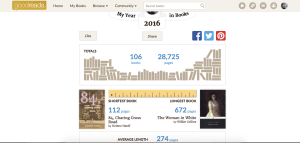
According to Goodreads, I finished 106 this year. Along the way I finished the 2016 Modern Mrs. Darcy reading challenge. Many of the books were excellent, and this shortlist represents those that idiosyncratically stick out in my mind. Please participate in a show of hope for the future: make 2017 a year of reading.


Lions and Lambs

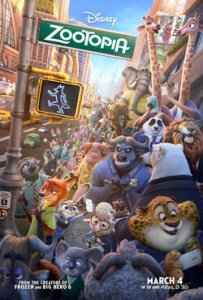
This brief break between Christmas and New Year’s Day, taking into account the vacation days expended to enjoy it, is a time filled with movies, reading, writing, and sufficient sleep. In short, it’s like a dream. I’ll get around to addressing the movies eventually, but right now one in particular is on my mind: Zootopia. Disney movies weren’t a big part of my childhood. We did watch the Wonderful World of Disney on Sunday nights, but movies were an expensive treat. I remember seeing The Jungle Book, Bedknobs and Broomsticks, and Herbie the Lovebug. When we could afford a movie, it was frequently at a drive-in where a carload was cheaper than individual seats. I missed several of the childhood western canon—I never saw Mary Poppins until I was in college. Becoming a parent in the 1990s meant becoming conversant with Disney.

zootopia

Oh, I’ve heard the conspiracy theories: Disney is “the evil empire,” part of the Bilderberg Group, the Illuminati, and any number of other collectives that want to run the world. They have access, we are told, to the young and a reach that excludes few before the age of ten. I know little of Disney’s business practices, but Zootopia suggests to me that they are telling our children the right message. The movie follows the ambitions of Judy Hopps, a bunny that want to be a police officer in Zootopia, the largest city in the animal world. Threatened and bullied because she’s a girl, and small—traditionally prey—she nevertheless overcomes the obstacles necessary to meet her dreams. Once she meets success, however, she finds herself engaging in prejudice against predators. Species profiling takes over and the white sheep (literally) take over.

The message of not assuming someone is a slave to their “biology” is a powerful one. Nick Wilde, the fox that assists Judy to her goal, becomes a victim. The only way forward for Zootopia is to recognize that profiling—gender or species—is wrong. Since the story isn’t preachy, it’s all the better. Watching unchecked prejudice surging through our political machinery today, it was difficult to believe that this movie was released all the way back in March. The prey animals are the majority, and they feel threatened and so follow the leadership that controls, deports the predators who’ve been law-abiding citizens all along. Only when we once again see shrews living peacefully next to elephants, rabbits, lions, and polar bears, do we get the sense that everything’s as it should be. I know nothing of Disney’s business practices, but with messages as important as this, I have but few worries.


Build a God

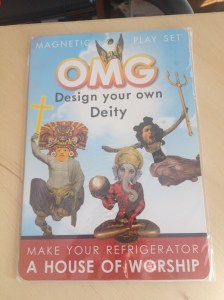
One of the more amusing gifts to find its way under my tree was a Design Your Own Deity magnetic play set. Since I have roughly only this brief holiday break for play in the entire year, I hope to make the most of it. Nevertheless, things like this always suggest something a bit more profound than they were possibly intended to do. The origin of deities is, by its nature, an unresolved question. Partly it’s because regardless of the reality of gods, religions are human constructions. Claims for revelation are frequently made, but the implementation is always our own. We can’t help but think that divinities are motivated by the same kinds of things that people are. I suspect that’s because we make gods in our own image.

img_3116

Historically there are few religions that were admittedly made up. We tend to treat with scorn more recent religions since we’ve become skeptical of a make-your-own deity talking to a person in the post-Enlightenment world. It’s much easier to believe if we say it happened long, long ago. Before we had the reassuring uniformitarianism of science, much could be left to the meddling of deities. Once we had a naturalistic paradigm, the door seemed to have slammed shut on supernatural explanations. Gods, who had been persons, now became symbols and symbols seemed to be less important than the real thing. Hadn’t we been designing our own deities all along? Now don’t we feel silly!

One of the common misconceptions of modernity is that ancient people weren’t very smart. We believe that because they lacked our technology. Looking at the way technology now demands most of my time, I wonder if that’s right. In the light of gadgets, deities have been squeezed out. I’m quite aware that the career choices I’ve made—involved with thinking about gods in some description—are hopelessly outmoded in the technological world. Still, as I look at the political landscape I see that we are still in the process of making our own deities. My play set includes some pretty exotic divinities. One that it seems to be lacking is Mammon. Of course, it’s best not to offend the currently reigning god, even if it is just a symbol.


The Morning After

dickens_gurney_head

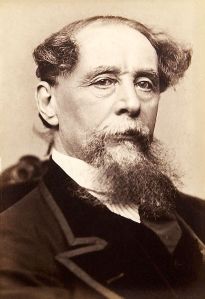
Quite apart from seeing a live performance of A Christmas Carol, Charles Dickens has been on my mind a bit this Christmas season. I suppose that’s not surprising since it has been suggested that Dickens “invented” the modern Christmas, but it is really, I think, because of how the wider world seems to be spinning backwards. The poor have always been a personal concern of mine. I grew up poor and I know how much suffering it entails. My case was a rather mild poverty—we were never out on the street, and we didn’t actually go hungry. We had nothing in the way of luxuries, though, and I could see the possibilities even as I could see the sky where the boards on the roof were pulling apart. It wouldn’t have taken much for us to have been cast out in a cold Pennsylvania winter. Others have it much worse.

On my daily walks to work, I see the homeless. Some sleep in cardboard boxes, some in tents. Others are out under the stars. One morning I walked by a particularly creepy and sad sight of a person sitting, shrouded in a blanket over his or her head, on a subway vent to catch some of the ambient heat. I know that I don’t have the means to buy each one a meal. Their number has been going up, not down. And I think of Bob Cratchit, threatened and bullied by Ebenezer Scrooge. He will lose his job if he’s not in early today, the day after Christmas. Because of his change of heart, Scrooge buys his clerk a pot of “smoking bishop.” And herein lies the only possible cheer.

My wife got me started on Dickens. She also sent me a story from NPR on smoking bishop. It seems, according to the story by Anne Bramley, that British Protestants delighted in making fun of church offices by naming their tipples after titles. Churchmen (and they were men) were largely exempt from being poor and, according to historians, often supported the Poor Laws that made the fate of the poverty-stricken even worse. In a kind of perverse revenge against privilege, drinks were named after various ecclesiastical offices. There’s little that the poor can do, except to try to find the scant humor in a situation where no one has the reach of a Charles Dickens anymore. Ebenezer, unlike Bob, is a biblical name. It means “stone of help.” In these chilly days dare we hope that help may come, even from a stone?


Capital Carol

The idea of exchanging presents on a holiday emerges from the impenetrable veil of time. We don’t know when the practice began—the idea of copying the Zoroastrian wise men in Matthew is a bit of a stretch and the date of Christmas wasn’t settled until much later in time. However and whenever it started, giving gifts at this time of year has become one of the defining features of late capitalism—it’s almost as if Jesus of Nazareth was born for this. An economy that measures self-worth in terms of money is just the place to have God-incarnate celebrated by giving lavish gifts. Those of us who make no money off the holidays can’t deny that it feels good to give someone something. People like, in general, to make each other happy.

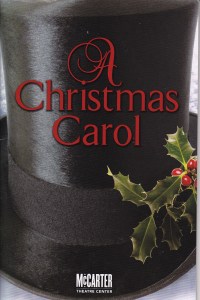
This year my wife asked for a non-material gift. We made our way to the McCarter Theater in Princeton to see their acclaimed performance of Charles Dickens’ A Christmas Carol. A gift of a memorable family time and a truly spectacular play. Seeing this story in 2016 felt especially important. Dickens was a famous advocate for the poor and was well aware of how they suffered at the hands of the wealthy. Indeed, those with too much money lose their humanity almost completely. The story is focused around Christmas, but the message is needed for every day, especially in over-long years such as this. Capitalism is a form of social evil. Anything that lowers humans to mere ciphers on a page is the very definition of sin.

christmas-carol

We all know how the story goes, but to see accomplished actors undergoing conversion is nevertheless a strangely hopeful experience. As the story makes abundantly clear, it requires so very little to make others happy. The point of having money, after all, is to use it for the good of others. Seeing one man facing his own mortality only to realize that he has isolated himself from the care of others is a powerful experience. As we move forward into the long and dark days ahead, there is a reminder here that we need to keep close to our hearts. There may be fewer presents under the tree this year, but we are all the richer for it. This is the kind of gift that we need to share with the entire world.


Charlie Grinch

There were probably about half-a-dozen animated Christmas specials I recall watching as a child. The two that became fixtures, and remain part of my present holiday ritual, are It’s Christmas Charlie Brown and How the Grinch Stole Christmas. I remember watching them from early days—of course you had to wait until their respective channels announced their advent in TV Guide (just writing that makes me feel older than the Grinch). Commuting wasn’t an issue then, so watching television was as common as candy canes and hopeful stockings. As an adult, though, you see things you overlooked, or simply accepted, as a child. I guess that’s what “believing in Christmas” is all about. The willful suspension of disbelief.

I’ve commented on these Christmas specials before. Charlie Brown has so many inconsistencies that an old biblical scholar can’t help but think of J, E, D, and P. What does the signage on Lucy’s Psychiatric Help booth really say? How many branches are on Charlie Brown’s Christmas tree? How does Sally get to the school before her big brother? The animation is clearly a little off—Lucy appears to emerge from the center of her booth’s wooden top as she gives advice to the woeful Charlie Brown with his Trump’s-been-elected-type depression. Still, Linus’ rendition of Luke’s Christmas story brings it home every time. Compare that with the Grinch.

Those who see a war on Christmas (there’s not) seldom cite the Grinch. How the Grinch Stole Christmas is entirely secular. No mention of a special birth. No angels or shepherds. Just a mean old man and his dog. The Grinch shares with Charlie Brown its message of looking beyond the commercialization of Christmas. In the case of the much better animated Grinch (although I still can’t figure out why that one Who’s hat repeatedly flashes from white to blue and back) it would seem that religion matters less than spirit. The Who’s Christmas song with its strange, non-English words, is a celebration of difference. Diversity. Even that angry old man who would steal Christmas itself is welcome in the end. The only war on Christmas is one that has been spawned in the imagination of those who fit the Grinch’s description in Thurl Ravenscroft’s rendering of Dr. Seuss’s lyric. Those my age will understand, and unless you were born yesterday, I suspect that you’ll get my meaning.


Hoping for Light

Although the stores have been playing Christmas music for some weeks now, it is technically Advent. I think we could all use a little Advent as days grow shorter and dark nights increase their influence over our lives. As a nation we’ve been brutalized by a minority candidate and this has become a bleak December that Poe would certainly have understood. The spinning mind occasionally falls upon George W. Bush who somehow has begun to look normal. The president who told us when America was under attack we should shop. After all, that’s what people do in December, right? We buy things to make ourselves feel better. It sure is dark outside most of the time. Advent is all about candles and light and hope.

img_2638

One of the more endearing aspects of human beings is our ability to see the positive amid negativity. Darkness is the natural state of the universe. Stars are tiny points of light in an endless cold and dark universe. Most of what’s out there has no light beyond those willing to burn bright enough for others to see. We, however, see the light of daytime as normative, slumbering away the hours of darkness. We thrive in light and the light has to be augmented by candles as we struggle against the natural darkness that would, if it could, encompass the universe. Darkness, despite its emptiness, is endlessly hungry. Advent reminds us that we must be light if we want anyone to see in the growing nighttime.

We miss this important dynamic if we leap straight from Halloween to Christmas, pausing briefly for Thanksgiving. The church has made its fair share of mistakes, but Advent wasn’t one of them. Experts tell us Jesus wan’t born in December. Christmas isn’t really a physical birthday. It’s an ancient rite concerned with the return of light to darkened skies. A fervent appeal for our colorful lights and candles to encourage the light that we know, we believe, is out there to return to us. Scientists tell us that it’s just that the earth lolls at 23 degrees on its axis and all of this is just a balancing act. That may be so. I’ve never been off the earth to check. Down here on the ground, however, the days come only reluctantly and the nights linger longer and longer. And we can choose to see darkness as our natural state, or we can ignite a candle to encourage the light to return.


Protest Reading

In these days of bold ignorance, reading in public is an act of resistance. A world that follows the uninformed to perdition requires those who stand as witnesses. Those who read. As a cabinet of the wealthiest people in the country is being assembled we need to remind each other that wisdom and wealth aren’t the same thing. Not even close. We read to improve our minds and we find, in such reading, that wealth increases happiness only to a point. Excess wealth leads to misery, but like the addicted, those who have it just can’t stop. Stop, I say, and pick up a book. To help with this my wife sent along the Banned Book Advent calendar. That’s not to say we can read a book a day, but I believe the world would be a better place if we could. Especially if those books were banned.

You see, banned books cause us to think. That’s the payoff. I’ve read many, many banned books. Some of them I didn’t like very much, but that’s not the point. Liking what you read may lubricate the process, but it is the reading itself that stretches the mind. Makes use of mental muscles we didn’t know that we had. Those who ban books want prejudiced minds to prevail. Think about it: prejudice comes from the combination of the prefix for “already” and the root for “judging.” The prejudiced have already decided. Reading challenges. It has from the earliest days of myths on clay down to the era of ordered electrons on a flat screen. Reading makes you question. The thought police prefer mindless acquiescence. Want to show your true colors? Pull out a book and read.

IMG_0899

The season of Advent is one of anticipation. We all know what’s behind door 25, but the journey is the point. That journey is better when it’s literate. When I travel my carryon always has books. More than I can read on the trip, just in case. Books are banned because we fear knowledge. Once exposed to an idea we must deal with it. Far simpler to lock it away in some sealed room and continue to do things like it’s still the 1450s. Before Twitter started revolutions, books did. When we put down our books we are opening an invitation to ignorance. Last month showed what happens when that invitation is given. I won’t make it through a book a day this season, but I flip out my reading material whatever chance I get. And I believe a better future will result.