Popes and Props

Something to believe in?

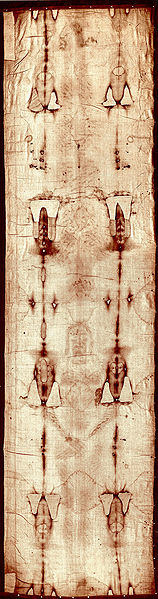
Like the pain from an old sports injury (or Sarah Palin), the Shroud of Turin just won’t go away. Decades after radio-carbon dating demonstrated what many had suspected all along – the shroud is a medieval devotional replica – true believers are still trying to find ways to prove that the cloth is physical evidence of the resurrection. Never one to shy from controversy, Pope Benedict XVI has endorsed the authenticity of the forged artifact. No matter how far science goes, it seems, it just can’t pry the hands of a needy faith off that piece of fabric.

The Shroud of Turin first appears in the historical record only in the sixteenth century. Prior to that a back-story has been composed that takes it all the way to the first century in Jerusalem. Hungry for proof of the truth of their conviction, thousands of Christians fervently believe this sheet is the tangible evidence of resurrection. What seems to have been forgotten in this whole debate is the Bible itself. Not one of the four divergent Gospel accounts of the resurrection (some of the most wildly disparate material in the whole of Sacred Writ) mentions the miraculous capture of a resurrection photograph. The Gospel writers, never shy about flashing miracles across their narratives, do not tout an artifact as proving the resurrection. The force of apostolic conviction was enough for the first century crowd.

Believers in the modern world lack such conviction. Too many forces in the natural world conspire against the supernatural. A faith shaken by science and the competition of hundreds of other religions desperately needs a sky-hook on which to hang certitude. Yet the Bible itself speaks to this very issue. “Now faith is the substance of things hoped for, the evidence of things not seen,” the writer of Hebrews declares. It seems, however, that true believers throughout history feel a little more comfortable with something palpable, just in case faith is not enough.
LOL Cat Bible Commentary, Part 1

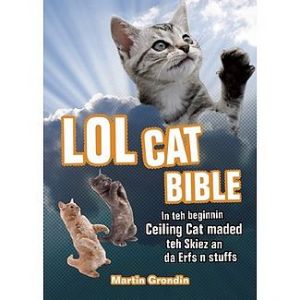
It was bound to happen. Here is the first installment of the LOL Cat Bible Commentary.

Genesis 1.1 Oh hai! In teh beginning Ceiling Cat maded teh skys an teh Urfs, but he no eated them.

In teh beginnin
In teh beginnin ub teh dai — Ceiling Cat nawt wurk at nite, cuz datz wen
Basement Cat come owt to do ebil stuffz.
Ceiling Cat
Ceiling Cat writed da Bible. He’z the mos smartess an strongess kitteh ever. An him reely good — he no eat other kittehs fud, an he nebber jumpz on another kitteh in da middul ub teh nite (but for hoomuns dis ok).
maded teh skys
But first him taked a nap. Den Ceiling Cat maded teh skiez so him had place to liv. An den him putted a hole in da ceilin so him kood peep down on teh Urfs. Wait, him nawt maek teh Urfs yet! Ai sowwy, plz to furgive? Kthx.
an teh Urfs
K, nao Ceiling Cat maek teh Urfs. Urfs is where the hoomuns howse iz.
Ceiling Cat no maek teh udder Urfs, jus da wun wif da howse.
but he no eated them
Ceiling Cat can has a hunger after awl taht wurk, Aifinkso! But him no eated teh skiez, cuz den him fall owt, an den dere no moar kittehz to wurk on da Urfs. An him no eated teh Urfs howse, either. Him wanted to maek teh birdiez an teh moal an teh fishiez. An him also want to maek teh hoomuns for to maek his fud.

1.2 Teh Urfs has no shayps an has darwk fase, an Ceiling Cat roed invisible bike ovah teh wawters

Teh Urfs has no shayps
Cuz Ceiling Cat nawt evur maded a Urfs befoar. Him not no wut Urfs shayp iz!
an has darwk fase
Ceiling Cat can to seez in teh darwk, but dere nawt eny shayps to seez. The Urfs has dawrk fase liek teh howse wif no elec…elek…elekt…wif no lytes.
roed invisible bike
Liek him wuz dreemin. Invisible bike is hawrd to be finded in teh dawrk, but Ceiling Cat maded it an him finded it.
ovah teh wawters
Ceiling Cat nawt liek to get him feetz wet, so him no rided teh bike thru taht wawter. Wawters has see monsturs an stuffs.

1.3 At furst, has no lyte. An Ceiling Cat sez, “I can has lite?” An lite was.

At furst, has no lyte
Ceiling Cat nawt need lyte, but him noes taht hoomuns will to need lyte for to maek noms.
An Ceiling Cat sez
Ceiling Cat has to tawk to himself cuz of monokittehism. No udder kittehs arownd yet, not ebben Basement Cat.
I can has lite?
Ceiling Cat reely wanted a cheezburger. But him needed a hoomun for to maek cheezburger. So him has to maek teh lyte for to get noms.
An lite was.
Nao him can to see howse an da Urfs he maded. Den him maded lolz an udder stuffz, but first him taek moar napz.

(Translated into LOL Speek by the world’s greatest CATS! Fan Kthx)


I See You, This Time

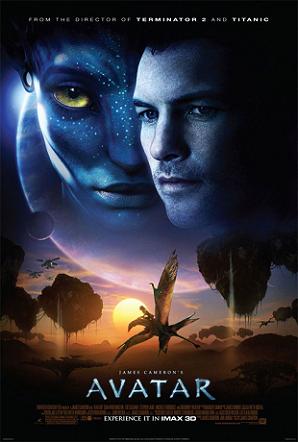
With the advent of Avatar on DVD, I finally had the opportunity to see the movie. This time there was no booming bass and overly active 3-D, and I didn’t end up feeling nauseous for days after. On a small screen it lacked the compelling sense of being in each scene that the first ten minutes of my theatrical experience of the movie had, before I had to seal my eyes tight for the rest of the film or be carried out on a stretcher. Nevertheless, I was able to follow the story this time.

I have posted several times on my affinity for old science fiction films; a large part of my boyhood was spent watching hours of improbable adventure on the black-and-white. Perhaps counter-intuitively, I ended up studying religion instead of science, or even literature. Religion, however, is deeply embedded in science fiction, probably because it is deeply embedded in people. And Avatar was no different. Early commentators noted the similarities of Pandora to Eden. Two trees in the garden (Hometree and the Tree of Souls) were easily borrowed from Genesis. The idea of nearly naked natives living in harmony with the world around them, the soft, graceful curves of the forest contrasted sharply with the angular, obtrusive construction vehicles intent on raping paradise. I’m a sucker for archetypes, I guess. The concept of Eywa as “All Mother,” a nurturing goddess rather than a frowning father deity, only enhanced the sense that Pardora’s box should not be violently wrenched open. Even the hideout of the protagonists was nestled among floating rocks called the Hallelujah Mountains – presumably the name given by earthlings.

Yes, the writing was at times trite, and the characters were caricatures of themselves, but in the tragic light of the Gulf of Mexico Oil Spill, Avatar’s world was pristine, uncomplicated by greed and corruption. The Na‘vi, like zealous Christians, are born twice; the metaphor of foolishly maintaining hope in the harsh light of uncaring entrepreneurs might lead to a limited salvation even for this tired old planet. I am an unrepentant tree-hugger. And if there is a film that, despite its limitations, says it is alright, even noble, to hug trees, then I say it is religious in the deepest possible sense.

All Mother is watching