Holy Land Grabs

Civilization began in the “Middle East.” Ever since then, it has been a struggle to keep it together. One of the sad realities of the last century and continuing into this is that peace in this region seems as elusive as a Tea Partier with compassion. Claims to land are among the most complex of human inventions. Having never been a property owner, I’ve only ever watched this from the sidelines, but I know the endless surveying, assessing, and negotiating that goes into drawing invisible lines across the surface of our planet in order to determine who owns what. At least as early as the Code of Hammurabi, the placing of property markers was considered the concern of the gods. Humans are clearly among the most territorial of animals.

When my wife showed me a CNN story about an archaeological dig at Khirbet Qeiyafa in Israel, this old issue raised its weary head once more. The site, whose ancient name is not yet known, is being suggested as “the city of David” by archaeologist Yosef Garfinkel. The evidence for the suggestion, as far as I can tell from news reports, is that the city fits the right time period and lacks pig bones. With the Bible’s great claims for David’s very large kingdom, archaeologists have been unable to find evidence that such a grand entity ever existed. David himself is not historically attested outside the Bible. Those who make land claims based on a putative gift of God, however, must find physical evidence to back it up. This wish hovers like a dove over every excavation.

The death of an archaeologist

Archaeology has frequently been commandeered by special interest groups. The field of study began in the “Middle East” to find evidence for the historicity of biblical stories, some of which were never intended as history. Daunting emotional claims, however, weighed heavily on the minds of those who led the excavations. The Bible made what they supposed to be historical claims, so the physical evidence had to back it up. When Jericho was excavated and found to have been abandoned at the time of Joshua not a few heads were scratched. Archaeologists returned to the city in later excavations to try to question the results. Jericho was a ghost town long before Joshua came along because the story of Jericho has something more important than history to convey. That larger message, applicable throughout the world, seems to be: don’t base claims to special privilege on the Bible. Tea Partiers could even learn a thing or two from that message as well.


Oh, Eye

As a frequent user of dictionary.com, I note the daily blog-post headlines as I look up my various words throughout the day. Yesterday’s article promised to be a good fit into this blog as well: “Why are zero and the letter ‘O’ both circles? The answer involves both science and mysticism.” The title is a bit wordy, but this is a dictionary site, after all. Each semester I briefly encapsulate the history of writing for my students. Since the Bible is a written document, it stands to reason that its origins reside within the sphere of writing. Many letters of our alphabet are pictographic in origin. Often as the initial letters of a word beginning with their sound, our letter-forms are mostly borrowed from the Greeks, who, in turn, borrowed most of them from the Phoenicians. The pictographic origins of all current ciphers in the alphabet are not known, but some have stories behind them. O is one such letter. As the article explains, O derives from the Semitic letter Ayin, a consonant that has no regular English equivalent. My late doctoral advisor at Edinburgh, Professor J. C. L. Gibson, delighted in saying it was the sound a camel made when overloaded. I have never forgotten how he rolled his eyes and stuck out his tongue while trying to replicate it. The shape seems to derive from ayin’s original meaning of “eye.”

The zero is more metaphysical. As the article at dictionary.com states, its premiere was attended by philosophical and religious arguments. The concept of nothingness still disturbs many people, and its early history was filled with debates about the divine implications of nothing. (Some things never change.) How could such an abstraction fit into a divinely planned and ordained world? Does it not imply that God left a few cracks in the joinery? Debate as they might, eventually the utility of zero was forced upon human thinkers. Its shape, apparently, derived from either the sun or the moon, but not the eye.

In ancient Egypt, however, possibly where the round ayin shape originated, the sun and moon were sometimes equated with the eyes of Horus. Horus is a benevolent god, overseeing the fortunes of the king, and thereby the nation. His wounded eye, damaged in his combat with Seth, has the power to heal as it cycles through its stages as the moon. His solar eye, necessary for life, can be harsh and unblinking. Today O is the fourth most used letter in our alphabet. It has its origins among the powers attributed to eyes in the ancient world. Perhaps if we learn the art of truly seeing, along with Horus, we might discover how to bring peace to those who gave us the gift of writing.

Somebody's eyes


Religion Al Dente

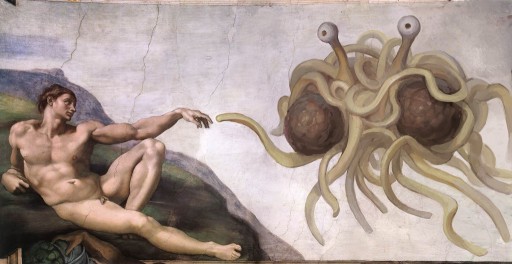
I first learned of the Flying Spaghetti Monster while teaching a course on the Bible and Current Events a number of years ago at the University of Wisconsin Oshkosh. Being freed from the confines of my humorless seminary teaching post, I was free to explore innovative ways to approach my subject matter. When discussing evolution, it was helpful to bring in Pastafarianism as an example of how some highly intelligent—and very creative—people deal with the ridiculousness of Creationism. Lest I be accused of unfairness here, Pastafarianism is also ridiculous. That is precisely the point. The Church of the Flying Spaghetti Monster (FSM) was formed to demonstrate that any inane idea might pass as a religion and should be given equal time with those who use ultra-conservative views on the Bible to effect public policy.

A friend sent me a link to a BBC story of an Austrian man who has finally been successful in his attempt to wear a pasta-strainer on his head in his driver’s license photo. Claiming the headgear to be demanded by the Flying Spaghetti Monster, Niko Alm wished to have his official ID photo taken with the symbol of his faith. I sense an evolution taking place here. The Church of FSM has gone mainstream in many respects; there is a Bible available, you can buy a bumper-magnet to rival a Jesus fish, adherents have designed a slick website, and it boasts many, many followers. While the website of the Church of FSM defiantly refuses to be taken seriously, it makes legitimate claims—religions do not require literal belief, and therefore Pastafarianism is a true religion with believers not being held to any particular doctrine.

The outcry against the FSM movement (which began roughly early in the new millennium) demonstrates its effectiveness. Are there really people who believe this religion? A tour of the website should be proof enough. The claims made by the group have analogues in traditional religion; many major religions teach events and doctrines that are equally unbelievable in the confines of the physical world in which we find ourselves. It is difficult to believe that Niko Alm actually takes this seriously, but who are we to judge? The FSM has moved from making fun of Intelligent Design to casting the very definition of religious belief into sharp relief. Who’s to say we haven’t all been touched by his noodly appendage?

Touched by his Noodly Appendage


Cherry Pie

It is one of those days when it is too hot to move. The heat is the kind that gives you a headache, and the Internet beckons. Thus I came across Cherry Hill Seminary. Having been a seminary professor in a previous life, I’m always interested in the craft. This particular seminary, however, is unlike any other. Advertising itself as “the first and only graduate-level education for Pagan ministry in the world,” Cherry Hill offers pastoral education for those who identify themselves as Pagan. I find the concept fascinating. In an age where the standard offerings of the religious marketplace are experiencing their own kind of recession, the alternatives seem to be flourishing.

Just last night I was explaining to my class how the difference between the religious and the pagan is simply a matter of perspective. Used pejoratively “pagan” means any non-Christian, generally. “Infidels,” “heathens,” or “godless fill-in-the-blanks”—religions crave the handy moniker to make those who are different into “the other.” It is easier to detest a person with a label. Cherry Hill Seminary, however, offers a respectful view towards religious education. The school, which offers its program online, has the goal of educational accreditation. From some of the seminaries I’ve experienced, the bar should not be too high. My only concern is that the uniqueness of this program might fade into the background against some of the weirdness that ATS accredits among the mainstream schools.

Starting at least as early as the Bible, religions have looked upon each other as dogs straying into a bigger dog’s yard. Each one wishes to be the strongest one, the most respected and applauded. Why should paganism be excluded? Requiring a bachelor’s degree for admission, Cherry Hill offers courses in Text, Tradition & Interpretation; Nature, Deity & Inspiration; Pagan Pastoral Counseling; Public Ministry & Expression; and Pagan Advocacy & Leadership. Some of these offerings sound more informative than various seminary classes I suffered through. And on days when it’s hot like this, fantasies come easily. It is not too hard to imagine, especially based on my own experience, being treated more humanely by a pagan than by one who claims my own religious heritage.

When the cherry tree blossoms...


Right by the Numbers

Reading about ancient religions helps to focus the long view. I’m brushing up on ancient Egyptian gods for my Ancient Near Eastern Religions class. Seeing how various gods rose to prominence with the fortunes of their patron kings or priesthoods suddenly struck a chord for modern-day religions as well. Many of society’s most conservative like to think that this is the day of Yahweh (or, not to put too fine a point on it, Jesus). This pre-biblical god has come into his own with the rise of the Catholic Church, following on from the conversion of Constantine, into the post-Reformation development of Evangelicalism. With the superiority of numbers and fiscal wealth, there is no disputing the one true god, is there?

What happens when the ultra-selfish free market consumes itself to a point that other cultures rise above it? Already outnumbered in souls by China and India what will Americans say when Buddhism or Hinduism outstrips Christianity? Is religion proven correct purely by the numbers? Cultural dominance has become inseparable from religious truth for many brands of Christianity. If in doubt, check out Andrew Schlafly’s Conservapedia (if any state would like to take him off New Jersey’s hands, you are certainly welcome). Being the right religion means being the might religion. Somewhere along the way it seems that the message of Christianity has become equated with bullying others around. I think Jesus must have gotten pushed around quite a bit as a kid on the playground.

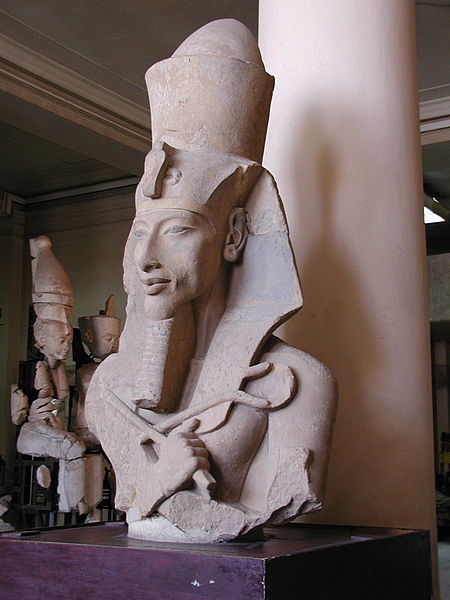
What's behind that self-satisfied smile, Akhenaten?

When Amenhotep IV became king of Egypt, the priesthood of Amun had grown very strong. Probably in an effort to suppress this powerful rival, the king changed his name to Akhenaten and promulgated the sole worship of Aton. Some like to give Akenaten credit for being a monotheist. To me it seems more likely that the old pharaoh was attempting to show intolerant bullies the way to behave: use religion to political advantage. If the opposition disagrees, shut them down. Problem is, this doesn’t work well over the long term. As soon as the unpopular king died, the former religion reasserted itself and things went back to the way they had been. Tut, tut. Seems like religious bullies never learn.


Religion Underground

Imagine a world where the affluent live in lofty houses and the poor, working class citizens trudge to long, dreary, factory shifts in order to keep the system working from their underground world. Although it’s not exactly post-recession America, it is not too hard to imagine. On my final day of vacation from relative unemployment, I watched Metropolis for the first time. A 1927 silent film, this movie of a dystopian world run by an unsympathetic ruling class is experiencing somewhat of a revival. Panned by early critics, the film is now often categorized as a classic of the silent era. It was also the most expensive silent movie ever filmed. Shot in Germany between the two world wars, the story follows a surface dweller who has fallen in love with a troglodyte. It even has robots.

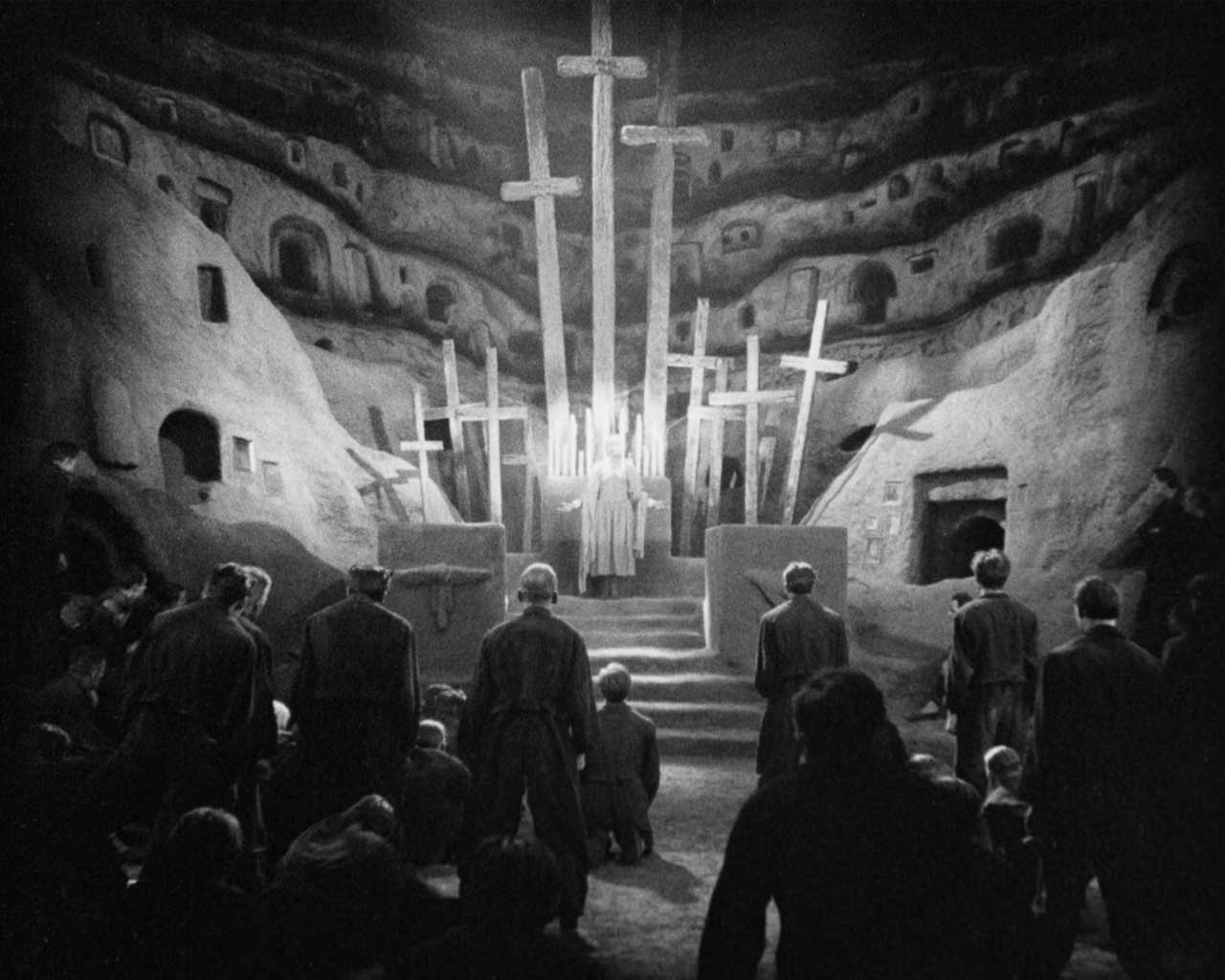
This Fritz Lang film fits in this blog because of its many biblical references and themes. Freder, the protagonist, falls in love with Maria, a working-class preacher among the underground laborers. Following Maria to the underworld, Freder sees the gargantuan machinery that runs the lives of the poor, and when workers die in an accident he calls out “Molech!” Molech, the putative god of child sacrifice in the Hebrew Bible, is shown as a fiery factory door consuming the forlorn men who dutifully march inside. Maria, however, teaches love and patience in suffering. In an underground cathedral she is the sole cleric long before most denominations recognized women as ministers. She compares the skyscrapers of the rich to the tower of Babel and insists that a mediator will come. With its strange blend of Christian and communist themes, this film made a significant impact in its time.

In our own day of entrepreneurship with faux-Christian backing it goes unnoticed that the Christianity of the first century was what might be called communistic. According to the book of Acts, early Christians keep their goods in common to ensure that everyone had what they needed. Among the disciples, Judas kept the common purse. What marked these early Christians as exceptional in the eyes of their earthly overlords was the concern that they had for one another—selfishness had no part in their religion. When Christianity became the religion of empire the lure of worldly goods distorted it almost beyond recognition. Christian industrialists built the tower of Babel with its leering Molech beneath the surface of the ground. Judas, it seems, has become the ideal role model for such a religion.

Maria's underground cathedral


Stobor and Dogs

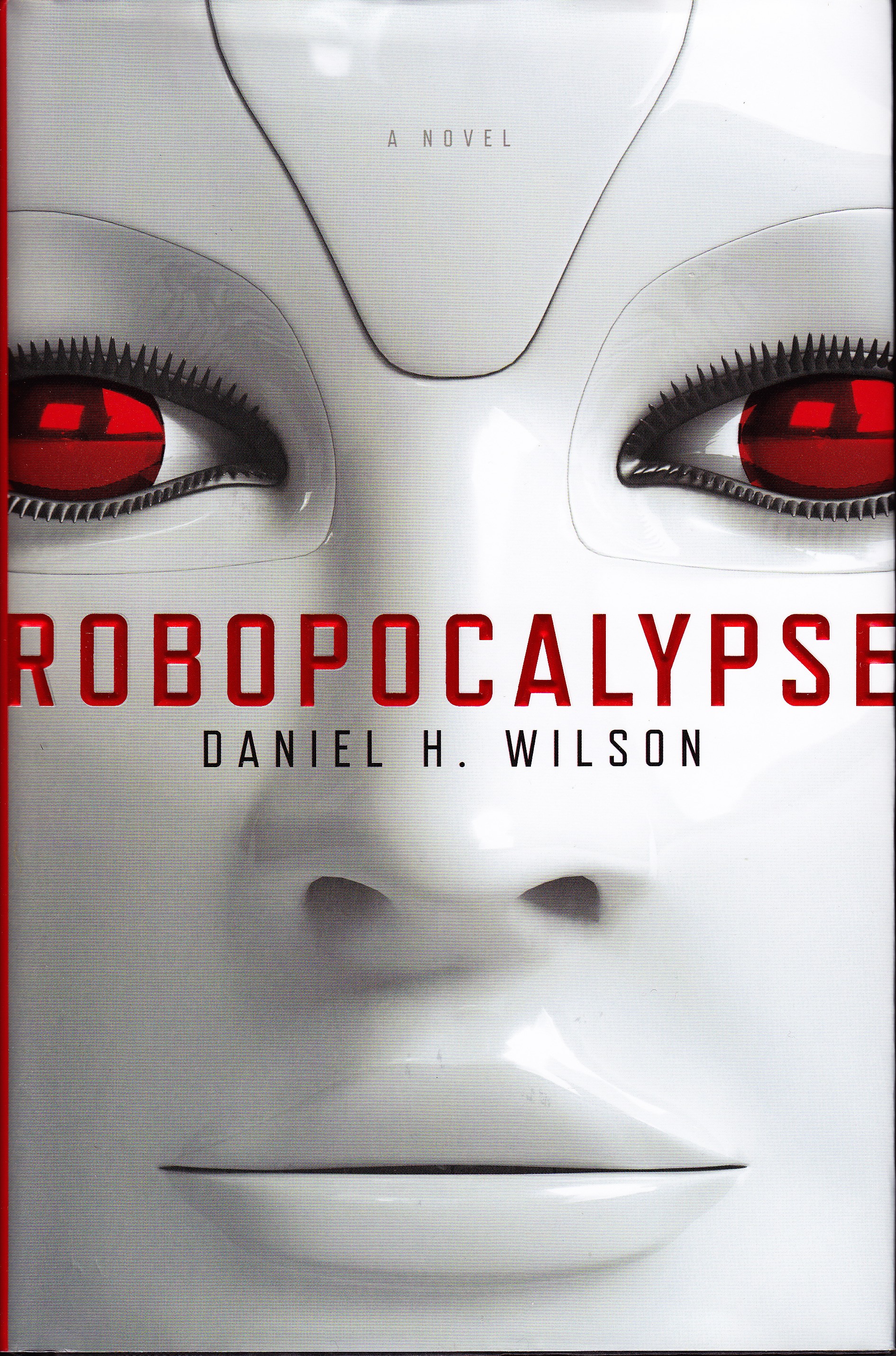
Having spent seventeen hours on public transit of various sorts yesterday, I had plenty of time to read. My chosen book for this trip was Daniel H. Wilson’s Robopocalypse. In my recent reading spate of dystopia novels Wilson’s vision seems more likely than others and thus perhaps a bit scarier. An obvious reason for this is that much of our tax money goes toward military projects that are, naturally, secret. A large part of Robopocalypse deals with military robots gone feral. Well, not really feral. The robots are controlled by a mastermind computer virus. In the first chapter this robot overlord declares to its creator, “I am your god.”

That statement is probably, metaphorically, true already. We live in a world where culture would change irrevocably without our current technology. Without it even fewer people would be reading the words I daily post here. Without it industry would shift into reverse back to the days of Thomas Edison or Eli Whitney. Present-day culture would be unrecognizable. Although not the best-written novel I’ve read, Wilson’s story does raise a salient issue—at some point the tool becomes the master of its user. For many years those who loudly proclaimed the superiority of Homo sapiens declared that we were the only tool-making animals. Subsequent observation has, of course, proven that to be inaccurate. Nevertheless, once knowledge of tools is acquired a trajectory is set. We lose a little bit of control.

Has technology replaced God? For some it clearly has. God is a symbol of comfort and meaning. As I watch thumbs busily texting away on planes, trains, automobiles—and especially in the middle of lectures—I realize that this altar of technology boasts many worshippers. There are very few scenarios where advanced technology is not present, like an omniscient being. Thankfully we have a few more years before Raymond Kurzweil’s artificial brain comes online. We should use those few remaining years to prepare ourselves for either an epiphany or an apocalypse. When the slaves become the masters, we are firmly in the territory of dystopia, at least from a human perspective.


Kings and Codes

I readily acquiesce to the suggestion that others are smarter than myself. In a world of overly competitive commerce that has wormed its way into higher education, I have found myself ill-equipped to compete against those who are more clever at working the system. At times I can be decidedly pre-medieval in my perception of fairness. Thus it was a combination of self-denigration and legitimate surprise to find a brief piece in the May edition of Wired magazine on the Code of Hammurabi. In this arena I would have supposed myself to be on firmer ground. The piece by Joel Meares appeared in the Blast from the Past section of the “Humor Issue” of the erudite magazine. The writers at Wired are by default well beyond my ability in the tech scene, but this piece was a consideration of how Hammurabi’s justice still plays its way out in popular culture. Beginning with the 1970’s movie series Death Wish, Hammurabi is given credit for inspiring Hamlet, The Count of Monte-Cristo, Red Dead Redemption, Frankenstein, Moby Dick, and Batman. Holy pedigree, Hammurabi!

Each semester I try to explain to my students why study of the ancient world is still relevant. It may be overly simplified to suggest that Hammurabi directly inspired all these works (the Akkadian language wasn’t really deciphered until the middle of the nineteenth century, CE, long after Shakespeare), but clearly the trajectory had been set long ago. Even before Hammurabi. The earliest known law-codes predate Hammurabi by many centuries and demonstrate that our sense of justice and fair play were being bandied about by the gods long before Hammurabi was a twinkle in Shamash’s eye. If we want others to play nice, the best way to convince them to do so is to lay the dicta in the realm of the gods.

Maybe I can’t figure out where Death Wish and Moby Dick share anything beyond a cursory resemblance to Hammurabi, but it is clear that the Mesopotamians were the first to articulate the idea that the gods set the rules and it is our duty not to upset them. Of course, in our society fair play is frequently sublimated to corruption at various levels. Someone is always willing to bend the rules if the covert payment is enticing enough. After all, doesn’t it look like Hammurabi is placing his fingers to his lips while receiving a kickback from Shamash on the pinnacle of the famous stele bearing the code that now bears his name?

Hammurabi winks at Shamash


Sanctuary

Sanctuaries are often difficult to get to, but are often even more difficult to leave. Various religions make use of the concept—a sanctuary is a safe place, somewhere away from the normal world. Perhaps this is one of the reasons humans devised religion to begin with; the world feels heartless and threatening much of the time, and a place where the unseen parent will keep us safe is a desideratum anxiously quested. The problem with sanctuaries is that too much safety inhibits growth. As history repeatedly demonstrates, sequestered religions grow stagnant and antiquated—frequently hindering more than helping.

The concept of a sanctuary is of a piece with the amorphous idea of sacred space. The idea that some places are different, special, or spiritually vibrant is one that admits of no testing or verification. Nevertheless pilgrims will seek out such places in order to recover a sense of balance or peace. Even scientists know the feeling, although it is frequently consigned to the psychologist’s couch. Finding that spot that gives momentary tranquility is big business, as any travel agent knows. While we may invest our sanctuaries with divine trappings, the practice is, at its roots, very human.

The world was not created for us. Congealing from a rapidly spinning mass of superheated rock and dust, it took a few billion years before life might even manage to float atop the cosmic embers. As part of this fascinating development called life, we have learned its hard lessons. Nature is beautiful and dangerous. We are its masters and its slaves. Some of us take great pains to escape to it and when it is time to leave we are ripped from it like a crying babe from its mother’s arms. Sanctuary is a human concept with divine implications.

A sanctuary


Dead Wood

nurse log

Whether it makes a sound or not, when a tree falls in the forest it joins that great cycle that embraces all living things. Decomposition is as much a part of life as conception. Rotting logs provide homes and minerals and nutrients to other living creatures. Although the individual life is over, life as a whole goes on. Nowhere is this more evident than in nurse logs. Nurse logs are those trees that directly host seedlings after they die. While examining such a nurse log yesterday my daughter said, “It’s life after death.” Resurrection. The more I reflected on nature’s resurrection, the more selfish the human concept seemed to become. We want—and some of our religions offer—individual resurrection, the continuance of me, not mere life.

Nature has no theology. In its immediacy and pragmatism, creatures live without pondering what it means, striving to pass on the gift of life they’ve been given through their offspring to keep the cycle going. Evolution may shape forms into new varieties along the way, but we are more amoeba than angel. We are part of something larger than ourselves. Unfortunately our society has evolved to emphasize individual drive over collective effort. We don’t want to tax the ultra wealthy, for they are where we all want to be. It is the poor who are sacrificed on the unholy altar of this thinking that truly reflect what nature intends for us to be.

To justify our selfish outlook humans made gods in their image, adding prerogative to perfidy. Somehow we deserve more than others—longer life and even more life after that. Evolution has, in its non-directional way, distorted the picture by providing us with inordinately parsimonious attribution of souls, according to theologians. Nature belies our paltry attempts at self-deification. Quietly in the forest a tree dies, offering its life for those that will come after. The nurse log knows the true meaning of resurrection, while we fumble to gain more for ourselves, backed by the religions we’ve invented.


Metaphor

Author Neal Stephenson, inspired by fellow author George B. Dyson, built a baidarka a few years back. The baidarka, an Aleutian version of the sea kayak, was such a necessity of life among the Aleut that it was treated as a living being. Whenever I find myself at the same latitude and longitude as the baidarka Neal built, I like to take it out for a relatively safe lake voyage. I’m not much of a swimmer, and taking boats out on the big water always chills me before the water actually touches my skin, but this is a kind of ritual that I feel compelled to observe. It is a participation in the mythic world of the Aleut. As spiritual beings, kayaks were a necessary part of life for island dwellers. In their own way, I suppose, they are saviors.

Author and partner in the baidarka

Traveling by water, I find, is a spiritual experience that eschews scientific quantification. It is a feeling, not a measurable commodity. To quote the great sage Rat in Kenneth Grahame’s The Wind in the Willows, “There is nothing—absolutely nothing—half so much worth doing as simply messing about in boats.” We are born of water, mostly made of water, and ineluctably drawn to the water. Rachel Carson suggested in her classic, The Sea Around Us (always one of my favorite books), that having evolved from the sea we are forever yearning to get back to the sea. Water is life as much as blood is.

broken water

When water breaks by being forced into an unyielding shore or by being thrown over a cliff to become a waterfall, flinging refreshing spray into the air, its great energy is released. Although its flow may be interrupted it will break apart granite and basalt, literally moving mountains and carving coastlines. Water that is placid in the morning may be raging by the end of the day. Water is life, and if life is anything more than a metaphor no one has yet convinced me of it.


Troying Around

While discussing Homer with my relatives, it was decided that we should watch the movie Troy. Although conceived as a blockbuster retelling of the Iliad, the presentation reminded me significantly of The Clash of the Titans (2010). In both instances the directors and writers attempted to portray a realism of sorts, making Achilles and Perseus into just regular guys with issues. There is something of the fallen hero here, and perhaps a misunderstanding of the way the Greeks understood their greats. While it can’t be denied that heroes were intended as figures of unattainable stature, they were in some sense conceived as role models for mere mortals. The Iliad is an exploration of the anger of Achilles and the unpredictable influence of the gods.

As the critics pointed out when the movie was first released, the absence of the gods from the film is a serious departure from the Iliad. Without the gods, Achilles takes on a level of prominence never intended by Homer (whoever he was) and the playing out of his revenge begins to feel like a bad western. Although the Iliad does focus on Achilles, it requires an ensemble cast. None of the characters are evil like the movie portrays Agamemnon. He, along with his brother Menelaus, is the hapless inheritor of the curse of the house of Atreus. No matter what Agamemnon does, he is doomed. This fatalism is cut short in Troy as Menelaus, Ajax, and Agamemnon fall in the foreshortened battle of Troy.

The Trojan War is a myth. There is no history to portray accurately here. Instead there are gods and heroes. In removing the gods—a subtle nod toward many modern sensitivities—the movie loses its soul to beat the bank. And so perhaps it is a modern parable for a society that values money above all else. Whether the gods are real or not is immaterial, for they are but projections of the human spirit. Without them we are mere molecules conglomerated into biological entities with no purpose. Troy is a movie that falls short of truly mythical status, but at the same time holds a mirror to modern culture and asks “are you so sure that you can live without the gods?”


Assyrian Dreamers

And the widows of Ashur are loud in their wail,
And the idols are broke in the temple of Baal;
And the might of the Gentile, unsmote by the sword,
Hath melted like snow in the glance of the Lord!

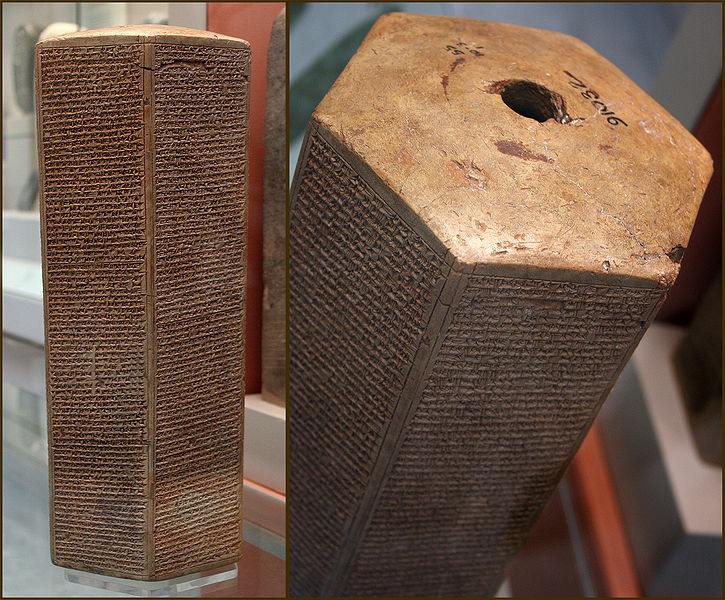
These lines from Lord Byron’s “The Destruction of Sennacherib” were recently quoted to me by one of my relatives who houses a tremendous store of memorized poetry. The poem is Byron’s vision of the siege of Jerusalem, a historical event that is now well understood because the actual annals of Sennacherib were discovered in 1830. The Akkadian version of Hezekiah’s revolt and the subsequent siege of Jerusalem in 701 BCE match the statement in 2 Kings 18 that declares Hezekiah bought off Sennacherib, thus sparing his kingdom. The biblical version then goes on to add the event eulogized by Lord Byron that an angel was sent after a prophecy of Isaiah and the Assyrian army fell decimated outside Jerusalem. The latter event is not historically accurate, but it is much more poetic. Who would write a poem about a king paying off his enemies?

Annals of Sennacherib

The Bible is comfortable with conflicting accounts of events, sometimes laying them side-by-side without comment, supposing that the reader is bright enough to see the obvious contradictions and draw the relevant conclusions. With the birth of Christian Fundamentalism in the 1920s, however, the myth of biblical inerrancy was born. In a world rendered in shades of gray, a distinct comfort lies in having answers in black and white. The Bible, considered the exact (if sometimes dodgy) words of God himself, could not be other than one hundred percent historically accurate. This version of history distorts what actually happened to what must have happened.

Lord Byron, notorious sinner that he was, seems to have been closer to the biblical spirit when he penned his famous poem. Glorying in the bravado of a warrior God who lays waste an entire army without lifting a sword or spear is fanciful, if breath-taking, poetic license.

For the Angel of Death spread his wings on the blast,
And breathed in the face of the foe as he pass’d,
And the eyes of the sleepers wax’d deadly and chill,
And their hearts but once heaved, and for ever grew still!

bears a grandeur lacking in “Hezekiah gave him all the silver which was found in the house of the LORD, and in the treasuries of the king’s house. At that time Hezekiah cut off the gold from the doors of the temple of the LORD, and from the doorposts which Hezekiah king of Judah had overlaid, and gave it to the king of Assyria.”


Hope Soap

I have the distinct good fortune of an occasional sanctuary. I married into a family that owned a share in a remote cabin on a pristine mountain lake. When I can afford it, I make the long journey during the summer and wonder why anyone would ever want to live anywhere else. When I began coming here in the 1980s, the preferred method of bathing was in the cold waters of a meltwater-fed lake. Although I’m extremely sensitive to cold, I’d nevertheless take the plunge and I’d always take my Dr. Bronner’s Magic Soap with me to lessen the environmental impact. My wife and I bought our Dr. Bronner’s at a local health-food store and were pleased not only with its eco-friendliness, but also with the many religious/philosophical sayings printed on the bottle in tiny script. After using Dr. Bronner’s yesterday, I decided to learn a little more of the religion on the bottle.

Dr. Bronner's in its natural environment

Emmanuel Heilbronner emigrated to the United States shortly before the Second World War. His parents were murdered in the Holocaust, but Heilbronner, shortening his name to Bronner, developed a religion that promoted love and peace, making him a popular figure in the hippie movement. He called his philosophy All-One-God-Faith or the Moral ABC and he had tenets of his religion printed on each bottle of his product. The factory he founded remains unmechanized and produces over a million bottles a year. The soap is not animal tested. Ironically, the bottle I used yesterday was purchased back when Dr. Bronner was still alive: visits to the lake are tragically brief and the soap is concentrated and lasts a long time.

Dr. Bronner’s religion is a blend of his father’s Judaism with Christianity and a sprinkling of Islam. Bronner was a promoter of the benefits of monotheism, and his eccentricity may partially be accounted for by the fact that he was treated with shock therapy in an asylum while developing his philosophy at the University of Chicago. Society has a way of trying to silence those who speak with conviction—especially if the conviction doesn’t lock step with those who secretly admire McCarthy. It is fitting, in tribute to this free thinker, to give the final word to Dr. Bronner: “1st: A Human being must teach ‘Love His Enemy’ to help unite all mankind free or that being is not yet Human! Jesus #1. Based on African astronomer Israel’s: ‘Listen Children Eternal Father Eternally One:!’ Exceptions? None!”


Patriot Games

Earlier this week I had the occasion to find myself in Newark’s Liberty Airport. I had mentally prepared myself for a government-sponsored groping (I find full-body scanners immoral and, no matter what the Patriot Act says, illegal) but I managed to make it through with just emptying my pockets and walking around in my stocking feet. Once I arrived at the gate area, I was once again struck by the duplicitous use of religion in America. Posted above each gate was a small banner reading “God Bless America” surrounding a stylized flag. I thought of the Hindus, Buddhists, and atheists flying out of that terminal (and in Newark I am certain there were all three species, in spades). Since 9/11 the staffs of the large New York City airports are justifiably cautious, but the blending of nationalism with divine will always makes me nervous. Especially since the weightier implications are so readily ignored.

In the biblical world the ideal was that travelers would be treated fairly. Someone away from home is already at a disadvantage. In ancient times the traveler deserved special consideration, not to be swindled or met with unfairness. Looking around at the prices merchants charge for those who’ve gone beyond the gate and have no choice, it struck me how when religion and economy collide, economy always continues on unscathed. The weary traveler, according to the Bible, especially deserves fair treatment. Charging extra to someone already at a disadvantage violates just about every biblical standard that echoes through those unread pages. God bless America? Only if it fills the coffers.

The sentiment expressed in “God bless America” is vastly at odds with the way we behave. Taking advantage of others is the bane of prophets and messiahs alike. Taking care of the poor, the disadvantaged, the traveler—this is the biblical ideal. Instead it is easier to band-aid over our sins with posters asking God’s blessing on our insincerity. Many people fear Islamic fundamentalists without taking into account the more subtle damage done by our own homegrown variety, giddily holding hands with an unfettered free market. Cheating the traveler may not be as wicked as blowing up an airplane, but both these tangled vines, in the biblical view, spring from the same root.