For the Love of Books

As is so often the case, publication and religion go hand-in-glove. George Routledge was a man with a vision. As a literary man of nineteenth century England, he moved from bookseller to publisher, establishing the well-known London house of Routledge (aka Warne & Routledge, George Routledge & Sons) in 1843. Although his initial successes were literary, among his first publications were the reprinted Bible commentaries of Albert Barnes. By 1854 a branch of Routledge was established in New York where it continues to operate. Acquired by Taylor & Francis in 1998, Routledge still pursues and produces notable academic books in many fields of the humanities and social sciences. The company is a testimony of the strength of vision of a man with a love of books.

I began this blog as a recently unemployed editor at Gorgias Press and part-time lecturer at Rutgers University. Both were jobs involving books and religion, but I am now moving to Routledge as a religion editor. Once again, I will be full-time in the world of books. Regular readers of this blog will know of my sense of loss at the closing of Borders this year. Although I claim no special insight into the way businesses work, the loss of comfortable space surrounded by books is something I felt very deeply. There seems to be a kind of redemption in taking on a position that will once again set me in the role of seeking to produce more books. It is as if the fabric of several loose strands of my life that had unraveled under the trials of the world of higher education have once again rejoined.

While whiling away the happy hours at the 4-H fair last week, I enjoyed strolling through the arts tent. There I noticed that someone in our county has started a creative writing club. This was a hopeful sign; the previous year I had made inquiry into starting such a club myself. When the world seems to have evolved beyond books, those of us who need them must invest the love of writing in our young. Although 4-H is not a religious organization, writing nevertheless has a sacred appeal. Those who feel drawn to the craft know the incredible grip that written expression can exert on a person—seeing your name on the cover of a book is a form of eternal life, metaphorically speaking. As editor I will not be the name on the cover, but I will be the one helping others to attain that immortality. It may not bring Borders back from the dead, but even the very idea of resurrection comes to us in the form of a book. Even so, Routledge is the agent of resurrection in my meandering career.
Whatever Happened to Marshmallows?

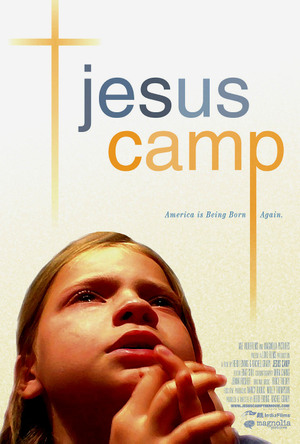
A rainy Sunday evening seemed like a good time to watch a scary movie. I had already viewed an exorcism movie or two over the last couple of days, so my wife and I decided to try something scarier: Jesus Camp. This 2006 documentary shows the workings of an evangelical, Pentecostal children’s camp run by Becky Fischer. By not skewing the evidence but by letting the organizers and children speak for themselves, a disturbing political agenda is revealed. Even more disturbing is the psychological scarring that accompanies such childhood indoctrination in a religion of fear. Fischer is obviously concerned with militant Islam, but her tactic of countering it with militant Christianity where children are soldiers (“this is war!” she shouts at one service) feels equally wrong. Part of the problem with such “Bible based” groups is that the Bible contains many contradictions and the Fundamentalists must pick and choose. For example, Rev. Fischer has chosen to disregard 1 Corinthians 14.34, stating that women should keep silent in the church. (I certainly do not advocate the literal application of that verse, nor of many others that made their way into a misogynous Bible.)

Utilizing the Bible only goes so far as a political tool. At the Kids on Fire camp the children are geared up to an emotionally intense state and lectured about the evils of abortion, evolution, belief in global warming, and Harry Potter. No mention is made that the Bible says nothing about abortion or evolution, and global warming had not yet become an issue. I can’t seem to recall Harry Potter being mentioned by name in the Bible, but other fictitious characters are from time to time. The Bible, having been written over a span of about a millennium, contains differing voices making statements for specific circumstances, and never intended to be used as political platforms. One gets the sense that “Bible believers” seldom read the Bible seriously themselves. Certain favorite passages are committed to memory and rehashed to death while others molder in dank corners of Fundamentalist basements.

What is lacking here is the long view. Once such groups win political power—they should be taken far more seriously in this arena—the religious freedom that will have launched them to that position will disappear. Like all human enterprises, however, it too will eventually crumble. Ted Haggard was spotlighted in the film, shot before his own hypocrisy came to light. At the camp George W. Bush is held up as a saint with Samuel Alito as his acolyte. The psychological manipulation and emotional abuse that the children trustingly accept is condemnation enough in itself. The camp was shut down after the film was released, but Becky Fischer, like Arnold Schwarzenegger has declared, “I’ll be back!” This is one Terminator I truly fear. Having watched a couple of exorcist movies over the weekend as well, I am left wondering which is scarier: demons that possess children or false prophets who do the same?


Parsing an Exorcism

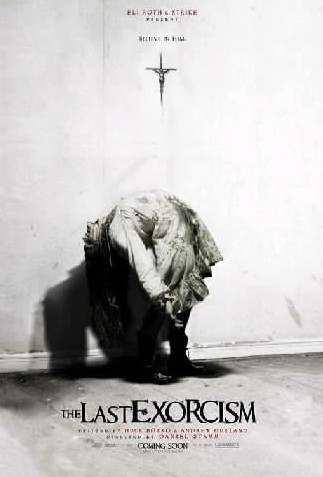
The latest in my spate of scary movie viewings is The Last Exorcism. The press when it was released last year made claims of extreme fright, but my impression was that I’d seen it all before. The “found footage” fantasy is difficult to maintain—although the camera work in the film is good—and the premise of demonic possession is frightening if the viewer is a believer. The hook for this movie, however, is that the exorcist himself doesn’t believe and becomes a victim of his own unbelief. The pattern overall follows The Exorcist, but without the creepy soundtrack and staged lighting effects, The Last Exorcism relies heavily on the viewer’s willingness to believe. The demonic possession is presented as extreme contortionism and self-destructive behavior, as well as the uncharacteristic violence by the victim. When Nell Sweetzer gives birth to a demonic child, a la Rosemary’s Baby, the role of good Christian gone occult feels a little hackneyed.

I’ve tried to analyze what scares so many people with movies of demonic possession. The core fears seem to come down to two: belief in the reality of demonic possession and the fear of being out of control. Historically the concept of possession was originally relegated to the gods with demon possession apparently arising as a pre-scientific attempt to explain epilepsy. The fact that most Christian denominations no longer recognize physical demon possession (a fact exploited by The Last Exorcism) makes it more frightening still. For a generation of media-saturated viewers convinced that cover-ups are common the credibility of the church, struggling with its own metaphorical demons, is suspect. Perhaps demons are out there—a common enough assertion on the reality show Ghost Hunters—and the church has lost control over them. When Jason and Grant explain what demons are, however, they are pretty far afield from Legion being cast into a herd of swine.

If the Internet is any kind of reliable measure of people’s fears, zombies and demons appear to be nearly on a level when it comes to belief. Both are supernatural and neither stretches credulity to the point of humans growing fangs or matted fur. Both participate in the idea that there is more to be feared beyond death. Both fail in the court of science. The Exorcism of Emily Rose raised the ambivalence of demonic possession to the level of the courtroom. One thing I learned on jury duty last week is that the truth is measured on the basis of the judgment of a quorum of rational individuals. The implications of this are frightening indeed: those who accept the reality of non-physical monsters (the jury is still out on ghosts) are fully capable, in a legal setting, of deciding the truth of the matter. The only corrective to witch-hunts and state-sponsored exorcisms would seem to be education. Today education comes via the media where zombies and demons freely roam.


Natural Born Killers

Every year I spend some time at the local 4-H fair. I grew up not knowing about 4-H, and the discovery of the organization as an adult has been an education for me. The local university extension that supports 4-H is Rutgers, although on campus you never hear about this rural aspect of the sophisticated world of academia. My daughter has been a member of the cat club for years, and although not a member myself, they are cordial and always offer me a chair (something no university has ever done) to spend a few hours in the shade while the kids showcase their skills and knowledge. Young potential is one of the few sources of optimism I find in a culture obsessed with selfish gain. My daughter’s cat club shares a tent with the alpacas, the epitome of herbivorous tranquility. With wool so soft as to be unbelievable, the alpacas with their long, graceful necks and huge brown eyes, look to be the least offensive creatures at the fair (except maybe the bunnies).

People in crowds, however, often shift dynamics and stress systems that would otherwise find their own balance. While many of the thousands of visitors at the 4-H fair are respectful of the animals, many others seem unaware that loud voices and running children and constant noise can stress even docile animals kept in small enclosures. Kids will find a cat in its cage and bark at it to get a reaction, and we all know the glass-tapping behavior that drives the reptiles wild. The fair has been part of my life for three years now and I’ve never noticed a stressed alpaca. They seem above it all. Yesterday, however, one stressed animal took on a surprisingly human behavior and began to bully a smaller alpaca in its pen. Apart from the caricatured spitting, the larger animal began licking and biting the smaller one, snaking its long neck after the smaller camelid’s head, biting its ears, and generally making its life miserable. The aggression lasted only a few minutes, but it felt to me like the tension of seeing bullies rough up a kid on the playground. The fairgoers felt uncomfortable, with some even wagging their fingers at the larger, aggressive animal.

Club members eventually stepped in to separate the fighting alpacas, and the poor, smaller animal kept trembling for several minutes after the attack. No blood was let; the assault was mostly psychological. I went out to get a snack at the food tent. When I returned I was relieved to see the smaller animal had been removed from the pen, given some space. Later I learned the young animal had died from the stress of the attack. I had seen the incident, and the violence had mostly been of an unrelenting display of dominance with a minimal physical attack. The aura of threat had created the stress. Saddened, I realized that a parable had unfolded before my naïve eyes that afternoon. Like all parables, only those with perceptive eyes may be able to see through the drama and get to the heart of the matter. If only people were as perceptive as even the innocent herbivores, perhaps such parables could finally come to an end. In the meantime, maybe I’ll watch the bunnies and forget what I read in Watership Down.

Just look the other way...


August Ancestry

Lugh

Now that August is in full swing, it is appropriate to think of Lugh. It would have been more appropriate, I suppose, to have considered him on Lughnasadh (August 1) but I’m afraid I missed the deadline. August is the only month with no officially recognized holidays, either lighthearted or serious, in the United States. Back in Celtic Britain the first of August was one of the quarter days, or days when the rent was due and religious festivals were celebrated. When Scotland was Christianized, Lughnasadh was kept under the name Lammas-mass, a festival of the first harvest of the year. The Christian correlation became the deliverance of Peter from prison or Saint Peter in Chains.

Lugh was, without doubt, one of the most important gods of the Celts. It has been suggested that the Celts understood their gods not to be transcendent beings of a different order than humans, but rather as their own ancestors. They apparently believed that gods came from great humans. Lugh is a warrior god, and occasionally god of the sun. His favored epithet is “long arm” or “long hand,” indicating his felicity with spears and swords. So widely was he known that many important cities were named after him, including Lyon in France, Vienna (known by one of his epithets), and perhaps even London itself. When Romans conquered the Celtic lands, the festival in August was that of the Caesar from whom the month takes its name, Augustus. Apart from the minor Christian festival of Peter in Chains, the month of August was simply forgotten as the seat of holy days.

The origins of gods differ in diverse cultures. The assumption of most people today seems to be that gods exist as an ontological reality and we reverence them because of their factual existence. The Celts, on the other hand, grew their own gods in the tradition that a noble human was worthy of veneration and full of undying power. Lugh may have been one such person. If he was, he has been lost in the heavy haze of hoary antiquity. He comes to us today in August, but more often in March. The word leprechaun is an Anglicized version of the Irish phrase “Lugh the cobbler” (one of his many associations). As such he is remembered every time we pour ourselves a bowl of Lucky Charms.

Part Lugh, part Potter


Why Islam

Radical ideas emerge in the most unlikely of places. In the world of religion the rule is generally to criticize first and then attempt to understand later. This is the burden of revealed religions where the only evidence to test is subjective experience. Lessing offered us the parable of the three rings: God gave humanity three religions (Judaism, Christianity, and Islam) without indicating which one was the correct one. Even before Lessing attempted to provide some kind of resolution to this intractable dilemma, proponents of each of the monotheistic traditions had already made up their minds. The divine buck stops here. Our society places little emphasis on learning about religion. Religion is something we do, not something we have to read about. Given the tremendous motivational force of religious belief, this situation would seem to be a set-up for disaster. Read the headlines and judge for yourself.

I was pleased, therefore, to come across the website WhyIslam.org. Written by Muslims to answer questions by non-Muslims, this non-judgmental, informative website seeks to educate. Despite its rapid growth in the western world, many people are poorly informed about Islam, what it stands for, and how it relates to Judaism and Christianity (especially). The media tends to focus on extreme cases of religious believers; unfortunately they are often the most newsworthy, capturing the limelight in the name of their faith. Whether or not religion was the motivation for an act of terrorism (certainly not limited to Muslim believers), once such an act is perpetrated the religious beliefs of the guilty parties are also suspect. Instead of trying to understand a different religion, the knee-jerk reaction is to fear it. WhyIslam.org is an attempt to counterbalance that fear. Education is the St. George to the dragon of fear. Instead, however, our governments often try to cut back on education and the trench only grows deeper.

If we are to survive the world of competing religions, open conversation is necessary. I’ve been ensconced in institutions where discussion was viewed as compromise and vehement hatred against the foe was considered the only legitimate response. This passed for education. Many seminaries are too busy indoctrinating students in the minutiae of their own tradition to open them to learning about other religions. What are they so afraid of? If a religion is really real, it should never quail in the face of competition. What is the danger in learning about fellow believers? Religions make many assumptions about their own priority—natural enough with regard to core beliefs. If they all encouraged learning about each other, perhaps religious violence would transform into religious education. Islam has much to teach the rest of the world, if the rest of the world would visit sites like WhyIslam.org and be willing to listen.


Faith on Trial

Great white throne of judgment?

I just had a brush with the law. I was recently called up for jury duty for what looked like a very interesting case, but I was dismissed before it got started. When I left the courthouse, I felt as if I was being watched. I was trembling. The reason, I suppose, began with a simple ticket. As a teen I was reluctant to drive. Those who’ve had the annoyance of riding with me know that I rigidly adhere to speed limits and traffic laws. At a momentary lapse some years ago, I was cited for speeding in a rural setting and my sense of justice was shaken. I may have been going too fast, but it is not a habit nor a common occurrence. This happened within a year of being dismissed from a long-term job because the politics of the institution at which I’d faithfully worked for over a dozen years had changed. My faith in the system had been badly shaken. The ticket, issued on a road with very little traffic and for an offense that endangered nobody, only exacerbated the sense of something awry on a cosmic level.

This story has a point. Being raised in a religion with a punishing God who spent most of his time seeking out secret sins and infractions had molded me into what I supposed was a model citizen. I read the Bible daily, attended church every week, avoided all the common sins that others seemed to enjoy with no repercussions. Nevertheless, the God I knew was angry. That anger was directed toward me. Like Michael Pedersen Kierkegaard, I was surprised when things seemed to work out so that I had a secure job in the midst of a recession. Although my thought had evolved considerably, the angry God was still stalking me; I have no doubt that he will be until my dying day. What we teach our children about religion will stay with them for a lifetime. When that job ended, sending me in a career spiral that has now lasted five years, I could feel those punitive eyes staring me down. Now if I see a police car in my rearview mirror, my pulse rate quickens and I break out in a sweat. Like God, they are seeking any little infraction to exploit.

Ironically, the jury assembly room in our county seat is in an old church. As I sat, waiting for my number to be called, I looked at the stained glass windows of Jesus, angels and saints. My first thought was how such a sight might be experienced by someone from a different faith background: what does our public space say about justice? Would a Hindu or Muslim find this welcoming, contemplating the seriousness of the juror’s role? It is a beautiful and comfortable waiting area nevertheless. As I found myself in the rarefied atmosphere of a courtroom with a judge, attorney, and many other jurors, I again felt the eyes of judgment upon me. I’d just exited a building formerly inhabited by an angry God–losing a building surely can’t put someone in a good mood, can it? Had I not been dismissed, I would have watched the drama of justice unfold. And it would have been myself that was sitting at the table of the defendant in a world where no one can ever live up to the standards set by a wrathful God.


Zombies of Harare

In a tale that would have Edgar Allan Poe turning in his grave, a news article from Zimbabwe narrates the darker side of resurrection. In a July 26 story entitled “Schoolgirl ‘rises from the dead’News Day online reports that a sixth form girl, after falling into a coma (the article says she had “fallen into a comma”-embarrassing enough under any circumstances) was pronounced dead and taken to the morgue. Her coughing, possibly from the cold, caught the attention of an attendant and she was rescued. Her schoolmates feared her until school authorities “assured them it (the mishap) was normal.” Even more disturbing is the sentence, “Cases of people gaining consciousness in the morgue after being certified dead are quite common and in most cases doctors would have erred.” The story serves a grim reminder of how in many parts of the world what is taken for granted in developed nations is still a desideratum.

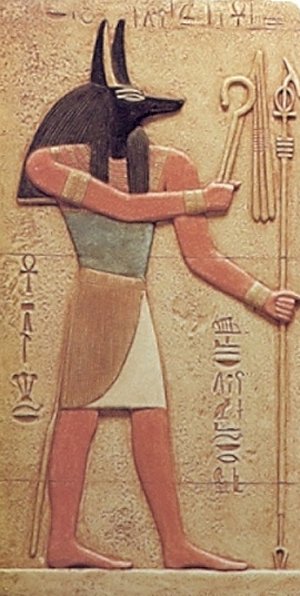
The fate of the dead is a major preoccupation of religion. Certainly among the most famous African outlooks on the subject, the Egyptians possessed a highly refined view of the life beyond. Having just covered Egyptian funerary beliefs in Ancient Near Eastern Religions class, the connection between this chilling story and an ancient optimism among the Egyptians is worth noting. Initially life after death was limited to the king in ancient Egypt. Over the centuries, a kind of democratization of the afterlife took hold and the chance for renewed life was open to us regular sorts as well. In a snapshot of how religions work, this transformation holds the keys for further religious developments. The benefits trickle down from the elite to the peasant. Those who awake in the morgue may count themselves lucky since Osiris demands their presence only at a later date.

When Anubis comes knocking, don't answer.

Modern ideas of resurrection are great motivators for religious belief. The fact that Paleolithic burials sometimes include grave goods demonstrates that some kind of afterlife hope predates civilization itself. It is one of the formative elements of religion. In a world where death may not be the worst possible fate, however, such an afterlife may eventually lose its drawing power. For Egyptian peasants, the afterlife was pretty much a continuation of peasant life. I suspect that those who wake up in a morgue have a new perspective on life after death that most of us, thankfully, never have to face.


Biblical Sex

Legislation covering female reproductive health maintenance has finally passed. Even in a nation where equality is highly touted, women will have, until 2013, been treated as more expendable than men. A few years back I read Mary Roach’s Bonk: The Curious Coupling of Science and Sex. There I learned that even as of the publication date of her book, many aspects of the female reproductive system were still poorly understood. The reason: lack of interest by (mostly) male scientists. Of all the great equalizers of humanity, it might be expected that religions would step in to champion the cause of citizens routinely treated as objects and chattels. Instead, the opposite has been the case. Most religions, and even until the last century Christianity in the forefront of them, relegate women a secondary status to men. Religion is all about power. Now that legislation will allow women basic reproductive rights without extra fees, Catholic hospitals are concerned about the implications. “They defied the bishops to support President Obama’s health care overhaul. Now Catholic hospitals are dismayed the law may force them to cover birth control free of charge to their employees.” Thus begins an article in today’s paper by Ricardo Alonso-Zaldivar of the Associated Press.

Instead of cheering equality, the church is muttering about medieval conceptions of conception. The entire idea that life begins at conception was not even possible in the biblical world where sex did not involve sperm and ova—such things were unknown in those days. The Bible has a few clues to when human life begins, and generally it is thought to be at first breath. Semen should not be wasted, however, since it was thought to be the full set of ingredients to grow new people. The uterus was simply a waiting area, a comfy place to grow with regular womb service. Men were the creators, women were the deliverers. That idea of reproduction formed the basis for all biblical and other ancient legislation on the subject. Comprehending “conception” as now scientifically understood, was only possible with the invention of the microscope. In response, a sexually underdeveloped church decided that the new data strengthened the male hold on ecclesiastical authority. Once the seed is planted, there’s no uprooting allowed. What male, after all, has ever had to carry an unwanted pregnancy to term?

Female religious leadership was recognized in many early societies, and even in some branches of early Christianity. No legitimate rationale exists for saying half the human race is disqualified on the grounds of basic hardware. After all “male and female created he them.” Concerns of “purity” for an age when menstruation was not understood could be marshaled to the cause of male supremacy. That mystery was solved when conception became clear. An unequal result emerged nevertheless. Since women couldn’t be discounted on genetic grounds, they could on the basis of “impurity.” And here we are two thousand years after pre-scientific Christianity was conceived, still waiting while a coterie of all-male bishops castigates normal health care for females. Believers like to suppose that their leaders receive special word from the mouth of God. Those leaders tremble in the face of true equality for the very first word the Bible has to say on the subject is “So God created man in his own image, in the image of God created he him; male and female created he them.”

Who's superfluous here?


Capricorn Too

While seeking the official Flat Earth Society website (don’t ask) I became aware of the fact that several such societies exist. Frequently used as a slur against Luddites and troglodytes alike, the Flat Earth Society would best be classified as a modern religion based on ancient paradigms. This is clear when considering the motivation of Samuel Birley Rowbotham, the erstwhile founder of the movement and author of Zetetic Astronomy. Rowbotham also published a broadside entitled “The Inconsistency of Modern Astronomy and its Opposition to the Scriptures!!” (c. 1850, exclamation points in the original). Those who still doubt the religious nature of the movement should consider that the full-text of Zetetic Astronomy is available on Sacred-Texts.com. The objection to non-geocentric astronomy, although now based on several factors, is religious in origin.

The clashing of worldviews is inevitable when empirical evidence comes into play. As early as the days of Pythagoras and Aristotle thinkers were questioning how physical reality fared against apparent reality. As animals who evolved to cope with apparent reality, the fact that the earth bolts around the sun at a dizzying speed is of little practical value to humans. Making that successful hunt, however, depends on the beneficence of the gods—incredibly important. In such scenarios religion wins out against science every time. The truth of actual existence is more fascinating but indescribably less rich than a mythological worldview. Instead of Dagan, Baal, Zeus, or Thor, we have static electricity. Sure, lightning still behaves in unpredictable ways, but there’s not a god out their hurling it towards sinners. Abstruse laws of fluid dynamics and the flow of electrons determine what is actually happening. Yet we flock to theaters to watch Thor.

While most educated religious believers seldom put too much credibility toward the biblical worldview, they often sense relief at having “flat earthers” to ridicule. Ironically, the stated goal of websites such as Sacred-Texts.com is to promote religious tolerance. For most modern believers, already under the gun of science, tolerance is understood to extend to religions like ours. Those that are outside: modern paganism, flat earth beliefs, ufo religions—such belief-structures deserve ridicule. Is such a mentality not indicative of a certain level of discomfort with “mainstream religions” as well? No matter how far Hubble peers, even to the ends of the universe, it spies no God. No matter how deeply geologists sound, no Hell is beneath our feet. We cannot easily let go of such concepts, no matter how pre-Enlightenment they may be. It may be a good exercise for modern-day people to occasionally read Zetetic Astronomy to remind ourselves that religion comes in all shapes and sizes.


Honest to God

“A lot of traditional beliefs are outside people and have grown into rigid things that you can’t touch any more”–these words come from a minister of the Protestant Church of the Netherlands, according to a report yesterday on the BBC. The title of the article, “Dutch rethink Christianity for a doubtful world,” touches on a theme mentioned earlier on this blog about the church in Sweden: clergy often live with their own doubts about God. Showing similar results to the Swedish study, the Protestant Church of the Netherlands hosts one in six clergy who are agnostic or atheist. I would suggest that the specialization of labor–as well as the persuasiveness of science–stand behind this phenomenon. In modern societies far removed from human roots, we really don’t pay much attention to the training others receive to take on their professions. We assume that higher education is doing its task and that professional bodies like the American Bar Association put up tests to deter those who make false claims. Seldom do we reflect that our off-the-farm lifestyle is a very recent human development and that we haven’t really had time to sort out whether all this complicated training ever really works.

Don't rock the boat...

When I was a seminary professor, I saw the dilemma this way: seminaries crave, indeed require academic respectability. Accrediting bodies insist that a substantial portion of faculty hold terminal degrees. Seminaries, however, are run by confessional groups that insist on certain unscientific worldviews and premises. Doctoral students, unless indoctrinated at faux institutions that block scientific evidence, are educated in a worldview that contradicts their religious training on several levels. Seminaries require educated faculty, but education itself undermines traditional beliefs. Some conservative groups have been aware of this dynamic for years and have begun establishing “universities” that intentionally bar subjects that challenge their worldview. In other words, they want clergy with false credentials who are willing to fight for the cause, while still receiving academic accreditation. Few insiders will blow the whistle since the modern church is built on this shaky foundation.

What is being discovered in northern Europe likely pulses beneath the surface of many developed nations (again, with their specialization of labor). After a person spends three years of training beyond college to receive a “Master of Divinity” degree there is high financial motivation to see the process through to the end. The faithful in the pews, far removed from the realities of theological education, expect the same old show. With employment options nearly nil outside the church, smart clergy know the score. It is better to live a life of quiet desperation, mouthing the party line, than to be thrown into that swirling maelstrom of survival called the job market. Organized religions began when people lived on the land, very few people were educated, and priests were left alone to do their job. Education is costly in far more than college tuition bills. As they are learning in the Netherlands, growing up is never easy.


If God Could Blog

My wife pointed me to the current Shouts and Murmurs section of the New Yorker online; this issue’s is “God’s Blog” by Paul Simms. It is witty, as usual, and the comments outshine the divine post. I had a good smirk and soon forgot about it. I found my thoughts turning to recent events and the idea of God blogging returned to me with a greater intensity. What if God could blog? The responses of online experts might be notoriously predictable.

Most politicians and Tea Partiers would fail to recognize the author, I’m sure. The conservative life-style and outlook have their own particular structures that may have had roots in Christianity at one time, but have now taken on an agenda of their own. God, admittedly a long-haired liberal in his last incarnation, certainly doesn’t advocate the way his dad’s name is taken in vain by such political bluster. I suspect he’d be denied more than three times before the stock market bell sounds.

The theological liberals would probably find such an anthropomorphic activity distasteful for a being as abstract as the divine. After all, by stooping to our level and showing himself active in the world he would be raising the ugly question of theodicy again. If the Big Guy can afford the time to type out a blog post from his android in the sky couldn’t he at least solve one of the more pressing human problems such as starvation or war?

Bibliobloggers would surely rate his posts pretty low. Erudition is born of online prestige and although God is a big draw, his book is still a bestseller and literary types are much more comfortable deconstructing the written word. Besides, since he doesn’t belong to any denomination (or monotheistic religion, for that matter) his authoritative comments would certainly be disconcerting.

I suspect the atheist camp would suggest it was all a hoax. With sufficient skill the source of the posts could be pinned to a physical machine and the words themselves would be traced to a physical brain that is no more than an organic computer. The God Blog could safely be ignored.

We live in an age that has outlived the need for a live feed from the divine. Real-time responses from on high would make everyone uncomfortable. Since we construct God in our own image, those who blog already know what the divine would write if s/he could blog.


Livin’ On a Prayer

Am I the only one who finds it disturbing that Neo-Con politicians are naïve enough to believe that prayer will solve all our problems? Where was God during the Bush years, for crying out loud? And yet headline after headline speculates about Texas Governor Rick Perry’s prayer-fest scheduled for Saturday. What is more disturbing than the lack of imagination on the part of would-be candidates is the sheep-like following on the part of a large segment of the electorate. If God is going to step in and take charge, he had a great chance back on May 21 and refused to pick up the option. If God was behind politics, why did George W. Bush fail to find Osama Bin Laden? If God is running things, why are so many unemployed? Ah, but the religious pundits have a pat answer: America is a sinful nation. What it takes is religion, Texas-style.

In the many years I spent at Nashotah House, the majority of our students hailed from Texas. They represented the conservative hard-line and doctrinal strappadoes that caused much suffering but still somehow didn’t placate an angry God. That, of course, says more about Nashotah House than it does about Texas. Perhaps it is the logical evolution of a country that began with prominent ministers gleefully describing sinners in the hands of an angry God. Nearly three centuries later and we are being told God is still angry. Thou shalt not hold a grudge, eh? The problem seems less about sinful folks just trying to get by (a la Bon Jovi) than about politicians using their religion to get elected. Centuries down the road it will be the topic of some new series of History’s Mysteries that an affluent, educated, and generally forward-looking nation cluttered its governing bodies with politicians who believed the answer to complex problems is to bow their heads and tell God how to fix it. Are we really half-way there, or have we spread our arms to embrace Jonathan Edwards once again?

In MSNBC’s article on Rick Perry’s prayer day, it is noted that the book of Joel is cited as an inspiration for the event. For such a brief book, Joel has been at the forefront of a ton of damage wrought by prooftexters. Joel wrote three brief chapters about a locust infestation for which the suggested response was prayer. One wonders if Rick Perry simply prays when the termites begin to gnaw on his expensive home, or does he call Ortho instead? Joel was truly old school. The locusts in his day meant literal mass-starvation. No chemical romance to solve the problem there. Unfortunately we don’t know how that one turned out—Joel doesn’t say. I’m just glad that Governor Perry hadn’t been reading Psalm 137 when inspiration struck, and can I get an amen from the pro-lifers on that?

Ricky used to work on the docks?

P.S. Matthew 6.5.


Red Eye Religion

It is a slow news day when Bigfoot makes the front page of the New Jersey Star-Ledger (without a body being found, of course). Not even halfway through the article the word “supernatural” shows up. This illustrates once again my contention that paranormal and religion often share mental space. A few months back I posted on the recent book Paranormal America by Christopher D. Bader, 
F. Carson Mencken and 
Joseph O. Baker. The authors, sociologists by trade, expressed a revealing connection between religious belief and willingness to accept the paranormal. One exception stood out, however; professionals who engage the hunt for sasquatch often toe the line of science and disparage the popularizing notion that their quarry is supernatural. There’s no doubt that Bigfoot has a growing clientele. Whether mythic or biological, there can be little doubt that the big guy’s here to stay.

Appearing in the newspaper as a bit of New Jerseyana, the local tradition about Big Red Eye—the north Jersey version of Bigfoot—suggests instant comparison with the Jersey Devil, a tactic the paper takes. Similar to responses presented when religious behavior turns criminal, adding a light touch helps to ease the tensions. Both religion and the paranormal thrive in the realm of belief. As I waited all morning in the garage for car repairs yesterday, the incessantly chatty morning talk-show hosts were going on about some quote that the Tea Party had been compared to terrorists. One of the gambolers stated, in rather self-righteous tones, “they are entitled to their beliefs-the constitution protects our right to believe what we want,” or something to that affect. Belief is a very powerful motivator. Even those who thrive on science alone secretly imbibe.

The physical reality of a phenomenon is not the sole indication of its significance. People are meaning-seeking creatures. Our concepts of what life means range from nihilistic, to simple, to complex. Even those who claim life has no meaning arrived at that place after the search. The significance of the unseen, the unknown, is that it provides an Ebenezer for meaning. Does Bigfoot exist in New Jersey? I can’t say. If so, it would still not rank as the strangest thing I’ve seen here. Nevertheless, among the fervent critics and uncritical adherents a common bond exists. Belief can’t be measured in any laboratory (yet) but only the most naïve would assert that it doesn’t exist.

Do you want to believe?


In Our Image

Preparing course notes on Ancient Near Eastern religions often sheds light on the religions we practice today. Religious beliefs are organic and, although many religions claim special revelation, their basic components have been around for millennia before they appeared. In the broad sweep of ancient times it becomes clear that religions evolve to fit the viewpoint of the power structures of society. The favorite god of a puissant sovereign became the chief god of a nation. When rulers change, gods sometimes change with them. Without doubting the sincerity of ancient believers, the truth is that gods serve the needs of the state as long as the state upholds the monarch. When gods become too sympathetic to the working class, well, it’s time to shuffle up the pantheon a bit. The story of Akhenaton’s advocacy of Aton worship is a case-in-point.

Somewhere along the way to modernity, symbolism became literalism. Anyone who follows the news of the various theocracies of modern history can see this pattern endlessly repeating itself. Politicians need a power-base and religious believers are often natural followers. By wedding gullibility to expediency a religious right is born. Akhenaton would have been proud. Of course, the message repeatedly doled out by our rapidly evolving, technical society is that studying history and religion (among other arcane subjects) is a waste of time. Look! New toys! We set ourselves up to fall prey to the unscrupulous.

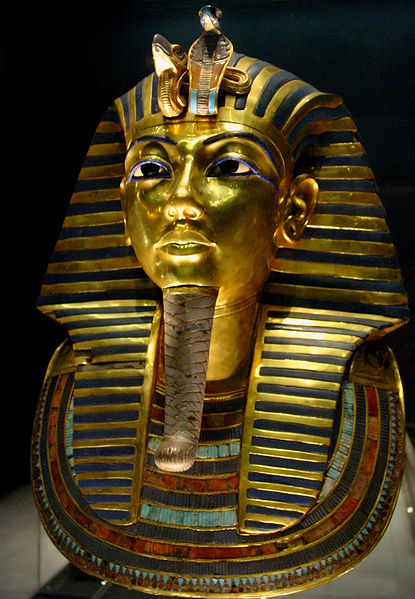
How else do we explain the revelations of hypocrisy that spring up like toadstools whenever an über-religious candidate claims public office? Thank goodness modern religions teach forgiveness! In the empires of days long gone, kings lived a life out of touch with the common worker. They enjoyed luxuries that the laborer couldn’t even conjure. When a challenge arose to that power, all you need to do is bring the gods onto your side and even the most stalwart peasant will back off. When Akhenaton’s young son Tutankhaten inherited his shaky throne, the populace demanded the old gods back. Tutankhamen acquiesced and the balance of power was restored. The gods, apparently, did not seem to notice.

The wise say nothing.