Risky Business

Scientology has been back in the news with the divorce of Tom Cruise and Katie Holmes. Media pundits like to point out the highly unorthodox nature of Scientology, but such critiques overlook the vital nature of New Religious Movements. Many of us are raised believing that religions, to be “true,” must possess at least a modicum of antiquity. We routinely reject the science of the first century of the common era (well, maybe the Creationists don’t), but we accept without question that the religious views of the time were on-spot and unchanging. It comes as a surprise, therefore, when a new religion like Mormonism or Scientology prospers. Accusations of being money-driven are rife, but then, who has recently audited the Vatican or CBN? Religions are “non-profit” by definition, but they certainly do raise money. As players in the capitalist game, I say more power to them. Who else can make tremendous profits and claim tax-free status (apart from major corporations, I mean)? Most believers are happy to throw a few dollars in the direction of some guru who will deliver him or her from hell, at least.

The fact that true believers in revelation don’t like to face is that every religion started some place. It would be a different story were there only one religion that ever developed, but as soon as someone started to declare their belief orthodox it was only a matter of time before heterodoxy joined the conversation. In the light of this wide-open world of religious beliefs, I think that creativity has been undervalued all along. Say what they might, critics have to admit that Mormonism, Scientology, and even Jehovah’s Witnesses have to score high on the originality scale. Since Yahweh has a lot of competition in the deity market these days it will be difficult to find an adequate final arbiter.

I would like to suggest a panel of experts, like on the appropriately titled “American Idol.” Gods are often hard to pin down, even with email and Twitter and Facebook. To fill in our distinguished panel of judges, then, who might we choose? The clergy of any tradition, I’m afraid, will be biased and so we might look elsewhere. Politicians too should be excluded since their remit is exploitation. Besides, they don’t often recognize creativity as something worth funding. Where does that leave us? We can’t use the average person, because who is going to watch their peers on television. Famous people. An athlete would be a good choice since overthinking religions can lead to trouble. We might need to avoid Tebow, however. Hollywood is said to be godless, so an actor would have great appeal—besides, good looks must equate to good theology, mustn’t they? Who will our third panelist be? Probably a writer; they are creative and their names are well-known. They would add intellectual heft without having the same star status as their more visible colleagues. Funny, L. Ron Hubbard was a science fiction writer whose religion thrives in Hollywood and who enjoyed the sport of yachting. We may have our winner here!

Religion or science fiction?



Tree Goddess

If you’re missing a virgin, I suggest you might try West New York. According to the local section of Friday’s New Jersey Star-Ledger an alleged image of the Blessed Virgin Mary has appeared in “an unusual tree” in West New York. The local diocese, no doubt correctly, suggests that the “image” is probably “just some discoloration that resembles Our Lady of Guadalupe.” Those inclined to accept pareidolia as fact, however, have already made up their minds. The tree has been barricaded off and flowers have been laid at its base and cell phone shutters are making their electronically fabricated snapping noises. A Google image search of “Virgin Mary West New York” brought up more than a million hits. People are desperate for a miracle.

Back when I was working on my dissertation, the tree goddess was inevitably Asherah. One of my unspoken speculations from those days was that trees are evocative plants, easily playing to the human imagination. In the right conditions a young tree can be mistaken for a person at a distance. The branches, particularly in late autumn and winter, resemble gnarled fingers reaching for the sky or any unwary passer by. And the natural knots and scars on tree trunks (such as in the current example) readily fire unlikely associations. They can be eyes, mouths, faces, or other anatomical bits—as people we project ourselves onto any likely (sometimes unlikely) avatars in the natural world. If images are to be believed, hundreds of people are devoutly weeping and praying at an entirely natural formation in the wood less than two miles from the most sophisticated city in the country.

Even with the Roman Catholic Church urging caution, blind belief is not dissuaded. What does it say about us that we so deeply desire a sign from above? This is the kind of question those who claim that a reasoned materialism will inevitably trump superstition must ask themselves in profound reflection. The fact is that people always have (and always will) assigned meaning to what they see. It is the gift and curse of evolution. “I think I shall never see / A poem as lovely as a tree,” Joyce Kilmer famously wrote before being killed in World War One. This New Brunswick, New Jersey native, who died at 31 in the killing fields of France, might wonder that so many stop at that first famous stanza. To those thronging in West New York, I would recommend a little Kilmer with their miracle. Let’s leave the last word to the poet: “A tree that looks at God all day, And lifts her leafy arms to pray…”


New Salzburg

For some reason Austria is on my mind. It been more than two decades now since I have been there, but I recently decided to read a little of the history of Salzburg. My interest revolved around a case of religious intolerance that took place well before the days of political correctness, but after the idea of religious freedom was being promoted in New World colonies. Two centuries after Martin Luther’s theses stirred the world (perhaps the last time in history a religious thesis has received such attention), the Roman Catholic Archbishop—and Count! (rank has its privileges)—Leopold Anton von Firmian decided to expel the Protestants from Salzburg. Religious diversity was frequently seen as a threat to civil authority. Either Protestants would recant or be forced from their homes in the winter, often losing everything they had in the process. A substantial number of citizens were exiled and found little in the way of refuge. Prussia finally offered some quarter and others made their way to England or to a then religiously tolerant Georgia.

Religious imperialism is a funny phenomenon. Religions, as sets of teachings, often emphasize the just and fair treatment of other people. When powerful people (or power-hungry people) become religious they find a great mind-control technique available in it. Popes, for instance, very quickly ceased being pastors and instead styled themselves as princes. This was a safe move since Jesus was king, and since he’s in heaven any attempts at usurpation are bound to be suspect. As a co-regent, however, various privileges apply! This is something Protestant reformers very swiftly learned as well. John Calvin was practically in charge of Geneva, and who can think of Lynchburg, Virginia without accounting for Jerry Falwell or Virginia Beach without Pat Robertson? Religion, by its genetic nature, seeks to take over and control.

In this it is not so different from other aggressive ideologies such as capitalism or communism. The problem is that religions claim sanction from the highest authority, and once a believer is convinced of that no amount of reason is sufficient to dissuade him or her. So it was that an Austrian Count, also an Archbishop, decided to turn out members of his own putative religion (Christianity) into a harsh winter where many would die and others would live the remainder of their lives in exile. Were this the hallmark of one religion alone we might have united together as a species and cast it out. Unfortunately history has repeatedly shown us that even the most placid religions can quickly form the dark face of a demonic storm front if certain of their privileges are threatened. No one likes to be wrong. In the game of religions, however, there must be losers if anyone is right. Where is the New Salzburg? It may be going by a different name these days.


Digging Deeper

A propos of apes, I’m not sure whence derives the draw of Planet of the Apes on me. I watched the movie with fascination as a child—since the obviously satanic delusion of evolution was impossible this had to be pure fantasy (and perhaps just a little dangerous). The movies just kept on coming, Beneath the Planet of the Apes, Escape from the Planet of the Apes, and Battle for the Planet of the Apes, each with their new twist on the theme that we are the beasts. Recently I watched the second installment, Beneath the Planet of the Apes. It had been years since I’d seen it, although I remembered the terrible mutants and their possession of an atomic bomb. Although the geography is badly distorted, it is made amply clear that the church where the bomb is stored is St. Patrick’s Cathedral on (beneath?) Fifth Avenue. As Brent makes his way into the partially intact cathedral he finds a priest praying to a missile with the letters alpha and omega inscribed on one of its fins.

Since last seeing the movie I spent a lengthy stint among the Episcopalians. Naturally I became thoroughly acquainted with the liturgy and therefore could appreciate subtleties in the movie I had missed before (nothing is ultimately wasted, it seems). As the mutants prepare to set off the doomsday bomb that will obliterate the entire planet—both apes and humans—they recite many prayers from the mass, substituting the word “bomb” for “God” and “Holy Fallout” for “Holy Spirit.” Okay, so maybe “subtleties” was the wrong word. Of course, back in the early 1970’s this was a very real concern, the arms race was well underway. Despite the overacting and forced script, the movie did offer considerable social commentary. Ironic and iconic Charlton Heston condemns the unadulterated praise of such a lethal weapon (or was it just missile envy?), even as he falls, shot, onto the controls, accidentally destroying the earth.

The fascinating aspect of this social critique is that the players may have changed, but the drama remains the same. Those who protest evolution praise the build-up of native strength so that the true Christians might obliterate their enemies first and better than they will obliterate us. One gets the feeling that destruction is not so bad a fate as being proven wrong. Somewhere along the millennia religion slipped its mooring from being an ethical way of life to become an extreme way of believing. And yet people are still the same. And the Planet of the Apes movies continue to appear, ever evolving. When it comes down to the final scene, however, it is not the evolved apes who destroy us. No, it is the utterly self-righteous humans who decide that if they can’t have it all, nobody will have any of it. In the name of the bomb, and the holy fallout, amen.


The Times they are a’Chanin

Across from Grand Central Terminal in Midtown Manhattan rises the Chanin Building. Named for Irving S. Chanin, the tower is no longer easily picked out among Manhattan’s dizzying skyline, but the building is a monument to the humanistic spirit that was beginning to flower in the 1920s between the harsh realities of the world wars. Outside the building, above the ground floor shops, runs a bronze frieze that still catches the breath of visitors who stop to stare for a moment or two. Interestingly, the frieze is a monument to evolution, showing the development of “lower” life forms among the water flourishing into birds and fish. Although prosperity gospelers would object to its inherent Darwinian message, they would appreciate a huge monument to the triumph of capitalism in Chanin’s dream, as much of Manhattan reflects.

Antipodes are a fact of geography and human understanding. It would seem that they are also a paradigm for those who “want it all.” Perhaps it is ironic in coming from a Disney movie, but I’ve always found Mary Poppins’ maxim apt: “enough is as good as a feast.” Indeed, leaving the table after eating more than I need I feel miserable and disgusted. There is only so much that people can have, and this is a matter of physics as well as biology. If God wanted us to be wealthy, why didn’t he make us that way? (Surely the God who promotes personal wealth must be male.) Evolution and capitalism could be a dangerous mix should we forget that evolution is not goal-oriented. Natural selection works by trial-and-error, only the trial isn’t planned or intelligent.

This dialectic reminds me of that old chestnut, Beneath the Planet of the Apes. Ursus, the gorilla warlord, gives a jingoistic speech concerning the Forbidden Zone. “It is therefore our holy duty to put our feet upon it, to enter it, to put the marks of our guns and our wheels and our flags upon it.” Of course, this second, lesser installment of the Planet of the Apes movies raises the entire specter of nuclear war to a disturbingly sacred level, but that’s a topic for another post. What I notice is the full circle of evolution here—not just human to ape, but human to capitalist ape. Apes that wish to own and control their entire world, including that region where, in the original movie, both ape and human fear to go. It should not surprise me to see talking apes in Manhattan, but then again, it might just be the bright sun reflecting off the bronze of Irving Chanin’s monument to economic growth.


For the Love of Gold

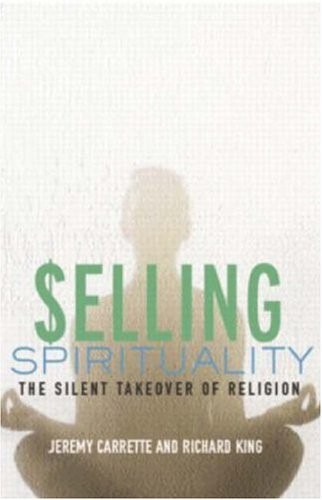
Do you ever get that feeling that you’ve been led along by a false premise that has gotten out of hand, like a practical joke that has gone too far? If I had to rate the books discussed on this blog in terms of urgency, Jeremy Carrette and Richard King’s Selling Spirituality: The Silent Takeover of Religion would top that list. I’ve felt for a long time that something’s been wrong, but I didn’t possess the training or resources to discern what it might be. I think Carrette and King may have named it. Just a few pages in and I knew there was profound insight here. Religion has been taken over by capitalism and the result is that alternatives to the godless, sanctified free market are rapidly disappearing. In a truly Orwellian sense, we have been taught the language of capitalism and have lost the ability to frame our ideas in any other way. Free markets take no prisoners—one must assimilate or die. Religions, which had traditionally served as correctives to selfishness and greed, have been co-opted into the forces of unbridled gain for the few. Amorphously marketed as “spirituality,” what sounds like religious conviction now lives in the service of consumerism.

By slowly shifting all our language and metaphors into those of Reaganomics (the very fact that you know what that means shows how far gone we already are) the capitalist machine, supported by the flaccid terms of spirituality, has established a new god—capital—and has pilloried any who dare question it. Think of the trashy phrase “prosperity gospel” for just one minute and you’ll see what I mean. Those of us who disagree with the orthodoxy that meaning can be found in money have become the resistance in a war we did not start. The twin hellions of privatization and corporatization have sunk their fangs deeply into the jugular of society and its old-fashioned value of caring for others. People are, like strangers in a strange land, just marks for the powerful. We’ll buy anything if it looks attractive enough.

The problem with consumerism is that it is easy. We all love to play along because—who knows?—we might end up getting rich in the process. We have gained the world and lost our souls. Carrette and King show clearly how entrepreneurs have learned to market the language of religion while divesting it of its venom. Go along, it urges, everything is fine. Even the economic collapse brought on scarcely two decades after Reaganomics has failed to convince the average citizen that they are but a petroleum bi-product to grease the unrelenting gears of commerce. Anything, even salvation, can be sold. Back in April I stood beside the graves of Eric Arthur Blair (George Orwell) and Karl Marx. And maybe in an unguarded moment I shed a tear or two that critical thinking seems to have been buried along with those who were brave enough to state the obvious.


Scotland’s Cryptic Evangelist

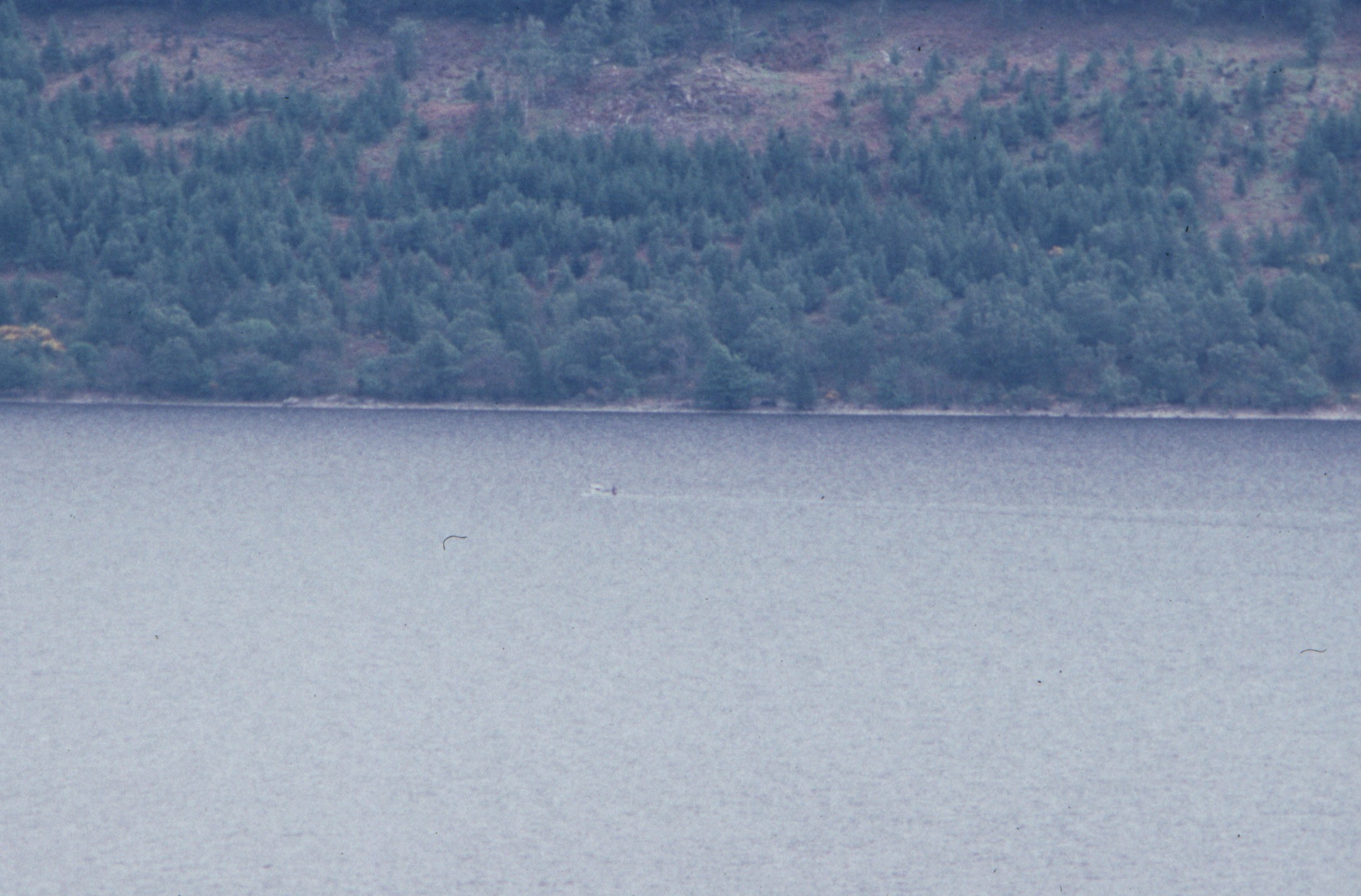
Many years ago it was now, on a Victoria Day bank holiday weekend, my wife and I were on a camping trip with friends in the Scottish highlands. Pitching our tents on the banks of Loch Ness, we joked about the potential danger—after all, Nessie had reputedly attached St. Columba, therefore even the pious had no refuge. Early the next morning, our party still intact, we drove to Urquhart Castle, arriving before it opened. Out on the loch we saw something moving through the water, leaving a wake. It was breaking the surface but was too small to be a boat and it was not a bird. It moved at constant speed until it was out of sight. This was in the days of actual film, and slide processing was “dear” as the Scots say, but I snapped off a photo anyway. The slide is too indistinct to make a diagnosis, but our friends, who had a better camera, came to the conclusion that it was a small boat. After looking at their enlargement, I still have my doubts. I’ve always sat on the fence for the Loch Ness monster. Certainly it seems improbable, but we have only a cursory knowledge of sea creatures and Loch Ness is deep and long and isolated. Is there a Loch Ness monster? Maybe yes and maybe no.

Of course, Nessie has been in the news, as my wife pointed out, backed by the considerable creativity of the creationist camp. Seizing a living dinosaur as the death knell of evolution, Fundamentalist schools in several states are using textbooks that argue Nessie’s existence proves that dinosaurs didn’t evolve and that they still walk (or at least swim) among us. An excellent corrective to this “either evolution or special creation” is Victor Stenger’s book God: The Failed Hypothesis, that I reported on a few weeks back. With apologies to the late Stephen Jay Gould, this tactic puts an entirely new spin on the concept of the hopeful monster theory.

Religion and monsters are thoroughly intermeshed. Often this intermingling comes as the result of revulsion against the unclean or impure aspects of life that monstrosity represents. Numerous analysts have shown that monsters tend to be unholy mixes of elements that religions prefer to keep widely separated—animals that would never have made it onto the ark, yet somehow have arisen since the deluge. Human fear at contamination has an excellent basis in evolution; those who never developed the sense to stay away from the sources of contamination grew sick and died off. Monsters, in this sense, serve as useful reminders for avoiding the “strange fire” that so displeases the Lord. Reading how good Christians are now reaching out the right hand of fellowship to their monstrous brethren, I wonder if a long-held belief is being imperiled. Those who would swim with monsters must be very cautious indeed, for above all things, monsters are notoriously unpredictable.


Black Swain

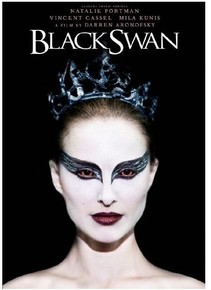
In a somewhat rare move, I watched a film that was released less than five years ago this weekend. Black Swan is difficult to classify since it crosses so many genres with relative ease and it left me strangely reflective. Although called a “thriller,” the frenetic pacing and sense of outside menace of most thrillers is lacking. Black Swan includes some horror elements, but little in the film defies rational explanation if Nina Sayers is really going insane. The underlying story, however, is something that every religion would recognize—the need for transformation. Even before John Calvin dreamed up the laughable doctrine of total depravity (and for any Presbyterian readers, I was predestined to write that), all religions have at their heart the concept that people need to change. Sometimes the transformation is subtle and gentle, at other times fiery and dramatic. If you end life the same way you began it, you are a religious failure. This premise lies behind every movie where a character transforms into something else, be it werewolf, Mr. Hyde, Mrs. Doubtfire, or a wereswan.

Our perceptions of who we are cause us considerable introspection. Nina Sayers is a timid yet ambitious girl, living with her mother yet wanting to be the seductive black swan. She really doesn’t comprehend what she is wanting to become, but she knows that it must be better than what she presently is. Again, the parallels with religion are striking. I have known good people who’ve transformed into black swans under the influence of noble religions such as Christianity and its monotheistic siblings. People who have become intolerant and judgmental, insisting that their way is the only possible correct way. In the mirror they see a white swan, but the audience sees the black one.

Black Swan is heavily symbolic and provocatively mythic. Like any honest account of life it refuses to provide any definitive answers. Since each experience we undergo leaves its mark upon us, we cannot help but transform. Volition, however, can lead us toward paradise or perdition and any ambiguous place in between. Is the Nina Sayers dying on stage the greatest sinner of all, or a saint who has been beatified as fully human? The answer to the riddle the film stubbornly refuses to relinquish. So it is with life. We will transform over its course. Religion will declare whether it is good or bad, right or wrong. At the end of the script, however, we are both the white and the black swan.


Double Exposure

Back when I was teaching full time, one of my favorite television shows was Northern Exposure. In fact, the fictional town of Cicely, Alaska, had quite a lot in common with Nashotah House. Both were populated by quirky characters in a relatively remote location. Both were small, insignificant places with visions of grandeur. Both were effectively run by conservative forces that liked to imagine themselves as benign or downright noble. Both distrusted outsiders with ideas that might challenge the status quo. One of my favorite characters was Maggie O’Connell, the woman in a man’s world who refused to let the male establishment set the limits to what she could do. A strong woman character whom the men all respected served as an antidote to daily life at the seminary. My wife and I liked the program so much that we even stopped in the town of Roslyn, Washington, where the outdoor scenes were shot, a couple of times on our way out west.

We don’t have television now, so we have to watch Northern Exposure on DVD. While at a hotel recently, however, the name of Janine Turner on the television made me look. I had known that the actress portraying Maggie O’Connell was a political conservative in real life, but here she was advocating an “anyone but Obama” type campaign or some such nonsense. I felt as if I’d been sold a false bill of goods for all these years. Like Margaret Thatcher, Turner believes in socially conservative causes. Margaret Thatcher, that contradiction of a woman who felt that females belonged in the home, had undue influence on a once great Britain. Where was the woman who played such an ardent feminist in a male world? How could anyone pretend that kind of passion in front of a large audience for six years and spent her real life trying to deconstruct a cause that has everyday ethical implications? It’s all an act.

Women have been relegated to positions of lesser prestige for millennia for the crime of caring for their offspring. Men have been free to abandon responsibility and seek selfish ends, if so inclined. No matter what our gender, we pursue in life what is most meaningful to us, and it amazes me when strong women support a structure that has consistently shown itself interested in keeping them down. Vaunted as a show where diverse characters come into constant conflict but always “strive to accept their differences and co-exist,” Northern Exposure displayed depth without eschewing what is laughable about the human condition. Real life, I suppose, it is much more like the small town of Rosyln, Washington. For a few years it was an out-of-the-way tourist stop where actors could play characters they really didn’t believe in while living in a fictitious town where everyone at least attempted to tolerate everyone else.

Do you recognize this character?


The Idea of a University

I have to admit that my sense of justice has been a bit offended by the loss of reputation of my chosen field. Seeing how universities are fast becoming job-training institutes, I fume about what once had been and no longer shall be. History is the lens through which I view the world (a subject many industrialists consider “useless,” but to their cause actually “dangerous”). Historians dispute which university was the earliest, although something similar to the idea of a university was developed in Bologna, Italy, around 1088.  The University of Paris was also very early, as were Oxford and Salerno.  While “business” as it was then known could be studied to some degree, a primary function of early universities was the training of clergy. No doubt, paranoia concerning heterodoxy and heresy helped spur on the idea that future clergy required extensive training. As universities caught on, many centers for the studying of theology (indeed, a branch of religious studies) sprang to life.  It could be argued that this was a “trade mentality,” but very quickly this became an academic point.  Who else but a theologian would every worry about how many angels could dance on the head of a pin?

Science was incorporated into theological studies from the beginning.  We all know about the antagonistic relationship between the Church and Galileo, but less often do we hear about the religious thinkers who were trying to put it all together into a workable system.  Often the university was among the few places where such abstract and critical thought could occur. Some of the great universities in the United States began as seminaries: Harvard, Yale, Boston University—they started as places to train clergy. How often do graduates of the Harvard Business School toot that particular horn? Permit me the privilege of a mournful sigh as I watch the torch pass from abstract thought to the abstract symbol of the gold standard. Money only possesses the value we assign to it.  Currency can be measured in less material avenues as well—the ability to think clearly and precisely and compassionately; these abstractions, I would lament, have inherent value.  Alas, the heart of the university has gone another direction. I have undergone the heartache of breakups before, and always one needs a little time to adjust to the loss.

The University of Virginia’s recent object lesson to higher education should perhaps serve as a warning tap on the brakes to those who would see higher education kneeling abjectly before the towering statue of commerce with its head of gold.  Maybe there is more to life than money?  Maybe education for its own sake is what sets civilization apart from life in the savage jungle.  Those who castigate our great institutions of learning seldom turn down the offer of an honorary degree.  While these academic niceties require neither coursework nor dissertation, they do offer a kind of credibility that the rich seldom find on their own.  So what is the idea of a university? Is it a place to learn a trade?  Sometimes.  The humble request those of us deemed useless make is that the university not forget its humble origins as a place of speculative thought in the service of religious thinking.  Critical thinking. Otherwise it will be more than irony that the city that gave us higher education is also the one that also gives its name to baloney.

from Wiki Commons


Friday the Sixth

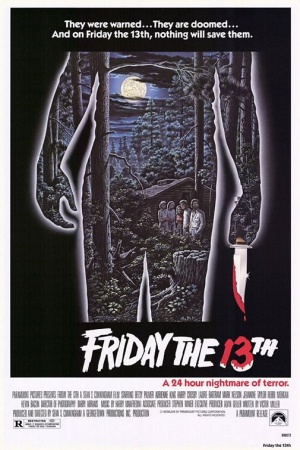
I tend to run behind on the movie front.  In some cases, decades behind.  I have never been a fan of slashers, although I did take a date to A Nightmare on Elm Street in the staid, dry town of Grove City while in college.  We broke up shortly after.  Still, I have a soft spot for “the classics,” and Friday the 13th has spun enough sequels to qualify.  “Jason” is a household name for the heartless serial killer, and the movie is set in New Jersey.  And it was hot outside and lazing on the couch trying not to stick to myself seemed about as much of a challenge as I could handle. Besides, a week from today is Friday the thirteenth. Now that I’ve finished with the excuses, here is a declarative sentence: I finally got around to watching Friday the 13th.  After many other films I’ve seen, I have to say that it didn’t really qualify as scary.  You know in advance that the counselors, by rote, must by killed in what are supposed to be shocking ways.  Shadowy corners and rainy woods and aluminum canoes are to be avoided, if the movie and its successors have taught us anything.  Nevertheless, the religion and scary film equation still applies.  And a strange kind of throwback to an unexpected classic (the literal kind).

The religious element comes in the form of the stock crazy local named Ralph.  Ralph warns the kids that they will die and says he’s been sent by God to warn them.  Of course they don’t listen.  If they had, there would have been no movie. As a child I was always offended by the caricature of the religious crazy, but I have come to see that this stock character is itself a symbol of fear.  Although ubiquitously laughed off, the person passionately driven by religion is indeed a potential danger to society.  In the days of my innocence we had little hard data upon which to hang such fears.  In the post-9/11 world it seems there are far too many sky-hooks for that purpose. Some of those sky-hooks are a little closer to the ground, but they inspire fear nonetheless. I’ve known all along that one of the reasons I watch scary movies is to give myself some advance warning of what might go wrong.  Not that it would help in any real way, but sometimes avoiding the shock by anticipating the worst seems like the only human thing to do.

What about the literal classic that I mentioned? Beowulf falls outside the Greco-Roman period, but is clearly a classic of English literature.  (Spoiler alert for anyone even more behind the times than me—) The only thing scarier than Grendel was, of course, Grendel’s mom.  So in Friday the 13th, the killing is done by Jason’s mom.  Like Grendel, Jason dwells underwater and surfaces to pull down his victim(s).  Like Grendel’s mother, Jason’s mother is decapitated by a sword (actually, a machete in the modern version), on the shore of the Crystal Lake.  After the mother’s death the child (Jason/Grendel) is resurrected.  Whether it was intentional or not, there is a lot going on here. The sacrificial mother is an inherently religious theme although many formal religions make it a male prerogative. The death of the mother brings the son back to life.  I wonder how Christianity might have differed if instead of three male deities, there had been a divine mother.  In such cases resurrection of the son comes only at a very steep price. Just like watching Friday the 13th on a hot summer night.


My Cultic Breakfast

The word “cult” is no longer used by religious specialists to refer to New Religious Movements, but when I was growing up in a fundamentalist home it was liberally applied to suspect groups. While having breakfast this morning I realized just how deeply rooted in American culture such groups are. I reached for my cereal. The reason that many Americans eat cereal for breakfast stems directly from the healthy lifestyle advocacy of John Harvey Kellogg of the Seventh Day Adventists. Adventists are vegetarians and are very concerned about healthy eating. Kellogg was a devout Adventist and produced Corn Flakes as a means of providing a—pardon the term—kosher choice for breakfast foods. Of course, growing up I’d been warned against the “cult” of Adventism, even as I happily munched their Corn Flakes.

So today I decided to have some Apple Jacks instead. Apples made me think of John Chapman, better known as Johnny Appleseed. Americans learn about the eccentric apple-planter from childhood, but most never learn that he was also a missionary for the Swedenborgian Church. Named after the Swedish scientist and theologian Emanuel Swedenborg, this New Church taught doctrines that set traditional Christians’ teeth on edge. Believing that Christ had already returned in the words revealed to himself, Dr. Swedenborg didn’t ingratiate the fundies by rejecting the standard interpretation of the Trinity and by promoting mystical beliefs. John Chapman spread Swedenborgian ideas along with his apple seeds. I’m sure that as we sang the Swedenborgian hymn at Methodist Church camp, we didn’t realize its heterodox origins: “The Lord’s been good to me, and so I thank the Lord, for giving me the things I need: the sun, the rain, and the apple seed—the Lord’s been good to me.”

What good is cereal without a spoon? As I grab my Oneida spoon, selected by my wife and me when we registered for our wedding, I’m sure I didn’t know at the time that the Oneida company is what is left of the Oneida Community. Founded by John Humphrey Noyes in the Burned-Over District back in 1848, the Oneida Community was one of the Perfectionist groups common at the time. Their town of Oneida held everything in common—everything. That included “complex marriage” which meant that all members had sexual access to all members of the opposite gender. They worked to support themselves, and one of their products was silverware. With the death of Noyes and concern of secular authorities about the interesting sex that was going on, the Oneida Community quietly closed, leaving us a company to produce fine stainless steel implements with which to eat our cultic breakfast.


Just You Wait, Professor Higgs

They finally found him. Peering deep into the invisible world of the sub-atomic universe, his hiding place has practically been discovered. I knew that when it happened my alma mater, Edinburgh University, would be part of the equation. That’s just the kind of thing you know deep down in your sub-atomic parts. Scientists are now coming very close to announcing definitive proof of the “God particle,” or Higgs boson. Named for theoretical physicist Peter Higgs, who predicted the particle, this elusive piece of physics has been nicknamed the “God particle” by journalists who want to express just how great its explanatory value is. The average citizen knows very little about the inner workings of science—thus we have Creationists and Tea Partiers—so we require striking neologisms to help us comprehend that this is not only important, but really, really important. For explaining the way the universe works, the Higgs boson has been likened to Newton’s discovery of gravity, although apples had always fallen from trees even before he learned why.

I have always found it curious that when we need a superlative we dash back to the biblical worldview. As John Heilprin and Seth Borenstein of the Associated Press make clear, “God particle” is not utilized by physicists (although coined by one), but is used “more as an explanation for how the subatomic universe works than how it all started.” To get us to read about science they have to use mythology. The more we understand about science and the way our minds work, the more perplexing it becomes. Humans are meaning-seeking creatures and we often find story more meaningful than fact. Facts, however, determine what actually happens or what actually is. The Higgs boson is getting close to facticity. We whimsically call it the “God particle.”

Could the great gulf between science and religion, I sometimes wonder, be bridged by good, liberal arts education? The liberal arts, particularly the humanities, are all about understanding what it is that makes us, well, human. They aren’t precise like science, or profitable, like business. At the end of the day, however, in those few quiet moments, don’t we dwell among the realm of humanity? When we stop posturing for our co-workers, the media, or our neighbors, when we are who we truly are—then we are engaging in the humanities. Education can be in the service of becoming human as well as becoming rich. In one of its latest triumphs, it has produced physicists who have discovered the footprints of the Higgs boson, potentially revolutionizing the universe as we know it. And many of us would have never even heard if they hadn’t called it the “God particle.”

Like atoms over our heads


Flea the Obvious

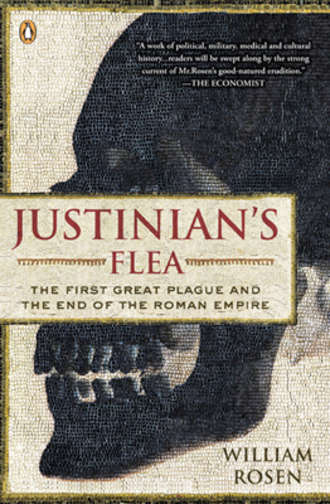
In one of my personal ironies of history, the period of ancient times that I find least interesting is the one I’ve been reading most about. Part of that is based on my lack of coherence when it comes to selecting reading material. I take recommendations seriously, so when a friend suggested Justinian’s Flea by William Rosen, I figured I’d better read it. I had fairly recently read Philip Jenkins’ Jesus Wars, about the nearly unbelievable shenanigans of post-apostolic Christendom, and so I felt up to taking on the Plague. Justinian’s Flea is about the fall of the Roman Empire. At Gorgias Press, where Justinian’s former prostitute wife Theodora was subjected to revisionist history that made her a lifelong saint, I learned to discount most of what went on during this time period. I was, it seems, a bit too hasty. Justinian and Theodora’s reign is quite interesting, and it is, as intimated, largely because of ecclesiastical politics.

Rosen begins his study by laying out the background to Justinian’s imperial days in Constantinople. In describing the disputes between what specialists now call various Christianities (formerly true believers versus heretics), Rosen notes that Christians had particular disdain for Gnostics, largely based on interpretations of what Jesus’ death might mean. At one point he writes, “Monotheistic religions are famously intolerant of apostasy, even when they disagree about what constitutes it.” Here he hit the flea on the head. “I doesn’t know what it be, but I’m ag’in it.” This attitude of religions has long been the motivation behind massive campaigns of bloodshed and intolerance. Often in the name of religions that claim peace and tolerance as the highest goods. So it was in the early church; heretics were routinely martyred for their “wrong” belief.

Not to throw in a spoiler, but the first great wave of the Plague does nearly draw an end to the ailing Roman Empire. Justinian’s expansions were mere band-aids trying to hold together a Frankenstein’s monster of many nationalities. So riding home on the bus I was surprised first of all that the driver engaged a passenger in conversation (generally frowned upon) and second of all, that he ranted for many miles about politics. It isn’t very comforting in the stressful traffic around New York City to hear your bus driver cry out, “the Roman Empire collapsed—maybe it’s time America did as well!” The prospects of getting home seldom looked dimmer. And I had just been reading about that very empire’s last days. I try to stay away from predictions because I dislike being proven wrong—the end of the story hasn’t been written yet. Rosen, however, has given us a great cautionary tale; if the humble flea can help bring down the world’s mightiest empire—one ruled by a leader overwhelmingly concerned with religion—maybe it’s time to canvass what the infidels like to take in their coffee.


Heat Wave

Stewing in the heat of the wave washing over much of the east, my thoughts sometimes turn to the cool, refreshing flood of Genesis. I’ve been Tweeting the Bible for some months now, and I am in the midst of the stories of the flood. Noting the many contradictions and discrepancies, it is a wonder to me how many of the religious are able to overlook or harmonize infelicities for the sake of a consistent faith. Most famously the story states that Noah took one pair of the clean animals, but also seven pairs of clean animals. The rain came down forty days. Or was it 150? One of the reasons that people continue to believe this story may be its specificity. No approximations or guesses, the numbers are precise, as if written down by an eyewitness at the scene. In actual fact, the story is among the oldest of recorded civilization and has its origins at least as far back as ancient Sumer. For as long as people told stories about the gods, they told stories about world-wide floods.

As a species that is able to think ahead, we have long been concerned with the fate that might befall us. Consider the amount of hype about the end of the world that has accompanied the random calendrical dates we’ve assigned to the cosmos: the world has been expected to end nearly every year since 2000, and that is only the most recent incarnation of this foreboding. If there are gods out there, they must have it in for us. The very fact of our being human seems to anger the deities. Even after God promises the world will never again be destroyed, he adds a caveat—not by flood, anyway. By the time we reach the letters near the end of the Christian Scriptures the future torment has turned to fire. There’s always something out there looming on the horizon.

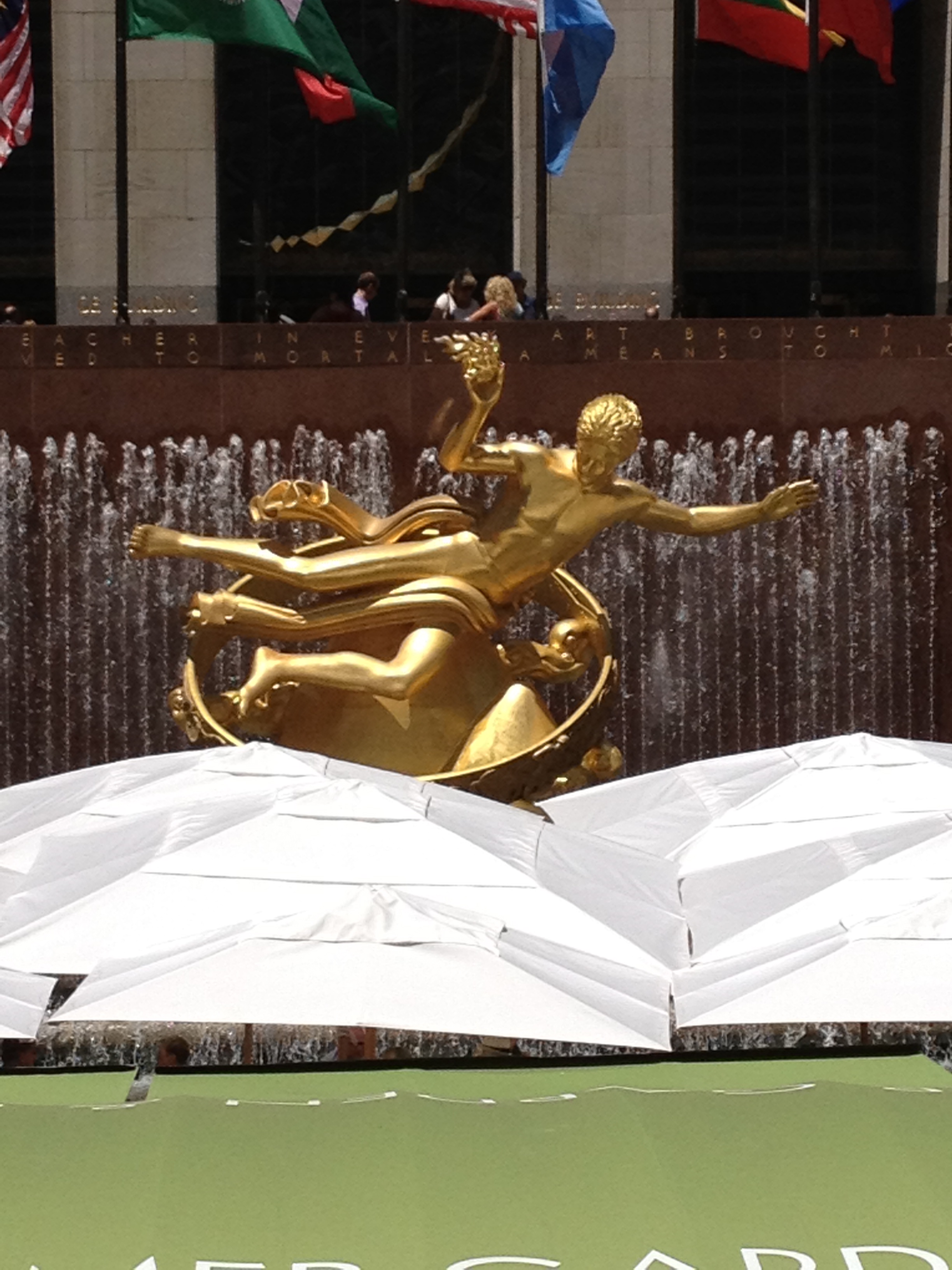
“Prometheus teacher in every art brought the fire that hath proved to mortals a means to mighty ends,” so reads the quote from Aeschylus behind Paul Manship’s statue of Prometheus. Prometheus was the Greek god (Titan, actually) favorably disposed toward humanity. His name means “forethought.” When humanity cowered and shivered in the dark, Prometheus brought the light and warmth of fire. It is easy to suppose the Greeks to have been more enlightened than earlier or contemporary civilizations, but Prometheus had offended Zeus and was subject to eternal torment for his thoughtful gift. Perhaps it is just the divine way—gods are jealous of us although they hold all the power. As I continue to tweet the good news of an angry god, I am starting to understand the power deities will always have over their vulnerable creatures.