Beyond Science

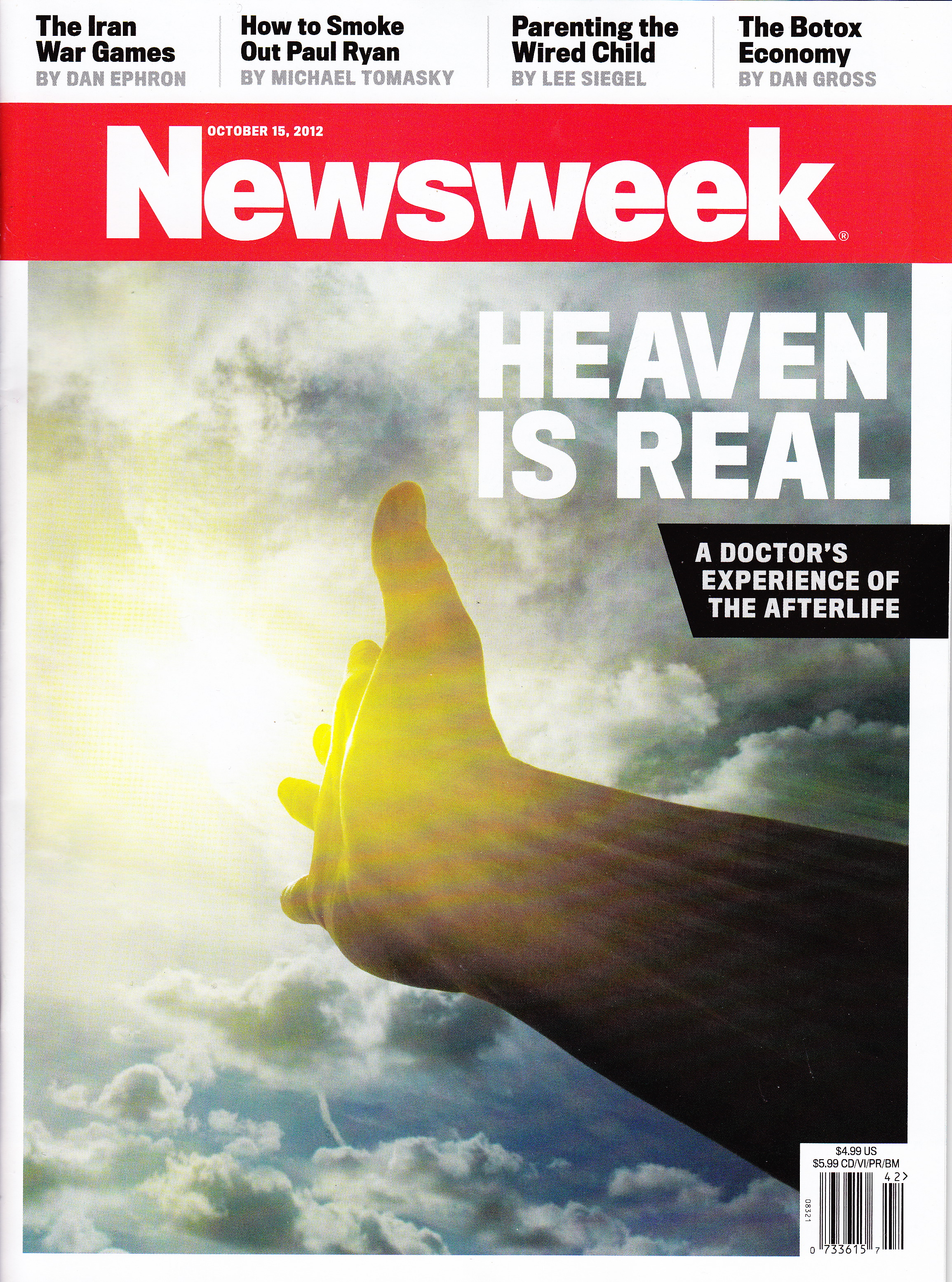
The nature of reality is not easily parsed. As a society we are still under the spell of rationalism, that wonderful left-brain system that seems to explain everything. Until we break down in tears and don’t know why. Like the proverbial chicken-and-egg, reductionists say it all comes down to electro-chemical reactions in the brain, to which non-reductionists reply “believe that if you want to.” Knowledge and belief, belief and knowledge. The truth is nobody knows. So when I see Heaven on the cover of Newsweek, I can’t resist wondering what’s inside. Dr. Eben Alexander, a Harvard-educated neurosurgeon, has just written a book called Proof of Heaven. In the Newsweek article he explains how during a week-long coma he had the most vivid experience of his life. While his brain was shut down. It might be more accurate to say he had the most vivid experience of his afterlife.

The classic debate for Near Death Experiences—so common they have their own acronym, NDEs—revolves around timing. Reductionists say the thought could have happened very, very quickly, just as the brain was shutting down. We all know how dreams can feel like they last far longer than we’re asleep, and how vivid they are. Those who accept the reality of an afterlife argue that many of the classic symptoms such as seeing your own body from above, or being able to describe in detail what was happening in another room at the time, count as evidence. It is the problem of the occasional phenomenon again. This is something no lab can measure, but it happens just often enough to make you wonder. The shaman might say, along with Inception, that the dream is the reality. That might explain why so much of “real life” is unpleasant.

As comfortable as the belief that reality is solid, material, quantifiable, may be, it does not count for the totality of human experience. Alexander’s heaven may not be the same as mine. Reality may not be one. Maybe Occam was wrong. Reading about shamans over the past couple of weeks, it became clear that some believe humans have more than one soul. (I can hear the reductionists rumbling—one soul is already too many!) Some cultures recognize as many as seven souls in a single individual. These, they suggest, account for the uncanny experiences of human life. Why do some people see ghosts and why are dreams so vivid and how does faith healing work? Reductionism calls them all illusions, tricks of the brain. Until his coma Dr. Alexander would have agreed. Now the newsstands suggest a different paradigm may be emerging. Dare we believe that the truth is out there?


Shaman on Us

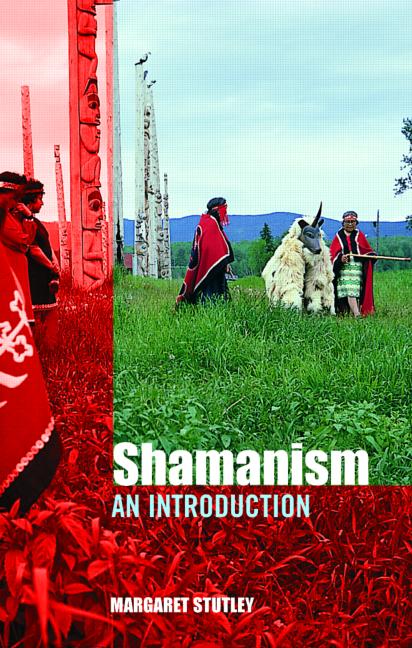
My reading habits are unorthodox. I don’t follow a fixed plan, but hope for something that will keep me engaged for the fifteen or so hours I spend commuting each week. I began October with a book about werewolves and followed it up with a book on the Hmong. Apropos of neither and both, I turned next to Shamanism: An Introduction, by Margaret Stutley. While not the best organized book, it does provide a smorgasbord of shamanistic traditions, principally from Siberia, where Shamanism was first recognized. Before I’d finished, I’d read about both epilepsy and werewolves.

Shamanism is not a “religion” per se. There is little agreement among scholars about what a religion is at all. Shamanism is very much a local set of beliefs and practices that have only very basic elements in common (shamans being one of them). It is a good example, however, of how moral heathens can be. Shamans often accompany egalitarian societies who do not require governments and religious leaders telling them to be nice to each other. No, this is not the noble savage myth, but it is a clear indication that major religions are not required for morality. It evolves on its own. Often shamanism is not constrained by overly left-brain influence, and sees connections science can only deny. The plight of Lia Lee was explained here in a way physicians could access—epilepsy and other diseases are problems of the soul as much as the body—if only they read books about religion. Healing involves calling the soul back. Treatment of the body misses the point. And sometimes the dead become werewolves.

We live in a world where real suffering is caused by lack of understanding about religion. Assuming a cultural hegemony of Christianity, or Islam, and sometimes even other religions, we discount those who believe differently than we do. The New Atheists frequently overlook just how seriously people take the world of the emotions and belief. That realm is a large part of what makes us human and it plays by no logical rules. Nor does it care to. In a country, such as the United States, where money is believed to be the very warp and woof of the good life, shamans sometimes secretly cut the thread. Still, don’t ask universities to expand the study of something as insignificant as religion because all intelligent people know that nobody really believes that stuff any more.


Good-bye Lia

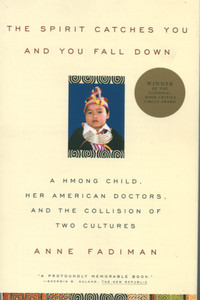
While The Spirit Catches You and You Fall Down, by Anne Fadiman, is not about religion, it is all about religion. The tragic story of Lia Lee is one where Hmong lives, completely immersed in what we would term “religion,” came into conflict with American perceptions of what religion should be. One of the events in Lia’s life involved the government removing her from her parents for their failure to follow doctor’s orders. Fadiman notes that this has been an issue is court cases with Christian Scientists and Jehovah’s Witnesses and other groups that refuse certain kinds of medical treatment for religious reasons. Adults may refuse—it is their constitutional right—but children cannot be subjected to an adult’s religion if it endangers their lives. Here is the rub; American religion only stretches so far. Sure, many of the faithful pray for loved ones, but they also trust the doctor’s knowledge. Not too put too fine a point on it, God doesn’t seem to do the healing unless the physician is involved. For many from traditional religions, like the Lee family, that is hardly trust at all.

Much of the problem in Lia’s case came down to taking the soul seriously. It is clear that the Hmong believe, really believe in the soul. It is the essence of a person. Reductionism declares that when all the matter is burned off, no soul remains to be found. Lia’s parents, however, could tell whether her soul was present or not just by looking in her eyes. Although she never recovered from her major seizure, the physicians had tried to prepare her parents for Lia’s immanent death. Removing her from the feeding tubes and sterile conditions of the hospital, the Lees took her home where she survived for years, although in a persistent vegetive state. Even as the book ends with Lia at seven, they are hoping for her soul to return. Lia died just two months ago, at the age of thirty. She was diagnosed as terminal at the age of four.

Diversity adds color (from Wikipedia Commons)

The story of Lia Lee is sad and one with no real villains (after the Secret War in Laos, and its aftermath). One of the most interesting aspects revolves around how the Hmong observe American religion. Well-meaning missionaries tried to convert them, but psychological studies have demonstrated that those who are the worst off are those who converted to western religions. At one point a Hmong girl, at a sacrificial ceremony to placate the spirits, tells Fadiman that she’s a Mormon. In another instance a Christian family tried to give their Hmong neighbors advice before a long drive, telling them they should pray to the Lord, not their ancestors. The Hmong honestly replied that the Lord had given him too many problems in America. It seems to me that the real issue here is just how seriously religion is taken. To the Hmong, it is their life. In capitalist America, it is very difficult to make religion your life. Even clergy have to have bank accounts, bills, and oil changes—all very secular aspects of life. If religion were taken as seriously here as among the Hmong, we would be facing a very different race this November.


Babel’s Gate

Up north past Edinburgh, beyond the Cairngorms, on the shores of the chill North Sea lies the village of Cromarty, Scotland. A death occurred in Cromarty, according to CNN earlier this week. And why would CNN be concerned with a single death in a small village in a remote corner of Scotland? Because with Bobby Hogg’s death, his language also died. Hogg was the last speaker of Cromarty. Having lived in Scotland for over three years, I heard many an impenetrable accent, but even as I strained to understand, I loved it. The loss of Cromarty is part of an on-going, world-wide extinction of languages. Sure, the big ones survive, thrive even. The small ones pass away, often forgotten. Those who unabashedly champion “progress” take no time to mourn the passing of the idiosyncratic, the individualistic, the non-conformist languages. Dominoes are easier to stand, after all, if they are all a uniform size and shape.

I taught Hebrew to my students for many years. Those who wish to be clergy should be able to read God in his original tongue, it stands to reason. As complaints began to simmer, as they always did, at the difficulty of learning a semitic language, I liked to remind students that a language is far more than a collection of vocabulary and a smattering of grammar and syntax. Languages are worldviews. We don’t know who invented language, but we do know that it evolves more rapidly than biology, once human populations are separated. As in the case of Cromarty, languages often reflect lifestyles—they preserve the words and phrases necessary for distinct ways of life. Automation, however, prefers one-size-fits-all. Those who can’t understand are less efficient players in the colonialization of the world by capitalism. Languages allow for diversity and specialization. Cromarty was the language of fishermen.

Yes, multiple languages reduce efficiency. You don’t have to read too far into your Bible to discover that. Yet even efficiency comes with a price. Year by year, the cacophony of human expression becomes more uniform. Yesterday there were a thousand languages, today only nine-hundred-ninety-nine. Yarns were spun in Cromarty, just as surely as they were in Hebrew. Young ears will never hear that ancient language, and with it a way of looking at the world also died. Yawn if you will, but if all the minor languages disappear the one remaining worldview will be all the poorer for it. Yiddish to Aari, languages reflect who we are—and Mr. Hogg’s passing is a loss to all humanity.

Do you hear what I hear?


Disease Divine

Diseases, for most people of the modern West, are difficult to diagnose as divine. At my wife’s urging, I’ve been reading Anne Fadiman’s The Spirit Catches You and You Fall Down: A Hmong Child, Her American Doctors, and the Collision of Two Cultures. I have a feeling I’ll be commenting on various aspects as I read through it, but something caught me almost immediately. Although the book is not about religion, the culture of the Hmong (about which I knew nothing just hours ago) is truly imbued with religion. Our medical science is, well, science (unless perhaps you’re from Athens, Georgia). Western culture since the Enlightenment has come to understand many of the body’s systems intimately, discerning just which chemicals to proscribe to treat this or that electro-chemical reaction in the body. And we consider it normal. Epilepsy, the condition of Lia Lee, is a disease that, as Fadiman points out, has had a long divine pedigree even in the west. The Judaic tradition at various stages considered it demonic possession, the Romans understood it as a kind of deity-induced madness.

Interestingly, Fadiman uses the case of Tony Coelho, an epileptic and congressmen, to make a point about the Hmong community. Coelho, she notes, had been intending to enter the priesthood but the Church has a canon forbidding ordination to an epileptic. This gave me a considerable pause. Clergy in many cultures must be “perfect” physical specimens. According to the Hebrew Bible, men who had certain deformities “down there” were disqualified, although, one notes, that they would have served fully clothed. Epilepsy, having been putative cured by Jesus many times, might seem a strange disqualifier from priesthood. I wondered why it was singled out from among the many maladies that might have seemed more pressing. Even in our enlightened age, epilepsy still bears the scars of the divine.

Narrating the experience of the Hmong in a Thai refugee camp, Fadiman notes that the subtext was often conversion. As she points out, for the Hmong medicine is religion. Although the missionaries had converted some, their very enthusiasm ensured that the Hmong would not generally go to them for treatment. Here is a stark difference between a people whose religion permeates every aspect of their lives and westerners for whom religion is compartmentalized in a different place than medical science. For the Hmong, wellness is part of a larger picture from which religious belief simply can’t be separated. For some epilepsy is a disease to be cured, if possible. For others it is a sign of a budding shaman. I look forward to reading more, as it is clear that by shifting perspectives, even the enlightened might have something to learn from those they deem uneducated.


Holy Wolves

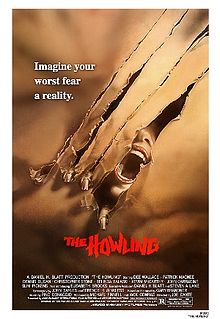
Nothing creates the mood for a werewolf movie like reading a book about real werewolves. The Howling was released the year I was finishing high school. At that time my humble circumstances allowed for very few visits to the movie theater, and certainly never to see horror films. I grew up watching B-films in black-and-white on television, but paying extra to see what was slightly unseemly in a theater stretched the limits for a good Christian just a bit. College was on my mind, and it was while in college that my horror film interest blossomed. All of which is to say, I’ve never seen The Howling before. I remember the movie posters, but the film had to wait until werewolves clawed their way back into my mind. Most of the classic movie monsters have their basis in religion, but The Howling doesn’t really delve into the origin of werewolves as much as it wonders what to do about when their numbers start to become a problem. Those who know about such things note that the special effects were cutting edge for the time, but CGI has spoiled us all.

Although the film doesn’t inquire into werewolf origins, it still gives a nod to the religious. The film’s werewolf population lives in a colony that has a “ritual center,” and since the cover for the colony is a retreat center for a psychologist’s patients, we find seekers amid the crowd. One of the inmates, Donna, explains that before joining the colony she had tried all the new religious movements, without success. And the one character who knows how to dispatch werewolves runs an occult bookstore in Los Angeles that is visited, in a shock-comic moment, but a pair of nuns. The message, so typical of the early 1980’s, is that all religions are just about the same. People are seekers, and any religion will do in a pinch.

In a way, this downplaying of the religious element in werewolves is not unexpected. As society was becoming more obviously secularized in the sixties and seventies, religion was becoming just one of many options available on the path toward self-fulfillment. In The Howling, becoming a werewolf was another. Ironically one of the old-timer werewolves laments the loss of “the old ways.” The werewolf colony lives on cattle that are farmed as politically correct sheep for the wolves, and it just doesn’t satisfy. The same might be said for religions. Accommodations, so necessary to survival in an evolving society, inevitably change the old ways of religion. Religions themselves transform over time. The Howling may not be scary, or believable, but it does serve as a kind of paradigm for worldviews that are undergoing transformation. Shifting shape, after all, is a sure symbol that one is still alive.


Science Friction

What hath CERN to do with Jerusalem? It might seem that the House Committee on Science, Space and Technology would be a reasonable place to look for members of Congress with a grip on science. But then, I often live in a fantasy world where things make sense. It is with some sadness, but no real surprise, that I read about the words of Georgia Representative Paul Broun, lambasting evolution and the Big Bang as theories from the Devil. Broun is a medical doctor who, under conviction of his Fundamentalist faith, has rejected the basic tenets of science. According to the Associated Press, he told a Baptist church congregation, “All that stuff I was taught about evolution and embryology and Big Bang theory, all that is lies straight from the pit of hell. And it’s lies to try to keep me and all the folks who are taught that from understanding that they need a savior.” Sounds like Satan had a very busy pre-history.

Anyone who knows me knows that I begrudge no one their personal religious beliefs. Someone who does not believe in embryology, however, might have selected a career more commensurate with his religion than medicine. Election year does tend to bring out the shock value statements in politicians. Having to convince their constituencies that they are just simple folk, they deny what their faith belies every time they accept an inoculation. If evolution is a lie, so is vaccination—something most medical doctors would have to have understood before facing medical school examinations. In the United States, however, such wrong belief is a generally apt qualifier for Congress. Especially among the Tea Party. Broun hails from the ironically named Athens, Georgia.

Over the weekend I watched the Star Trek (original series—please, I’m a connoisseur) episode, “The Mark of Gideon.” It is one of the episodes I don’t recall from childhood, but then, with Kirk and all that “mushy stuff” of being alone on the Enterprise with a woman, well, maybe it just didn’t stick when I was in my tender years. In any case, the symbolically named Gideonites have overpopulated their planet to the point of disaster by good clean living. They attempt to hijack themselves a disease “inadvertently” to reintroduce population control. Captain Kirk asks why they don’t use safe methods of birth control, even volunteering the Enterprise to be a kind of inner-galactic condom-dispenser. The Gideonites explain that they believe all life is sacred, and that preventing life is a great crime—regardless of the misery it causes. I had to smile to myself. Sounds like the people of Gideon may have had been lectured by a Georgia medical doctor who had gone off on a peculiar flight of fancy.


Where? Wolves?

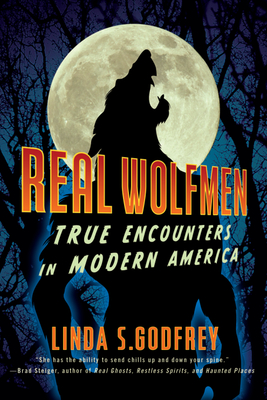
The problem with occasional phenomena is that they are seldom empirically verified. Try as we might, no one has managed to be in the exact place at the exact time on Loch Ness to capture definitive evidence that Nessie exists. Of course, it is very difficult to prove that something doesn’t exist. I have a creeping suspicion that not all of reality can be quantified. I’m very glad for the parts that can be, but a little mystery never hurt anyone. I’ve just finished reading Linda Godfrey’s Real Wolfmen: True Encounters in Modern America. There—I’ve already lost some of you! We all grow up to learn that there are no such things as werewolves and I’ve experienced many a peaceful night in that knowledge. Nevertheless, many people do report seeing upright wolf-like creatures, and many of the people interviewed by Godfrey appear to be entirely sincere. What makes this intriguing to me is that many of these episodes are reported in a circumscribed area (near which I used to live). While reports come from across the country, it is easier to dismiss one person who saw something odd once than it is to discount many people who see a similar thing over many years in the same general vicinity. That’s why I keep coming back to Godfrey’s books.

Being an open-minded writer, Godfrey also considers possible spiritual explanations for what people see. Shamanistic traditions, in this case particularly Native American ones, do not dismiss transformations from human to animal. It is difficult for most of us to accept that a person could bend the laws of physics and biology—for which we suffered through so many tests in our education—to mutate or mix human DNA into or with lupine stock. Indeed, it takes the faith of the world of religion to believe that. And yet, people see beasts.

We have been in the process of sealing the borders to our universe since the Enlightenment. The vaster our universe becomes the smaller the realm of possibilities grows. But we haven’t even explored all of our own little planet yet. The deep-sea trenches remain largely out of our reach, and the sheer volume of the oceans boggles the imagination. Even on land, we can’t watch every place all the time. The possibility of getting to somewhere truly remote is frequently an optimistic illusion. At times with my wife’s family I’ve ventured to places so far from civilization that freedom truly feels palpable. And as we hike down some neglected trail, talking to alert the grizzlies to our presence, nearly always we end up encountering others out here to escape from the likes of us. Yet a whole lot of the woods remain off-trail. It’s not a small world after all. And it’s October. Who’s to say there’s not the occasional werewolf out tonight?


Parsing God

Being married to a Girl Scout leads to many benefits beyond just the cookies. Not that cookies are unimportant, of course. Having been a Boy Scout briefly back in the 1970’s, I recall three-finger salutes, rambunctious meetings, and the occasional camping trip complete with the rabbit coming out of the hole, going around the tree and then something else. I’m sure there was a Boy Scout pledge, but I can’t remember it. Like most group activities, Boy Scout meetings served mainly to remind me of my own inferiority, and so my mind does not often enjoy visiting those places. Having attended a few Girl Scout meetings over the years as my daughter was growing up, I heard the Girl Scout promise a few times, and was a little surprised that the phrase, “To serve my God” has remained unaltered, even with the changing face of the population. When I attended an event hosted by the Elks, the civic organization, the presenter began by explaining the rules for who might join. It too, is limited to theists. The reason for such admission requirements has me pondering if there was a time God was an endangered entity in the United States. If not, why insist on this proviso?

I’ve been reading about religion’s role in society. Something that those who seek primarily the deep, personal and experiential aspect of religion may not realize is that religion is a form of social order. Scientific knowledge about God, if God be incorporeal, non-material, and beyond space and time, is impossible. Religions don’t prove God’s existence, but they serve to reinforce the sanction of the sacred for human society. They have an essential role in that drama. By limiting membership to believers organizations such as the Elks are merely asserting their belief in the working of the system. Of course, from the beginning those who do not believe risk little by claiming they do believe.

But what of the doubter, who may be the truest believer of all? Some Girl Scout literature has a footnote, parsing God: “The word ‘God’ can be interpreted in a number of ways, depending on one’s spiritual beliefs.” Belief is a form of commitment more than a mental certainty. In the Hebrew Bible belief was not as strong a suit as obedience; and thus it had been for the history of organized religion. Starting perhaps as early as Jeremiah, a shift began to take religion more toward a matter of internal commitment. In the face of utter loss, Jeremiah (or one of his fans) suggested that belief was more important that unthinking obedience. Belief is very subtle but vitally powerful. Lives are staked, and sometimes lost, on it. So while you’re enjoying another cookie, try parsing your belief. Me? I’m still trying to figure out when that rabbit goes back in the hole.


Bart’s Gospel

One of the near constants of the entertainment world is the social commentary on The Simpsons. The morality issues that get frequent play had led to a book entitled The Gospel According to the Simpsons some years back. And since Americans like their morality straight from the popular media, The Simpsons is not a bad place to look. The episode “My-Pods and Boomsticks,” although a few years old now, raises issues that are still current in our culture. I watched it with my daughter recently and she commented, “It’s just like Zeitoun.” My family read Zeitoun this summer (some high school reading programs have a way of involving more than just the student) and the revelation of just how deeply suspicious the nation is of Muslims disturbed us all. This particular Simpsons episode involves a Muslim family from Jordan moving into Springfield. Although Bart befriends their son, Homer just can’t get over the assumption that Muslim equals terrorist. In the end, however, it is Homer who ends up dynamiting a bridge rather than believing Muslims can be good citizens.

Apart from being the longest running primetime animated feature in history, The Simpsons bucks the convention of veering away from religious topics. Indeed, many episodes foreground religion and feature Hinduism, Judaism, and Buddhism as well as Christianity and now Islam. The religions may be gently chided, but they are not mocked, and we are given a glimpse into our own religious biases. Islam, as a religion, is not evil or bent on destruction. Like Christianity, it has many varieties and believers range from the sacred to the profane. It is not the religion that is a problem, but the society that gives the lie to true equality. Believe what you will; harm no one.

At work the other day I received an office memo about lunchtime Yoga. Whenever I see such notices I consider how this religious practice, in American minds, has become completely secular. The same may be said of some of the martial arts which, in original contexts, have a deep base in eastern spiritualities. These things do not bother us because we do not bother to learn about them as religious activities. Even Kung Fu Panda has a spiritual undertone. Religions display a wide variety of expressions throughout the world. Going to church one day a week and condemning those who believe differently all seven, many people do not stop to think of the contributions that other religions have made to our society as it exists today. American culture, while predominantly evolving from a Christian base, has strong elements of most of the major religions that go unrecognized or packaged as secular self-helps. We could still stand to learn a thing or two from Springfield.


Dracula’s Dinosaur

It must be October when a dinosaur with a parrot’s head, porcupine quills, and fangs is announced. Yesterday’s issue of Time online featured a drawing of the creature and a nifty animation of reconstructing the aptly named Heterodontosaurus. Well, that’s actually the genus name. The species goes by the delightful name Pegomastax africanus. Last I checked, however, space on the ark was filling up. Dinosaurs create a unique embarrassment to Creationists. One suspects that if they didn’t have kids they’d dismiss dinosaurs all together, but the troublesome fossils just won’t go away. What’s more, although they’ve been extinct for 65 million years, they keep producing new species for us to recover, describe, and name. When I was growing up (and I have it on good authority that the argument is still used) Creationists told us that no transitional forms had ever been found. Therefore evolution simply could not have occurred. This was generally followed up by a reference to Genesis. Excuse me, a fanged porcupine-parrot? If that doesn’t count as a transition, what does?

Religion loses nothing by admitting to an ancient earth. Nothing but literalness. One of the joys of reading is the exploration of metaphors, similes, and hyperboles—writing delights us with its constant surprises. Even those who claim to read a text literally are engaging in a form of interpretation even earlier than the first wedge mark pushed into clay. Written texts give us something to ponder, to think about, and occasionally, to obey. Just when it looks like the cover has slammed shut on the black book we find a new set of dinosaur tracks running across our clay tablet. The literal-minded might not see these as being a message from God, but surely the endless variety of creatures that have walked this planet more than make up for it.

We used to have a pet parrot. His name was Archie, named after Archaeopteryx, the feathered dinosaur. Although Archie was cut off by disease in the prime of life, he was a curious bird and when I reached into his cage to try to get him on my finger he would dole out what he meant as a painful bite. I always took it as a sign of affection. Had our little friend had the fangs of Pegomastax africanus, I would’ve thought long and hard before risking the finger-perching trick. I like to think it would have reaffirmed my fascination with the amazing adaptability of nature. Evolution, unlike God, has no purpose. An endless tinkerer, it gives us thousands of differing dinosaurs that had been gone many, many millennia before Moses ever even thought of Noah. Pegomastax is safely extinct now, and the only ones who have to worry about this perfect Halloween dinosaur are those who think that one particular view of one particular book is the only way to find truth.

We still miss you, Archie.


Ban This

It should be a scarlet letter week. In honor of Banned Book Week, I’ve started to re-read Kurt Vonnegut’s Slaughterhouse-Five. Somehow I made it through high school and college without having been exposed to Vonnegut. A friend started me reading his works when I was about ready to start my Master’s degree, and I’ve always enjoyed coming back to him. When my daughter asked me why Slaughterhouse-Five had been placed on The List, I honestly couldn’t guess. Banning books, of course, is a scheme chiefly intended to keep children unexposed to ideas that adults find uncomfortable. We can’t go around telling other adults what not to think (although that hasn’t stopped many a religious tradition from trying), so some individuals figure that we can protect our unthinking young by putting in the corner literature that asks awkward questions. More radical conservative elements suggest destroying them. These are the true grapes of wrath.

Ideas can be wonderfully dangerous things. We now face a brave new world of internet access where ideas float lightly on the web and unless we watch our children constantly, we can’t control what they might see. Ideas as traditionally expressed in literature go through a tremendously long and convoluted birth process. We even use the language of conception to describe how they begin in one’s mind. Ideas implant, gestate, and grow. For the writer this might represent weeks, months, or years of writing, erasing, re-writing, and yes, parenting the idea. The written book has to meet the approval of publishers and only after yet another editing process are they pronounced fit to see the light of day as books. Having passed through many hands, many heads, such ideas become part of their culture. If we find them objectionable, well, isn’t that just part of life? Perhaps that is the largest message to be gleaned from the world of books: no one will be pleased with them all. Even the diary of a young girl will raise alarm.

Some of the finest literature to escape human minds has been challenged or banned. Ironically, in the land of the free and the home of the brave fear of books runs at a fever pitch seldom encountered elsewhere. Afraid of mice and men. What has made this country such a wonderful experiment—the embracing of diversity—has somehow morphed into a neighborhood where nobody feels safe if there are objectionable words on the bookshelf. Ironically Ray Bradbury’s critique of banning books, Fahrenheit 451, is itself a banned book. What most proponents of stopping literature probably don’t realize is that according to OCLC, the source for library data, the most banned book of all time is the Bible. To be honest, those who’ve read it know that it has sex and violence and many other adult situations. In the original languages there are even “swears.” Maybe it’s time people just grew up. The best way to accomplish that is to read a book. Hey, it’s a jungle out there.


Who’s Got the Keys?

Having grown up Protestant, I assumed that was normal. Adults, who have the benefit of years of negotiating with other adults in ways that may seem unsavory to children, have the definite advantage here. Children believe what their parents tell them, and should the matter come down to eternal life or everlasting damnation, you sure want them to have your back. Sunday’s New Jersey Star-Ledger has a perspective piece by Tom Moran, whose parents raised him Catholic. Catholics and Protestants are Christians divided by a common religion. As I have studied the teachings of each over the years, it has sometimes felt impossible to fit the two together in any meaningful way. They both think Jesus is cool, but beyond that, the disagreements almost immediately begin. Moran notes that in the US fewer than one in four adults identifies as Catholic although one in three was raised in that tradition. His article goes on to outline how Catholicism has frequently aligned itself with law at the sacrifice of compassion. Sounds like religion to me.

Religionists place great, perhaps even eternal, stock in being right. The Catholic Church has traditionally considered itself expert in issues of reproduction, a conceit that is only more bold when it is regulated by celibate men. And the source can’t really be the Bible since there are plenty of places where the good book is a little naughty. The biblical understanding of reproduction was a conclusively unscientific postulate. When microscopes, not telescopes, revealed what was going on at the microscopic level, theology should’ve blushed and excused itself from the room. Instead, the church proclaimed that it knew better than any bespectacled intellectual; after all, unwavering tradition must count for something. This bears the imprint of a system with little left but theological bluster. And it’s losing its thinking members.

Moran interviewed Newark Archbishop John Myers, a man concerned with the sanctity of marriage and who has a questionable record of reporting abuses, for his story. As Moran pointed out, Myers has not been the outspoken advocate of the poor, but he does back the candidate with sacred underwear. I’m not sure when the last time was that the good Archbishop took a drive around Newark. It is hardly a little piece of heaven on earth. Even waiting for a train in the station can fill a customer with a sense of despair. God’s will, apparently, is somewhat more narrowly focused on what consenting adults do behind closed doors. The level of disjunction is enough to throw the Popemobile out of alignment. Of course, I write all this from the sidelines. I was raised Protestant, and no matter what the Mormons or the Catholics say, I was taught from my youngest years that they’re just plain wrong.

Those are some big keys…


Country Roads

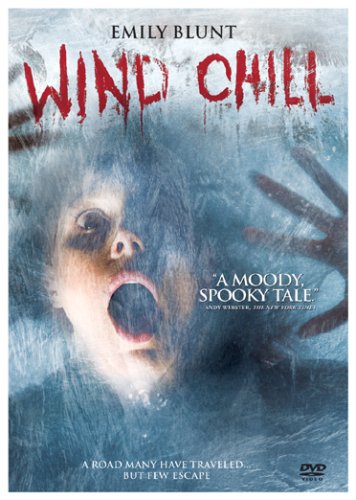
It may be a little too early for winter, but scary movie season has begun in my personal calendar. This weekend I watched Wind Chill. Although critics weren’t always kind to the movie, and the ending is somewhat predictable, it is one of the more decidedly creepy films I’ve seen recently. Since it is set in Pennsylvania there was a bit of a homey touch to the terror. I have driven on similar roads to that in the movie, during snowstorms, and that is one of life’s true terrors. What makes the movie so frightening is its ambiguity. Put a teenage girl alone with a guy in a car on an isolated road and you’ve already got enough elements to make your spine tingle. It becomes clear that the guy hasn’t been honest with the girl all along (the characters are never given names in the movie) and as they spend the night in the broken-down car reality and nightmare become increasingly difficult to parse. Of course, religion plays a role in the show.

The guy is giving the girl a ride home for the holiday break. He’s been watching her, a little too closely, for some time although she doesn’t know that until it’s too late to turn back. As they fumble for conversation it turns out that he is an “Eastern Religions” major and they met in a philosophy class. This just keeps getting scarier and scarier! After they break down (spoiler alert!) and the ghosts start showing up, we learn that some of them are priests. They had come to this haunted road to give the last rites to some accident victims before freezing to death in the poorly insulated cells in a strange little monastery on the hill (this is Pennsylvania, remember). As the night wears on we find the priests condemning the bad cop to a fiery death before light dawns and the girl finally finds salvation.

Of course, this is a variation of the old urban legend of the teenage couple out parking when something scary happens. Having everything in half-light and through smeary, foggy windows makes it more difficult to perceive what is actually going on. A lying religion major, priests complicit in a deserved fatality accident, and Nietzsche’s eternal recurrence give the film a little intellectual heft among the muted special effects and bleary-eyed confusion as the night goes on. Morality is on trial here. Although not the most profound of films, Wind Chill deserves some credit for bringing religion and horror to the same remote location and having them trade cards in the dark of night.