Rachel Weeping

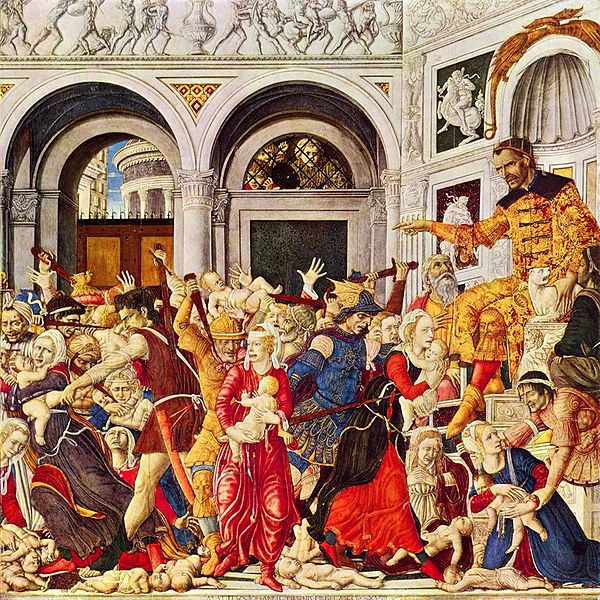
“In Rama was there a voice heard, lamentation, and weeping, and great mourning, Rachel weeping for her children, and would not be comforted, because they are not.” I just can’t get it out of my head. The tragedy of Newtown, Connecticut is the madness of Herod repeated over and over again. I stand outside my daughter’s room and weep as she sleeps, terrified of what we’ve become. For the right of one person to own guns, twenty-eight are dead. The balance of power is way off-kilter, like a fishing vessel in a perfect storm. Those who protest are those who are unarmed who wish to remain that way. The bravado of the NRA says, “I would protect them, if I were there.” If I were there. I would feel no safer. Where was the NRA in Stockton, California, Iowa City, Iowa, Jonesboro, Arkansas, Littleton, Colorado, Red Lake, Minnesota, Nickel Mines, Pennsylvania, Blacksburg, Virginia, DeKalb, Illinois, Oakland, California, or Newtown, Connecticut? Polishing their rifles in readiness, no doubt.

The time has come to put an end to easy access to guns. Life was more civilized in the days of the flintlock and musket—at least people had time to react or flee before another shot was loaded. Instead we tell people they will be safer if they can squeeze off forty-one shots before that crazy idiot shoots another. Drop to your knees and beg for mercy, you’ll be safer. While you’re down there, say one for a nation that loves its firearms more than its children.

Days like this it feels like God has us in his sights. The longer I ponder this the blacker my thoughts grow. We may blame the madman, but it is society that allows this to happen. Herod was king, and even the mother of God fled. But what of those left behind in Bethlehem? They paid the price for a man in love with power. I see a man in a cage, being sprayed by an upright ape holding a firehose. The man is one of the most vocal supporters of the NRA, but now he is the inferior being. “It’s a madhouse!” he cries. Yes, Mr. Heston, it is a madhouse indeed. Only those aren’t apes outside the cage, and those are firehoses in their hands. On further reflection, perhaps they are truly apes. Rachel is weeping for her children, while Herod reloads.
Slaughter of the innocents, 2.0
Slaughter of the innocents, 2.0

Bleak December

Tragedy follows on tragedy in 2012. Maybe the world really is ending this year. Not even a week after a man accidentally shot his own seven-year-old son in western Pennsylvania, a gunman kills twenty school children, six adults and himself in Connecticut, and still the “Religious Right” advocates our God-given sanction to own guns. Various commenters rail that guns don’t kill people—please allow the evidence to disagree. Loudly. Violently. Twas the fortnight before Christmas and all through the school… Nightmare before Christmas indeed.

As a nation we have outlived our need for guns. The only real threat out there is other people who have guns. Even a simpleton can see that it is an insane spiral because no one trusts the other guy. A miniature arms race. A cold war within a nation, state, town, or school. Like the journalists who write the sad stories for the papers, I think of Virginia Tech, Columbine, and children who will never grow up. Wikipedia has an entire article entitled “School Shootings.” America has its own sub-page. I think of other children scarred for life because some people think that it is our right to “protect” ourselves. From what? Still, they’d swear it on a stack of Winchesters. Having been shunted around from job to job and apartment to apartment, I’ve lived next to many people that I found unstable and thank local laws that they were unarmed. The sack on Santa’s back this year is a sack of serpents, and it has been opened and there’s no way to get them back in.

If the Church wanted to make itself relevant again, all denominations would band together and demand stricter gun control. No, it won’t stop every madman from massacring children, but if the Christian community really believes the Gospel it claims, it is far better to die than to kill. The next world is supposed to be better than this. The mother of the shooter, Nancy Lanza, appears to have been the owner of the guns. Probably they made her feel safer. She is now cold in the morgue because of them. Along with a classroom of children in the school where she worked. As the families of the murdered face Christmas this year, they will think that 2012 is the year the world ended. If only it would. But then, nature, and gun-ownership-rights activists ensure a future much more bleak than that.

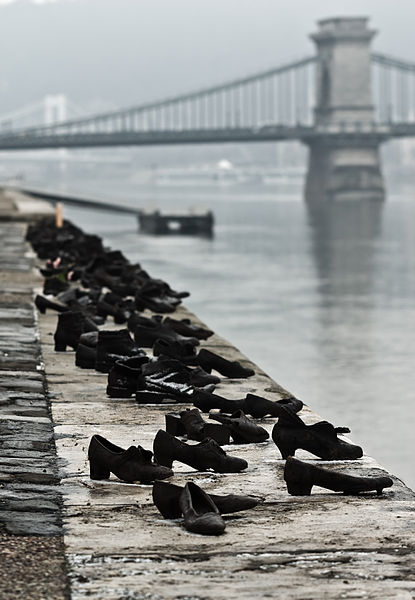
Nikodem Nijaki's photo of shoes on the Danube Promenade

Nikodem Nijaki’s photo of shoes on the Danube Promenade


A Big Joke

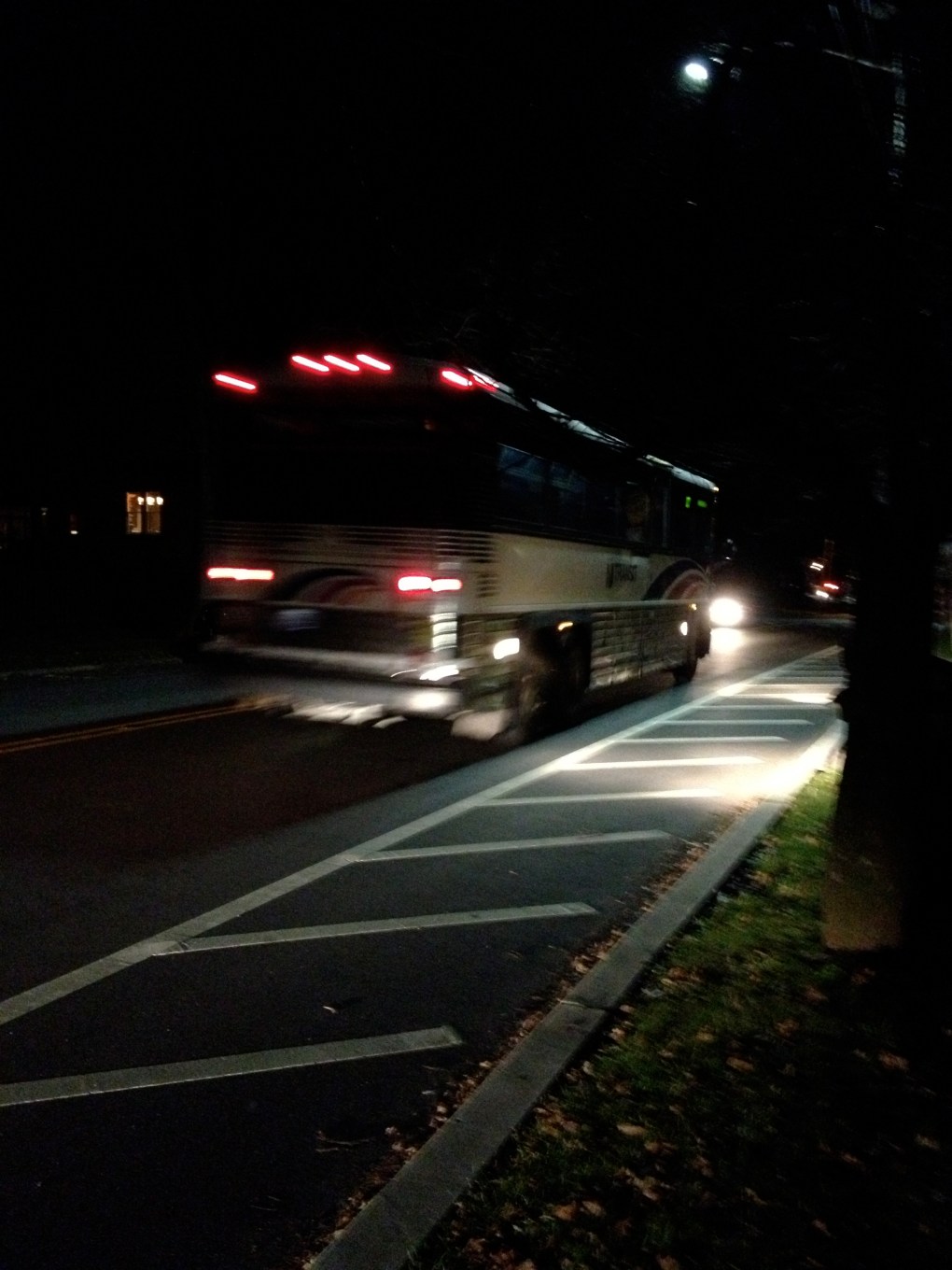
On the evening table my wife left a token of hope for me to read in this hopeful season. New Jersey “Transit” claimed that the very next day riders of the extensive bus system would be able to track buses precisely on their smart phones. No more wondering “has the bus already come, or is it late (again)?” I laughed when I read this because that very evening in the Port Authority my bus never came. The frazzled and apologetic dispatcher said nobody knew where the driver was. Did anyone think to drag the East River? I wondered. As other buses pulled to the gate, drivers refusing to switch routes, the line grew and grew. The bus scheduled for the next half hour did not show. My daughter was waiting for me to fix dinner. On a good day I’m home by 6:30. This was not a good day. I laughed ironically at the article and went to bed. My morning bus leaves, in theory, before 6:00 a.m. A day later, in the Port Authority. My bus, which can now be tracked with precision, precisely failed to show up. I’m sure you know the dispatcher’s chorus—please join in—”nobody knows where the driver is.”

So what is a diatribe like this doing on a blog about religion? I’m as mad as Hell about this, that’s why! Every month I pay hundreds of dollars for a bus pass. I think the least New Jersey Transit could do is the courtesy of sending a bus. In case anyone from NJ Transit is reading this, a bus is a large vehicle that seats about 50 adults and generally runs the same way every day. It’s called a “route.” People use it to get to and from work. Of course nobody expects the executives of a company that services over 19,000 bus stops to take a bus to work. They probably have to be on time. I take the earliest possible bus from my town to New York City. Most days it is late and consequently so am I. For this I spend over three grand a year.

This is not about Hurricane Sandy. Buses have been back on schedule since Thanksgiving. What it comes down to is the fate of most capitalistic ventures—the working person butters the bread of the Executive Director who earns more than $260,000 a year. Last night I toyed with the idea of getting other disgruntled commuters to link arms and stand across the exit ramp, or to lay down in front of the buses until a bus for my route was sent. I suspect, though, that they realize as well as I do that Tiananmen Square doesn’t take much to morph into Times Square when an individual stands in the way of corporate gain. Tonight I plan to wear my good walking shoes. After all, I paid good money for them too. Unless, of course, anybody out there would like to drive this bus?

Ghost bus

Ghost bus


Fanpire Club

FanpireIt has become an odd world indeed when thousands of people look to vampires for family values. Although I’ve not read any of Stephanie Meyer’s Twilight books, I have been curious at the reception they have received. A literary agent said, a few years back at an event I attended, that publishers want vampires. There is no end in sight. Perhaps it is my inherent trust of scholars that led me to read Tanya Erzen’s Fanpire: The Twilight Saga and the Women Who Love It. Why would a religious studies scholar write about Twilight? Because Erzen realizes, as many scholars are beginning to that: 1. vampires are very religious monsters, and 2. many more people care about books like Meyer’s than they ever will about scholarly minutiae. I, for one, learned that I’ve missed out on a huge part of pop culture by insisting that my fictional reading must have at least an attempt at depth. Erzen ably points out that there may be truths beneath the surface even here.

When I first became aware of the Twilight books, I was surprised that no one seemed to be making the connection with Dark Shadows. I grew up with the subtle, sensitive vampire who was deeply conflicted. The books that serialized the television series were not profound either, but they evoked an angst that bespeaks a religious need deeply buried. Erzen is able to dig some of this out of Twilight as well. By interviewing fans for whom Twilight has become an ersatz religion, Erzen can show that even squeaky clean Mormon men can’t possibly live up to the vampire standard. The fantasy that has engrossed so many is an image of selfless love. As if Edward Cullen were a less chaste, and more undead Jesus. After all, he gives Bella eternal life and his love never grows cold. The values fit rather well with Latter-Day Saint theology, and provide a model for mortal family values.

More striking is Erzen’s revelation that fandom does not equate to feminism. The women who are empowered to love in unorthodox ways are very much controlled by their men-folk in Meyer’s universe. As Erzen points out repeatedly the ideal lover here is an obsessive stalker with a penchant for abuse (although mostly unintentional). Freedom for women comes at a cost. They may be offered the best in some fields, but even today women do not find equal representations in positions of power in our society. CEOs? Evening news anchors on major networks? Senators? Presidents? Our society is one that talks the talk of equality, but stumbles when it attempts the walk. Vampires cannot exist without victims. Even in the most “advanced” societies in our world, women must struggle in a hierarchy for which the architects, contractors, and supervisors are mostly men. Perhaps women find vampires so fascinating because it matches their experience of a society that takes far more from them than it is ever willing to give back.


Chrismahanukwanzadan

Happy holidays from a pluralistic world! Whenever I see the “Keep Christ in Christmas” signs that crop up this time of year, I think of the wonderful profusion of holidays that people from most faiths can share without being territorial about it. After all, the Pagans got there first—the Christian Christmas predates Jesus by centuries, it turns out. So when my daughter wished me a happy Chrismahanukwanzadan—from a mix of Christmas, Hanukkah, Kwanzaa, and Ramadan—I had to smile. Seems like some in the younger generation are really starting to get it. It doesn’t matter what you call it, but a holiday that celebrates people getting along is worth the effort. Being possessive of our holidays rings of hollow triumphalism—I feel happy because I have something that you don’t. Is this really the spirit of this secular season of giving wrapped in many confessional names? I’m sure shepherds and Magi didn’t exactly share a Weltanschuung.

Those who despair the lack of Christmas have not spent much time with history. As a cultural holiday the celebration of Christmas is younger than the United States, at least in this context. From the beginning Christmas was a pastiche of traditions from different religions celebrating aspects of Odin, Sol Invictus, Jesus, and Zarathustra, at the very least. Bringing these religious figures together into a season that represents the human need for light amid a dark and cold time of year, who would want to exclude others from their own holiday traditions? Having stood in the bleak fields of the Orkney Islands in a massive stone circle aligned to the winter solstice and constructed over a millennium before the birth of Christianity, I have to believe Christmas is one of the earliest expressions of human desire and certainly not limited to Christians.

What makes a holiday holy? Is it exclusive rights like those slapped on every movie you pop into the DVD player? The trademarking of an idea someone else thought of? Religions have a long history of forsaking the spirit of the law for the letter—its most familiar name is dogma. No matter who came up with the idea of doing what we can to bring a little light back into the dreary world around the time when night seems unending, it is a cause that any person of any religion, or none at all, can fully appreciate. Instead of marking territory, should not those who claim Christmas as their own be glad to share it with all? If the one who’s birth the church proclaims at this time of year in no way improves our outlook to others we might wonder if there should be cause to celebrate at all. My answer, such as it is, is Happy Chrismahanukwanzadan!

A holiday in anyone's book

A holiday in anyone’s book


Mutants, Mystics and Memory

MutantsMysticsParadigms. These patterns of thought are self-reinforcing and very useful. As anyone who’s studied foreign languages knows, paradigms are an effective way to keep all those impossible verb tenses in mind. Until you encounter an irregular verb. Once you discover irregular verbs, you start to find there are more of them than you wish. As with language, so with life. Like most boys, I grew up reading comic books. We didn’t have much money, so I wasn’t as fluent in super-heroese as some kids were, but I felt that irresistible draw to garish colors inking exaggerated muscle-tone under a costume that held a body capable of extraordinary things. Everything seemed possible. Then adult responsibility hit. Who had time for comic books and heroes?

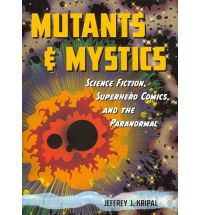
That’s why I was delighted to discover Jeffrey Kripal’s Mutants and Mystics: Science Fiction, Superhero Comics, and the Paranormal. The three sub-topics just about summed up my childhood. But, like Paul declared to Corinthians, the first time around, “when I became a man I put away childish things.” Turns out, maybe my desire to be grown up was premature. I commented on Kripal’s Authors of the Impossible earlier this year. In his work I’d finally discovered that academics can sometimes get away with asking unorthodox questions. Perhaps it was my exposure to biblical studies, a discipline which goes one of two ways—overly facile attempts to maintain a literal reading, or a staid, solid approach tied to serious linguistics and archaeological records—that forced me into a reductionist paradigm. Well, everybody else was doing it! Academic thought had little room for the unusual, the bizarre, the irregular verb. The same applies to our no-nonsense, money driven society. Just shut up and do your job.

Mutants and Mystics, however, shows that our repressed unusual experiences, like a freudian phobia, will find ways into daily reality. It is a mind-stretching book. As for Authors of the Impossible, Kripal is to be congratulated on allowing himself to consider walking down paths that most academics assiduously bypass. Coming to his work as a fellow student of religious studies, I see that he has arrived at similar conclusions to mine, although clearly more advanced. I’d just assumed that since I never had the serious backing of a serious university my way was the low-way. The way of the kid who just couldn’t bring himself to grow up. There is a reason we spent our formative years reading about heroes for whom the impossible was daily reality. Perhaps we were in training after all, and comic books prove the point of old Isaiah that a child may indeed hold knowledge adults often just can’t see.


Freud’s Nightmare

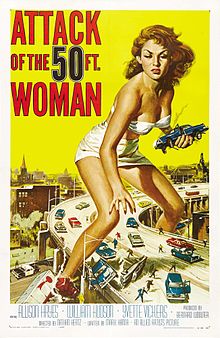
B movies are a guilty pleasure. Weekends sometimes allow for guilty pleasures, when I can check my mind at the door, take a seat near the screen, dim the lights and grab the popcorn. 1950‘s sci-fi reflects paradigms that have ossified in some people’s brains, it seems. It has been many, many years since I watched Attack of the Fifty Foot Woman. I was a child the last time I saw it. As an adult the message is strikingly different. The year is 1958, and my parents haven’t even married yet. Millionaire Nancy Archer has a run-in with an alien in a “satellite,” but he only wants her for her jewelry. Meanwhile her cheating sleaze of a husband, Harry, is making out with the redhead at the local, and plotting to kill his wife for her money. So far the story is fine, if tragic. Then the woman, enlarged by radiation, breaks free from her chains, rips the roof from the bar, and grabs her husband. To the local sheriff, there’s only one option—shoot the “monster.” He unloads a riot gun into her, and, hitting a transformer, electrocutes her. The crowd, aghast, run to see if her trashy husband is alive. The wronged woman they ignore. The metaphorical elephant in the room. Role end credits.

Attackofthe50ftwoman

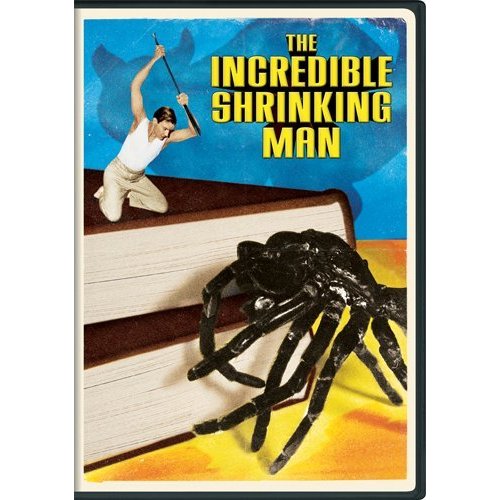
The misogyny of this story escaped me as a child, as did the sexual innuendo. I was only after the cheap thrills of cheap special effects. So I turned to The Incredible Shrinking Man, released a year earlier in 1957. Scott Carey, after sending his loyal wife Louise to the galley for a beer, is hit by a radioactive cloud while on his brother’s boat. An accidental dose of insecticide some months later sets him to shrinking—a freudian fear for all men. As he grows smaller, his will to dominate his wife—now a giant to him, increases. Many scenes end with a tiny man leaving his wife in tears. Even when he is supposed dead, but in reality is too small to make himself heard, Louise is reluctant to leave, in case he still needs her help. Like a short beer, I suppose. The spider scene, which no doubt caused nightmares when I was a child, follows on his monologue about having to dominate his new, tiny universe. The little man shrinks into non-existence with the realization that “to God there is no zero.” What he doesn’t say aloud is, “as long as one is male.”

IncredibleShrinking

These are the 1950s to which some political commentators (and not a few voters) wish us to return. Men fear being dwarfed by women. Call it radiation, or call it social regress, or call it paranoia—the message is all the same. Man must dominate. Women who overshadow are a threat. In the earlier film, Scott Carey is a passively shrinking man. By the next year, when Nancy Archer grows, it is now an “Attack.” Fast forward half a century. Dreamwork’s Monsters vs Aliens makes a parody of Nancy Archer, and Susan Murphy’s fiancé, Derek Dietl (who is clearly modeled on the smug, self-righteous newscaster in Attack of the Fifty Foot Woman) ends up alive, but shamed. The male alien who seeks to dominate her is destroyed. And the male monsters feel somehow less fierce in her presence. As this year’s political posturing clearly demonstrates, there is still a long, long way to go before true equality appears. Many men are clearly stuck in the black-and-white fifties. The full-color, larger than life Ginormica will hopefully better reflect the paradigms of the future.


Accidental Abortion

There comes a time in life when you realize that if a small town you know makes it into the news headlines, it is likely tragic. So it was when I read this morning that a man in Mercer, Pennsylvania—just a few miles from where I grew up—shot and killed his 7 year-old son, by accident. I grew up in a part of the country that has a love affair with guns. This may have been understandable in the days when a stroll to the outhouse could mean chancing a bear or cougar encounter, but these days bear sightings are rare and cougars, well, almost unheard of. The man was trying to trade in a couple of guns at Twig’s Reloading Den. Climbing back into his truck, the handgun discharged, killing his son. This is very tragic, yet the officer making a statement said something chilling. The man thought the gun was unloaded but, “This happens all too often where people think the gun was empty.” All too often. All too often.

I grew up in western Pennsylvania, and if Facebook is anything to go by, it has become consistently more Evangelical since I left. And that is saying something. In my younger days I wore a large cross around my neck and took my fair share of ribbing for being religious. Now I see those with whom I attended school posting on all manner of conservative causes, including the contradictory anti-abortion and loosening of gun control. This is not a phenomenon restricted to western Pennsylvania. At Nashotah House it was alive and well. Several students kept guns in their dorms, protested against the violence done to the unborn, yet called killing heretics “retroactive abortion.” It was their smiles when they said such things that frightened me. Wait until they grow up to kill them.

Like any insecure person I sometimes think a gun for protection might be good. I especially think this when I’m in the grizzly bear habitat of the Pacific Northwest, miles from civilization. I picture myself shooting into the air with a rifle that out-Thors thunder itself, a mighty man. Yet the only time I actually saw a grizzly bear I immediately jumped out of the car to snap a picture or two. I dream of going back to the days before guns were invented, but this evil genie has been let out of the bottle. There’s no getting it back in. Are we vulnerable without guns to “protect” us? Yes. But my reading of the Bible my Evangelical friends so often cite insists that turning the other cheek is the way to show that you believe it. A seven-year-old is dead not far from my hometown. His father was trying to sell guns at a store that doesn’t even buy guns. The boy died in the gun store, and yet my fellow Americans feel safer knowing they’re armed. I hope your hometown stays out of the news.

Feel safer?

Feel safer?


Read Ban

Someone in the Greenville County Library doesn’t get out much. The LA Times reported this week that a surprised parent got a look at Alan Moore’s Neonomicon, a graphic novel that her child was reading, and went to the library to get it banned. There is a perverse kind of logic to this. The 14-year-old minor checked the book out from the adult section. The story doesn’t say why, but anyone familiar with H. P. Lovecraft would immediately see the familiarity of the title to his fictional Necronomicon. And anyone wanting to read that is surely above the age of innocence. As a result of this imbroglio another book has been banned. As the parent of a teenager I understand concerns about reading material, but then I know that graphic novels can be, well, quite graphic. I know because I read.

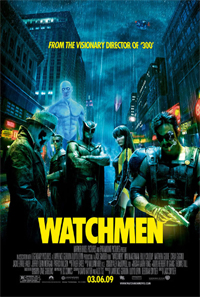
I’m currently reading a fascinating book about religious aspects of comic books. Many of us grew up with comics, and anyone who’s read some psychology knows that people are very much image-oriented. Even our Bibles for children are heavily illustrated—often with drawings nearly as far from reality as those of an Alan Moore story. Adults raised on comic books have been enticed back with such novels as The Watchmen— something that looks like maybe kids are the intended readership, but they’re not. The only way for adults to know is to read. (That, and to consider that the movie version of The Watchmen scored a solid R rating. That little itch should be telling you something.) But reading literature has fallen out of fashion.

While waiting for my bus home one day I decided to take the more local route because the bus was still at the gate when I arrived at the Port Authority. This is a longer ride, but with any luck it might get me home ten minutes earlier. When I asked a woman if I might sit next to her, and I began pulling out my book, she said, “you’re that guy that reads.” Guilty as charged. As I wait for the express bus, I spend the time with a book. Until she said that I never considered that almost nobody else does. Forget the days of earnest looking men, faces hidden behind newspapers, passing the commute by reading. Now it’s all ages and genders, holding electronic devices. Not that I’m surprised. People are visually oriented, after all. But I immediately recognized Moore’s nod to H. P. Lovecraft in naming his novel Neonomicon. I think I might have an idea of what to expect if I were ever to read it. It is, however, far easier to ban books than to take the time to read.

Watchmen


Spirituality Sampler

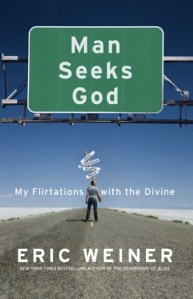
ManSeeksGodSometimes you read a book and wonder if somehow the author got into your head and fished around for material. Although I’m not Jewish, at least not that I know of, I found Eric Weiner’s Man Seeks God: My Flirtations with the Divine to be uncannily familiar at points. Not that I’ve ever been a journalist, nor have I had more than a few hundred people read anything I’ve written, but somehow I just couldn’t shake the underlying connectivity. For those of you unfortunate enough not to have read it, Man Seeks God is Weiner’s spiritual journey through various religions, seeking his God. Born culturally Jewish, Weiner never really resonated with the religious aspect until the last chapter of the book. In between, however, he shows a true pioneer spirit and tries diverse faiths, some of which are not for the fainthearted. As fits the postmodern period, he’s an authentic, intentional spiritual shopper. And he provides many laughs along the way.

Such a book must be difficult to write. There’s a lot of baring of the soul, and even a little baring of the body, at times. Weiner begins with Sufism, the mystical branch of Islam. Yes, it’s based on love. He then travels to Nepal to pursue Buddhist meditation, followed by a stint with the Franciscans in the Bronx. The only one of the “big five” he doesn’t sample is Hinduism. That might have thrown a speed-bump into his ending, though, to be fair. He makes no claims of comprehensiveness. At this point the story takes a turn toward decidedly exotic selections in the cafe of spirituality. I couldn’t read his account of the Raëlians without snorting aloud once or twice on the bus. Taoism takes Weiner to China and into a distinctly more philosophical frame of mind. He explores Wicca and Shamanism, which may be more closely related than he supposes, before coming home to Kabbalah, the mystical branch of Judaism.

Spiritual seeking is as mandatory as breathing for some people. Eric Weiner is one of those teetering on the edge of active exploration and the ability to shut out the questions, if only temporarily. Reading his confessions, it’s clear that he’s a rational, intelligent man. He made it through decades without really feeling the need for religion. When the ineffable pressed itself onto him, however, he turned to the mystical traditions. I was warned, in conservative Grove City College’s religion department, to be very careful of mysticism. The professor was dry-eyed serious as he said that seeking direct experience of God would generally lead to heresy. So there it was, in plain sight. Doctrine has precedence over the truth. Long ago someone smarter than us figured it all out. Our job? Just follow their path. I have a feeling that Weiner, having had some unexplained experiences of his own, might disagree. Sometimes you have to take out a personal ad in the spiritual scandal-sheets to get an idea what the divine really is.


Jolly Saint Nicholas

StNick

Each December the Princeton University Chapel Choir performs a free holiday concert in the impressive university cathedral (actually, it is a chapel, but given its size I’ll stick with cathedral). This year’s concert was Benjamin Britten’s “Saint Nicholas.” The association of Saint Nicholas with Christmas, not really a major holiday until relatively recent times, was an aspect that developed long after his death in the fourth century. The date of his death, December 6, and his association with the giving of gifts, made him an obvious model for Santa Claus (who still bears his name). Most of the gifts I’ve received from bishops involved losing a livelihood and personal dignity, so it is little wonder that Nicholas is venerated. Few bishops of his generosity exist today.

The stories of Nicholas of Myra, however, are full of mythical accounts that bear less resemblance to history than to legends of old. Eric Crozer’s lyric for Britten’s piece invokes several of these miraculous tales. Saint Nick, it seems, stilled a storm at sea, multiplied food and walked on water like Jesus. The lyric also tells the legend of how he raised three pickled boys from the dead, although I have to admit I couldn’t get my mind off zombies after that. This story seems to owe something to the myth of Tantalus, who, like Nicholas, was from Anatolia. In real life we do know that at the Council of Nicaea Nicholas punched Bishop Arius in the ear for his heresy. Theological discussions are like that sometimes. And I wonder if that might not be the origin of another curiosity of which a friend recently reminded me—Saint Nicholas doesn’t travel alone.

Our modern version of Santa Claus takes its roots mostly from germanic traditions. In that culture the saint is accompanied by a more sinister character who doles out punishment to the naughty. He is known by many names: Krampus, Ruprecht, Schmutzli, Zwarte Piet, or simply the Devil. Instead of using their diabolical fists, they generally carry rods to smack the not-so-nice, kind of the Republican side to the liberal Santa. This dark figure does not appear in Britten’s “Saint Nicholas” where a (mostly) kinder, gentler saint appears. A saint who raised briny boys from the beef barrel also belted another theologian upside the head. Life, even for saints, is full of contradictions.


Rock Hard Cafe

IMG_0518

At first glance it may not appear to be much. A small chunk of rock, probably limestone. Hardly large enough to be used in a sling against a giant in a pinch. Still, it is special. What makes this rock special is the context from which it was removed. A friend has recently returned from Israel and he brought this rock for me. It is from the Mount of the Temptation, atop which sits a lonely monastery cared for by a single, elderly monk. The thought of someone thinking of me in such a (literally) God-forsaken wilderness is touching. My brief travels through the desert of Judea offered plenty to occupy my restless mind. I’m pretty sure we zoomed by the base of the Mount of Temptation in an air conditioned bus one day on our way to somewhere less desolate. Or more. The sharp-voiced little skeptic in my head immediately kicks in: if Jesus was alone when tempted, how could anybody possibly know where it happened? I can’t picture him leading a tour there later—“and this is where I almost turned stone to bread; don’t those pebbles look like challah to you?”

But then, it’s not about historical accuracy. This little stone in front of me is a symbol. Broken off of the karst geography of the rocky spine of the Holy Land, this shard is meant to remind me to avoid temptation. A nearly identical piece of stone from Israel sits among my teaching trinkets. One of my students went to Israel back in my days at Nashotah House and returned with a bit of limestone for me. She said, “you can keep it as long as you put it on top of my gravestone when I die.” This was a custom I’d observed long before I’d even heard of Nashotah House. Long before religion grew flinty and unyielding. Stones bear remembrance. Although Israel is not as arid as many people believe it to be, rock is a natural resource of uncommon abundance. We age and die, but the rock remains. The rock remembers.

My six weeks in Israel were spent among the rocks of an ancient settlement known as Tel Dor. Archaeology, I learned, is mostly just removing the dirt from the rocks in the ground—at least at the entry level. Those stones tell a story. They were once a city, a district administrative center. Now they lie in dusty profusion, and only the most ardent of Bible readers will recall ever seeing Dor’s name in the pages of Holy Writ. Built by Solomon, the Bible grandly claims. Now all is ruins. The grandeur of a king toppled with the passage of time. My mind is drawn back to a treeless stretch of a mountain devoid of even the hardiest plants. A person can grow mighty hungry there. Mighty hungry indeed. Temptation comes, unbidden. Life is an unbroken chain of temptation, for those willing to be honest in the desert. That little stone is, in truth, bread.


Old Lies

WilfredOwenMuch of my exposure to literature has come through my daughter. I didn’t really grow up in a literary family. We had a prominent television and not much money for books, so I was headed for a typical American predilection for TV as some form of intelligence. When I began reading, it was what I could discover on my own and the required reading of English classes. Needless to say, I missed a lot. My daughter recently had to analyze a poem of Wilfred Owen. Although my wife had a book of Owen’s poetry, I never really had reason to read it. Like Joyce Kilmer, Wilfred Owen was a poet that was killed in World War One, only one in a long list of poets and dreamers that have been slaughtered in pointless conflicts. The poem that she studied was “Dulce et Decorum Est.” The poem describes a gas attack during which one soldier is unable to get his mask on in time and the gruesome death that follows.

The poem led to a family discussion about the cruelty of chemical weapons, and larger still, the pointlessness of war. Throughout history wars have been waged by the rich and powerful for reasons that may ultimately benefit some of their subjects but which, if not for the pride and prejudice of the powerful, would perhaps have been resolved without recourse to more efficient ways of killing. I always remember the Star Trek episode “A Taste of Armageddon,” where the Enterprise encounters a planet at war waged by computers and those who are calculated as victims report willingly to death chambers. This, they claim, is a more humane way to fight. In a Kirkesque maneuver, the man who gets me cut-rate flights and hotel rooms destroys the machine telling the people of Eminiar VII that if they have to face the grim cruelties of war they will find a way to stop fighting. Futuristic thinking indeed.

Today we have robots that can fly and attack, killing our enemies without putting us at risk. These are the grandchildren of mustard gas and a myriad of creative and horrid ways that people have devised for killing others. Wilfred Owen was killed just days before the war ended. His poem exposes the lie of Horace’s line, “dulce et decorum est pro patria mori”—sweet and decorous it is to die for one’s country. If I hear Owen clearly, it is the “dulce et decorum” to which he objects. Until we find humane ways to solve our differences, even in the Kirk Model, there will be wars. Death fought over effortless solutions of those in power will never be sweet or decorous. Although poets often die young, their lives remain as symbols pointing the direction ahead for the rest of us mortals left to reflect on their words.


Seeking Sava Savanovic

According to the Associated Press, Sava Savanovic seems to have risen from the grave again. In the world of professional vampirologists, I am a mere hack, but when local Serbian officials start instructing villagers to stuff their pockets with garlic, I know enough to sit up and listen. The Balkans and eastern Europe claim the lion’s share of vampires, but the idea is an ancient one that some scholars trace back even to the Sumerians. While the AP report seems very tongue-in-cheek (as opposed to teeth-in-neck), there is no doubt that ancient fears are as hard to kill as actual vampires. It is no surprise that vampires found their resurrection in the western world as the Enlightenment was catching on. The emphasis on reason and science alone leaves many people very cold. We all may be lemmings headed for the cliff, but we don’t want to be told so. And when the scientists pack up all their equipment and head home, there are still unexplained noises in the night.

Sava Savanovic may have been a historical person, but not one approaching the stature of Vlad Tepes off to the north and a few centuries earlier. A little closer to home, Peter Plogojowitz, an actual Serbian peasant, was staked for being a vampire in the eighteenth century. Fortunately, he was already dead at the time. The story is recounted in Gregory Reece’s Creatures of the Night and the account remains one of the earliest documented Balkan vampire records. The Enlightenment was under full steam and yet, and yet…

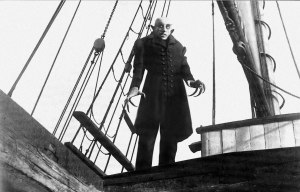
Nosferatu

Interestingly, the report on Newsy shows a Fox News reporter declaring with certainty that no vampires exist. Given the track record of Fox News of catering to causes near and dear to Neo-Con hearts, it is hard to accept that people believing in fairy tales only inhabit the darker regions of the Balkans. No, vampires do not just crave blood. The ancients often believed that they were after reproductive fluids in order to generate more of their kind. A more recent version is the fiend who drains others of their money so that they may live in their remote castles far from the reach of the unwashed populace that has to work for a living. Perhaps we should be envious of those fearing Sava Savanovic—he can be frightened away by garlic and crucifixes, after all. The modern American vampire fears nothing but death and taxes, and the latter they’ve already defeated.


The Last December

December 2012—it is supposedly the last month in the world. Yesterday did dawn with the date being 1212012, but since the local tree farm opened its gates yesterday, my family set out to select a tree anyway. As we wandered amid the pines it was clear that for many the iconic sign of Christmas is the tree. We learned on our first year in New Jersey that you’d better not wait until reasonably close to Christmas to pick out a tree—we visited this very lot then only to discover that precut trees were all that were available (and they were from Pennsylvania) and we had established a tradition of picking our own. Getting to know the tree first. Walking around and looking from all angles, trying to learn if it was healthy or too dry. Were there any gaping gaps that would be an obvious problem? Hard to tell when the tree is wrapped up in fishnet plastic and tucked into a corner like an old umbrella. Here, so close to the Big Apple, you need to claim your tree early. If you don’t want to cut it down right away, you can tag it—claim it as your own and come back later to chop it down. We weren’t the only ones taking great care in selecting.

IMG_0514

Tree farming is a business with a long view. Trees don’t mature overnight. When it’s the last month of the world, one must take these weighty things into consideration. Even before this terminal date, you would need to make an awful lot of money in just one month of the year to keep the business going. Maybe they need a green Christmas. Of course, greenery in winter symbolizes life in the midst of death. The germanic originators of the tradition were keeping a very appropriate pagan idea alive when they dedicated their trees to Christmas. Last year when we couldn’t have a real tree, it felt like we’d lost a friend. Our tree farming friends know that feeling very well.

The “Keep Christ in Christmas” signs and bumper stickers have begun sprouting up in yards and on bumpers in their annual exuberance. Funny thing is, Christmas has its base in ancient pagan customs. To hear the Bible tell it, Jesus’ birth was an understated event. The only people who had an angelic concert were some shepherds (we don’t know how many) on the hills outside of a small town. And, as far was we can tell, it would have probably been in April. As the days grow wearily short, however, we need a little light to keep us going. That was the pagan wisdom behind the Yule Log and various festivals of light to encourage nature to bring some brightness back. These short days can be difficult enough even in the age of artificial light and constantly glowing electronic screens. And knowing this is the last month of the world, we want to festoon our trees with tiny pinpoints of expectation and hope that nature somehow gets the message that we’ve had enough of darkness and wish for a 2013 redolent with light. But we’ll just have to wait and see.