
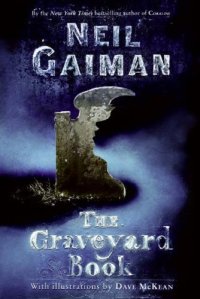
 During an Ancient Near Eastern Religions course a few years back, one of my students commented that something was like “in American Gods.” I suppose my quizzical look betrayed that I wasn’t familiar with the book, and, aghast, he said, “you’ve never heard of Neil Gaiman?” The funny thing about being a professional academic is, if you want to be good at it, there is little time to read. Popular culture is vast; I’ve never even heard of “Gangnam Style.” But I did subsequently read American Gods, and from then on I’ve been picking up Neil Gaiman books as a special treat in my literary diet. A couple years back another friend recommended The Graveyard Book, so I read it over my brief holiday break. It is the time of year for treats. Gaiman’s fantasy worlds, although seldom explicitly deity-populated, tangle the real world with the supernatural—just the juncture where religion emerges. Although defining religion is not as straightforward as looking it up in a dictionary, you can nevertheless feel when you’re in its realm.
Nobody Owens was raised in a graveyard among ghosts. Since science tells us there are no such things, religion steps up to the challenge with suggestions of an afterlife. Whether or not there’s a Heaven or Hell, ghosts partake in that uncanny milieu we call religion. And since this is fantasy, there are other mystical creatures as well. In Bod’s world werewolves are called “Hounds of God” and they are on the good side. Ironically, the only clergy mentioned (along with various political figures) are actually ghouls. The world of the dead involves a religion of its own where an altar and chalice lie deep beneath a special grave and a human sacrifice makes up the climax of the story.
Religion, of course, occurs where the supernatural meets regular people. We dismiss it at our own peril. When Bod attends school his teachers guess he must be from a religious family because he doesn’t have a computer or any electronic devices. Religion eschews such progress. And yet it touches on the real world. I recognized Highgate Cemetery almost from page one. It could be that my own visit there just last year was fresh enough in my mind that Gaiman’s descriptions naturally took over. Or it could be that since I walk that imaginary line that we recognize as religion every day I recognize its more familiar features. Neil Gaiman’s popularity is a testimonial to how we still need the hidden world unexplained by science. We may call it fiction but it is just as real in the human mind as anything in the quantum universe.
 Steve A. Wiggins