Class-less Society

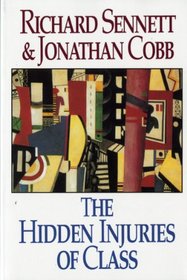
HiddenInjuries Dated, yet still relevant, The Hidden Injuries of Class by Richard Sennett and Jonathan Cobb brings to the limelight that which much of the world wishes to ignore. At least the affluent world. The very concept of “class” has a dangerously tilting effect on human society. That which is “valuable” is only so by common consent, and those who have more of it inevitably raise themselves above those deprived. In a world where food is scarce, bread becomes currency. The trick to any unequal society is declare an arbitrary standard of value that some may horde while others strive to attain it. We are largely content today to work for money we seldom physically see. We are employed at professions assessed by their value to the “owners” of companies who frequently misunderstand that ownership to include the lives of their employees. And that’s just the middle class!

No doubt, living standards for most people have improved in the decades since Sennett and Cobb produced their study, but the base root of the problem still projects out far enough to be tripped over repeatedly—lack of a sense of personal worth. The working poor have always striven for dignity, a sense of worth. I found much in this book that rang true for my personal circumstances. The Hidden Injuries of Class is based on interviews with workers, some of whom “changed classes,” working from blue collar to white collar positions. Validating my experience, the sense of self-worth among those who’d thus advanced did not keep pace with their class expectations. Those of us raised in the working-class world know our place. Yes, we may learn to act like those middle class, and sometimes privileged workers around us, but we know deep down that we came from humble stock. We sit at desks in offices, knowing that we belong behind a broom or holding a shovel. Not a day elapses when I don’t ponder that I’m a drone a little too deep into the hive.

Any society requires those who are willing to do the less-than-desirable jobs. It will take more than reality TV to add dignity to the personal assessment of such workers, however. Although I’m not a TV watcher, the times I view reality programs that highlight the “ordinary people” we come off looking like the unsophisticated rubes of the affluent imagination. Duck hunters may laugh all the way to the bank, but when you’re off camera a different reality, I’m sure, takes hold. We are entertained by the antics of those who don’t know how society folk behave. In my limited experience I went from janitor to academic dean of an Episcopal seminary where Archbishops of Canterbury were not rare visitors. Literal lords of the realm sat at the same dining table that now holds the peanut butter that comprises my lunch each day. I can act polished with the best of them, but I know once they leave I’ll again become the kid who grew up among junk cars and working-class prospects. And I know which is the more authentic life.

Great Caesar’s Cost

College has been on my mind quite a bit lately. Thinking back to my own experience, I chose a school, as a first-generation college student, based on what I knew at the time. It wasn’t much. I chose a school close to home, and safe. A place friendly to, in what I believed to be a world in open hostility to, “Christianity,” by which I meant the conservative, Evangelical variety. The school I settled on, Grove City College, was at the time a selective school. This was the early 1980s and the “Religious Right” was just beginning to appear on the political horizon. Grove City was a Presbyterian college, and the Reformed, although sometimes theologically conservative, have generally been a bit more socially progressive. I recall the admissions numbers being trotted out to the incoming class, about how elite we were (something I’ve always denied and find personally objectionable) at having been admitted to a selective, private enclave such as GCC (“God’s Country Club” as it was locally known). Many of the kids did come from monied families, but I was there on the basis of government subsidized (and unsubsidized, as if I knew the difference) loans.

When my daughter was considering colleges she had been warned about Grove City. One of her friends was contemplating it, but soon wisely cast her thoughts elsewhere. Nevertheless curious, I picked up the Princeton Review’s The Best 376 Colleges, a kind of Bible for the collegiate-bound, to see if my old alma mater rated a mention. Sure enough, Grove City was present. For those wishing to make it in the heartless world of business, it can be a good training ground. What caught my attention, however, was the acceptance rate. According to the 2012 edition, 74% of applicants were admitted. So much for selective! This figure swirled around my gray matter for some months as I started to sort out the implications.

Over the past few decades, Grove City College—which was always conservative—has allied itself closely with the posturing of Tea Party types. Herein lies a true dilemma for the educated bourgeois: how to be intellectually progressive and socially repressed at the same time. To accomplish this difficult trick, a non-negotiable bedrock is required, and since even the earth is spinning crazily on its axis the only true solidity in the universe is religion. Claiming that, despite the 14.5 billion years of this universe’s elapsed lifespan, only one thing never changes and that is a particular interpretation of Scripture, you can go ahead with your science and your arts. But most of all, with your business. Although black holes may exist, and textual criticism may indicate Scripture has its own gray areas after all, nothing counts much at the end of the day if you don’t have capital to back you up. Open admission policies can be interpreted in more than one way, depending on your point of view.

Photo by "the Enlightenment"

Photo by “the Enlightenment”


Hair to the Throne

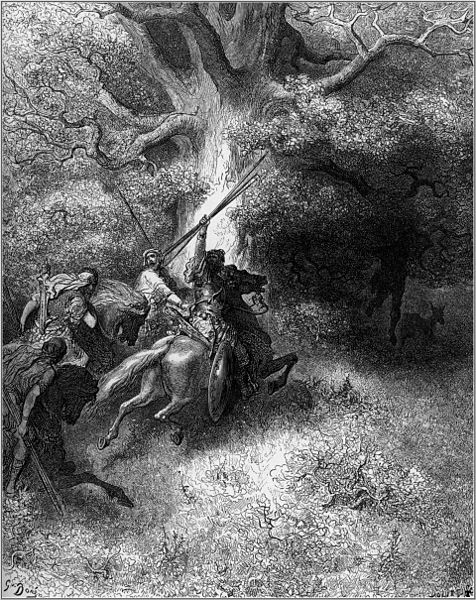
Absalom was the first of the big-hair rock stars. According to the book of 2 Samuel, his hair was so luxuriant that he had it cut once a year and it weighed two hundred shekels (about five pounds, not sterling). This little bit of foreshadowing in 2 Samuel 14 will appear again in the story of Absalom’s demise, as he is caught in a great oak tree by his untrimmed hair. I’ve always related to Absalom on the coiffure issue—I don’t like getting my hair cut. In my more self-analytical moods, I relate it to having stepped on a bee’s nest as a child and having received multiple stings on my bare legs. That horrible buzzing of bees in my ears stayed with me, and whenever the girl at SuperCuts grabs the clippers and the bee-like drone nears my ears I flinch in terror. Like Absalom I have rather an abundance of hair, and so when I’m shorn, it is easily noticeable. I don’t like people to comment on it, however. One of the most banal phrases, not to mention an utter tautology, is when someone smartly observes, “you got a haircut.” With what am I to follow this up? “Yes—I was feeling a bit too much like Absalom in the forest of Ephraim where Joab found him dangling in the tree after David followed the advice of Hushai instead of Ahithophel”?

Gustave_dore_bibel_death_of_absalom

While walking through a mall recently, I commented to a friend how all the stores seemed to be clothing and shoe stores. You never find a bookstore any more, or museum shops, or anything approaching profundity. People really mostly care about what they look like on the outside. I’m more of an interior guy. Not among those generally cast among the hunky, good-looking examples of masculinity, I’m small, bookish, and still wear clothes that I’ve owned for two decades. My hair is usually out of control as well, but not in a fashionable Einsteinian way. I am, I fear, the heir of Absalom.

Religion used to be a source of profundity. It was, once upon a time, the queen of sciences, and philosophy was her handmaid. Seeing the way that religion appears in the media today, however, I’d have to guess she’s been shopping at the mall. Those who measure religion by the cut of her hem rather than by how deep her thoughts may be, have brought her into the limelight of popular culture. She used to be all about the meaning of life and offered a reason for many of us to get out of bed in the morning. Absalom’s trouble started out when he fell in lust with his half-sister Tamar. His addiction to appearances led him to bad decisions that ultimately divided David’s kingdom and cost him his very life. And I guess that’s the price you pay for not getting a haircut on a regular basis.


Grand Delusion

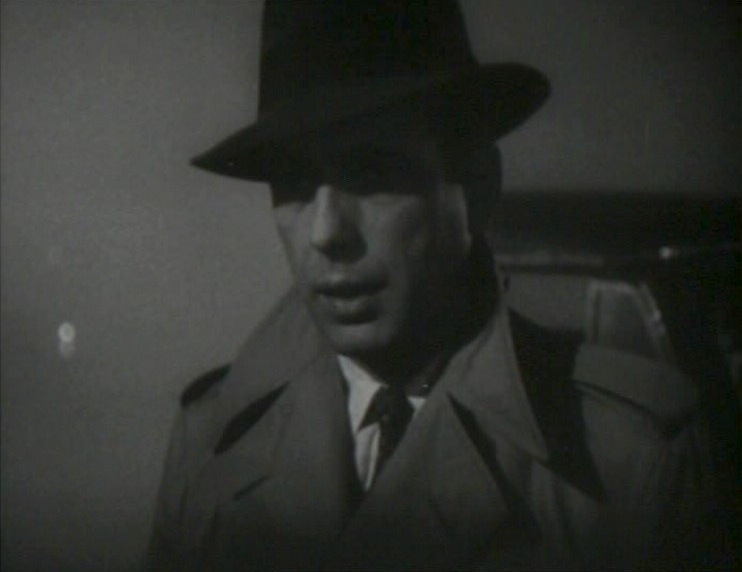
Humphrey_Bogart_in_Casablanca_trailer

“The problems of three little people don’t amount to a hill of beans in this crazy world,” Rick memorably quoted in his once safe haven in Casablanca. Rick had fled his country for moral causes, only to become jaded and callus in an unfeeling universe. So it was with interest that I read the story of the Gastonguay family that my wife pointed out to me. The Gastonguays were stranded at sea when they took their kids and father-in-law and tried to sail away from a US rife with abortions, homosexuality, and “the state-controlled church.” Apart from sailing lessons, and perhaps a primer on US history, the little family had all they needed. They believed that their religion was sufficient to survive on Kiribati, their personal Xanadu, where there aren’t enough people to interfere with free religion. The Gastonguays, however, ran into a series of ocean storms after they set out from San Diego in May, eventually being rescued by a presumably Catholic Venezuelan fishing vessel. Their plane fare home is being footed by the godless government they fled.

Mrs. Gastonguay seems to be the family spokesperson. She notes how the Bible is pretty clear on social issues, according to the story on NBC. I couldn’t help, perhaps a bit naughtily, of thinking of the Bible as well, particularly Ecclesiastes 11.1. “Cast thy bread upon the waters: for thou shalt find it after many days.” That bread may be quite soggy, however, and the government you distrust might just have to bake you some new if you are to eat. I complain about government policies and shenanigans on this blog, but it is because I appreciate the ideals upon which this country was founded. Religious freedom is more or less a reality. Our government doesn’t force you to have abortions or marry a homosexual. School vouchers, which the Gastonguays may appreciate, are about the closest we come to a state-sponsored church.

Shifting genres a bit, I think of the hair band Styx’s hit, “Come Sail Away.” On that mythic journey the unnamed captain sees a gathering of angels swirling about his head. Of course, the angels are really aliens inviting him aboard their starship for an even more dramatic exit from a planet so full of troubles that any good Christian should have trouble sleeping. I can’t say that I don’t dream of escaping every once in a while. The ills that churn my stomach most are a pythonesque capitalism that just won’t let a poor soul breathe free without having to earn an extra greenback or two on the side. If it was up to me, however, I think I’d rather hang with Dennis DeYoung and await the unfolding of the grand illusion. That starship might just be the closest any of us will come to heaven on earth after all.


Misplaced Zealotry

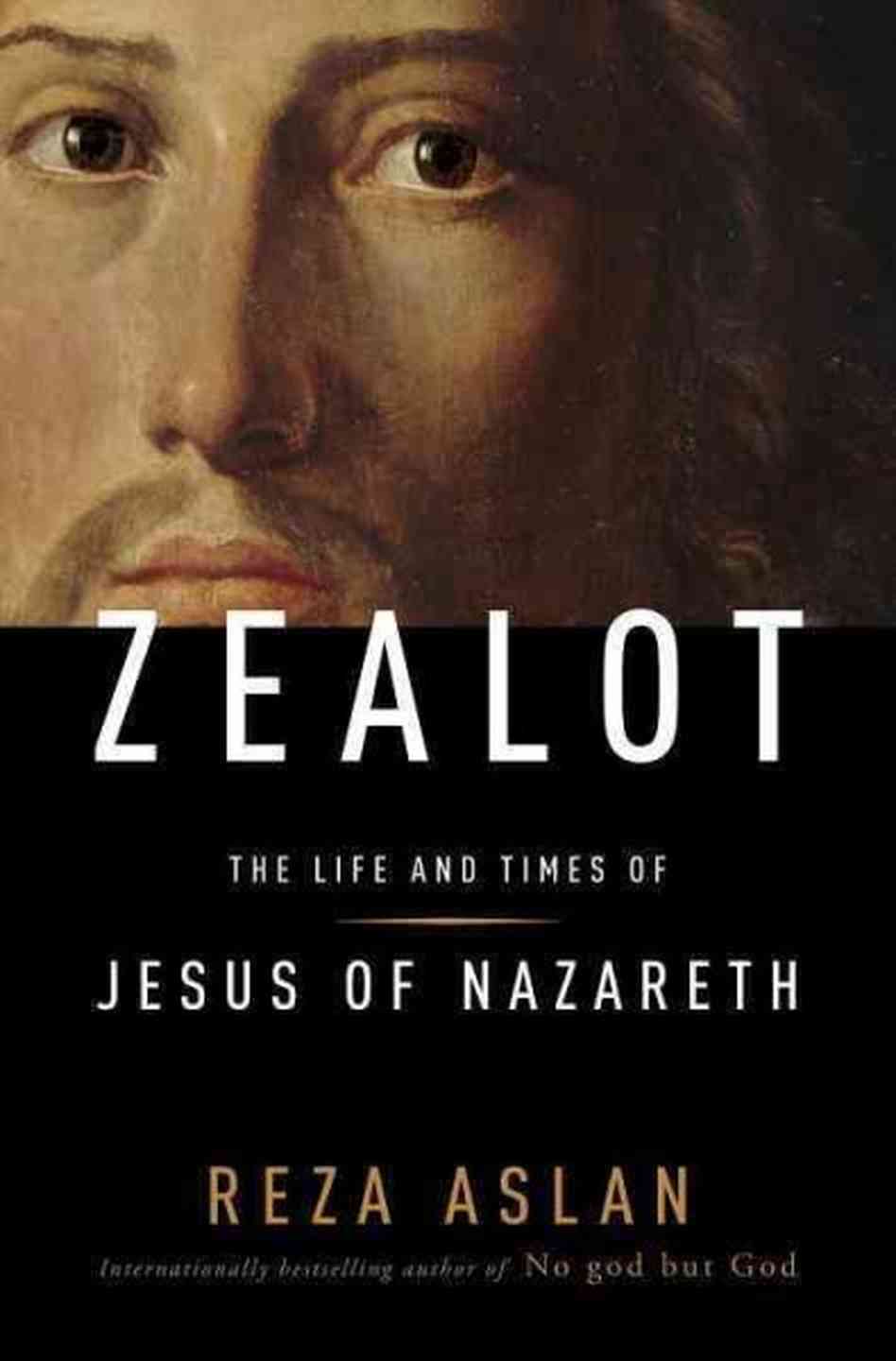
zealotReza Aslan’s book Zealot: The Life and Times of Jesus of Nazareth has brought public interest back to the only begotten, and it’s not even Easter time. A confession: I’ve not read Aslan’s book, so my thoughts here are purely academic. (In a time-honored tradition, I will comment without benefit, or liability, of having actually read.) My interest is, to be frank, less on what Aslan has to say than with how people are reacting to him. Within days of publication, the internet began to swell with news stories about public reaction to Aslan’s treatment. My interest was raised by the Chronicle of Higher Education, where an article by Peter Monaghan quotes Lauren Green of Fox challenging Aslan, “You’re a Muslim, so why did you write a book about the founder of Christianity?” I know this is Fox, and that it is poor form to abuse the idiot, but I couldn’t help but to wonder at such a misguided question.

I would ask, honestly, how many Christians have read a book on Moses or David, or any Hebrew Bible figure, that was written by a Christian. Far fewer hands would be in the air if the same question were framed with the caveat, “written by a Jew.” Every supersessionist religion reserves the right to analyze what has gone before in the light of its own theology. We all know the Moses of Cecil B. DeMille, but how many know the Jeremiah of Abraham Heschel? Do we bother to read what the believer writes about his or her own hero? Would we need to? We already know what the conclusion is going to be. I, for one, am very curious how some Muslims perceive Jesus. That’s always a fascinating question, since Islam, in many parts of the world, superseded Christianity, and has, until recent times, often peacefully coexisted.

Is it not because the author is Muslim that the challenge was issued? How quickly we forget that western civilization (which began in the “Middle East”) owes much to Islam. While Christianity plunged Europe into the Dark Ages, Islamic scholars were rediscovering Aristotle and making genuine progress in science. And yet, we are suspicious of what is discovered by those of “alternative” cultural heritages. I would be more surprised should Muslims show no interest in Jesus. During the past presidential election, many non-Mormons flocked to bookstores (okay, that’s an exaggeration; nobody flocks to bookstores any more, now that Harry Potter is done), eager for books about Latter-Day Saints. Most of them written by non-Mormons. I don’t know what Aslan has to say about Jesus. I suspect some are disconcerted because he bears C. S. Lewis’ code-name for Jesus in the Narnia chronicles, but Aslan may well have something to teach us about ourselves. I, for one, welcome it. How can we ever learn tolerance if we’re unwilling to hear how we appear to others?


And the Band Played

One of the more curvilinear sequences of numerals has taken on demonic attributes over the centuries. Even the most secular of people, at least in the United States, can identify 666 as some kind of bad juju. The more literate among them will be able to pin the origins more precisely to the book of Revelation, often likely as not misnamed “Revelations”—something sure to drive your New Testament professor as mad as a beast. Fans of true precision will surely want to add that it is Revelation 13.17-18 that makes the number infamous. The latter verse starts out with “Here is wisdom,” which already spells disaster, for who doesn’t want to think him or herself wise? 666 is said to be the number of a man, and is conflated with the “mark of the beast”—one of the quickest ways to bring evolution and economics into the discussion. In popular culture 666 is said to be effective in invoking the devil. This idea is not found in the Bible, but it sure makes for an easy way to identify the Prince of Darkness in movies and popular culture.

The other day I received a mysterious email at work from a “Dr. Strangelove” with the email username of “camus666ster.” Indeed, the topic was appropriately apocalyptic and it managed to make it through a pretty strenuous spam-filter. Here was something apparently supernatural during the work-day. I’m also conscious that a building visible from the window behind my desk is 666 Third Avenue, but I’m pretty certain that these two sexagesimal cousins have nothing to do with one another. It is only a certain religious sensibility that brings them together. Where else in the world do authorities have trouble with people stealing roadsigns for route 666? And why do I get the feeling that someone is watching me?

IMG_0696

Revelation may have had more impact on our culture than any other single book. Whether it’s checking your iPhone for the weather, or wondering what is going to happen next in the Middle East, we all want a view into the future. It is a view that some suppose old John saw while exiled on Patmos. Others recognize that Revelation was a thinly veiled contemporary account to give hope to persecuted Christians in an era of imperial violence. Either way, the book, despite some effort to keep it out, ended up having the final say in the Christian canon. In a nation where every person possesses several unique identifiers, we still look over our collective shoulders for an anonymous beast who is about to bring down society. Don’t worry, folks, I’ve got his number.


Fair Country?

One of the lesser known Bruce Springsteen songs is “County Fair.” I hadn’t heard the song until I purchased The Essential Bruce Springsteen some years back when you actually had to buy a disc to get the music. Not a rock-n-roll anthem, it is a quiet, poignant song about the existential pleasures of a county fair. My daughter has been a 4-H member for six years and we’ve annually attended our county fair-the largest free fair east of the Mississippi, it is said-each of those years. In a good year 10,000 people will wander through, looking at farm animals that seem so foreign in our urban lives and which most people only recognize covered in gravy or some glaze. They see the exotic animals and pets so cute that they should be illegal. Like a fledgling college campus there are Arts and Sciences tents. Model planes, model trains, and model automobiles. To a sophisticated adult this might seem like pretty mind-numbing stuff, but I never fail to leave feeling inspired. I play “County Fair” religiously before heading out the door. Yesterday saw the close of the sixty-fifth Somerset County 4-H Fair, and despite the periodic showers, people seemed to be enjoying themselves.

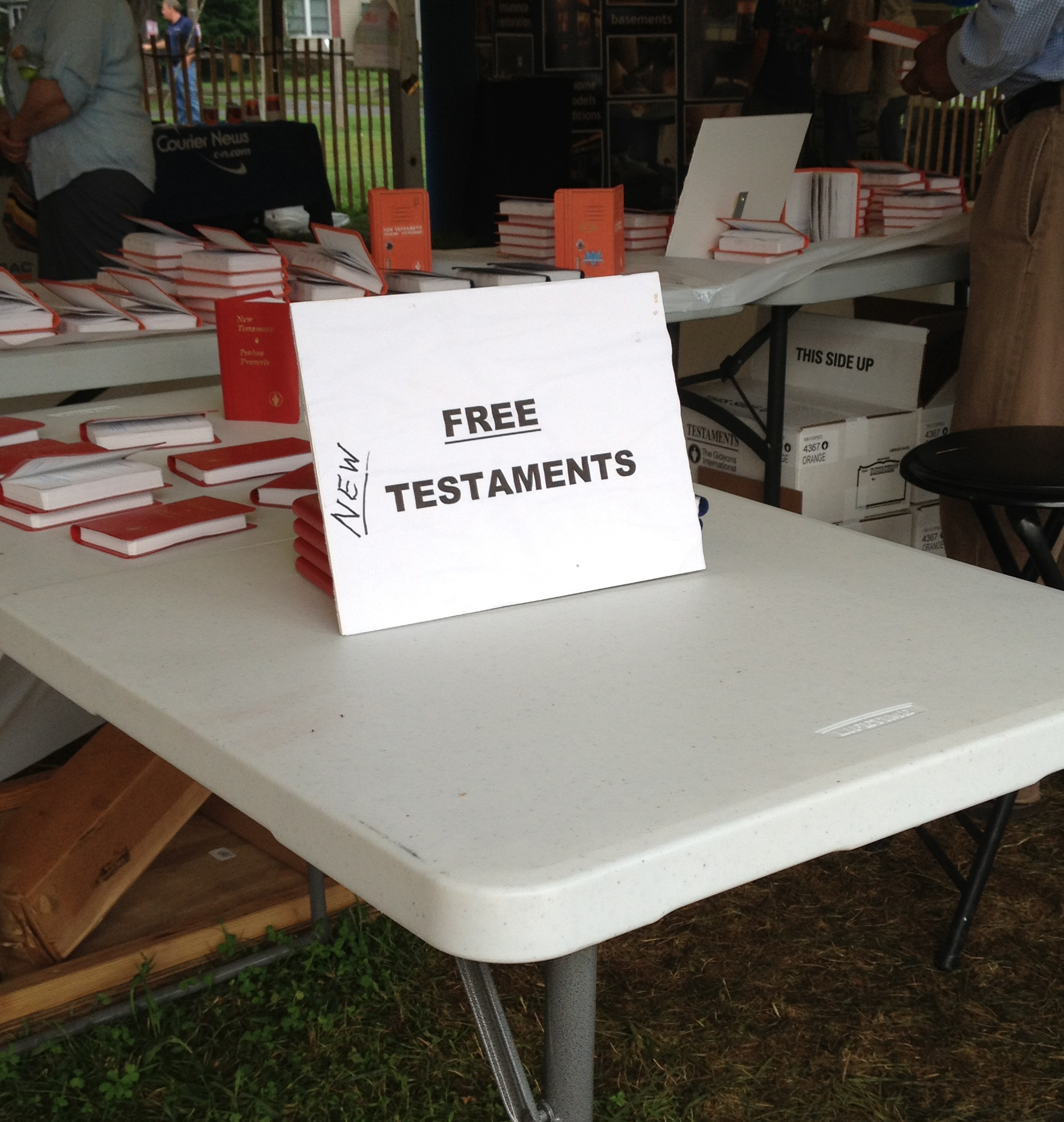
Under the commercial tent stands the Gideons’ table. Each year the fair is literally littered with free Bibles. I noticed with interest that the sign, which had originally read “Free Testaments” had been redacted to “Free New Testaments.” I tried to imagine the conversations, or confrontations that led to such a change. I can’t say for certain, but I suspect Hebrew Bible professors are not among the higher demographics of fair attendees. Most of the colleagues I know would never confront a poor Gideonite about ambiguously handing out New Testaments. I did, however, experience a kind of existential downgrade here. Christians used to declare, doctrinally at least, that the “testaments” were equal. Sure, when you’re standing on the George Washington Bridge trying to decide whether or not to jump, there’s some parts of the older testament that you’d probably be better off not reading. Nevertheless, doesn’t the rule book say the two are part of a whole?

IMG_0922

Nationally, as I well know, there are fewer “Old Testament” jobs than “New Testament.” But that slick little book the Gideons hand out feels a lot more streamlined than the bulky full edition. And I also realize that walking around a relaxing event like a county fair, seeking the most innocent kinds of fun imaginable, that a Bible in your hip pocket is probably overkill. There seems to be no devil lurking here among the sheep and the goats. Feet damp from the rain, under a cloudy, August nighttime sky, sitting in the car my daughter reflects on how this is her last fair as a 4-H member. I wish there were some twinkling stars overhead to make this a storybook ending. But all I’ve got is a truncated Bible in my pocket, and it is missing my favorite part.


The Power of Magic Again

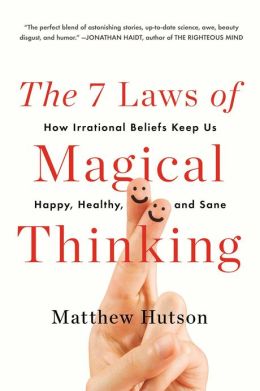
7laws Magic is everywhere. It may not be real (or it just might). There’s no doubt that Matthew Hutson believes the supernatural has nothing to do with it. The 7 Laws of Magical Thinking is a provocative book in that regard. An atheist who argues that we shouldn’t discourage magical thinking because it is so darned human, Hutson is a rare kind of treasure indeed. The 7 Laws of Magical Thinking begins by pointing out that we can’t psychologically accept what is really real. Reality always eludes us. Our brains are hardwired to accept what Hutson calls magic (including what I call religion). Those who enjoy provocation can take some satisfaction in knowing that either side can add another layer to the shell: physics explains everything, but maybe magic is responsible for making the universe conform to the laws of physics. And so it goes.

Although I enjoyed Hutson’s book–and he’s clearly a gifted writer—I couldn’t help but wonder at a very deep parity between the determinism he believes is really real and the magical view that is implied by such self-help manifestos as The Secret—the things that happen to you are meant to happen. I know, I know—Hutson’s point is that there’s no agency involved in determinism, but my point is that the end result is still the same. You end up where you are. I’m not so sure. Determinism has always left me cold. But since I’m no God I guess I can’t change that, yet I wonder if there might not be something outside this closed system after all. No one can peek and tell.

Neurology may tell us more than we want to know about the mechanics of the brain, but consciousness is reality. Science may some day lay its cold hands on consciousness, but it will always be someone else peering into my head wondering what I’m thinking. I’d have it no other way. I was strangely cheered to note that Hutson ends his whimsical study with a “stab at a secular spirituality” (a good stab, that is—not the malicious kind). I’m sure that many materialists will find such an a gesture as pandering to the masses. I think Hutson is sincere, however. Even the über-rationalists, as he points out in the book, slip into magical thinking and metaphors. It is the human condition. Those who watch Star Trek (original series, please!) know that the most tormented crew member of the Enterprise is Mr. Spock. The rationalist who can’t connect with emotion is a soul in torment. Even if that soul is a myth. The rest of the crew, I am certain, believes in the power of magic.


Where Angels Drink

Moving water is an impressive erosive force. When I have the opportunity to visit family in the western United States, we generally visit a cold, meltwater stream in the mountains where numerous circular cavities dot the resistant granite and basalt that make up the main exposed rock of the mountains. These cavities are nearly perfectly round, and can be quite deep. They are formed by pebbles and other sediment settling in natural depressions in the rock and being swirled around as the waters gush down the mountain. Over the millennia, the swirls grow into deeper holes, trapping the pebbles that will act as a natural drill, cutting away the circular depression as they are roiled around by the endless flow of water. Some of these potholes can grow quite large, but the ones I generally see have the diameter of perhaps a basketball, and are only about a cubit deep. They are young potholes.

At least that’s what I used to believe. The last time I was in the mountains, some younger members of the wider family were there. They came back from visiting the exact same creek that I had the day before, reporting that they’d seen the angels’ drinking cups. Excited in the way that only kids can be, they chattered on about the potholes and quickly moved on to other diversions. My mind, however, was fixated at the geologic phenomenon I had just seen. More precisely, I was amazed at how a religious explanation had come to account for a well understood aspect of nature. The previous day I had explained to my daughter the forces of nature that had carved these curiosities quite without angels. I had witnessed a kind of mythopoeia: the birth of a myth. The children probably did not make up this name, but I had never before heard it.

A very large pothole from Wikicommons (in Finland)

A very large pothole from Wikicommons (in Finland)

When potholes grow very large they are sometimes called the more secular giant’s cauldrons or giant’s kettles. When we see something in nature that appears to be intelligently designed, the mind naturally moves to the realm of the mythical. We don’t believe in giants any more, but angels are somewhat commonplace in the repertoire of supernatural creatures taken seriously. Surveys continually show that many Americans believe in angels, whether guardian or garden variety. Many people claim to have seen them. I can’t make that boast myself, but I now have a suspicion of where I might look to find angels. Particularly if it is a hot night in the mountains, I will, I’m sure, find them at their favorite watering holes.


Five Man Electrical Band

I grew up looking for signs. If you sincerely believe the Fundamentalist worldview, then we are all part of a great, divine dramaturgy in which we have expected roles to fulfill. The script (Holy Scripture) is a little vague on the individual details, but if you know where to look you can find signs. They may be obvious and literal or subtle and ambiguous. The faithful, however, know they must seek them out and take their chances. I grew up in a decidedly blue-collar world. In my head, though, it felt like I was meant for something more. My career ambition was to be a janitor, but my reading and the counsel I received from those who knew more than I did suggested I might have a higher calling. The concept was unfamiliar at first, but compelling. I had to be able to read the signs. I remember hearing about seminary for the first time. If I was going to be a preacher, I had to go to seminary. The summer before starting college, I sat on the dilapidated front porch of my step-father’s house and taught myself to draw the Greek alphabet. Signs were rare, but when spotted, definitive.

Seminary came to define my existence in a way that I couldn’t foresee. I started college with the idea that, all things being equal, I’d end up at seminary. Still, I was drawn to the life of a faculty member in a liberal arts setting. Eventually, I recognized it as my calling. Getting to seminary proved more difficult than I’d imagined. It wasn’t the grades—it was the expenses. I was in debt and I knew that bank barons did not forgive us ours as we forgave others theirs. In seminary, signs came to take on differing interpretations. Maybe I was correct about ministry or maybe not. Looking closely, I could see that the script had marginal notes, and that it wasn’t even the original manuscript after all. I’d learned original languages only to become more confused about the signs. When I left seminary I knew one thing for certain—I didn’t ever want to teach in one.

My first professional job, of course, was teaching in a seminary. It was not a matter of free choice as much as free economy in free-fall. In the early ’90’s recession, jobs were few and signs completely distorted. When impolitely asked to leave my seminary position after a decade and a half, I was type-cast as a bit-player. The washed-up seminary teacher. I began to see signs along the highway for seminaries trying to recruit potential clergy. This was no longer a calling, but a job option. Don’t enjoy the rat race? Why not try opting out? The pay won’t be as good, and society will come to despise the very doctrines you’ll be taught, but at least it’s a living. I still see such signs. And I’m still not sure if I’m reading correctly. And even today, I notice with appreciation when a floor is expertly stripped, cleaned, and waxed.

IMG_0723


Resurrinception

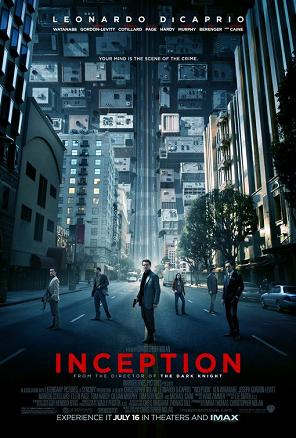
Inception_ver3Like most profound movies, Inception keeps me coming back repeatedly. I’ve already written a post on how the Theseus and minotaur myth lurk deep within the labyrinths of this film, but upon my most recent viewing a new angle caught my attention. In the first level down into Fischer’s dream, when Saito is unexpectedly shot, Eames asks Cobb, “What happens when we die?” It could be the question of a child faced with a dead pet for the first time. Of course, Eames refers to death in a dream under sedation, and limbo is the closest thing to spiritual death that a person can experience. The timing of that question, however, triggered in my head the number of resurrections that take place in the movie. I have frequently noted here that resurrection is a standard part of the tool kit for western movies, particularly American ones. We expect resurrection. So, finally, three layers down, a dream within a dream within a dream (even Poe would be proud), Saito dies. He is lost in limbo.

Limbo is a fuzzy theological construct thought up by the church for those who don’t deserve Heaven, or Hell, or even Purgatory. Some, it seems, end up in limbo. In Inception limbo is unconstructed sub-conscious, an area even Freud would fear to tread. Saito dies and goes to limbo. Fischer, meanwhile, also ends up in limbo because Mal shoots him dead in the third-level dream. Mal is already in limbo because she killed herself in real life—or was it a dream? Cobb, of course, must die to return to limbo to retrieve Saito so that he won’t be arrested when the plane lands. In limbo, three of the four escape, riding the kick back up to consciousness. Only after baptism in the first level dream, when the van plunges into the river, do the lost souls emerge. What happens after we die? Resurrection.

I’m not suggesting that Christopher Nolan planted a Christian idea in the viewers’ subconscious mind. Resurrection is part and parcel of our culture. Perhaps, however, this helps to explain the durability of some religious concepts. We long for resurrection on such a deep—maybe subconscious—level that we want to see it on the big screen. Even ghosts, we’re told, haunt because of unfinished business. It is Saito, the Japanese business mogul, however, who undergoes the most resurrections. He dies in the van underwater, in the fortified mountain hospital, and in limbo (perhaps in the elevator as well, but this is uncertain). His is a regular reincarnation of resurrections. Inception, I’m sure, will keep me coming back for more. One of the questions that none of us escapes while alive, is that uttered at the level of the dream.


Treasure Hunting

It is raining in Midtown. On my lunch hour I’m in a deserted public square down on my knees with an umbrella over my head. My free hand is reaching under a piece of outdoor furniture feeling for something. At least this one is not located in the private regions of a metallic stag. What in the world am I doing here?

One of my sometime passions is Geocaching. Many years ago we started this as a family activity but with schedules changing and families being forced apart by work and school, I’ve taken to caching alone. For those not familiar with Geocaching, you many not be aware that in millions of places around the world tiny containers are hidden from view. There is likely one not too far from you. They are listed on different websites, but Geocaching.com is the main source. You set up a free account, get ahold of a GPS device and go looking. Some of the containers have goodies for the kids, while others are very, very small and your only reward is signing your name and logging the find online. As a family we found nearly 400 caches over the years. Since I spend my days in Manhattan I’ve been urban caching. Urban caches are very small and stealth must be used because those who don’t know about Geocaching who find the containers often take them, not realizing that they have a purpose. So that’s why I’m on my knees in the rain in the middle of New York City.

I raise Geocaching as a topic because of a recent article on NBC about Scouting. Girl and Boy Scouts often know about Geocaching. This is similar to what used to be called (probably still is) orienteering—learning how to find your way around. The NBC story, however, focuses on a different kind of finding your way around. Over the past several years, non-faith-based alternatives to the Scouts have been enjoying some measure of success. Not that Girl or Boy Scouts are explicitly Christian, but they did emerge from that social context. The article specifically cites the Spiral Scouts, a Wiccan-based group, as well as several secular, and even some overtly faith-based alternatives. Yes, it looks like many groups, regardless of religion, want to get kids used to the great outdoors.

DSCN2484

Some might fear that alternative movements signal a rend in the social fabric. I think the social fabric ought to be more like a quilt. If sewn properly, a quilt is just as functional as whole cloth, but much more interesting to look at. Girls, boys, gays, straights, Christians, Pagans, Jews, Buddhists, Muslims, Hindus—what is wrong with that? I think that after being out in the rain, I might just curl up under a quilt when I get home, and I’ll be thankful for all the diversity I see comforting me under the gray skies.


By Jove!

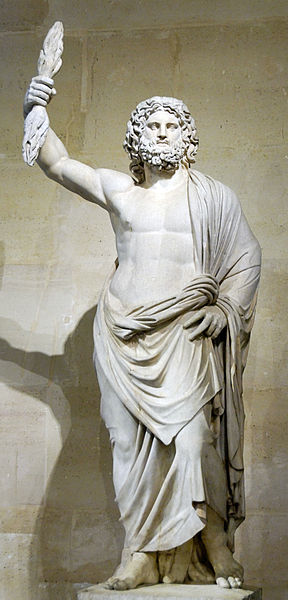
When Zeus is taken seriously in the New York Times, even the open minded scratch their heads. It’s not because any of us really believe Zeus is up their hurling thunderbolts, but because anyone would even dare raise the question. Yes, Gary Gutting’s Opinionator article is lighthearted and perhaps even a little cynical, but it does raise serious questions. Did our ancestors believe in the gods with no “proof”? I can’t help but think of the phenomenally expensive video, I Still Worship Zeus. There are, in this day of high technology and low tolerance for non-scientific outlooks, people who continue to believe in Zeus. Well, his name does come from the same root as the old Indo-European word that gives us the Latin Deus, or “God.” And, let’s face it, the stories of the Greek gods can be pretty cool (despite sub-par big screen renditions). But to take any of this seriously…Seriously?

Jupiter_Smyrna_Louvre_Ma13

As Gutting points out, some of the great minds of Greek science didn’t question the existence of Zeus. I certainly wouldn’t care to pit my puny wit against that of Plato. Those scientifically minded Greeks, apparently, believed in the gods because of their explanatory value. Too many coincidences and synchronicities and epiphanies suggest something more than meets the eye. We don’t see gods today, so Gutting asks how we know the world hasn’t changed. Now, I take uniformitarianism seriously. It is the basis for geology and much of evolution. Our old, old earth shows no evidence of a sudden change in the way things happen. What is malleable is human interpretation. As recently as a century ago, belief in some kind of divine world was very pervasive. Only in the past few decades—since World War Two, I would guess—has the premise of the Judeo-Christian god become suspect. The daily experience of living in a world where theodicy just can’t explain all the suffering has led us to a kind of stalemate with the gods.

I once had a scholarly exchange with a colleague over the nature of the word “evidence.” Our little tiff was published in the Journal for the Study of the Old Testament. My colleague had suggested that Yahweh—the god of Israel—was considered a solar deity. I averred that evidence did not exist. With rejoinder and riposte, we had to agree to disagree. The evidence I was seeking was stringent, but as we all know, absence of evidence is not evidence of absence. And that is the point that Gutting makes, whether seriously or not. The question is not “Is Zeus there?” but “Was Zeus there?”. I decline to offer an opinion. I do applaud the New York Times, however, for attempting to get us thinking about serious issues once again. If Zeus did exist, then it behooves us to consider all the implications. And perhaps to reconsider home-owners’ insurance in a world where gods may roam at large.


Gnostic Agnostic

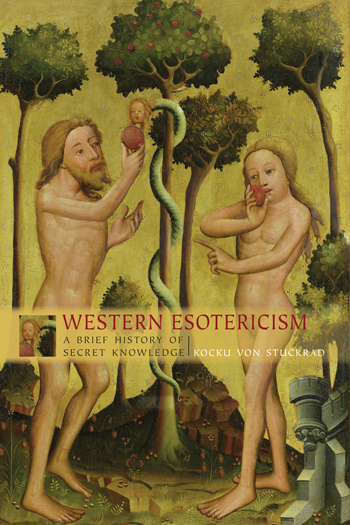
ACU-Stuckrad-WesternEsotericism-COVER.indd Hidden knowledge is sweet. Belief in it is very old. Kocku von Stuckrad’s Western Esotericism: A Brief History of Secret Knowledge offers its own kind of hidden knowledge—well, it’s not so much hidden as it is simply ignored—that even science owes a debt of gratitude to the draw of the esoteric. We are trained to treat such “New Age” ideas with contempt from our tender years, and we are assured that the light of reason has dispelled the gloom of occluded wisdom. Von Stuckrad, however, clearly demonstrates that the desire to explain our world streams from the same font as the belief that a larger, if hidden, reality lies behind what our senses perceive. Such ideas originate in antiquity and continue in various forms up to the present. The impetus to explain it all shows in Galileo’s belief in astrology as well as astronomy and Newton’s fascination with alchemy as well as calculus. Great minds have always been willing to be stretched.

In more recent, and self-assured, days vocal spokes-folk have declared a single way of knowing, and it is empirical and imperial all at the same time. That which cannot be explained rationally cannot be explained at all. Still, our experience of life often suggests otherwise. Sometimes it feels as if science overuses the coincidence excuse, and maybe there is something more going on. The esoteric, without fail, has been assigned to the category of religious thought because, in the current paradigm, the only real opponent to science is religion. If it’s irrational, it must be religious.

Ironically, von Stuckrad’s research demonstrates that the culture that led us to science, in many ways, has its basis in esoteric beliefs. That gnawing suspicion that not everything is explained by numbers and experiments has been with us since the days of Gobekli Tepe, the pyramids, and Stonehenge. Each of these monuments (and many others besides) were astounding feats of engineering—and engineering is applied science—while all being profoundly religious. Science in the service of the unknown. Such complexity need not be considered naive; even scientists can be subject to religious ways of thinking. Von Stuckrad does not advocate esotericism in his book; he merely documents it and treats it non-judgmentally. There is perhaps a hidden lesson here for all of us as well. Instead of declaring a single heavyweight champion of all the world, perhaps true wisdom lies in being fully human with all its complexity and contradictions.


God in the Shops

Over the past few weeks, as I’ve been out and about, I’ve been noticing the way that the divine has been utilized by shop-keepers. In a culture where incipient religion is so pervasive, it seems that God is treated much like the NSA in some quarters—always watching, always vigilant. I popped into a shop selling locally made items (I try to support the local economy when I’ve got a greenback or two to spare, although that is rare), where I saw a sign reading “Shoplifting & Theft Will Be Judged By God.” The sentiment gave me pause. Deeply embedded in our society is the idea that without a divine mall cop, we would all run amok with crime. Although religion is pervasive in the world, much of it is non-deistic, and yet highly moral (particularly in east Asian nations). Their cultures have advanced, even beyond western culture in many aspects of technology, and yet gods (and specifically our God) do not figure into the ethical equation. Pillage and plunder do not seem to erupt when God is not in the shop.

IMG_0903

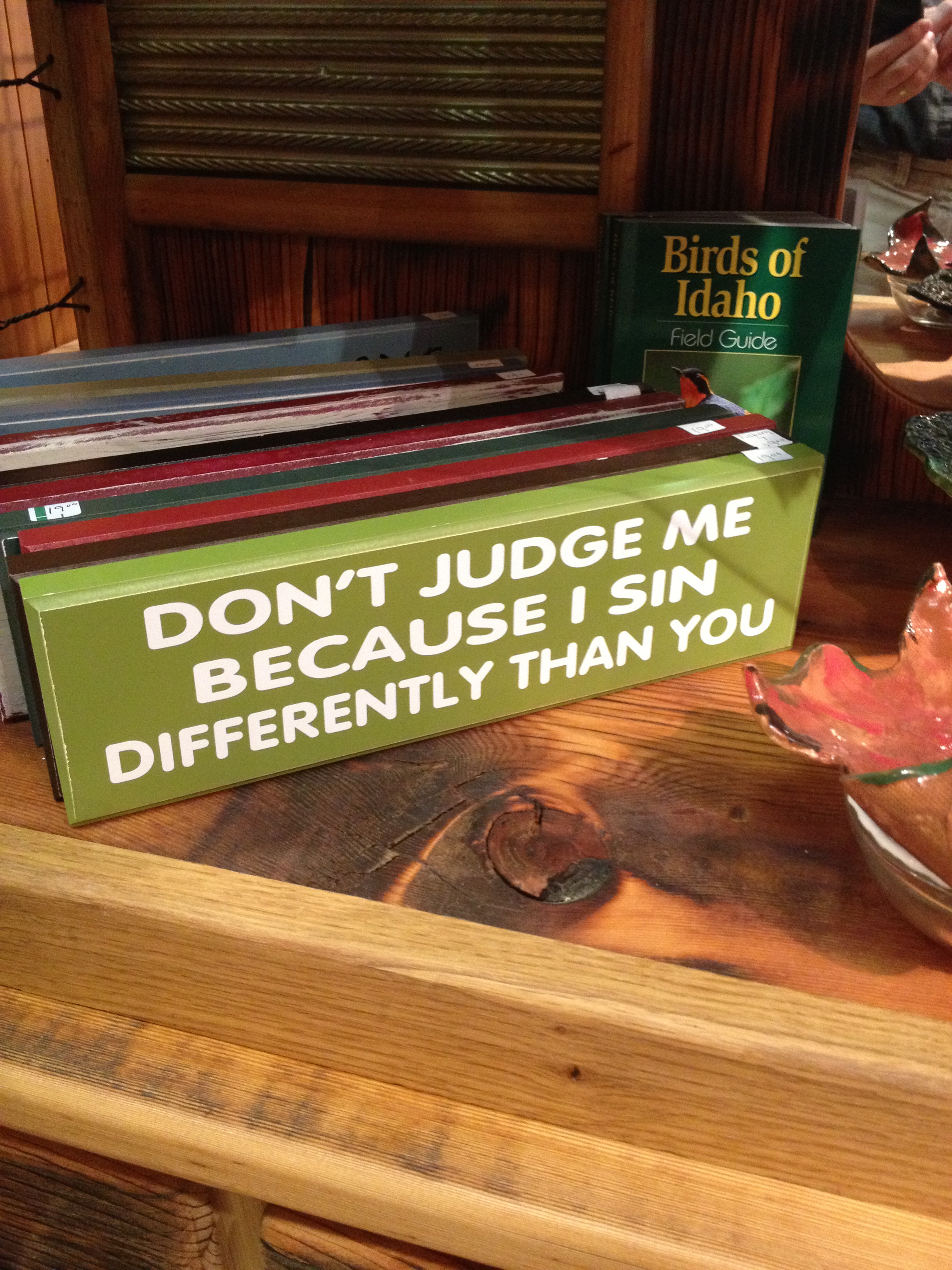
Whimsical signs have been popular decorative items for decades now. The problem with whimsy is that it loses its effectiveness once the initial chuckle is over. Signs reading “no pain, no gain” in fitness clubs may inspire day after day (although I have my doubts), but the cute warning that “the dog is crazy” on your doormat fails to impress after the first reading. (It must be pretty obvious that I don’t entertain much.) Nevertheless, shops stock those impulse-buy signs that are clever and witty, if soon outdated. I found one the other day reading, “Don’t judge me because I sin differently than you.” Even with the strains of self-righteousness, there is valid thought here. When the woman caught in adultery was brought before Jesus, he said, “Let the one without sin throw the first stone.” This disputed passage is one of the most pertinent in all of Scripture. No stones flew.

IMG_0909

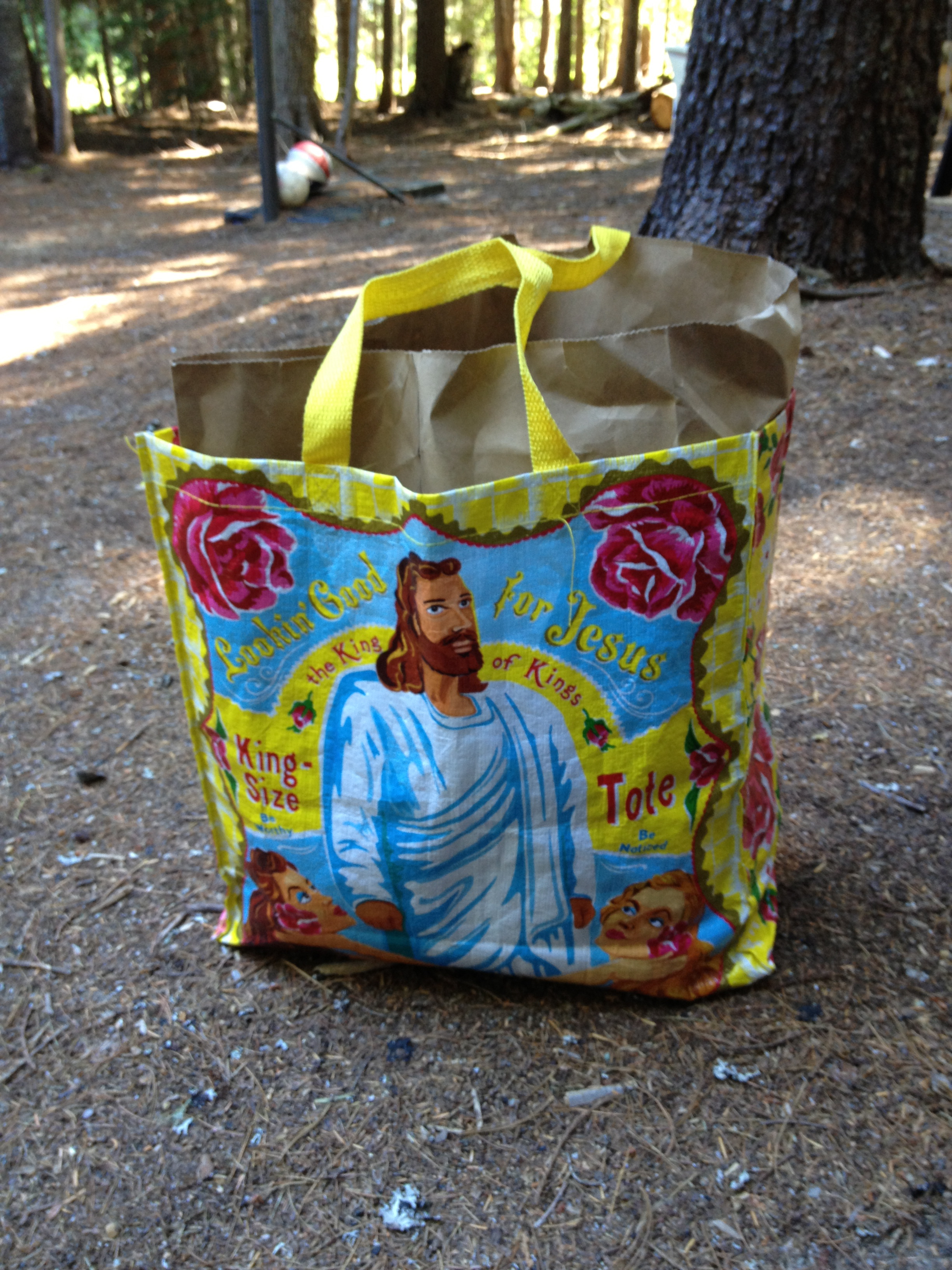
Finally, a friend came in bearing a shopping bag with Jesus on it. “Lookin’ good for Jesus, the King of Kings, King-size Tote” it read. The bag was clearly designed with a heavy dose of irony. I couldn’t help but notice that the bag was full of bottled gas. This portable version of the only begotten is a reminder of how commercial our religion has truly become. Although clearly presented with tongue distending cheek, we know that, as I tried to convince many at Gorgias Press, Sects Sells. People will buy cute knock-offs of their deities. In Wisconsin we used to visit Holy Hill, a Carmelite shrine where all manner of sacred kitsch lined the walls, from glow-in-the-dark rosaries to cheap, plastic saviors. The shop was never empty. Perhaps it is possible to worship both God and mammon after all.

IMG_0908