The Problem with Love

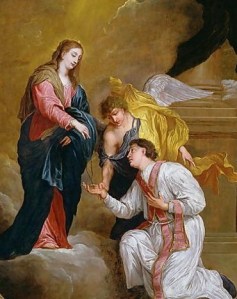
As far as we can tell, historically there is no Saint Valentine that is particularly connected to February 14. Even if there were, it is difficult to imagine a saint promoting what we know as love. Love is a slippery topic. The ancient Greeks (who did not marry for love) were so perplexed that they came up with three different words for it, and the nascent Christian community tended to prefer agape-type love. Love that expresses well-being for the community and has little to do with the physical attraction that people everywhere find so compelling. It is safe to say that Christianity has always been uncomfortable with the kind of love that Valentines Day celebrates. The holiday, because of its associations, has often been removed from the liturgical calendar a time or two. People are already prone to express their biological urges, so it is best not to give them an excuse, sanctioned by the church.

This is an odd situation, thinking love is wrong, or at best, tolerated. As far as we can tell, the earliest Christians had no particular concerns in this way. We can’t measure, of course, how people loved their spouses, but there was nothing inherent in the new religion to suggest physical attraction was bad. By the time Paul of Tarsus started writing his letters a couple of decades after Jesus’ life, at the earliest, some doubts had crept in. They seem to have been largely personal. We know little of Paul’s life, but we are aware that he saw the kind of love known as eros to be a problem. Concession had to be made to those who couldn’t control themselves, but otherwise, in good stoic fashion, love was to be ignored. By the time of Augustine of Hippo, some three centuries later, sex passed on original sin and love had become decidedly dark.
St-Valentine-Kneeling-In-Supplication

Attitudes change with time, of course. After two millennia a certain practicality sets in. We have moved through the troubadours and courtly love to psychology and deep human needs. Arranged marriages are, for the most part, considered like shackles from the past. And love, that feeling that we never completely outgrow, is believed to be a positive thing. Saint Valentine (and there were at least two of them) would likely have disagreed. While the Romans celebrated sexuality, they also believed in restraint most of the time. Valentines Day, however, still has something to teach us. Despite the commercialization of the holiday, in a world with a surplus of hatred, any kind of love is, as long as it’s mutual, is worth celebrating.
The Price of Academic Publishing

During seminary, I believe it was, a professor once told those of us in class, “You don’t get rich in academic publishing.” As the author of a widely used class resource, he added, “unless you write a textbook.” Both sides of his observation are true. I work with many young scholars who haven’t published as much as I have and I have to “manage expectations.” No, that monograph will not become a bestseller. Libraries will buy it, and, statistically, a few hundred people will read it. For those who play the more lucrative game of being acknowledged experts, however, cash can be freely flowing. The public is hungry for authentic information on religion. Despite what we’re told in the media, people are very curious about the truth.

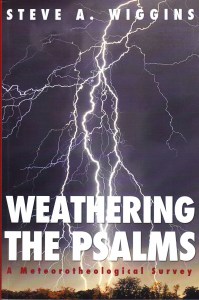
My own academic career ended before I could crank out all the books I’ve got in my head. You have to reach a certain stage of academia before that begins to happen. I’ve been working on my writing in the meantime, and I think I might be able to reach that crossover crowd that writes for non-professionals. I’m not sure I’ll have the time, but the ideas and, I hope, the skills are there. This all came back to me when preparing my taxes. One of the truly religious certainties of this world, taxes are, I know, for the common good. At least in theory. I never complain about them. Preparing them is a different story. My little book, Weathering the Psalms, followed the typical academic course of being largely ignored. I received a small royalty check for it. I wished I hadn’t. You see, I use TurboTax to file my return because someone with as simple an economic life as I have finds hiring a professional superfluous and, ahem, not cost effective. We don’t own a house or any capital. We just hope we’ve paid enough to get a little back in the spring.

WeatheringThePsalms

Then I came on the 1099 for my meager book royalties. (They were in the double digits, just to give you an idea.) I tried to enter it into TurboTax. Uh-oh. That kind of income requires a separate form. “Congratulations,” the screen said, “on earning money from your freelance business.” That can’t be good. It turns out I had to purchase an add-on for TurboTax to handle this new tax scenario. The add-on, literally, costs more than the amount of royalties. Technically, then, I lost money on the publication of my latest book. Those are the harsh realities of academic publishing. An abstract publisher contacted me a few days later—would I like to do the abstract of my own book? Why not? I’ve paid for it. If I ever get back into academe I’m going to write books people will want to read. In the meantime, I write them to contribute to the tax base. At least academically.


Universal Universities

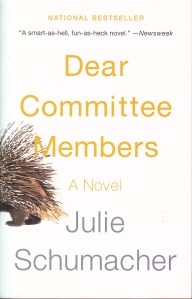
DearCommitteeHaving been in academia for nearly two decades, and having watched from the sidelines ever since being benched, I found Dear Committee Members a little too true to life. This novel by Julie Schumacher is presented as a series of letters of recommendation by an embattled English professor at Payne University. Set over the course of an academic year, the reader watches as the fictional university eviscerates the humanities to make the life of more “practical” departments like Economics much more comfortable. Sarcastic, bitter, and full of pathos, the novel is frequently funny, but it runs so true to life that it would be difficult to say whether it is indeed fiction or not. The book was a national bestseller, but universities continue down this very road, with all seriousness.

I have said before: it is time for those of us who really believe in education to take on, challenge, and overthrow this paradigm. Education is not about making money. There is more to life than that. My reading, which coalesces somewhat coincidentally around these themes (Dear Committee Members was recommended to me by a bookseller that I don’t know personally), paints a larger picture that is disturbing. The capitalist economy is growing out of control, its own dictates now excluding human decision (see my post on At the Altar of Wall Street earlier this week), and one of its strongest investors is higher education. It is a business, you see. The utter and complete devotion to the economy cannot take place without new generations of students indoctrinated into money as the meaning of life. Some of us—many of us—disagree, but we are not organized and we have no funding. We are the human resistance.

Setting out to make money was never my goal in entering the professorate. Motivated by finding authentic meaning in life, I have found that those departments where such a search resides—religion, philosophy, English, music, the arts—are under siege and constantly have to justify their existence to the administration. Dear Committee Members is funny in its overstatement, and in having a protagonist actually say what many of us think. And thinking is what it is all about. Education is about learning to think. Not earning a mint. We are in need of an altar call. The only ones with power to take back education from corporations are people. Who’s willing to join the cause with me? At this point I’d even be willing to consider sympathetic robots.


Faith for Sale

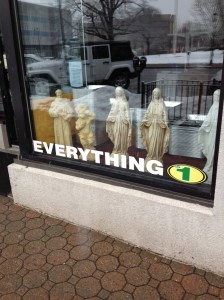
Materialism can be defined in a number of different ways. One of the more common is that people desire material things. We want stuff. Now, we all need things to survive. My sympathies are always with the poor for whom each decision can be a potential tragedy. Spend too much on something and you may not have enough left to purchase something you need. As people, though, we all long for nice things. So it is that places like dollar stores exist. The dollar store is not the same as the “five and dimes” with which I grew up. The latter stocked things that were, in large measure, practical. Things you might need: pencils, string, soap. A dollar store, however, may lead you down a different path. A lot can be had for a dollar. Some of it may seem to promise more than it can deliver.

IMG_2670

My wife sent me a photo of a dollar store where the window was lined with what appears to be religious statuary. I’d be lying if I weren’t to admit that my first impulse was to go and purchase some cheap salvation. I’m sure the statues aren’t made of stone. I’m not even Catholic, so I’m not sure a one-dollar Mary would help with much of anything. Still, it is something to buy. Something material. Something that seems to make promises beyond itself. Here is the danger of the dollar store. It’s only a dollar!

Every now and again I play with this thought-experiment: if I knew that I would only survive one more year, what would I buy? Many things seem superfluous in the face of eternity. Would material comforts, or larks, do anything more than depreciate the little I would leave to others? That game tends to show materialism in a rather crass light. What do I really need to buy? We all have our weaknesses, for sure, but it can’t hurt once in a while to think that the material is just that: material. And we might have a very different set of values if we didn’t measure worth in terms of material gain. Faux-stone Mary would likely back me up on that.


Commitment

Marriage is a human institution. As those who invented it, we should be able to define it. Biology may not help here, since animals become mating pairs in many different ways. Besides, we’re selective in our application of science to the question. Not only that, human views of marriage have changed quite a bit over time, and the practice of marriage is still not uniform today. Back in biblical times, for example, polygamy was more or less normal. Marriages were arranged for tactical and economic reasons, and bonding for love had, one can only guess, very little to do with it. It was practical, pragmatic, and of use to the state. Prior to that, if the evidence is to be believed, “marriage” was a communal practice among groups of maybe 150 individuals. The purpose was the same: social harmony and cooperation.

An article on The Wild Hunt has me thinking about this again. (And you thought I was going to be discussing gay marriage, didn’t you?) According to a recent piece by Christina Harrington, handfasting, the marriage among pagan communities, has now been legally recognized in England and Wales. As far as we can tell, again delving back to the Bible, marriage was not considered a religious matter in antiquity. Part of life, it was handled by families who were witnesses to the promises made. Over time, various religious bodies came to give their blessings to people pledged to each other. In fact, for some religions marriage is perhaps the most important sacrament. Once this happened, however, dominant religions became jealous of their right to declare a marriage binding or not. Even as a child I remember a stigma attached to a merely civil wedding. It is, however, the state the declares a marriage binding.

Photo credit: the ShahMai Network (from WikiMedia Commons)

Photo credit: the ShahMai Network (from WikiMedia Commons)

Marriage is a convenient method to sort out tax statuses among genders with earning disparities. A government has no interest in whether a couple marries for love or not. Even gender doesn’t really matter. Can you tick that “married” box on your tax form or not? So it is that recognizing handfasting is likely, on some level, politically expedient. Meanwhile, those who marry for love have the added benefit of being with someone they chose and having a friend at hand. Tax season is upon us. Valentines Day will soon be here. And in some parts of the world the government is catching up with the times and realizing that marriage is what people make it.


The Bottom Line

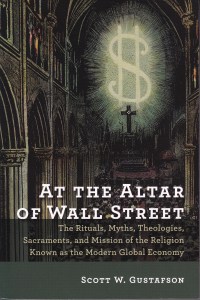
AltarWallStUnderstanding, or even caring about, economics has been one of my abiding weaknesses. I suppose growing up poor, excess money was a foreign concept—at least on a quotidian basis—the possibility of acquiring much of it remote. The poor know their place. Still, I was intrigued by Scott W. Gustafson’s At the Altar of Wall Street: The Rituals, Myths, Theologies, Sacraments, and Mission of the Religion Known as the Modern Global Economy. It has turned out to be one of those very important books that could be world-changing, if enough people read it. The basic idea is simple enough: Economics is a religion. Immediately many people will put the book down. Economics may be the dismal science, but at least it’s a science, right? Not so. Not completely. While economics uses scientific principles (as does theology), it is a belief system based on an underlying myth that has pushed us to the place where the rich are far too rich and we’re convinced that the plight of the poor is simply a reality with which we must live. It’s all based on a myth of barter.

There are places I quibble with Gustafson, but he makes a very compelling case that the Global Economy, through a series of historically discernible steps, has come to be money making money for money’s sake. As he clearly demonstrates, developments in stock trading have made this an enterprise where people are completely left out of the equation and understanding what has happened impossible. As long as money has been made, the Economy is happy. This way of thinking, which is de rigueur for business schools and presidential wannabes, believes with the conviction of an evangelical that as long as money circulates everything will be fine. Those who believe this walk down Fifth Avenue with blinders on.

Step by step Gustafson demonstrates that Economics has all the trappings of any religion: a priesthood, mythology, rites and rituals, and an overarching theology. And this belief structure, like that of many religions, persecutes heretics. Indeed, human sacrifice is an innate part of this religion called Economy. It has sent missionaries out to the far reaches of the world to convert other ways of living to that of the Global Economy. And in this religion, it is safe to say, those who make it to Heaven are remarkably few. This book does offer potential solutions. They are solutions the wealthy and powerful will not like, so they are probably not going to be enacted any time soon, if at all. So while the rest of us are standing in line at the soup kitchen, I would suggest some reading that will make far more sense than you think it might. At the Altar of Wall Street could change the world for the better, if the Economy allows it.


Grim Where?

An inordinate amount of my childhood time was spent on television. While the device of the day had been around for a decade already, I was among those who grew up learning that watching was easier than reading. Like most children, I took the path of least resistance. I watched. As a teen, however, I rediscovered reading and from that time television began to take a back seat to books. When the great switch-over to digital occurred we didn’t get a conversion box, and we could never really afford cable for as little TV as we watch. When a program gets commended, or if nostalgia takes too great a toll, we can always purchase programs—the price of watching television without the commercials. So it was that I began watching Sleepy Hollow. Very quickly in the first season the monster of the week trope was established as the plot grew more and more tangled. The Bible was so prominent in that season that I wrote an academic paper on it.

Sleepy_Hollow_-_Title_Card

Over the past few months my wife and I have been working through season two. The DVD version was delayed and we only watch on weekends. Recently we finished the eighteen episodes of the second installment. Clearly the budget had improved over the first season, but the Bible, it was also clear, had diminished. Throughout the first season the driving motif of the story was that biblical “prophecy” (from the book of Revelation) was unfolding in Sleepy Hollow. This is what one scholar has termed a “local apocalypse.” Throughout season two, however, the end of days is shut down. Molech, its architect, is killed. The headless horseman is less Death than a jilted lover. The second horseman, War, loses his armor and dies.

Magic, however, along with special effects, take on an increased roles. Instead of turning to the Bible to solve problems, the most helpful book to have on hand is a grimoire. Sleepy Hollow, which is anything but what its name suggests, is full of monsters. Powerful magic is required to contain them, and, it seems, the Bible is no longer needed as a tool to take down evil. Perhaps there is a parable at work here. I was drawn into the series by its biblical literacy, as well as its literacy in general. More action has been introduced, and fewer books. It’s a pattern I’ve seen before. I suspect I’ll watch season three presently. When I do I’ll be casting a wistful eye on the stack of books I have yet to read, and I’ll be wondering if reading may not have become easier than watching.


Act of Balance

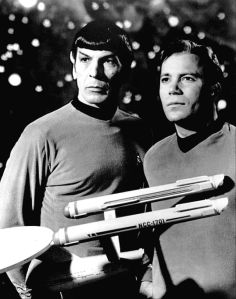
They call it the green-eyed monster. Jealousy. Under its weightier name of envy, it becomes a deadly sin. I often wonder if envy isn’t behind the debate that seems to have atheists and believers in religion talking past one another. Each seems to want, it appears to me, what the other has. Atheism has emerged in this new century as the current brand of intellectualism. Those who rely on reason alone don’t require comforting ideas such as God or salvation to get along in a world that has learnable rules and no magic. On the other hand, as an article by Barbara J. King on NPR points out, some religionists (Alister McGrath, while good for illustrative purposes, may not be the most representative choice) insist that atheists miss out on the meaning of life. Goal-oriented behavior, which we all understand, in a traditional monotheistic context is a divine mandate. We want to get to a better place either here on earth or after we die, and God has given a set of rules to follow to enable us to get there. Along the way, nature veritably drips with the dewy beauty with which God has infused the universe. Those Mr. Spocks among us miss it all, for their non-nonsense approach to reality.

Leonard_Nimoy_William_Shatner_Star_Trek_1968

It’s pretty clear, as I’ve traced it out here, that the believers envy the reputation of solid rationality readily claimed by scientists. We all would like to be able to prove we’re right. Pointing to a law of physics and declaring, “this law can never be broken” carries a satisfaction that is rare in the theological world. Still, I wonder if some atheists aren’t just a little jealous of the teleology of having a goal set by someone else. Heaven and Hell may be passé, but you have to admit that having challenging rules laid out is somewhat invigorating. Doing something because you “should” can infuse a sense of meaning into life. Some people, if they could just do what they wanted, would opt for no more than eating, sleeping, and meeting biological necessities. They sometimes claim religion gives them the motivation to do more. It can make a difference if a deity takes the initiative.

You’ll never, however, be able to prove a religious point empirically. Gravity pulls things downward as surely as sparks fly upward. And we can send a person into space to prove it’s true. No astronauts, as far as we can prove, have ever seen God in space (RIP, Edgar). Reason and emotion, religion and science, thought and action—these things need each other in order for a balanced life. Problems arise, it seems to me, if we take an extreme position. Life is complicated, and simple answers just don’t apply. Perhaps if we allowed for a bit more balance, we might all find life just a bit more satisfying.


Steel Pennies

409px-CasablancaPoster-Gold

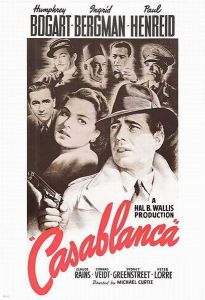
I remember seeing my first steel penny. At first I didn’t think it was real. Like many poor kids, I was a collector. I collected anything cheap: cancelled stamps, bottle tops from glass pop bottles, fossils, just to name a few free trinkets. And I’d started coin collecting, with pennies. I’d noticed the difference between wheat backs and Lincoln Memorial pennies, and I knew that the former might be worth something some day. There was a hobby store in town and by thumbing through the collectors’ books, before being shooed out, I’d learned that keeping an eye out for wheaties was a kind of investment. Just hold onto it long enough, and it’ll grow in value. I never saw a 1943 penny, though, until a fellow collector traded me one. During the war, he explained, copper was too valuable to use for pennies. Wartime, it turns out, changes lots of things. About the same time as these steel pennies were being minted, Casablanca was still showing in theaters.

As I sat down to watch Casablanca again last night, some new thoughts occurred to me. A wary eye can spot the cost-cutting measures of a wartime movie. Somethings never change. Nazis were bad guys, obviously, but we still didn’t know who’d win the war by then. And refugees flooded to Casablanca to try to escape Europe for America. The movie makes quite a lot of this endless waiting. It’s hot in the desert. People are waiting to go somewhere better. And there are elements of torture there as corrupt officials cooperate with Nazis, even though this is Free France. It occurred to me that this is an allegory of Purgatory. I’m pretty sure it’s not intentional, but here are lost souls waiting for deliverance. The plane to Lisbon is the soul’s escape to Heaven. Meanwhile the relentless waiting.

For a movie approaching 75 years old, Casablanca holds up remarkably well. The extras on our DVD tell us the plane in the final scenes is a cheap cutout just a few feet away on a sound stage. The mechanics attending it are little people to bring it into perspective. Tucked away in some box somewhere I’ve got a few steel pennies. These days coins change so frequently that I wonder just how stable this world really is. While the “Middle East” still has us as worried as ever, our money is, for all practical purposes, only virtual. Paychecks are mere electrons and I’m just a temporary repository between my employer and those who claim increasingly more of my pretend money. We seem to be caught between two worlds. In one nothing is really real at all. Rick’s Café Americain feels somehow very familiar, as we spend our time waiting for passage on a plane to Lisbon.


Gallows Hill

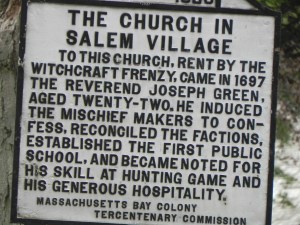
Over the past couple of weeks it has been in the news that the site of the “witch” hangings in Salem, Massachusetts has been identified. The actual site had long been suspected, and it was only recently confirmed by a group of historians using the empirical evidence available to historians. Although my interest in the Salem trials pre-dated my wife, nothing brings you so close to history as being a part of it. Descended from the brother of three of the women accused of being witches at Salem, my wife brings a sense of reality to the tragic accusations of three centuries ago. Although toyed about in the media (an episode of Sleepy Hollow, “Spellcaster,” in season two, featured an actual Salem witch) the fact is that nineteen innocent people were executed for a fanciful belief that the Devil was roaming about New England, and when you can’t catch the Devil, you have to use a scapegoat.

DSCN0518

One of those investigating the location of Gallows Hill was Benjamin Ray of the University of Virginia. I’m sure Professor Ray wouldn’t remember me, but one day as I was doing a campus visit for Routledge, I had taken AmTrak to Charlottesville to visit the religion department. Many of the faculty declined to see me, and as I sat on a bench in the hall (one of my academic dates had stood me up), Dr. Ray walked up to me and asked me if he could help. I explained who I was and he invited me to his office where we talked about Salem. I told him was wife was related to Rebecca Nurse, Mary Eastey and Sarah Cloyce, the two former, as he knew, executed for an imaginary crime, and the third accused. A strange quiet settled over the office. He told me his interest began because he too had descended from a Salem family. His ancestor, however, had been an accuser rather than a victim. It was a strange rapprochement. Opposite sides brought together in scholarship.

What truly frightens me about Salem is that we have not outgrown it. Presidential hopefuls spew the same fear and hatred toward Muslims, the hispanic immigrants who make our economy possible, and women (this should sound familiar) trying to “take the place of” men. And the crowds cheer, as crowds will do. Even though Donald Trump cussed twice in his Liberty University speech (an infraction for which a student would have to pay), President Jerry Falwell, Jr. (typing that makes me shudder) shrugged it off saying that we’re all sinners. Some sinners, however, carry a wicked, knotted rope with them while other sinners try to eke out a living in a nation where some can get rich by owning casinos while others frantically spend their inadequate cash hoping to win Powerball. We now know where innocent people accused of witchcraft died, but have we learned anything from it over these past three centuries?


What Do Sheep Know?

We trust those we see in the media. You see, those who have the longest reach can bring in the most advertising dollars and therefore must have a wisdom the rest of us lack. The cult of celebrity is perhaps the truest cult of all. Don’t get me wrong, I like reading books by bestselling authors once in a while, and I like movies by talented directors and writers. The problem with the cult of celebrity that it often confuses fame with knowledge. If someone knows how to get you to pull your wallet out, they must know about all kinds of things, right? It stands to reason. A recent article in The Guardian features an interview with Ridley Scott. Forever in my mind typecast as the director of Blade Runner and Alien, I think of Scott as one who understands science fiction. He, of course, gave us a version of Exodus that many didn’t buy, and now that The Martian has been gaining attention, people are once again wondering what they might learn from the director.

Blade_Runner_poster

Ironically, like the recently late David Bowie, Scott considers himself an agnostic. As the Guardian article says, that doesn’t stop him from having a lot to say about God. Catherine Shoard notes that religious questioning runs throughout Scott’s movies. The big issues, it seems, still matter. People will crowd to his movies and perhaps not even know that they were facing the questions that motivate people like Scott. Taking up such questions in the hopes of making a career out of it all is still not a wise choice, but if you can put it in fiction without people knowing it, you might become famous.

I’ve always been of the opinion that everyone is an expert when it comes to religion. Believer or not, everyone knows what to believe and is pretty certain about it. The people I find most fascinating in this mix are those who dare to question. While many doctrinaire religions call questioners “doubters” and suggest curiosity is some kind of sin, there are both religious and non who face the world with questions rather than answers. To me, this seems a more honest approach to things. The funny thing about this appreciation is that it is seldom reciprocal. Of course, people might be interested if I’d directed a block-buster movie or if I were a star. Until that happens, I’m an expert just like everybody else.


Digging to Look up

Ancient technology is a growing field of interest. A couple years back I gave a talk about ancient technology at a local Steampunk convention. The smallish audience that attended had lots of questions about how ancient people accomplished marvels such as the Antikythera Mechanism, or even the pyramids of Egypt. As new discoveries continue to show, our antique forebears had access to knowledge we have always assumed to be beyond them. An article in Gizmodo tells the story of how Matthieu Ossendrijver, an astroarchaeologist (and hey, this was simply not a job description I ever found in a college catalog, for the record!) at Humboldt University, has been studying an Akkadian clay tablet (the article doesn’t specify which one, beyond “text A”) that demonstrates that the Babylonians understood one of the principles that led to calculus. Tracking the movement of Jupiter, the Babylonian priests knew that measuring the area under a curve could provide the distance traveled by an object. This principle, in the annals of science, wasn’t discovered until about 1350, C.E. Babylonians knew it over a thousand years earlier.

Jupiter_and_its_shrunken_Great_Red_Spot

Although we marvel at the engineering of the ancients, we tend to think of them as superstitious. After all, they believed in gods and things like that. As Maddie Stone points out in her article, however, priests were also astronomers. Believing that messages from the gods existed among the stars, peoples of ancient times kept careful track of the heavens. Apart from romantic couples looking for time alone, how many people spend an evening under the stars, looking up at a universe that is so much larger than the internet that it can actually made you shudder? There is a wonder out there that can’t be replicated electronically. People knew that the sky and the gods somehow belonged together, and they knew this millennia ago.

Given that many of us hold doctorates in reading ancient, dead languages (too many, perhaps), you’d think all the clay tablets found would’ve been read, catalogued, and neatly stacked away by now. This is far from the truth. Tens of thousands of tablets were excavated back in the days before archaeology became an endangered practice in places like Iraq and Syria. Crates full of these tablets were shipped to museums and few have been transcribed, let alone translated. There is ancient knowledge stored away among the receipts and chronicles and myths of people who lived in the cradle of civilization, and now that information remains buried in museum basements because it is deemed not worth the money spent to provide jobs for those who can read them. As is often the case, however, when we are willing to listen to others, even long dead, we are amazed at what we can discover.


Not Your Father’s Demon

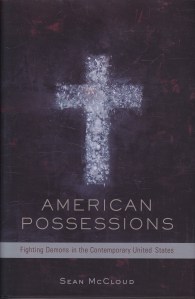
AmericanPossRegan MacNeil is a name that can still send shudders up and down stout spines. Despite advances in CGI and special effects, The Exorcist is consistently rated among the scariest movies of all time. Demon possession, clearly, is a very troubling thing. American Possessions, by Sean McCloud, is not a place to go to find Catholic priests expelling the forces of darkness. Subtitled Fighting Demons in the Contemporary United States, the book, one might suspect, is saying more than it seems to be letting on. This is a book about Third Wave evangelicalism and its demon-fighting manuals. Although the term “Third Wave” may be unfamiliar, the next time you go to a Tea Party you’ll know you’re among them. These born again uber-capitalists believe in a literal demonic world. In fact, demons are so common that Jesus would’ve had a hard time keeping up with their exponential economic growth. These demons are more frightening than those that possessed Regan. The are more akin to a different Reagan.

Especially popular among Pentecostals (the fastest growing form of Christianity) this modern day belief in demons sees them in places Jesus didn’t think to look. Family curses (at places ruled out in the Bible, but still, apparently, possible), addiction, depression, sexual urges—these are all demonic. And once these modern demons are cast out, unlike that of Regan, they can come back. And if they don’t possess you they will oppress you. And they can live in your material goods, your house, and even the land it is built upon. They are everywhere, and they have to be fought against constantly. They also, apparently, vote Republican.

This view of the world, strange as it is to many people with a basic education in science, motivates a large sector of the United States population. Expelling these demons requires a specific view of Christianity—a view that absolutely excludes Catholics. And it is a view that promotes free market economics, blaming the victims of poverty for allowing themselves to be oppressed by demons. Many aspects to this belief system will strike the reader as completely unbelievable, all the more for being so seriously believed. At the same time, we are told, we should pay no attention to religion, at least as educated people. The problem with this is that these true believers vote. And the kingdom they would have come on earth is, in a way they would certainly deny, possessed.


Yopp

My fellow academics, lend me your ear. Two or three friends have sent me articles this past week, featuring academics speaking out against the businessification of academia. I’ve been railing about this for years, and I am encouraged by my fellow academics who are looking up from their research long enough to realize they live in a crumbling, if ivory, tower. Too long and too often academics have taken the road of least resistance. Jobs may be rare, but hey, I’ve got one, so who’s to complain? It is tres chic not to believe in anything these days, but I am now, and have always been, a believer in education. And education is not something that can be bought or sold. Higher education is not a business, and if society insists on replacing university presidents with CEOs, then it is time for those of us who believe in education to unite and form our own forums to educate. It won’t pay as well. You might have to skip an academic conference or two, but if we really believe, we can make a difference.

I’m not finger-pointing here. I know that when I had an academic post, such as it was, I wasn’t particularly motivated to suggest that a new model was needed. But now that adjuncts and those of us who are underemployed Ph.D.s outnumber our tenured brethren and sistren, it is time for us to begin talking about alternatives. Once a university becomes a money-making machine there’s no turning back. Too many people love money too much for there to be enough integrity for a president to say, “No, I don’t need a raise. Hire more faculty instead.” Those academics who believe it will happen need to get out more. Although the most educated people in a given society, academics can also be among its most naive. If you can’t join them, beat them. (Metaphorically, of course.)

My education, in many ways, began with Dr. Seuss. We couldn’t afford the books, growing up, but we had television—especially the poor have television. I remember watching, anxious with encouragement, as JoJo sets aside his yo-yo to lend his voice to a cause. His lone “Yopp” saves an entire world. My fellow academics, those with ears like Horton are rare. His species of elephant (let those with ears to hear, hear) may be extinct. I am suggesting right here, right now, that we get together and start working on a solution. This is my Yopp. I shall not, however, be surprised if my inbox fails to light up. The temperature, I know, is already rising. And Whoville, as always, will make itself available for purchase to the highest bidder. I believe it can be different.

IMG_2582