:-D

Screen Shot 2016-06-12 at 8.33.16 AM

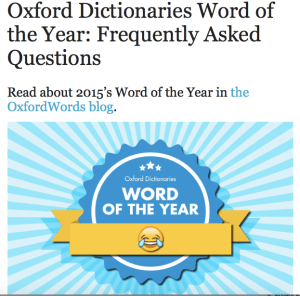
Technology runs amok. I confess to being born before earthlings landed on the moon. I remember a world where Purelle boogers simply did not exist. A time when to read the Bible meant opening that black leather with gilt edges that suggested some unknown bovine had paid the ultimate price to wrap those red-lettered words. Then came the LOL Cats Bible. The Lego Bible. Now the Emoji Bible. Emojis are made possible by the demand of cell phone users to express that which otherwise requires considerable wordsmithing. They’re popular. So much so that Oxford Dictionaries’ word of the year is the unpronounceable 😂. I’m not even sure if you’ll see it on your screen. If not, imagine a yellow circle laughing until it cries. Or crying until it laughs. There’s some ambiguity there. In any case, bibleemoji.com offers to translate your favorite Bible verses into emojis.

A naughty little boy, I suspects, lurks inside many of us of my particular gender. So I opened a new tab and went to biblegateway.com. There I looked up Ezekiel 23.20, in the King James, of course, and copied and pasted it. The results were somewhat 😒. “4 she doted upon their paramours, whose flesh is as the flesh of asses, & whose issue is like the issue of 🐴s.” I don’t know about you, but I see several missed opportunities there. A picture, they say, is worth a thousand 📚. Is there an emoji for “words”? Can there be? I’m trying hard to keep within my word quota here, so please bear with me.

I’m hoping against hope that unicode has kept up with my puerile fascination with rebus writing. It seems likely that all writing began that way. Draw a picture of what you mean and, with a little luck, others will understand. The capital A, for example, represents the head of an ox. It’s easier to see if you flip it upside-down. Better yet, just write it this way: 🐮. The ancient Egyptians, one gets the impression, would’ve been proud. After all, we call their labor-intensive communication system hieroglyphics, or “sacred writing.” It was inevitable that what some consider holy writ would eventually come down to the lowest common denominator. Still, I’m somewhat disappointed. When I dragged my mind to more lofty verses all I found were simple textual changes to my requests. Perhaps it’s for the best. When I tried “Jesus wept” I got “jesus wept” rather than the expected 😭. 😦

The Lure of the Dark Side

I have to confess that the easy self-publishing of ebooks is a real temptation sometimes. Perhaps it’s one of those inexplicable side-effects of earning a Ph.D., but sometimes you have the impression you have something to say and traditional publishers just don’t agree. In my work life I see many clever ideas that, well, let’s be frank, just won’t sell. Publishers do have to keep an eye on whether a book can earn back the money put into it, and sometimes a good idea leads to no cash payout. So when you can easily sign up online—you don’t even have to talk to anyone—and post your unedited words right on Amazon and call it a book, well, anyone can be an author. So I was looking up books with the terms “Bible” and “America” on Amazon when I came up with Donald Trump in the Bible Code. I found the self-designed cover frightening, and the sentiments expressed in the description grounds for terror. Then I noticed it was only 15 pages long. I’ve written student evaluations that were longer than that.

Trump

At three bucks, that’s—wait while I get my calculator—twenty cents a page. Now anyone who’s been able to read the original Bible Code and not cover a snicker or two will possibly find such a jeremiad palatable. After all, it’s a book! Somebody published it. Well, actually, all you need for self-publishing is an internet connection and at least one finger to type and click. Or a toe. You too can become an expert! No education required. Publishing fiction in such a format is one thing, but when people can’t tell a prestige publisher from a vanity press when it comes to factual material, we’re all in trouble.

There’s an old saying: “those who can’t do, teach.” I think I first came across this wisdom in a Peanuts cartoon, with all the gravitas that such implies. Editors, it seems, are not required for publishing. In fact, some of us who live by the word seem destined to die by the word. Even with connections I have trouble getting my ideas published. More than once I’ve lingered on Amazon’s CreateSpace page with my finger hovering over the mouse. Publication is one click away and some people make six digits a year publishing only on Amazon. Since I produce about 145,000 words a year on this blog alone (apart from my other writing), the urge is very strong at times. Then I look at that cover and I stay my finger as it hovers. I’ll wait a little longer. At least until November.


New World Witches

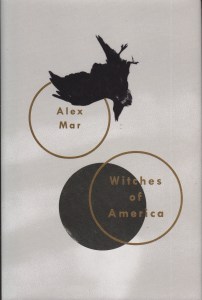
MarWitchOne of the most coveted phenomena in the publishing world is the bad review. Controversy sells a book like nothing else. It wasn’t because of the controversy, however, that I read Alex Mar’s Witches of America. Looking back, I wasn’t even sure of what to expect. Witches can mean many things and there is little one can do, beyond reading the blurbs and summaries (and who has time for that?) to know beforehand what a book’s really about. I like books about witches, so I just read it. I soon found myself engrossed in a spiritual memoir. Perhaps even more than books on witches, I’m drawn to women’s experience of religion. Many such accounts have haunted me over the years, but Mar’s story was different than most I’ve read. Women often write of escaping intolerant, priapic religions of a conservative stripe. Mar may be the first account I’ve read of a spiritual seeking becoming part of modern paganism.

The negative reviews largely focus on what they perceive as a false bill of goods. A woman passing herself off as an authentic seeker just to write a book that violates confidences. As a writer, and as someone who knows authors, I was a little taken aback at this. Those who know writers know they’re disruptive personalities. They look at things differently than most other people do. More than that, their experiences are subjective and must be explained in that vein. Some reviewers claim Mar was just wanting to write a book. Writers know that books write the authors. Spiritual experience is notoriously difficult to capture in words. I’ve read plenty of books about modern witchcraft, including the balanced, academic titles everyone commends. Mar was able, however, to explain the lure far better by taking a personal approach.

There are inherent dangers to sharing your innermost experiences. Other people are involved and honest perceptions will sometimes hurt. A writer finds it difficult to hold back. Spiritual experiences are something complex, multilayered, and scandalous. Often I was told, as an undergraduate at a conservative Christian college, that mystical experiences were to be avoided. They are powerful, frightening, and addictive. I can’t say if Mar violated any confidences, but it seems to me that the portraits she paints of witches are complimentary, and generally feel heartfelt. Then again, Christianity has been analyzed seven ways to Sunday, so it may feel like violation if a religion is still largely secretive. Were it not for the negative reviews, I would’ve never guessed that I’d read anything more shocking than the spiritual memoir that offers other ways of looking at what we think we already know. Oh, and did I mention the book was about witches?


Commander in Heaven

I pity the nation that doesn’t have divine founders. Origin myths help to orient our thoughts about where we belong in the order of things. Given enough time, any national founder will become a god. When a friend recently shared a blog post about Gogmagog, I had to dust a few cobwebs from my memory to place the mythic founding of Britain. During our years in Scotland my wife and I read about the heritage of the British Isles, according to bards before the Bard. Bede, Geoffrey, and the anonymous author(s) of the Mabinogion. Long before the Romans arrived on those islands, there had been gods, demons, and giants. The Medieval writers, of course, were drawing from the Bible. Gog and Magog are figures from Ezekiel, borrowed by Revelation. Sacred writ says enough about them only to make them mysterious. Their combined role in British myth makes one think they might be giants.

The founding of Israel, of course, is treated as history by many. I don’t mean the recent founding of the political state, but rather the biblical version of things. Moses leading the Israelites out of an oppressive Egypt, miraculously through divided waters. Foundation myths are that way. We can watch the process unfolding, even after just a few centuries. George Washington’s literal apotheosis is virtually certain. Even Alexander Hamilton experienced an unlikely resurrection when he was in danger of being removed from the ten-dollar bill. For nations to thrive this kind of transformation must take place.

6082318543_90e9752777_o

This is perhaps easier on states whose origins are lost in antiquity. There was nobody there to see the general fall off his horse or the commander in chief inhale. This was what folklorists call illud tempus, the time of events unlike those of today. Quotidian time has become profane—just look at the headlines if you don’t believe me. Those who are gods today are only those who make themselves so. We can see it happening all the time, if we pay attention. The implications should give us pause, when we consider those we think of as heroes or giants. Time makes gods. And it is just possible that we might be better off without a pantheon so terribly large.


Avoiding Ritual

IMG_0100

While on my current British kick—not really intentional, but sometimes life gives you limes—I thought I’d mention another piece sent to me by a friend. This one falls under BBC Earth, and it’s about “Why Ancient Brits threw out their most valuable possessions.” You can find the story by Amanda Ruggeri at the link. The basics are pretty simple: some people with a metal detector discovered what turned out to be a Bronze Age “hoard” in Lincolnshire. You have to understand that, in a way that makes me totally jealous, the United Kingdom has tonnes of ancient artefacts still undiscovered. While my wife and I lived there it wasn’t unusual to read about such finds in the newspaper. (Newspapers still existed then.) People had been smelting in the British Isles for a long time. The Phoenicians actually popped round the pub to get their tin—which can be one of the main ingredients for Bronze. What the article somewhat embarrassingly addresses is the nature of the hoard.

Hoards are where a large number of (usually metal) objects are discovered, after having been deliberately buried. These are not uncommon, what with Phoenicians, Romans, Angles, Saxons, Franks, Vikings, and others invading all the time. The issue that embarrasses is the “r word.” Ritual. While we don’t know the reason, the fact that people deliberately deep-sixed their valuables, routinely, suggests a ritual. As the article makes clear, professionals try to avoid the r word. Ironically, such deliberate burials, often with items purposefully broken, is also known from the ancient Levant, often predating the hoards of the prehistoric UK. Intentionally broken items—often of clay, and not infrequently depicting perhaps deities—were buried in biblical times. We don’t know why, but scholars suggest they could’ve been offerings. After all, breaking something potentially useful is an act of faith.

I’m not suggesting a direct connection here. I took a sound scholarly thrashing some years ago for suggesting a tale I heard on the streets of late twentieth-century Scotland had its origins in ancient Sumer (grad students are prone to such thinking). Still, it might not hurt anthropologists to cast a wider eye now and again. People had similar rit— well, let’s just say strange habits, in a land far away. Just cross the Channel and make a left. When it starts getting arid head south. The ancient world may have had more of an “internet” than we think. While that pathway may not always be marked by material remains, we now know ideas travel fast. Even something such as putting a daily post on a blog might become a ri—, strange habit.


Latin Lessons

IMG_1134

The Romans are coming! The Romans are coming! No, wait. They were already here. Here, that is, if you’re European. And more specifically, a Londoner. The Guardian recently posted a story about the oldest writing in the United Kingdom being unearthed as Roman missives—originally written on wax that overlaid boards, Roman style—are being unearthed at the site of the new London headquarters of Bloomberg. Having spent many years of my life learning to specialize in ancient writings on original media, it always does me good to see hoi polloi getting excited about old texts. These Roman notes are so old that the marks on the wax have only survived by etching faintly onto the underlying wood, the wax having long ago deteriorated. The mundane writing wouldn’t have lasted had it relied on the original medium.

Even with their penchant for irony, the British don’t seem to have made much of the fact that the oldest writing in the UK has been located beneath what will become the headquarters of the media giant, Bloomberg. We will pay handsomely for good media. Anybody can coat a piece of wood with wax and scratch away. Almost nobody will read it. If it survives long enough after you die, it becomes a media treasure-trove. All the sudden we can’t wait to find out what Londinio Mogontio ate for dinner last night. Such mundane things we write about. Just to clarify, I’m talking about the Romans, not Bloomberg. Trenchant media information is, after all, what we live for. We must know what others think this commodity is worth. They’ll pay good money for that.

Tibullus will repay Gratus—it’s right there on wood. These guys were also worried about the exchange of commodities, it seems. And while nobody gives a Roman denarius anymore, we can get people’s attention by saying yes, the Romans were here. Sitting in this very spot before the cross has grown cold, making sure that accounts have been settled. The last thing you want is a Roman at your door demanding restitution. One does have to wonder what Junius the cooper thought about all this. Junius is the one with an office across from the house of Catullus. His barrels may have been broken down to make more planks for writing. The fourth estate gone wild. All that hard work would’ve gone unnoticed too, had not a major media giant decided, literally, to rake the muck under old London where before even the original tower was built friends, Romans, and countrymen were lending each other denarii. And one suspects, their beers, if Domitius Tertius Bracearius is who we think he is.


Man’s Best Fiend

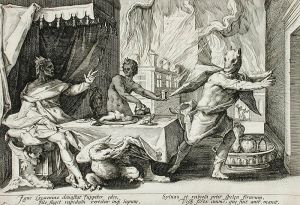
While reading the Hull Daily Mail (don’t ask), I came across an article entitled “Rock legend Alice Cooper ask questions about the Beast of Barmston Drain.” Apart from that lovable Britishism of making groups into grammatical plurals, this brief article gave me much to wonder about. After all, Paul Simon’s most recent album features a song entitled “The Werewolf,” (about which I recently wrote) and here is another rock performer from my youth raising the question about a similar beastie. According to the piece by Amy Nicholson, the Beast of Barmston Drain is a new urban legend about a creature half-man and half-dog. No doubt, werewolf reported sightings have been in the ascendent over the past few years, but how such an insignificant beast drew the attention of Alice remains unknown.

800px-Lycaon_Transformed_into_a_Wolf_LACMA_M.71.76.9

Many who know me—and those are few—are shocked to learn that I grew up listening to Alice Cooper. A fundie kid listening religiously to the father of shock rock? Songs about monsters, spiders, female maturation, and necrophilia? Perhaps it was because Welcome to My Nightmare just summed my childhood up rather nicely. Whatever the reason, to this day Alice Cooper is the only big name rock act I’ve even seen in concert. And that was only about six years ago, when I was still teaching at Rutgers. I had trouble hearing student’s questions in class on the next Monday night. Alice and werewolves in the same headline feels so much like yesteryear that it makes me want to believe in shapeshifters all over again. No wonder Hull is set to be the City of Culture. (Hey, Glasgow had it’s turn, so fair’s fair.)

To me, werewolves reveal much about a culture that strives to be far too civilized. We suppress our inner animal to become tie-wearing, wine-swilling sophisticates only to wonder where the wonder’s gone. And we start seeing werewolves lurking in culverts and drainage ditches. At least people are getting out at night. I’ve followed American tales of the dogman for years now, reading all of Linda Godfrey’s books on the subject. Even if it doesn’t exist, we stand to learn much of the creature that just won’t go away. Of all the transformations people talk about, that to the wolf is the most compelling, and among the most ancient. It may only be a dogman that people are seeing at the moment, but given some time it will evolve back into the wolf from which the story had its very beginnings. The answers, as always, probably lie in our childhood.


Moving Mountains

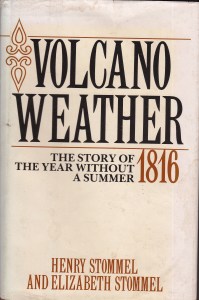
VolcanoWeatherJust 200 years ago, there was a “year without a summer.”  Well, that’s an exaggeration, but the name has stuck and is familiar to those of us with an undue interest in weather.  Although the coldness of that summer was far from universal, frosts came in New England in June, July, and August, killing off the staple corn crop for much of the region.  Snow fell even later than it usually does in the northeast, including a measurable fall in July.  My interest in this particular cooling episode was spurned by reading about the eruption of Krakatoa in 1883.  The connection?  Mount Tambora, a relative neighbor of Krakatoa, erupted in 1815 with an ejected debris volume of about ten times that of its later colleague.  The dust cloud from Tambora has long been a culprit for the dismal summer the following year.  Henry and Elizabeth Stommel researched and wrote a little book on this event entitled, Volcano Weather: The Story of 1816, the Year Without a Summer.  Although the book shows its age (it was written in the early 1980s), it remains a fascinating exploration of the many things that weather can do.  And has done.  Two of my favorites from this book were Napoleon’s adventures and the writing of Frankenstein by Mary Shelley during a rainy summer in Switzerland.
 
I should note, however, that the Stommels do not declare that Tambora was the reason for the year without a summer.  They tend to think the volcano had something to do with it, but the weather, that most protean of phenomena, can be impacted by the very small as well as the very large.  In fact, their description of the eruption includes the recognition that locals felt volcanic eruptions to be normal acts of the gods.  Many island cultures recognize the divine power of the molten earth.  The weather getting out of whack, we can be sure, leads to much prayer even today, thousands of miles from any eruption.  Something that hasn’t changed since the 1980s is that natural phenomena—especially powerful ones—evoke the divine.  Huge, impressive volcanoes, or even the very immensity and complexity of the atmosphere, suggest something we can’t comprehend.  Global warming will soon, however, bring this point home.
 

One of my takeaways from this book is the fact that the weather’s lack of uniformity emphasizes just how little we know.  The year without a summer mainly affected the northern hemisphere, and that only piecemeal.  Parts of northern Europe and North America felt it more intensely than other places.  It was not “the coldest year ever” and anyhow, is it even possible to know whether the coldest year would feel unnecessarily chilly where you are?  I’m pretty sure it’s snowing in some part of the world right now.  Human arrogance when it comes to global warming can be put into perspective by such acts of nature as Tambora.  From a human perspective, we live on a time bomb.  Volcanoes care not a whit for our bidding and wishes and dreams.  They can impact climate more instantly than our trite human efforts and thinking we alone are gods. To prepare for the future sometimes we need to look two centuries back.


Virgil’s Vigil

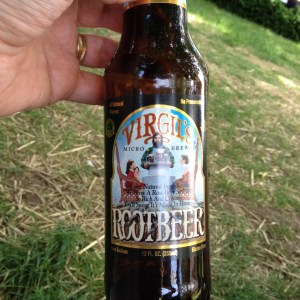
IMG_2798I can never keep Virgil and Beatrice straight. I blame Dante. Allegories can be so tiring. So, sitting under a tree in Princeton, enjoying a root beer float prepared at The Bent Spoon, I ponder the empty bottle before me. Virgil’s root beer. So good, it states, that I’ll swear it was made in Heaven. It is good, I must say, but didn’t Virgil lead Dante through the other place? You see, I’ve just spent a pleasant morning at Grounds for Sculpture, the outdoor museum set up by Seward Johnson, a sculptor that some accuse of kitsch. Others come by the busload to see what it’s all about. Johnson’s cast sculptures of people are so lifelike that it isn’t unusual to find yourself staring at an actual person sitting on a bench, wondering if they’re real or not. I spend a lot of time pondering reality, and this place makes that question explicit.

Descartes said “I think therefore I am,” but what if I am really the thought of another? How would I ever know? As I wonder around among the sculptures, a different face of reality shows itself. Many of Johnson’s pieces are sculptures based on paintings. To get behind the surface you have to imagine what the unshown side must’ve looked like. That which the original artist left out. Any art is a matter of perspective. Unseen realities—isn’t there something Dantesque about all this? Is Virgil the guide through Heaven, or is that Beatrice?

These statues, in quotidian poses, are so real. If they’re cast from actual persons, maybe they are. After all, this camera I carry is capable of capturing souls. And if you don’t make it through the first time around, there’s always Purgatory as a safety net. This bottle in my hand causes me confusion. Is my tipple divine or diabolical? How much difference is there between them, really? Princeton is a place that needs no one, after all, except those who have already made a success out of life. A place with expensive root beer on offer. A vice for which I’m willing to pay. Maybe life is a divine comedy after all.


Holy Castle

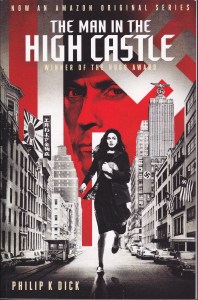
ManHighCastleReading about Philip K. Dick prompted me to read one of his novels. But which one? Some Amazon pick-up lockers on the way to work are painted with a mural of The Man in the High Castle. I haven’t seen the series, but there was the paperback, facing out, at the local independent. It’s been a while since I’ve read Dick, so I have to find my legs for his style. I’m surprised at just how much religious language he uses. Our cultural biases tend to insist that intelligent people aren’t hoodwinked by religion, but it does, nevertheless, appear. The premise of Dick’s novel is based largely on I Ching, the “Book of Changes.” Indeed, the conclusion of the novel relies heavily upon it. Along the way, however, Dick shows his sacred mettle when it comes to Judaism and Christianity as well. His prose is sprinkled with biblical quotes.

More than just a surface awareness, The Man in the High Castle offers some deep reflection for the reader. Mr. Baynes, seated on the rocket to San Francisco, ponders the Nazis who’ve won the Second World War. Reflecting on their hubris he considers how they’ve come to think of themselves as divine. “Man has not eaten God; God has eaten man.” This gave me cause for pause. Apart from Dick’s narrative, the idea of divine anthropophagy is in keeping with much human experience. We often consider ourselves masters of our own fates. Many, however, find themselves dangling like a spider from a web over the fire. Not that of Edwards’ Hell, but simply that of human circumstance. The Nazis didn’t win the battle, but listening to today’s political rhetoric, they may have won the war.

Nobusuke Tagomi explains to Baynes how I Ching, a 5000-year-old book, is alive. “As is the Christian Bible; many books are actually alive.” Far from poking fun, Dick suggests there may be something to all this mumbo-jumbo after all. We are conditioned to mock, dismiss, and ignore religion in this world where rationality leads to presidential races such as this one we’re currently suffering. Follow the trail back, I suggest. Look for clues. Philip K. Dick isn’t the only secular writer who knew more than the average person about what fascism looks like, and about the role of religion in its downfall. The novel may not be easy to read. It demands much of those who approach it. Nevertheless, it preserves the truth that many books, indeed, are alive.


Grasping for Meaning

DSCN6301

How often we’re told—and writers on biblical topics are especially guilty of this—the meaning of a story. Despite what materialists say, we are meaning-seeking creatures. We want to know why. When we read a story we want to know what it means. I occasionally dabble in the pool of fiction. Many times I read the emerging story and wonder what it means. Sometimes the meaning changes over time. Sometimes it means many things at once. Recently I read someone explicating the meaning of the story of Noah. The meaning? No, a meaning. That little article makes all the difference. Definite or indefinite, we need constantly to remind ourselves that stories bear meanings. Plural. They mean nothing otherwise.

Those of us who spend a lot of time with sacred texts see that it suggests something specific to us. Those who manage to gain followers start their own religions. The problem comes when one meaning is fixed to a text. I often saw this growing up as a Fundamentalist. I also saw it frequently at Nashotah House. This verse means this. Nothing other. Any interpretation outside this particular one is heresy. Heresy is, of course, punishable by death. Lest you think this is just the idle musing of an underemployed biblical scholar I must remind you that wars have been fought over such things. People have died. All for someone’s mistaking an indefinite article for a definite. There are those who say certain canons of the Mass must not exclude the definite article or otherwise all you’re getting is a very cheap and meager lunch out of the deal. For this you put on your best clothes?

We read stories for entertainment, but if they mean nothing they are quickly forgotten. Dreamtime stories, as David Abram reminds us, may lack plot but they have place. They take us to a place where we aren’t physically present. Or if we are physically present, we need to be taken there in mind as well as body. They give life meaning. Ironically, as a culture, fewer and fewer people find meaning in their work. Living for the weekend, they find their sense of fulfillment by what they do when not on the clock. And some of that time has traditionally been demanded by those who offer worship experiences. After all, weekends were their idea in the first place. There may be some meaning in that. If there is it is only one meaning among many. And even while attending, it is best to keep an eye or ear open for something other than the meaning which the ordained may insist is the only true one.


The Devil Made Me

TheWitchesWitch-hunts, I suspect, will become all the rage again if a certain presidential candidate is elected. The fear of witches is not easily explained in a world driven by materialism, but certainly misogyny plays an unholy role in much of it. Stacy Schiff’s The Witches: Salem, 1692 has been selling well. Since my wife is one of the many descendants of the Towne family that suffered three witch accusations resulting in two executions (Rebecca Nurse, Mary Esty, and Sarah Cloyce) we read this book together. It is a detailed account of the year we went mad. A year when being different, especially not being Puritan, and not being male, was dangerous. Religious tolerance was not a gleam in the colonists’ eyes since religious freedom translated into not being forced into the government church, not allowing others the same privilege. Indeed, as Schiff points out, religious tolerance was considered by many to be a satanic idea. If ministers starved due to such freedom, it would be easy for Satan to take over. As it was, the Dark Prince seems to have done a pretty good job among the Puritans without such tolerance.

The idea of the Devil has been (and still is) the ultimate scapegoat. People in a capitalist society are naturally frustrated—surprisingly few see this—and frustration always seeks a reason for its own existence. That is patently clear at Salem: blame the Indians, blame the French, blame the Quakers, blame the women. Any and all may be agents of the Devil. Even the descriptions of the Lord of Darkness varied so much that, were he a human, no one could be quite sure who it was they saw. The Devil always takes the form of your enemy. All it takes is an influential clergy willing to push tense believers over the edge. Soon we begin building walls. Then we build gallows.

Religious tolerance has always been a frightening thought. Protestantism challenged a somewhat uniform Catholicism and the mite of a doubt burrowed deeply into peoples minds: is my religion the wrong one? Tolerating other religions means admitting that yours might be wrong. The logic that plays itself out is a terrifying one to some. Belief is never easily changed. States can’t stand dissenters. The only capital crime for which the federal government still executes citizens is treason. Treason sits uncomfortably on the other side of the coin whose obverse reads “tolerance.” You’d think that three centuries would be long enough to learn something. Unfortunately some lessons—often tragic ones for the powerless—have to be played out over and over before we start to comprehend that Satan can be anyone we want him to be.


Nature’s Voice

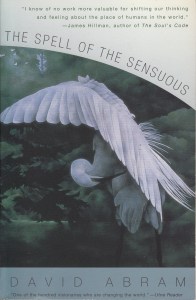
SpellSensuousCivilization isn’t all it’s cracked up to be. Sure, it’s got its moments—modern medicine, indoor plumbing, Honey Boo Boo—but often it’s artificial. It’s like somebody made up a set of silly rules and those who dare violate them are treasonous barbarians. Over the past few years I’ve been reading books that consider our biological development and what nature seems to indicate about how people might exist more holistically in the world. I don’t mean New Age outlooks, although, surprisingly, such treatments often aren’t far off base. I’d never heard of David Abram or his book The Spell of the Sensuous. (For those who think sensuous means only one thing, the subtitle is Perception and Language in a More-Then-Human World.) Although somewhat dated, this is an insightful book. The basic premise is that we are, by nature, part of a much larger world but we have, like spoiled children, decided to take it all for ourselves and isolate our species from all others, claiming a superiority that none dare challenge. In the process we’ve lost much of what it benefits us being animals, and have separated ourselves from the wonders of the world all around us. Working in Manhattan, I have to agree.

Basing his observations on having lived among aboriginal peoples, Abram notes that although anthropologists have denied the tenets of Christian missionaries on the religious front, they have continued in that teaching concerning biases against nature-based belief systems. Peoples who live close to the land observe things which seem superstitious to the “civilized,” but which are, in reality, simply astute realizations based on watching how the world works. Like Thomas Nagel, he notes that consciousness pervades the natural world. Animals, plants, even the earth itself displays forms of awareness that we ignore in our rush to exploit and gain “wealth.” In reality, we suffer for having made ourselves something we’re not.

There’s a lot in this book, far more than a single blog post can say. I don’t agree with all the points Abram makes—that writing may be responsible for our dilemma is a bit of a stretch—but there is great wisdom in this tome. At several points I had to stop and ponder the implications of what he was saying. Yes, nature speaks. Creating a world where “success” is measured in removing yourself as far from nature as possible requires elaborate rules. As far as I can tell, obeying the rules means that if you’re one percent of the one percent you’ll have nothing to complain about. If you have enough money—itself an artificial construct—you can run for president with no other qualifications. Meanwhile, nature suffers at our hands and may only recover once the world is forced from our hands and the sensuous once again takes over, doing what it has always done.


Not for Prophet

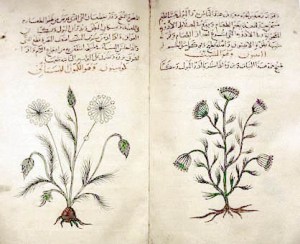
Delicate isn’t a word we’ve been taught to associate with Islam. I remember a priest speaking to me oh-so-earnestly about how Islam by nature wanted to take over the world. I wondered about his education in the history of Christianity. If you turn the clock back far enough, even the early Israelites, according to Judges, attempted genocide. We do religions a grave injustice by reifying them in this way. A recent story on NPR tells about the restoration efforts of a library in Fez, Morocco. As Leila Fadel points out in this story, we tend to suppose Islam is ISIS destroying history, but this library, full of Arabic manuscripts, is one of the oldest in the world. We sometimes forget the great contributions Arabic—yes, Islam—has made to world culture. Including literary culture. Some of the scientific works of Aristotle were preserved only in Arabic. Even the word “algebra” bears the distinct signature of its Arabic roots. What we should be attempting to halt is extremism.

Arabic_herbal_medicine_guidebook

One of my readers commented the other day about absolutism. This was in the context of Christianity, but it applies here equally as well. Absolutism tends to see only sharp divisions in a world where everything, in reality, blends into everything else. Islam emerged from a prophet who was influenced by Christianity and Judaism in the context of Arabian polytheism. Many of the tenets of Islam would settle comfortably in the pew, if we would let them. “Revealed” religions, however, take no prisoners. The concept of “revelation” means that your scriptures come straight from God’s anthropomorphic mouth to your all-too-human ear. When your religion is revealed, you can’t mix it with the best of your competitors. That’s one of revelation’s greatest dangers.

It does my soul good to see the begloved curator of the Qarawiyyin Library touching an Arabic manuscript so gently. It is the very picture of a pair of lovers. Those who love books—truly love books—can wish no harm on their fellow human beings. Reading is, after all, exploring the minds of others. All texts, in this way, are sacred. All are revealed. Too often we listen to those who tell us this is all an apocalyptic struggle to the death. In reality, revelation never ceases. Of its source I’m uncertain. Of its literary progeny I am certain that human minds are only richer for having received the words of the many prophets of the literary endeavor.


The Survey Said…

Survey

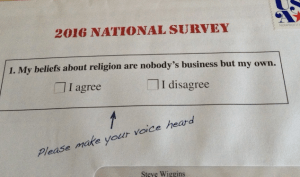
There may come a time, perhaps “when the trumpet of the Lord shall sound,” that junk mail will be no more, a mere historical curiosity. For now, in these days of declining postage prices, we’ll continue to put up with it. I suspect much of it targets my generation and those older—people who are modest about the time they spend on the internet, and who long to look out the windows when they’re at work. (The non-virtual windows, I mean.) Although I lament the waste of paper, and the cost to our literal dendritic friends, sometimes free amusement comes in my mailbox along with the occasional profundity. I received a survey the other day that had decorative check-boxes on the envelope for agreeing or disagreeing. “My beliefs about religion are nobody’s business but my own” the question read. My knee-jerk reaction, itself a religious term, was to think “Of course! Nobody can tell me what to believe.” An occupational hazard of being a religionist, however, is that the ready application of exegesis always stands to hand.

Are my religious beliefs nobody’s business? I suspect since the sender was looking for money that some manner of business was indeed involved, but beyond that are my beliefs nobody’s concern? Freedom of religion allows us to believe what we will, and since beliefs are very, very difficult to change, this is a central tenet of any form of democracy. You can’t have a free people without letting them believe what they can’t help but think to be true. It may, however, sometimes be somebody else’s business what I believe. If my religion is dangerous—and what religion isn’t, to some degree?—don’t hoi polloi have a right to know? Ah, but then aren’t we in danger of registering, profiling the believer? This is a violation of rights as well.

My pen hovers uncertainly over the paper. My views are something that I keep to myself. Few people know what I actually believe. On the other hand, day after day I post thoughts that in some way can be tied to religion. Is this a trick question? A junk mail survey shouldn’t be so hard. When did studying before checking the mailbox become a requirement? In my teaching days I had students who claimed they had a right to know what I believed. I had a right to keep my views private. Who’s right? Whose right indeed? Belief doesn’t come easy. It’s not as cheap as the media makes it out to be. Unless, of course, it arrives unbidden among the junk mail that makes up so much of our lives. And even then it might be something to take seriously, at least for a little while.