By Their Love

One of my high school teachers—I don’t have to say who; if you attended my high school you’ll already know and if you didn’t you won’t know him anyway—wrote in my yearbook, “I hope you get what you deserve.” I wasn’t very good in this teacher’s class, but he explained to me, “I sign everyone’s yearbook the same way. If you do well, I hope you get rewarded. If you don’t do well, I still hope you’ll get what you deserve.” This teacher had a reputation for being somewhat of a philosopher, and his words have struck me as particularly appropriate for this moment. We, in the cosmic scheme of things, get what we deserve. As a nation I guess we deserve a First Lady, in an example to young women everywhere, has appeared naked on the internet. Her husband married her after two previous women and has made his views on gender perfectly clear. My conservative friends went to the polls knowing that. I hope they get what they deserve.

The problem is the rest of us are stuck with him too. I’ve lived through bitter, spiteful campaigns before. The genteel art of campaigning is thoroughly deceased. 2016, however, is the first year that I saw pure hatred as a political platform. And it wasn’t on both sides. Trump made of virtue of hating one’s neighbor and claimed the election was rigged until he won—then it was, of course, impossible that it would’ve been rigged. Former First Lady Hillary Clinton, who kept her dignity throughout, never stooped to inciting hatred of fellow Americans. It likely cost her the election. To the people now saying this is just politics and stop complaining I say we have all been victimized and we all ought to feel very ashamed. This election wasn’t about money. Or financial positions. Or foreign policy. It was about hate.

DSCN4694

Hate can only be counteracted by love. I have seen many women responding to a man who considers them mere sexual object by reaching out in kindness to strangers. Women organizing to try to make this country a more positive place. Meanwhile, I hear men I know saying at last we have a strong leader who will bring them prosperity. If money is what you care for, you have my pity. This country is about freedom, equality, and fairness. All of that was jettisoned last Tuesday. Even those saying “get over it” are doing so with a smugness that is a thin veil over intolerance. I’ve never carried on with frustration so long after an election before. That’s because never before has an election—no matter which party triumphed—been won by a platform of evil intent. My grandmother, a Teutonic matron of occasional Valkyrie disposition, used to sum it up well when we boys were getting out of hand. “Schäme dich!” she used to scold. I know a country that could use her words right now.
Identity Crisis

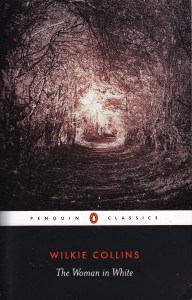
womaninwhiteSince at least my middle school days I have been in search of the great Gothic novel. I can’t claim to have found it just yet, but I’ve read many notable samples along the way. Somehow Wilkie Collins’ The Woman in White remained completely unknown to me until earlier this year. The title was evocative enough to make me pick it up, daunting though its 600 pages might be. Like many novels of its period it was serialized, which likely accounts for its length. Honestly, it took a while to get into it fully. Once ensconced, however, it kept me reading for over a month. (I took some breaks for work and sleep.) I wouldn’t say it was my ideal of the great Gothic novel, but the character of Count Fosco is amazingly drawn and seriously compelling. As the huge man lets mice run over his massive body and treats birds with conscientious gentleness, he is plotting ruin to his fellow human beings to benefit himself. He is an accomplished egotist.

What makes the novel so profound to me is the question of identity. One of the characters in the novel, the eponymous woman in white, has a double in the love interest of the protagonist. Doubles are common in Gothic tales, but in this instance when the woman dies and others believe her double to be her the question of identity is raised. Who am I, really? In the day before DNA evidence, it was impressively difficult to prove you were who you said you were, if your appearance was altered. Emaciated, abused, and drugged, Laura doesn’t look like herself and even her own uncle doesn’t recognize her. In the end her identity is established by legal testimony alone, without benefit of any biological proof.

Identity has been on my mind lately. Especially on a national scale. Brexit and Trump were both movements fueled by distrust and distorted notions of national identity. In short, Britain and the United States, so the reasoning goes, should belong to white men. As Monty Burns famously said, “Well, for once the rich white man is in control!” I personally like a little color in my field of view. I value deeply those I’ve met whose experiences and skin tones don’t match my own pallor. I want our national identity to include more than just fifty shades of white where women are objects and men are some kind of noble studs. Back when I started to read this novel I had a grip on that view of reality. Now that I’ve finally finished it, I wonder who we really are.


Throwin’ Away My Shot

In what sense can someone claim to win when they failed to get the majority vote? A crooked one, by definition. Some might say “rigged,” to use language that has mysteriously disappeared once one party “won.” The definition of crooked is “not straight; bending; curved.” We cast our votes, and depending on which imaginary lines we live within, those votes are diverted to a party of electors. That means that the person who actually wins the majority vote might not win. When it happens—not often—it always benefits the Republican Party. So it has been in my lifetime. And the “winner” never mentions that the majority voted against him. It’s always a “him.” By a recent count Hillary Clinton had over 400,000 more votes than Donald Trump. That final figure may be closer to a million. Whose votes didn’t count? Compare that conservative 400,000 to the 2,000 votes that “won” Pennsylvania. Go ahead, Trumpetters, you like numbers. Isn’t that an order of magnitude or two out of whack? Doubled? Crooked.

The point of the electoral college is that it has now become a game. Games, as we know from each time George W. Bush was elected, can be cheated. “Hanging chad” is engraved on the tombstone of democracy. Was my vote one of the 400,000 that didn’t count? Most assuredly so. If you know how to read, chances are so was yours. Gaming a system hardly seems to be the basis for the will of the people. The people have spoken and they have been, once again, ignored. W didn’t endorse Trump. I wonder what he thinks of the electoral college now. How does it feel, Mr. President, to have thrown away your shot?

506px-alexander_hamilton_portrait_by_john_trumbull_1806

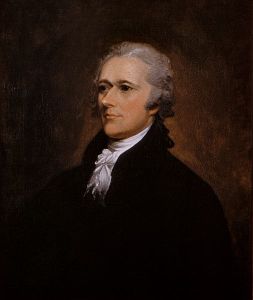
Some who claim that Republicans know what it feels like to lose need to stop and think. When has their opponent never won both the popular vote and the electoral college? It hasn’t happened in their lifetime. The electoral college may have made sense once, but it no longer does. When we try to tell young people that their vote counts, then put the candidate in office who decisively lost the popular vote, we’re really telling them “throw away your shot.” Still, Republicans are gloating even as the Democrats play by the rules (they’re nice people) and politely throw away their shots. It’s time we stood up for ourselves. When the most contentious candidates (the mind reels at where the GOP can go from Trump), not backed by any previous presidents of their own party, can win based on a technicality, we all need to stand in Weehawken and contemplate what this country has come to.


So Long, Marianne

fullsizeoutput_122f“It’s a cold and it’s a broken Hallelujah.” Leonard Cohen has died. But can you blame him? This seems to be a week for losses. I came to appreciate Cohen’s work long after his best-known songs had been and gone. The interviews with and news stories about him that I’ve read convince me that he was an extraordinary man. Spiritual and sensual, he was a true contemplative. He strove to experience what it means to be human. I sometimes fear we’ve lost that as a goal. I see headlines proclaiming that we can now have chips implanted in our brains—we can become part computer. “You held on to me like I was a crucifix,” he once sang. Who believes in crucifixes anymore? Salvation doesn’t come from above. It comes from self-interest. From business and bank accounts. And that chip in my head.

My wife taught me the value of music therapy. When the forces of darkness gather, listening to music can help you through. Many artists have covered Leonard Cohen’s songs. So much so that some have forgotten who it was that wrote them. A true artist, I suspect, doesn’t mind. Those of us who delve in creativity know that we are more like receivers than gods. It takes worshipers to make a deity. The songs that Cohen wrote were messages to the world. Poetic and deeply personal, they are reminders that being human is okay. In fact, it’s what we’ve evolved to be. I have a feeling we’re going to be needing more poets in the days to come. Someone has to shine the shoes of those who work in Trump Tower. My mind is singing “Chelsea Hotel.” Everybody knows.

Cohen was a reminder that sacred and secular are not so far apart. In fact, they are often difficult to distinguish. There may be a problem when you discover that in seminary, but if you can put it into a song perhaps people will listen. Eras, it seems to me, ought to have anthems. F.D.R., one of the truly great Presidents of the century past, proposed “Happy Days Are Here Again.” I wonder what songs we’ll be associating with the presidency over the next four long years. Will there be any music at all? Far be it from me to proclaim any man a prophet, but can you listen to “First We Take Manhattan” and come to any other conclusion? Go to iTunes, or that chip in your head, and listen. You might just end up singing “Who by Fire” as well.


At the Crossroads

flood_album_cover

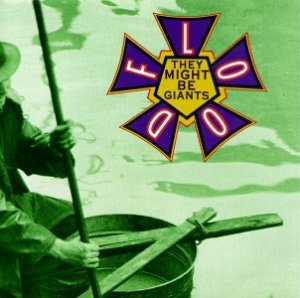
Back before there was iTunes—before Napster was even a thing—I heard a song on the radio. It was by a relatively new band, They Might Be Giants. We lived in Illinois at the time and I was being paid so poorly that we couldn’t afford luxuries like CDs. When I called the local radio station to ask them to play the song (“Birdhouse in Your Soul”) they apologized—they didn’t have the album. “We really should,” the receptionist told me. Although I was only earning a part-time salary—the fate of many a doctorate holder—and my wife was still in school, we eventually bought Flood. It quickly became one of our favorites. One of the songs that immediately struck us both was “Your Racist Friend.” It’s been going through my head lately, for some reason. “I know politics bore you, but I feel like a hypocrite talking to you and your racist friend,” the duo sings. I could quote the entire song, but let me highlight one of my favorite lines: “Can’t shake the devil’s hand and say you’re only kidding.”

I’ve been reading online that some people are saying, “Just get over it. You lost. Deal with it.” Auf Deutsch, “Komm damit klar.” After so many rounds of Kübler-Ross that Elisabeth is getting dizzy in her grave, I’ve begun to realize something. This was no ordinary loss. I’ve been alive long enough to be disappointed with election results several times. The psychological trauma from Tuesday rates somewhere between 9/11 and the Challenger explosion. To put this is perspective, when Reagan won I was depressed for a while, about as much as when the Steelers lost Super Bowl XL, and I’m not a sports fan. I’ve never spent the hours after an election glancing at the faces of others to see if they looked as damaged as I felt. “Just get over it” people?—it’s called shock. “Can’t shake the devil’s hand and say you’re only kidding.”

This was no ordinary election. Yes, I was born in the Kennedy administration. I was too young to understand Camelot, but I’m now old enough to read the writing on the wall. I saw our nation put a man on the moon. I felt the unending frustration of Vietnam. I watched Nixon resign after Watergate. God help us, I even survived two terms of W. I’ve never felt that we were bargaining our soul before. I was at the crossroads at midnight. I know what I saw. Can a man who has openly treated women as objects, insulted people for their race, and advocated thug violence to win lead a unified country? I don’t know. “If anything was broken I’m sure it could be mended,” the song says. Let’s hope so, but let me contemplate the ghost of democracy past. It’s my right.


Final Frontiers

img_0610

Is there such a thing as an existential illness? Answer that if you want to, but it’s rhetorical. I’ve been voting since 1980 and I’ve taken my fair share of bruises in the process, but this time my soul feels as if God has hung his “gone fishin’” sign on the pearly gates for good. I am ill. Maybe it was the ebullience that came from having eight years of progress where, although things weren’t perfect, they were sort of holding steady. I’ve always considered myself a populist. I don’t know how a billionaire can convince millions of people he’s one. To be populist you’ve got to be one of hoi polloi. Growing up poor, I took my licks then and I’m still taking them now. No, this wound goes deeper than the bone. Deeper than the viscera. It’s an existential illness.

All things considered, I don’t write too much about politics on this blog. All my adult years I’ve been an unapologetic Democrat. I confess to having grown up Republican. But I believe in the fair treatment of others. I know not everyone will or can be happy. I also know that it’s wrong to denigrate anyone because of their gender, race, orientation, or physical ability. Seems to me that our country was sort of the final frontier where you could go if you believed this kind of thing. Where can you go from the final frontier? There are no other land masses to discover. Maybe if I put on enough layers, Antarctica might not be so bad. Beyond that, where can one go to be a liberal in a world that desperately need some heart? Where money isn’t the measure of all things. Where Mom is right just as often, if not more than, Dad.

It’s a strange thing, this existential illness. Politicians are already cooing their pleasantries, as if nothing more than a slight upset occurred. It seems to me that whenever there’s an upset the popular vote disagrees with the electoral college. It also seems to me there should be a place where the wealthy aren’t considered better by virtue of their material status. I have this existential illness, but I can still dream. Is there a way forward from here? Sometimes I think I can see that horizon where all people are treated fairly and equally, and sometimes the sun seems to be rising over that horizon. Today I feel motion-sick from being jolted backwards. I’ve been disappointed before, but I don’t remember it hurting this badly. If anyone knows a good existential doctor, please pass along her name.


United Hates of America

horrorfilmHorror comes in many forms. Some people may wonder why I watch horror movies and read scary stories. The election results tell the story. As we descend into four years of horror, I was reading Peter Hutchings’ The Horror Film. At least I feel somewhat prepared. Or course, I’m still in shock. So I turn to horror shows. One of the things I found in Hutchings’ book was the idea that this kind of movie is a collective nightmare. The thing about nightmares is that sometimes reality is even worse.

It’s difficult to think straight sometimes. When I was a child I was taught that hatred was evil. Hate itself was a bad word, close to, maybe even worse than, swearing. What horror shows us clearly is that hatred leads to results we’ll only regret. Being bullied because you’re a little guy, or because you’re female, or because your sexual orientation is different, is something far too common. It seems it may be institutionalized now. No wonder so many horror movies take place in insane asylums.

Don’t mind me, I barely slept. I woke up in a country I no longer recognize. Or maybe recognize a little too well. The thing is, I feel sorry for Peter Hutchings’ The Horror Film. It is a worthy little book. I learned a lot from reading it. In fact, some of what I learned may come in very handy in the next few years. Zombies, after all, are called the walking dead. And I can’t really see the future at all. Maybe I’m just waiting for the curtain to part. Maybe I’m still asleep. I’ve seen enough horror movies to know how that scenario ends.


Frozen Over

The_Blob_poster

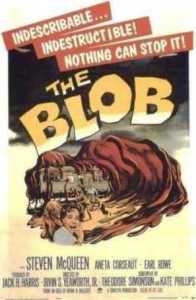
For reasons that may eventually become clear, I was watching The Blob. It seems that each generation’s fears are unique to its time—let the reader understand. For whatever reasons, star-appeal I expect, Steve McQueen was cast as the teenage Steve Andrews. A little unbelievable as a twenty-eight-year-old teen (Sissy Spacek was a more convincing teenage Carrie at twenty-six) Steve drives around his small town trying to find and stop the Blob. What is the Blob? Nobody really knows. Emerging from a meteorite, it seems to be an EBE (Extraterrestrial Biological Entity) that encompasses, dissolves, and assimilates animal life forms, getting bigger all the time. In a day when the Russians were actual enemies, this is hardly an intentional vision of capitalism but an apt description nevertheless. If it touches you, you’re dead. Since it can ooze through air vents, there aren’t too many places at hide. It forces itself upon you.

Steve’s love interest, Jane Martin, has a lisping little brother named Danny. While big sister is out on a date battling the jello-monster, Danny—a future NRA member—charges outside in his pajamas shooting at the thing with his cap gun. Can this be? One capitalist shooting at another? Don’t be fooled. This is the nature of the free market. Either the Blob ends up on a dinner plate, or Danny does. We know that prior to 1960s monsters seldom kill little children (but don’t get me started on Frankenstein), so it is the Blob that will succumb. As the town’s teens combat the goo with fire extinguishers, freezing it, Jane, Danny, and Steve escape to go hunting another day.

Those of you who’ve read my blog for any time know that subtext is often the point. I’m counting on you following along with me here—think of what day it is. The small town police chief, Dave, calls in the Feds. No wall will keep this alien out. It has to be deported. To some place that will never thaw. Like all good monsters, the Blob never really finally dies. It must be kept frozen to keep humanity safe. The final words Steve utters are indeed chilling, “As long as the Arctic stays cold.” Getting on sixty years later our “industriousness” has begun to melt the ice caps and the friends of the Blob deny global warming. I’ve seen The Thing from Outer Space too, and I know the last thing you want to do is thaw the Arctic. Remember what day it is, and do the right thing.


For the People

The complex of holidays that make up the transition from light to darkness represents a different mix, depending where you are. Life on the equator, for example, experiences no real variation in daylight hours and I would expect that equinoxes and solstices are relatively meaningless. Or at least less so than where darkness encroaches. For those of us in temperate zones the difference in day length can be quite dramatic and our holiday calendar guides us through it. Getting through the darkness. So this weekend, on Bonfire Night—also known as Guy Fawkes Night, or November 5—I watched V for Vendetta again. This isn’t actually an annual practice, but some years the need to remember the fifth of November is quite strong. This is one of those years. I can’t remember having ever been this anxious about a presidential election. Tomorrow we are voting on whether we want democracy to continue or if we want a dictator who can stir hate like no candidate I’ve ever seen. He even makes Ronald Reagan look tolerable.

I’ve posted on V for Vendetta before, so I need not go over the story. The theme, however, that governments are to serve the people is a message that bears repeating. Governments are to serve the people. We’ve come to a crises point in self-government. A vote for Trump instead of Hillary is saying “I give up, I want Big Brother to take over.” Perhaps the movie I should reference is 1984. Orwell may have got the year wrong, but the story right. Make people afraid, stir the pot of negativity and they will act in desperation. Reactionary governments quickly become dictatorships and that message, mean-spirited and full of ugliness, has been placed squarely in our faces.

The point of V for Vendetta, and the point on which the movie ends, is that V is each of us. We have the ability to make smart choices just as we have the ability to act out on irrational hatred. Who would’ve thought that election years would become days of such terror? I’ve always felt strongly about social justice, and I always vote with a conscience. I have never voted for a hate-monger or someone who believes the way to help the poor is to give the rich even more. There is a deep perversity here, a cultural psychosis. And the problem is we’re locked into four years of the result. For the sake of human decency and sanity, we all need to get out and vote. And I sincerely believe that pulling that lever is a choice for self destruction (Trump) or a future of new potential (Hillary). I just hope we’re smart enough to make the right choice.

img_3024


Giving Trees

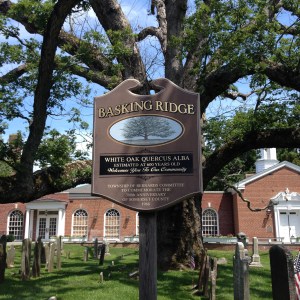
They’re not exactly worshipping the tree, but the Basking Ridge Presbyterian Church is holding a memorial service for the old oak tree. I’ve written about the Basking Ridge oak before. I learned about it only in January, and I visited it this summer. Some say it’s the oldest tree in the state, while others make that claim for the Great Swamp oak, which isn’t too far away. The climate change we’ve introduced, as well as natural aging, appear to have doomed the tree. It had leaves this summer, but not in the profusion that signals health to botanists. The decision has been made to take the tree down before any massive branches fall and cause injury or damage. In the light of these sad developments, holding a service seems perfectly natural. The tree is older than the church over which it presides, after all. It’s even older than John Calvin who started the Presbyterian tradition.

img_2878

My first book was on Asherah, the goddess often associated with trees by scholars. As those who’ve read my book will know, I’m a bit skeptical, on the basis of the actual evidence, that Asherah was a “tree goddess,” but it is also clear that trees are ancient objects of veneration. From the human perspective, they can live a very long time. There is a bristlecone pine in this country that dates back to before Noah’s flood (something the creationists conveniently ignore). With that much life-force, which, we’re told, is really a fiction, these trees deserve special respect. After all, they were in the neighborhood long before we got here. Still, the Basking Ridge oak has been artificially preserved before. It’s been on life support for years. Concrete was poured to support the massive trunk, and many ponderous branches are shored up by support rods. We respect our elders.

Maybe it’s not tree worship. Maybe it’s worship beside a tree instead of worship of a tree. Prepositions can make all of the difference. Nevertheless, it’s an occasion to stop and consider our place on the planet. The fear many of us feel regarding this week’s election is a mere second in arboreal memory. The independence of this country came after the oak had been here centuries already. It may not be tree worship, but we should respect the memories of such a tree. A country young and optimistic rather than old and jaded. Maybe this tree knows a secret that it’s willing to bequeath to those of us whose lives are but a few leafing seasons in length. Good-bye, Basking Ridge Oak. It was a pleasure to meet you.


Daily Bread Plus

I have a confession to make. I’m not a foodie. These days such an admission is tantamount to a venial sin, but the fact is I’m one of those who eats to live, not lives to eat. Still, like many people I’m concerned about whence my food comes. I can’t grow my own and just about all of it comes wrapped in plastic. Thus I found a BBC article my wife sent me to be of great interest: “An uncanny mixture: God, alcohol and even cannabis” by Kait Bolongaro. Focusing on monasteries and their brewing and distilling traditions, Bolongaro uses the foodie angle well. People want to know where their grub comes from, and the current interest in knowing the location of the source plays well into this. European monasteries have long been known for their production of alcohol. Even Jesus drank wine.

I’m no connoisseur of spiritous liquors, but the story is quite interesting. Many people don’t realize that monastic orders, in addition to praying and not having sex, also support themselves through industry. Many make goods to sell. Those in this article make booze. As Bolongaro points out, the fermentation and distillation process is an exacting one. In fact, it is a science. In the case of Chartreuse only three monks know the secret formula. They control the temperatures and conditions remotely, by computer. And I thought Bible Gateway was the only place the religious spent their time.

IMG_2642

Science and religion actually have a very long history of cooperation. Gregor Mendel, whose work gave Darwin’s theory of evolution by natural selection its actual mechanism, was a monk. Other religious have been close observers of nature and processes. There is no commandment against good beer, as many Teutonic brothers would no doubt point out. But to get it right you have to know your chemistry. As the article says, some things can’t be rushed and monastic life lends itself to such slow processes. The rest of us in our secular pursuits rush through life far too fast for religion or science. Contemplation requires “down time.” Time off the clock. The kind of time, we’re told, that simply doesn’t exist any more. The story, after all, appears in BBC Business. I’m no foodie, but I have to confess that the cheese and pretzels purchased from the Amish in Lancaster do tend to taste better than those that come wrapped in plastic. There may be a religion to science after all.


Before and After

Fresh from seminary with a head full of historical-critical theory competing against my immortal soul, I was lost in the Church of the Holy Sepulcher. I’d learned enough in class and in my own reading to know that the association of Jesus’ burial here only dates back to the fourth century. And also that the identification was made by a politician—Helena was the mother of Constantine—and not a archaeologist, or even a theologian (God help us!). The location was, in other words, hearsay. Three hundred years is a long time to keep track of where something happened. I sit on a bus trundling through Weehawken every day and ponder that we don’t really know where Alexander Hamilton was shot. Such are the ravages of time. I was young and, presciently didn’t know if I’d ever return to Israel, so I wanted to make sure at the time. It was holy confusion. Finally an elderly Coptic monk beaconed me into his edicule to touch the stone. He gave me a cheap rosary and asked for a donation.

churchoftheholysepulcher1885

The scene returned to me when a friend sent me a story about the “discovery” of the actual chamber behind the build-up. The report by Fiona MacDonald in Science Alert briefly tells the background to the location and describes the hurried excavation. Still, we have no idea if, as Indiana Jones might say, “They’re digging in the wrong place.” Tradition has nevertheless hallowed the spot. For seventeen-hundred years some people have suggested this is where it all happened, and where many of the liturgical churches agree. Some Protestant groups, attuned to the Bible a bit more than tradition, have suggested The Garden Tomb is the correct location. The years ago when an academic future seemed in store, I stopped by there too, just in case. There were no crowds.

An enormous amount of effort was poured into building and maintaining the Church of the Holy Sepulcher. Crowded with tourists and various orders of clergy, I wondered how anyone might find such an experience spiritual. Territories are marked out between the various denominations seeking legitimacy in stone. Who wouldn’t want to own the spot where it actually happened? Wouldn’t that be the ultimate truth claim? So more money is being spent. More digging is taking place. Science, some believe, might come to the rescue of religion. From my experience, brief though it was, trying to make sense of the Holy Sepulcher, I have my doubts. But what do I know? I’m not even sure if Copts use rosaries.


Rule Book

gamespeopleplayMirrors can be such deceptive things. In my head I’m a much younger man than the one I see staring at me. And I have to remind myself that other people see what the mirror sees, and not what I really am. Things age. A friend who aged so much that she’s no longer alive recommended to me years ago Games People Play, by Eric Berne. Of course I’d heard of it before—I wasn’t born yesterday. I do enjoy reading psychological books. Psychology like having a window in someone’s forehead. If you could really master it you’d understand so much of what seems a mystery to people like me. But it is an old book. When Berne casually cites the year he was writing it as the year I was born, I began to suspect that some of the data might be outdated. The guy in the mirror certainly seems to be.

We still play games, though. The hope Berne expresses in the last chapter is that we might get beyond this endless game playing to true awareness, spontaneity, and intimacy—the things psychological games are meant to mask. I also have to confess to recognizing myself at several points and then reading that games are played by disturbed people. “So that’s why I x, y, or z,” I found myself thinking. Disturbing thought. And these ideas are as old as I am. Probably older.

Reading this book from ‘60s, I noticed a strong sense of certainty that is now lacking. I can’t imagine too many psychiatrists or psychologists making quite so many declarative statements these days. I know it’s a classic in the field, and I know there are some valuable insights here, but we don’t call people “squares” any more, and a good deal of the analyses point to assumed gender roles that we now know are as much fabrications as the games themselves. I was looking for a game that my departed friend had pointed out to me. We both knew a man who was apparently picking fights because he wanted to leave his job but he couldn’t bring himself to do it. “Stamp collecting,” she called it. She may have been right, and I have to wonder if many of us really know why we do the things we do. Maybe I could use a window into my own forehead. Of course, I would need the mirror to see it. It’s a little game I play.


The Least of These

Despite criticisms to the contrary, the pre-Reformation church did have concerns about the average person. About the poor. In those days church offices commanded a good deal more esteem than they currently do among the populace, and being a priest was a position of power. The concern for the quotidian human—at least of the Christian variety—was demonstrated in All Souls’ Day. Although the date migrated around the calendar before settling on November 2, it came part of one of the very serious (days of obligation) annual celebrations along with All Saints’ Day, November 1. It was recognized that not everybody could be a saint, and all the faithful departed deserved a special day of commemoration. Through a complicated history this two-day celebration came to be associated with Celtic beliefs about the crossover day between worlds, samhain, giving birth to Halloween. It seems appropriate on All Souls’ Day to think about the poor.

An article in the Washington Post reports on findings that poor children, in their words, “that do everything right don’t do as well as rich kids who do everything wrong.” There are indeed deficits that attend the poor all their lives. Those of us who began in such circumstances can sometimes break through in a system that favors the upper classes, but it is rare. Good paying jobs are reserved for friends of the wealthy or to those who might pay them back in some way. The poor have little to offer beyond their souls. Our system, the so-called “free market” deals in souls. The poor are, make no mistake, chattels. Even in higher education, where we’d like to think thinkers think, positions are granted based on privilege. The loftier music and liturgy is, after all, reserved for All Saints’ Day.

dorothealangemigrantworkerschildren

Like many raised in humble circumstances, I grew up hearing about the American dream. If you work hard you can succeed. But that really depends on who you know and how much they’re willing to help out. Stats are now beginning to back up what those of us who have lived experience in the lower register already knew. Having faced it throughout my career, I know I’m not alone. Just the other day I met someone else who grew up poor who’d hit the bullet-proof ceiling carefully installed by children of privilege. Not ambitious beyond desiring the basic comforts of a job that covers the bills and allows for some reasonable amount of surplus against lean times is, it seems, more than the wealthy are willing to grant. After all, All Saints’ must come before All Souls’, for even Heaven has its hierarchies.


Tis a Season

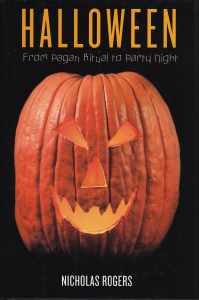
halloweenI always seem to be running late. Still, I wanted to be reading a book about Halloween on Halloween. If I might be pardoned for bleeding over into All Saints’ Day, I’ll share some thoughts this November on Nicholas Rogers’ Halloween: From Pagan Ritual to Party Night. Academic treatments of holidays, I fear, often suffer because of dispassion. Academics tend to emulate Spock in their writing, and I think that those who write about Halloween should really “get” Halloween. Oh, one can discourse about its quaint history in this ever so rational world, but one might just miss what the whole thing is about. To be fair, Rogers was writing his book during the trauma of 9/11. He wonders if Halloween may be fading. Nashotah House was suffering under an evangelical administration at that time, and the usual Halloween spirit was muted. Some fifteen years on it seems that Halloween earns yet more money and people admit that it’s hip to be scared.

Rogers gives a brief treatment of the early, but hidden, history of the holiday. The Celts weren’t much into writing about their festivals and invaders didn’t think much of their quotidian life to begin with. Trying to understand Halloween from modern times, piecing the puzzle together back over time, doesn’t really help much either. Treating the day in its British context, then in its American context, Rogers favors a thematic approach. His section on Halloween movies is interesting. Like most modern treatments of the holiday, his book makes comparison with el Dia de los Muertos, and the usual complaints of cultural imperialism. Maybe Halloween is just too much fun to pass up. It also means this post isn’t that outdated.

Nobody owns Halloween. It is taken as a serious holiday by some Wiccans, but liturgical Christians are far more intense about today, All Saints’ Day. It isn’t a national holiday and no national government decides the correct day for trick-or-treating. Perhaps prophetically Chris Christie cancelled Halloween the year of Hurricane Sandy, but did he really? Sitting in the dark for a few days with evenings lit by candles—some of them in Halloween holders—felt pretty spooky to me. Halloween may be a source of intellectual curiosity, but it is a holiday you either get or you don’t. October is its prelude, November is its aftermath. It is, as the Celts used to believe, when cold weather seriously begins to take over and light is a rapidly vanishing commodity. I may be a day late, but Halloween isn’t quite over yet.