Animal Ways

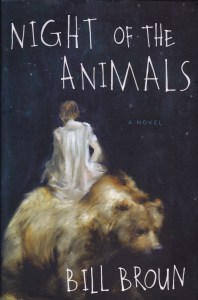
nightofanimalsNoah’s Ark has a way of showing up in many literary forms. Familiar to many from Genesis, it actually predates the Good Book by hundreds of years. On the backside, it keeps recurring in literature as diverse as Neal Stephenson’s Snow Crash, Jonathan Carroll’s The Ghost in Love, and Margaret Atwood’s MaddAddam trilogy. It also shows up in Bill Broun’s debut novel Night of the Animals. Set in a future that’s becoming present faster than Broun likely anticipated, the story revolves around an addict who hears animal voices. The story stubbornly refuses to let you get any grip on a slippery reality, so the reader’s left guessing even at the end. In the 2050s Britain is under a fascist regime that seeks to keep the wealthy happy and everyone else servile. (Keep reminding yourself this was written before 11/9.)

Cuthbert, the protagonist, believes the animals—most of which are extinct in the wild—are calling him to release them from the London zoo. As an addict his perception of reality is constantly in question. His sense of mission, however, is not. One of the stranger elements in the tale (and that’s saying something!) is the revival of Heaven’s Gate. This cult, instead of wiping itself out, has gone international. The approach of a comet sets the Neuters (as they’re called) on a mission to wipe out earth’s remaining animals. Many of them are in the London zoo, which brings Heaven’s Gate into direct conflict with Cuthbert, who is busy trying to release as many talking animals as possible. London literally becomes a zoo and Heaven’s Gate openly attempts a coup.

All of this sounds wild and fantasy-prone, but like 1984, fiction sometimes peers deeper into reality than science. Is it science fiction? It’s set in the future, but it’s difficult to say. What has all this to do with Noah’s Ark? The novel itself draws the parallel—the zoo that preserves the last of their kind is, by default, an ark. The Ark. Floating on a world-ocean of irrational turmoil where might (read wealth) makes right after all. Religious imagery interlards the story. Cuthbert becomes St. Cuthbert. His possible granddaughter (the reader is never sure) manifests as the Christ of the Otters. There’s even a kind of Second Coming. This is a novel that feels like altered reality. That illusion is given the lie when you close the book and turn on the news.


Hidden History

the_official_poster_for_the_film_hidden_figures_2016

History involves perspective. We sometimes forget that. I was alive when human beings first reached the moon, so maybe I’m a bit blasé about what a great technological accomplishment that was. Down here on earth we were still having trouble with the human rights thing—still are, incredibly. Working in my own silo I hadn’t heard of Hidden Figures and wouldn’t have gone to see it if my wife hadn’t suggested it. It’s hard to be reminded of the world into which I was born and how terribly backward it was. For all my conservative upbringing we were never racists. Of the two African American guys I remember attending my elementary school, I was proud to call both of them friends. I could see no reason not to think of them as friends. We lived in the same town and had the same basic needs. I had no idea the struggles they really faced.

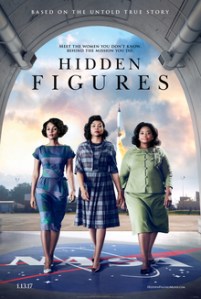
Although offering social commentary, gently coating it with humor, Hidden Figures follows the story of three mathematicians who made America’s participation in the space race possible. Moreover, they were all women. African American women. Brilliant, but unequal under the law. I was glad for the darkened theater as I couldn’t keep my eyes dry thinking of the terrible backward step we’ve taken since November. This nation has never been fair to African Americans and police statistics bear that out. Given equal opportunity, I can’t help but think of what me might accomplish. How this nation could support a bigot for the highest office in the land I can’t compute. It sets the clock back before I was born. We wouldn’t be where we are not without shining examples of humanity like Barack Obama.

We are fighting for the future. Over the past few weeks every few days I’ve been attending marches, rallies, and political meetings. I’ve been signing petitions until my clicking finger is numb. I wish there were more that I could do. The blatant racist, sexist maneuvers by Mitch McConnell should stand out as a mark of shame on all who claim the name American. Silencing Elizabeth Warren from reading a letter by Coretta Scott King regarding Jeff Sessions. When our children’s children look back on this age they will rightly wonder how people who’ve been privileged all their lives could turn their backs on progress in the name of racial insecurity. And how Mr. McConnell could’ve had the appallingly bad taste to do so during Black History Month. History involves perspective.


Theoretically Speaking

lit-theory-vsiI’ve been brushing up on my literary theory. All writing tends to get classified as fact or fiction, and we don’t stop to think, generally, about what “literature” is. Those of us who write fiction and non know that a well-placed hyperbole might throw us from one camp into the other. Such is the power of rhetoric. So it was that I found myself reading Jonathan Culler’s Literary Theory: A Very Short Introduction. Witty and insightful, Culler acknowledges the elephant in the room for many of us—theory, in a literary context, is often impenetrable. I’ve often wondered what one had to do to be considered a theorist, and this little book actually addresses that. Nobody has time to read all the theorists, though, and come up with their own creative things to say. Chose your poison.

The Bible, of course, is literature. That’s one reason I was reading Culler. I found one of his assertions immediately applicable: people in nineteenth-century England saw literature as a unifying principle. The British Empire encompassed the world, and to make diverse peoples a part of it, literature might be used, they thought, to do the trick. Culler suggests that it might have been a substitute for religion, which, he notes, was no longer holding society together. This gave me pause. Religion—at least official religion—began as social glue. The earliest recorded religions were state sponsored and served to cast the monarch in the role of the special appointee of the gods. There’s no arguing with that, right? Elaborate, expensive temples were erected. Financed by tax-payers’ dollars. This worked fine since priests declared the rule of the king as sanctioned by the gods. Nations warring against each other were thought of as rival gods fighting.

When science began to take the universe literally, religion lost its stickiness. How do you hold a society together when the gods no longer exist? You see, scientists didn’t think out the whole picture in advance. Scientists, like most academics, work in silos (that’s a metaphor). The discovery of a scientific truth can dissolve a social epoxy quite efficiently. Recognizing the slippage in the British Empire, theorists (I suppose that’s who noted such things) considered literature the great uniting force of a diverse people. We’re kind of facing that same dilemma today as literature is becoming, for many, as irrelevant as religion was a century-and-a-half ago. At the same time, people don’t understand science well enough to assess it for themselves. What are we supposed to do? Is there a theorist in the house?


An Anatomy of Lies

I had an email from Mike Pence. Mike Pence doesn’t know me from Adam, but if he met me he surely wouldn’t like me. His email tried to explain, in tottering logic, why he voted for Betsy DeVos. When I finished wiping the vomit from my mouth, I began to think about someone America needs again: Mark Twain. I’d just been reading about some of Twain’s classics and I recalled his famous quip (which he attributed to Disraeli): “There are three kinds of lies: lies, damned lies and statistics.” We now live in an era so surreal that it requires a fourth kind of lie: alternative facts. Government communications are full of them. Not one word from the White House can be trusted with the common decency that you’d attribute to a Boy Scout innocently helping an elderly person across the street. One hand is held out for you to shake while the other is picking your pocket.

The volume of the lies has grown louder. I’m sorry Nigel Tufnel, but this amplifier goes up to twelve. Some time back I blogged about the overuse of superlatives. When everything’s the ultimate, nothing’s the ultimate. We need a new anatomy of lies to apply to our Addamsesque government. Since the only people who believe in Hell are the ones who elected Hell’s own party to the White House, you can’t even tell them where to go any more. There was a day when telling someone to go to Hell brought real consternation. These days all you have to do is buy a ticket to the District of Columbia. People listened to Mark Twain. Here was an educated southerner who told the truth, no matter how fictionalized. Truth no longer exists, and I should just get over it. Problem is, the country I was born in now only supports the rich and I can’t afford to live in a cardboard box.

We all know what a lie is. If we’re honest we’ll all admit to telling one once in a while. All humans do. Damned lies are those we used to condemn. The exegesis of the word “damned” these days is perhaps euphemistic for “good for government.” Statistics, as 99 percent of people know, are made up. Then come “alternative facts.” Even after being called out repeatedly for making things up, Sean Spicer, Kellyanne Conway, and now even Mike Pence, continue to rationalize their own reality.

Mr. Clemens, what do you call fabricated detritus so filthy that “lie” is hardly adequate to make an impact in its dense, brown verbiage? The kind of thing we might expect from an individual incapable of distinguishing truth from fantasy? Don’t take it personally, Mike, but I’ve assigned you to my SPAM list. You’ve just been made an alternative fact in my personal reality. How’d you even get my email address? Mark Twain may have been a pen name, but his fiction was fact. He was a man ahead of his time.

Image source: Qwertyxp2000, Wikimedia Commons

Image source: Qwertyxp2000, Wikimedia Commons


A Glimpse at the Future

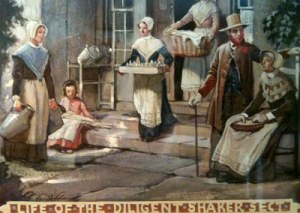
Last month one of the three remaining Shakers died. In this era of religion unawareness, not many Americans, I expect, could identify this dying religion. The Shakers aren’t the Quakers—we like to give religions we don’t understand pejorative monikers—they are a group that grew out of the Friends but that had important differences. Shakers believe, especially, in celibacy. It had to grow through conversion since Shakers could not reproduce biologically. At their height there were about 6000 of them—the number of Twitter followers of a fairly successful humanities professor, I suspect. They were hard-working and their brand of furniture endures beyond the life of the sect. The official count of Shakers worldwide now stands at two.

This little bit of news saddened me. Not that I’ve ever been tempted to join the Shakers—it would be a bit of a stretch for a family man—but I’ve always admired countercultural groups. Like many religious sects of the late eighteenth century, the Shakers were millenarians. That is, they believed in the imminent second coming of Christ. Given this belief, biological reproduction wasn’t really necessary. In fact, it was counter-productive. Like so many of the slumberers of the Great Awakening, the Shakers eventually settled in upstate New York. Since their lifestyle was different, they had to form their own communities. The last community is in Maine. When the last two Shakers go to their reward, barring a miracle, the denomination will be extinct.

life_of_the_diligent_shaker

The Shakers were distinctive for yet another reason as well. They were open to, and often defined by, female leadership. This might be expected in a world where men have difficulty controlling themselves in mixed company. Catholic monasteries locked men in without women. To agree to live in a mixed gendered community but without mixed gendered relations took a dose of will power that borders on the saintly. The Shakers won’t be the only religion to have gone extinct, when that happens. Religions, like organisms, grow, thrive, and die. This little group had a disproportionate impact on society. Those who watched Michael Flatley throwing his body across the stage to the haunting joyfulness of the Shaker Hymn “Simple Gifts” likely had no idea that the world owed one of its most beautiful melodies to a group of people living celibate lives in the woods of Maine. The Shakers’ unique contributions to the weird and wonderful world of religion will be missed by at least one.


In Poor Taste

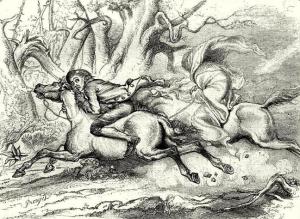
I remember seeing a television commercial once (not during the Super Bowl) where an older guy, a lawyer, complained at the camera, “It used to be that lawyers didn’t advertise.” He went on to say that he felt uncomfortable promoting himself since it was in poor taste, but since the legal profession had swung that way he was entering the game. I know how that guy felt. I grew up with the firm notion that self-promotion was in bad taste. If my career has taught me anything, it’s that unless you’re born well connected, if you don’t promote yourself nobody else will. Still, it rankles. With that hearty introduction, I would, in poor taste, point out that my latest article has been published. Those of you who keep an eye on this blog will know that I gave a paper about the Bible in Sleepy Hollow to a learned society a couple years back. That paper is now available in the Journal of Religion and Popular Culture.

ichabods_chase_crop

Doing research is difficult when you don’t have institutional support to carry it out, but doing such things as an independent scholar can be kind of liberating. I used to research, write, and get published an article a year, back in my teaching days. Nashotah House didn’t have the greatest library, but they did have interlibrary loan and, towards the end of my time there, internet access. More than that, life wasn’t measured in increments of nine-to-five. Living on campus, commuting could be measured in seconds rather than hours. Although publication didn’t bear the weight there that often pressures academics elsewhere, like that lawyer whose name I can’t remember, I wanted to be in the game. I guess I still do.

In these days of uneducated government, if you don’t do it yourself nobody’s going to do it for you. It’s what I once called “the educational imperative.” We are duty-bound, as conscious beings, to move knowledge forward. How many apocalyptic scenarios are there where, when the powers that be devolve into inanity, the monks in their cloisters have to keep knowledge alive? (The question’s rhetorical.) I’m reminded of Station Eleven by Emily St. John Mandel since there women do a good bit of keeping the culture alive when society collapses. Or, to put it another way, like Sleepy Hollow. When the forces of evil break into the world, it’s an African American woman who saves it. If your school has access to JSTOR, you’ll be able to find out more in my paper.


By Any Other Name

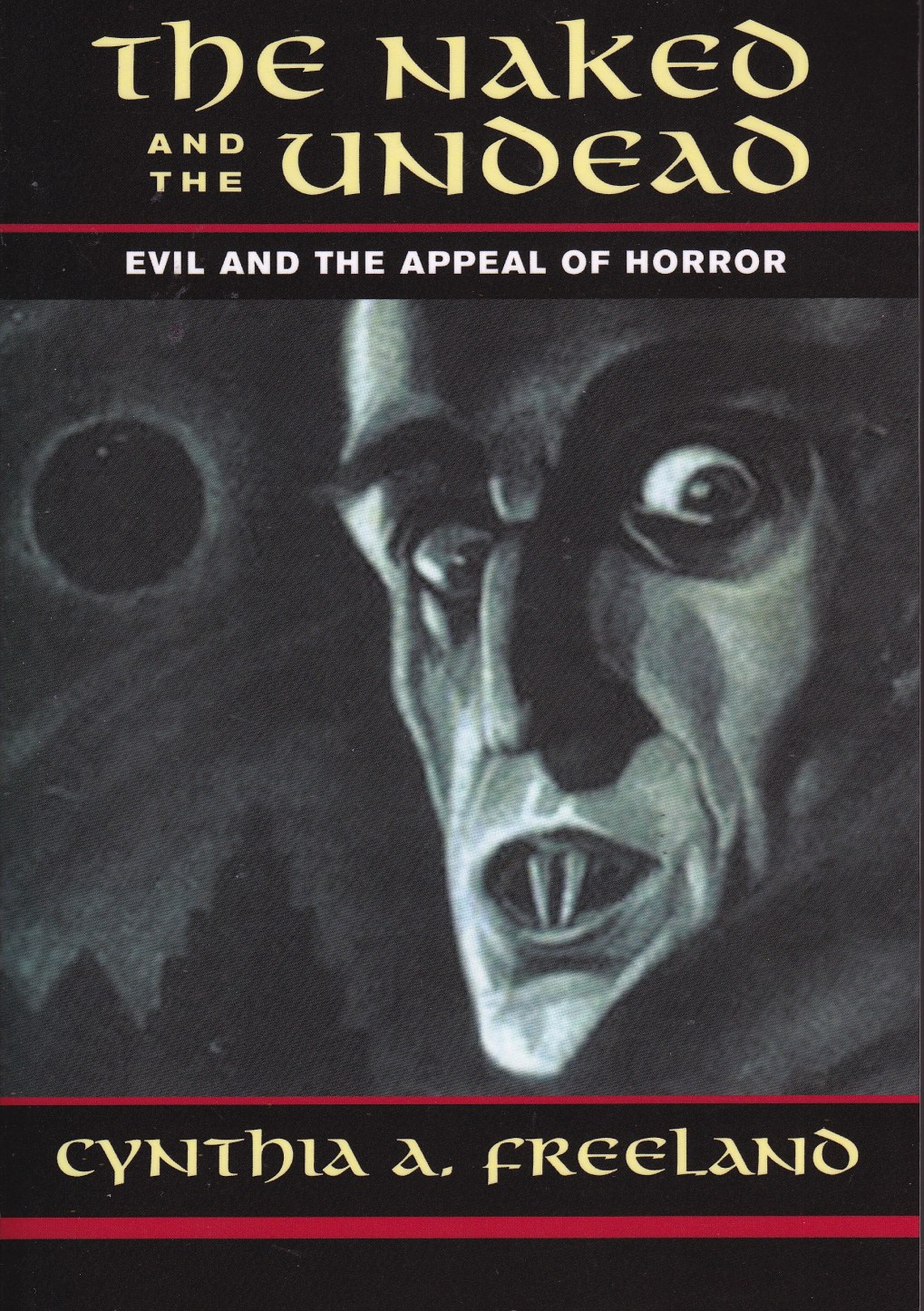
nakedundeadGood and evil. Well, mostly evil, actually. No, I’m not talking about Washington, DC, but about horror movies. Cynthia A. Freeland’s The Naked and the Undead: Evil and the Appeal of Horror is a study that brings a cognitivist approach to the dual themes of feminism and how horror presents evil. It’s not as simple as it sounds. Like many philosophers Freeland is aware that topics are seldom as straightforward as they appear. Feminists have approached horror films before, and other analysts have addressed the aspects of evil that the genre presents, but bringing them together into one place casts light on the subject from different angles. Freeland begins this process by dividing her material into three main sections: mad scientists and monstrous mothers (which allows for the Frankenstein angle), from vampires to slashers, and sublime spectacles of disaster. Already the reader can tell she’s a real fan.

One of the simplistic views of horror is that these kinds of movies—particularly slashers—are misogynistic by their very nature. Feminists, including Freeland, question that assumption. Horror is a genre with a decidedly checkered history. Some films do feature mostly female victims to male monsters. Not all do, however, and even those that do may be saying something other than the obvious. Looking for the locus of evil in these movies provides a lens that focuses the meaning somewhere other than the surface. This is one of the benefits of philosophy—probing questions may be asked and unexpected answers may result. Along the way you can have a lot of fun, too. Especially if you watch horror movies.

A large part of the criticism probably arises from the fact that film making was, for much of its earliest history, run by males. That’s not to say women couldn’t do the same thing men were doing, but the opportunities simply weren’t there. Most film makers, I expect, have trouble getting out of their heads to think about how someone of a different gender might perceive this kind of movie. Fear, we are told, is “coded” feminine. It seemed natural to such film makers to put the female in peril since both women and men would respond to it. Since then it has become clear that fear isn’t coded for gender. Indeed, one of the hallmarks of modern horror is that we all have cause to be afraid. Fear is no respecter of gender. Freeland’s analysis, now getting on in years, correctly looked ahead in many respects. Especially concerning the ongoing presence of evil.


Cheap Faith

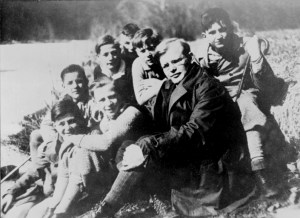
“If I see a madman driving a car into a group of innocent bystanders, then I can’t, as a Christian, simply wait for the catastrophe and then comfort the wounded and bury the dead. I must try to wrestle the steering wheel out of the hands of the driver.” Many of my conservative Christian friends may be surprised to learn that these are the words of Dietrich Bonhoeffer. Evangelical hero and firm believer in costly discipleship, Bonhoeffer lived, and died, during the Nazi takeover of Germany. A promising young theologian, he escaped Germany to come teach at Union Seminary in New York City. Increasingly disturbed by what was taking place back home, he forsook safety and returned to Germany to try to wrench the hands of Hitler from the steering wheel. Bonhoeffer didn’t write empty words.

The above quote comes from a letter he wrote to his sister-in-law Emmi. Bonhoeffer’s book, The Cost of Discipleship, well deserves its status as a classic. In it Bonhoeffer declares that a cheap faith is not a faith worth believing in. The Prosperity Gospel would have made him ill. You see, Bonhoeffer believed that the religion preached by Jesus didn’t allow for shirkers. Those who get rich and claim God helped them to it. There’s a reason some people say Mammon is a demon. This was in the days when Christianity still had a conscience. When leaders of religious movements weren’t afraid to speak out against accommodating with evil when that was the more comfortable course to take. And his wasn’t empty rhetoric.

Bonhoeffer was arrested back in his native land. Sent to Buchenwald and then to Flossenbürg, he was hanged on April 9, 1945. He was 39 years old. Two weeks later the Allies liberated the camp. Bonhoeffer knew evil when he saw it. Now, some seventy years later our vision has become blurred. We live in a country that declares itself “Christian” but, unlike any religion Jesus taught, declares itself to be first. “America first,” we’re told. Flipping through the pages of the Gospels my eyes fall on a forgotten verse. “The first shall be last,” it reads, “and the last shall be first.” Scholars argue over the authentic words of Jesus, to be sure. What we do know is that he too was executed by his government before he reached 40. And they killed him for the radical message that what God requires is loving your neighbor as yourself.

Photo source: Bundesarchiv, Bild 183-R0211-316 / CC-BY-SA 3.0, Wikimedia Commons

Photo source: Bundesarchiv, Bild 183-R0211-316 / CC-BY-SA 3.0, Wikimedia Commons


The Big Chill

It’s cold. It may not be Alaska, or even Wisconsin, but I can’t feel my fingers and the temperature hasn’t risen above freezing all day. New Jersey doesn’t get the incredible chills we used to experience in Wisconsin, but I’ve been outside going on two hours and I really need some warmth. And it’s not just me. At least a couple hundred of us are out here and it’s not for the Super Bowl. It’s for justice. We’re rallying at the beautiful courthouse of Somerset County, in solidarity with our Muslim Americans, protesting the latest actions of our own government. Some of the people here are old enough to remember Hitler. Others are young enough that they have to be held. We are from countries all over the world. We are saying “No!” to the evil that is coming out of Washington.

img_3191

Those who voted for Trump out of a sense of fiscal conservatism were sorely misguided. This was a hostile takeover of what used to be a democracy by people who rely daily on alternative facts. Who make up massacres that never happened. Who claim that their personal billions have made them victims. Who believe that men have a God-given right to determine what women can do with their bodies. Who state that men who aren’t attracted to women or women to men are somehow deviant. Who openly mock the disabled. Who resist Black Lives Matter. Who can’t tell you one of the five pillars of Islam but can tell you that they’re all wrong. A government that’s over the people, despite the people, and against the people. Self-serving, self-enriching, and self-satisfied. A government where party has become more important than the welfare of the nation. A government that lost the popular vote by nearly three million, and those were only the ones who bothered to get out to vote. A government that lays its hand on the Bible and lies. That prays for itself, not for the good of its people.

That’s why I’m out here in the cold. I’m standing in a crowd that, like those who gather at airports, courthouses, and city streets, is saying “Enough!” The abuse of power is taking advantage of what you can “legally” claim without regard for the will of those you represent. Representative government fails when it fails to represent the people. We don’t want to be out here freezing our fingers, noses, and toes. We’d rather be comfortable and warm at home. As chilly as it may be in New Jersey tonight, it’s colder in the heart of this country and unless we the people do something, Hell itself is in real danger of freezing over.


I’m Saying Nothing

It used to be called argumentum e silentio, the argument from silence.  It didn’t take very long into my post-graduate reading to learn that arguments from silence were very rarely admitted in the academy as any kind of evidence at all.  In fact, argumenta e silentio are generally considered a logical fallacy.  The idea is fairly simple: an argument from silence is when a source (often an ancient one) doesn’t mention something.  That lack of mention is sometimes used to argue for the absence of the thing not mentioned.  For example, some first century writers in the region of Roman Palestine did not mention Jesus of Nazareth.  This has led some to suggest that Jesus never existed.  The evidence is an absence of evidence on the part of certain important historical figures.  There are obviously lots of problems with this.  I’m a modern person and there are plenty of people I never write about.  It doesn’t mean that I don’t know who they are (although in my case, it might!).
 
Why am I concerned about arguments from silence?  Lately I’ve noticed quite a few scholarly tomes coming out on the topic of silence.  I’m not referring to Susan Cain’s excellent Quiet, but to scholarly monographs that explore the silence in ancient texts about certain subjects.  In my more curmudgeonly moments, I feel that perhaps when we have nothing left to explore but what a text doesn’t say maybe we’ve explored that text enough.  Younger scholars, casting about for something new to say about the Bible, look to what ancient sources don’t say to give them a research topic.  Back in my own academic days you’d receive a stout scholarly rap upon the pate for even including an argument from silence in your thesis.  Now you can write entire books about what someone didn’t say.  What’s more, you’ll likely find a publisher.
 
I’m at times a bit fearful for the future.  Although my academic work approached the Bible critically it wasn’t because I didn’t like or didn’t respect the Bible.  Hey, it’s far more famous than I’ll ever be, and in fact, more people have heard of it than have even heard of Trump with his endless tweets. No, the Bible is an endlessly fascinating book.  It’s just that if you can’t find something to say about it, why write about what ancients didn’t say?  Maybe it’s time to move on to a sacred text that hasn’t been probed for a couple of millennia.  I have no vested personal interest in this, having been excluded from the academy by biblical literalists and having had the rest assent to that decision by silence.  Ah, but there’s the rub.  That phrase, by the way, doesn’t occur in the Bible.  I wonder if that’s significant.

dscn4370


Jericho

Those who think walls actually keep people out have never ridden the train through North Philadelphia. Or into Newark. I have to admit that I’ve always found rail-side graffiti aesthetically pleasing. Some of these vandals are real artists on a scale that is truly impressive. Speeding trains are, of course, dangerous. And in urban areas they are fenced off to keep people out. Thing is, walls don’t work. Riding to Washington DC for the Women’s March a couple weekends ago, I was watching the graffiti on the way into Philly. Vast, colorful, and with a flair for design, it makes the usual visual fare for railway riders much more interesting. Buildings, we know, have facades to be public facing. If you go around to the back of the strip mall, things look a lot more spartan indeed. I’ve spent my fair share of time in employee break rooms. Executive washrooms they’re not.

The thing about facades is that they’re fake. Like in those old westerns where we see them jutting up higher than the actual roof of the store or saloon, making them look bigger than they really are. Or even a small town boy who works in Manhattan can see it. Walk down the avenues of Midtown and the glitz is never-ending. Once you get to the minor cross-streets you see the service entrances and smelly trash bags stacked in the alleys. Would you want to enter that store if you knew what was coming out the back? We prefer our self-deception. We prefer to call our lies alternative facts. We can sleep better at night that way, knowing that our heads of state are so so brutally honest. Just don’t wander behind the cameraman. Things aren’t what they seem.

img_3171

To get to New York City from where I live, you have to change trains in Newark. The graffiti along the way is intense. Long ago I noticed a signal hidden in the noise. “Paint the Revolution” it reads. Or read. I don’t know if it’s still there. Graffiti’s often the bare truth. The thing is, it’s difficult to photograph. Trains move fast and phones focus slowly. Things look blurry and those in power can tell us the words of hoi polloi are ugly and defacement of property. Have they ever walked behind the building to where the workers come out? It’s easy to find. If you smell the piles of garbage you’re getting close. Executive washrooms they’re not. But the back door is far more honest than any facade.


System Reboot

I think Steve Bannon has already taken over my computer. How else can I explain everything stopping in the middle of a word, fingers flying, building up to some rhetorical flourish and suddenly the screen goes blank. Windows that I’d forgotten I had open reappear only to shut down. A brief message appears telling me that an “update” is being installed. I don’t mind do I? After all, it’s the middle of the night. Who’s watching in the middle of the night? We all know who the real president is, but why he’s interested in my muddled musings is anybody’s guess.

You see, I live a regimented life. You have to when your bus arrives before 6 a.m. I crawl reluctantly from my bed at 3:30 for one purpose only—to write. The commute and work take about 14 hours of the 24 I’m allotted every day, and I’m told that 8 of the remaining should be for sleeping. That doesn’t leave much time. So I skimp on the dozing part and get up to scribble my thoughts when, traditionally, demons are a-prowl. I need my computer to be with me on this. Kind of difficult to post on a blog without it. Not that I enjoy my early morning violence to the soft fabric of dreamland. My fellow early morning commuters know what I mean. Every day there’s a car just pulling up to some bus stop as the driver’s put on his blinkers, indicating he’s pulling out. I know some folks roll out of the bed, into the shower, and onto the bus. Some continue their sleep on the bus. I can’t blame them. I’m Manichaean about my day. It’s either asleep or awake. I don’t nap, so I need to write when I’m most awake. Just after 3:30 a.m.

How do I know it’s Steve Bannon? It’s only a guess really. I’ve heard that Mark Zuckerberg and Bill Gates keep a piece of opaque tape over the camera of their laptops. Why anybody’d want to see a confused, morning-headed, middle-aged guy with his mouth hanging open, wondering what’s just happened to the blog post he was writing is beyond me. But then I’m no expert in national security. In this year of 1984 we’re all threats to the powers that be, I guess. Thing is, I can’t remember what I wanted to say once the laptop restarts half an hour later. And that’s probably the point.

Image credit: Nirwrath, Wikimedia Commons

Image credit: Nirwrath, Wikimedia Commons


Celestial Politics

Two things about my childhood: I grew up religious, and I grew up learning you didn’t talk about religion or politics. Now I see that that combination leads to tremendous potential for abuse. Many conservative Christians believe that their faith only ever endorses a Republican candidate, no matter how bad. This is a strange idea and it goes back to some strange people. If I can talk about it.

We live in a cult of celebrity. This is nothing new. People have always admired the individual who could get him or herself noticed. As early as the epic of Gilgamesh, the guy willing to show his bad self managed to capture the public imagination. We’re still reading his story some five millennia later. Of all places this tendency to treat a human being as authoritative should be considered strange is evangelical Christianity. This religion grew out of a largely Calvinistic backdrop where no individual could be assumed to be good. Indeed, total depravity was part of the theological environment. Mix in this stern outlook with the revivalism of the two “great awakenings” and an uncanny alchemy takes place. People, who used to be bad, now found enthusiasm in religion. The first real superstar in the United States was George Whitefield, a preacher. He had a massive following and was, in every sense of the word, a celebrity. This culture became the social substrata of the new nation. Open to all religions, yes, but mostly belonging to this one.

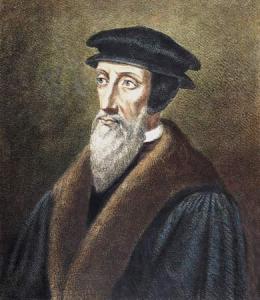
Once American religion became based on popularity, singular figures emerged as defenders of this faith. “Trusted” leaders and authors. Not all of them home-grown either. Names like C. S. Lewis, Dietrich Bonhoeffer, and Francis Schaeffer—not to mention Billy Graham—grew to a status they never had in their lifetimes. Well, Schaeffer and Graham came to be evangelical gurus in their own rights and Graham remains among the living, but Lewis and Bonhoeffer were really adopted by conservatives only after their deaths. The interesting point here is that Lewis and Bonhoeffer often wrote things that directly challenge the easy evangelicalism that accepts them as celebrities. The problem is, we don’t talk about religion any more. We use it for voting, and for feeling good about ourselves. Superior, even. It seems strange to think that Calvinism had some safeguards built in that have been knocked down for the sake of the polls. I can’t imagine John Calvin casting a vote for Donald Trump. But then again, Calvin became a celebrity in his own lifetime, so I might be wrong about that.

calvinjohn