Write or Wrong

Lots of people write for lots of reasons. Some love it. Some hate it. Some can’t help themselves. For those who know me primarily through this blog, it may not be obvious which of these sorts I am. After having read Dani Shapiro’s Still Writing: The Perils and Pleasures of a Creative Life I finally feel confident putting myself in category three. It’s not that I don’t like writing—I live for it. The kind of person Shapiro describes, however, is the one who defines their entire being through writing. Each day I post between 300 and 500 words on this blog. I’ve been doing it since 2009, which means I’m somewhere over the million-word mark. But those compelled to write will never be satisfied with just that. One does not live by blog alone, after all.

Once in a great while I get asked how many books I’ve written. Well, that’s not a question with a straightforward answer. Two of my books have been published. I’ve written at least ten. Some of them never made it from my desk to a publisher’s wastebasket. A few of them have. Like others who are addicted to writing, I can’t stop. Ironically, with a decade of experience working in publishing I’m not so good at getting my own work placed. Some of it is fiction. Some of it is non. Some of it is even poetry. If you’re a graphomaniac, I don’t need to explain any further. If you’re not, think of chocolate, or sports, or anything else you just can’t get enough of. That’s what it’s like.

Shapiro’s book, although not point-for-point, but more than not, is like wandering through my own gray matter. I had no idea that other writers—including a successful one like Shapiro—felt the same constant, nagging doubts and insecurities. I didn’t know that others considered staring off into the middle distance (there’s not always a window nearby) as work. Or that sometimes you write something and when you’ve finished it seems like it wasn’t you at all. Writers can be a trying lot. We tend to be introverts. We have odd habits (in my case, waking up at 3 a.m. to write on a daily basis). We tend to be able to spot one another in a crowd, but more likely as not we won’t say anything to each other. And strangely, we write even if we don’t get paid. With lifelong royalties somewhere in the low triple digits, economically it makes no sense to do what I do. Generally the world feels creative sorts aren’t terribly productive. It’s because we measure value differently, I expect. I’m glad to have met another traveler on this path although, as is often the case, our meeting will only be through writing.

Ironically

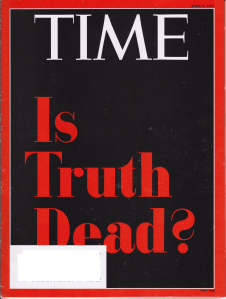
Irony is a national resource that’s in abundant supply. Those who inadvertently create it may be the least equipped to appreciate it, but that’s ironic, isn’t it? Time magazine used to be considered conservative. That was before the days when telling the truth was, by definition, liberal. A few weeks ago the famed news magazine ran a cover that was aimed at those of us who remembered the same cover that same week 51 years earlier. It read: Is God dead? That cover ran in the wake of a new wave of theology that perhaps may have been the last time that discipline held any public interest. Some thinkers had been tinkering with the idea that God might not be there. That was newsworthy.

Nature doesn’t work in round numbers, so just over a half-a-century later we found ourselves in a possibly even more dire world than one without God. This one has no deity, but it does have Donald Trump. Addicted to lies like they’re opiates, our commander-in-chief contradicts himself at 45 rpm. Comey was fired for mishandling the Clinton files. Then, moments later it was because of Russia. Then, moments later, I had been planning it all along. Kellyanne applauds from her alternative fact bunker. No truth may penetrate here. And we call this the free world. Where there is no truth there can be no freedom. Mitch McConnell and Paul Ryan, riding on the tsunami of disinformation, are loving the surf. Not a word from the thumbs of the president can be trusted.

Truth used to be an anchor. Now ships just drift. You can never tell whether they’re headed to North Korea or not. The GOP, in true American style, is attempting to rig the voting mechanism of this country so they can never lose power again. “It’s democracy,” they lie. They propose new health-care laws to which they will be exempt. Somewhere deep in these twisted pipes is a value long rusted shut. It’s rusty because it’s made of irony. And should that valve ever be wrenched open again we’d understand that draining swamps is a very bad idea. Yes, mosquitoes and other bloodsuckers may abound, but they’re all a part of the natural order of things. The dragonflies eat the mosquitoes and the fish eat the dragonflies. The greatest fish story of all is that the Republican Party believes in anything beyond its own supremacy over the entire nation it is lawfully bound to serve. Ironically, God’s not here to see this.


Mothers’ Daze

Washington’s war on women has made this Mother’s Day especially poignant. As hard as it is to believe, Paul Ryan and Mitch McConnell had mothers. I can’t comprehend any male being anything but grateful and humble in a woman’s presence. Don’t accuse me of idolatry—I know women aren’t perfect. Neither are men. Especially not men. Mother’s Day isn’t an excuse to treat our moms as less-than-special other days of the year. We sometimes forget that life is a gift. And we should always say “thank you” to those who give. Pregnancy isn’t easy on a woman’s body. Indeed, until recent times childbirth was the number one killer of women. At some periods in history female life expectancy was only into the twenties. Giving birth is a self-sacrifice. We would do well to remember that daily.

Social organization outside the home was conveniently male early on, but not necessarily so. Without our mothers none of this would’ve been possible at all. Why do we fail to give back when we’ve been given so much? Yes, our moms are special to us, but women everywhere are mothers, daughters, and sisters to all of the men out there. To be human is to be both female and male. How could we ever forget that? How is it possible to use woman as political bargaining chips as if one person has any kind of right to tell another how to use her body? When we look at mom do we see only a physical body? Do we not see a mind? Emotions? Love? How can we look into the face of all that and claim that men are in any way superior or deserving of more than their share of power and prestige? Mother’s Day should be a revolution.

I don’t mean to be combative, but I’ve been pushed into a corner. From my earliest days I’ve felt women were stronger than men. Being raised by a mother on her own can be a revelatory experience. I emerged with nothing but gratitude for the sacrifices one woman had made to be called a mother. If any men have forgotten that lesson, use this Mother’s Day to repent. If you’re alive to read this, or to share it, you have a mother to thank. And tomorrow’s no excuse to forget that and act as if this one day were enough to show gratitude to those who have taught the human race to love. It’s Mother’s Day, but so should every day be.


An Elephant’s 100 Percent

When I walked out of that dissertation defense, still a little unsure whether I’d passed or not, I thought my testing days were over. My early memories of struggling with exams—I wrote that a sphere was a kind of weapon on one vocabulary test I recall—made me anxious for an end of the process. Hadn’t I proved myself time and time and time again? People are funny that way. We’re suspicious of those who pass. Are they really as smart as that, or have they learned to game the system? (Admittedly, with what’s going on in Washington these days doubts about intelligence have definitely earned their keep.) Tests, however, have become less common these days, at least in the fearful exam room context. Now we’re giving them to animals.

It has long been clear to me that animals are quite intelligent. When that mouse, cat, squirrel, or robin pauses in front of you, looks you in the eye, then decides its course of action, it’s clearly thinking. Of course, some animals are more on the GOP scale of intelligence, such as deer that bolt out in front of cars, while others—ironically including elephants—show up 45 in tests we assign. An article in The Independent describes how elephants are far smarter than we’ve given them credit for being. Jealousy, perhaps, makes the elephant’s own party withdraw protections from endangered species. We’ve got to be sure nobody shows us up. At least not while we’re on camera.

Animals have greater thinking abilities than we’ve been willing to admit. For being so highly evolved, we’re an awfully petty species. We don’t want to share our great accomplishments with others. We’ll call the amazing architecture of the bowerbird “instinct” rather than admit they can build homes better than many in the Appalachians can. We’ll kick over anthills rather than face the fact that a hive mind is a terrible thing to waste. We’ve known for decades, if not more, that all life is interconnected. Because we’ve got opposable thumbs and reasonable cranial capacity, we’re the best thing this planet could hope to evolve, so we tell ourselves. What has made us so insecure? Why do we find the prospect of animal intelligence so frightening? It’s terribly hard to give up the role of being lord and master, I guess. Or if we were to switch it to a classroom analogy, we always want to be the teacher, never the student. But after walking out of that dissertation defense twenty-five years ago I learned that the testing had only begun.


Sideliners

Sidelines can be interesting places to sit. You’re close to the action, and you’re privileged with a close view that few others have. You can’t, however, play the game. Sidelines are familiar to biblical scholars. I can’t count the number of times and/or ways the input of those who spend their lives trying to comprehend the Good Book are, well, sidelined. In the publishing world those who work with Bibles are simply ignored by most others, despite the enormous revenue Bible sales generate. In the academy religion departments overall are fair game for any potential budget cuts. And since what religion study survives tends to be intercultural, the Bible faculty are deemed somewhat less necessary than other sub-disciplines. It’s easy to forget that Christianity is the largest organized religion in the world and that some 2.2 billion persons claim that name. The Bible’s their foundational book. It tells us what motivates them. And yet, it’s easier simply to ignore the whole thing. Then something insane like an Evangelical-fueled Trump election, and everyone continues to say, “we can safely ignore this.”

I recently saw an article by scientists which explored why people engage in dangerous behaviors. The main idea was that although we know certain things are bad for us individually or as a planet, we still do them. We do them with the full knowledge that they’re deadly and will likely hasten our demise. Ignoring religion (and in the case at hand, the Bible) is very much like that. A well-armed true believer can ruin your day pretty quickly. Religion, in recent years, has generated over $82 billion in revenue per year. At least those in the dismal science ought to sit up and take notice of that! Hey, for once, the numbers are with us! Statistically, religion is very important. Sounds like a good thing to pretend doesn’t exist.

Having grown up a Fundamentalist, I often ponder this state of affairs. The Bible, we all knew, was the most important thing. Studying it formally does tend to force new ways of considering it, but few Bible scholars would want to dismiss the Good Book out of hand. It still means too much to too many people simply to ignore. Far safer is the proper handling of Holy Writ. This is much easier to instill when institutions support it. It really is a necessary kind of education. Still, it gets sidelined for industries with lesser profits and lesser baggage. I grew into a career defined by the Bible, but even if I hadn’t I’d hope that I’d be able to recognize that some things just shouldn’t be ignored. Yet I’m on the sidelines cheering on those who consider such a career a tragic mistake.


See Around Us

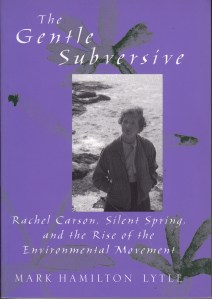
There aren’t too many people that I consider personal heroes. Those that I do have earned the sobriquet in odd ways, I suppose. That makes them no less deserving. Rachel Carson became a hero because of The Sea Around Us. Published over a decade before I was born, it was a book that I treasured as a teen—or even as a tween, had the word existed then. I was no literary critic, but her style and lyrical writing drew me in and my own love of the ocean I’d never seen was kept alive through her words. Mark Hamilton Lytle, I think, shares my evaluation of Carson as a hero. The Gentle Subversive: Rachel Carson, Silent Spring, and the Rise of the Environmental Movement brought out much of what I admired, and still admire, about her. A woman in a “man’s world,” she became a scientist with a gift for literary finesse. She struggled, she believed, and she died far too young.

Lytle’s book builds up to the publication of Silent Spring, which appeared just two years before Carson’s untimely death. I picked up Silent Spring as a tween as well, but only read it within the last few years. I knew this book had nearly singlehandedly launched the environmental movement, but as the shame of modern life constantly reminds me, I’d been too busy to read it. Born the year it was published, and not terribly far from where Carson herself was born, I had an affinity with the book that strangely kept me from it. It isn’t easy to read, even today. Especially today. With a government ignorantly rolling away all the environmental safeguards that six decades of careful thought have put into place, we need Carson now as much as we did in the 1960s. Her modern critics, as might be expected, tend to be men.

Carson showed that a woman can change the world. Those who disparage her stunning work claim that her following is a religion, not science. Carson was a rare scientist who saw that everything is interconnected. There may be some mysticism to this, but for those willing to admit it, we feel it to be true. On the eve of environmental degradation that will, in a perverse kind of justice, possibly wipe us out, we need to return to the fine words and clear thinking of one woman who took on industrial giants to give a voice to the people. We do have a right to determine what happens to our planet. Lytle makes the point that Carson was like a prophet. For me the comparative preposition can be removed altogether.


Kindling

Paula Cocozza, writing for The Guardian, describes “How E-books Lost Their Shine.” Like most inveterate readers, she says she has stacks of books growing like mushrooms after a summer rain, in her bedroom. I was working in the publishing industry (I still am, so please take no alarm at my rhetoric) when e-book sales plateaued. Then declined. “Industry analysts” were baffled. I wasn’t. The reasoning goes like this: e-books are light and cheap and amazingly convenient—why would anyone want something different? Those of us who love books know. If you know what I mean when I write “library smell” I’m preaching to the converted. More beguiling than new car scent, that first deep breath when you step into a library takes you places your physical body may never go. All those bodies of books gathered together let off a bouquet that insists you follow your nose to an earthly paradise. I just tried sniffing my iPhone. Nothing. No synapses fired. I’ve read books on it, but have I really?

Studies tend to show we have trouble remembering books read electronically. It’s just too fast. Wham-bam-thank you whoever you are. Let’s get on to the next thing. But books, as Cocozza writes, are slow. Publishing’s a slow industry. You submit your proposal, and the editor reads it. The editorial board discusses it. The book is written and sent to a copyeditor. Then a compositor or typesetter. Then a proofreader. Then it’s off to the presses. Printed, bound, and shipped. It can take a year or more. And when you curl up in bed with a book, furtively sniffing it, gently rubbing your fingers along its pages, drawn into a world not your own, plastic’s the last thing on your mind.

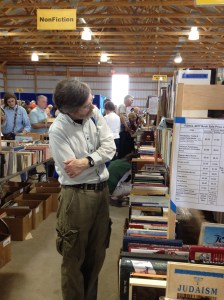
A few Saturdays ago I attended the Hunterdon County Library book sale. I go every year. It’s a big deal. People line up in advance. You step into the barn-like sales floor and it hits you—the smell of all those books. The aroma of knowledge. You can’t repurpose an e-book. You can’t sell it back because nothing was ever really produced. You purchased electrons, you’re stuck with electrons. Hit “delete” when the storage is full. All these books in this room are valuable. All for pocket-change. Many of them were wildly overprinted in the exuberance that naturally comes from being over-stimulated. Like kids about to enter Willy Wonka’s chocolate factory. Industry analysts are puzzled. If they’d get their fingers dirty by thumbing through a used book once in a while they wouldn’t be. Yes, its dusty, grungy, and probably laced with germs, but I wouldn’t trade it in right now for a Kindle, even if it costs me nothing.


Filling the Frame

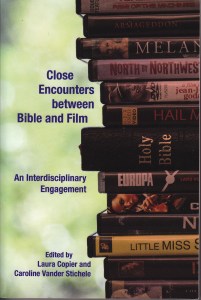
Those who study the Bible have to reckon with the fact that someone else probably said it first. This is one of the inherent liabilities of studying something a couple thousand years old. Still, scholars have to keep their jobs, and so they come up with new ways of looking at something ancient. One of my favorite new methods is the use of movies to understand the Good Book. Clearly nobody in ancient times had any ideas about films, let alone stills, but still, they liked to tell stories. They have that in common with modern cinema. Although I’m naturally distrustful of collections of essays—there are so many of them and they are all of mixed quality—I decided to read Close Encounters between Bible and Film: An Interdisciplinary Engagement, edited by Laura Copier and Caroline Vander Stichele. I have to admit that I picked it up with some trepidation, but I was pleasantly surprised in the end.

Like all edited volumes, Close Encounters is uneven. Nevertheless, a fair number of the essays are well done and insightful. The others may be insightful too, but my exile from academe has led to a drop in tolerance for method-heavy essays. They make me think the Bible should mean nothing to anyone but experts, which, if true, is a sad state of affairs for a world that depends on it for salvation. But I digress. The fact is movies quite often draw on similar collections of brain cells as do sacred texts. That’s interesting. Not only that, but flicks show just how deeply embedded the Bible is in western consciousness.

Having read many books on cinema and the Bible, I was pleased at how well this one seemed to flow. At times it’s as if that authors are struggling to find some common ground, but the realization that both sacred text and cinema are part of the cultural sphere suggests that the connections are there. More than that, they suggest that the Bible might still retain some relevance for modern people after all. Hollywood hasn’t lost sight of Holy Writ either. Just a few years back three major biblical epics came out in one season. For me this makes it clear that the stories of antiquity still speak to modern people. They have to be gussied up with CGI and big-name actors, but the underlying tales go back to a day before lights and camera were necessary for action. And we might learn something while our intention is simply to be entertained.


Taking Time

Good writing is hard work. One of the mixed blessings of the internet is that it makes publication so easy. Get yourself a blog and nobody has to approve anything! Ideas come tripping across your fingers onto some electronic substrate and, viola! You’re an author! The problem is that being an author’s not the same as being a good author. Writing well (and I make no such claim for myself—after all this is just a blog) is hard work. A piece has to be written, and then read again and again. I’m reminded of the story of a convicted murder whose name I’m forgotten (call it a defense mechanism). This was early last century. The murderer was caught, initially after having been found wandering, disheveled, in public. As a respectable man (he was a doctor, I think) part of his defense was that he’d never have left his house without being presentable. He would have on a collar and hat. People would see him, and he had to convince them of his presentability every single time he walked out that door. (This isn’t an affliction that I share, by the way.) Writing for publication is like that—you need to take care to look respectable every single time.

I can’t speculate about how other writers do their thing, but for me the main requirement for this is time. Any piece that I want anyone else to see, has to be written. Read. Edited. Re-read. And probably edited again. All before the public sees it. This is just for the informal stuff. I’m currently writing a book (which is pretty much a constant state with me). The draft was finished months ago. I started thinking about a publisher. Then I read it again. I couldn’t believe I’d ever thought it was ready for a publisher. Several rewrites followed. I’m in the midst of another one at the moment. I think of it like my ill-used rock tumbler. You want shiny rocks, you’ve got to send them through with finer and finer grit. If you do it right, they’ll come out looking like they’re wet, and they’ll stay looking that way. Polished writing takes time.

Some things can’t be hurried. As a middle-schooler I had a summer job with the school district. One of my assigned tasks was painting bus shanties. Many of these were, as you’d expect, way out in the middle of nowhere. I’d be dropped off with a couple other teens and we’d paint the shelter inside and out. One day I got tired of the constant, boring, and repetitive task of filling a paint pan with white paint, carrying it into the shelter, using it up, and then doing it all over again several times. I decided to pour the paint directly on the plywood floor of the shelter. All I’d have to do would be to roll it out and who’d be the wiser? I only did it once. Little did I consider that the best painting, like the best writing, is a thin layer over the substrate. You need to go over it more than once, leaving time between layers. More importantly, I didn’t realize that you can’t gauge how much paint you need this quick way. The best thing is to run out and refill. Then you can pour the remainder from the pan back into the can. The floor took hours and hours to dry. Not only that, but the top surface dried first, so when I stepped in, I pulled up a thick layer of paint off on the bottom of my shoe. Tom Sawyer I was not. I had to redo it. What I learned that day, though, was a lesson about writing. Take your time. But you don’t have to take my word for it. I just write a blog.


Comet Tales

Göbekli Tepe, apart from being impossible to pronounce correctly, is a site of embarrassment to historians. First of all, this archaeological site in Turkey is too old. Abandoned around 9000 BCE—some 5000 years before the Sumerians show up with their writing—Göbekli Tepe had already gone through several phases of elaborate building and willful destruction. A large “temple” has been unearthed there with elaborately carved plinths that suggest a mythology at which we can only guess. Conventional wisdom states that the state came first, then organized religion. Göbekli Tepe suggest that it was the other way around—religion came first. We have no writing to go by here, however, just towering monoliths that make us scratch our heads in wonder. We are the apes.

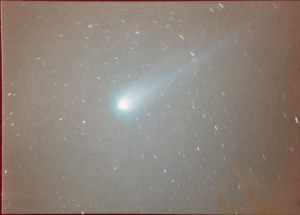
Hyakutake, 1996. My first comet.

A friend pointed me to an article in New Scientist that suggests one of the Göbekli Tepe “carvings show comet hit Earth and triggered mini ice age.” That’s a lot of ice. And eisegesis. Part of the problem here is that old scientists tend to sweep anomalous evidence off the table. It’s an admitted part of the empirical method. If a single anomaly stands against a host of conventionally expected results, the anomaly goes into the bin as an outlier. Göbekli Tepe, as real as it is, is an anomaly. Reputable books on it written in English by archaeologists and historians do not exist. Embarrassed turning away and staring at shoes ensues. The site is just too old, too sophisticated, and too far outside convention to be dealt with rationally. You can read a lot into an isolated carving, especially when accurate information is lacking.

To give you some perspective: the great pyramids of Egypt date from the Old Kingdom of Egypt, after 3000 BCE (remember, we’re counting backwards here). Stonehenge’s main phase (the famous blue stones) was a couple of centuries later than the Great Pyramid of Khufu (Cheops). Göbekli Tepe had closed up shop some 6000 years prior. By comparison, more time had passed between Göbekli Tepe and the Great Pyramid than between the Great Pyramid and us. We, with the internet in our pockets and humans walking on the moon, preparing to go to Mars, are only less than 5000 years from jolly old Khufu. Göbekli Tepe, with its inscrutable carvings, shouldn’t be there. And yet it is. Standard procedure suggests it be ignored. So far, conventional historians have done just that. And in my opinion that’s worse than an ice age brought on by comets written on a stone that nobody can read.


Who Cares?

With all the petitions going around I’m getting a bit dizzy. I won’t go to the doctor though, since I think Trump may be a pre-existing condition. In any case, seeing all these petitions gives me an idea for one of my own. I suggest a petition that says members of congress should not have a health plan. Now wait, hear me out—I’m not vindictive, just practical. Apart from the fact that some of them have been kept alive and active well past their sell-by date, these are people who are supposed to represent us, right? How can they represent what they don’t understand? For a few years after being sent down from Nashotah House I had no medical insurance. Cobra was rightly named because it was more fatal than a bite of its namesake snake. If I had anything go wrong, well, dying was always an option. How many of our “representatives” understand that? When’s the last time they had to stick their fingers between the seats on a public bus to look for change? It’s far easier to pull it out of your constituents’ pockets.

Like everything out of the White House since January, this hasn’t been thought through. Let’s see if I’ve got this right: the rich want tax breaks so they take away the healthcare of the poor people who work in their factories. The poor people die. They can be replaced with cheap labor from south of the border, but we need to build a wall to keep them out. And all of this is going to cost quite a bit so we have to tax the poor people to pay for it. Wait, the poor people are dead. Look, guys, you’re not rich unless you have someone to compare yourself against. I’ve never been to the country club but I bet it’s pretty hard to putt if your green looks like my front lawn.

Hm, death may be a pre-existing condition…

If the government wants to lead, it needs to consist of people like us. That’s why I say we should petition the members of congress to forego their own health care. The day after the House vote I had an email from my Republican representative. He said, “Don’t blame me, I didn’t vote for it.” Well, we live in a day of government-sponsored prejudice. All Republicans are alike. Enjoy it while you can, 45 sycophants. Midterm elections are coming up and I’m going to send a petition to the newly elected Democratic majority. If I’m feeling faint in the meantime I’ll just put my head between my legs. That’s what our elected officials are doing.


Wall-E of Separation

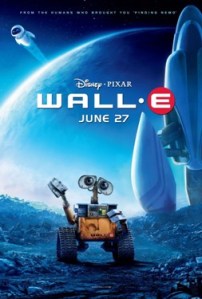
io9 is a progressive website. Its futuristic stories delight and entertain. When a friend sent me a story on io9 titled “New Fan Theory Asks the Obvious Question: Is Wall-E Satan?” I had to read. Then wonder. People know so little about the Bible. The idea is simple: in Wall-E the people live in an undisturbed paradise until Satan (in the form of EVE’s plant) tempts them to leave paradise and return to an earth they’d forgotten existed. Okay, so the Genesis parallels are blindingly obvious (Peter Gabriel was even formerly a member of a band named with the title of that very book). What’s wrong is that there’s no Satan in the Bible’s first book. I give Katharine Trendacosta credit—she discounts the connection of fat, immobile future humans and paradise. The idea that the snake of Genesis is Satan, however, is about as biblical as original sin.

Genesis never calls the snake Satan. It doesn’t mention original sin. In fact, many (Christians, especially) don’t realize the event isn’t called “the fall” in the Hebrew Bible at all. The gaining of knowledge by the first human beings is painful yes, but can be a good thing. Some Jewish interpretations of Genesis 3 suggest precisely that. The story goes that Eve and Adam were living, stupidly, in the garden. The snake points out that the fruit will make them wise—and it does. They do not immediately die as God said they would. Instead they lose a blissful ignorance and have to grow up. The serpent is never said to be the Devil until the very last book of the Christian revisionist scripture, Revelation. Sometimes a snake is just a snake. That’s the way it is in the book of Genesis.

Christian interpretation, however, took over the story of humanity’s awakening and made it into the fall into sin and evil. Things have been so bad ever since than that we have to elect Trump to start a war that’ll end it all. That’s Christian revisionism writ large. Read Genesis again. Slowly. The snake is not said to be Satan. “The fall” isn’t sinful. In fact, the word “sin” doesn’t occur until the story of Cain and Abel in the next chapter. So, is EVE inspired by Satan to end the paradise of the Axiom, unaware of its true origins? Only in a revisionist history of the Bible. The idea existed long before io9, and, according to Genesis, it was wrong even then.


Good Newsists

In the interest of avoiding conflict thereof, I cannot yet give a review of Randall Balmer’s Evangelicalism in America. Since I’m writing a review of it for Reading Religion, I’ll use it as a springboard into a topic that should concern all who believe in religious freedom. One of the resounding themes of Balmer’s treatment is that Evangelicalism, after it wedded to the Religious Right, lost its soul. Those are my words, not his, but the sentiment’s about right. For anyone who wasn’t politically aware in the 1980s, it may seem a surprise that religion didn’t enter into politics before that decade. With the exception of the fear of the Catholic in the case of John F. Kennedy, religion wasn’t used as a political wedge until the presidency of Jimmy Carter. The Religious Right, unhappy with the born again Southern Baptist in the White House, moved to solidify the Evangelical bloc.

Evangelicals had been an underground movement for half a century. Many had no idea what being “born again” meant when Carter first claimed the sobriquet. Balmer points out that it was the threat of the withdrawal of tax-exempt status to discriminating Christian schools that led to political action. Bob Jones University, fearful of racial intermarriage, didn’t admit African American students. Leaders of the Religious Right saw the loss of tax-exempt status as a move against their sacred segregated culture and a push that required a shove. Coopting the abortion issue (historically Evangelicals had supported women’s rights, including the right to abortion in many cases), they nailed together a platform for political activism which put women “back in their place,” kept racial “purity,” and romanced a total aberration in Christianity—the “prosperity gospel.” All of this is well documented. And well hidden.

Looking at Evangelical politics today, abortion—the control of women—has become THE issue. It’s hard to believe, as Balmer amply illustrates, that Evangelicalism used to be allied with the Social Gospel. It was a religious view with a conscience and it supported issues that are now polarized as “liberal” and leftist. This shift came about gradually, but not accidentally. There were political players—Balmer names names—who had one goal in mind, and that goal wasn’t Jesus or what he’d do. It was the sweet prize of political power. Evangelicals, you see, are born followers. A leader with a strong voice can lead them just about anywhere. Many Evangelicals today would deny their more liberal history, but it is right there for anyone who’s willing to learn something about who they once were.


Weather Vain

The other day I was awakened by a severe thunderstorm. It’s been quite a while since that’s happened. Unlike when we lived in the Midwest, thunderstorms in New Jersey tend to be widely scattered and somewhat uncommon. (It’s all a matter of perspective, I know.) My basis of comparison is how often I notice such storms. I’ve never been able to sleep through one. Thankfully this one came at around 4:30 a.m., past when I’m usually awake on a weekend. I’d forgotten the raw power of just how loud and bright such a storm can be. Danger seems all around. The feeling is primal and urgent. As I got out of bed and walked into the dark kitchen, windows filled with electric blue followed by and tremendous blast, I thought once again of Weathering the Psalms and the story behind it.

By the way, when I speak to young scholars about publishing I tell them this isn’t the way to go about finding a topic. That having been said, my book was born in the Midwest. Life at Nashotah House revolves around required chapel twice daily. Weather does not stop it. In fact, holding the daily office by candlelight because a storm had knocked out the power was not uncommon. Morning and evening prayer—indeed, all of the canonical offices—are built around the recitation of the Psalms. Reading the Psalter in slow, stately tones while thunder raged outside, rattling the ill-fitting stained-glass windows, left an indelible impression. It was only natural in such circumstances to notice how often the Psalms mention the weather. Thus a book was born.

I’m currently at work on a new book. I can’t say the topic just yet because someone might be able to beat me to it. (Knowing the way I come up with book ideas, however, I doubt it.) Sitting in my darkened living room, in my writing chair with the fury just outside, I was strangely inspired by the storm. Then it was over. Silence followed by birds singing, just like in Beethoven’s sixth symphony. The thunderstorm is one of nature’s psalms. As at Nashotah House, in the Midwest we had perhaps too many of that particular kind of psalm. Nevertheless, in the silence that followed I was left strongly in touch with my muse. These are the states that lead to poetry and song. Every great once in a while they might even lead to a book idea. As I tell students, just don’t expect that anyone else will get it.


United States of Ego

We all know the type. The guy who brags that he can do something complex without all the study and “hard work” (scare quotes theirs) necessary beforehand. When he starts strutting his stuff, and realizes that it is much harder than he thought, he has to find a way of backing down without losing face. We all know somebody like that. Now we all know somebody like that by dint of his being in the White House. Politics, like most complex things, isn’t as easy as it looks. When you’re president of the United States, backing down quietly’s not an easy thing to do. Why not start a nuclear war instead? Better dead than read, as the saying goes.

Thing is, braggarts may convince others that they don’t know what they’re talking about, but they’ll never convince themselves. The truly sad thing is we’ve never lived in a country where it was possible to buy your way to the White House before, based purely on ego. Don’t get me wrong—I know that every president has to be an egoist to some degree. What the previous 44 have had, however, is considerable knowledge of politics. Even the dumbest of them read. They knew this wouldn’t be some simple task that you could simply wing, like a business deal. You have to do homework. A lot of it. And it’s not easy. Even the relatively simple life of a professor of religious studies requires years of training. Hours and hours and hours of reading and thinking. Believe it or not, it’s hard work.

Now we have a chief executive tweeting that it’s hard to be president. Everyone, it seems, except 45, knew that. That’s why most people would never bother to run for the office. Our civilization utterly depends on experts. That surgeon that works on your heart, you swear, had better be an expert. Those guys who build the missiles we lob onto whomever we feel like, had better be experts. And even if your steak comes out of the restaurant kitchen poorly prepared, you send it back for expert treatment. And yet, we’ve elected the least qualified candidate who’s ever run for the office in over two centuries of history. His expertise: pleasing himself. Greed is a poor substitute for leadership. Even now that it’s crystal clear we live in a headless state, his supporters cheer him on. Let’s hear it for the poor uber-wealthy. Those guys need all the help they can get.