Thy Fandom Come

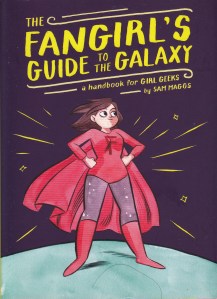
It’s not hard to feel that you’re from another planet. If you were born in the sixties and had kind of a rough transition to this whole internet thing, you know what I mean. Still, I want to be part of it—it’s kind of like New York City, only bigger. And faster. The commute doesn’t take nearly as long, now that dial-up’s a thing of the past. So I bought someone who was into fandom Sam Muggs’ The Fangirl’s Guide to the Galaxy: A Handbook for Geek Girls. This particular fandom, well, fan, gave me the book to read. I’m a feminist, so I don’t have any issues with reading a book intended for girls. What became clear to me, however, is that I don’t understand the internet nearly as well as I thought I did, and that girls find they’re oppressed there too. What is it with men and control?

It is an ethical issue. I don’t blame people in the past for not thinking like we do, but today there’s no excuse whatsoever for considering somebody a lesser person because of their gender. Women and girls have just as much right to “guy things” like geekdom as do males of the species. Fandom is all about fun. Enjoying the fantasy of living, for a little while, in other worlds. From the way many men treat women it’s no wonder that they feel that need just as much as my own self-identified gender. Religion, unfortunately, bears much of the blame for this. In the largest religious bodies in the world women are still excluded from leadership roles. Religion is kind of like fandom in that way, I suppose. It can be all about exclusion. We exclude others to make ourselves feel special. Why not celebrate difference and find a place for everyone?

It’s difficult to read The Fangirl’s Guide as a man simply because you’re constantly reminded (and not intentionally, because it’s written for girls) at how inhospitable men have made much of the world for their female earthling compatriots. I was reminded at several points in this book of how films like Wonder Woman and the recent Ghostbusters stand out in their sympathetic portrayal of women heroes. And equally how men find reasons to criticize them. Then I consider the White House and shudder. When a nation elects an open and avowed patriarchalist as president we all could use a fantasy world in which to hide. This little book didn’t make me into a fangirl, but I do hope it makes me a better man.



Implied of Course

The American terrorist attack in Charlottesville over the weekend should have us all frightened. Despite declarations of “it couldn’t happen here,” fascism is an adaptive disease that finds its way to new hosts quite readily. The atmosphere coming out of Washington only promotes contagion. Trump’s response—bad behavior all around, no one party to blame—left the supreme white commander open to criticism. The appropriately named “White” House spokespersons responded with an implied “Of course that includes white supremacists,” according to the Washington Post report. That’s an awful lot of weight for an adverb to bear. The past six months have given many of us reason to doubt it’s true at all. “Of course” 45 loves all Americans. Or at least their cash.

Of course, I could be making a lot out of an implied deflection. A national leader should not hesitate to point the blame squarely at any supremacist group. Listen closely: no group is superior to another. Anyone’s background, examined closely enough, is likely to turn up a character or two who would be suspect. Trump’s election gave a new boldness to fascist groups—this is the way America’s going, isn’t it? Republican leaders, full of squees and shivers, refuse to say anything negative about a man whose thumbs can’t even reach the humility emoji. Hate crimes are wrong. They used to be illegal. What has happened to leadership? It’s more than just the CFO, wait, I mean Commander in Chief, who’s implicated here. It’s an entire political party that won’t stand up against injustice. What ever happened to “truth, justice, and the American way,” Clark? There’s never a phone booth nearby when you need one.

Back when I worked at Nashotah House, we had a conflicted environment. One of my colleagues told me something that has stayed with me ever since: “silence implies consent.” If you don’t condemn evil, you are complicit with it. We all need to stand up and say racism isn’t just an opinion—it is evil. Human rights are more than just civil rights. All people have the right to be treated fairly. Someone who hates others enough to climb into a car, start the ignition, and accelerate toward a group of pedestrians is guilty of premeditation. A president who won’t say as much is tacitly saying it might just be okay. Of course, it might just be that he’s too self-absorbed to get the thumbs going on the words we’ll never read: “I’m sorry.” Of course I’d be glad to be proven wrong.


Prophecy of Hezekiah

Maybe my recollection of the Gospel’s a bit hazy. I seem to remember one of the main characters of the New Testament saying something about doing unto others as you would have them do unto you. And turning the other cheek. I may be recalling incorrectly, since Robert Jeffress, one of Trump’s “evangelical advisors” (and since when do Presidents need evangelical advisors?) has said the Bible gives you permission to take out your enemies. Granted, it takes a twisted exegesis of Romans, and twisted exegesis works best in twisted minds, but this runs full frontal in the gospel ideal of love just two books earlier in the Good Book. Forcing the Bible to say what you want it to say is a tactic as old as preaching itself, but still, those of us with training in Scripture shudder.

Pulling verses out of context like the Bible’s a magic book is called “prooftexting.” Not related to the current plague of texting, prooftexting means you can make the Bible say whatever you want it to. The classic example is that the Bible says “there is no God.” Check it out. I’ll even give you the reference: Psalm 14:1. What’s that? I’ve left out the most important part? “The fool says in his heart, ‘there is no God.’”? You see what I mean. The danger here is that a feeble-minded, biblically illiterate world leader could easily be swayed. Nukes, after all, are great for your ego. Who wouldn’t want the Bible to say that it’s fine to take out all your enemies, and horde all the money you possibly can (not it’s not the root of all evil—Paul is dead, after all.) Except Paul wrote Romans. How are we ever to decide?

The Washington Post story by Sarah Pulliam Bailey may not suggest that we should pay attention to Bible scholars—hey let’s not get too radical here!—but the world would be a very different place if we did. The Bible is a complex and difficult holy book. (As most holy books are.) The idea used to be that you had to spend a lifetime in a monastery, or at least a few years in a seminary, to say something intelligent about it. And that training wasn’t reinforcement of literalism. But we live in a brave new world. A world that re-envisions Jesus as the loving God with his finger firmly on the button. And sycophant preachers saying, “Go ahead, make my day.” It’s all there in the book of Hezekiah.


Bible Hobby

Hobby Lobby needs a hobby. Besides the Bible, I mean. The amorphous media has been buzzing about the new Bible Museum set to open in Washington DC soon. The Lobbyists seem to think the Bible will save America. Not the Bible exactly, but their narrow, constricted, and uncritical view of the Bible. Seems a lot to expect from a museum. Museums, the Green family apparently hasn’t considered, are monuments to the past. When I last saw the politically incorrect Elgin Marbles I didn’t feel inspired to run out and build a parthenon. Instead, I simply wondered about the past and how it must’ve been cool back then. I didn’t want to live there though.

I’m sure there are great plans for the Good Book in the Bible Mausoleum. Looking at displays of the same text over and over can surely get a little dull, if we’re being honest with ourselves. I like Bibles as much as the next guy. Actually, I probably like them more than the next guy, but that’s beside the point. I don’t need to go to a museum to see them. There are Bibles all around my office, a mere arm’s length away. Here at home I can take in many of them at a glance—there are Bibles on three sides of me even as I write this from my favorite chair. Saving a nation that’s had the Bible from the very beginning sounds just a touch ambitious to me. But then, I’m no billionaire with nothing better to do with my money. There’s probably a tax write-off in there somewhere.

The thing about the Bible is, once you learn about it you can’t unlearn what becomes clear along the way. Cover your eyes or ears if you will, but we know the Bible had a long and complex history before becoming “the Bible.” It doesn’t have much of a plot without Revelation tacked onto the end—and seriously, that was one of the reasons it made it into Holy Writ to begin with! The circumstances that led to the Bible were often quite profane, in fact. It was the recognition of it as a sacred book that was a religious activity. The next step was to spread it as far as possible. That’s pretty much been done. The end result? The election of Donald Trump. If that’s salvation we’re all screwed. At least when we’re all standing in the bread line we’ll have a museum to visit while we wait. And it will be an encomium to something that was great once upon a time.


An Odyssey

Once again in Ithaca, I find myself thinking of the classics. Although it’s difficult to believe these days, even rural Americans used to value a classic education. Take upstate New York. Not only is there an Ithaca, but also a Rome, Syracuse, and Homer, among other locations. This speaks of a time when the non-urbanites wanted to be considered sophisticated rather than gun-toting, bigoted rubes who actively hate higher education and all that it stands for. My maternal line of ancestors came from this region, and although they were simple farmers, they still named my grandfather Homer. And his sister was Helen. They knew the Bible, yes, but they may also have know the Iliad.

In a recent, flattering online game, Oxford Dictionaries offered a quiz to help you identify which classical hero you were. This is flattering because most of us aren’t heroes, but instead work-a-day types just trying to survive in a Republican world. I had to confess being pleased to find the result suggested I identified with Odysseus. Odysseus was king of Ithaca, you see, and considered one of the heroes more inclined to use his brain than his brawn (although he could use that too, if push came to shove). Perhaps it felt right to me since my own life feels like an odyssey. And my grandfather was Homer. I was first exposed to classical mythology in fifth grade, and I have loved it ever since. Besides, I’m more of an upstate mentality than a downtown one. The thing about an odyssey is that you’re not always in control of where you end up.

Sitting here in Ithaca I wonder how Americans came to despise the notion of classical education. The standard of living is higher in college towns like this. People treat each other well and there’s a strong sense of community spirit. On the way here yesterday we had to drive through rural New Jersey. We stopped in the decidedly non-classically named Buttzville for gas. The car in front of us had “Blue Lives Matter” and pro-Trump bumper stickers all over it. Yet the guy who limped out and made his way into the vehicle looked like he had probably benefitted from government largesse over the years. Proud of a president who brags about not reading. Who wants to bomb a country he can’t find on a map just because it’s different. I think to myself, I’m glad I’m on my odyssey to Ithaca.


Movie Meaning

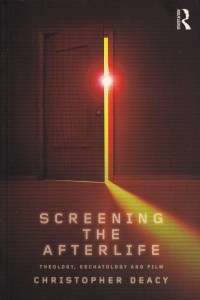
Theology has never been my thing. Now, those who don’t parse things too finely may find that an odd statement. “This blog almost always addresses religion,” they may say, “how can you say theology’s not your thing?” Perhaps for the layperson “theology” means anything having to do with religion. In the biz it has a more specific meaning. Theology is tied to a faith system. It tries to explain, rationally, what that belief system entails. Religious studies is more about studying what religion is and how it works. It was this fine distinction that put me off from reading Screening the Afterlife: Theology, Eschatology and Film. Christopher Deacy treats the subject theologically and, depending on the theologian, that can mean a lot of effort for little result. I was, however, pleased about a number of things in Deacy’s book. He doesn’t shy away from horror, for one. And he takes cinema seriously.

The idea behind the book is straightforward—theology and movies should be in dialogue about the afterlife. At a number of points Deacy makes it clear that films reach a wider audience than theology books. Again, those of us in the biz know that to be very true. If people watch movies they begin to accept what those movies tell them as true. For those of one of the established faith systems, if things haven’t altered all the much since I was young, discussing the religious meaning of a secular film is always interesting. (Some of my friends drew the line, however, when I found Elijah parallels in a film where a bread machine went out of control, but that’s a story for another time.) People take movies seriously. During economically depressed times, movies thrive. We need to pay attention to them.

The problem with theology is, no matter how open it may be, there’s always some element of rightness involved—this perspective is right and that one wrong. It can hardly be any other way. To open the door too widely is to invite yourself to exit. Deacy selects films he finds theologically meaningful when addressing (mostly) Christian views of the afterlife. I’m guessing—and it’s only a guess—that many people get their information from popular media and theologians are completely off the screen. That doesn’t mean theology has no place, but it does mean that its place is in the hands of other scholars rather than those who just want to sit around and talk about the film they saw last night. Both may be profound, but one is more clearly enjoyable than the other.


Meaning What?

An occasional reader will contact me to say that something I’ve been writing about for years has appeared in a major media source. Not the story I wrote, mind you, but in an episode of convergent explication somebody better connected has drawn the same conclusions I’ve been muddling over since the 1980s. So it goes. One such story appeared recently in the New York Times. Despite the title “Don’t Believe in God? Maybe You’ll Try U.F.O.s,” the piece is really about finding meaning. According to the Times, and I’ve been saying this for years, meaning is something that the facts don’t always give. Religion gives purpose to life. Most academics, naturally, ignore it.

The use of UFOs in this story is clearly an attempt at demonstrating the irrational. Those who see such things are the laughingstocks of the “sophisticated” crowd. Anyone who’s attended an editorial board meeting where a book mentioning UFOs is raised will know immediately what I mean. Laughter all around, no matter how serious the treatment may be. After all, only crazy people see them, right? That having been said, the Times article is quite correct that UFO religions are on the rise. Increasing numbers of earthlings are looking offsite for meaning. And who can blame them? Traditional religions often suggest that the beyond, however defined, is much more interesting than the mundane we find laying around all over here. Ironically, this can be a one way street.

What is that?

“Believers” in UFOs often resist the association with religion. After all, isn’t it the religious who are really crazy? As long as people see things in the sky they can’t explain (and this has happened for millennia) there have been Unidentified Flying Objects. Despite Project Blue Book they’ve never been studied in a serious way by science. The few bona fide scientists who’ve dared admit an interest have put their academic or industry jobs at risk. If you wonder why all you have to do is attend an editorial board meeting. We like to laugh at those more gullible than ourselves. As someone once said, indignation feels good. Nothing raises indignation like feeling superior to others. And we feel superior when their intellects are obviously so feeble as to believe in things like religion. Oh, I’m sorry! Were you expecting me to write “UFOs”? Well, go ahead and make the substitution. I won’t be offended. After all, I’ve been saying this stuff for years.


Lovecraft Legacies

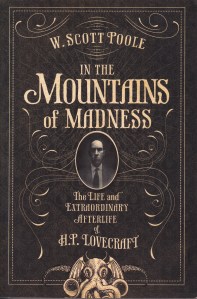
Although long fascinated by popular culture, I’ve not really been part of any fandom. I suppose this is because my interests tend to be quite broad, and finding one piece of pop culture over which to obsess is difficult. I might miss something somewhere else! While not really a “fan” of H. P. Lovecraft, I’ve read much of his writing and I’m amazed at how pervasive his cultural influence has been and continues to be. W. Scott Poole, who’s taken us into realms historians often shun, has done a great service to those interested in Providence’s most famous son. In the Mountains of Madness: The Life and Extraordinary Afterlife of H. P. Lovecraft is a thoughtful, honest, and in-depth consideration of both the man and his fiction. The basics of Lovecraft’s life are easily accessed, but the probing questions Poole puts to the evidence are thought-provoking and, in many respects, revelatory.

Perhaps the largest Lovecraft demon that Poole tackles is H. P.’s racism. There’s no secret about this, but fans often find ways of excusing it or explaining it away as being a product of his time. Those of us who write can understand that Lovecraft didn’t get out much. When he did get out he preferred it to be among people like himself. (Male, white, and gentrified.) It’s difficult to say what the origins of prejudice are, beyond the natural tendency to fear those who are different. Still, intelligent people can generally figure out that such biases are based on lack of experience or willingness to learn about other cultures. There are many, many cultures in the world and it’s often hard to think that yours isn’t the best. A large part of today’s political turmoil is based on this very thing.

An added benefit to reading Poole’s book was the realization that although Lovecraft really didn’t travel much (he didn’t live very long either, and the two are at least partially related) he did at one time visit the small town in New Jersey where I live. That came as a bit of a surprise. The last time I visited Providence, there wasn’t much in the way of signage or plaques to mark where Lovecraft had left his stamp. That may have changed in recent years as his literary star has continued to ascend. Still, to find out that he’d passed this way once upon a time was a nice little bonus in the investigation into who this man was. There’s a lot more to dig out of Poole’s book, and fan or not, if you’re interested in Lovecraft this is a must read.


On the Rocks

This universe is indeed a mysterious place. You don’t have to believe in the paranormal anymore to see it. A look at the headlines makes my point. There are those, however, who do look at the genuinely strange, and once in a while this realm crosses paths with that of religion. A friend pointed me to a story on Mysterious Universe about floating rocks. Apparently this story is going to be on the mainstream Travel Channel, so it’s not completely bonkers. It caught my attention because it’s about rocks. While of decidedly poor qualification to be a rock-hound, I have more than a passing interest in geology. Itinerates shouldn’t collect rocks, but I can’t help myself. Anyway, I’ve been known to go to publicly open mines and tap away with my rock hammer hoping to find some not-so-hidden treasure.

According to the story, there is such a publicly open mine in Arkansas. Crystals (I expect quartz) are available for surface excavation, for a fee. Then the owners, the Murphys, noticed the anomalous rocks. Since they are conservative Christians (this is Arkansas after all) they feared what powers might be behind rocks that don’t obey the laws of gravity. The mine didn’t get closed and hushed up because of an unusual source of inspiration. An article by Billy Graham on divine mysteries led them to keep the mine open and to allow for investigation. Once the Travel Channel comes out with its program Crystal Mine is sure to experience an influx of business. Mainstream scientists, one expects, will not be among them.

The universe is vast. We haven’t explored all of our own planet yet (we’re kind of busy destroying it at the moment, so if you don’t mind…) and yet we gleefully claim what’s impossible. I don’t know if there are levitating rocks in Arkansas, but I do think we’ve been a bit hasty about some of our conclusions. We may yet find things that will force the concepts—the laws—to change. Consider gravity, which seems particularly relevant in the case of floating rocks. Sir Isaac Newton (devout theist that he was) ending up having to relinquish the “correct” explanation to Albert Einstein. Some have been so bold as to suggest that maybe even Einstein might not have gotten the whole skinny on gravity. We continue to learn. Levitating rocks are indeed strange. Not so strange, however, as Billy Graham being the one to rescue an anomaly for the world to see.


Survival Instructions

When the apocalypse comes—present political antics assure it more than any biblical prophecy—I fear for the survivors. This post is for them. I presume you’ll get the internet back up and running quickly; it is, after all, humanity’s most important achievement. I know you’re hungry, but first a bit of history. (Sorry, I used to be a professor; it’s how my mind works.) The trendy drinking glasses that some restaurants used to use were called Mason Jars. They were originally for home canning. You see, in summer when the earth was generous, we’d have too much food. Judging from the state of my refrigerator, it’s impossible to keep it fresh for more than a few days. So people invented canning. You’ve probably found a stash of cans, which is why you’re reading this post. These glass cans came with a pretty obvious screw-on lid, under which was a sealed lid that you could pop off with a thumbnail if you were desperate enough. Food awaits.

Then a metal canning process was invented. To open a metal can you need a special tool called a “can opener.” Since I’m sure all electric can openers were destroyed in the apocalypse, you’ll need to know how to open a can with the items at hand. Do not panic. If any Swiss Army knives have survived (and I’m sure they have, if anything has) you can use one of those. Unfortunately, describing how is more a job of poetry than prose. Besides, I don’t have a webcam to record myself, or my disembodied hands, doing it for you. You might find a commercial can opener a better option. Be careful, they break easily. If you find some in the ruins of a store take them all—you’ll need them. Got one? Okay, now here comes the tricky part.

You need to use this device to open the can to get at the goodies inside. I’m writing this during a rather paranoid and poorly educated period of human history, so please bear with me. It is your salvation. Even the simple can opener has to be sold with wordless instructions in my era. I am here posting those instructions. Follow these two simple steps, numbered conveniently “1.” and “2.” You will have food for your starving bellies soon enough. And while you’re slurping down whatever sweet or savory goodness is inside that metal container, maybe you’ll pay heed to a bit of friendly advice from someone who didn’t survive the dread end of the world: when enough of you find each other to need to elect a ruler, please be sure that whoever it is knows what she’s doing. One thing you might look for is someone who at least knows how to use a can opener.


Citation Anxiety

As a recovering academic, I sometimes am compelled to look when Academia.edu sends me notices. Academia, most of my academic colleagues don’t realize, is a for-profit website that advocates open access. “Open access” (or OA in the biz) is academic trash talk for making the published results of research available for free. It’s a great idea, but it often doesn’t take into account how complex publishing really is. Peer review, printing, and distribution of articles all take money and to make all research free cuts out what those who publish the research can use to fund the venture (with a cut taken out, of course, to make the whole thing worth their while). That’s the way capitalism works. (Look it up under economics.) In any case, not realizing that Academia is also a profit-making venture, lots of us put our published papers on it, making them freely available to anybody who cares.

Once in a while Academia will send its users a flattering notice: “X-hundred people have cited your papers.” Be still, my throbbing heart! Desperate for any attention, most academics (let alone us exes) are thrilled that more than 100 people have read their stuff. So I clicked their link. “309 papers mention the name ‘Steve Wiggins’ or ’S.A. Wiggins’” it cheerfully reads. I know something the robot apparently doesn’t. I’m not the only Steve Wiggins on Academia. There is a slightly older agronomist whose name I share. He’s employed in academia and has more papers than me. And “S. A. Wiggins” could be anybody. My 309 paper mentions shrinks to double digits. Not high double-digits either. Names are hardly unique identifiers. With some seven-and-a-half billion people, there’s bound to be some reduplication. I always tell the few curious to search “Steve A. Wiggins”—with the quotation marks—to find the few, true references.

Taking on the internet is a fool’s errand. This blog gets a few piddly hits a day. I often consider closing it down. Readers don’t share it enough to get any attention. It takes a lot of effort on my part since I write books (both fiction and non) in my hours not at work. So when Academia shows up in my inbox my excitement spikes, just for a moment, and I go on with my other work, which never seems to get done. And then, when I’m sure nobody else is looking, I go ahead and click on the link.


New Religious—Bang!

Religion, no matter what the skeptics say, gives us something to believe in. Even those who claim no religion believe in their non-religion. We can’t escape belief. It’s no surprise, then, that new religions constantly emerge. As people find new things—or events—meaningful, and they come together around the phenomenon or episode, a religion eventually emerges. Take the example of the Chelyabinsk meteorite. On February 15, 2013 a resounding explosion rocked Chelyabinsk. What was likely a former asteroid had headed for Russia (which they seem to prefer almost as much as Donald Trump) and became a meteoroid (the name for meteors while they’re still in outer space). Once it entered the earth’s atmosphere and became a meteor proper, it superheated and exploded in the sky—a phenomenon known as a bolide. For those of us who’ve experience them, bolides are unforgettable. Once the pieces of the exploded meteor hit the earth they became meteorites.

Image credit: NASA/ESA, public domain

Meteors are an everyday occurrence. Any time you see a shooting star—which you can do any clear night—you’ve seen one. Large, exploding meteors are rare. Shortly after the Chelyabinsk meteorite fell, according to Astro Bob, the Church of the Chelyabinsk Meteorite formed. This group did not wish for the main body of the surviving meteorite to be raised from Lake Chebarkul, where it fell. Their protests became religious as they chanted, prayed, and sang. A new, if temporary, religion was born. Astro Bob goes on to say that religions and meteorites are no strangers. Indeed, up until the Middle Ages and even a little beyond, it was believed that rocks could not fall from the sky. A meteorite, then, was a sign from either God or, well, you know who. When the impossible happens religions are quick to follow. Astro Bob’s story was written in 2013, so he doesn’t declare the fate of the Church. The meteorite was raised from the bottom of the lake in October of that year.

New Year’s Day in 1987, while I was home from seminary on break, putting a puzzle together with my brother, our house shook. A loud boom accompanied the shock wave. We ran outside to find the neighbors staring at the sky, and a few casting a wary glance toward the petroleum refinery in town. The news later that day told us a bolide had exploded nowhere very near us. We were within the shock wave, and those fortunate enough to be outside that January saw a flaming meteor in the daytime sky. I remember it well thirty years later. I already had a religion at the time (Methodism, starting to tend toward Episcopalianism) so my plate was already full. It was nevertheless a dramatic event, and when your world is literally shaken, you will naturally look for something to believe.


The Rights and Privileges

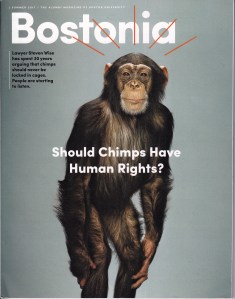
Bostonia is but one of several alumni magazines that makes its way to our humble apartment. Between my wife and I we have many colleges and universities begging us for money while offering us no jobs. Despite being a denied professor I have little time for magazines. I’ve always been a book man. If I’m going to put time into something I want an ISBN to claim at the end of the day. Still, the cover of the Bostonia asks a relevant question: “Should Chimps Have Human Rights?” I have long argued, based on books I’ve read and on personal experience, that animals are conscious beings, like we are. If consciousness evolved, it has to have its roots in other animals, otherwise scientists are positing “special creation,” call it what you will. If animals share consciousness, they should share rights.

People have used animals for as long as they could figure out how to do so. It may have been a two-way street at first, since we’re pretty good at protecting critters we find valuable and who doesn’t like a free lunch? They stick around us. The earliest domesticated animal seems to have been the wolf, which we made into a dog. Other common mammals joined the mule train after that. Humans: they treat you rough, but they’ll make getting food a snap. There’s a kind of consciousness involved already, don’t you think? If they can’t figure out that we’re not going to harm them (at least not yet) then they’re smart enough to keep their distance. Not all wolves became dogs.

Primates, however, are a special case. They sort of look like us. Chimpanzees, especially, act like us. They don’t get human rights because those are reserved for others of our own species. I mean, consider those in charge of the free world! They believe in the right to acquire as much of the world’s resources as they can for themselves. They guard the use of those resources so they can live in unutterable luxury and make everyone else pay through the nose for the very necessities of keeping alive. The masses pay taxes while those who have more than enough do not. We are a domesticated species, it seems to me. Don’t get me wrong—I do believe chimps should have human rights. Other animals too. We’re all connected. But the real question I have, looking at the headlines from Washington, DC, is turned the other way around: should humans have the rights of chimps? Don’t ask me; universities won’t hire my likes when others will bring them greater glory. They’ll gladly accept my money, however. It’s their right.


Water Bears

Since we should all be busy planning on alternatives to planet earth, my mind has turned to tardigrades. Known as “water bears” these very simple animals are amazingly complex. Don’t go looking for them in your drinking water, however. They’re microscopic. So why am I thinking about tardigrades at a time like this? Because they’re one of the few organisms that scientists believe could actually survive the destruction of the planet. Who knows? They might even be able to survive in Washington, DC. Maybe that’s why they’re in The Washington Post.

You have to look closely to see one.

Able to cling to life at the cusp of absolute zero, in conditions with no oxygen, and at doses of radiation that would leave the human race—among most other species—fried, these micro-organisms are truly remarkable. No wonder scientists are playing with thought-experiments as to how to wipe them out. Hey, scientists are only human after all. Don’t worry—nobody’s really trying to kill these little guys off. The question behind Ben Guarino’s story seems to be what makes these tiny creatures so amazingly resilient. It raises an issue that I often ponder. The will to survive. Evolution is, according to standard theory, without purpose. Natural selection works in a “logical” way: the most successful organism survives long enough to breed and its traits become standard options in the next generation. Nobody needs to want anything (except to mate) and chance takes care of the rest. But that doesn’t explain the will to survive. The “eye of the tiger,” if you will. I’m sure this wasn’t what the Washington Post was intending to trigger, but doesn’t it seem strange that even “non-conscious” micro-organisms “want” to survive?

The desire to exist is dangerous territory. It has a whiff of the divine about it. One of the characteristics of life, if my high school biology isn’t completely outdated, is the ability to reproduce. What it didn’t address, for fear of teenage snickers, I’m sure, is the desire to reproduce. Why does life insist on its own continuation? Is it truly just an eons’ long succession of one-night stands that results in creatures capable of even asking that question? Or is there something more to it? Tardigrades have segmented bodies, legs, and claws. All at less than 40,000 cells per individual. They lack a neocortex (which doesn’t necessarily disqualify an individual from being president). They can’t answer the questions we put to them. As individuals they are remarkably easy to kill. As a species, however, their resilience carries the answers to some very deep questions. If only we had the will to ask them.


Apocalyptic Dreams

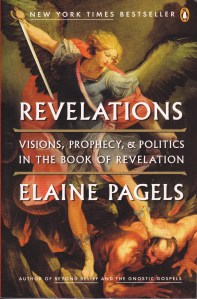
Words. They can be slippery sometimes. Take for example the word “revelation.” It can be secular or sacred, and if the latter, general or specific. Many recognize it as the title of the final book of the Bible, and some can’t even get enough of it and make it plural—Revelations. “Revelation” is actually a translation of the Greek word apokalypsis, the “original” title of the book. It has been a source of contention as well as fascination just about since John—whoever he was—put quill to parchment. Elaine Pagels, whose work is always rewarding to read, plays on the singular/plural convention that raises the ire of many a biblical scholar. Revelations: Visions, Prophecy, and Politics in the Book of Revelation is a refreshing change from what I read in college and seminary. No book exists without a history and that of the Apocalypse is colorful indeed. And it revolves around what has been traditionally taught about “revelation.”

The current final book of the New Testament presents itself as a revelation. It isn’t, however, the only book from this time period to do so. Many revelations existed, as did many gospels, in the first couple centuries of the Common Era. Some early leaders of the Christian movement who became inordinately influential decided that John’s revelation would be okay to keep but the rest should be destroyed. And they very nearly were. Some were recovered by the fortuitous discovery of the Nag Hammadi library in Egypt. These texts have preserved some of the other gospels and revelations that rivaled those of the current canon. It is in her close observations about their continuities and the motivations behind the politics of early Christians that Pagels sheds fascinating light on how Revelation became a tool of manipulation in a power struggle, primarily for centralized religious control of Egypt. Looking at headlines even now we know that it never really worked.

Revelation very nearly didn’t make the canonical cut. Many church leaders of the fourth century believed it spurious and not entirely helpful. It has, however, arguably become the most influential book of the Bible. Evangelicalism is hard to imagine without some kind of end times dispensational viewpoint that owes its existence to John of Patmos. Reformers, while not caring for the book, saw Revelation’s usefulness as a cudgel to strike at Rome. The papacy likewise saw it as a vivid threat against reformers. Those who took sola scriptura a little too literally used Revelation as the focal point of their hope and practice. Today we’re left with Left Behind and the Rapture and the Antichrist, whether they occur in Revelation or not. (They don’t, but who’s counting?) Pagels will give anyone plenty to think about here, and she’ll do it in surprisingly few words.