Straining Credulity

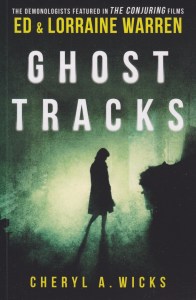
Ed and Lorraine Warren aren’t easy to figure out.  I realize that for someone who holds an actual doctorate from a bona fide, internationally recognized research university this might be something strange to say.  That’s because the standard academic response is simple dismissal.  Ed, at least, was known to have stretched the truth from time to time, but that’s not the same as never having reported weird things that actually happened.  This is why I’ve long advocated academics at least looking at the evidence—rare though it may be—before the simple hand-waving dismissal.  Part of the problem is that the Warrens’ books were written by credulous followers who don’t question things nearly enough.  Ghost Tracks, by Cheryl A. Wicks, may be the last of this strange genre of hortatory, biographical accounts “by” the Warrens written while Ed was still alive.

Skepticism is very important.  But so is listening to people.  What I find compelling is that similar weirdness—frequently dismissed out of hand—has been recorded throughout the length and breadth of history and across the entire globe.  The problem is that many of these things fall outside current scientific means of testing.  While perhaps not widely known, very reputable universities quietly explore these possibilities with actual science.  Part of the problem of the Warrens, as well as various other “ghost hunters” is that they use scientific equipment and think that makes them scientists.  It doesn’t.  Science requires deep engagement and many years of strenuous study.  And yes, skepticism has to be part of it.  The thing the Warrens have to offer is that they realize(d) that when science does engage the supernatural interesting things emerge.

Sensationalism, however, is the slave of capitalism.  Books sell better when they make extraordinary claims and declare they’re based on true events.  Trying to make a living investigating the paranormal led the Warrens, it seems, to tip the balance a little too far in the way of credulity.  Some of the stories in Ghost Tracks are more believable than others.  Some are just plain frustrating.  Ed’s interview with George Lutz (of Amityville fame), for example, is full of dropped balls.  A good question receives an intriguing answer only to have the subject immediately switched by the interviewer.  Even just a little skepticism and a follow-up question would have done scads to improve the believability of the story.  This is something a scientist would have known.  Someone as smart as Sir Arthur Conan Doyle, although his Sherlock Holmes generally found  ratiocination led to physical explanations, believed in the supernatural.  If only his Holmes might’ve been brought to this discussion we might possibly have learned something.

The Dots

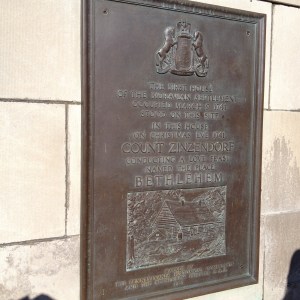
Connections have always fascinated me.  Maybe it’s because life is a random stream of stuff constantly thrown at you that makes a mockery of any plans you might try to implement.  Me at Nashotah House?  Really?  Nevertheless, these events shape us and everything that happens thereafter is seen in light of them.  So when connections occur amid this continual flux, I sit up and take notice.  For example, I had never thought of moving to eastern Pennsylvania.  Now, around Christmastime, I find myself not far from Bethlehem.  Bethlehem was so named because it was founded on Christmas Eve by Moravians who’d settled in the area.  Although not counted among the most numerous of Protestants today, Moravians had a profound effect on the founder of Methodism, John Wesley.  In fact, he met Count Zinzendorf, whose name appears on this handsome plaque in historic downtown Bethlehem, at a pivotal moment in his own spiritual journey.

Having grown up Fundamentalist, the United Methodist Church would not have been our choice, although we had unwittingly attended one of the Methodist offshoots—the Church of the Nazarene—from time to time.  In one of those unplanned things, we found ourselves in Rouseville, Pennsylvania, where the only Protestant church was United Methodist.  Once ensconced in the UMC it was my plan to become a minister in that tradition.  That led me to Boston University School of Theology where I first learned about the Wesley-Zinzendorf connection.  It was also there that I met my wife.  And subsequently joined the Episcopal Church.  Why?  John Wesley had been adamant that his followers not drop out of the church in which he was an ordained priest.  I was only following instructions.

Had that not happened I would never have had my first, and so far only, full-time academic job.  Nashotah House was conservative, and I was not.  We nevertheless had a connection.  Growing up I’d barely heard of Wisconsin, let alone planned to live there.  When Nashotah no longer required my services my career had to change as well.  None of this was in the plan.  Who plans to move to New Jersey?  And now everyone thinks of me as an editor, a fallback position if there ever was one.  Since I work in New York City, moving back to my native Pennsylvania wasn’t really on the agenda.  An outside agent led to that.  So I find myself near Bethlehem in the Christmas season, staring at Count Zinzendorf’s name, which I first heard of in a seminary now far away.  Connections, even with those long gone, are always worth noting.


Book Birds

I just read an interesting article about how social media, and the internet in general, hijacks our time.  If you’re reading this, no doubt you’ll agree.  Those of us who write books on our “free time” know that the way books are both found and sold is on the web.  Publishers  encourage authors to build a social media platform, usually involving Twitter.  Academics are often hopeless at social media—they’re lousy at following back on Twitter, as I know from experience.  There is a kind of self-importance that comes with higher education which makes many of the professorate assume the work of others is less important than their own.  It’s more blessed to be tweeted than to tweet others.  After all, such-and-such university has hired you, and that proves the value of what you have to say.

Head-banging tweeter

Book publishers, however, will be looking at how many followers you have.  Not that all of them will buy your book, but at least a number of them will know about it.  Curiosity, indeed, drives some sales.  Just like many academics, I’m jealous of my time.  I’m also conscious of that of others.  These blog posts seldom reach over 500 words.  I tweet only a couple times a day, although I understand that’s not the way to get more followers.  You need to tweet like a bird, often with images or memes, but try explaining that to your boss when each tweet is time-stamped.  The academic is uniquely privileged to be given control of their time outside of class and committee meeting.  Tweet away.  That doesn’t mean they’ll follow you back.

The reason for tweeting is, of course, self-promotion.  45 may understand little, but he understands that.  You can commit treason and people will overlook it if you tweet persistently enough.  My own Twitter activity is like the eponymous birds after which the site is named; it is active before most people are awake.  And it, like this blog, is not designed to take up your time.  Since my tweeting during the work day is limited, my tweets are seldom picked up.  I try following other academics, but often they don’t follow back.  After all, what does a mere editor have to say that could possibly be of interest to the high minded?  Alas, I fear my advanced studies of the Bible have become bird-feed.  And my forthcoming book won’t get noticed.  I only wish more colleagues would consider the adage, tweet others as you would like to be tweeted.


Evangelical Angels

Angels are everywhere at this time of year.  The Christmas stories of the gospels of Matthew and Luke have made them an indelible part of the tradition.  It’s not unusual for entirely secular individuals to be decorating with them and they are generally without controversy in public displays of holiday spirit.   A colleague once asked me why Americans were so credulous when it comes to a belief in angels—the numbers of believers are quite high, statistically.  I wonder if it’s because we need them.  Considering that the Republican Party is the Evangelical’s party, it’s no small wonder that even atheists embrace angels.  We all could use a little help from on high.  This time of year, such hope can be disguised behind tinsel and bows.

America must seem a strange country to those who immigrate (or had immigrated, when that was possible).  We wear our religiosity—and this is not the same thing as true religion—not only on our Christmas trees, but even on billboards by decidedly secular highways.  It’s as if even all the things America stands for, such as love of money, guns, and automobiles, only hold together with the saccharine glue of a sickly sweet religion.  A Bible-believing nation that has no idea what the Bible actually says and lauds a president who breaks at least a commandment a day and gains no reprimands.  We have shown our red neck to the rest of the world and yee-haw we are proud of it.  And we got the Good Book to prove it.

After all this shakes out we’ll be needing some angels, I suspect.  My colleague felt that sophisticates, big city skeptics, ought to be more willing to dismiss unenlightened beliefs such as those in spiritual beings.  The thing is, spiritual beings serve a very useful purpose.  They keep us honest—and I don’t mean in an Evangelical way; I’ve seen Evangelical honesty and it’s as corrupt as the Devil.  No, I mean that angels are important to show that we have hope.  Maybe they are secular angels—even the Bible doesn’t give any description of them at all, so how can you tell a secular from a religious angel?  That lack of pedigree doesn’t mean we don’t want them watching over us.  Belief is an important part of being human, secular or not.  The billboard space tends to go to those who want your money, and that applies to the ones that appear to be religious as well.  If this is the way the religious behave, we’d better hope there are angels everywhere.


I’ll Be Googled

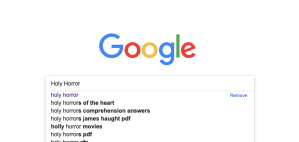
It’s a strange sensation to do an innocent web search only to find yourself cited.  (And no, I was not googling myself.  At least not this time.)  I was searching an obscure publisher and my own pre-publication book, Holy Horror, came up on Google books.  Now, the computer engineers I know tell me that Google remembers your searches, and this has a way of being unintentionally flattering; when I search for my book it pops up on the first page because I have searched for it before.  Still, it was a bit of a surprise to find myself where I had no idea I’d been cited.  All of this drew my mind back to my “post-graduate” days at Edinburgh University.  To how much the world has changed.

One of the first things you learn as a grad student is you can’t believe everything you read.  Granted, most of us learned that as children, but nevertheless, with academic publishing a new bar is raised.  That which is published by a university press is authoritative.  So we’re led to believe.  But even university presses can be fooled.  This prompts the fundamental question of who you can really believe.  Our current political climate has elevated that uncertainty to crisis levels, of course, and the vast majority of people aren’t equipped to deconstruct arguments shouted loudly.  Where you read something matters.   Even publishers, however, are fallible.  So what am I to make of being cited by the web?  And is my book already available before I have seen a copy?

Even credibility can be bought and sold.  Colleagues make a much better living than me with the same level of training, but with more influential connections.  It was just this reason that I decided to try to shift my writing to these who don’t need credentials to impress each other.  Some of the smartest people I ever knew were the janitors with whom I started my working life.  As a fellow post-grad in Edinburgh once said, professors are always ready to fail you for your lack of knowledge but most can’t tell you what an immersion heater is.  (That’s one of those Britishisms that no amount of graduate courses at Harvard will teach you.)  I suppose when it’s all said and done nobody else will ever search for the obscure publisher that brought my book to Google’s attention.  No matter, at least Google will always flatter me.


Long Nights

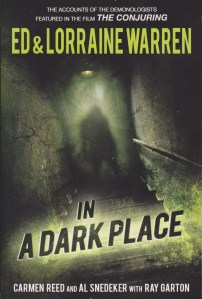
Before I really knew who Ed and Lorraine Warren were, I watched a made-for-television movie called, I think, A Haunting in Connecticut.  Unlike many television movies, it was actually quite scary.  Fast forward several years and I find myself writing a book that involves the Warrens.  I felt obligated to read all the books they “wrote”—all of them ghostwritten—and I’d been holding off on the one titled In a Dark Place, which is the story behind this television movie which was subsequently made into a theatrical movie.  The book is by Ray Garton and the parents of the family involved (Carmen Reed and Al Snedeker) are also credited.  The story is indeed a dreary one, not something I expected would bring any holiday cheer.  About that I was correct.

Why do I do it, then?  A concern with veracity drives me.  Throughout history enough people have told stories like this that either we have to lump our species together as a bunch of lying attention-grubbers, or there might be something to what they say.  The academic and official responses have long been to state that such things can’t happen, so they don’t.  When compared with how we come to know other things about life, we quickly realize that it involves experience.  In cases where experience is anomalous we tend to dismiss it.  We are great conformers.  What if there really was a demon in the Snedeker house?  Others have told similar tales.  If there’s any reality to it, shouldn’t we know?

As a former academic, I always thought that if we really wish to learn the truth, no subject should be off-limits.  That’s not the same thing as credulousness.  We don’t have to believe everything overwrought people say, but the subject should be worth consideration.  Of course, those who ghostwrote for the Warrens claim that they were given liberty to stretch the truth to make a better story.  They also tend to claim that the basic elements of the story are true.  When someone’s writing a book, there’s likely some hope of remuneration involved.  And sometimes the truth isn’t quite flashy enough for major presses with the bottom line in sight.  Still, the question of what really happened is left open.  The internet is a place where credulity reigns.  We can seek truth there only with great caution.  Maybe that is the lesson to apply to books like this as well.  Although In a Dark Place is scary, there was money at stake, and as the wise say, money changes everything.


Editing the Week

Every great once in a while I have to pull my head from the clouds and remind myself I’m an editor.  Actually, that happens just about every Monday morning.  Surprisingly, academics who have trouble getting published don’t bother to consult editors for advice.  Having sat on both sides of that particular desk, I certainly don’t mind sharing what I’ve learned since publishing isn’t as straightforward as it seems.  It has its own mythology and authors—I speak from experience here—feel extremely protective of their books.  Nevertheless, editors are under-utilized resources when it comes to figuring out how to approach a topic.  They often possess valuable advice.

It’s easy to think publishing exists to preserve and disseminate ideas and insights, tout court.  The idea that if you get past your dissertation committee you’ve done service that requires wide readership is natural enough.  Publishers, however, have other angles to consider.  Books incur costs, and not just paper, glue, and ink.  There are many people involved in bringing a book from idea to object, and each of them has to be paid to do their part.  (Many academics in the humanities may not understand the concept of “overhead,” but it’s an everyday reality in the publishing world.)  Not only that, but even the book itself is a matter of negotiation.  My latest book (and I suspect well over 90 percent of the authors with whom I work have no idea that I write books as well) had a chapter expunged and a new one written at the behest of my McFarland editor.

One of the pervasive myths in this business is that authors write whatever book they want and then find a publisher.  Sometimes that works.  Often when it does the authors are disappointed in the results.  There are presses that specialize in cranking out such works, slapping an enormous price tag on them, selling them to libraries, and then letting them go out of print.  I’ve been there.  I know.  Academics want prestige presses to take their books to a higher profile, but without having to change things according to the advice of an editor.  There are hidden lives of editors.  I can’t share much of that here, but I can expound its corollary—taking advantage of free editorial advice makes good sense.  I wouldn’t be bothering you with such mundane thoughts on this blog, but when I rolled out of bed today I learned it was Monday morning.


Taking It Seriously

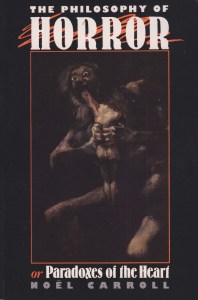
It would be incorrect to say that I choose to watch and read horror.  What would be more correct would be “Horror compels me to read and watch it.”  Those of us mesmerized by the genre tend to be a reflective lot.  We ask ourselves the question others frequently ask us—why watch it?  And yet, horror films tend to do very well at the box office.  Some even become cultural icons.  Of the many books analyzing horror, it would be difficult to suggest one more influential than Noël Carroll’s The Philosophy of Horror: or Paradoxes of the Heart.  It has been in just about every bibliography I have read in the subject.  It’s easy to see why.  There are lots of gems in this book, and it does indeed address the paradox at the heart of it all.

Philosophy, due to the very fact that there are competing schools, doesn’t attempt to provide the answer.  It offers an answer, one that hopefully makes sense of the overall question.  What question?  The one with which I began: why do people get into horror?  Carroll comes down to a deceptively simple answer, but I would make bold to suggest it does so at the cost of having undercut the religious element.  As in nearly every book on horror, Carroll does address the connection with religion.  He finds it lacking, but the reason seems to be his definition of religion.  He follows, perhaps a little too closely, Rudolf Otto’s Idea of the Holy.  No doubt, it’s a classic.  Still, it doesn’t encompass the broad scope of religion and its genetic connection to horror.

At many points of The Philosophy of Horror I felt compelled to stand up and cheer.  I didn’t, of course, since much of the reading was done on the bus.  My ebullience was based on the fact that here was an intellectual who gets it, one who understands that horror is pervasive because it is meaningful.  Sure, it’s not to everyone’s taste.  It’s not, however, simply debased imagination, or arrested development gone to seed.  There is something deeply compelling about horror because it helps us to survive in a world that is, all paranoia aside, out to get us.  Yes, it engages our curiosity, as Carroll asserts.  It satisfies more than it disgusts.  It also defies explanation.  Perhaps that’s the deep connection with religion.  It can never be fully explained.  That doesn’t mean we shouldn’t try.  And this book is a valiant effort indeed.


Reasonable Religion

Part of the pushback against religion, it seems to me, is based on the fear that there might be something rational to it after all.  Sorry to get all philosophical on you on a Saturday morning, but the idea has been bothering me all week.  You see, reductionist thinking has already concluded that religion is “emotion” and science is “reason,” and only the latter has any validity.  When’s the last time you met somebody and asked “How are you thinking?” instead of “How are you feeling?”  Neurologists are finding that reason and emotion can’t be divided with a scalpel; indeed, healthy thinking involves both, not reason alone.  Funnily, this is a natural conclusion of evolution—we evolved to survive in this environment—our brains developed rational faculties to enhance emotional response, not to replace it.

I know this is abstruse; go ahead and get a cup of coffee if you need it.  What if emotion participates in reality?  How can emotion be measured outside of individual experience?  We experience it all the time without thinking about it.  From the earliest of human times we’ve had religion in the mix, in some form.  Perhaps we are evolving out of it, but perhaps neurology is telling us that there’s something to it after all.  Something immeasurable.  Chaos theory can be quite uncomfortable in that regard—every coastline is infinite, if you get down to nano-divisions.  When you measure something do you use the top of the line on the ruler or the bottom?  Or do you try to eyeball the middle?  And how do you do it with Heisenberg standing behind you saying there’s always uncertainty in every measurement?

Absolute reality is beyond the grasp of creatures evolved to survive in a specific environment.  Religion, in some form, has always been there to help us cope.  Yes, many religions mistake their mythology for fact—a very human thing to do—but that doesn’t mean that emotion has nothing to do with rational thought.  It seems that instead of warring constantly maybe science and religion should sit down at the table and talk.  Both would have to agree on the basic ground rule that both are evolved ways of coping with an uncertain environment.  And both would have to, no matter how grudgingly, admit that the other has something to bring to that table.  Rationality and emotion are entangled in brains whose functions are simple survival.  Pitting one against the other is counterproductive, even on a Saturday morning.


Russian into Things

It’s the holiday season.  The people I overheard at the bus stop the other day were discussing shopping on the bus.  It can be a long trip from here, and evening traffic out of New York (ironically) is quite heavy this time of year.  Bored commuters, sitting on the bus with their phones, shop.  I couldn’t help but notice that I was the only one with the overhead light on during the fully dark ride home this week.  At one point the driver seemed to think it was a mistake on my part and snapped it off.  I carry a book light with me for just such eventualities, but I had that odd feeling one gets when everyone else got the memo but you didn’t.  In any case, I was reading a physical book, not shopping.

Then I read about a book I need for my research.  Problem is, I don’t have an institution, or a wealthy sponsor, so I often buy books used.  Back in my teaching days Amazon was new, and the idea of buying books online foreign and unfamiliar.  Now you can’t find a bookstore when you want one.  In any case, this particular book was on offer on eBay.  Now, I haven’t used eBay for quite a while.  I never think of it as a place to find reading material, but there it was.  Who would’ve thought research would ever lead in this direction?  The price was reasonable, so I signed in as a guest and placed my order.  With out of print books like this you run the risk of price-gouging or sudden unavailability—the independent researcher’s nightmare.

When the confirmation page came up, I couldn’t help but notice that the header was in Russian.  I wondered if Trump’s dream had really finally come true, or if the eBay on which I ordered an out-of-print book was really a trap.  How do you find out?  Who do you tell when your current government is completely at the beck and call of the Russian government?  I was in a brown study for a while.  The book, used, on Amazon was listed at over a thousand dollars, and this for a paperback published in 2009.  People will pay quite a lot for certain books, even if they don’t retain their resale value.  Ideas, it seems, are worth more than money.  But we no longer have a government to protect our interests.  Not even research, it seems, is safe any more.

If you squint, he could be St. Nick


Christmas at the Bus Stop

I had to make one of my periodic treks into New York City this week.  Unlike most years when a warm spell comes after the onset of winter, we’ve kind of fallen straight to the heart of the season this year and those of us standing in line for the bus were experiencing it via wind chill.  The cold got some regulars to talking about Christmas.  Although I’m not the oldest one who makes this long trip, the majority of the commuters this far out have yet to attain my years.  Those chatting at the stop had kids at home that still believe in Santa Claus.  It made me recall how we trick our kids with all kinds of quasi-religious folkloric figures, but also how seriously some adults participate in the mythology as well.

Among those chatting, the leaving out of cookies and carrots was almost canonical.  The cookies are for Santa, of course, and the carrots for the reindeer.  The more I pondered this, the more it became clear that this is a form of thank offering.  The story of Bel and the Dragon, in the Apocrypha additions to Daniel, tell of how priests leave out food for an idol.  The offering is gone in the morning and the credulous worshippers assume the statue has eaten it.  Religious offerings, except those entirely burnt up, were often used to support priesthoods.  Santa has his elfly acolytes, of course, but the priesthood for his cult is that of parents eager to make Christmas a special time for their children.  Capitalism’s big pay-off.

Then one of the commuters mentioned how she had her husband leave a footprint in the fireplace ash to add verisimilitude to the ruse.  We never had a fireplace when I was growing up, and I often wondered how Santa got in when we had no chimney to come down.  In any case, my hazy morning mind thought once again of Daniel and Bel.  The way that wily Daniel exposed the fraudulent priests was by sprinkling—you guessed it—a fine layer of ash around the offering after the priests had “left” for the night.  In the morning he showed the people the footprints of the deceptive heathens to the people.  The statue hadn’t eaten the food after all!  Serious consequences followed.  Christmas, despite its commercialization, brings fond childhood memories to many of us, and we’re reluctant to let that go.  The one man in on the discussion (it wasn’t me) said that when he was growing up they had a somewhat different offering.  “My dad,” he said, “told us to leave Santa a beer and a sandwich.”  This guy’s name might’ve been Daniel.


Carrie On

Stephen King was still a fairly new writer when I first read “Lawnmower Man” for an English class in high school.  Carrie had been published by then, but I didn’t read any more Stephen King until after my academic job ended.  (There is, for those who are curious, a correlation between that traumatic change and my interest in horror.)  Like many, I suspect, I saw some of the movies before reading the King books behind them.  With a writer as prolific as King there’s always the issue of where to start, and I’m often subject to the selections independent bookstore owners make.  I seldom buy fiction through Amazon—I have to see the book for it to grab me (a kind of King thing to happen).

A used copy of Carrie recently came my way.  Now, I’ve seen the movie (both versions) many times; it is discussed at some length in Holy Horror.  I’d not read the novel until now.  Obviously there are differences between book and movie, but as this was Stephen King’s debut novel it struck me just how central religion was to the fearful scenario he paints.  That’s pretty clear in the film, I know, but it’s even more so in the novel.  Carrie is made into a monster by religion.  One could argue that she was born that way—telekinesis as a genetic marker is also a theme in the book, although absent from the films.  Still, it is Carrie’s rejection by others, largely because of her religion, that leads her to use her powers to destroy Chamberlain, Maine.

In a strange way, Carrie is a coming-of-age story from a girl’s perspective.  Strange because King is a man and some literary magazines won’t even accept stories written from the point-of-view of someone of the opposite gender.  Men can’t know what women go through.  Indeed, most of the male characters in the story are less than admirable, while some are downright wicked.  The real question is whether religion saves from wickedness or causes it.  There’s not much ambiguity here on the part of Mr. King.  Holy Horror, although it deals with movies and not novels,  makes the point that films based King don’t infrequently use religion as a source of horror.  Long-time readers of this blog know that I frequently make the point that this genre, more so than most, relies on religion as an engine to drive it.  And religion also has a role in repressing women.  Coincidence?  Ask Carrie.


You’re History

A story from Inside Higher Ed discusses a study of history majors and their rapid decline.  This occurs during a sudden onset of “job related” majors and the graph accompanying the article shows how STEM has taken over higher education.  These are the fields with actual occupations awaiting them at the end of the degree, while disciplines such as history and religion (also very near the bottom) have less clear career paths.  Indeed, when I’ve been in the job market I find that a religion degree is less than useless, no matter what the department recruiters tell you.  If you’re not bound for the clergy you undertake the study at your own peril.  History, I expect, suffers from a similar dynamic, but the peril in this case is to all of civilization.

We’ve seen over the past two years how a stunning lack of knowledge of history sets a nation on the path to chaos.  Businessmen with no classical education don’t make good national leaders.  Knowing where we’ve been, as Santayana so eloquently stated, is the only thing that keeps us from repeating past failures.  History is our only safeguard in this respect.  Over the Thanksgiving break I spent a little time delving into family history.  Since I don’t come from illustrious lineage, I felt the frustration of finding out what happened to obscure people from the last couple of centuries.  Lack of history on a personal level.  On a professional level, my doctorate is really in the history of religions (ancient religions) and I’ve become keenly aware of just how little history there is to the very popular modern Fundamentalist movement.

Maybe I said that wrong.  They do have a history, but the belief system that is touted as ancient is really quite modern.  Anti-modern, in fact.  When historical knowledge is lacking, however, people can make all kinds of claims based on nothing more than wishful thinking.  History keeps us honest.  Or it used to.  When we’ve outlived the need for history we’ve started down a path unlit by any embers of past human foibles.  We’ve been living in a culture in love with technology but not so much with critical reflection of where such innovations might take us.  Doctors are beginning to complain that they spend more time on their computers than with their patients.  The time freed up by the internet has been taken up by the internet.  And when all of this comes to its natural culmination, we would be well served by historians to make a record of what went wrong.  If we could find any.


Personal Gothic

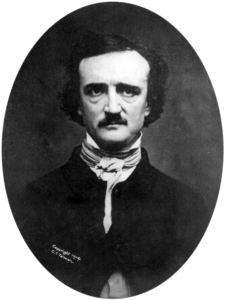
As I continue work on Nightmares with the Bible, I am reminded just how influential Edgar Allan Poe has been in my life.  It’s not that I read Poe every day, but it’s more that his stories have stayed with me since childhood.  For an English term paper in high school, the last one I recall writing, I selected Poe as the subject.  Something of the sadness of his life made me feel as though we were kindred spirits, although I could never meet him, and never let him know that he would have had a friend if he had been born a maybe a century and a half later, and if possible, in Franklin, Pennsylvania.  If his fondness for drink came with him, he would likely have met my father in such circumstances.

Even today I feel a kind of fiercely protective interest in Poe, as if his poems and stories had been written exclusively for me.  Seeing a handwritten fine copy of “The Raven” on display in the Morgan Library and Museum brought tears to my eyes.  Like Poe, I strive to make a living as a writer, but unlike Poe, I cop out.  I’m too afraid of losing everything.  Jobs necessarily interfere with writing, and some jobs actively discourage it.  Nevertheless, I still feel the shudder when I think about the first time I read many of his stories.  This was, I suspect, what fed my young interest in horror.  It wasn’t the blood and gore of the slasher film, it was the quiet, sad, disturbing atmosphere of Poe.  It has been recaptured by few, in my experience maybe only by Shirley Jackson.

Those who write are connection seekers.  Writing is a way of testing to see if we alone see the world in our own way.  Will others respond?  Poe somehow, mainly after his own lifetime, touched a responsive chord with many.  His work is now very widely known.  His visage appears on everything from bandages to socks.  His stories and poems are endlessly retold, adapted, and parodied.  When I read Poe I hear someone speaking from a life of hard knocks.  His response was to strike back, through his writing.  The life story written by one of his relatives suggests that he wasn’t as gloomy and tortured as he is generally portrayed.  Perhaps not.  Nevertheless, those of us who find gothic literature somehow redemptive know, once we close the cover, who it is we should thank.


Beneath the Exorcist

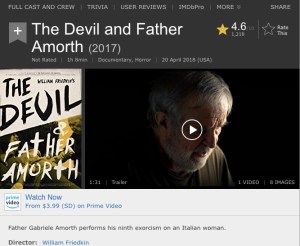
William Friedkin rose to fame as the director of The French Connection.  William Peter Blatty had written the screenplay for the Pink Panther film, A Shot in the Dark.  Now Blatty had a serious project in mind as he considered whom to pitch to direct the film of his novel, The Exorcist.  He wanted, and got, Friedkin.  The two disagreed about the final cut of the movie, with Friedkin winning out.  The movie was a tremendous success.  Several years later the cut favored by Blatty was released, again with success.  Blatty died last year.  The year before that so did Fr. Gabriele Amorth, an exorcist for the Diocese of Rome.  Last night I watched The Devil and Father Amorth, a documentary by William Friedkin about the famed exorcist.

The Exorcist made an impact on the lives of many people, not least Friedkin.  Over four decades after making this film, the director is still mulling it over.  The Devil and Father Amorth is primarily footage shot by Friedkin of an exorcism performed by Amorth.  In general the filming of exorcisms is forbidden, but given his stature as a film-maker, Friedkin was given permission to film without crew, on a small, hand-held video camera.  Although nowhere near as violent as the fictionalized film, it is disturbing to watch.  As a documentary, it includes interviews with doctors, some from Columbia University, who agree that possession is “a thing,” but one suspects they might disagree with the director as to what that thing might be.

Although Friedkin isn’t an academic, society accepts that (at least some) film-makers are intellectuals.  Perhaps lacking subject specialization, they nevertheless read a lot and possess quite a bit of street knowledge concerning psychology.  Friedkin does.  At just over an hour, this documentary isn’t long, but it is provocative.  For me it raises once again an issue that I address in Nightmares with the Bible—the curious laity, due to lack of engagement by traditional scholars, must rely on such efforts to get information about spiritual entities.  The documentary, which deals with a heavy subject, is one that Friedkin tries to lighten a bit at the end by stating that if there are demons then angels must also exist.  This goes back to the idea, discussed more fully in my book, that demons derive from fallen angels.  The “one size fits all” approach of academia has shoehorned belief in one direction.  While The Devil and Father Amorth won’t likely convince skeptics, many who watch it will be left wondering.