No Refuge

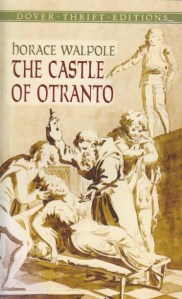
A convention in histories of the horror genre is to trace it to Gothic fiction.  Gothic fiction itself is traced to The Castle of Otranto, by Horace Walpole.  Having grown up reading Gothic stories along with religious texts, perhaps surprisingly I never came upon Walpole’s oeuvre.  Some weeks back I happened on a used bookstore, which, by convention, had its cheapest fare on sidewalk carts.  I was surprised to see a negligibly priced copy of The Castle of Otranto, which I took in to the counter.  The clerk looked puzzled a moment, then asked if it was from the carts.  “Oh,” he sniffed, “that explains it.  We don’t carry Dover editions; they’re too cheap.”  Perhaps that remark haunted me a bit, but I finally got around to reading the slim book and it left a kind of unanticipated horror in my mind.

Okay, so this was written in the eighteenth century, and set further back, in Medieval times.  A spooky castle, knights and knaves, and fainting damsels all populate its pages.  Religion, particularly in debased form, became a standard characteristic of the Gothic.  Here a monk, an erstwhile lord, holds a secret that leads to the downfall of a house of pretenders who have claimed ownership of the castle.  All pretty straightforward.  Even the ghosts and talking skeletons fail to raise fear.  One aspect, however, does hold horror.  The three princesses in the story are completely at the whim of the men.  They acknowledge as much and claim it against piety to declare any different.

It would be unfair to assert that such sexism was intentional—like most human behaviors it evolved over eons—but in this era to read it is to shudder.  We have moved beyond the horror fiction that men own women and that they have any right to determine their fate.  Especially in these days, it’s embarrassing to be reminded that such was ever the case.  Despite the word from on high we cannot hide from history.  The domination of men has been a testament to how poorly civilization has been run.  Some of its benefits can’t be denied, but on a whole we see a succession of aggression and wars, suffering and poverty, generally brought on my societies that have taken their cues from patriarchical ideals.  My reading of The Castle of Otranto brought this back with a force not unlike that of the giant ghost haunting its walls.  Is it too much to hope that some two-and-a-half centuries might show some evidence of progress?

Not-Quite-Normal Religion

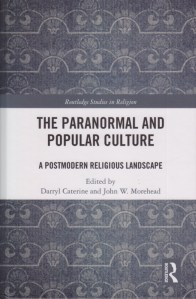
I’ve been thinking about categories quite a lot lately.  In a world connected by the internet, it seems that traditional categories don’t stretch far enough.  For example, I recently read The Paranormal and Popular Culture: A Postmodern Religious Landscape, edited by Darryl Caterine and John W. Morehead.  Published by Routledge, this is an academic study.  It contains some things, however, that many academics would find challenging.  I can’t summarize the entire book here since there are twenty very different essays included, but I can say this is a book that makes you think about categories.  Even the word “paranormal” means different things to different people.  To my way of thinking it has to tip the hat to Rod Serling and that place where fiction and fact begin to overlap.

That’s appropriate for this book: there are articles about what people perceive as factual encounters with all kinds of creatures and events, as well as studies of the decidedly fictional beings like Batman and zombies.  Our categories, in the modern world, tend to be inviolable.  Even scientists who handle Heisenberg know, however, that we are now in the postmodern world (as the subtitle indicates) and true objectivity is beyond the reach of all.  None of us stands outside the box looking in.  We’re all in the middle of it, and we look around ourselves trying to figure out what is real.  Another problematic category that, reality.  We don’t even understand what consciousness is yet, and how can we hope to know what is really real?  We all have dreams and some take them more seriously than others.

Reading books like this with an open mind is a truly po-mo experience.  After finishing more than one piece I found myself having to put the book down for a while at least so I’d have a hand free to scratch my head.  You see, we’ve been taught to laugh at those who believe in the paranormal.  It has been the only acceptable way that rationalists can deal with that which flies in the face of the system.  The internet, however, has put those isolated, ridiculed individuals into a community and the advent of reality TV (and what can be more real than what we see on the tube?) erodes the laughter factor little by little.  Plumbers can find ghosts but scientists can’t.  The average person relates more to the plumber, I think.  It all comes down to categories.  Making sense of them can, and will, impact our views of reality.


Label Maker

Did you ever have one of those label makers?  The kind with a rotating wheel that embossed a plastic ribbon with letters that you could stick to things?  Labeling is so easy!  I often feel constrained, however, by the chosen labels of extremist groups.  Not all evangelicals are power-hungry or enemies of human welfare.  This is perhaps one of the keys to the success of extremists.  Camouflage has long been recognized by evolution as a most effective tactic.  I have many evangelical friends who do not protest cartoons, or ride around in Trump-laden vehicles, polluting the environment like there’s no tomorrow.  The problem is what to call them since the more radical wing has usurped their nomenclature.  I often think of this because I eschew labels in general, but people in a collective can do quite a bit more damage than a single disgruntled individual.  Perhaps “disgruntled” should be part of their name?

Religions generally begin as efforts to help make the world a better place.  The historian of religions sees, however, that over time many believers begin seeing the peripherals as the central tenets of the faith.  Since I’m familiar with evangelicalism, let me use that as an example.  As a form of Christianity, evangelicalism began with the Reformation.  Pietist groups, freed from Catholicism’s idea of communal salvation, began to worry about their individual souls and how  they might be saved.  Their belief structure eventually came to include the necessity of converting others because, if you read the Bible a certain way, that’s a requirement.  Over time this outlook  evolved into the idea that only one group (one’s own) has truly understood the Christian message.  Once numbers grow numerous, it becomes like the medieval Catholic Church—large enough to take political power.  Somewhere along the line the central message of helping make the world a better place morphs into making the world evangelical only.  Or whatever label we feel constrained to use.

labels are problematic

I’m not picking on the evangelicals here—this could apply to any extremists.  And it certainly doesn’t apply to all evangelicals.  Religion has been part of human culture from the very beginning.  A good case can be made that it is one of the basic components of consciousness itself.  A person has to learn how to become unreligious.  We are also political animals.  Who doesn’t want things their own way?  We can’t all win, however, and some religions have difficulty separating, say, a savior willing to die for others and the insistence on one’s own way no matter what others want.  Like most aspects of life this is a balancing act.  I grew up evangelical.  I have friends who are evangelical.  I don’t want to insult anybody, but what can you do when you feel disgruntled by the degradation of religion into an excuse for hate?  I lost my label maker long ago and I no longer know what to call things anyway.


If Onlyists

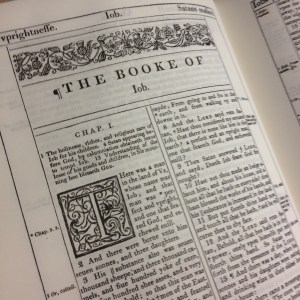
A special brand of Fundamentalism called King James Onlyism is a particularly odd variety of faith simply because of its required backing and filling.  In brief, this particular evangelical position claims that the only inspired translation of the Bible is the King James Version.  It’s best not to look too closely at the KJV, however, or the problems start.  Primary among them is that the version most Onlyists cite is not the original King James.  Published in 1611, this translation is immediately evident by its use of “I” for “J” and for the long s (the one that looks like an f).  Perhaps more troubling for Onlyists, it also includes the Apocrypha.  There was still some debate at the time concerning the status of these deuterocanonical books, and they were part of the actual KJV.

The typical King James used by Onlyists is a revised KJV.  In England, where the translation was done, revisions were made from time to time, leading to an Oxford version (Blayney text of 1769) and a Cambridge version (Scrivener text of 1873).  On these shores further adjustments were made leading to the rather strange situation where there is no single King James Version of the Bible.  There are many King James Versions.  Attempts to control Scripture often end up like that.  The underlying problem is the belief that there is a single version of Holy Writ.  Inerrantists are pledging their faith to something that doesn’t exist.  Defending this approach many would claim that the revisions are minor, but small changes can make huge differences.

The belief in one single version relies on the belief that God inspired not only the original writers, but the translators as well.  It denies that the better manuscripts that have come to light since the early seventeenth century (including the Dead Sea Scrolls) contain any authentic information of what the Good Book says.  Textual criticism, in the absence of any original manuscripts, is the best way we have of discovering what the original likely said.  Onlyists argue that the manuscripts from which King James’ translators worked were the divinely selected ones and their work was inspired—a position against which no empirical proof can be offered.  This faith trades in certainties that only bringing in direct heavenly control can achieve.  And it means that Catholics are wrong, despite King James’ inspired error to include the Apocrypha.  That’s the thing about a trump card like inspiration—once it’s played there’s no way to overcome it.


What’s Wrong with Heroes?

There can be no doubt that under Trump conservative Christians have been flexing their muscles.  Few things corrupt so readily as political power, and evangelicalism—already an unrealistic way of looking at things—is itching to throw punches.  A story on For Reading Addicts that my wife sent to me bear the title “DC Comics cancel latest comic after backlash from conservative Christians.”  The piece by Rowan Jones notes that Second Coming was cancelled due to pressure from evangelicals with the cultural sensitivity of the Kouachi treatment of Charlie Hebdo.  Cartoons, it seems, are a real threat to true believers in a way that reason is not.  Jones notes that the comic was actually largely supportive of Christian values, but like an evangelical Brexit the reaction was taken without understanding the issue.

The anger of conservative religions—it hardly matters whether they are Christian, Muslim, or Aum Shinrikyo—often plays itself out in displays of violence.  I wonder if part of this insecurity comes from the fact that the expectations of their faith don’t work out they way they’ve been led to believe they will.  The myth of the blessed existence of the true believer is given the lie by life in a secular world.  While the evangelicals support Trump, 45’s tax plan takes money from their pockets and hand it to the ultra-wealthy.  This raises no objections, but a cartoon showing Jesus helping the poor?—now that’s offensive!  And still no second coming takes place.  It’s difficult to retain a fantasy view in the face of cold reality.

Who doesn’t like a hero?

Religious beliefs are a deeply personal matter.  It is a dicey business to try to get someone to change their outlook when they’ve been convinced that the consequences are eternal.  Although vaguely aware of other religions all along, Christianity in the “new world” was taken quite by storm at the 1893 World’s Parliament of Religions in Chicago.  Suddenly it was clear that other moral, decent religions had developed similar ethics to what had largely been supposed to have been Christian innovations.  It’s difficult to feel superior when others in the same room seem just as intent on improving the lot of humankind as you do.  Even when a particular religion holds all the political power of a nation it’s overly sensitive to cartoons.  This is a curious situation indeed.  I’m not a comic book reader—I don’t even have time for internet articles unless someone sends them to me with the suggestion that they’re worth my time.  And I, for one, think a little more humor might just make the world a better place.  Either that or we need a hero.


Seeing the Future

Nine.  That’s the number of people before me in line.  It’s not yet 4:30 a.m., and our day began at least an hour ago, but work won’t start for another two.  As the bus pulls up to the stop, I think about work.  Well, like most people I think about work a lot.  You see, I’m often asked about how to get into the publishing business.  There’s a cosmic irony to this because I had never planned to be an editor and never undertook any of the usual training.  The anticipated trajectory of a doctorate in the humanities used to be teaching, which is what I did for many years, but when an educational career slips off the rails in a capitalistic society you have to be willing to learn real fast.  (Fortunately the long years of schooling do help with that.)

I’m sure that I’m not the only person whose career plans didn’t pan out as anticipated.  Back in seminary one night long ago, three friends and I had a “future dinner.”  We prepared a supper and each came as who we would be twenty years down the road.  I recall that I was a world-traveling professor and the author of several books.  “Come on,” my friends complained, “be realistic!”  It’s a bit beyond those two decades now, and I was a professor for many of them.  I have written several books, although so far only three have been published.  World-travel?  Well, that’s been a bit modest in recent years, I have to admit.  One of the other friends I’ve lost track of.  Another committed suicide after graduating.  We really can’t see far into the future.

Publishing is a challenging gig.  My rapid career contortions perhaps prepared me better than I think.  I have a kinship with those who ask about how to get started in it.  Generally we’re educated people who like books and wonder what kind of career you can find with that combination these days.  (There are more of us than you’d think!)  Compared to higher education academic publishing is a small world.  I’ve come to know many more academic colleagues since being an editor than I ever did as a professor.  I have something they want—a reputable venue for publishing their latest book.  Often I have to do a lot of educating since publishing doesn’t work the way that most people think it does.  It’s like being a professor without the status.  No, I didn’t see this in my future.  As I look for a seat on the already crowded bus I wonder how many of these other early risers planned their careers just like me.

Difficult to see where this is going.


In the Inn

One of those things that really bothers me is the concept of being forced out of a home.  It’s never happened to me personally, but that doesn’t mean I can’t fear it.  That idea works its way into more theoretical applications as well.  Lately both my phone and my laptop computer have sent me messages saying there’s no more room in the inn.  Now, dear reader, you may understand technology better than I (you almost certainly do), but I wonder just how much these weightless thoughts I store here can possibly tip the scale.  I back up my hard disc weekly—there’s no telling who’s going to get kicked out when all the room is finally gone!—but when I open my space manager I find all kinds of things I can’t identify.  Software that I’m not sure it’s safe to remove.  I have no idea what the function of many apps might be.  So I just start deleting.

No room for your data here!

And I keep deleting.  I won’t touch my writing, however.  It’s backed up on a high-capacity drive, but such drives fail.  I want to keep a copy here on my laptop where I can reach it.  The real problem is that this massive sorting exercise keeps me from doing the things that I’d rather spend my time on—writing blog posts, for example.  How can I relax to do that, though, knowing that there’s no room to store them when I’m done?  Why does iTunes take up so much space anyway?  I feel guilty deleting anything from it because of all those warning dialogue boxes with their dire notes that this action can’t be undone.  Occam’s erasure has its consequences, I guess.

I suppose this is related to my recent observations on how tech demands time.  I’ve got some big projects going.  One is to sort out and file all my browser bookmarks.  They are embarrassingly plentiful.  Then there’s the sorting of thousands and thousands of electronic photos into files.  When I first starting using devices there weren’t enough pictures or bookmarks to worry about.  Now each of these projects has been ongoing for months and neither is nearing the end.  I’m old enough to recall when office supply stores sent catalogues (print catalogues, no less!) to my employers stating things like, “We’re in the  midst of an information explosion.  You should buy folders in bulk.”  They meant manilla folders.  Were we ever so naive?  Now what about these ebooks that I also have in hard copy?  Which should I get rid of?  That choice, at least, is easy.  Even my manger has room for books.


Which Shaman?

It’s a strange kind of vindication when you see someone argue your ideas independently.  Even if they understand those ideas in a different way.  I suppose it’s necessary to say that in academia those who have university posts are assumed to be more authoritative than those of us who don’t. That’s not sour grapes, it’s simply a fact.  Some years ago, after having first seen Christopher Nolan’s The Dark Knight, I wrote a post on this blog suggesting that the Joker functioned as a shaman in that movie.  Being a blog by a non-university academic, the post had a few readers, but it is not peer-reviewed and therefore, officially just a matter of opinion.  I have studied religion professionally for decades now, however, and I would still stand by my assessment.

Recently I came across an article that argued Batman was a shamanic figure in that same movie.  It was affirming that another academic had come to a similar conclusion, however, we differ in our interpretation of who bears shamanistic characteristics.  It doesn’t help, I suspect, that shamanism isn’t well understood, and even the name is a bit of a misnomer.  We don’t really have a word for non-major religious practitioners of indigenous populations who may have little in common, so we call them shamans.  Their religious systems are too specific—“granular” is the favored business word these days—to categorize them easily.  And the reason for this is that we think of religions in the light of the large, organized conglomerations that arose in western Asia a couple millennia ago.  It’s difficult to make room for smaller exemplars.

Something larger religions have done is distorted the idea of religion as a local phenomenon.  Communities used to reflect the religious experience those who lived in them knew.  Catholicism divided the world into parishes and even tolerated some differences between them.  Protestantism gave Europeans (and their New World descendants) a set of choices, and towns in America often sport many steeples not because religion draws a community together but rather because it generally tears it apart.  Hierarchical religions are about as opposite of shamanism as Batman is different from the Joker.  They may have similar ends in mind, but their methods are quite different.  The shaman is a figure that leads to spiritual wholeness for the community.  Their methods seem questionable to larger, highly structured religions.  And the unaffiliated trickster may accomplish more than an establishment figure in a local setting.


Punch Bug

There’s no other reason for buying a Volkswagen Beetle than making a statement.  We bought ours in 2003, before they got squashed.  Mechanically it has been a good little car, but, despite the fine engineering, the hood latch is made of plastic.  And we all know what plastic does.  Yesterday was sunny and a Saturday so I spent at least four hours trying to get the hood open.  (Unsuccessfully.)  Now, I’m no gear-head, so I watched a video on YouTube that 23,000 views (some 22,000 of which were me) on how to work around this major design flaw.  After three hours in the sun I had my face pressed to the bumper, trying hard not to think of all the bugs that have met eternity there, so I could see up to where the inaccessible latch smugly sits.  No tool in the history of humankind can reach it. After another hour I gave up, although just one weekend before this trick worked.

YouTube is an alternate universe.  There, latches can be made to work.  Men who appear larger than me can wedge their entire hands in that unforgivingly tight space while my knuckles are going to take days to heal.  They use simple tools that trip well-oiled springs and their engine blocks are revealed to them like the commandments on Mount Horeb.  Clearly I am not counted among the blessed in this mechanical paradise.  I do pretty well at this kind of thing if someone shows me how, but with a broken hood-latch you’re working by faith with car parts unseen.  Kind of like wrestling with an angel at night.

I did notice among the YouTube videos an unexpected sense of tradition.  The new Beetle (although ours is well over a decade old) has the engine in the front.  The original Beetle (one of which I drove until the cost of parking in Boston compelled me to sell it) famously had it in the rear, making the front the trunk of the car.  That nomenclature has persisted despite the passage of time and changing the facts.  In my mind the front of the car, where the engine is located (or so I hear) is called “the hood.”  The rear is “the trunk” (more spacious in the new Beetle, as I know from experience).  Although the design and layout have changed, the old language remains.  It seems to me that all of this conforms to a belief in special revelation.  Once uttered it cannot be changed.  Or opened, apparently.  Please excuse me, but after all this typing I’ve got to get some ice for my knuckles.


Science of Compassion

It has been several years now since I’ve been directly (or indirectly) involved in robotics.  During my daughter’s high school years I was active in the FIRST Robotics program, spending some week nights and many weekends supporting the kids—far more clever than me—building and competing with the robot.  It was during this time that I came to know some of the mentors involved.  They knew I was looking for a job in a field not their own.  Instead of wringing their hands like my professorial colleagues did, they made concrete suggestions as to how to go about finding a reasonable position.  Unlike many religion professors, they were willing to go out of their way to help.  It’s a lesson I’ve never forgotten.  A somewhat well-known religious leader is known for having said “by their fruits you will know them.”  So it is.

One of these friends recently sent me a New York Times story about a disabled toddler.  Because of our government’s very compassion health care system, this boy was denied access to a wheelchair.  When the local high school robotics team learned about it they designed and built a motorized chair for the boy.  Again, my point couldn’t be more obvious.  This team did what was the right thing.  They didn’t stand around saying the family would be in their thoughts and prayers.  No, they did something about it.  While the story made me feel good, it also saddened me.  I’ve been part of the religious studies community for at least three decades now.  When I lift up mine eyes to the hills, however, whence cometh my help?

Please don’t get me wrong—I know probably better than most how difficult life and funding can be as a humanities academic.  I also know, however, that humanities are nothing without humanity.  How easy it is to forget that when a tenure-track position opens up!  There are creative solutions possible.  I have suggested them to those empowered to enact them from time to time.  Their response has generally been to explain why it can’t be done rather than giving it the old college try.  In robotics you try to see if it works before deciding it can’t.  Perhaps there’s a message here for those who hear.  Engineers find solutions while many academics find excuses.  There’s any number of reasons not to help the boy get a wheelchair: somebody’s going to have to pay for this, there are other things that demand the students’ time, there are government agencies who already do the work.  Or.  You can try because it’s the right thing to do.  Whose fruit tastes better, I wonder?


Receiver

Being a writer (I can’t claim to be an author since I don’t make a living at it) is like being a radio receiver.  You pick up signals, or so it seems, and it’s your job to try to make sense of them.  That’s why I always carry a notebook.  Specifically a Moleskine volant extra small plain notebook (I can’t abide lined paper).  I’ve been using them for years and I’ve got quite a little stack of them in my writing nook, battered, taped, and well-used.  There’s part of my soul in those little things.  But they’re getting increasingly difficult to find.  More than once I’ve come to the last page only to have searched in vain all the local bookstores and speciality shops without finding a replacement.  (Big boxes like Staples appeal to the lowest common denominator and writers demand special treatment.)

Tools of the trade

Sometimes they’re not even available on Amazon, surprising as it may seem.  You see, I’m particular about where I store my thoughts.  People have suggested to me that I use my phone, but by the time I get it out of my pocket, turn it on, type in the passcode, and open the app, the thought is gone.  They travel quickly.  My notebook, always with me, has a pen companion.  It’s refillable and I take great care to buy refills that write instantly, without having to scribble to get them going.  I keep careful note of the brands that are reliable.  There’s nothing more frustrating than watching a great thought flee as you’re furiously scribbling to get your pen to capture it in your Moleskine.  No, this is an area where there can be no compromise.  If only notebook sellers saw it that way!

The trouble with being a receiver is you have no control over when the signal comes.  You wouldn’t know it from my publication record, but I have many, many unpublished pieces.  Most of them, regrettably, have to be reduced to electronic form so they can be submitted and rejected via email or Submittable.  I would have nothing with which to build, however, if my zibaldone were absent.  After my brain this is the first filter.  And when they’re full it’s time for another.  The next time I find them in my favorite indie bookstore I’m going to buy them out.  I’ll store them in the attic—I can find space up there, along with my pen refills—against a time of need.  Somethings a writer just can’t do without.


Croce’s Lament

So how much time is there?  I mean all together.  I suppose there’s no way to know that because we have no idea what came before the Big Bang.  Those who invent technology, however, seem not to have received the memo.  New tech requires more time and most of us don’t have enough seconds as it is.  Perhaps in the height of folly (for if you read me you know I admit to that possibility) I’ve begun uploading material to my YouTube channel  (I hope I got that link right!). These are cut-rate productions; when you’re a single-person operation you can’t fire the help.  I figured if those who don’t like reading prefer watching perhaps I could generate a little interest in Holy Horror visually.  (I like my other books too, but I know they’re not likely to sell.)

The question, as always, is where to find the time for this.  My nights are generally less than eight hours, but work is generally more.  What else is necessary in life, since there are still, averaged out, eight more left?  Writing has its reserved slot daily.  And reading.  Then there are the things you must do: pay taxes, get physical exercise, perhaps prepare a meal or two.  Soon, mow the lawn.  It may be foolishness to enter into yet another form of social media when I can’t keep up with those I already have.  What you have to do to drive interest in books these days!  I think of it as taking one for the tribe.  Readers trying to get the attention of watchers.

There’s an old academic trick I tried a time or two: double-dipping.  It works like this: you write an article, and another one, and another one.  Then you make them into a book.  I did pre-publish one chapter of a book once, but getting permission to republish convinced me that all my work should be original.  That applies to reviews on Goodreads—they’re never the same as my reviews on this blog—as well as to my YouTube videos.  There’ll be some overlap, sure.  But the content is new each time around.  So you can see why I’m wondering about time.  Who has some to spare?  Brother, can you spare some time?  I’ve been shooting footage (which really involves only electrons instead of actual linear imperial measures) for some time now.  I’ve got three pieces posted and more are planned to follow.  If only I can find the time.


Bookmark This

I haven’t forgotten about horror.  In fact, this past late winter my list of must see movies has continued to grow.  I don’t subject you, my kind readers, to endless barrages about Holy Horror since I believe the idea behind the book is novel in its own right and can stand on its own.  The other day I even ordered bookmarks to be made, for free distribution.  Thing is, days are getting longer, and warmer, and people are thinking the opposite of horror just as spring is the equinoctial opposite of fall.  Like a good monster I’m biding my time.  And doing so on an editor’s budget.  (The pay scale’s not the same as that of a professor; believe me, I know.)  Horror’s funny that way—it is seasonal, at least in most people’s minds.

I make the point in the book that fear serves a useful function.  It occurs in other genres quite frequently, although they bear the outcast label less overtly than horror.  Perhaps this gets to the root of my fascination.  Having grown up as part of the pariah social class of the poor, my sympathies are with the genre that often fails to find respectability.  Many of those who criticize horror do not watch it.  Some of these films are quite sophisticated, and the genre blends into other “speculative” categories such as science-fiction and some action, as well as into the more naturalistic thriller.  And thrillers are merely dramas with an elevated pulse rate.  This difficulty of distinguishing genres sharply is one reason Holy Horror addresses some films that aren’t strictly horror.

Work continues apace on Nightmares with the Bible.  Again, the ex-professorate never receives sabbaticals during which concentrated work might be done on books.  In the pre-dawn hours, however, I steadily make progress.  Very shortly an article I wrote for Horizons in Biblical Theology on the topic will appear.  Safely during the spring.  As the days grow longer more of my weekend time is demanded by the outdoors aspect of home ownership, cleaning up after the freezing and thawing of a long winter when infelicities were safely covered under snow.  Sometimes I fear for the progress made on my next book—it is the first advance contract I have ever had—but then I remind myself that fear does serve useful functions.  It’s not called a deadline for nothing.  So even as the darkness fades I prepare for the next round to begin.


Winter Travels

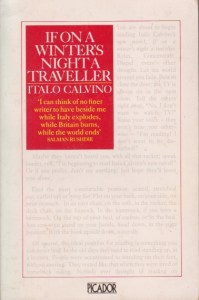
Every now and again you read a book that drops you into a world of wonder.  That’s how I’d describe Italo Calvino’s If on a Winter’s Night a Traveller.  What’s it about?  It’s difficult to say.  It’s a novel about reading, and more specifically, interrupted reading.  You might call it Post-Modern, but in a good way.  I came across the book in a manner that, like the story itself, emerged from different narrative structures.  First of all a colleague sent around a quote from the book that grabbed my attention.  I decided that if I ever found a copy in a bookstore I’d buy it, based on that quote alone.  A second stream was the Modern Mrs. Darcy’s reading challenge.  One of this year’s categories was a book in translation, which this is.  And yet a third factor was that I found the book on the shelf of a used book vendor in Ithaca.  And so I read.

Like David Mitchell’s Cloud Atlas—and having nothing to do with the fact that it was the most recent novel I’d read—If on a Winter’s Night a Traveller is a nested story, a story within a story.  Breaking the “fourth wall” Calvino addresses his readers in the second person and makes them characters in the plot.  The reader buys a defectively printed book and when he tries to return it to the seller, a fantastical world opens up.  I’m not sure that there’s a particular genre here—literary fiction constitutes a genre of its own—but there are a few speculative elements that keep the story pulling you along without really giving any conclusions (that the po-mo aspect to which I referred).

Apart from being merely fun, the story is thought-provoking.  What goes on when we read?  Do we not get absorbed into the mind of the writer?  And not only of the author but also of others who’ve read the book with whom we might discuss it?  Writing is an endlessly addictive activity.  One of my observations about careers without sabbaticals is that those who wish to practice the art must carve time out from days interrupted by work to be writers.  For me that means awaking early, for this blog is only one of many writing projects I have going.  To write well, however, means reading much.  And if you’re casting about for a story that’s hard to classify and difficult to put down, I would gladly recommend If on a Winter’s Night a Traveller.


Double the Magic

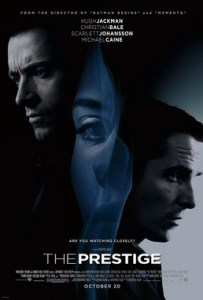
Since The Prestige came out over a decade ago I’m not going to worry too much about spoilers below.  This post also comes with another caveat: if you watch this film you’ll be left scratching your head and finding yourself strongly tempted to punch the replay button immediately.  Like most Christopher Nolan films, the movie is complex and intelligent.  It also plays on an age-old horror theme of the doppelgänger.  There be spoilers here!  

Following the rivalry of two stage magicians seeking the ultimate illusion, there’s a great deal of sleight of hand in the way this movie manipulates its viewers.  You are in the audience of a magic show and you’ve volunteered to go up on stage.  I watched this film on the recommendation of a friend without even checking the genre.  That can be a disorienting experience in itself.  One of the first questions we bring to movies as well as to texts is “what kind is it?”  I had the assurance that it was “the good kind” and that was about all.  That assessment was right.  While the credits rolled—it was already late at night, for me—I was strongly tempted to start it all over.  Sometimes people ask me why I watch horror films (and no, this is not horror) and I think the answer is related to what I find here.  Like most people I want the advice of others on what to do should things go wrong.  And in The Prestige they do go wrong.  Spoilers follow.

The crux of the film involves actual doppelgängers that result from Nikola Tesla’s experiments.  Tesla was a mysterious person in real life, and without knowing the genre you can watch this film and find it believable.  There’s a kind of faith involved in movie-going, after all.  One of the early exploiters of the doppelgänger was Edgar Allan Poe.  In “William Wilson” he narrates a tale of a double that might indeed be the real William Wilson.  The Prestige plays the same card.  Most of us live knowing that daily our senses can be fooled.  We actually enjoy it once in a while.  Stage magicians stake their livelihoods on it.  Nolan is a master of bringing complex twists to the silver screen.  In Holy Horror I briefly discuss his Memento.  I have a suspicion that I might’ve had more to say about it had I watched this film earlier, with a copy of Poe in hand.