The Heart of Publishing

My heart goes out to academic authors.  It really does.  They labor over a book important to their field and see it come out costing near triple digits and wonder why it’s not in the local bookstore.  There is, however, a very wide gap between academic and trade publishing.  It is bridged here and there by authors who value readers over reputation, but unless you deliberately try to learn how all of this works, it is bewildering.  Academics, you see, are area specialists by and large.  You don’t write a dissertation on the Bible, for example, but on a specific part of the Bible (New Testament or Hebrew Bible).  And within that section your specialization is not a single book, but often a small part of a book, or a theme.  I’ve seen dissertations written on a single Hebrew word.  Specialization.

With all of this tight focus, it’s easy to forget what browsing in a bookstore’s like.  Even with some of the incredible brick and mortar stores in Edinburgh, technical books had to be ordered—this was before Amazon.  When you check the books of colleagues out of libraries it doesn’t always occur that you do this because libraries are the only places that buy such books.  And with the explosion of doctoral degrees in shrinking areas of studies (there are no jobs here, folks!) the number of published dissertations has skyrocketed.  Even advanced scholars forget the average reading public would find their work impenetrable.  It’s not going to be in the local bookstore, and it costs so much because it sells so few copies.  I do feel for academic authors.

In addition to all the area specialization, it would make sense to research the academic publishing industry.  Yes, it is an industry—it has to try to turn a profit when sales are minimal.  And with so many books being published, libraries can’t keep up.  The end result is high prices.  I’m as guilty as the next academic at wishing economics would just go away and leave me alone.  I want to believe in the pursuit of knowledge for knowledge’s sake.   That’s not the way the world works, however.  At least not the publishing world in a capitalistic context.  The internet itself has become competition.  Much of the information’s out there for free.  So your academic book, when it comes out, will be priced out of your comfort range (been there, done that).  It’s not that your publisher doesn’t believe in you, but that they have to try to turn a profit.  All it takes to understand why is a bit of research.
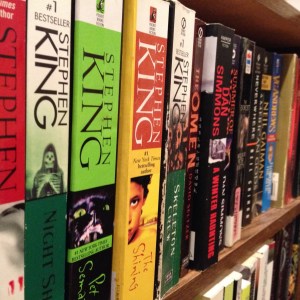
Not that kind of book.

Digging Bad?

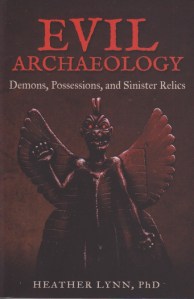
Academics, as a rule, focus on books by other academics.  Theirs is a specialized vocabulary with specific goals (tenure, then an Ivy League position).  It’s easy to see, sometimes, why they distrust books by those of us outside the academy.  We aren’t as constrained, and can say some speculative stuff.  I just finished Evil Archaeology: Demons, Possessions, and Sinister Relics, by Heather Lynn.  Now, most academics I know won’t take seriously a book where the author is cited by “Ph.D.” on the cover.  That’s a sure sign of trying to impress a lay readership.  This book is clearly heartfelt, and personal, but it does raise a host of questions regarding sources and details. I found myself wondering where the author found out so much about Pazuzu when I, who hold a doctorate in ancient West Asian studies, had such trouble locating sources.  Then I checked the bibliography.

Even academics have been known to cut a corner or two, now and then.  For my last book I didn’t have access to a university library so I had to make do with what I could get my hands on.  (JSTOR is not cheap for individuals, in case you’re wondering.  If you teach and you get free access from your library, you don’t know how lucky you are!)  So it is with my present research.  I muddle along, often buying used copies of the books I need, sometimes from eBay.  Researchers can be driven that way.  Lynn’s book covers a lot of territory, and not all of it seems related to demons.  Little of it covers archaeology in any detail.  But then, it’s not intended for academic readers.  I learned a thing or two.  I also distrust a thing or two she claim (having once been in the academy), but there’s no doubt she’s trying to do a service in this book.

Demons cut a wide swath.  Lynn discusses bits and pieces from here and there, and at times her treatment is rather a gallimaufry of anecdotes.  There are interviews, personal experiences, and urban legends.  It does seem hard to believe that scientists worldwide are studying demons in order to explain illnesses, though.  For me, finding a new book on demons just when I was finishing my draft on the same topic, it was imperative to read what she had to say.  It’s clear she’s seen some of the same movies I have.  I like to think that, as an inbetweener I can still read academese as well as regular writing.  You always find interesting things there in the middle.


Bradbury’s Dream

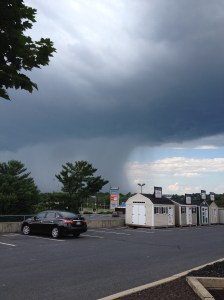
There’s a Ray Bradbury story—I can’t recall the title, but with the Internet that’s just a lame excuse—where explorers on Venus are being driven insane by the constant tapping of rain on their helmets.  They try to concentrate on discovery, but the distraction becomes too much for them.  Living in Pennsylvania has been a bit like that.  I grew up in the state and I knew it rained a lot.  Here in the eastern end we’ve hardly since the sun since March.  And when you’ve got a leak in your roof that only compounds the problem.  If I were weathering the Psalms, mine would be a lament, I’m afraid.  You see, the ground’s squishy around here.  Mud all over the place.  Rivers have been running so high that they’re thinking about changing their courses.  And still it rains.

There’s a lesson to be taken away from all this.  The fact that we use water for our own ends sometimes masks the fact that it’s extremely powerful.  Not tame.  The persistence of water to reach the lowest point contributes to erosion of mountains and valleys.  Its ease of transport which defines fluidity means that slowly, over time, all obstacles can be erased.  It’s a lesson in which we could stand to be schooled from time to time.  Rain is an artist, even if it’s making its way through the poorly done roofing job previous occupants put into place.  Would we want to live in a world without valleys and pleasant streams?  And even raging rivers?

There’s no denying that some of us are impacted by too much cloudiness.  When denied the sun it becomes easy to understand why so many ancient people worshipped it.  Around here the temperatures have plummeted with this current nor-easter and the heat kicked back on.  Still, it’s good to be reminded that mother nature’s in control.  Our high officials have decided global warming’s just alright with them, and we’re warned that things will grow much more erratic than this.  As I hear the rain tapping on my roof all day long, for days at a time, I think of Bradbury’s Venus.  Okay, so the story’s appropriately called “The Long Rain” (I looked it up).  Meanwhile tectonic forces beneath our feet are creating new mountains to add to the scene.  Nature is indeed an artist, whether or not our species is here to appreciate it.  If it is, it might help to bring an umbrella this time around.


Linking In

Like many in the internet age, I have most of my “connections” online.  It’s somewhat of a rarity to be invited, for example, to connect on LinkedIn by someone I actually know.  I remember the early dissemination of information from that network—it was strictly for people you really did know in real life, because they could help or hurt your career.  I took that seriously for a year or two, but it became clear that this was another Facebook with a more professional cast.  I’ve been told of authors who try to build their online platform by adding thousands of connections on LinkedIn.  The website, however, is not intended as an advertising venue.  It has, however, become one.

I’m not denigrating LinkedIn.  I’ve found two jobs through it and I’ve had recruiters reach out to me because they found my profile there.  For a religionist that can be quite flattering.  Academia and society tend to tell you that such a skillset is okay but basically useless.  Having others who know the wide diversity of human employment these days can be a sign of hope.  Nevertheless, advertising has crept into LinkedIn.  I’m not talking about the frequent invitations to go professional on the site, which will only cost a small fee that will suddenly show up on your credit card bill when you least expect it and thought you were in the clear.  No, I’m talking about connections contacting you to do gratis work for them.  Advertising their book, or their services.  Letting others know, they ask, that they can provide this or that service.  (Just to be clear, I’m not referring to people who contact me personally because we have an actual connection!)

For those of us working stiffs not in a position to hire anyone—professionally or personally—this is another symbol of how any form of communication becomes commodified.  Fully over half of my email is soliciting money in one form or another.  Hearing from an actual person with an actual message for me is so rare that I’m stunned to find one in my inbox.  Capitalism just doesn’t know when to let go.  And it doesn’t have a good read on what little I actually do buy.  Underwear (and just using that word will color the tailored ads I receive for weeks) vendors seem to think I’m concerned about the fashion of garments others don’t see.  The books Amazon suggests, based on a solid track record, are generally far off from my interests.  What hope do those who don’t know me have of selling me their wares through LinkedIn?  The dream of connection without cash changing hands nevertheless remains alive.

Old school connectivity


Mother of Stone

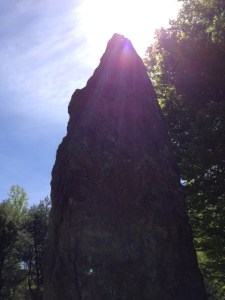
One thing we all have in common is mothers.  Whether it’s the mysteries of biology or something more spiritual than that, the connection lasts forever.  The thought occurred to me yesterday as we visited Columcille, one of those places that reflects a vision for a piece of land that transforms the ordinary into sacred.  Columcille Megalith Park is inspired by the standing stones of Celtic lands.  Open to the public for a suggested donation, the park consists of a stone circle and several menhirs (megaliths) arranged along paths through the woods.  Recognized by the Nature Conservancy as a sacred space and outdoor sanctuary, it draws thousands of visitors of all faiths with both recreational and religious rationales.  Throughout the park we found evidence of spiritual interaction with nature left on or near the stones.  But what has this to do with mothers?

One of the areas in the park is the Sacred Women’s Site.  As we lingered there yesterday, I reflected on the sacred nature of all women, and mothers.  That’s not to suggest that motherhood is for all women, but rather that our society has been slow to catch up with the idea that women show us the way.  Men have “had charge” for millennia now and look at where we are; cooperative ventures and peacekeeping efforts crumble as world leaders encourage the resurgence of exceptionalism.  We’d rather have an inveterate liar lead the nation than a politically able woman.  Britain wants to pick up its marbles and let the European Union disintegrate.  We seem to have forgotten that just a century ago a world war ended.  We need sacred spaces like Columcille.  We need to remember the sacred women.

One takeaway from our brief visit was that although there was also a grove for sacred men, that of the women was more peaceful.  The idea of standing stones making a site sacred goes back at least to the Bible.  Stone circles are found from ancient Israel to the far-flung Orkney Islands of Scotland.  Standing among them, whether modern like Columcille or ancient like the Ring of Brodgar, or yes, the more famous Stonehenge, there is a sense of sacred purpose.  Miles from Stonehenge stands Avebury, a town built around another stone circle.  There the megaliths were divided between female and male stones, with both required to make the ring complete.  Such places require a tremendous amount of work.  When they’re constructed, however, they give us places to think of mothers and the mystery of life.


A Nightmare or Two

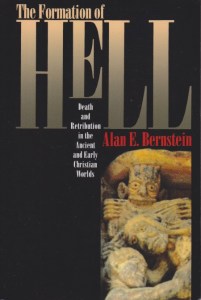
Some books are complex enough to require a slow reading.  Alan E. Bernstein’s The Formation of Hell: Death and Retribution in the Ancient and Early Christian Worlds is such a book.  For those of us raised in a faith primarily geared toward avoiding Hell, the concept becomes a lifelong nightmare.  It doesn’t help that, depending on your clergy you’re taught different, sure-fire ways of achieving that avoidance.  Often it hinges on “believing” the “right” thing.  Fundamentalists tend not to call it “doctrine” since that sounds rather Catholic, but the idea’s the same; it’s a tenet of faith.  As Bernstein shows, however, Hell is an idea that developed over a very long time with several different views of what happens after death.  There’s no single, linear progression, but rather a conglomeration of ideas from a variety of sources.

No single volume can cover all the background to Hell.  Bernstein focuses on Egypt for the early material, as well as Babylonia.  These early civilizations demonstrate that people have always wondered what comes next, and what happens to those who oppress others—the bullies of this life who don’t deserve the same eternal rest as the rest.  Usually some form of punishment awaits, but not always.  In the Hebrew Bible one of the great issues was the fact that everyone goes to Sheol, good and bad alike.  As in classical Greece and Rome (on which Bernstein spends a great number of pages) the concept of the netherworld is gloomy, but not torture.  Except in exceptional cases, of course.  The Greeks had Tartarus as a place for those who dissed the divine.

Even early Christianity didn’t have a uniform view of it.  The New Testament is decidedly divided on the topic.  Revelation seems to be the last word, but it’s not.  Later thinkers such as Origen and Augustine (who came to different conclusions) weighed in.  Catholic Christianity lavished great love on the latter and Augustinian views became disproportionately influential.  Reading his lack of compassion can cause nightmares, although he justifies it theologically.  The one thing I missed in Bernstein’s lengthy treatment was the Zoroastrians.  This religion of ancient Persia introduced a distinct dualism into the biblical world; it perhaps represents the first relatively developed concepts of Hell and Heaven.  Zoroastrianism suffers from lack of documentation, however, and it is difficult to parse it as meticulously as Bernstein does the other cultures covered.  This book requires much pondering as it’s read, and if you were raised believing this kind of thing it’s sure to bring back a nightmare or two.


Dandy Lions

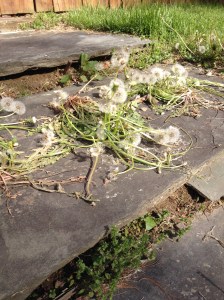
O great—just what I need right now.  I knew lawn care would soon become a necessary avocation after buying a house, but this I did not expect.  Over the weekend I found myself pulling up dandelions that were growing out of cracks in the front steps.  Since we compost, I laid them out on a slab, figuring when they dried out I could make them into more soil.  (From which more dandelions will grow, I know, but still it just feels right.)  I came back a day later to find that the dandelions had returned to the vertical position.  Zombie dandelions!  They apparently couldn’t stay dead.  Now, I’ve been writing about demons for the past several months and I’d forgotten about zombies.  Well, I did post about resurrection on Easter, but my short-lived digression left me unprepared for this.

Really, the persistence of life is a sign of hope.  Perhaps dead zones, such as morality in Washington DC, will someday come back to life.  There’s hope for a tree, Job tells us, even if cut down.  These dandelions were a message for me.  Don’t give up.  Prior to religion being hijacked by theology it was a system intended to make life better for people.  Human beings were more important than heretical thoughts.  You help those who need it, regardless of what they believe.  Or don’t believe.  That was the point behind resurrection, I suspect—we can rise above all this dirt in which we find ourselves.  There’s a nobility to it.  Then again, fear trumps hope just about every time.  The dandelions are rising and we have no hope of outnumbering them.  

The ancients feared the dead coming back.  It’s a primal phobia.  All those things we buried with tears we hoped would stay the way we left them.  Life, as Malcolm says, will find a way.  Politicians, it seems, will find a way around it.  Call it executive privilege or whatever you will, the end result is the same.  The yellow-headed fuzzies will threaten you even when uprooted and left to dry in the sun.  Now, our lawn isn’t pretty.  Grasses of different varieties contend with weeds I’ve never seen before for scarce resources.  I’ve never minded dandelions.  They don’t ask much, only they now seem to be demanding the right to come back from the compost.  And if we let that happen, all hope is lost.


On Publishing

I fear I may be transitioning.  I may actually be becoming someone who knows something about publishing.  Reading about the merger between Cengage and McGraw Hill actually seemed interesting.  What’s happening to me?  Actually, the largest impact has been the realization that scholars need to become more aware of the world around them.  As a doctoral student I was taught to find an unexplored subject and write obscurely on it.  Then, when it’s time to publish, to say to the editor that general readers will understand and find it compelling.  It took some time, however, even though I frequented Waterstones and Blackwells, to realize that the books they housed were not the kinds of books I’d been taught to write.  Back in America, where the brands were Borders and Barnes and Nobel, the same thing applied.  People want books they can understand.

Two articles that caught my attention recently addressed the plight of the academic monograph.  One was “Worried About the Future of the Monograph? So Are Publishers” from the Chronicle of Higher Education.  The other was “Making Monographs Open” from Inside Higher Ed.  Both share some common themes: scholars write books so obscure that even academic libraries won’t buy them and since it’s “publish or perish” it becomes the publisher’s problem.  Listen, I understand that mentality.  Isolated in the woods of Wisconsin with the wind howling through the trees, writing about weather in the Psalms seemed perfectly natural.  Forgetting that the average reader doesn’t know Hebrew, I assumed everyone would find my disquisition irresistible.  Even back in the early 2000s publishers disagreed.  Life is so interesting!  There are so many minutiae to explore!  If you haven’t had the pleasure of following in the tracks of a thought that won’t let you go, you’ve never been really seduced.  But then, somebody’s got to pay for all this.

Scholars are reluctant to acknowledge that publishing is a business.  Indeed, higher education is now a business as well.  Everything’s a business.  To stay solvent publishers have to sell enough books to cover the cost of making them.  As these articles point out, that cost isn’t negligible.  The scholar who explores the publishing industry (as rare as that may be) will discover plenty of resources to help rethink academic writing.  Even without reading the industry rags, just paying attention when you’re in your neighborhood bookstore can be an eye-opening experience.  I was looking for a book (hardly even academic) last time I was in Ithaca, New York.  If any town is likely to have such books on the shelf, it’s Ithaca.  I had to ask and leave empty-handed.  There are lots of books out there, colleagues!  And if you want to get yours published, it pays to do a little research.  Your time will not be wasted.  And I fear I’m becoming someone who knows a little about such things.


Relatively Unknown

The Edinburgh Festival draws people from around the world to experience culture and fun in one of Europe’s most beautiful cities.  The festival also attracts the fringe—artists not associated directly with the festival, but who get included in what used to be a huge, thick catalogue that would keep us busy for hours, considering what a student and spouse could afford, and what you could not afford to miss.  One year a group called Outback was performing at an area church.  It featured Graham Wiggins on the didgeridoo—an Oceanic aboriginal instrument that is essentially a tree branch hollowed out by termites.  It’s so long ago now that I can’t recall if I knew ahead of time, but the leader of the group, the didgeridooist, was Graham Wiggins.  While not exactly a rare surname, Wiggins isn’t common either and when I saw him a strong family resemblance was immediately obvious.  So much so that after the concert we went to meet him only to find out his Wiggins side was from Oxfordshire.  Mine was from South Carolina.

Graham Wiggins, who was a month younger than me, was known as “Dr. Didg” because he held a D.Phil. in solid-state physics from Oxford University.  While an American, he had decided to stay in the UK to make a living from his music.  Some months later, on a Christmas break, we saw him busking in Bath on a chilly night.  We bought the band’s second CD from him that evening.  When my wife put on our Baka disc the other day, I grew curious whatever became of him.  I was surprised and saddened to learn that Graham Wiggins had died three years ago.  I knew we shared a surname and a family resemblance, as well as UK doctorates, but I learned he went to the British Isles from Boston University, which is where I had studied before attending Edinburgh.  He left the year I arrived.

Websites are reluctant to say of what Wiggins died.  I learned of this just days after finding out that a high school classmate had passed away, so mortality has been on my mind.  Wiggins, unlike this Wiggins, was a talented musician with a brilliant mind.  We saw him interviewed on television about the physics of didgeridoo playing.  I never did find out if we were distantly related.  The US Wiggins clan from South Carolina doesn’t have strong genealogical interests, although we know they started out in North Carolina many years ago.  It stands to reason they had come from England at some point, since it’s an English surname.  I only met Graham of the clan twice, but now I can’t get the fading didgeridoo sounds from my mind.


Writing Life

Writers are a conservative lot, in many respects.  Consider the epigraph.  I’ve written about this before—in modern-day publishing epigraphs require permission to reuse and serve little purpose beyond two negotiable factors: to prove the writer is well-read, and that someone else just summed up your chapter in a single sentence.  Most modern books have stopped using epigraphs, but scholars read old books produced before aggressive copyright laws.  There is a trick you can use, however, that brings an epigraph into the realm of the fair use doctrine.  It involves moving it into the body of your chapter.  Make it a quote.  Comment upon it.  For all their research skills, many academics do not take advantage of easily found advice on academic publishing.  Just ask an editor.

We all, I’m sure, have tunnel-vision.  Life is so incredibly busy and demanding that choices have to be made.  For most academics publishing is part of the rubric for tenure.  Perishing is the only other option.  Been there.  Done that.  Those of us who make a more modest living on the other side of the book sometimes write for different reasons.  We may need to supplement our income (as if academic publishing really ever helps with that!), and thus we must pay attention to the finer details of the business.  Write what people want to read.  Think like a reader.  And, yes, get rid of the epigraphs.  We know you’re smart; you’ve written a book.  Another reason for writing beyond the tenure-dome is the compulsion.  The need to do it.

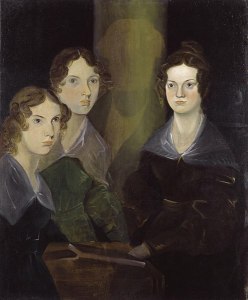
While the struggling artist is a tired trope, it’s also true.  Many of the writers most admired today had lifetimes of struggle and obstacles which often stopped them too soon in life’s tracks.  I often think of the Brontë sisters.  In a family apparently cursed with premature death, living in a time when women writers were rare, three sisters set themselves the task of becoming novelists.  Not one of them lived to forty.  Anne, who wrote The Tenant of Wildfell Hall, made it to twenty-nine.  Emily, author of Wuthering Heights, died at thirty.  Charlotte, who gave the world Jane Eyre, survived to thirty-nine.  They defined, in many ways, the English novel.  And while they lived to see some measure of success in their brief lives, they wrote against the obstacles of life and the specter of early death.  Writing is a passion.  A craft.  And even academic authors provide a favor to the world if they do it well.

Brontë sisters by brother Branwell


Thoughts While Flying

Uh-oh!  I seem to be airborne.  All that’s in front of me is concrete.  If I don’t do something, my exposed hands will hit first.  Tuck, and try not to hit your head.  Still, on impact the first thing I do is look around to see if anyone saw that.  It’s embarrassing to trip and fall, especially when you’re old enough to be avoiding that sort of thing.  I jog before it’s fully light out, however, and the sidewalks can be uneven.  Just in case anyone’s watching my Superman impression, I immediately climb to my feet and resume my pace.  I’ll be sore tomorrow.  As a jogger since high school you’d think I’d have this worked out by now, but you’re never too old to learn, I guess.

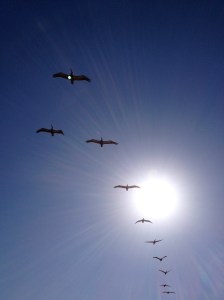
The amazing thing to me is just how much you can think in those fleet seconds that you’re actually in the air, about to hit the ground like a sack of old man.  That’s exactly what happened, though, from the split second I felt my toe catch in an unseen crack and felt my balance give way.  Taking additional steps while trying to straighten back up sometimes works, but my top-heavy head was too far out of sync and my feet were sure to follow.  Your memory of such things goes out of body and you watch yourself comically flying, without the grace of a bird, toward an unforgiving substrate.  Such is the fate of the early morning runner.  I don’t have time to do it during the day.  What if someone emails and I don’t answer?  They’ll think I’m slacking off.  Remote workers!

Despite the occasional spills, I’ve always enjoyed this form of exercise.  In the post-Nashotah House days while still in Wisconsin I’d sometimes do nine miles at a time.  Whenever I’ve moved to a new place I’ve gotten to know the neighborhood by jogging around.  Even if it’s not fully light you can see plenty.  (Although the cracks in the sidewalk aren’t always obvious.)  I tend to think about these things as life lessons.  Parables, if you will.  One of the deep-seated human dreams is that of flying.  Birds make it look so easy, and fun.  A human body feels so heavy when it impacts the ground.  I suspect that’s why we find gymnasts so fascinating to watch.  As for me, I’m just a middle-aged guy in sweats and wearing glasses.  And even as I head home I’m already thinking how remarkable the number of thoughts are in the few seconds while in flight, somewhere over the concrete.


Final Stretch

There comes a point, in my experience of book writing, when you can think of nothing else.  This is near the end of the process.  For months and months you’ve been working at it in increments, and the sudden realization hits you that other people are (you hope) going to read what you’ve been scratching out for a couple of years.  My interlocutors tend to be in print or email form.  I don’t work day-to-day with colleagues who know about the book, nor, I suspect, would they care very much.  In my case this comes as I’m trying to generate attention for Holy Horror, with very limited results.  But I don’t have time to think about that now.  Nightmares with the Bible is almost ready to submit.  If only I had more time to read everything.  If only.

Writing is a challenging form of expression.  Let me qualify that: getting writing published is challenging.  The actual craft flows.  The book that is intended to pass scholarly muster, however, must be full of notes and quotes.  I’m trying to leave those behind as much as possible since I’ve been reading about these topics for decades and that ought to count for something.  Still, that nagging doubt awakes you—haven’t you overlooked something?  Some vital source that you should’ve cited?  Some argument that knocks your book off its stilts?  Near the end of the process it’s hard to concentrate on other things such as blog posts and tweets.  Yet you need to build your platform while you’re standing on it.  And then there’s the small matter of work that will demand well over forty of your waking hours this coming week.  And the index—you can’t forget the index!

In the intervening months you might’ve read some newspaper headlines, read some books off-topic, read other people’s blogs, kept up with social media.  Now, however, you have tunnel vision.  You’ve said what you have to say, you think.  You must check it.  And recheck it.  Did you leave a sentence open for later comment?  What chapter was that in?  Have you figured out how to close it?  Woe betide those to whom this happens at tax time.  Or before a business trip.  Making a living as a writer you do not.  This avocation, however, is your life.  Your legacy.  Editors who’ve been remembered are few.  A book is a stab at immortality.  There are meetings.  There are work deadlines.  There’s a lawn to mow.  Those, however, are mere distractions at this point.


Horizontal Thinking

“Theology” is a word that means very different things in different contexts.  I dislike labels in general and I seldom call myself a “theologian” since that implies a systematic or “dogmatic” theologian on this side of the Atlantic.  (And a better paying job.)  In the about to exit Britain “theologian” tends to mean someone who studies religion and can be used regardless of discipline.  In any case, I avoid the use of the title since my interests tend toward the history of religious ideas, not making them into a workable system.  I was a little surprised when I received an invitation from the journal Horizons in Biblical Theology to contribute a piece on horror and the Bible.  The issue in which the article was published (41) has just appeared.  Ironically, invitations to contribute seldom came when I was employed as an academic.  Of course, “independent scholar” is now a fairly common avocation.  Especially in theology.

Horizon

I won’t post any spoiler alerts for the contents of the article—I don’t want to quell the stampede of those eager to read it—but the basic idea is that biblical studies has embraced horror.  Like long-lost cousins, they have come together at last, realizing that they are both pariahs.  People generally don’t know how to carry on a discussion with a biblical scholar, as if those of us who spend time with the Good Book are constantly judging others.  I can’t say as I blame them since that image is reinforced fairly constantly.  Horror scholars, on the other hand, are thought to be weird examples of arrested development—stuck in the juvenile phase.  Social respectability isn’t their strong suit, although horror movies do well at the box office and one of the most successful writers ever is Stephen King.

Religion and horror share more than being associated with troglodytes, however.  Both address primal human fears.  Religion may not be “all about” fear, but a healthy dose of it is.  If life was peachy all the time, would we have any need of religion?  We need help coping with our fears, and religion has a long history of dispensing it.  Knowing we’re going to die, and in all likelihood will experience some suffering before that, whether physical or psychological, is a heavy burden to bear.  Religion has always been there to provide meaning and sometimes even solace.  Horror, or at least the best of it, does so too.  I’m not sure I would call it theological, but if you’re interested you know where to find my latest musings on it.


No Animals Harmed

Out for a walk after work the other day, I spied a black cat.  Not the superstitious sort, I didn’t let this deter me from continuing on.  Then I noticed that it was a mere three or four feet from a ground hog that was just as large as, if not larger than, the cat was.  They were staring at each other, weighing their options.  The ground hog didn’t appear too concerned.  Then a rabbit hopped up, on the other side of the cat.  A perfect syzygy of fauna that remained still for a moment in a tableau of nature.  About the same time as the cat noticed  the rabbit, the rabbit noticed it back and quickly hopped away.  The cat crouched and slunk after the bunny and the woodchuck ambled off at its own pace.

Not only was this conjunction an odd combination of three species of mammal—four if you count me—but it was such a conscious interaction that I had to think of it as almost human.  Three very different individuals, probably all with eating on their minds, had to assess how to interact, wordlessly.  As far as I could tell the drama ended amicably.  The cat looked well fed, in any case, and the rabbit far outdistanced it from the start.  Chuck was unconcerned.  Although the hard line still exists in science, drawn between ourselves and our fellow animals, I’m convinced that they have a share of consciousness.  We’re told that they’re mere “machines” following instinct.  These three “machines” along the trail were sure acting like they were thinking.

What are they thinking?

As the situation played out, no violence ensued.  Three individuals out enjoying the spring happened to find themselves in a scenario that called for negotiation.  The cat, like Republicans, felt compelled toward aggression, I should imagine.  It had a choice: take on a larger, more worthy foe, or turn its attention to the weaker, more vulnerable prey.  Naturally, it turned toward the weaker of the two.  There were differing agendas at play here, and with a dose of consciousness added in, these critters behaved so like human beings that I felt compelled to share it.   The ground hog and rabbit looked on the situation with some wariness.  They thought about it, and each took the prudent route to safety, for the time being.  Nature, it seems, will find its balance if we let it.  And we, if we would acknowledge it, still have something to learn from nature.


Theofantastique Interview

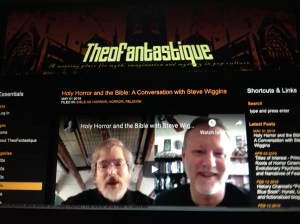
Two times.  In my “professional” life I’ve been interviewed only twice (not counting, of course, far too many job interviews).  The first time was as a talking head for Nashotah House.  This was in the days before the internet really caught on, so it was done in DVD format.  If you come over to visit I’ll dig it out and we can have a good laugh.  The second occasion was much more fun.  Although I write about horror a lot, I don’t mention Theofantastique nearly enough.  Back in the days when I started blogging, I discovered this site that featured all kinds of interesting stuff on religion and horror (and actually on all kinds of genre pop culture).  I always enjoyed the insights and got more than a few books for my own research and reading from tips I found there.

When I finally got brave enough to contact John W. Morehead, the curator of the blog, we both quickly realized we had some things in common.  John very kindly offered to post an interview with me on Theofantastique about Holy Horror.  It’s live now and it was really fun to talk to an actual person about my book.  You see, I work alone.  I knew that, leaving the classroom, I was departing my chosen career.  On those high school aptitude tests they told me that I should be an entertainer.  What professor isn’t?  I pity their students if they’re not.  I’ve been posting videos on YouTube for a few weeks now.  It’s immediately obvious how much having a live audience helps.

Unfortunately, Holy Horror isn’t exactly priced to move.  In fact, local bookstores have turned me down for free presentations based on the price alone.  It is, however, a fun book to read.  At least I intended it that way.  When life give you horror, make Bloody Marys, I guess.  By the way, John has been coming out with some interesting books also.  I posted on his The Paranormal and Popular Culture recently.  Theofantastique is often the place where I first learn of new horror films (I don’t get out much) and new books that I should read.  Of these two things there’s never a shortage—horror is a thriving genre—and talking about why you wrote a book helps to clarify things a bit.  Horror may seem a disreputable genre to many, but it has redeeming values.  To hear about them, please watch the interview.