Author Revise Thyself

Monster fans may have noticed that, despite the season I haven’t been writing much on the topic.  One of the reasons for this is that I’m in that dread stage known as “revision.”  As an editor I often see book proposals—or even entire books—that have never been revised.  You can tell.  I learned this while writing Holy Horror.  If you’re one of the people who took out a second mortgage to buy a copy, the book you purchased was based on a manuscript rewritten thoroughly at least five times.  The idea is that like rocks in a river, all that pouring over a text smooths the words like stones over the millennia.  Few rocks emerge from volcanic or sedimentary situations as smooth and round.  That takes revision.

My peer review report for Nightmares with the Bible came in a few weeks ago.  Nightmares had been revised a couple of times, at least, before I submitted it.  I understand the review process very well, as I deal with it daily.  Sometimes single blind (the writer doesn’t know the reviewer’s identity), other times double blind (neither reader nor writer know the other’s identity), the process is meant to provide feedback on a manuscript.  Having written many more manuscripts than have seen publication, I know just how useful peer review can be.  Like anything, however, it can also be treated legalistically, as if the reviewer knows more about a subject an author has just spent years researching.  No matter your impressions about this, once the reports come in, revision is in the cards.

Self editing is difficult.  And occasionally embarrassing.  You read again what seemed to make sense to you at the time, but even after you hit the “send” button you’ve continued reading.  New information comes to light.  Monographs are a very expensive form of dialogue.  Well, not so expensive as all that.  Many people are happy to pay out the cost of a monograph for a dinner out, which lasts an evening.  A book, mutatis mutandis, lasts much longer.  Like that meal, it’s taken internally and digested.  You can read the same book twice, however, without having to pay the second time around.  It’s a good idea, then, to revise before sending it to a patron’s table.  Ironically, revising a book on monsters takes time away from writing about monsters.  I also have essays awaiting revision, circling overhead like planes at Newark’s Liberty Airport.  And then there’s work, which has nothing to do with my own writing at all.  There’s a reason Nightmares occurs in the title.


Seventies

It’s pretty rare for me to be out on a week night.  Like a kid on a “school day” I’ve got to get up early the next morning.   And yawning a lot at work is bad form, even if nobody can see you.  I risked it recently, however, to meet with some colleagues from the Moravian orbit in Bethlehem.  As we talked, current projects came up, as they’ll do when doctorate-holders get together.  Demons are a conversation stopper, but I nevertheless asserted that our modern understanding of them derives directly from The Exorcist.  The insight isn’t mine—many people more knowledgable than yours truly have noted this.  One of my colleagues pointed out the parallel with The Godfather.  Before that movie the mafia was conceived by the public as a bunch of low-life thugs.  Afterward public perception shifted to classy, well-dressed connoisseurs who happen to be engaged in the business of violence and extortion.

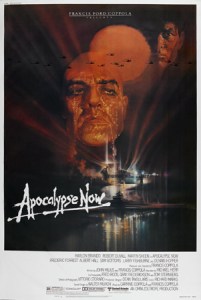
The insight, should I ever claim as much, was that these films were both from the early seventies.  They both had a transformative cultural impact.  Movies since the seventies have, of course, influenced lots of things but the breadth of that influence has diminished.  I noticed the same thing about scholarship.  Anyone in ancient West Asian (or “Near Eastern”) studies knows the work of William Foxwell Albright.  Yes, he had prominent students but after Albright things began to fracture and it is no longer possible for one scholar to dominate the field in the same way he did.  Albright died in the early seventies.  Just as I was getting over the bewilderment of being born into a strange world, patterns were changing.  The era of individual influence was ending.  Has there been a true Star Wars moment since the seventies?  A new Apocalypse Now?

You see, I felt like I had to make the case that The Exorcist held influence unrivaled by other demon movies.  We’re still too close to the seventies (Watergate, anyone?) to analyze them properly.  Barbara Tuchman suggested at least a quarter-century has to go by for the fog to start clearing.  Today there are famous people who have immense internet fame.  Once you talk to people—some of them my age—who don’t surf the web you’ll see that internet fame stretches only so far.  It was true even in the eighties; the ability to be the influential voice was passing away into a miasma of partial attention.  The smaller the world gets, the more circumscribed our circles of influence.  And thus it was that an evening among some Moravians brought a bit of clarity to my muddled daily thinking.


Who Cares?

America’s all about money.  I read quite a bit about care-related exhaustion, and being in a situation where several family members are requiring care I’ve begun to notice that our government just doesn’t care.  Talking with a family member recently, his exhaustion was clearly evident.  Not affluent, he has to care for a spouse with Alzheimer’s and continue to work ten hour days because nobody pays you simply to help another human being in need.  Care can be monetized, of course.  Then Republicans sit up and take notice.  Until then, however, I try not to be overwhelmed by what is clearly a growing crisis.  Some call us the “sandwich generation”—we support our children longer as more and more jobs become obsolete, and we care for our parents longer as lifespans extend and extend.  For the working poor, the benefits do not keep pace with life expectancy.  And what child wants to see his or her parent suffer?  Why doesn’t our government care?

Instead of devising new ways to deal with a massive crisis (I know many people who are constantly running on empty from having both to caregive and to work), Washington tweets about how the wealthy are the objects of “witch hunts.”  Those with too much are so oppressed, but they just can’t see their way to share what they have.  Meanwhile even those of us with educations find ourselves not knowing what to do.  Politicians play their games forgetting that the pieces they move about the board are alive and sentient.  After all, there’s only one king on each side.  And who feels too bad if a pawn or two gets bumped off, as long as the monarch is kept safe?

There are solutions.  Not perfect, of course, but societies with a dash of socialism realize that if those on the bottom can’t do their jobs, those on the top will tumble too, when the foundation fails.  Any builder knows the importance of secure footings.  One guy, often cited by the GOP but never really listened to by them, said houses built on sand fall.  Giving care takes time, money, and energy.  Employers want those exact same things and should you fail to provide them, you will find yourself also requiring care.  Even if your reason was that you were caring for another.  Meanwhile policies will be made to favor those who line the pockets of the political.  Who cares?  Certainly not the officials we “elected” to “lead” us.


Frozen Streams

I was walking in Ithaca, with my feet not far from Sagan.  Winter had settled in prematurely, as it often does in upstate.  I was wearing a hoodie and old fleece combo and I suppose I looked a bit tatty.  My wife and daughter had gone to see Harriet, but movies about how badly people have mistreated others, strangely for a guy who watches horror, really depress me.  Ithaca, until recently, supported three independent bookstores, so I figured I could pass the time easily enough.  It was growing dark and breezy, and I visit bookstores only with a list, otherwise it’s too dangerous.  Autumn Leaves, a used vendor, I’ve visited many times.  Their religion section is disappointingly small, but I tend to find offerings in other areas when I blow in.

Buffalo Street Books is the last remaining indie that handles new books, but I stopped by The Bookery, now closing, on my way.  This was saddening.  Ithaca houses both the ivy league Cornell and the highly regarded Ithaca College.  I suspect many of the street sweepers hold doctorates.  Has book culture entirely bent the knee to Amazon?  At the end of the last millennium, Ithaca housed 25 independent bookstores.  Today it’s evident that Buffalo Street (formerly The Bookery II) struggles to keep its hold.  I feel ethically obligated to buy something there, to take one for the team.  I had a short list and the shelves in The Bookery had been nearly bare.  It was just too depressing to stay there.  I found an inside bench and sat to read until the movie was over.

Or so I thought.  I ventured back outside and now it was fully dark, being six p.m., and I wandered back to the familiar Ithaca Commons.  I went into a couple of shops, but they looked at me as if I were homeless.  (I suppose I was, in a sense.)  I haven’t had a haircut in a while, and my beard is scruffy and white.  My hoodie and fleece don’t speak to affluence.  I had unconcealed books—I routinely refuse bags—and I suppose I could come across as a touch eccentric.  (I don’t have enough money to be authentically eccentric.)  I wondered how street people do it.  Outside the east wind was decidedly sharp and windbreaks on the pedestrian zone are few.  I came to the monument to Martin Luther King Junior.  I was walking in Ithaca but I really felt that books could make that dream come true.


The Happy Science

Many seem to be wondering, if the media are to be believed, why America, like REM, is losing its religion.  (And yes, I know that the expression for the latter means to lose one’s temper, not literally to lose one’s faith.)  Derek Thompson at the Atlantic recently wrote about how the more literal loss took place around 1990.  He posits that the rise of the Christian Right, the Cold War coming to an end, and 9/11 are behind the loss.  As an historian of religion, even with a more ancient focus, I have to wonder if his gaze goes back far enough.  Being born early in the sixties was an opportunity to have a front-row seat.  My family was very religious.  To us, the rest of the world may have been going to Hell, but locally we were trying to please God, as most everyone we knew was.

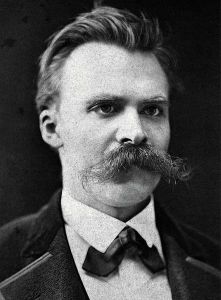
Theologians and sociologists thought God had died.  Nietzsche, always ahead of his time, had declared as much nearly a century before the sixties got underway.  The public face of religion, however, is never the same as what’s going on below.  The religious right was built on a deep-seated hypocrisy from the beginning.  Now hypocrisy is so very human it’d be easily forgiven were it not for the constant insistence on self-righteousness followed by the revelation of some base human vice.  Time and time again televangelists didn’t cover the tracks of their peccadillos well enough, and Catholic priest couldn’t fight that feeling.  They were doing what humans have probably always done, but while wearing the vestments of public respectability.  Like Cthulhu, it seemed like God was dead but dreaming under the sea.

Religion, as all scholars of the phenomenon know, changes only very slowly.  Church attendance began dropping in the seventies, but back then there was such a thing as the rule of law and a real concern that your neighbors didn’t think you a Commie.  Fast forward to the era of Trump when the rule of law broke down completely and religions rank right up there with Republicans as being the most dishonest elements of humankind.  We look back at when the slow trickle seemed to breech the dyke in the 1990s.  The real game changer (since 9/11 was still in the future) was the birth of the internet.  People began to talk freely about the two subjects—religion and politics—that those of us from the sixties were taught assiduously to avoid in polite company.  Nietzsche published Die fröhliche Wissenschaft in 1882.  It would take about a century to sink in, and human religious leaders would be the ones to prove his point.  At least in this world of choosing our confessions.


TMI

Recently I was left alone for the entirety of a Saturday.  On rare days when I feel affluent, I’ll go and purchase supplies to take on the many tasks that need doing around the house—most of the books on my office are still stacked on the floor for lack of shelves.  I can build them, but that takes money.  Often when I have an unclaimed day I plan it out weeks in advance.  Things have been busy enough of late that I didn’t even have the time to do that.  All the sudden I woke up on a November Saturday with tabula rasa in front of me.  Then I realized one of the constant pressures I face: TMI.  One of my nieces—the one who started this blog, actually—first introduced me to Too Much Information (TMI).  I don’t get out much, you see.

Like most people who flirt with tech, I snap photos with my phone.  When we go somewhere that I suspect we’ll never be able to afford to go again, I take an actual camera and let fly like I work for National Geographic or something.  Since my laptop’s on a data diet, all of these end up on a terabyte drive, hurriedly downloaded as IMG or DSCN files, waiting to be sorted later.  Do this since the inception of digital photographs and you’ll get a sense of the magnitude of the problem.  My laptop says it’s full and I have to delete images with that dire warning they’ll go away forever.  I back them up.  When was the last time I did this?  I wrote it down, but I forgot where.  What did I even name the file?  Did I back it up or is it on my hard disc?  Why are there eight copies of the same photograph?  I spent the day sorting, virtually.

Before I knew it, the sun was beginning to set.  I’d awoken at 4:00 (being a weekend I slept in), and after a day of organizing electronic photos into electronic folders, I’d barely made a dent.  Deduping alone takes so much time.  Some of the pictures, while nice, I couldn’t remember at all.  I shudder, though, thinking about grandparents that burned old photos because nobody remembered who they were any more.  Then I realized that our lives are the most documented of any in history (so far) but nobody really cares.  You could learn an awful lot about some stranger just by going through their photos—where they’ve been, what they thought important, and just how obsessive they could be.  As I wound up the day, I realized why I don’t get out much any more.


Dead Language

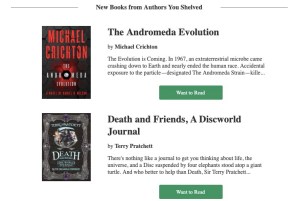
Tis the season for returning from the dead.  Goodreads is one of the few websites that I allow to send me notices.  I try to check them daily, and I even read their monthly updates of new books by authors I’ve read.  I was a bit surprised when November’s newsletter began with The Andromeda Evolution by Michael Crichton.  I really enjoyed The Andromeda Strain when I was in high school.  The fact that I was in high school four decades ago made me wonder about the robustness of Dr. Crichton, especially since I knew that he had died over a decade ago himself.  I don’t know about you, but the writing industry feels crowded enough without dead people keeping in the competition.  It’s like those professors who refuse to retire, but also refuse to teach or do research.  Some people, apparently, can never get enough.

We live in an era of extreme longevity.  In the scope of human history, people haven’t lived so long since before the flood.  Some of us—not a few, mind you—work in fields with limited job openings.  We are the sort who don’t really get the tech craze, intelligent Luddites who’d rather curl up in the corner with an actual book.  There are very few professorates available.  Even fewer editorships.  And anyone who’s tried to get an agent without being one of the former knows that there are far too many writers out there.  Now the dead keep cranking ‘em out.  I’ve got half-a-dozen unpublished novels sitting right here on my lap.  Crichton’s gone the way of all flesh, but with an active bank account.

The end result of this Novemberish turn of events is that I want to read The Andromeda Strain again.  I haven’t posted it to Goodreads since when I read it the internet itself wasn’t even a pipe dream, except perhaps in the teenage fantasies of some sci-fi fans.  Since you can’t rate a book twice on Goodreads, and because paper books don’t disappear when you upgrade your device, I can do it.  I can actually walk to the shelf and pull a vintage mass-market paperback off it.  Even if the Earth passes through the tail of some comet and all networks are down.  And I seem to recall that the original strain came from outer space.  As did the strange radiation that brought the ghouls back to life on The Night of the Living Dead.  Now if only some of the rest of us might get in on the action.


The New Light

Sometimes you meet kindred spirits in books.  Barbara Brown Taylor’s Learning to Walk in the Dark has been waiting patiently.  It’s one of those books that I suspected would meet me where I live, and regarding this I was correct.  Brown Taylor, a former Episcopal priest and professor of religion (both of which I attempted but failed to achieve), has the courage and insight to suggest that darkness might just be a friend.  The darker half of the year settled hard on me this year.  As its black wings gathered about me I reached for this book.  I’ve been struggling with a question I’m sometimes asked: why do I let my thoughts linger in what must be considered darker corners?  I watch horror and write books and stories about monsters.  What’s wrong with me anyway?

One accusation may be fairly leveled at much of American religion is that it is shallow.  Light is uncritically accepted as good and dark becomes somehow evil.  There are biblical prooftexts that can be used to “prove” this, but they change color when you wrestle with them.  Learning to Walk in the Dark contains many ways of reflecting on realities which are inevitable.  Brown Taylor visits museums that give the sighted the experience of being blind in a safe environment.  She spends time in caves.  She stretches out beneath the stars and contemplates the dark night of the soul as well as the cloud of unknowing.  These latter two are, of course, spiritual classics.  There’s quite a bit that can be learned from experiencing darkness and listening intently.

My own predilections toward subjects called “dark” are forms of therapy.  My religion simply can’t be shallow.  I need enough water to swim.  And yes, I’m afraid of deep water.  Darkness perhaps comes more naturally to those of us who are awake for every sunrise.  If I move far enough north that may cease to be the case, but for the last decade or so my internal alarm goes off a couple hours before the first sliver of light creeps over the eastern hills.  And I seem to have assimilated to it.  As I read Learning I could imagine the accusations flying from my former Nashotah House context.  Looking at that patriarchal theology of sin and misery, however, I think there’s no question whence true darkness comes.  Without the dark we could never tell that it was light.  Since we need both, it seems wise to follow the sage advice here offered and get to know the dusky side a bit more intimately.


Old Grains

Back when I was somebody—a professor is somebody, even if only a seminary professor—I was invited to meet with a group of Seattle writers and intellectuals.  I was in Seattle already because driving all the way out here was possible when you live in the Midwest and your summers are basically open and free.  (Professor’s privilege.)  One of the group members, the one who invited me, asked me about grain.  When the club met they ate.  With a bent toward history, one of them brought period-appropriate bread.  What kind would be fashionable for a night of ancient Near East talk?  (I was still researching and writing on Ugarit at the time, before Ugaritology passed away.)  Without stopping to think I replied “Einkorn.”  I didn’t know if einkorn was still around or not.  All I knew is that it was the earliest (at least as understood at that time) domesticated grain.  The loaf that arrived that night was a more accessible grain variety.

All of this came back to me as I stood in the local health-food store.  We don’t shop here for regular groceries—it’s expensive to eat healthily—but we’d been invited to someone’s house and said we’d bring appetizers.  The health-food store had vegan cheeses, so we needed crackers to go with.  Then I spied the word “einkorn.”  The Seattle discussion had to be well onto two decades old by now.  I was finally able to answer my question, einkorn was still alive.  The craze for ancient grains did not exist in my professorate days.  Some companies, according to occasional news stories, were trying to brew the beer of ancient Egypt or Sumer, but the health conscious hadn’t gone so far as to trying to replicate the diet of the earliest agriculturalists.

Ancient grains cost more because the yields are smaller.  Although the grain heads look disturbingly like those house centipedes that scamper in the basement when you flip on the light, they aren’t nearly the size of a current wheat head.  It stands to reason that it takes more of them to make up the same amount of flour, and appetites have grown over the millennia.  Like most vegans, I read boxes.  Another ancient grain cracker, apart from brown rice, included amaranth, flaxseed, millet, quinoa, sesame, and sorghum.  Never mixed this way in antiquity (for amaranth and quinoa were part of the “new world” and the others “old”), modern mixologists have devised new ways of using ancient grains.  Einkorn nearly went extinct with the development of wheat, rye, and barley.  But it hung on, and now, as a dozen millennia ago, it has a way of sustaining both dreams and fantasies.


Greatest Weakness

What a privilege it must be to work in a world of ideas!  (And to get paid handsomely to do so.)    My particular (and peculiar) career—if that’s what you call it—is intimately bound up with academics.  Those who know me personally treat me nicely, but the vast majority who haven’t a clue that I’m anything other than a guy who’s helping them get published sometimes forget their privilege is showing.  I’m not busting on my homies; I know what it’s like.  But I’ve noticed some interesting trends (“turns” in academese) that are fascinating from the point of view of an ordinary mortal with a mortgage and a great deal of anxiety about it.  For example, I find catch phrases time and again.  (See what I did there?)  Academic writers learn that if they buck the conventions they’ll be relegated to presses that don’t enhance your career.  All roads lead to Harvard, after all.

All of this is preamble to a curious trend that I’ve been seeing claiming that an idea’s greatest strength is also its greatest weakness.  I read this time and time again, so I began to wonder about the origin of this idea.  Now, not even Google understands “what is the origin of the phrase greatest strength is greatest weakness?” but it does bring up about a thousand-and-one websites about job interviews.  I’ve had many of these throughout this thing I’m calling a career, and just like everyone else I’ve read that when asked what your greatest weakness is reply that your greatest strength (whatever it may be) is it.  The classics such as “I’m a workaholic,” or “I just can’t stop acquiring more x” (and we all need more x), are tired cultural tropes.  How did academics pick up on this?

Does it stretch back to Achilles and his heel, or Goliath and his gigantism?  Or is it that to admit weakness is to disqualify yourself from a job?  A well-meaning friend told me I should go through this entire blog (as if anyone, including me, has time to do that) and expunge all mentions of having lost my job.  They should be replaced with insinuations that I’d chosen to leave.  “Nobody,” he implied, “likes a loser.”  Well, I guess my greatest weakness is that I’m an honest graphomaniac.  I write incessantly.  Novels and nonfiction books, short stories and essays, and even a learned article or two.  I used to be an academic you see.  And I was always honest.  It was my greatest weakness, if you see what I mean.


The God Test

Humans don’t mean to be cruel, I’m pretty sure, when they test animals for intelligence.  We’re a curious lot, perhaps a bit too self-absorbed, but we want to know how other animals are like us.  Of course, we reserve actual thinking for ourselves, given how well we’ve managed to conserve our only environment, but we grant some special spark to our biological kin.  So we devise tests for them.  Since we can’t get beyond human experience, many of these tests are devised for creatures like us.  When animals fail our superiority is reconfirmed.  Then it’s back to the lab.  I’ve got to wonder how it feels to the subject of the experiment (or is it object?).  Some being that has mastered the art of capturing you, perhaps with the aid of alien technology, is trying to get you to understand something that’s only clear from its (the captor’s) viewpoint.  You need to suss out that viewpoint and solve the puzzle in the same way.

This makes me think of many forms of religion.  We’re born to a lower species (human) as the experimental subjects of gods, or a God, who watch(es) to see how we figure things out.  There’s a right answer, of course, but we’re only given hints as to what it is.  We’re given toys to play with—some of them dangerous—and we’re allowed to select clowns and buffoons to lead us.  We can kill off unthinkable numbers of our own kind and the only clue that we’ve succeeded is some tasty treat at the end.  Of course, we have to assume that the intelligence governing this whole farce is much greater than our own.  Doesn’t feel so good, does it?

Holism is the ability to see a continuity in all of nature.  And nature doesn’t just mean this warm globe on which we find ourselves.  It’s vast and mysterious and some parts of it are very cold and others very hot.  There are places we cannot go, and others that seem inevitable, given the choices.  Like the victims of bullies we don’t think about the larger system, but seek to impose our wills on those who see things differently than we do.  Some tote guns while others pack books.  All of us will shoo away insects that buzz too close.  Most of the animals “beneath” us will simply eat them.  Is this all a game?  Or is it some kind of experiment where we have to guess the answer, but with only a fraction of the information required?


Quiet Now

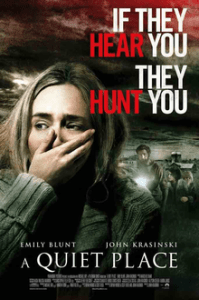
The funny thing about my movie watching is that it’s a reflection of my scattered lifestyle.  While I was teaching my career progression was linear with a goal of moving beyond Nashotah House to a college or university that shared my values better.  Publishing was a fallback, and I’ve learned a lot but I haven’t unlearned my academic leanings.  So, like the rest of my life, my movie watching is piecemeal.  I found a copy of A Quiet Place in a Halloween sale.  My wife bought it for me and on a weekend on my own I watched it.  I had no idea what it was about, but I’d read that it was an intelligent horror film, and that was good enough for me!  There may be spoilers here if you live in a cave, like I do (metaphorically), so be warned.

The backstory isn’t fully spelled out, but the monsters in this movie are blind and attracted to their victims by sound.  The focus is on a family in upstate New York that’s trying to survive without making any noise.  Since there are kids involved, you’ll see how tricky this could be.  John Krasinski’s film builds the suspense wonderfully.  Borrowing from M. Night Shyamalan at his best, and Alien and even Stranger Things, the movie has a odd effect.  When it’s over you don’t want to make any noise.  I watched it while my wife had to work over the weekend, and I put the DVD away as quietly as I could, and then went to bed.  Awaking alone the next morning, I continued the vigil.  Critics praised the movie for its silence, perhaps what we’re most afraid of in this noisy world.

I spend a lot of time saying nothing.  Editing is a quiet job.  Telecommuting is a quiet lifestyle.  At Nashotah House we had mandatory quiet days, which, if they weren’t mandatory I would’ve loved.  I’d seriously considered a monastic lifestyle when I was younger—there’s great value in being quiet.  A horror film that teaches that lesson, despite many obviously unanswered questions, is worth paying attention to.  Horror films have continued to grow more intelligent over the years.  This one is rated PG-13 and will have you on the edge of your seat (or under the bed) anyway.  And it’s got an important message.  For those of us who don’t say much (maybe that’s why I write all the time) a movie like this acts, if you will, as a loudspeaker.  Does anybody hear me?


Outdated Commandments

Recently, according to an ABC story a friend sent me, some self-righteous Catholics stole indigenous statues from the Amazon from a location in Rome.  The statues had been a gift to the Pope and placed outside the church of Santa Maria in Traspontina.  Like mass shooters these days, the Christians responsible filmed themselves doing this and shared it on social media.  I’ve experienced a lot of religious intolerance in my life.  I lost my job and my childhood to it, among other things.  Stories like this are beyond sad because religion really does have the capacity to bring people together rather than to tear them into warring factions.  Unfortunately it tends to draw in the hateful looking for excuses for their violence.

Not unrelatedly, I attended a church program on gun violence.  Before this gets immediately blown up into “anti-gun,” please note—the program was about violence, not guns.  During the Q&A after the presentation someone asked who the panelists were trying to reach, “preaching to the choir.”  After that he admitted to being a gun owner and felt that his position was unfairly represented.  Tension mounted.  One of the panelists, the one who’d witnessed his first murder at age 11, and who’d spent time in jail himself, broke in and said “This is about violence, let’s not make it about guns.”  I was struck by his focus and control.  He’d told us earlier that if a gang member could be convinced to wait 24 hours before getting his gun after an insult or injury a shooting almost never took place.  Violence is often a spur of the moment thing.

What’s so troubling about those who smirk as they film themselves doing violence, like stealing statues outside a church, is that this is not an impulse act.  This is planned, hateful violence.  It wears the mask of religion, often titled “orthodoxy” or “conservatism” but it is in reality simply a way of excusing your hatred.  Ironically, the Jesus they claim to be following said, “Let the one without sin throw the first stone.”  I guess we’ve got quite a few sinless conservatives out there, although I have to wonder if filming yourself might not count as pride.  It used to be called a deadly sin, but who’s counting?  Self-righteousness isn’t quite the same thing as vanity, although they sleep in the same bed.  But let’s not get lust involved, once that happens there’ll be no telling one sin from another.


Whose Computer?

Whose computer is this?  I’m the one who paid for it, but it is clearly the one in control in this relationship.  You see, if the computer fails to cooperate there is nothing you can do.  It’s not human and despite what the proponents of AI say, a brain is not just a computer.  Now I’m not affluent enough to replace old hardware when it starts slowing down.  Silicon Valley—and capitalism in general—hate that.  I suppose I’m not actually paid well enough to own a computer.  I started buying laptops for work when Nashotah House wouldn’t provide faculty with computers.  Then as an itinerant adjunct it was “have laptop, will travel (and pay bills).”  I even bought my own projector.  At least I thought I was buying it.

I try to keep my software up to date.  The other day a red dot warned me that I had to clear out some space on my disc so Catalina could take over.  It took three days (between work and serving the laptop) to back-up and delete enough files to give it room.  I started the upgrade while I was working, when my personal laptop can rest.  When I checked in it hadn’t installed.  Throwing a string of technical reasons at me in a dialogue box, my OS told me that I should try again.  Problem was, it told me this at 3:30 in the morning, when I do my own personal work.  I had no choice.  One can’t reason with AI.  When I should’ve been writing I was rebooting and installing, a process that takes an hour from a guy who doesn’t have an hour to give.

As all of this was going on I was wondering who owned whom.  In college professors warned against “keyboard compositions.”  These were literal keyboards and they meant you shouldn’t type up your papers the night before they were due, writing them on your typewriter.  They should’ve been researched and “written” before being typed up.  That’s no longer an option.  This blog has well over a million words on it.  Who has time to handwrite a million words, then type them up all in time to post before starting work for the day?  And that’s in addition to the books and articles I write for actual publication.  And the novels and short stories.  For all of this I need my laptop, the Silver to my Lone Ranger, to be ready when I whistle.  Instead it’s dreaming its digital dreams and I’m up at 3:30 twiddling my thumbs.


Panic at the Bookstore

Usually it works like this.  I go into a used bookstore with a list of titles I’d like to find.  Yes, I know I can look them up on Amazon and pay some price gouger more than the book’s worth, but you sometimes find things forgotten on a shelf out of the reach of technology.  When I went into a used bookstore in the vicinity of Ithaca last month I didn’t have my list with me.  When I visit such a store, especially the first time, I don’t like to walk out empty-handed.  The word “Exorcism” on both the spine and cover of Ken Olson—excuse me, Dr. Ken Olson’s book on the subject, well, how could I not?  Exorcism: Fact or Fiction? is published by Thomas Nelson.  That immediately told me something of what the book would be like.  It wouldn’t be an academic treatment, and it would be somewhat evangelical.  Still, I didn’t have my list with me.

Olson hasn’t had an easy life.  His license to practice psychology was revoked after he performed an exorcism and my sympathies are always with those who have lost jobs.  Rejection is, after all, a form of violence.  The book, however, isn’t so much about exorcism as it is about evangelical views of it.  Written around the time of the satanic panic in the 1990s, the book takes seriously the claims of the alleged victims and also the physical existence of the non-corporeal Satan.  This actually leads to a few logical brick walls.  Referring to the body parts of non-physical beings can be an exercise in metaphor, but evangelicals tend to be literalists otherwise.  This discrepancy begs for discussion but receives none here.

The history of moral panics is interesting.  We live in the midst of them pretty much constantly now.  The internet doesn’t really help.  Moral panics are times when particular concerns spread rapidly (for which the web is ideal) without having any critical questions asked.  They often lead to a mob mentality that can victimize the innocent.  Although that’s clearly not his intent, Olson’s book tends to do this too.  If a victim is female, as is often the case, conservatives blame her for such things as abortions, forgetting, it seems, that a male was involved.  Since abortion scares are another example of a moral panic, it’s not surprising Olson treats them along with other forms of spiritual warfare.  Those who turn to the book looking for The Exorcist will be disappointed.  You might find a copy of that, however, at your local used bookstore.