Time for Golem

I don’t claim to understand how the film industry works.  My two books on horror and religion deal with interpreting the movies, not their native cinematic environment.  I say this because I limited my treatments in them to films with a theatrical release.  Mainly this was so that readers would have had easy access to them.  Some films, of course, never go to theaters and it seems that happened, in the United States, to the Israeli movie The Golem.  I saw a trailer for it last year and patiently waited for it to arrive.  I recently found it on an online streaming service and finally had a chance to watch it.  Golems, as original Jewish monsters, have shown up in a variety of popular media including The X-Files and Sleepy Hollow.  Film treatments have been rare, and this one makes for a fascinating monster movie.

What makes the golem so compelling is that it is an explicitly religious monster.  To create a golem (according to the film) the maker must use Kabbalah, Jewish mystical texts, to learn how to bring it to life.  Hanna (Hani Furstenberg), the female protagonist, is the only one in her seventeenth-century village willing to try.  The real hook, for me, is that the golem she creates is a little boy.  The role must’ve been fun to play.  Golems cannot speak, so there are no lines to learn.  Kirill Cernyakov nails the part with an ability to portray emotionless menace.  The problem with a golem, you see, is that it goes on rampages, killing even those it’s conjured to protect.  Since the movie is intended to be a retelling of the classic story (involving the golem of Prague), it doesn’t have too many surprises.  It is, however, a thoughtful movie.

Write-ups on it call it “the Jewish Frankenstein,” but scholars who research Frankenstein often go the other way, seeing Frankenstein’s monster as a form of golem.  The basic idea is taking something inert and bringing it to life.  Afterward the creator is unable to control it.  It’s too bad that The Golem didn’t get a wide theatrical release.  I’ve seen far worse horror films that did.  Perhaps the focus on religion was too blatant?  One of the points I make in Holy Horror and Nightmares with the Bible is that religion and horror belong together.  Some Jewish viewers will undoubtedly spot inaccuracies (even this goy did) but the movie isn’t a religious text.  It is an appropriate rebuff to Trumpian “politics” and even features a plague.  It is a movie for our time.


Home Alone

Due to circumstances beyond my control (and what other kind of circumstances are there, anyway?), I recently had to spend a few days alone.  Even as an introvert I’ve never enjoyed “batching it” for long, perhaps because my imagination is so untamed as to belong in a zoo.  Nevertheless, you learn things with time alone.  Particularly in a pandemic.  I’m not inclined to seek the company of strangers, and I don’t know many people here in town yet.  So I introspect.  Of course, Zoom and FaceTime keep me in touch with others, but I can’t help remembering a PBS special I saw about Admiral Richard Byrd.  Byrd famously self-isolated himself in a one-room shack in Antartica for five months when weather made travel impossible.  His contact with the outside world was limited to electronic communication.

Photo credit: US Navy, via Wikimedia Commons

Byrd had been seeking the ultimate isolation.  It turned out to be psychological torture.  Even those of us who are introverts are social creatures.  We just need smaller doses than most.  I can’t recall the name of the PBS series that Byrd was part of, but I do recall the profound impact it made on me.  I was teaching at the time and there was another series on PBS that I was discussing with my fellow professors and it was because of this other series that I had the television on at all.  The Byrd program came next and eclipsed the former.  (We essentially lived without television in our Nashotah House days.  Cable wasn’t available and trying to get reception with an inadequate aerial antenna led to frustratingly snowy, dizzying reception.)

We like to have other people around.  I grew up with siblings and time alone was a rare commodity.  I left home to live in a dorm with roommates for four years.  After that apartments in the Boston area often felt isolating, even with housemates.  It was a time for introspection.  By the time I moved to Edinburgh I was married and I’ve not really looked forward to my time alone since then.  November typically brings AAR/SBL with it’s five nights alone in a hotel room.  I get by because I’m so exhausted by the  event.  Nevertheless I often think of Admiral Byrd and how this mentally strong man began to break down under the strain of not seeing another person for five months.  We need each other.  The pandemic has been teaching us lessons of self-reliance, but hopefully it’s also teaching us to reach out to others.  Even America can feel like Antartica sometimes. 


Truly Exceptional?

Exceptionalism seems to be in the air these days.  Most recently it’s become a plank in the Republican platform—America is God’s own chosen nation (despite what the Bible actually says).  It’s also been a trait of nearly all human endeavors.  Human exceptionalism, that is.  The idea, whether admitted or not, is based on the Bible.  Even those bespectacled scientists who make no time for religion insist that humans are different from other animals.  Why?  The Bible tells them so.  Evolution certainly doesn’t.  And so we go about thinking how superior we are to other lifeforms.  And not only that, but to other humans in other geographical locations.  It seems Homo sapiens sapiens could use an ego check every now and again.

Not only does our sense of superiority go downward over the animals, it also reaches to the very boundaries of this infinite but expanding universe.  We are alone, scientists declare.  The only intelligent life in a universe far beyond the ability of the human brain to comprehend.  There can’t be any alien visitations with (laughably) superior beings crawling out of their flying saucers.  No, we were the best that evolution could do.  And we elected Donald Trump to be our president four years ago.  What’s that about an ego check?  Especially since we’ve learned that there is water on the moon.  Almost certainly there was once liquid water on Mars.  There may even be traces of life in the atmosphere of Venus (although the earthly jury is still out on that one).  Only humans can make that declaration.

Photo credit: NASA

I have to wonder at this arrogance that comes along with consciousness.  Do we believe we’re the best simply because we learned to apply the laws of rationality to our gray matter?  Back when I was a seminarian the word “pantheism” was rather like a swear.  To suggest a universal connectivity (literally) was an offense against the deity portrayed in the Bible.  (I would hope that a God that big would encourage us to understand the implications of a universe so large.)  We humans have our good points, of course.  I love people and their foibles.  Were we not so dangerous we might even look cute in the cosmic eyes above, as well as the inferior eyes of our pets.  Exceptionalism, it seems to me, ought to be the dirty word.  It seems far more human and humane to throw the gates open wide and consider the possibilities.  I love people, but if we’re the best there is, the universe is in serious trouble.


Believing Beyond

The closing line “I’ll come back to you—in the sunlight” is all I remembered from this little book.  Perhaps I hadn’t read it all the way through, but likely I did.  An unapologetic fan of science fiction as a kid, I must’ve picked up Beyond Belief at a fairly young age.  Although it’s a Scholastic book, it is appropriate for older readers as well.  I picked it up again because I start to get anxious when I can’t post about a book for a while.  My current reading projects are either very long or somewhat technical, meaning they take time to finish.  I’m running out of my ready stock of shorter books (mostly collections of stories from the time before book prices were hiked up and publishers felt the need to make them thicker so consumers wouldn’t feel so cheated.

I had put off reading this collection edited by Richard J. Hurley because of that one story I remembered.  As a kid I recognized the name of Isaac Asimov, but probably not that of Theodore Sturgeon, Richard Willey, or Richard Matheson.  These stories were masterpieces of sci-fi in its golden era.  Although they seem antiquated—perhaps even quaint—now, they are the kinds of stories that inspired young pioneers of space travel and may have contributed in some measure to this strange world in which we live.”Phoenix” by Clark Ashton Smith, has stayed with me for decades.  This tiny tome is old enough that I’m not going to worry about spoilers.  I’m only grasping for an emotional thread with childhood.

The sun has gone out.  Two young lovers talk on the eve of the earth mission to reignite the sun by a series of thermonuclear reactions.  The male, of course, is on the mission, but he assures his love that he will return to her in the sunshine.  Something goes wrong, of course.  The ship crashes into the sun, reigniting it, but annihilating the ship and crew.  As the future lady looks out on the newly illuminated world, she knows her love cannot have survived, yet he has returned to her in the sunlight.  That powerful story of self-sacrifice and love left unfulfilled stung my young psyche.  So much so that reading the other seven stories in this book was like reading tales I’d never heard before.  Beyond Belief was a quick read interjected in much more  complicated literary endeavors.  Like childhood, it didn’t fail to bring a warm glow after far too many years.


Bethlehem’s Grinch

We’ve got a Grinch around Bethlehem, according to Nextdoor.com.  A guy driving around stealing boxes from porches, in broad daylight.  According to home security cams, he wears a mask (which is more than many Republicans do).  The understandable outrage in the comments is at least partially justified.  A Covid-ridden populace is reluctant to go into shops, and shipping is easy.  You pay for a gift for someone you love and a stranger steals it with impunity.  There is anger there.  It’s also troubling to me, however, how people react.

One commenter claimed this guy was stealing from working people instead of getting a job.  Anger often speaks rashly, I know, but I had to exegete this a bit.  Without knowing this masked man, how are we to judge his employment status?  I mean people like Donald Trump have made entire careers of cheating other people for their own personal gain.  Isn’t this the way of capitalism?  And perhaps this man has a job and thieving is simply moonlighting.  Or, more seriously, perhaps he had a job that was taken away when the Republican-controlled White House and Senate refused to do anything about the pandemic and can’t even agree on a deal to help working people out?  Who’s the real Grinch here?  Theft can take many forms, some of them perfectly legal.

This holiday news, of course, makes people paranoid.  With many vendors trying to compete with Amazon’s (generally) first-class delivery system, packages are left on porches past bedtime.  Even without a Grinch about, that makes me nervous.  Just last night an Amazon package listed as “delivered” didn’t show up.  I found myself on the customer service chat pouring out my soul to a stranger halfway across the world.  Knowing my carefully chosen gift might be stolen to be resold by a faceless thief made for an anxious evening.  Amazon assured me it would be replaced if it really wasn’t delivered after all.

So I’d be upset too, if my orders were actually stolen.  Some people have medications or other necessities shipped, regardless of holiday seasons.  Stealing boxes is wrong.  It may not be the only thing wrong, however.  Isn’t a system that forces people to desperation inherently wrong?  A system that makes getting ahead almost impossible for most people so that a very few can control nearly all the wealth is hardly one that doesn’t involve theft.  Those stolen from are rightfully upset.  But who is really doing the stealing in the first place?


Chick Tracks

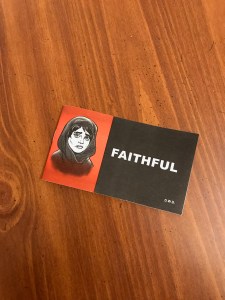
Goodreads isn’t the only booklover’s website, but it is one that publishers pay attention to.  Having a following on Goodreads helps for making marketing manageable.  Or so the thinking goes.  In any case, I recently had a message on Goodreads about Holy Horror.  It seems someone has, against all odds, found the book and is reading it.  This particular reader asked me in a comment about Chick tracts.  I’ve written about Jack Chick before.  He was a veritable one-man evangelical force of super-nature.  He is responsible for many of my personal nightmares with the Bible.  His cartoon tracts were designed to scare the Hell out of kids, literally.  I read them religiously.  My Goodreads reader pointed out that I could’ve made use of them in Holy Horror.

This made me ponder the reticence of academics to address religion as a cultural force.  Chick tracts are extremely common, even today.  As I posted last year, we were handed one while walking between venues at the first annual Easton Book Festival (an event forced virtual this year by, well, you know).  Not that Chick’s intellectual ability deserves study, but his influence is undeniable.  How many of us fundamentalist kids were set on our life trajectories by tracts that looked like mini-comic books but which had an unwavering, uninformed viewpoint held as gospel?  Chick tracts broached no dissent.  The Bible alone, and the Bible as interpreted by fundamentalists alone, was the only possible way of avoiding everlasting hellfire.  Nightmares indeed.

Chick died in 2016 after half-a-century of terror (his first tract was published in 1960).  Apparently Chick was a shy evangelical and his prolific cartooning was a way of assuaging his own fears of not evangelizing.  Ironically, in his tracts he offloaded that burden onto others—kids were made to feel inferior if they didn’t talk about Jesus to their friends, no matter how shy they might have been.  There’s not much information easily available on this influential man.  A motivated scholar, I’m sure, could dig up information—nearly any life can be illuminated to some degree—but I’m not sure the will is there.  If it ever happens, I suspect the study will be done by someone like me, raised on Chick and fed steady doses of childhood Bible reading.  My Goodreads interlocutor was perhaps onto something by suggesting my watching horror has something to do with Chick tracts.  Stranger things have, I’m sure, happened.


Preserving Culture

When I travel (remember travel?) I try to visit the places of famous writers.  It doesn’t matter much whether I’ve read a lot of their material; I know kindred spirits when I feel them.  Last summer—the one before the pandemic—I had to make a business trip to Oxford.  Now Oxford has a long, long list of literary illuminati, and I didn’t have much free time.  My hotel, however, turned out to be just a couple of blocks from the house of J. R. R. Tolkien.  One patch between meetings, I wandered over to the house.  It’s behind a high wall, so you can’t see much.  Like most European private homes, it isn’t ostentatious—over here we like to make it obvious when we’re wealthy.  In any case, I stood as long as a stranger can comfortably stand outside someone else’s house and tried to commune with the spirit of the former occupant.

Just the other day I noticed a New York Times headline that stated a movement is afoot in merry old England to purchase Tolkien’s house to make it a museum.  Although there’s no scientific way to prove it, people are somehow connected to the places they live.  There’s no other sensation like returning to your home town.  If, for some strange reason, anyone wishes to recall me after I’m gone (perhaps my pen name will take off someday), they’ll find precious little.  Not one of my pre-college homes still stands.  Not that that’s that unusual in the low rent district.  Still, when I visit my hometown, small as it is, almost nothing of me remains but it still feels like I belong.

I can’t say that I felt much other than my own awe at standing outside Tolkien’s house.  It’s on a residential street, and people were driving and walking by.  I was the only one who seemed to be hanging about.  Probably a bit suspicious-looking wearing a tweed jacket and in general appearing like a displaced academic.  Much of the tourism industry, however, is based on the draw of certain locations because someone famous lived there.  We want to be in touch with them.  Show our respects, perhaps.  If visiting Oxford weren’t always a work occasion for me, I could quite enjoy wandering its literary haunts and ending up for a leisurely afternoon spent in Blackwells.  We congregate in such places for a reason.  I’ve lost track of all the authors’ homes I’ve visited over the years.  Each time, I’m compelled to say, I’m glad someone thought to preserve them.


Roll out the Memories

That takes me back a bit.  It’s also a great idea.  The Epic of Gilgamesh tablet 5 rolling pin, that is.  A friend shared Farrell Monaco’s blog with me and the Gilgamesh cuneiform rolling pin took me back to a seasonal event in Edinburgh.  The Scots love to socialize.  My doctoral training involved lots of seasonal gatherings—something that we’ve missed since returning to the United States.  On one such occasion with my fellow Ugaritic students, we said we’d bring cookies.  Now the correct term for such things is “biscuits,” I know, but we had a recipe that really didn’t fit the biscuit description.  It was for chocolate cookies.  The dough was the consistency of a clay tablet.  I taught my wife enough Ugaritic so that, using toothpicks, we inscribed a good part of the Baal Cycle on the desert.  Alas, the tablets are no long extant.

Photo by Egor Myznik on Unsplash

Of all writing materials, clay and stone are the most durable.  Our cuneiform cookies were in the days before cell phones, however, and film wasn’t cheap.  We didn’t bother to make a photographic record, and, alas, such tablets are edible.  They were a little difficult to read when baked and even more so when eaten.  The use of culinary cuneiform makes me think that its design potential has gone under-utilized.  Also back in Scotland for a while Coke was running a promotion with cuneiform on its labels.  The problem with cuneiform is that even for someone who reads it an isolated character or two, without context, is difficult to decipher.  I never did figure out what Coke was trying to say. 

The Gilgamesh rolling pin apparently exists in the real world and can be purchased by antiquarians with university-salary-level jobs (somewhat over the pay scale of the mere editor).  Tavola Mediterranea is listed as “The Home of Culinary Archaeology on the Web.”  Although publishers and others doubt there is any interest in my erstwhile area of expertise, I feel vindicated by Monaco’s website.  There is a real hunger for things ancient, but universities tend not to support that interest.  I often wonder at how great centers of learning have evolved into upscale job training centers.  Then again, I’m the kind of person who reads the Epic of Gilgamesh for fun.  I even have an illustrated children’s edition of the story.  Now I’m waiting for Ugaritic tablets to show up on cookware.  Given the slow death of the field of Ugaritology, I suspect the day of making Baal Cycle cookies is long gone, and unless a new recipe for encouraging public interest can be found, we’ll all starve for knowledge of it.


Biblerama

Perhaps you’ve heard—the New Revised Standard Version is being updated.  Stop the presses!  I’m sure that everyone has been anticipating this as much as biblical scholars have!  If you’ve not been able to feel the buzz maybe it’s because you’re not in the Bible publishing business.  As the discussions have been going on (rights holders are of course consulting with publishers, because that’s where the money is) a great deal of energy goes into deciding what exactly to call it.  And since Christianity is so fragmented there have to be different versions of the versions.  Some include the apocrypha and others do not.  Some prefer British spelling and others American.  Imperial interests are important, even when it comes to Scriptures.  What may be overlooked in these developments is the connection to the most influential English translation, the King James.

The King James Version was not the first English translation of the Bible, but it was the version that captured the imagination of some as directly inspired by God.  Strangely enough, King James onlyists can seldom name the translators who apparently had the divine mouth to their ears, but never mind that.  The KJV held immense sway especially among literalists because it is so quotable.  In the 1950s it was revised.  (There are, by the way, several differing versions of the King James Version, and the original included the apocrypha.)  That first major revision came to be known as the Revised Standard Version.  Translators seldom begin their task with what original language manuscripts they can find; new translations are based on existing translations in families.  It’s okay, we’re all related.

Bible closet

When I was a kid the RSV (Revised Standard Version) was considered pretty good by many.  Hardly an overwhelming affirmation, but still, it’s something.  The real concern began when the New Revised Standard Version (NRSV) came out in the eighties.  The reason?  It used inclusive language!  See what happens when you allow women to read?  Ironically, the book that has been used for centuries to liberate white men is something you want to keep out of the hands of women and non-whites unless you make it clear that everyone from Adam to Jesus and Paul was a white man and this is his story.  Now the New Revised Standard Version is being updated.  Nobody’s quite yet sure how it will be denominated.  And this is only one family in a vast genealogy of Bible translations.  If you’re not in the Bible business, you’re missing all the excitement.


Turning Point

As the “Keep Christ in Christmas” crowd gears up for another Yuletide season, its capitalistic brother wonders about how good Christians will shop during a pandemic.  We’re not great materialists in my house, and our holiday spending tends to be modest.  Even so, the stocking stuffer is the kind of thing you find while browsing in stores.  I don’t feel comfortable indoors with strangers now.  Apart from groceries and hardware I haven’t been in any kind of store for at least a month now.  How to get ideas for those little, often inconsequential gifts that are demanded by homage to Saint Nicholas?  The holiday season is a wonderful amalgamation of differing traditions that should, in a perfect world, suggest openness to all and inclusivity.  At least this year we have that to look forward to.

Inclusivity is a gift worth giving.  Many of us are weary of the privileged “angry white man” who has held control of just about everything for the past several centuries but is still never satisfied.  The holidays around the winter solstice—itself the marker of days finally beginning to lengthen again—should be a symbol of the many traditions that make Christmas what it is.  There is no one “pure” idea of what this season represents (beyond shopping) because people all over have traditionally welcomed the return of light after many days of darkness.  Sometimes that darkness of exclusivity can last for years.  Now that we are beginning to spy a sliver a light on a distant horizon perhaps we can see enough to correct the error of our ways.  Perhaps.

That still doesn’t solve the dilemma of pestilence-filled stores where people want to huddle inside because it’s cold out there.  I can’t seem to recall where they hung the stockings in the manger, but surely they must’ve been there.  It’s how to fill them that’s the issue.  Our world has become so virtual.  How do you put streaming into a sock?  How do you stuff that cuddly subscription service into hosiery?  In a pandemic we’re reaping the fruits planted by a technologically-based society.  The art of browsing hasn’t been electronically replicated.  It’s the moment of inspiration in that curiosity shop that seems to be missing this year.  Most of us, I suppose, would be pleased to find a vaccine in our carefully hung stocking.  At least a government that takes the threat seriously will be something to anticipate.  Just a little longer, and the light will be coming.


Mere Christianities

While reading about the experience of an American Catholic who’d gone to Rome (check out this post), something in particular struck me.  Although the setting was in the 1960s, the author noted a truth that is still with us: Americans take religion much more seriously than do their parent bodies overseas.  This may be true elsewhere in the world as well, but those of us in this former frontier know that American isolation means religion developed here in a way different from much of the rest of the world.  To get a grip on that we need to realize that Christianities in America are largely of European origin.  That’s important because the roots of these traditions lie elsewhere and the question of how they measure up against the religion started by a Galilean peasant bears close scrutiny.

First of all, if we take what we can gather from the Gospels the things that Jesus might’ve actually said, we find contradictions.  This isn’t unusual.  Nobody was writing things down as he said them and Jesus probably taught off the cuff (not the maniple).  These traditions were recalled a couple decades after the crucifixion.  Try remembering exactly what you said just a year ago and you’ll get a sense of the difficulties.  Paul of Tarsus took this teaching in a new direction, both in doctrinal and physical senses.  Christianity became a European religion.  Fast forward by a few centuries and we find its much-changed Protestant forms inspiring people to go look for a place to practice it their own way.  Politics never follows far behind religion and so the American Indians became victims of those seeking religious freedom by fleeing from home.

Meanwhile, back in Europe, much of the fire that had led to sparks flying over here had been banked.  The Enlightenment and its application to these various traditions had shown that literal interpretations were historically unlikely.  Indeed, Americans trained on the frontiers by clergy with little education had taken Christianities in entirely new directions.  Literalism was often assumed, although its expressions varied wisely.  When you look closely at how religions develop you learn that the rank and file believer is out of touch with “official doctrine” and those who specialize in it find they can’t course correct without looking hypocritical.  The book I was reading had Vatican officials complaining Americans too Catholicism too literally.  It seems this is the fate of any faith that allows itself to become a mere religion.

Photo credit: Mapham J (Sgt), No 5 Army Film & Photographic Unit, via Wikimedia Commons


Internet Nowhere

So I wake up early.  I’ve been trying for years now to learn to sleep in a bit.  Somehow my body got to thinking the outrageous commute schedule to New York City was normal and I can’t convince it otherwise.  That means my most productive time comes before others awake.  It also seems to be the time favored by internet service providers to take their systems offline for a while.  You see, like any system the internet needs down time.  I slept in until 3:30 this morning and awoke to find internet access unavailable.  I use it during my writing, looking up answers to questions which both my fiction and non raise.  When the internet’s out there’s little I can do, but I’m already awake.  Society prefers conformists, but some of us maybe hear a different beat on our march.

The fact is we expect constant connectivity.  Many of us pay a significant monthly amount to ensure that we have it, but this is no guarantee.  Calling your local service provider at 4 a.m. on a Saturday (I’ve done this) is like dealing with IT at work: they really have no clue what’s wrong but they can talk technical to you, if that makes you feel good.  After all, it’s in the middle of the night.  So I try to decide on something else to do.  Reading works.  Books, however, often lead me to want to look something up.  But the internet’s down, at least around here.  We are utterly beholden to the tech industry that can (and does) wink out from time to time.  When the robot uprising occurs we just need to wait for the service maintenance hour.

I reboot my router.  It’s the first course of action when the internet’s out.  I think I’ll check out a personal hotspot, but to do that I need the internet.  It’s a great, constant feedback loop.  I suspect I’m not the only early riser who faces the internet dearth in the wee hours.  I know I’m overpaying because my data (whatever that is) plan on my phone always shows a monthly surplus.  When it comes to the techies, you just nod your head and pay your bill.  I do wonder what’s happening in the wider world.  Without the net you feel especially isolated in pandemic times.  It’s Saturday morning and the internet’s unavailable.  Back in my teaching days I know just what I’d be doing.  Instead I’m waiting for technology to catch up.


Bethlehem

Now that the holiday season is upon us, I guess it’s okay to post about the upcoming.  It’s actually pretty hard to avoid, living so near Bethlehem.  While Easton claims the first Christmas tree in America, Bethlehem was settled on Christmas Eve and named accordingly by the Moravians.  It’s a tourist destination for Christmas aficionados everywhere, and, as my wife quotes about 2020, “we could use a little Christmas.”  So we headed to the Christkindlmarkt over the weekend.  Apart from an abundance of consonants, Christkindlmarkt is a chance for vendors to bring their wares to where tightly shut pandemic wallets are willing to open up a bit.  This year, however, the “markt” was completely outdoors rather than under the usual four large tents with heaters running.

It was an enjoyable morning out, with temperatures near sixty—certainly not something you can count on for late November.  There were fewer vendors here for a variety of reasons.  You get a boost, for example, by getting people gathered together.  Our herd instincts kick in.  Seeing others spending, we decide to take our chances.  Outside the great rusting behemoth of Bethlehem Steel’s famed stacks stands sentinel.  This year, however, socially distanced tents and booths meant having to walk and stay back while others browsed, all while wearing masks so that smiles could not be seen.  Gathering without gathering.  With no interest in leading a charge against the disease on a national level, we’re all left to muddle through.

Several of the vendors had novelties portraying the year 2020 as the disaster that it’s been.  Instead of ending it with wishes for national peace, the incumbent is trying useless lawsuits to prevent the voices of voters from being heard.  Stirring up his followers to protest against frauds that never happened, while having hundreds of lawsuits awaiting outside his own door as his actual deeds have been examined seriously for the first time.  Bethlehem reminds us that peace and hope ought to be in the air at this time of year.  Thinking of others rather than ourselves.  Do we see that being modeled by 45 and his ilk?  Instead I’m standing here outside where there used to be a warm gathering tent.  A place where we each donate our body heat to help keep everyone warm.  Giving, even as the Republican-controlled senate withholds any stimulus package they think is too generous.  Yes, we could use a little Christmas right about now.


Anticipation

My work computer was recently upgraded.  I, for one, am quickly tiring of uppity software assuming it knows what I need it to do.  This is most evident in Microsoft products, such as Excel, which no longer shows the toolbar unless you click it every single time you want to use it (which is constantly), and Word, which hides tracked changes unless you tell it not to.  Hello?  Why do you track changes if you don’t want to see what’s been changed when you finish?  The one positive thing I’ve noticed is now that when you highlight a fine name in “File Explorer” and press the forward arrow key it actually goes the the end of the title rather than just one letter back from the start.  Another goodie is when you go to select an attachment and Outlook assumes you want to send a file you’ve just been working on—good for you!

The main concern I have, however, is that algorithms are now trying to anticipate what we want.  They already track our browsing interests (I once accidentally clicked on a well-timed pop-up ad for a device for artfully trimming certain private hairs—my aim isn’t so good any more and that would belie the usefulness of said instrument—only to find the internet supposing I preferred the shaved look.  I have an old-growth beard on my face and haven’t shaved in over three decades, and that’s not likely to change, no matter how many ads I get).  Now they’re trying to assume they know what we want.  Granted, “editor” is seldom a job listed on drop-down menus when you have to pick a title for some faceless source of money or services, but it is a job.  And lots of us do it.  Our software, however, is unaware of what editors need.  It’s not shaving.

In the grip of the pandemic, we’re relying on technology by orders of magnitude.  Even before that my current job, which used to be done with pen and paper and typewriter, was fully electronic.  One of the reasons that remote working made sense to me was that I didn’t need to go into the office to do what I do.  Other than looking up the odd physical contract I had no reason to spend three hours a day getting to and from New York.  I think of impatient authors and want to remind them that during my lifetime book publishing used to require physical manuscripts sent through civilian mail systems (as did my first book).  My first book also included some hand-drawn cuneiform because type didn’t exist for the letters at that particular publisher.  They had no way, it turns out, to anticipate what I wanted it to look like.  That, it seems, is a more honest way for work to be done.


Money Days

Those of us who live in caves (figuratively) have trouble filling all this in.  Not a great fan of capitalism, I find “Black Friday” a troubling add-on to the holiday schedule.  Now I’ve lost track of all the expanding special days: Small Business Saturday, Cyber Monday, Giving Tuesday.  Must we celebrate capitalism so much?  I have no problem with non-Christian holidays, but when money becomes the sole basis for special days I have to wonder.  Mammon is a deity of which we’d been warned a couple of millennia ago.  The real irony is that it’s the very religion that posted that warning that now seems most closely related to the capitalistic system that perpetuates its worship.  It wouldn’t be such an issue except that the religion that has bought into the system so readily is the one that is putatively based on its condemnation.

Irony is something for which historians are always on the lookout.  Perhaps this is especially so among historians of religion.  Religion has come to denote a codification of our highest ideals and aspirations.  When did money attained such spiritual status?  It seems that Christianity was the vehicle.  Although it’s most obvious in American politics, the relationship goes back to the whole colonial enterprise.  Once Christianity became an imperial religion under Constantine, its focus began to shift.  Even those splinter groups that started off with higher ideals soon came under the overarching umbrella of the capitalistic system sprung from the teachings of a poor carpenter from Nazareth.  And so we find ourselves amid a creeping array of money-based holidays that provide the secular answer to Advent.

Of course, Advent itself became a season of anticipating the commercialized holiday of Christmas.  And here as the calendar year winds down the financial year hopes for a shot in the arm because economy is the doctrine of this new religious thinking.  And the irony is that the system is set up so those who already have too much get more while those who don’t have enough end up with even less.  Sounds biblical, no?  Ever since my ouster from academia, I’ve had to cash in vacation days to make myself a little semester break.  A body gets used to a certain schedule, and those rhythms are difficult to shake.  As we work our way through pandemic-laced spending holidays I’ve got my eyes on a bit of time off from my small part in supporting this all-consuming machine.