Strange Reading

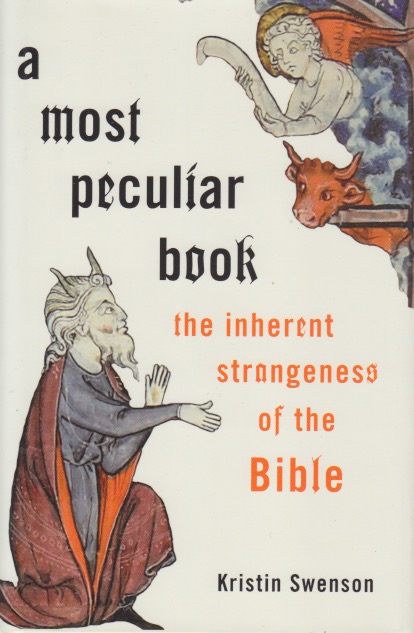
What more can you say about the Bible?  A lot’s been said already.  So much, in fact, that nobody can read all of it in a lifetime.  That realization started to come to me as I was trying to find everything that had been written about Asherah—who’s mentioned in the Bible—to write my dissertation.  I didn’t find everything, but I found a good deal of it.  Enough, in any case, to write my cautionary words about the subject.  Kristin Swenson’s A Most Peculiar Book brings the insights of a fellow traveler to the fore.  In a serious yet lighthearted way, she points out, as the subtitle says, The Inherent Strangeness of the Bible.  In other words, it’s not what most people—especially those who speak the loudest about it—think that it might be.

There are many angles from which to approach the Good Book.  One size most definitely doesn’t fit all.  A book like this would benefit from being read by those who take the Bible literally, but one of the problems is that literalists have no motivation to read such a book.  Indeed, their trusted leaders actively warn against it.  Such treatments are dangerous at best, and are possibly demonic.  One of my professors once put it well: fundamentalism isn’t a theological position, it’s a psychological problem.  In any other area of life those exact same literalists will apply reason and logic.  When it comes to their beliefs, however, refusal to engage with the tools that make their lives otherwise successful becomes an eleventh commandment.

Swenson points out things that will likely be old news to biblical scholars.  Having been through all this in a way ourselves, we remember what it was like to become “woke.”   To those raised as literalists, this is no small ask.  It stabs at the heart of everything you’re raised to believe.  The fear is that there’ll be nothing on the other side, at best, Hell at worst.  These are very real fears.  They may never completely leave, no matter how long you’ve been awake or how much rational coffee you’ve drained.  Such fears deserve a sympathetic hearing.  Without it I’m not sure any progress can be made.  Strip below posturing and bravado and you’ll find fear.  I do hope A Most Peculiar Book will find its way to such folks.  Swenson shows there is life after biblical studies and her book has some fun facts for those unfamiliar with the book about which there’s somehow never enough to say.

Evolving beyond Fear

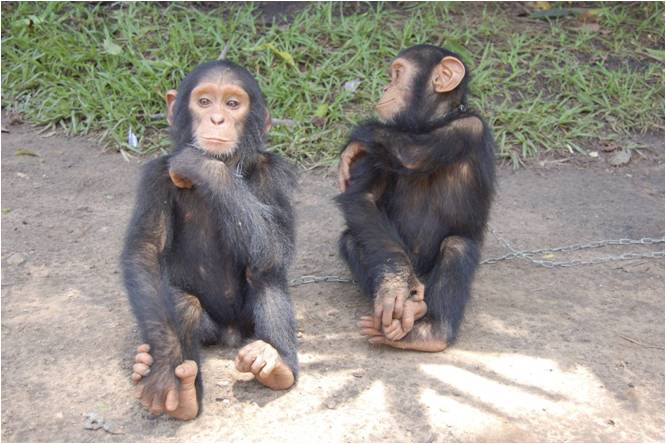
Live Science recently reported on a story that may shed light on human evolutionary behavior.  While my conclusions are speculative, they make sense, given the circumstances.  Titled “Albino chimp baby murdered by its elders days after rare sighting,” the story by Nicoletta Lanese describes how an albino chimp caused a fear reaction among its community shortly after it was born.  A few days later it was killed by the chimps.  Scientists must be careful not to attribute human motive to such attacks, and so they note that this particular community has a tendency toward infanticide, but that doesn’t explain the initial fear reaction.  An individual who was “different” appeared and the response was one of deadly violence.  We’re far from understanding human motivations, let alone those of animals, but it’s difficult not to see this as typical human behavior.

Photo credit: Afrika Expeditionary Force, via Wikimedia Commons

Just because a behavior has evolved doesn’t mean it’s inevitable.  We evolved out of our need for tree dwelling in order to open new potential habitats—an experiment that proved wildly successful.  Can we not evolve out of fear of those who are different?  That seems to be the idea behind recent diversity and inclusion initiatives.  There are those who still resist them, but examine their beliefs and you’ll soon find fear of those who differ.  This atavistic tendency is remarkably close to the chimp behavior in killing an albino.  If we are to remain civilized, we must name such fear for what it is and grow beyond it.  Conservatism is often based in fear.  Fear of change is natural enough, but had our ancestors given in to it we’d still be in the trees.

We need to admit that the lives of those different matter. How long will we allow difference be a reason to fear other human beings?  The story on Live Science is difficult to read.  The chimp behavior is so typically human that we can feel sympathy for the murdered infant and his mother.  Fear, if left unattended, can bring us to this.  The antidote is education.  The more we learn the better we can cope with fear, which is, after all, a natural and necessary response to an evolved world.  Our fear of being prey has caused us to drive extinct most of our natural predators.  The world is hardly a better place for it.  Might not weighing fears and thinking through reasonable solutions be a better coping technique?  Fear can revert a human back into an animal state.  Or it can drive us toward improvement.