Higher Learning?

I was reading, as one does, about a mental institution.  In the last century they were often called, rather insensitively, “lunatic asylums.”  The neurodiverse were often shunted away so that the rest of society could get on with business as usual (as if that’s sane).  There were any number of reasons sought for such individuals thinking differently.  The source I was reading had a short list and I was surprised to see on it, “over study of religion.”  It really said nothing more about it but it left me wondering.   First of all, it brought Acts 26.24 to mind: “Paul, thou art beside thyself; much learning doth make thee mad!”  Religion, from the very start, it seems, had the reputation of driving people insane.

Image credit: Published by W. H. Parrish Publishing Company (Chicago), public domain, via Wikimedia Commons

As someone who’s spent well over half a century thinking about religion, reading about religion, and analyzing religion, I can see Festus might’ve had a point.  This way much madness lies.  I don’t think religion evolved to be thought about.  It was largely a fear reaction to being, in reality, rather helpless in a world full of predators and other natural dangers.  Although we’ve managed to wipe out most of our large predators, we’re still under the weather, as it were.  We can’t control it, and what messing around we’ve done through global warming has made it less hospitable to our species and several others.  And also the small predators, those that evolve quickly, such as Covid-19, are now the real challenge.  Facing fear was the real evolutionary advantage of religion.

Being story-telling creatures, we made narratives about our belief systems.  Then we started taking those stories literally.  Believing too seriously, we used those stories as a basis for hating and killing those with different stories.  We still do.  Can anyone deny Festus’ accusation?  I’m sure religious mania has, historically, led to some institutionalizations.  It was kind of a trope in the seventies, for example, that too much Bible-reading could lead to criminal behavior.  It’s not difficult to see why those trying to classify what might make an individual off balance might look to religion as an explanation.  Nationally, and very publicly, we can see strident examples of this promotion of irrational ideas on a daily basis.  Many of the large mental institutions have been closed down and many of the neurodiverse have been turned out to the streets.  Ironically, it is often the religious who try to care for them.  Understanding religion, it seems to me, might be a great public good.

Rusticated Fears

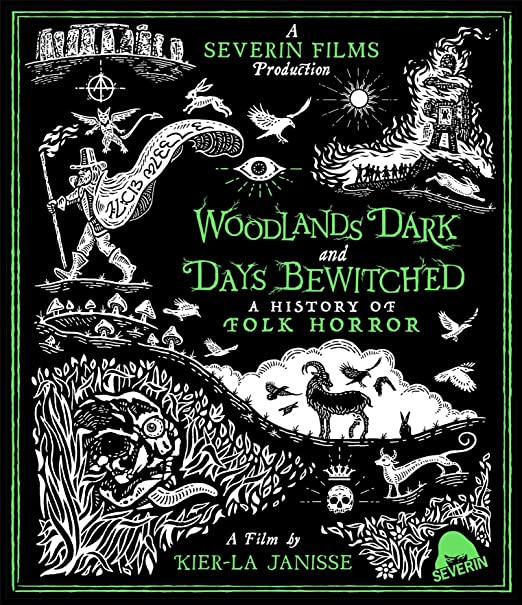
I don’t recommend sick days.  This one was weird with all the symptoms of illness but really having them just be the side-effects of a shingles vaccine.  I don’t recommend it, but I was able to use the day, between dozing off, by watching Woodlands Dark and Days Bewitched: A History of Folk Horror.  This late 2021 documentary is over 3 hours long and I’d been wondering when I’d have the chance to view such a lengthy movie.  Besides, when you’re feeling utterly miserable, horror is a kind of elixir to make it all better.  Watching the film made me aware of just how many movies I haven’t seen.  Another way of putting it is that I still have my work cut out for me.

Folk horror, you see, has a natural appeal for those of us who grew up away from urban centers.  Much that we did in the small towns of my childhood was, frankly, weird.  As the interviewees make plain, cities are the centers of economic and cultural power.  The big educational institutions are there and those of us from the hinterlands might not obey the rules that city dwellers seem to absorb through their feet.  In reality, I suspect, urban culture largely derives from folk culture.  Those who venture away into the large cities take pieces of their home with them.  Cities tend to blend all this together and transform it into something different.  Those in rural areas, however, have their own way of doing things.

Perhaps it’s embarrassing to center this much, but it was clear to me in watching Woodlands Dark and Days Bewitched that much of the fear showcased to city folks (for movies tend to be shown in urban settings) is the weird religion of the country cousins.  Both the words “pagan” and “heathen” are references to those who dwell outside urban areas.  “Pagan” comes from Latin for rustic, while “heathen” means those out in the heath.  Mainstream religion is that of the cities—the Vatican is located in Rome, and the large mosques, synagogues, and cathedrals are in population centers.  There’s no telling what the country dwellers might get up to if left to their own devices.  And religion taken seriously can be quite dangerous to outsiders, as we’ve seen time and time again.  Folk horror never really went away but it is undergoing a resurgence at the moment.  As the documentary suggests, this tends to happen in times of social instability.  At least we have something to look forward to as the world collapses around us.  Folk horror will help us cope, if my experience is anything to go by.


Homegrown Haunts

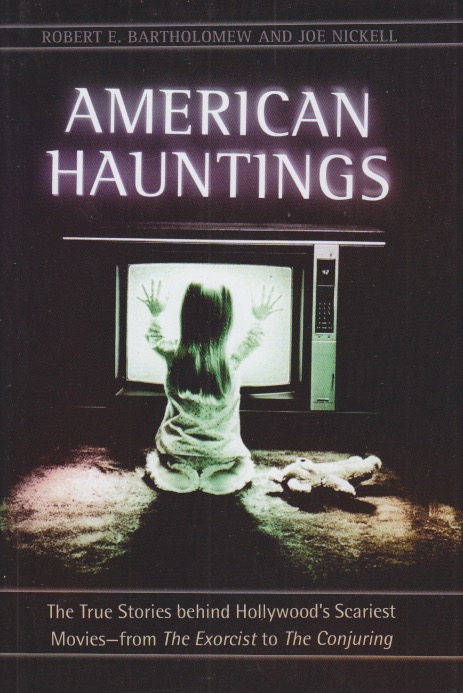
The thing about the unknown is that it’s, well, unknown.  Like many people I’m interested in getting at the truth behind ghost claims, so American Hauntings: The True Stories behind Hollywood’s Scariest Movies—from The Exorcist to The Conjuring, by Robert E. Bartholomew and Joe Nickell looked helpful.  Indeed, it is.  To a degree.  The book, however, devolves at points to debunking cases that aren’t in the movies and frequently asks “Why didn’t somebody take a picture?”  (In cases where there are pictures they say how they could be faked.)  Given the authors, you kind of know none of the claims will be accepted.  Even so, there’s a lot of good information here.  They do a great job of outlining the very probable hoax at Amityville.  For some of the lesser known cases they offer explanations harder to believe than the poltergeists they so abhor.

That’s the thing: for all the “hauntings” they default to poltergeists and then explain how poltergeists are faked.  They begin with An American Haunting, and move on to The Exorcist, Poltergeist, The Conjuring, The Amityville Horror, and The Haunting in Connecticut.  Sandwiched in there is also the non-movie Don Decker case.  What struck me as strange is they often seem offended that movies embellish stories.  That’s what movies do.  They’re quite right about the money aspect, however.  They also take in films that make no claims about being true, such as Poltergeist, which drew inspiration from an actual case but didn’t make that assertion.  It’s also odd that they didn’t ask some of the writers about this.  I once met Brent Monahan, author of An American Haunting.  He readily admitted some of it was made up.  In other words, taking offense at the “based on a true story claim” feels a bit naive.

In some cases they speculate what might’ve happened without visiting the location.  It’s hard to tell if a leaky roof can explain things when you don’t specify if the room is on the first or second floor.  Also, suggesting a young boy is faking because a professional magician can duplicate effects raises its own set of questions.  If a kid is as good as a professional, why doesn’t s/he go on the circuit and make some money from it?  That kind of question, by the way, characterizes much of the skepticism in the book.  Why not become a magician?  Because we don’t have the whole story.  It seems to me that dismissiveness doesn’t really help to get at the truth.  Nevertheless, this book contains much that is useful and skeptical voices should always be included when attempting to sort our extraordinary claims, even if you never , ever want to be caught without a camera.


Phobia Therapy

I don’t like being scared.  That’s why I watch horror.  You see, many people deal with fear by running away from it.  Embracing artificial fears, however, prepares you for the horrors life will inevitably throw at you.  We humans have created an artificial environment for ourselves with many natural dangers removed.  For example (and there are always exceptions) we’ve been able to seal ourselves up in our homes and wear masks in public to avoid a killing virus.  For the most part we’ve destroyed our large predators.  As a society we tend to avoid the things that make us afraid which, in turn, makes us fragile when we have to face truly frightening situations.  I wouldn’t suggest becoming a fear junkie, but experiencing scary scenarios can diminish the overall  fear factor.

People often make assumptions about those of us who watch horror, even though it is the majority of Americans.  We’re seen as creepy people who lurk in dark places, unable to get along with our fellow human beings.  Perhaps it’s true, or perhaps it’s a reasonable coping technique.  I tend to think of it as a spiritual practice.  Spirituality is often about feeling, but it’s not completely divorced from rationality.  Often it has to do with that gut feeling that this is really real.  This is something that my years on this weary old globe have taught me is true.  Many times it’s this way in the face of evidence.  Others have trouble believing it, although some bearded guy alone on a mountain top says it’s true.  So life goes.

Spirituality is important.  I have many humanist friends and they are often uncomfortable thinking about spirituality.  It seems dangerous, a superstition that somehow survived enlightenment.  Enlightenment, however, is itself a spiritual idea.  There’s something inside of us that makes us who we are.  Whether it’s something physical or something else, it requires nourishing in order that we might thrive.  We expend a lot of energy arguing about the right (only right) way to do it.  The way to be a more spiritual person.  To me it seems that it’s about discovering what replenishes us.  What makes us into better people.  You find that and you feed it.  Spirituality comes in many forms and shapes.  Some of us have it fed by what others dismiss as mere horror.  There’s more to it than meets the eye, however.  I watch it to learn not to be afraid.


Wicker Redux

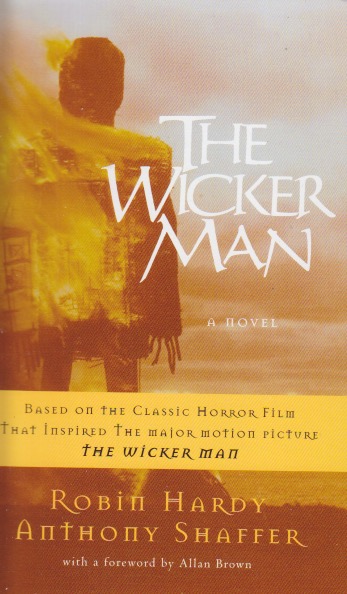
The Wicker Man (1973) is a cult classic.  If it had had proper distribution and promotion it might’ve become a more mainstream hit when it was released.  Instead it was a slow burn.  Once it reached cult status controversy grew.  The movie doesn’t acknowledge, but was clearly influenced by, the novel Ritual by David Pinner.  I reviewed the novel earlier, and it isn’t particularly great.  The movie changes so much that it maybe was “inspired by” rather than “based on” the novel.  Several years later the director, Robin Hardy, decided to novelize the film.  His The Wicker Man also credits Anthony Shaffer because a good deal of the dialogue is lifted straight from the screenplay Shaffer wrote.  But the novelization also changes things.  That means there really is no novel that gives the full story of the film.

The creative process is never-ending.  Anyone who’s had a story published knows the tinkering that goes on, even after it appears in print.  The last word’s never truly that.  It takes restraint to leave something alone.  So Hardy wrote one of the more important characters out of his novel and wrote in another who seems to have very little connection to the story itself.  I’m still not sure what the point of adding him might have been.  Incidents that seem to be bracing for a sequel are present, and indeed Hardy wrote a spiritual successor that became a less impressive movie some years later.  Sometimes you do get it right the first time around.

Not that the movie is perfect—none are—but it has held up considerably well, growing in stature over the years.  A novelist, however, tends to have a deft touch that seems to be lacking here.  There’s a great deal of telling instead of showing.  Hardy’s Howie almost becomes a Mary Sue.  Tying his love of birds into the plot of the novel would’ve been one such deft touch.  Instead we have here a serviceable novel with much that’s familiar and even some that is strange and provocative.  It does restore some of the famously edited footage from the first cut of the film.  It tries to make Howie’s religious conviction clearer.  Changing parts of a story comes with the territory of those who spin yarns.  Hardy never really rose again to the heights he achieved in directing The Wicker Man.  It’s no wonder, then, that he felt compelled to return to it in literary form.


Day of the Lord

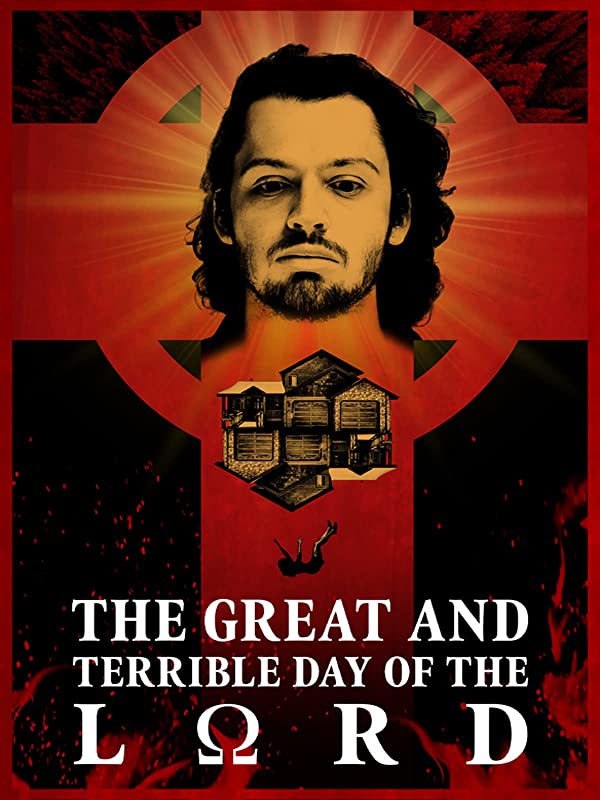
The kindly folks at Horror Homeroom recently asked me if I’d review the new movie, The Great and Terrible Day of the Lord.  Since I’ve been occasionally writing on religion and horror for them for a couple of years now, they knew I’d be interested.  The review just dropped and you can read it here.  Since this blog is a less formal place I’ll say a bit more about the film here, while encouraging you also to read the review.  They won’t be the same.  The movie, which is independent of any of the big studios, is hands-down the most theological horror I’ve ever seen.  That’s because it’s fully based on a religious idea.  It consists almost entirely of dialogue, so some will doubt it’s horror at all.  What is being said, however, can be quite scary.

Using only two characters, the movie would work well as a stage play.  The story revolves around a couple on a romantic weekend getaway.  Far from any other people, they’re enjoying a fancy cabin in the woods when suddenly he (Michael) reveals to Gabby (her), that he’s God.  Not all the time.  In fact, he’s come to her at this moment without Michael even knowing it because she’s going to die that weekend.  He wants to ensure she can get to Heaven.  Throughout the weekend Michael switches back and forth between being himself and being God.  Gabby fears she’s trapped with a psychopath, but as God Michael knows things about her that she’s never told him.  They discuss the problems with God’s existence and the issue of theodicy as Gabby slowly comes to accept she will die there.

My Horror Homeroom piece has spoilers, but I won’t put them here.  Horror fans might claim this isn’t horror at all.  There’s no bloodshed, very little violence, and no monsters play a role (unless you count the Devil).  Still, it is psychologically tense and it raises some scary questions.  I was raised as a Fundamentalist.  The fear implanted early that you might die not right with God has stayed with me all through my years of working in religious studies.  From my perspective this was a pretty scary film.  The script is very well written.  So much so that I wonder if Jared Jay Mason, the writer, hasn’t taken a course or two in theology.  My formal review gives quite a bit more detail, but you might want to watch the movie also.  I found it surprisingly effective.


The Mystique of Research

One thing that many people may not understand about research is that those trained in it are basically learning how to find stuff out.  It doesn’t matter what the subject is, research is a matter of learning what’s available to help you understand that particular subject.  Typically it involves becoming familiar with the classic “standard books” on the topic then branching out.  Even the internet, however, has its limitations when it comes to trying to find out what’s available.  My curiosity extends far beyond the religion I often blog about.  I write about religion because I’ve studied it all my adult life.  When I discover a new area of interest, or rediscover it, I often wonder how to get the salient books on the topic.

Amazon isn’t a bad place to start, but they don’t have everything.  I’ve run searches on its powerful algorithms that come up with no results.  Bookfinder.com is great for locating out of print material, but it also depends on you knowing what to search for.  WorldCat and Google Books also help.  The one thing you really need, however, is time.  Research requires a lot of time.  You find a book on the subject and read.  Then you look up the sources the author used.  Search the names of other authors to find out what they’ve written.  Watch publishers’ catalogues for the new books they’re producing.  Read journals to see who’s writing on what.  It’s like a never-ending treasure hunt.  It’s beguiling and addictive.  But it’s limited to few full-time—those who are paid to find things out.  The rest of us make what time we can.

Prior to the internet we had, it seems, a lot more certainty.  Much of that certainty was false, but it was nevertheless firmly believed.  Many people despise researchers because they challenge what we’ve always believed about the world.  As if the truth were known x number of years ago and hasn’t changed at all since then.  We want things to stay the same—we want our wallets in the same place we’ve always put them so we can find them when we need them.  Then your told there’s new, virtual currency but you have to mine it.  I know many people who don’t even own computers.  Research opens new worlds, but not all people are natural explorers.  Some prefer to stay close to home and near to the certainties they learned growing up.  Others are restless and have to learn more.  And perhaps go places where we don’t even need our wallets.


Come In

It feels good.  To be invited, that is.  Like many people I know how rare it can be.  When teaching at Nashotah House, invitations were scarce.  It’s a small seminary, not widely known.  Besides, the internet was in its infancy then and a great many people (including the seminary dean) were suspicious of it.  Few invitations came.  None for peer review opportunities, none for interviews.  I was invited to the Ugaritic Tablets Digital Edition project (for which I wrote a successful grant application) but that was because I met one of the lead editors while my wife was studying at the University of Illinois.  It’s strange, but nice, to be invited to things now.  It still happens rarely, but when it does it has two things in common: the invitations come closely spaced in time, and they have to do with horror.

Photo by Stella de Smit on Unsplash

This past week two invitations came.  One was to review an independent horror movie for Horror Homeroom and the other was to have an interview on the New Books Network.  Since this is the internet and since the internet’s endlessly self-referential, I’ll be writing about them both in more detail, directing you to the end results when they arrive.  It just feels good to be included.  I didn’t have many academic mentors at Nashotah House.  I’m a first-generation college-student; I didn’t know what academia would try to do to a person.  I had no idea what a “post-doc” was.  I did publish an article a year and write a second book which, I understood, was the key to getting hired by a “real school.”  I had a few interviews, but I’m demographically challenged, I guess.

Weathering the Psalms was written at Nashotah House but it has only led to one weekend church program.  My books on horror, written post-academe, have managed to get some small measure of attention.  It always struck me as ironic that, although raised among the theology crowd I never really found acceptance among them.  Those who know there’s something to horror, however, are a welcoming crowd.  The other day I was listening to Alice Cooper’s Welcome to My Nightmare and realized, whether intentional or not, the invitation was sincere.  It remains one of the formative albums of my life.  As a child the only invitations I had were altar calls.  I responded to many.  As an adult I’m still inclined to say “yes” when someone invites me in.  Rarity only adds value.


Anticipating Holidays

There’s that mundanity that sets in after the twelve days of Christmas are over that reminds us we’re back into regular time.  Many people no longer believe in the sacred, but the holidays are still sacred time.  January can be kind of stark that way.  Once we reach Halloween the rest of the year seems achievable, but there’s a lot to do between now and then.  Reemerging from the run-up to the holidays—it’s the long period of anticipation for the rest that comes at the end of the  year—back to what is now being called BAU (business as usual) is like cold water on your face first thing in the morning.  Each time I wonder if I’ll have the energy to do it all again.

Holidays punctuate and define our year.  It may be that your December holiday is fading now to a (hopefully) pleasant memory, but depending on your employer you might have Martin Luther King Day coming up soon.  I’ve known people to complain that it comes too soon after they’ve already had a few days off and they’d rather have a different day, later.  That kind of misses the point.  Business analysts (whom business leaders listen too except when they don’t like what they say) suggest that the four-day work week is sufficient to achieve what we need, now that we’re connected all the time.  Some jobs, of course, require your physical body to be in a specific geographic location and there’s not much that can be done about that.  Hours can be reduced if more people are hired, but we’re going through a strange period of people quitting their jobs.  I’ve always wondered what that must feel like.  Is it like a long holiday, only with even more financial worries?

The twelve days are over, and although I didn’t have all of them off I kind of wonder where they went.  Some folks are eager to get the tree down and decorations put away.  To look out at the blank canvas of snow and envision how to paint the year ahead.  Others of us see the wisdom of hibernation.  Bears seem to have the right idea.  Still, I enjoy the starkness of January.  The cold can be bracing and the snow a chore to remove.  But being out in it can become a kind of holiday in its own right.  Our time on earth should be a time of celebration, even as we look forward to the holidays later this year.


Ghost Chasing

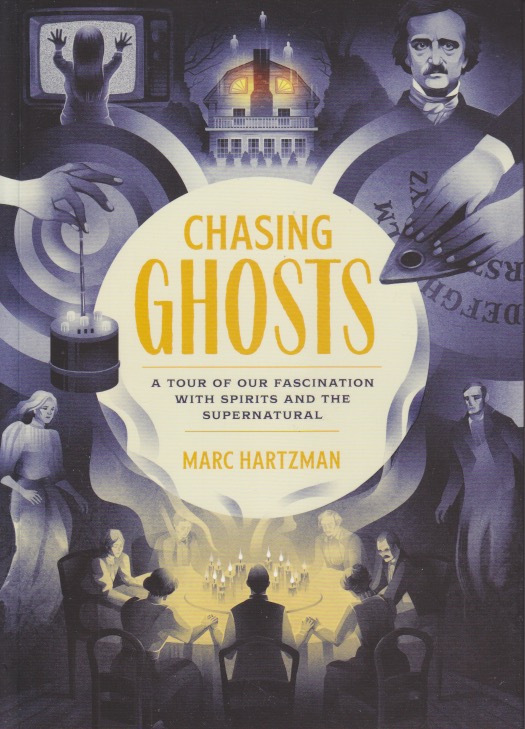
I’ve known about Quirk Books from their very first publication.  That’s a rarity, I suppose, since many publishers have been around far longer than I have.  I tend to think of Quirk as mainly a purveyor of unusual fiction.  I’ve pitched a book or two to them myself over the years.  In the last few years they’ve been producing some good nonfiction as well.  The topics are, well, quirky.  I just finished reading Marc Hartzman’s new book with them titled Chasing Ghosts: A Tour of Our Fascination with Spirits and the Supernatural.  It’s a good compendium of material that traces the very long history of human obsession with the restless dead.  It begins with some ancient ideas about ghosts and comes up to contemporary times.  Not all of this can be covered with great detail, of course.  But there’s a lot here.  And it has a great cover.

The chapter on Spiritualism and seances is necessary, but it also reveals one of the reasons, perhaps, that modern skeptics still scoff at ghosts.  Mediums (not necessarily Spiritualists) were often caught in trickery, but as Hartzman points out, that doesn’t logically imply that everything was a hoax.  For me, when the rules start to include special boxes or sitting behind a curtain the old skeptic meter starts clanging loudly.  Still, some of this happened because, it seems, you can’t force a ghost to attend.  If there are ghosts and if they retain personalities, well, how do you like it when people tell you that you must be here at this time so I can make you do what I want you to do?  

The chapter on haunted locations covers many of the expected and a few lesser known haunts.  Often a very real human tragedy has occurred in such places.  Is it unreasonable to think we might impress such things on our environment somehow?  Or that our consciousness—which we still can’t explain scientifically—might not hang around to resolve unfinished business?  The final section on using devices to “capture” ghosts brings us up to the present ghost hunter craze.  The pursuit of ghosts is extremely popular, leading to the predictable result that academics shy away from it.  It’s a shame, really.  A few universities have, and some still quietly do, sponsor(ed) departments or facilities to study such things.  It seems to me that if people have been seeing, hearing, and feeling something for millennia, it might be worth some serious effort to find out what’s going on.  Until then, quirky books like this one will always be a guilty pleasure.


The Nature of Epiphany

Last year on January 6 we had an epiphany.  Many of us thought, I suspect, that since the angry mob wanted to kill Republicans and Democrats both that their actions would be condemned unilaterally.  Instead we learned that the Republican Party said, “Boys will be boys.”  And of course boys like to kill things.  A year later the GOP has stalwartly refused to condemn the attempt of a violent takeover of the government by a legitimately defeated candidate.  If the other party tried this they’d be calling “treason.”  We had an epiphany of a double-standard masquerading as evangelical Christianity.  Now, instead of thinking of today as the Christian epiphany, well, wait a minute.  Maybe that’s the epiphany we had—understanding what Christianity can become.

One of the tenets of democracy includes the freedom of religion.  Studying ancient religion can be quite revealing.  For one thing, we get a better idea of what religion was.  Few ancient authorities were concerned about what individuals actually believed.  Religion was largely what the powerful and influential did to placate gods who were easily bribed by sacrifice and praise.  The role of the average person was to be taxed to support this, and the monarchy.  I’ve been watching how, since the 1970s, the United States has been going that route.  We’ve always been a religious nation (“Christian” is much more debatable), but Richard Nixon’s ploy to swing evangelicals to the Republican Party worked.  Those not blinded by ideology will know that evangelicals tended to be staunchly Democrat.  Through the ensuing decades we watched Republican presidents giving our tax money to religious organizations they supported.  Why not throw another lamb on the altar while you’re at it?

The sacrificial system, you see, supported the temple staff.  Somebody had to eat all that meat!  Even in the Bible it was recognized that God didn’t exactly consume it the way a human being would.  Then last year on Epiphany, the party that’s supported just this kind of thing tried to throw all but Trump—yes, even Pence—onto their sacrificial pyre.  A year later we see those very senators saying, “well, it might be useful to have such people in reserve, just in case.”  Early Christians believed that you could tell another believer by their actions.  In that they weren’t wrong.  And those who are able and eager to kill in order to get their way have revealed, by their actions, their true beliefs.  It was, and still is, an epiphany indeed.


Energized

I grew up in Pennsylvania, but there’s a lot I don’t know about the commonwealth.  (I do know that it’s a commonwealth rather than a state.)  My parents weren’t educated—neither one finished high school—so I didn’t have a lot to go on at home.  I recently learned that it is the second largest energy producing state in this somewhat tenuous union.  Texas is, of course, first.  I suspect this is because the Keystone State is old.  Not because it was one of the original thirteen colonies (which it was), but because the Appalachians around here are ancient and abundant in coal, oil, and natural gas.  And speaking of natural gas, the state houses of congress are dominated by Republicans.  The state motto should probably be “Burn, baby, burn.”  Given the number of Republicans, it is also one of the most corrupt states.

Even in the rural parts where I grew up, it was clear that energy was a huge part of our history.  The petroleum industry began in Pennsylvania.  Col. Edwin Drake’s well at Titusville is still producing.  The oil fields here are shallow (speaking of the GOP), however, and the interest shifted to Texas where, well, everything’s bigger.  Growing up, refineries were a familiar sight.  One of my vivid childhood memories is witnessing a refinery fire.  I was too young to really understand.  My brothers and I were outside playing when it started to snow in the summer.  It wasn’t really snow, it was hot ashes falling from the sky from a refinery fire about five miles away.  We later drove out to see the huge vats melted like wax, charred and rusted under what had been an industrial paint facade.  Petroleum companies are like that.

My second hometown of Rouseville lived under constant threat of a refinery fire.  The small town of about 800 was completely dominated by a Pennzoil refinery that took up much of the valley.  We trembled whenever the refinery sirens went off.  My life may have been shortened by breathing in all those toxic fumes.  Big petroleum comes with massive costs.  We know that alternative sources of energy are available, but we have very rich people who stand to lose some of their vast fortunes if we move away from fossil fuels.  There’s much about Pennsylvania that I don’t know.  I’ve lived here longer than in any other state.  And I, for one, would like to see this fascinating commonwealth work for the betterment of the world it inhabits instead of rewarding the bad behavior of the wealthy.


Carton Thoughts

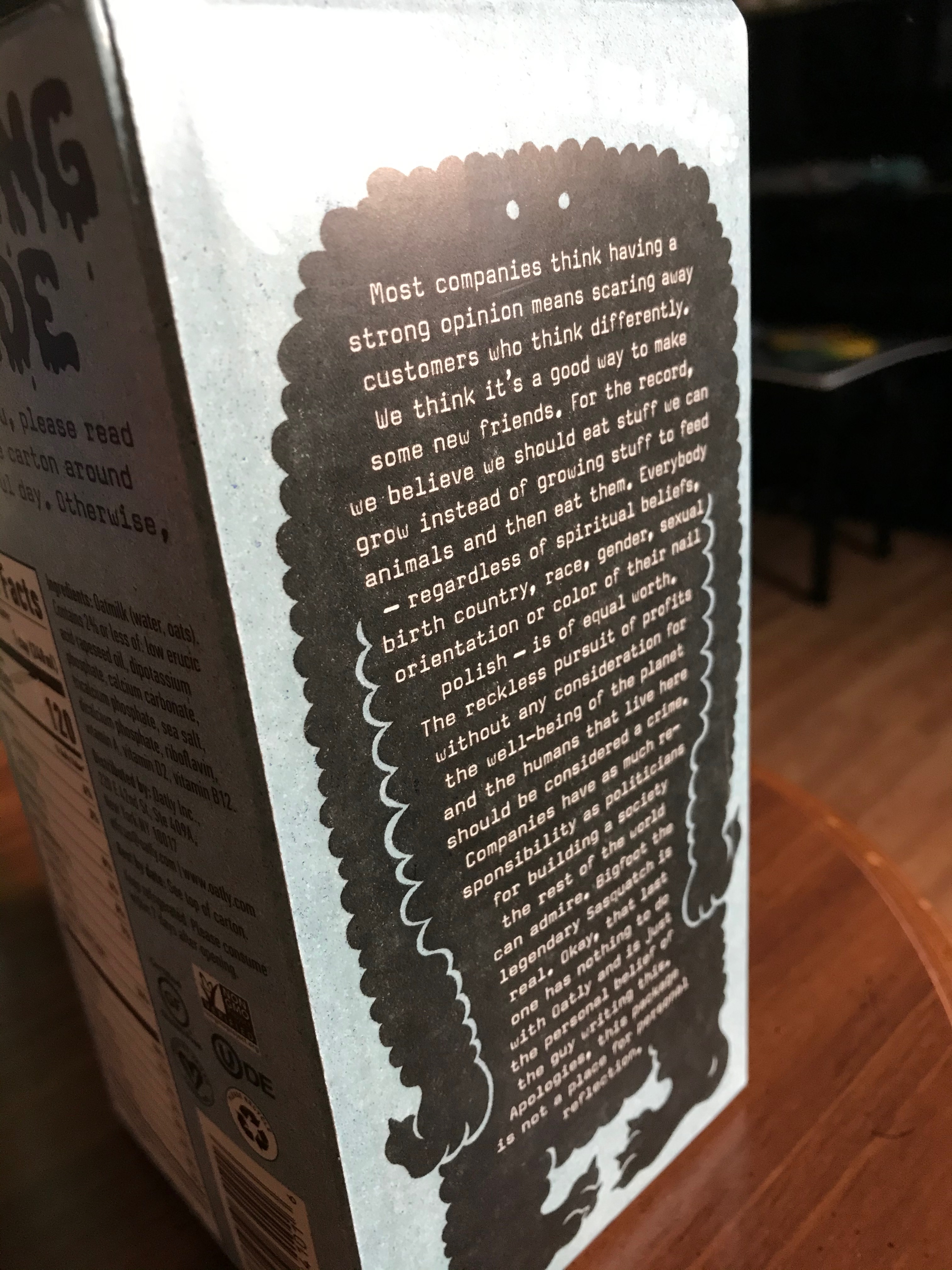
Did you know they’re recyclable?  Milk cartons, that is.  In our vegan efforts we switched to non-dairy milk years ago.  Unfortunately the plant-based milk industry doesn’t use gallon containers, so we buy the 2 quart (sometimes smaller) paper cartons.  Our community has a pretty good recycling program, but it doesn’t include cartons.  They are perfectly recyclable, however.  I’m saving them up to mail to the places Carton Council lists.  We can reduce waste, if we have a will to do so.  I know people who live in states with no recycling programs.  These states tend to lean red.  The world, however, doesn’t belong to anyone.  We need to learn to pick up after ourselves.  Take a look at the Carton Council webpage.  Sign their petition.

A large part of the problem is that we’ve allowed ourselves to be convinced that happiness involves consuming.  Our entire capitalist system is based on consumption.  We over-package what we consume, comestible or not.  There’s the ubiquitous plastic wrap, the box, the inner lining.  Often you can’t find the item you need in a local store so it has to be shipped.  All that wrapping.  All that waste.  One of the things environmentalists know well is that people quickly lose enthusiasm for saving their only planet.  The topic is depressing and overwhelming.  We’ve been living like there’s no tomorrow for at least half a century now.  Small steps can help, however.  Paying to ship recyclables afield isn’t the perfect solution, but it feels better to be doing something.

Economics is called the dismal science for a reason.  At the root of it, it seems, is that we’ve valued money above humanity.  And our environment.  One thing that Christianity got right, before it was sold, is that we should think of others.  Capitalism sees others in terms of assets or liabilities.  If our actions harm others—including the unborn that evangelicals are so concerned for—shouldn’t we be doing something about it instead of sitting around waiting for a miracle?  Some containers simply can’t be recycled.  Some devices can’t be made without rare earth metals.  Some jobs requite on-site workers and the travel they expend.  Not all goods are found where they’re needed.  But we can stop wasting perfectly good recyclable materials.  Clothes returned to online retailers often end up in the trash.  Why can’t what is sold also be given away if returned?  At least the needy could keep warm.  Maybe it’s possible to make that dismal old science smile by taking care of the resources we have.


925

Sometimes you just know.  One of the things I know is that nine-to-five schedules are killers.  Literally.  I grew my permanent teeth as a teacher.  Before that I had been set on being a minister.  Something they have in common is that neither profession relies on a nine-to-five schedule.  The hours are much longer than a forty-hour work week, but they’re flexible.  If you’re not in class, or in church, or a committee meeting, or your office hours, you can dash out to the store if you need to.  You can shut your eyes for a few minutes if you didn’t sleep well the night before.  As long as you get your work done adequately, nobody really bothers you about your time.  My initiation into the nine-to-five, in my mid-forties, was a shock from which I’ve never quite recovered.

A few years into this unnatural territory, my nine-to-five (925 is quicker to type) evolved into the commuting variety.  I didn’t live terribly near New York City, so that meant catching a very early bus.  I’m a morning person, so that’s not really a concern.  The problem is that my brain’s not a 925 brain.  Like one of my professors, I still awake at 1:30 (having gone to bed about five hours before) with an idea that won’t let me go.  When that happens you have to put on heavy layers of clothes against the night’s low thermostat and make your way downstairs to the computer.  By three a.m. your body’s in the fully awake commute mode.  Thing is, you’ve got a 925 day in front of you.  When I was teaching I’d be able to snooze again before even my eight o’clock class (I was never one to object to the early shift) began.

The idea behind the 925 is an atavistic throwback to pre-internet days.  Pre-pandemic days.  Days when you had to be watched to ensure you were working.  When you had to sit in a cubicle where nobody and everybody can see you.  If you’re not staring at your screen or not in a meeting you’re not working.  So this antiquated thinking goes.  Teachers and ministers don’t hold to regular hours.  They identify with their jobs—the very definition of “professional.”  If it’s what you’re born to do you don’t complain.  And if you happen to awake at 1:30 with an idea that just has to be expressed, those who pay you will understand if you yawn a time or two the next day when, ideally, you won’t be stuck staring at a screen.


What’s New?

Now that 2021’s behind us, what will we make of the year ahead?  New Year has generally been a time of reflection.  I don’t put a lot of stock into it because years are just random markers pointing out when we’ve been around the sun once again.  They’re good for organizing things, but does a year have any particular significance?  Many people talk as if 2020 and 2021 were cursed.  I tend to think of the Black Death and the influenza of a century ago and realize that if you’re reading this, we made it through.  Not personally perhaps, but our ancestors did.  The Covid-19 pandemic wrenched us unwillingly from our comfort zones, but isn’t that part of life?  Were things good before?  Was it kind or humane to have Trump in the White House?  Was (is) the death-grip of capitalism on the western world cause for celebration?

Yes, we had to travel less.  Our ancestors—for some of us that may be as recent as our grandparents—would likely have considered our travel excessive.  Why do we always want to be somewhere that we’re not?  What makes a home a home?  What can we do, moving forward, to make that more appealing?  The past two years have changed a number of things, some decidedly for the worse, but some for the better.  I keep reminding myself that our outlook is terribly short.  The planet has hosted life for billions of years.  Some plants live for millennia.  We see only our lifetimes and use them to decide what’s normal.  I’m never quite sure what normal is.

I do know that it’s considered a new year now, for those who celebrate the new start on January 1.  Other cultures have other dates to mark this time.  We call it 2022 based on likely incorrect information about when Jesus of Nazareth was born.  Our Muslim friends mark the years via Muhammad.  Others find yet other markers important to their cultures.  Is any of this normal?  It is normal to be so terribly polarized as a nation, with supporters of one candidate hating those who support another?  Is it normal to complain because we’re surviving through a pandemic, because our conveniences have changed?  I suppose it’s normal to want things back the way they were.  Some of us are ambivalent about this whole internet thing.  There was value in knowing how to fold a paper map.  There will, however, be value in the time allotted before us.  2022 may be just a number, but as we reflect perhaps we should think of how to improve where we find ourselves.

From NASA’s photo library