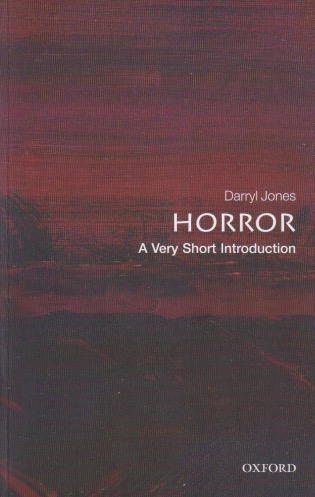
Horror Shortly

Some short books have an outsized punch.  Especially when dealing with a large topic such as “horror.”  This isn’t just horror movies, which could easily fill such a book, but also literature and other media as well.  Darryl Jones has proven himself on this topic before and this Very Short Introduction is a showcase of what is a fascinating genre.  I’ve read a number of books in this series and this stands out as one that works admirably within extreme limits—they are very short—in making good decisions about representative aspects in what is really a sprawling field of inquiry.  The introduction lays the task out well and I came away from each chapter feeling inspired.  Of course, not all of horror can be covered in less than 150 pages.  Some may find their favorite fear unaddressed, but they’ll learn something nevertheless.

In his first content chapter, Monsters, Jones focuses on vampires and zombies.  These are both forms of cannibals as they’re currently conceived, zombies being relative newcomers to most favored monster status.  His next chapter, on the occult and supernatural, takes on the Devil himself before addressing satanists, demons, and ghosts.  These are, of course, religious monsters.  Although Jones doesn’t dwell on that aspect, the close relationship is nevertheless evident.  For those of us who explore religion and horror this framing proves helpful.  It’s worth pausing here to consider how all of these entities overlap a bit.  As anyone familiar with ghost hunters knows, ghosts and demons may both be found haunted places, and the Devil is the head demon.  Of course, horror is a fiction genre but many people believe in these entities.  That brings religion and horror within the same room.

Body horror occupies the next chapter, and here werewolves come into the picture.  Other aspects of body horror are also discussed, but the painful transformation of the shapeshifter is prime territory.  Horror and the mind brings us to psychological thrillers and the gothic fear of madness.  The topic segues nicely into science, which the next chapter covers.  Not only science itself but the mad scientist.  Finally, the lengthy afterword looks at where horror has gone, and may be going, in the new millennium.  Something that struck me, and which brings this back into religion, is how frequently Darwin and evolution are mentioned.  This concept challenged the human place in the divine hierarchy and led to much of what we think of as horror.  This book is a great resource in a small package.

First Books

It was back in the day when I believed a book was the final word.  Remember those times?  (I have a suspicion that many Republicans really are longing for the days of simple answers: “Smith wrote it in History of Everything so it must be true,” and such.)  You’d read a book assigned in college and assume that since the author wrote a book s/he (but generally he, in my day) must be right.  If college really caught on, however, you’d start comparing sources.  Still, there was that one book that got you started thinking in a new way.  Back in the day when I believed a book was the final word I read J. Alberto Soggin’s Introduction to the Old Testament.  I remember the context well: Harrell Beck’s intro course at Boston University School of Theology.  We were given a list of texts and allowed to pick.  I chose Soggin.

Reading that book I realized for the first time that ancient Israel had borrowed from its even more ancient neighbors.  The fact that I’d attended Grove City College and majored in religion without ever having been introduced to the idea says volumes.  (Some parties, it seems, have always preferred to suppress information.)  I followed it up with Helmer Ringgren’s Israelite Religion.  I was hooked.  If we knew that there were ancient sources, and if we knew their languages and their cultures, why hadn’t it been obvious to the general public?  I started on a doctorate to uncover the truth since I couldn’t find courses on it at seminary.

We didn’t take many books with us to Edinburgh, but Ringgren was one.  By then I’d begun to realize that introductions weren’t really research books.  I spent my years digging deeper and deeper into ancient West Asian culture.  If it’d been possible I’d be there still.  Soggin and Ringgren, I realized by this point, were clearly biblical scholars, and not students of the specialized field that’s still called Ancient Near Eastern studies.  But still, their books had started something.  My copy of Soggin has followed the socks in the dryer, and I now realize the politics of introductory texts (if you believe it’s innocent you may be happier remaining in your bliss).  Still, I owe a debt of gratitude to those scholars who wrote in accessible words aimed at the novice.  Time has passed and nature has begun its own tonsure process, but this fallen monk has learned that many books are the only way of getting to the truth.


Better Things

It’s only a store brand, but still.  Maybe like me you remember opening a box of Raisin Bran and pouring out the first bowl.  And finding only bran.  Maybe a raisin or two.  By the time you munched your way to the bottom of the box you’d get a bonanza in that last bowlful.  It was more fruit than cereal.  Then they somehow figured out how to suspend raisins so that didn’t happen.  My mind hasn’t caught up yet, I guess.  I was down to the last bowl, and I was eagerly anticipating it.  Especially since the day before I’d only had three raisins and it was clear that the end was near.  Then the last bowl.  One raisin.  That’s a lot of bran to start your day, like C. S. Lewis’ always winter but never Christmas in Narnia.

Speaking strictly for myself, I like to save the best for last.  When I receive snacks in my Christmas stocking, I keep my favorites until all the others are gone.  In my personal myth of scarcity I’m quite aware that good things run out.  And they’re not always easily replaced.  Therefore I tend not to buy the things I like best.  This is the kind of psychology that drives economists mad.   As a child I was taught to put others’ needs before my own and that lesson has dovetailed with the running out of good things.  Of such things monasticism was made.  The raisins are now near the top of the box, but the crumbs are still on the bottom.

I often find breakfast to be the most philosophical of meals.  Perhaps it’s because I write my blog posts in the early morning.  Perhaps it’s because others are awake when I eat lunch and supper.  Perhaps it’s because that valuable things are rare.  It’s the nature of what we find most meaningful.  We live in a culture of largeness and acquisition.  What we truly want, however, may be very small indeed.  Ours is a culture of choice and plentifulness.  Raisin Bran is a choice, as is the store brand.  And it’s even possible to open the box at the bottom and return to my old form of expectation.  I doubt I will ever outgrow the idea, however, of trying to save the best for later.  It’s a form of optimism, after all.  And isn’t it best to start the day with the knowledge that better things are coming?