
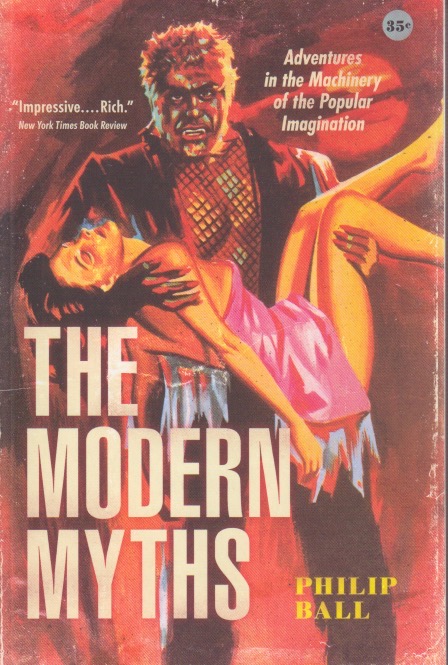
The last book I slipped in under the wire of 2022 was Philip Ball’s excellent The Modern Myths: Adventures in the Machinery of the Popular Imagination. It would be easy enough, if judging by the cover, to suppose this to be a book about horror, but it’s not. At least not wholly. Ball is actually addressing the idea, in his wonderful writing style, that certain myths in modernity can be traced to various speculative tales, mostly from the nineteenth century. Not intended to be comprehensive, this study makes brilliant cases for several stories that offer meaning, which is what myths really are. The first such myth analyzed is Daniel Defoe’s Robinson Crusoe. This novel led to the modern tope of being stranded on an isolated island and we see it everywhere from Gilligan’s Island to Lost. Ball isn’t offering an encomium to the literature—in fact, he points out the problems with the stories and their writing and indicates that this is part of the mythic process. Along the way we learn about the authors and their lives, as well as the afterlives of their stories.
Similar treatments are offered for several culturally significant speculative stories that many people have never read but nevertheless know. Mary Shelley’s Frankenstein, Robert Louis Stevenson’s Dr Jekyll and Mr Hyde, Bram Stoker’s Dracula, H. G. Wells’ War of the Worlds, Sir Arthur Conan Doyle’s Sherlock Holmes tales, and the twentieth-century phenomenon of Batman are all given similar treatment, leading to insight after insight. The book also gives the reader the distinct sense that ours isn’t the final word on anything. We’re part of a tradition and those who produce speculative material—future myths may not be anchored in literature—and those who analyze us will also, in their turn be analyzed.
One such mythology currently under development, Ball suggests, is the zombie myth. Grounded more in movies than any literature, the canonical traits of how it goes are widely recognized and have been taken in several directions, including parody. Of course, projecting which stories will be future myths, outgrowing their original settings to provide cultural meaning, is something we can’t do with accuracy. We all know, however, what it means to be a Jekyll and Hyde, or what to expect during a zombie apocalypse. Such stories tend to come from speculative genres because those are what people tend to like. We read and gravitate toward science fiction, horror, super heroes, etc. And we do so, Ball makes a great case for, because they contain the stories that explain our world. And given this world, some explanation is definitely necessary.

 Steve A. Wiggins