Life Lessons

Most of us know a bad movie when we see it.  Some of us walk away.  The rest of us linger and wonder.  Some weeks ago now I watched Ed Wood’s Plan 9 from Outer Space.  “So bad that it’s good” is the mantra often chanted about it.  I lingered because of Ed Wood.  While it’s somewhat fictionalized, Tim Burton’s Ed Wood is itself an odd movie.  It performed poorly for a Burton film starring Johnny Depp.  Critically, however, it was praised and it eventually became a cult film about a cult film.  Or films.  Mainly, I suspect, because Ed Wood is such an interesting figure.  He was a man who wanted to make movies—knew he was meant to make movies—but never got the backing he needed to make them.  He did it anyhow.

Ed Wood starts with Glen or Glenda.  Written and directed by Wood, who also starred in it, this movie was about cross-dressing.  In real life Wood’s mother used to dress him up as a girl and although he was heterosexual, Wood became a transvestite.  This was, of course, in the days when such a thing was scandalous.  Making all of this surreal, and poignant, Wood had befriended an unemployable Bela Lugosi—known to be a drug addict—and had him star as God in the movie.  The next film Ed Wood focuses on is Bride of the Monster.  Again starring Lugosi, this one has a giant octopus in it and heads toward horror territory.  The film about a filmmaker ends with his notorious Plan 9 from Outer Space, the last film in which Lugosi appears and which was financed by a Baptist church.

Ed Wood ends before Wood becomes a poverty-stricken alcoholic and dies in his fifties.  There is a poignancy both to the stories of Wood and Lugosi that also applies to many people in life.  People who know, without a doubt, what they should be doing with their time on earth but who are kept from it by those, who like Lugosi’s God, pull the strings.  We all have limited time and as we grow older we realize that spending it doing a job that’s a drudgery is really a kind of crime.  Would Ed Wood have become a famous director if he’d been backed by the money to produce the movies he wanted to?  We have no way of knowing.  What we do have, however, is a tribute by a talented film maker to a fallen colleague, and that, it seems is the best part of human nature.

More Scary Stories

There might be a disconnect.  As a child the stories I had read to me were either Bible stories (Archway Books) or wholesome Easy Readers.  I think that was pretty typical in the sixties.  We didn’t have a lot of money but an abundance of respect for the Bible, so the former by far predominated in my literary experience.  As any kid will do, I thought this was normal.  There was a stir in the kids’ world two decades later, in the eighties, when Alvin Schwartz began compiling scary folklore and retelling it for children.  His Scary Stories to Tell in the Dark series has been challenged or banned from the start.  Most parents don’t want to admit that their kids like scary tales.  We didn’t direct our daughter’s reading much when she was old enough to pick Scholastic Books, and one time she wanted Scary Stories.

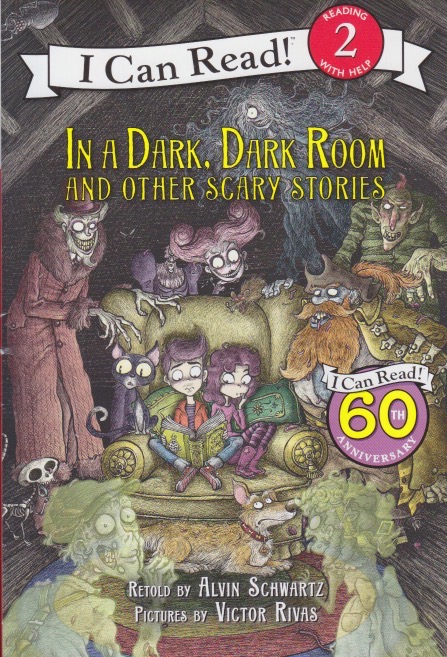
We were a bit shocked, not by that, but when a relative got us started on Roald Dahl.  His somewhat macabre children’s books were fine.  One of them, however—and I can’t recall the title—it’s packed away in the attic—was stories for older kids and it was so gruesome that I had difficulty making it through.  Not for me, but thinking about it from the perspective of a young child.  I recently had cause to read In a Dark, Dark Room and Other Scary Stories, again by Schwartz.  The copy I read wasn’t an original edition, but had illustrations, in color, by Victor Rivas.  I tried to think how scary such tales must be for kids who don’t know them already.  These illustrations were humorous, which helps, and tended toward Victorian or Edwardian style. Encountering such ideas for the first time, however, could leave an impression.

We tend to find olden times scarier than our own, it seems.  Partially this is correct, I suppose.  Science has helped us delay the inevitable by ameliorating many things that were formerly deadly.  At the same time it has helped those interested in such things to develop even deadlier weapons.  Mass shootings have become more common, to be mingled with the quotidian horrors of daily life.  Ghost stories hardly seem to be the most scary thing anymore.  I don’t know the answer to when kids are psychologically ready for scary things.  I still recall our neighbor—she was a few years older than we were—telling my brothers and me scary “true” stories that happened in the woods just across the street.  Those were in the “innocent” days before printed ghost stories for kids, but they gave me nightmares even so.  It was, however, the machinations of “Bible believers” that led me back to horror as an adult.  It’s kind of a disconnect.


Irving the Writer

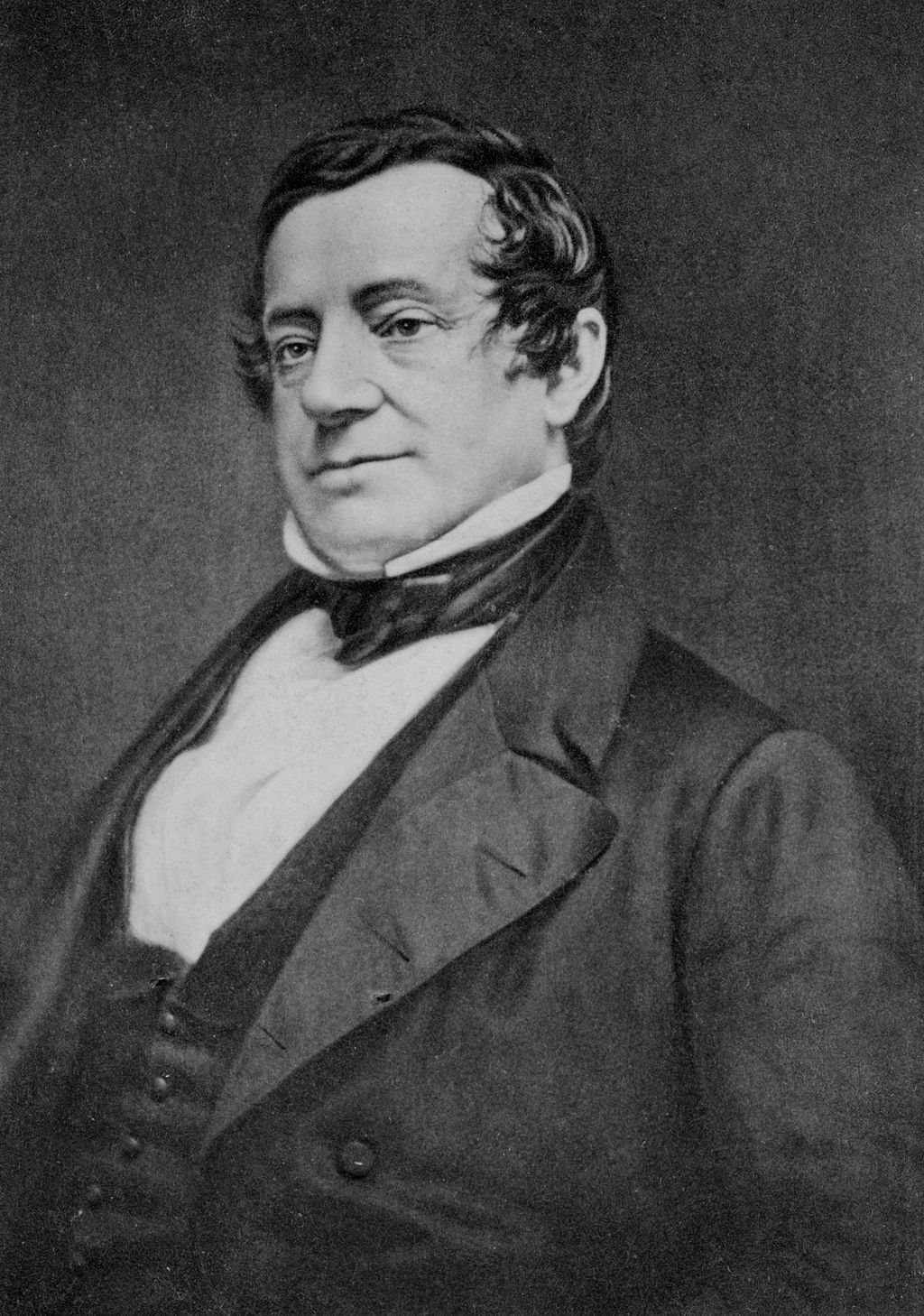
From the Library of Congress, via Wikimedia Commons

No writer is “on” all the time.  I often marvel that, with the busy lives they lead, they manage to finish any books at all.  Even so, not all are uniformly good.  Following up a biography of Washington Irving with a book by that eponymous title, this was my first foray into the Twayne’s United States Authors Series.  Written by Mary Weatherspoon Bowden, this volume (Washington Irving) seems fair-minded and honest about Irving and the irregularities of his writing.  My impression, not having read all his work, is that he started out great and became good further down the line.  Not that I’m in any position to judge.  We read and we like what we like.  Bowden pretty much goes through all of Irving’s writings—sometimes story by story—giving a sense of what they’re all about. (The book was released in cloth with no real cover image, so enjoy Irving’s smile instead.)

As famous and influential as Irving was, his reputation as a writer has been in decline for many decades.  One reason for this is that his first major twentieth-century biographer, Stanley T. Williams, apparently despised him.  So much so that he wrote a two-volume biography demonstrating his faults as a writer.  This demolition job meant that works like Bowden’s had to try to counter the prevailing opinion of Irving’s ability.  Bowden shows how carefully planned out many of his works were without denying that Irving had to try to make money from his writing.  The thought at the time seems to have been that literary pursuits were best left to the wealthy—those with leisure to indulge in letters.  Irving showed that it was possible to write your way to a reasonable living.

Of course, not all of his writing is that good.  And several volumes of it are “history.”  Today you have to earn an advanced degree, or at least a masters, before you can pass yourself off as a historian.  Irving did it the old fashioned way.  He read as much as he could get his hands on and synthesized it.  Today he’s not really remembered as an historian, or as a statesman.  He’s known as the author of a few, mostly brief, American classics.  Even though Bowden writes of Irving appreciatively, she doesn’t really inspire you to run out and read all his work.  He did have a tremendous output for the time and was an extremely influential author.  Nevertheless, others came and surpassed him, even as they were his contemporaries.  Still, it seems there ought to be some credit in being first, and some integrity in actually managing to live by the written word.  Irving is worth another look.


No Doubt

The mind inclined toward doubt is in for a rough ride in an evangelical childhood.  I recall vividly my many, many hours struggling against doubt, trying, crying, praying for certainty and faith.  Many, many dark nights of the soul.  Attending college and seminary I learned of the others in history who struggled the same way, or at least similarly.  I also learned that doubt is natural and healthy, it protects us from falling headlong into the many snares and traps the world continually sets for us.  Blind faith, as I recently quoted from Kurt Vonnegut, is dangerous to everyone.  I was thinking about this again the other day as there was something I fervently wanted to happen but I just couldn’t bring myself to believe would actually come to pass.  My mind isn’t built for blind faith.

Given that, it probably isn’t any surprise that I went into religious studies as a field, even though it’s a dead end.  I still believe it’s vitally important, but that’s a belief much of the world doesn’t share.  It’s one of the few fields of study where a doctorate leaves you without job prospects if you don’t get a teaching post, if you’re not ordained.  And should doubters be wearing clerical collars and preaching to those who want to believe?  Belief is malleable.  It changes over time and it does so via its constant interaction with doubt.  It leads to a life of second-guessing and constant reassessment.  I suppose that’s why I’m baffled to see politicians with less education being so cock-sure that they’re right about things.  I doubt they know what they’re talking about.

Institutions take on lives, like people do.  Although I disagree with the treatment of corporations as individuals by law, still, I understand the thinking behind it.  The church, for example, grew to be a very powerful force in the fourth-century Roman empire.  These collective individuals had vested interest in keeping that power as the church grew more and more influential.  That dynamic still exists where even a small, non-denominational group gathers and asserts that it alone is right.  All you have to do, it tells its members, is believe.  Don’t doubt.  And if you do doubt you’ll be excluded.  Exclusion is difficult to bear.  But even doubting Thomas has hundreds of churches named after him.  Each, no doubt, has many true believers as members.  And on the outside mingle the doubters.


Knickerbocker

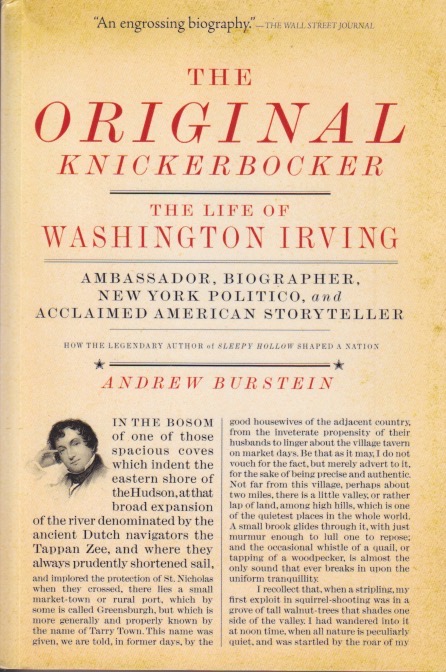
Washington Irving is one of those people with an outsized influence on American history who nevertheless has become ignored.  He met nearly every US president from Jefferson through Franklin Pierce, and what’s more, most of them knew who he was.  Sometimes decried as a less-than-original writing talent, Irving nevertheless led a remarkable life and through it all, treated others with respect and gentility.  He’s also a bit of a mystery.  All of this is captured quite well in Andrew Burstein’s biography, The Original Knickerbocker.  Burstein does go off on some diversions from time to time, but most of them are quite interesting.  One of the facts that astounded me was just how many early American political leaders were writers.

I don’t mean wealthy individuals hiring ghost writers to praise them in their “autobiographies,” but actual writers.  Fiction and all.  These were, pardon the period phrase, “men of letters.”  Writing was a way of not only influencing people, but of improving one’s mind.  Some of these individuals became presidents, others cabinet ministers, or foreign diplomats.  Once his literary star ascended, Irving could get struggling writers a government post by a letter sent to the chief executive.  It was a different day than that in which we live.

In my mind, Irving also stands out in that his fame came early and his later writings, while perhaps selling better, never eclipsed his early fame.  And honestly, never reached his earlier shine.  It began with his satirical History of New York.  This book established him as a wit and a gifted writer.  Since his family ran a secure business, Irving was able to travel without working for several years and didn’t produce his next book for another decade.  The Sketch Book of Geoffrey Crayon, Gent. may not be known to many today, but two of its sketches are still told and retold.  One is “Rip Van Winkle” and the other is “The Legend of Sleepy Hollow.”  This book also helped to establish the American celebration of Christmas, something begun in his History.  Although he would write many more books, he’s still best remembered for two short stories from his second.

Burstein takes his cues in this biography from “Rip Van Winkle.”  This particular story is kind of a parable of Irving’s life.  Irving couldn’t know this, of course, having published the story when he was about 36.  His subsequent books sold well enough, and apart from a stint as American minister to Spain, he was able to make his living through his pen.  There’s quite a lot in Burstein’s treatment that I’ll come back to, I’m sure.  But for the moment, it left me feeling as if I’d met a great, if struggling, writer in person.


Natural Disasters

Like many, my heart goes out to those in Turkey and Syria suffering through the destruction and aftermath of a major earthquake.  Such natural disasters often bring out the best in people—empathy, love, and offers of support.  They lead to both tragedy and human warmth.  They also give us pause to reflect, if we will, on our worst behaviors.  Rescue efforts have been hampered, in Syria especially, by a weakened infrastructure, caused, at least in part, by foreign bombing.  And yes, the United States was part of that.  People who now feel our sympathy only months before faced death from us.  What is it about our species that makes us want to destroy one another through our own technology but then turns and wants to help when a “random” act of nature occurs?  We must prefer death on our own terms.

Image credit: Luca Comerio (1878-1940), Corpses of victims of the earthquake in Messina, via Wikimedia Commons

For me, part of this is reflected in how the so-called “culture of life” treats liberal social causes as the “culture of death.”  Those groups that support “the culture of life” are against abortion but desire no controls on gun ownership.  This is the same basic principle—we want to cause death on our own terms.  We want to play God and decide who is worth saving and who should be destroyed.  I have no doubt that if, say, a tornado destroyed an entire city block outside a convention center where the NRA was meeting that those at the conference would rush out to try to help find survivors.  When they reconvened, they would try to figure out how to protect their “right” to own and collect assault rifles.  Is this “culture of life” really worth preserving?

Meanwhile the people of Syria and Turkey are suffering.  Thousands are dead, winter is setting in, and Covid is still out there.  They need our help.  The amount we spend on aid will, however, pale next to the amount we spend on bombs, drones, and missiles.  I have to wonder if we never really stop to think about what we’re doing when we engage in behaviors that destroy others.  That weeping mother outside an earthquake-collapsed building could be the same mother outside a missile-collapsed structure.  With natural disasters we know that we all stand a chance of being victims.  We feel for those caught in the way.  Once politics enters the picture, however, and we have the ability to control who lives or dies, everything changes.


Pumpkin Season

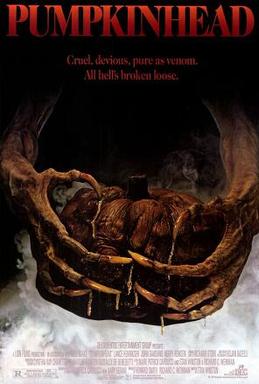
A creature feature with a moral.  Not a bad way to think through ethical dilemmas.  You see, we don’t have a lot of extra money lying around, so when I need a pick-me-up I try to find something free to watch.  Well, free because I subscripted to Amazon Prime years and years ago for the free shipping and now it involves “free to me” streaming on select titles.  Often I learn about movies from browsing and that’s how I came across Pumpkinhead.  I’ve learned my lesson about just clicking through without checking it out ahead of time.  It turns out the Pumpkinhead, apart from having major studio backing, was pretty favorably reviewed back in 1989.  My wife and I were in Edinburgh at the time, newly wed and trying to concentrate on doctorates.  I hadn’t been bumped back into horror yet.

In any case, what is this moral?  What is this movie?  Set in the unnamed rural south, the movie involves the accidental death of a good, honest man’s son.  Some city slickers, hot rodding on dirt bikes, accidentally run the boy down.  This good man visits the local witch, against the advice of the locals, and she raises a demon for him—the eponymous Pumpkinhead—to get revenge on the meddling kids.  The moral comes in where the witch warns him that such revenge comes at a terrible price, and it does.  The man and the avenging demon begin to merge and his desire for revenge leads to his own demise.

Religion plays a role in this film as well.  One of the locals, wanting to help the final girl and her boyfriend—the only ones left alive out of the six city folk—takes them to a ruined church, figuring that a demon won’t enter hallowed ground.  He’s not exactly right about that, but an extended shot of the religious imagery makes you think about the nature of revenge and what it means in a Christian context.  Besides being the first film role for Mayim Bialik (only 13 at the time), it also spun off two sequels.  Being a good student at the time, I was completely unaware of all of this.  I learned about the film while trying to stay awake one winter afternoon and trying not to spend any money to do so.  Not a great movie, it nevertheless does feature repentance and it explores the consequences of being driven by a desire to get back at others.  And the monster isn’t bad either.


Scraps of Paper

My wife is a saint.  She doesn’t throw away the little scraps of paper on which I write notes to myself.  They’re everywhere.  And this even though I carry around a notebook to capture ideas.  Sometimes I left it in the pocket of another pair of pants, or on the bedside table.  And I need to write something down.  Soon the scrap is filled with vital info (at the time) and eventually gets mislaid.  When it’s found I need to go over it line by line to see if something remains crucial or if it was just prosaic (get oil change, set up eye doctor appointment, etc.).  You see, ideas can strike at any time.  I keep a commonplace book inside the door in case they do when I’m out jogging.  I now keep a separate notebook on the bedside table in case something occurs as I’m falling asleep.  And, of course, I keep my little zibaldone with me (when I’m wearing the right pants).

Those who believe electronics will save us suggest putting everything in a notes app.  The problem is that I have several.  I do most of my initial writing in Scrivener.  When it’s time to share either with a publisher or a colleague, I convert it to Pages, and then to Word.  But my devices also have Notes, which I can see synced on my phone.  That makes it handy for shopping lists and such.  Then there’s also Text Edit, which I use for rtf documents.  Where an idea gets saved depends on which app I’m using at the moment.  More scraps of paper, virtually.  I need to write it down so I remember what’s where.

All of this led to a rather embarrassing situation the other day.  As usual, I’m at work on another book.  Since writing about horror isn’t something I was trained to do, I have to do quite a bit of bibliography building along the way.  This is the kind of thing you learn in higher education, so no worries.  The thing is I had started a bibliography in one app and began writing the book in another.  I’d very nearly finished a draft of the book when I just happened to scroll through the folder where my former bibliography was kept.  I was stunned to learn I’d already done this work since I didn’t remember recording this at all.  I suppose the solution would be to record all my thoughts.  But that would be too dangerous.  And besides, when would I have time to review them all?  I guess I still prefer scraps of paper, even if they’re sometimes electronic.


Everything

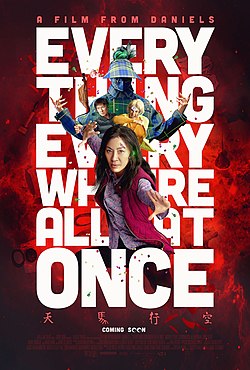
It’s been getting a lot of press, Everything Everywhere All at Once has.  It’s been winning awards and it demonstrates that absurdism isn’t dead.  Absurdism is an essential element of existentialism, the philosophical school with which I most closely identify.  I had no idea others found it so appealing.  This movie’s difficult to encapsulate—the summary on Wikipedia is actually not bad—but it has to do with human potential when living in a multiverse where every decision splits the ‘verse into new bubbles where your actions play out in all possible ways.  And, of course, it’s tax season.  There are clearly elements of The Matrix here, as well as Brazil.  And it’s distributed by A24.  The message is good, as the story plays out.  The images are impressive and confusing and will make you think.

From the time I left home I’ve looked for two main elements in movies—they should make me feel and make me think.  When they do both they are successful.  Everything Everywhere All at Once is successful.  It also reminded me of how healing existentialism can be, which is what drew me to it in the first place.  Life, or to point a finer point on it, consciousness, is absurd.  You can follow the same rules and get different results each time.  And you have to live with the consequences.  If you think about it too much it leads to despair.  I need, and it seems others do as well, to be reminded once in a while that absurdity is endemic in this universe.  How else can we explain Trump?  Existentialism breaks in on reality and I used to self-medicate with Nietzsche and Kafka and Camus.  Lately I’ve been using horror.

The thing about absurdity is that it’s funny.  We may not laugh about what the universe hands us as much as we should.  Existentialism also holds that darker element called dread.  Sometimes that comes to the foreground.  In my own life, I guess I thought getting a Ph.D. from a major, internationally renowned, research university might help.  I had forgotten the role absurdity plays in all of this.  Everything Everywhere All at Once shows the universe, or multiverse, is the ultimate trickster.  There are those, serious scientists, some of them, who believe that each decision does split off another universe and that all possibilities play out somewhere in the multiverse.  Even if that’s true, we’re stuck in this one.  It makes sense, therefore, to laugh at it once in a while.


Urban Tiger

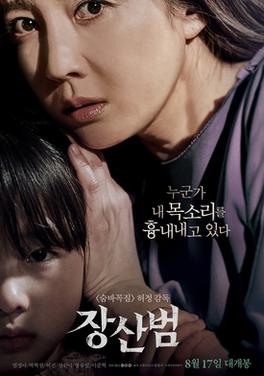
Many things are universal.  Ghosts, for example.  What ghosts do and how they behave, however, can be culturally specific.  The Jangsan Tiger is sort of a ghost and sort of a creature, and it has a religious backstory.  Of course, I’m referring to the Korean horror film, The Mimic.  I found it while looking for Mimic on Amazon Prime, but that definite article made this one free and it had received pretty good ratings.  Released by the careless trespass of a murderer, the Jangsan Tiger stalks a family that really just needs a break.  The parents, Hee-yeon and Min-ho, lost their son five years ago.  They move to Mt. Jang with their daughter (Joon-hee) and his mother, believing that the distance from Seoul will do them some good.  The Tiger, however, has other plans.

Apart from the well-timed jump-startles and stings (this movie “got” me more than once), the story is filled with pathos.  Parenting is probably the biggest emotional gamble a person can take.  The Jangsan Tiger imitates voices and convinces its victims that it is someone they love.  The children actors are particularly effective and their crying is difficult for any parent to watch.  This is horror that pulls at your heartstrings.  The family, as expected, begins to crumble under the pressure.  Religion comes into it because a shaman, ostracized from society, had summoned the Jangsan spirit in a kind of Faustian bargain.  He sacrificed his daughter and now that he’s released again, sacrifices others who are lured into the cave on Mt. Jang.

Interestingly enough, the actual mountain Jangsan—the movie is based on an urban legend—is in real life the site of an active mine field.  Somehow this moves the film from urban legend territory into that of parable.  Many of the scary stories we tell our children are intended to keep them safe from dangers they really can’t comprehend.  Adults plant minefields to make the land unsafe.  The real tiger prowling those lovely hills is one that walks on two legs.  And what that monster craves is human sacrifice.  Now, I can’t claim to understand the entire plot of the film.  Between subtitles and the lack of cultural experience, I’m merely a spectator to something that feels deeper than just a movie.  Those who spend time with horror know that it’s often sophisticated and intelligent.  It’s a genre that appeals to both the mind and to religion.  There’s a reason the shaman stands between worlds.


Sunk Costs

The other day, in a fit of post-holiday tiding up, my wife found something that she couldn’t reach to put away.  As I took the thing and dutifully began to return it to its high cubbyhole, I realized that it was something we no longer needed.  Now, we’re very careful about not just throwing things away—this attitude of disposability has led to far too many landfills and rampant pollution.  So what was this thing?  It’s a dryer vent brush. After a couple years in our house, and with the awareness that the previous owners clearly ignored things like lint build-up in dryer vents, I purchased this brush to weasel in through the outdoor vent and try to get as much lint out as I could.  The old dryer died a couple years later, and we bought a more environmentally friendly heat-pump dryer.  Heat pumps require no vents, so the brush, in its high cubby hole, had simply been forgotten until it got in the way of something else.

This is an example of a “sunk cost.”  Economists, those purveyors of the dismal science, tell us never to worry about sunk costs since you can’t get your money back.  I suppose this is the impetus behind yard sales.  We’ve always been careful with money—we have to be—so purchases like this brush are calculated to meet a current need.  An investment.  Looking around, I see a number of sunk costs—there’s an extraneous office chair just a few feet from me at the moment, made superfluous when Gorgias Press moved offices and gave away office furniture that wouldn’t fit into the new place.  That’s the chair I’m sitting in at the moment.  The other, cheaper chair, however, is still functional.  Something’s telling me a yard sale might not be a bad idea.

But do I want neighbors to see the things we’ve accumulated over the years (and there seem suddenly to have been so many years)?  Some of the stuff obviously could have a future life.  The dryer vent brush was only used for a couple of cleanings and still has much life left, for an inanimate object.  Much of the technology that we’ve sunk money into would serve only as museum pieces, however.  And those costs tend to be much higher.  We try very hard to reduce, reuse, and recycle.  We give books away to little free libraries, if it’s clear they’ll never be opened again in this house.  But I can’t help wonder if sunk costs are a plague of capitalism and consumerism.  There’s got to be a better way.  And while I’m pondering it, I have a funky blue brush to use for scratching my head.


Of Ewes and Groundhogs

I need more time to prepare for Imbolc.  Or Groundhog Day, whichever you prefer.  Candlemas for you Catholic holdouts.  February 2 has the trappings of a major holiday, but it lacks the commercial potential.  Too many people are still working their way out from under Christmas overspending and tax season is just around the corner.  Still, I think it should be a national holiday.  My reasoning goes like this: since the pandemic our bosses now have our constant attention.  They’re in our bedrooms, our living rooms, our kitchens.  I see those midnight email time stamps!  We’re giving them a lot more time than we used to and seriously, can they not think about giving us a few more days off?  Some companies strictly limit holidays to ten.  

Can’t recall where I found this one…

Others, more progressive, have simply dropped the limits on paid time off.  And guess what?  The work still gets done.  I could use a day to curl up with a groundhog, or to go milk my ewes.  (Being a vegan, perhaps I could just pet them instead.)  What’s wrong with maybe two holidays a month?  (We don’t even average out to one per month, currently.)  I always look at that long stretch from March, April, and nearly all of May with some trepidation.  That’s an awful lot of “on” time.  (Our UK colleagues, of course, get Easter-related days and a variety of bank holidays.  Their bosses, I understand, would rather go with the more heartless American model, but tradition is tradition, you know.)  What if I see my shadow and get scared?  What am I to do then?

Imbolc is part of an old system for dividing the year into quarters that fall roughly half-way between equinoxes and solstices.  I go into this a bit in my book, The Wicker Man, due out in September.  That movie, of course, focuses on Beltane, or May Day, but the point is the same.  Look at what happens when you deny your people their holidays!  You’d think that the message that showing employees that you value them makes them more loyal might actually get through.  Businesses, however, have trouble thinking outside the box.  Take as much as you can and then ask for more.  What have they got to lose by giving out a few more holidays?  Otherwise each day becomes a repetition of a dulling sense of sameness.  Rather like another movie that focuses on this most peculiar holiday.


Gothic Days

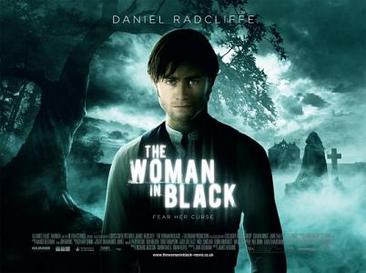
The tradition of telling ghost stories during the months of long darkness has evolved over time.  Since the time seems right, I watched a movie for which I read the book some years ago.  I recall that The Woman in Black is moody, and gothic.  What I don’t remember is how it ends.  More than one source—at least one from someone I know and one from a book—suggested I should see this movie, and I’m glad I did.  It’s a haunted house movie, set in a haunted village and the production values (unlike some movies I’ve recently watched) are quite high.  This film was a reboot in a couple of ways; there was an earlier film version, and it was also a new Hammer production.  In the latter capacity it broke records for Hammer box office earnings.

You see, Hammer, in its first incarnation, struggled for any kind of respectability.  The company almost single-handedly kept horror movies alive while US studios moved more toward sci-fi-themed projects, before the rebirth of modern horror.  Fans knew to go to Hammer for their monsters, but society folks (and those who wish to be society folks) don’t find horror worth any attention.  From my amateur point-of-view, such movies give the viewer a lot to think about.  The problem, as with most underdogs, is that a few bad examples tend to get all the attention.  Life is scary.  That doesn’t mean we shouldn’t try to live it, but it does mean that we might learn something from other people’s mistakes.  Or we might find ourselves haunted.

The Woman in Black is set in Edwardian times.  (I often ponder why we still refer to historical eras by the British monarchs—Elizabeth, Victoria, Edward, etc.—in a world finally moving away from imperialism.  Still, it’s convenient.)  Perhaps not quite as evocative as the Victorian Era, but still moody enough.  Although there are some disturbing scenes, this is no slasher.  Like the novel it’s the tale of a vengeful ghost, wronged in life and out for revenge.  While the end of the movie isn’t the same as the novel (okay, so I looked it up!), it’s similar.  And perhaps it’s best considered a parable of parenting.  No amount of training can prepare you for it, and although it’s supremely rewarding, it’s also very scary.  Susan Hill, the novel’s author, lost a child and that sense of haunting pervades both book and movie.  Gothic is often about grieving, and perhaps about learning something from it.