Finally, Therapy

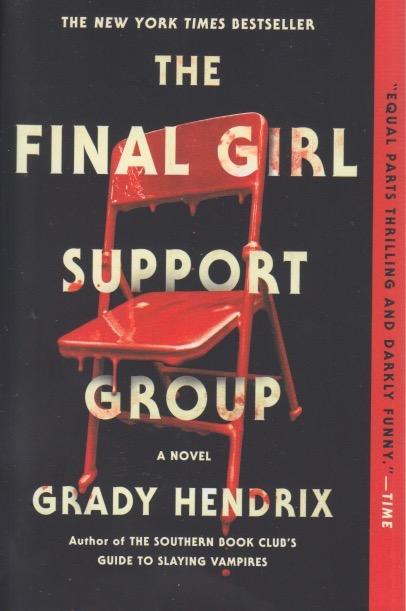
Like religion and horror, humor and horror can also get along well.  As an aesthetic, it’s not for everyone, but Grady Hendrix does it well.  It took some convincing for me to read The Final Girl Support Group.  I’d read one of Hendrix’s nonfiction books and was impressed, and that led me to his fiction.  It also demonstrates how an academic might actually be able to make a difference.  As you might guess, the novel features “final girls” from several fictional events, made into fictional movies, who get together for therapy.  It’s a funny idea and yet it’s not.  Hendrix clearly wants women to be treated fairly, but he’s also clearly a horror fan.  It’s sometimes a tricky balance to hold.  He does it pretty well in this novel.

The idea of a “final girl” comes from Carol Clover’s crossover academic book, Men, Women and Chain Saws.  This is the book that introduced the concept to the world.  As with most analytic concepts it’s only an approximation.  Clover noted the way that, in slasher films, the only survivor tends to be the virginal girl who doesn’t join in substance abuse.  Since the slasher genre is usually first credited to John Carpenter’s Halloween (Hendrix suggests in his acknowledgments that it’s Psycho), I’ve always wondered because Laurie Strode does take a toke in the car and we’re not really told much about her dating life.  I’m not a big fan of sequels, so maybe I’m missing something.  In any case, slashers have never been my favorites, and as sexist as it might sound, Poe’s observation about threats to beautiful women is something the “final girl” relies heavily upon.

The novel itself is pretty gripping.  I’m not going to put any spoilers here.  I was reluctant to read it but I’m glad that I did.  It’s classed as “horror” because of the theme but there’s definitely a lot of literary finesse as well.  It’s the kind of thing that doesn’t really seem to be deep, but upon reflection, it has more to say than you think it does.  The resolution of the novel is messy.  I suppose that’s one thing that makes it literary.  The characterization is amazing well done.  I had trouble keeping track of the back stories of all the final girls but that’s part of the fun.  While there are definitely horror moments, Hendrix never lets you forget that you are supposed to be laughing too.  It’s a fine balance and he manages to hold it together throughout while giving agency to final girls.



Eternal Return

Amazon gets a lot of bad press.  For me, anyone that sends me books gets a warm fuzzy association.  Besides, returns are a snap.  Amazon has sent me the wrong item a time or two.  You simply let them know and they’ll refund you.  No fuss, no muss.  Twice recently, in my effort to support both the planet and used book vendors, I have received the wrong item.  Here’s where I praise Amazon.  The most recent vendor (reputable and an old player in the used book market) required a multi-step effort to even make the claim of a wrong item, and then wouldn’t pay for the return.  Let me get this right: it is your mistake and I have to pay for it?  Just because someone who apparently can’t read the title put the wrong book in the bag and it took two weeks for me to receive it?  Is there any wonder people buy from Amazon?

To err is human.  I get that, believe me I do.  But if you make a mistake you fess up, you don’t charge the customer for your error.  Have they not realized that looking at the price tag after a trip to the grocery store is more effective than watching a horror movie?  I can’t afford to pay for their mistakes.  Then my existentialist friends come to the rescue.  Yes, they remind me, this is all absurd.  A world based on inheritance and privilege, where an active and alert mind sees that when an error is made, the one who did not make it takes responsibility.  I’m no fan of capitalism, but Amazon doesn’t make me pay for what I didn’t order.  I guess size matters after all.

Perhaps there should be caveats plastered across the internet: buy at your own risk.  If we make a mistake with your order, you will be responsible for it.  It just kills me to complain about book vendors.  Probably I care for books a little too much.  I try to buy responsibly, otherwise there’d be no house to, well, house the books.  I just don’t like feeling cheated when purchasing a used book.  It’s out of character for book vendors.  They’re the modern saints, those who are looking out for the good of the world.  Eventually the seller relented, but not happily.  My associations of Amazon will always go back to when I first discovered that there was a website on which you could find just about any book and have it delivered, and often cheaply.  I miss those days and their optimism.  I need that warm, fuzzy feeling again.  I need to buy a book.


New York History

Regular readers know I’ve been on a Washington Irving kick.  My wife kindly agreed to read his History of New York to me as I was doing the dishes (we’ve read over 150 books this way, over the years).  This was the book that brought the then 26-year-old Irving to fame.  A satire of the early European history of Manhattan, it contains many of the Irving quirks that would reappear in some of his later humorous writing.  Today Irving isn’t noted as a great stylist, and his work isn’t considered particularly original.  And the reviews on Goodreads reveal that some people read this book thinking it’s an actual history.  Well, I guess it is, but it’s an unreliable one.  Satire rolls that way.

The book was attributed to Diedrich Knickerbocker, as part of a hoax.  Irving ran ads in the papers for a landlord seeking Knickerbocker for skipping out on paying his rent.  The book begins with the landlord explaining that Knickerbocker had left in arrears, and so he is publishing this manuscript he found in his rooms in order to help pay the bill.  In what would become the fashion of the time, the book was lengthy, a set of seven “books,” beginning with the creation of the world and lasting through the governorship of Peter Stuyvesant, the last Dutch administrator of the New Netherlands.  Interestingly, nobody before Irving really took any interest or wrote about the Dutch period of the city.  Since then, of course, serious histories have been undertaken.

Irving was an early example of a writer who blurred fiction and history.  You can learn a lot by reading A History of New York, but you have to do a lot of fact-checking.  My wife had previously read a serious history of the Dutch in New York (Island at the Center of the World) to me, making me curious about Irving’s book.  It is humorous, but no doubt, the butt of some jokes gets lost with the passage of two centuries.  And satire, depending on how it’s done, may not age well.  Irving would go on to write what is still his best received book, The Sketch Book of Geoffrey Crayon, Gent., about ten years later.   And he would continue writing after that as well, but never quite recapturing the glow of the work of his youth.  For those of us who’ve worked in, and for those who’ve lived in, New York City, there’s quite a lot to like here.  Even if you can’t get all the jokes.


Disputing Tradition

I respect tradition.  Normally.  Once in a while tradition should be disputed.  The other day I was reminded of the seventeenth-century aphorism, “The early bird gets the worm.”  As a lifelong struggler against literalism, I had to get over the bird and worm part, and was thinking early meant, well, early.  This, combined with even earlier saying “Early to bed and early to rise makes a man [sic] healthy, wealthy, and wise,” convinced me that early did reference waking.  And these saying require some revision.  I’m an early riser.  I don’t get many worms and although I seem to be mostly healthy, I’m certainly not wealthy, and many would question my wisdom.  So why do we encourage people to wake up early?  The fact is most people stay awake late.

I’ve noticed a few things about early rising.  One is that I can get a lot of creative work done with no interruptions.  My last three books were mostly written between three and five in the morning.  (The royalties, however, never even approach the cost of the materials required to write them, so strike the “wealthy” part of the equation.)  I’m ready for early meetings at work.  I can think of six impossible things before breakfast.  But.  (There’s always a but.)  Afternoons are my evening hours.  I lose my focus and dread late (i.e., after 3 p.m.) meetings.  As my family is beginning their fun part of the day, I’m heading to bed.  I can’t do evening meetings, clubs, or hobbies.

So why do I do it?  For one thing, I can’t not do it.  I awake early as a matter of biology.  Over the years it’s slipped back from about 5 a.m. to 3:00.  I remember being a child at sleepovers at a friend’s house and waking early, watching the sun stream through the blinds, wondering when somebody else might wake up to play.  In college it was an advantage to get to the showers first.  As I professor I did my research before the duties of the day took over, preventing any real progress.  None of this, however, has made me wealthy.  I do have to admit that I could probably get worms, if that were something I desired.  I see animals out and about when I’m jogging during morning twilight.  There are likely worms about too.  I’m usually awake before the birds.  And this has made me question traditional wisdom.  Of course, I don’t claim to be wise, either.


Dinosaur Planet

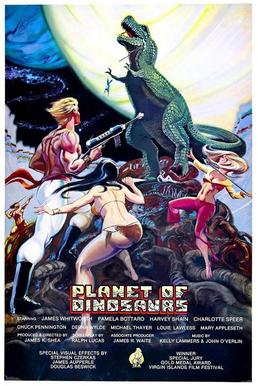
Time, as the crew of the Odyssey finds out, can cast things in a different light.  Admittedly I watched Planet of the Dinosaurs because it was free on Amazon Prime and I was having trouble keeping awake on a weekend afternoon.  It’s the kind of bad movie I’d’ve loved as a kid, and if I’m honest, I still do.  Although it was released in 1977 (it’s hard to believe Star Wars was the same year) the award-winning (!) stop-motion dinosaurs are so unbelievable that it hardly seems possible that the film’s budget was almost all spent on them.  It certainly didn’t go to pay a writer because the dialogue is about the cheesiest I recall ever hearing.  Jurassic Park was still a decade and a half away, after which no stop-motion dinosaur would ever be credible again.

Still, bad movies aren’t all bad.  In fact, there’s an aesthetic to them.  For me the real draw, as with an Ed Wood movie, is that these directors were struggling against an inadequate budget.  This isn’t in the Spielberg league.  And you can only afford so much.  The idea is akin to that of Planet of the Apes—which benefitted not only by a better budget but by a script by Rod Serling.  A planet similar to earth but caught in a different time.  And it’s a chance to explore what it would’ve meant for people and dinosaurs to coexist, which, despite some ark hawkers, never happened.  If it had we probably wouldn’t be here to make bad movies about it.

Our set of nine castaways manage to survive with only four eaten by dinosaurs.  And when these stop-motion reptiles aren’t on screen, the people are filmed walking, inanely talking, or thinking that a stockade of sticks and twine will keep out nine metric tons of Tyrannosaurus Rex.  There’s an attempt at social commentary when the vice-president of the company funding the mission realizes that he’s not the boss among castaways.  Where there’s no money, the balance of power shifts.  Of course, he gets impaled by a Centrosaurus.  At the end, the five survivors have settled down, built a house, and started having children.  They look pretty good for having survived on dinosaur meat and berries.  It helps that the corporate VP isn’t around.  I watch movies like this because, like James Shea, I’m on a tight budget.  And Amazon Prime often dictates what I watch when I’m having trouble keeping my eyes open. 


Literary Detective

A writer’s life can take many forms.  Alexandre Dumas, for example, (the father, just to be clear) had tremendous success with his novels The Three Musketeers and The Count of Monte Cristo.  Due to the politics in his lifetime, he was exiled and repatriated.  Of the upper classes, he had many affairs.  And finally, in 2002, was reinterred in the Panthéon in Paris with the president of the nation renouncing past racism.  You see, his father was a creole born in Haiti and apparently for that reason he’d been denied burial with France’s other luminaries.  I’ve been reading early European and American novels lately.   I just finished Dumas’ lesser known The Woman with a Velvet Necklace, which was originally published together with some other “stories” (this one alone is over 200 pages) in French, of course.

The story itself seems to have been based on a short ghost story by Washington Irving titled “The Adventure of the German Student.”  In brief, a student meets his dream girl in Paris during the revolution.  She wears a cloth necklace and when it’s removed her head falls off.  Tracing the origin of Dumas’ version on the internet took considerable detective work.  It involved learning the book in which it was originally published (long out of print), translating the title into French, and reading the French article in French Wikipedia since there’s no English article on it.  The story was originally published in 1850, some quarter-century after Irving’s tale, and logic compels one to conclude that either Dumas knew Irving or that Irving was using an old French ghost story that was in circulation at the time.

Since few internet sources exist on the novel, its origins remain somewhat of a mystery.  The French Wikipedia article doesn’t address them.  We know that Washington Irving was a writer appreciated both in America and Europe, having spent many of his years living in the latter.  We also know that Irving borrowed the basis of the story from materials he picked up while traveling.  There’s more literary detective work to be done here, but we live in an age when literary scholarship is devalued (it doesn’t bring in money) and until someone who’s an academic gets on this trail, Dumas’ use of Irving will always remain speculative.  The novel itself does reveal, after the first forty or so pages, why Dumas was a popular writer.  He has a way of drawing the reader in.  The story itself is odd and sad but has a message.  And, as it turns out, a mystery as well.


Miracles

“Expect a miracle,” Oral Roberts used to say, “and a miracle is yours today.”  The famed Evangelical probably didn’t have Catholic-variety miracles in mind, although a story on the Catholic News Agency does.  Miracles come in big and small varieties.  In case you’re feeling encrusted in materialism, there are plenty of things science hasn’t yet explained.  It helps to have a little wonder in your quotidian routine.  So what was this miracle?  It took place in Hartford, Connecticut.  Specifically, at St. Thomas in Thomaston.  In case you’re not Catholic, or high church Episcopalian, a brief explanation: after the consecration of the host (communion bread), ordained clergy pass communion wafers to those who come forward to receive them.  Believing in transubstantiation, this is done with a great deal of attention to detail.

Photo by Josh Applegate on Unsplash

The vessel that holds communion wafers is called a ciborium.  (My years at Nashotah House were good training for this.)   Since consecrated wafers should never be defiled, only a certain amount are consecrated at a time—enough to cover those present for the Eucharist, usually.  Any extras are locked in a tabernacle for future use.  In this miracle, a minister handing out the wafers noticed he was running out.  Believe me, this is something to which clergy pay close attention.  Then suddenly there were more wafers in the ciborium.  A multiplication of loaves, but in much smaller and pre-ordered form.  One child called them, I once heard, “tiny little quesadillas.”  Perhaps a small miracle, but we take what we can get.

A miracle is defined as “an extraordinary and welcome event that is not explicable by natural or scientific laws and is therefore attributed to a divine agency.”  Since we can’t observe all phenomena all the time, they do occur now and again.  What happened in Connecticut?  I don’t know.  No scientist was observing, and no vestment cams were in use.  We have the word of a clergyman with no cause to lie.  Maybe something unusual did happen.  Yet I can hear the evangelicals protesting that if God were to perform a miracle it would have something to do with Donald Trump rather than some popish fetish.  That’s the problem once religions get involved around miracles.  Too much is left to interpretation.  Sometimes I think of the miracle of the sun at Fatima, Portugal.  Or of people miraculously healed from late-stage fatal diseases without medical intervention.  These things happen and when people are pressed for an explanation they tend to turn to the divine.  Perhaps, however, things just aren’t what they appear to be.


Holiday Hopping

Weekends in spring are like touching base.  They’re the only places you can’t be tagged out and you run from one to the next, hoping not to get caught.  Our British colleagues, more secular than we, tend to have both Good Friday and Easter Monday off work.  Religious America grins that Easter’s always on a Sunday so nobody has to be given any time off.  This disparity has long played into my fascination with holidays.  After generously giving you off both Christmas and New Years—within a week of each other!—the typical US company will throw a long weekend or two into January and February, but then won’t let you out of sight until the end of May.  And this is just as the weather is warming up and we’re wanting to be outdoors a bit more.  On weekends only, of course.

Holidays are a religious idea.  We have the various world religions to thank for them.  The idea of sacred time was, once upon a time, taken seriously.  And nothing is more secular than business.  World religions gave us the concept of weekends and the little breaks that we take from doing the same stultifying thing day after blessed day.  The more enlightened of companies have decided, after senior-level employees have accumulated days off with years of service, that adding extra days for every decade of servitude isn’t really fair and stop the practice.  So we find ourselves in that strange day between Good Friday (a work day) and Easter (thankfully, a Sunday), and thinking, “you know I could really use a break about now.”  We cast a weather eye toward Memorial Day while dreaming Beltane dreams.

My personal fascination with holidays really kicked off when beginning 925 work.  I don’t mind long work hours if it’s a vocation rather than a job.  When the relationship’s purely economic, however, you begin to miss the time to regenerate.  We remember someone died yesterday, too—we’re told—liberate us.  Tomorrow amid lily scent we’re informed he came back.  The rest of us, however, look at the clock and know that despite world-changing events we’ll be back at our desks on Monday since, well, what do you think we’re paying you for?  Don’t try pointing across the Atlantic, either.  They’re burdened with holidays and we’ve been liberated to capitalism.  And what are you doing, reading this blog on a Saturday?  I am most honored and grateful.  And I hope you have some time to rest, since it’s still a long way to the last Monday in May.


Friends and Dreams

The mind is a labyrinth.  Ever since the time change (especially), I’ve been waking with the weirdest dreams.  One involved someone I haven’t really thought about for years.  Someone I knew in college and who was a close friend, but who’s fallen out of touch.  (And who would likely not approve of my evolving outlook on things.)  Why she came out in a dream is a mystery to me.  It does give me hope, however, that all those things I think I’ve “forgotten” are really still in there somewhere.  A friend once told me that it’s not a matter of “remembering” but of “recollecting.”  He claimed that the memories are still there.  Ironically, I can’t recollect who he was, although I think it was someone I knew in college.

My generation’s ambivalent about the internet.  Most of my college friends I simply can’t find online.  I recall one of my best friends saying he would never use a computer.  I suspect he’s had to backslide on that, for work if for nothing else, but he’s not available online at all.  The same goes for people my age at seminary.  Some I occasionally find through church websites, but honestly, most of them have better pension plans than I do and have retired to become invisible.  We children of the sixties are likely the last generation that might be able to make it through life claiming never to have given in to computers.  It took quite a bit of effort to get me over the reluctance.  One of my nieces set up this blog for me nearly 13 years ago, otherwise I’d still be hard to find.

But minds.  Minds can, and do change.  My mind was dead-set against computers in college.  For one class I was required to do one assignment via computer, and I did that task and that task only.  Seminary was accomplished with a typewriter and snail mail.  Even my doctorate, done on a very old-fashioned Mac SE, was purely a feat of word processing.  Nashotah House was wired during my time there, but that was mainly email.  My mind was slowly changing at each step of the way.  I wasn’t becoming a computer lover, but I was realizing that I was learning something new.  Now I can’t get through the day without writing and posting something on this blog and sharing it on Twitter and Facebook.  And checking email—always email—to see if anything important has come in.  And, perchance, someone I had a dream about might actually email me out of the blue.


Curses

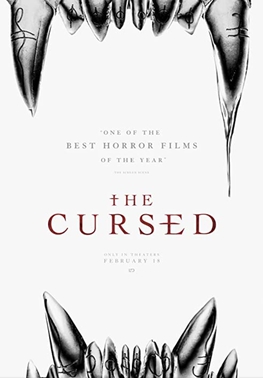
Once again I’m reminded that Holy Horror was never intended to be comprehensive.  I recently watched The Cursed (the 2021 one, directed by Sean Ellis).  This appeared after Holy Horror was published, but it’s a good example of religion (and the Bible) and horror.  It’s artfully done but rather gruesome and difficult to watch.  I suspect such aspects as gruesomeness are why many people dislike horror.  That certainly isn’t my favorite part either.  I watch for the story.  The lesson learned.  The moral delivered.  And also to get a sense of what’s going on in the wider culture.  People tell disturbing stories for a reason.  And quite a lot can be learned from them.  The Cursed has a complex story that was, I suspect, influenced by the historical incident of the Gilles Garnier killings in early modern France.

Set in France, this movie focuses on disputed land and the inappropriately extreme measures wealthy landowners will take to keep it.  A group of Romani (“gypsies”) have laid claim to some aristocratic lands.  Seamus Laurent, a local baron, decides (with the advice of the clergy) to kill them off.  Foreseeing this, one of the women had a set of silver teeth made and put a curse on them.  After she’s killed, the teeth are found by the children of the town and the teeth make monsters.  There’s some confused imagery here, but the story-line is clear.  The monster is revenge for the cruel treatment of and land theft from the Romani.  They may be dead, but betrayal leads to revenge.

That’s where the Bible comes in.  Apart from the locals fleeing to the church for safety, it turns out that the silver was from the thirty pieces given to Judas to betray Jesus.  One of the murder victims had a page torn from the Bible with Ezekiel 22.22 highlighted.  Unlike Pulp Fiction, this quote from Ezekiel isn’t made up and the “prophecy” is taken to refer to the beast conjured by the injustice done to the rightful owners of the land.  This film is subdued, moody, and gothic.  The story is sincere and well told.  It leaves enough gaps for discussion.  It also shows, once again, how religion and horror benefit from each other’s presence.  Stealing land is a biblical crime.  Although the church doesn’t ultimately protect, the absent God in this movie is on the side of those oppressed and tortured by the wealthy.  Maybe it’s time for a sequel.


The Importance of Sharing

Growing up with siblings, I remember it well—my mother instilling the message of sharing.  If something good came my way, I could count on hearing “Share that with your brothers!”  These days sharing is easy and it only costs you a click.  And it’s very important.  Especially to those of us with soft voices.  You see, there is another new Wicker Man book coming out this year.  This is the 50th anniversary of the movie and there’s a lot of interest.  The other book is getting quite a bit of free press because the publisher knows the importance of sharing the information.  Click that share button!  Meanwhile I’m watching what we in the biz call the NBA (New Book Announcement) creep very slowly out of its box.

A couple days ago I wrote about how Amazon isn’t aware of the book, and Google can’t seem to find it.  In the intervening days it has now shown up on Lehmann’s bookselling shop in Germany.  You here, reading this, are the only people in the United States (if you are) who know about this book.  My voice isn’t very loud.  I don’t get retweeted and I don’t even have a cover image to share yet.  I’m still waiting for it to appear on the publisher’s website.  (This is one of the reasons I’m (hopefully) moving on from publishing with academic presses—they tend to be a touch slow.)  What can you do to help?  Share this post.  It’ll only take you a second.  Look down below this post and you’ll see this:

Of course, I can accept that you don’t like what I’m saying.  But if you’re on Reddit, Facebook, Twitter, or Pinterest, you can share the misery.  All it costs is a click.  The thing about the internet is that little things can add up to a lot.  That’s the whole idea behind websites that take a small cut to get the item you want out to you.  Life by a thousand cuts.  If enough people share, even those with a “Yop” to utter can save all Whos, right Ted?  I used to think all those YouTubers were a bit gauche with reminders in each and every video to click the “like” and “subscribe” buttons.  Now I’m coming to understand that that’s the way life on the internet is lived.  And May Day is just around the corner. Notice for my book will continue to creep out slowly.  Meanwhile I’ll look at Lehmann’s website and hope for the best.


Rock the Absurd

Okay, so it was bound to happen eventually.  You see, the internet makes us all interchangeable in a way.  I occasionally lament being confused by various algorithms with other “Steve Wigginses” out there (and there are many).  So while innocently checking my personal email after work the other day I spied a message clearly not sent by one of the many organizations that spam me constantly.  It was an invitation to participate in a conference.  Now, with a 925 job that’s just not possible, but I always appreciate being asked.  Then I read what the conference was about.  Agriculture.  Why were they asking me to attend a conference on agriculture?  Then I recalled, one of the other Steve Wigginses is a professor of anthropology, specializing in agriculture.  Was this an electronic mail mishap?

It also made me wonder if this poor soul (I don’t know him and have never met him) has been receiving email about horror films and wondering why.  His research trajectory has him trying to help people (which is why I wanted to be an academic in the first place) in a real down-to-earth way.  This made me realize the dilemma of other biblical scholars I know who are interested in monsters and horror, but who also realize that we need to help the world.  I can say from experience that it’s a lot easier to do as a professor than it is as an editor.  At least a professor has a platform to stand on.  And all of this brought to mind the theater of the absurd, tying me back to my younger days.

As I started high school I learned about the existentialists.  Looking at my own life, I saw it was absurd.  The times when I start to get down are when I’ve started to take all this seriously.  This Steve Wiggins, in any case, spends his life trying to figure things out.  But he lives in a world where two and two don’t always come to four.  Anyone who’s been inside an organization with open eyes knows the absurdities—large or small—that go on within it.  As old Ecclesiastes says, the race isn’t always to the swift.  That’s biblical and bankable.  So it’s a bit absurd that three (that I know of) Steve Wigginses are or have been professors.  It’s absurd that we don’t all use our full names because most two-name combinations on the web are going to lead to duplicates.  Mix-ups are bound to happen and we should just enjoy the absurdity we see.

Photo by Steven Weeks on Unsplash

Philanthropy

I’m sure it’s happened to you.  You’ve driven two or three places, often in different towns, then you simply give up, go home, and order it on Amazon.  I try to support local businesses whenever I can, but if you’re looking for something specific, Amazon can generally find it.  (And despite the advertising hype, eBay does not have literally everything.)  This happens often enough that I’d set up my favorite charity, the Crohn’s and Colitis Foundation, as my Amazon Smile charity.  At least I could feel good knowing that my support of the internet giant was being shared to help find a cure for a major, often unspoken, disease.  The latest stats I’d seen said Amazon had donated, I believe, somewhere around $45,000 to the Foundation.  I felt good.

Then I received a notice that Amazon is retiring the Amazon Smile program.  The notice informed me that they’re focusing on other philanthropic causes.  I have to wonder what they are.  Will they help those suffering from terrible diseases?  I think of the Vlogbrothers (Hank and John Green).  They are internet personalities as well as successful authors and content creators, and they hold telethon-like fundraisers donating all of the proceeds to charity.  They do this once a year and additionally they’ve started several small businesses, again, with all proceeds going to charity.  Like that great Unitarian actor, Paul Newman.  If you have enough money, why not give the excess away?  Both John and Hank have families.  I’m sure they’re fiscally savvy enough to make sure their kids won’t have to struggle.  And yet they give millions away.

Philanthropy makes me smile.  It is the best that humans have to offer.  Those who’ve managed to break through realize that there’s an ethical obligation to give back.  What with political Christianity we’ve generally outlived morals, it seems.  They no longer have the hold on culture that the social contract seemed to dictate generations ago.  So it’s up to those with tons of lucre at their disposal to demonstrate largesse.   It nevertheless makes me happy when I hear of it.  I don’t understand finance and I don’t have a head for numbers.  Instead, I try to support those who believe in giving back.  For books that’s often Bookshop.org.  But time is limited, and weekends are too precious for spending driving hither and thither for something that’s only a click or two away from my restless fingers.  I just hope Amazon’s supporting some worthy charity.  Human need is too great not to. If they are it may make me smile.


Addenda

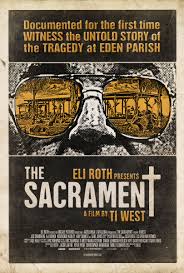
In retrospect, I suppose I wrote Holy Horror a bit prematurely.  Back when I started writing it, I had thought that the Bible in horror wasn’t as common as I’ve since found it to be.  I still stand by what I wrote, but I could’ve included a lot more movies that I’ve watched over the years since.  The Sacrament is one of them.  Based on the Jonestown massacre, the film sets the movie in the early twenty-tens.  A reporter for VICE is going to find his sister who’s joined a religious commune in some unspecified country.  In an effort to get him to join, she invited him to visit.  She was unaware, however, that he brought another journalist and cameraman with him.  The movie gives creepy vibes right away since they’re greeted at the helicopter landing site by men with guns.  Eventually they’re allowed to enter.

“Father,” the leader of the commune bears a resemblance to Jim Jones and soon it’s clear where this is going.  Along the way, however, Scripture gets quoted to justify their communal lifestyle.  There are many fictional aspects thrown in—the young women seduce the journalist whose sister invited him.  She makes no bones about saying they do it to convince him to stay.  The camera crew is almost convinced that this is the paradise it claims to be, but they start getting requests for help.  The writers clearly did their research on Jonestown since several details of the final weeks of the Peoples Temple are fictionalized here.  The mass suicide is shown in graphic detail.  The number of the dead, however, is only about a fifth of those who actually died in Guyana in 1978.

The movie clearly shows that the commune is problematic, but it also raises uneasy questions.  If it weren’t for the murder of Leo Ryan, would Jonestown ever have happened?  Probably, but the film shows “Father” making the point that nobody was being harmed.  That’s belied by the introduction of an abused girl and the number of people who want to leave.  It’s true of Jonestown that mind-control tactics were used and people weren’t permitted to leave, especially as Jones’ paranoia grew.  The movie leaves the viewer wondering whether utopian communes can ever work, people being what they are.  We crave our freedom, even when things look great.  The movie condemns the exercise, but not so much that it leaves lingering doubts about whether, had things been different, it might’ve worked.  And it would’ve worked, had I seen it earlier, for Holy Horror.


Search Your Engines

It’s been fascinating to watch.  We tend to think things appear instantaneously on the internet, and sometimes they do.  Book announcements, however, are less prone to that.  The Wicker Man, my book for the Devil’s Advocates series, was first announced to the world (apart from me) on Oxford University Press’s website because they distribute books by Liverpool University Press.  It took several weeks before it appeared on LUP’s site (I’m projecting here, it still hasn’t showed up there).  Like an anxious father, I checked every few days to see if word was getting out.  After about two weeks it showed up on Barnes and Noble’s website, but not Amazon or Goodreads.  Then it appeared on ecampus, a textbook seller.  Days later it appeared on Amazon’s site in Spain only.  Word gets out slowly.

Some things hit immediately, of course.  Everyone in the world knows about them seconds after they happen, whether they should or not.  Some young folks, who grew up with the internet, are having trouble letting go of the, well, troubles of the world that jet through the 24/7 news cycle.  Books by unknowns travel much more slowly.  Of course, I’ve been trying to reinvent myself.  In as far as I’m known, I’m known as an ancient Semitic goddess scholar.  (The ancient part is correct, in any case.)  I turned to writing about religion and horror about a decade ago and if web searches mean anything, my most searched book seems to be Holy Horror.  That makes sense since Nightmares with the Bible is so expensive that I can’t afford additional copies even with the author discount.  The Wicker Man will be up near forty dollars, but that’s cheap these days.  At least it will be paperback.

Maybe I have been checking more than I let on, but I’ve also noticed something else odd.  Ecosia, the tree-planting search engine, comes up with more results (based on the ISBN) than Google does.  That astonished me.  Google apparently isn’t as good at searching as it would have us believe that it is, at least for obscure information.  (In my case, very obscure.)  Ecosia even outperformed Bing.  With this internet full of stuff, you’re obviously missing out if you don’t use multiple search engines.  Yahoo added yet one more site with the book.  I’m wondering when the actual publisher, or Amazon’s main site, will catch up.  Giants do move slowly, I guess.  Maybe once the cover image is released…