Reading Early America

Reading about Washington Irving is reading about early America.  And reading about early America is to read about what’s happening in politics today.  One thing that’s very clear, even among the founders of this nation, is the fear that politicians like those we have today would arise.  You see, nothing like America had happened before—a nation deciding to govern itself without a king or queen.  A democracy.  The founders weren’t blind to human weakness, however.  They repeatedly warned against what we now have—a two-party system (which will naturally deeply divide a people) that backs ambitious, wealthy individuals who crave power rather than the good of the country.  Instead of bravery, we elect cowards who dodged the draft because of their personal wealth, and then called veterans “losers” when they’re elected.

There’s some comfort in this long view, however.  The fear we all constantly feel is nothing new.  From 1776 onward, those who were architects and analysts of this republic have warned that we’re always on the brink.  Reading about such things at the same time as reading about the history of Russia is enlightening.  Russia was a monarchy.  It’s sometimes hard to remember that it has only been a hundred and five years since the Romanov family was executed and “rule by the people” became the norm in that nation.  That Mikhail Gorbachev was the first leader of post-Soviet Russia and that was only less than 25 years ago.  We are all part of history.  And history is very old.

America only works as long as those who lead it are dedicated to the nation, not to themselves.  What is the sense of a nation if not putting the needs of others on the same level, or even above, your own?  Sacrificial thinking is behind what used to be called “servant leadership.”  Instead, we tend to see those who find out how to game the system rising to the top through money, grift, or high self-regard.  And when multiple nations have such people in leadership roles we find ourselves in the situation that we face in the twenty-first century.  But we faced it also in the twentieth century.  And in the nineteenth.  People, it seems, do not change.  Monarchs, through no right other than extreme wealth, rule nations.  The idea never dies.  The thought that wealth equates with worth is a poison to all political systems.  This is something you learn by reading about early America.  Today’s an election day.  If you support democracy, make time to get out and vote.


Lost at Sea

Where do books come from?  It still comes as a surprise to many authors, but books tend to be shipped by, well, ship.  When publishers use overseas facilities, it’s far too expensive to send books across the ocean by air.  I had many people express disbelief when I explained their books were delayed by the Suez Canal blockage, but if most of the world’s international goods are sent by ship (and they are) what might seem like a quirky news story has very real ramifications worldwide.  I was reminded of this by a recent NPR story of two new cookbooks having been lost at sea.  The ship from Taiwan, bound for New York, ran afoul of a storm in the Azores, resulting in the loss of 60 shipping containers—including those holding the newly printed books.  There is a worldwide shortage of shipping containers (seriously) and one of the problems is they keep falling off ships.

Photo by Elias E on Unsplash

If you haven’t googled “cargo ships” and looked at the image options, do.  You’ll see astonishingly large ships with what look to be entire cities worth of cargo containers stacked on the deck.  Many of these containers are lost at sea.  Current estimates are that about 1,000 containers fall off of ships per year.  Although the authors of these particular cookbooks took a lighthearted approach to the news, the book that really brought this home to me was Moby-Duck, which I blogged about some years back (you can read it here).  That book was about trying to follow the plastic “rubber duckies” that fell off a ship back in 1992.  This isn’t, in other words, a new problem.

Videos posted of these massive ships being tossed about and losing cargo are impressive in their own right—they make the ocean seem omnipotent.  But the fact is, we’ve littered it pretty badly.  Books, in their defense, will decompose naturally.  We live in a society defined by consumerism.  We see things and we want them.  In order to make them inexpensive, American companies buy the items from overseas where labor costs are much cheaper (and where many nations have socialized medicine, I might add, making employees cheaper to pay).  As ships grow larger we might expect these kinds of accidents to increase.  The older I get, the more I pay attention to economics.  The dismal science does hold a macabre fascination, especially when entire printings of a new book end up at the bottom of the ocean.  Authors, if they’re curious, ought to consider where books come from.


Learning from Mother’s Day

Looking back over the past year, I see that we’ve still got a lot of progress to make.  It’s only been about five millennia of “civilization,” but we still haven’t figured our that women are just as important as men.  Probably more.  This Mother’s Day we stop to think of our moms and many of us wish we were closer to home so that being there this day were possible.  Even the spineless men who degrade women are probably on the phone to their moms today, or maybe sending flowers.  The real truth emerges tomorrow.  Did we learn the lesson?  Are women to be accorded the same rights as men?  And who, really, has the right to decide who’s more human than anyone else?

Born as human beings, we need our mothers to survive.  They nurture and comfort and provide for us, even if fathers step out of the picture.  I’m reminded of an experiment that I learned about in some science class along the way.  A baby monkey (I can’t recall the species) was given a choice of two artificial “mothers.”  One, made of wire, monkey shaped, had a bottle where the baby could feed.  The other had no bottle, but was covered in fur.  The picture of that poor monkey clinging to the bottle-less but “comforting” fur-covered mother has haunted me ever since.  The look of desperation on its face makes me want to weep.  Why can’t we treat all people equitably?  We require no experiments to reveal the truth here. I look forward to the day when such messages will no longer be needed.

Too often we allow our holidays to assuage our guilt over poor treatment for the rest of the year.  Churches used to be plagued with those living sinful lives making it to Sunday’s absolution only to start it all over again.  If only we would learn the lessons Mother’s Day has to teach us.  People depend on one another to survive.  We like to think of ourselves as independent and not requiring help from anyone.  That’s a lie on a Trumpian scale.  We need each other.  Every live deserves fair treatment.  The same wage for the same work.  The right to protect their bodies and their health.  The right to show us a better way of being in the world.  It’s Mother’s Day, and if you’re reading this you have a mother to thank for this very modest possibility.  When a new sun arises tomorrow, let’s remember what we learned today.  Thank you, Mom!


Mutant Madness

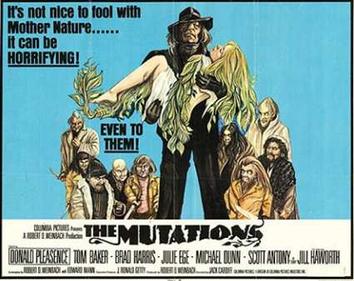
I’ve never seen Freaks, nor have I ever wanted to.  It’s an exploitation film of carnival actors that  Tod Browning, for some reason, thought might make a good follow-up to Dracula.  Most of us are aware that it’s bad enough exploiting  those with unfortunate deformities for money, and making a movie out of it doesn’t help.  I have to confess that I stumbled onto Jack Cardiff’s The Mutations thinking it was a creature feature, without realizing it was a seventies version of Freaks.  With a mad scientist thrown in for good measure.  Honestly, though, the carnies are the characters with the highest moral standards of anyone in the movie, so at least it has that going for it.  You’d have thought that by 1974, however, that people would’ve known better than to reprise a movie that wasn’t well accepted forty years before.

Professor Nolter, the mad scientist, is a university professor trying to force evolution’s hand by blending animals and plants.  So far, so good.  He uses his students as victims, which makes you wonder why their wealthy families don’t start any investigations when they go missing.  The professor is assisted in his experiments by one of the co-owners of the carnival, which allows for a presentation of the carnies in a most awkward piece of cinematography.  Two of his students are successfully made into plant hybrids, but one dies shortly afterward.  The other escapes, so he decides to replace him with yet another student.  Meanwhile, the carnies tire of their exploitation—rightfully so—and turn on the henchman/co-owner of the show.

The only real payoff here is the successful hybrid that turns into a student into a human Venus flytrap.  If he hugs you in his rubber-suited arms, you’re a goner.  And the film starts off with several minutes of time-lapse photography of plants growing, which is pretty cool, even amid the strangeness that’s to follow.  When I saw that the movie starred Donald Pleasence, and having Halloween on my mind,  I figured, “How bad can it be?”  It was, after all, free on Amazon Prime.  As with many exploitation movies, it’s poorly written and the props aren’t believable.  Some of the giant plant-animal hybrids are worth looking at, even though they’re never explained.  In the end the mad scientist’s creations kill him, as expected.  I would normally consider such information as a spoiler, however, considering that the movie spoils itself, I won’t worry too much about it.


Iron Man?

As a vegan, I sometimes end up thinking more about nutrition than I used to.  Back when I first became a vegetarian colleagues wondered how I got my iron.  I’m one of those apparently rare individuals who really likes broccoli.  I could eat it nearly every day of the week without tiring of it.  In any case, iron is important for health.  I’ve known people with iron deficiencies and it can be a real problem.  Doctors recommend ferrous gluconate as a dietary supplement since the body absorbs iron better from it.  (It’s best on an empty stomach, I’m told, followed by orange juice.)  But I’m no physician.  In fact, I’m quite squeamish, which may seem strange for someone who watches horror.  Still, thinking about iron took me back to my childhood.

I was a sickly child.  Couple this with a tendency to think too much and I must’ve been a handful for my mother.  I remember trying to explain to her once that I didn’t believe reality was real.  I was maybe twelve at the time.  She prescribed ironized yeast.  Now, Mom’s no doctor.  She didn’t even finish high school.  So thinking about broccoli made me wonder about ironized yeast.  First a web search revealed it’s not sold any more.  Further, it was a health food fad beginning in the 1930s.  Although I remember the taste and scent distinctly, I couldn’t find a website saying what it was or how it was made.  More to the point, why did my poor, frustrated mother think that it would help me couple reality with what was happening around me again?  (And was that even such a good idea?)

Questioning perceptions seems to run in my family.  I’ve long known that my thought process is very different from that of other people.  My saintly wife still says the reason she was attracted to me is that she’d never met anyone who thinks the way I do.  My thought process has had plenty of opportunities to drive her crazy since those early days, I suspect.  My brother and I sometimes talk about what it’s like being, I suspect, were we diagnosed, neurodiverse.  It’s easy to fall into the perception that others think like we do.  I suspect all people do that.  Few, at least among those I’ve met, question the reality that their senses tell them really exists.  Physics tells us it’s mostly empty space.  And yet although I still don’t know what it is, maybe I’d better find someone with an old stockpile of ironized yeast to get back to business. It is, after all, a work day.

Who knows what goes on in the mind of others?

Final (not) Thoughts

One thing I’ve noticed as I’ve aged is that I pay attention to necrologies a lot more.  Few people from my college and seminary days stay in touch, and the same is true of my teaching days.  People are busy, I know, but I always look at alumni magazines memorial pages.  Whenever I get on the Society of Biblical Literature website a morbid curiosity draws me to the list of departed members.  I’ve known several of them in past years.  Still, it was a shock to see Michael S. Heiser on the list recently.  For one thing, Michael was younger than me, and for another, I knew him for a long time.  Theologically we were pretty far apart, but that never stopped us from being friends.  We both lived in Wisconsin and we both ended up in academic-adjacent jobs.  We shared an interest in unusual things and we were even blog buddies for awhile.  Michael died back in February.

I hadn’t heard because SBL moved its recently deceased list off the home page (I suspect that’s not the best marketing), so you have to click through.  But when I did I was saddened to see Michael there.  Then I notice two colleagues even younger who’d died in the last few months.  It gives you pause.  There are no guarantees in life, I know.  Those who manage to make it to my age are fortunate, but can generally expect to have a few more years.  That’s not a promise, however.  Having watched a lot (possibly too much) television in my life, it brought to mind a Frasier episode where a colleague the famous psychologist’s age died, sending Frasier into a search for reasons why.  That’s something those older than me tell me that I’d better get used to.

We tend not to want to think about it, but I’ve had both a parent and parent-in-law say how strange it is to find yourself old while still thinking like a young person.  It is bewildering.  And it’s one of the reasons I write so frenetically.  It was after I finished my third book, I think, that I realized I didn’t have all the time in the world left.  I have lots of books I want to write, many of them already started and slumbering on my hard drive.  Michael was also a prolific writer, and a more successful one than I have become.  His blog had more followers.  And it seems like only yesterday that I ran into him at an SBL meeting and he did an impromptu interview with me.  Life’s too short not to stay in better touch.


Connecting Many Leagues

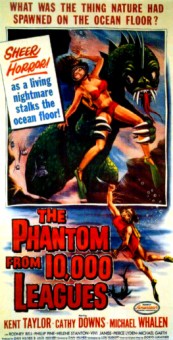
Much of movie viewing life is about making connections.  Many, many films have been made and I’m not the first to suggest that cinema is a form of modern mythology.  But those connections!  Pressed for time one busy weekend, I found the brief, low-budget The Phantom from 10,000 Leagues.  It was included with Amazon Prime and I had an obligation in about 90 minutes.  I could just squeeze it in.  As I’d anticipated, it was another of those poorly written, cheeky teen-magnets from the fifties.  The monster created by radiation, the threat to the world that the government sends only two guys to handle, and lots of lingering shots of men in business suits walking on the beach, it’s about what you’d expect.  It did well at the 1955 box office, though.

My first thought was that it was an attempted marriage between The Creature from the Black Lagoon and The Beast from 20,000 Fathoms.  Indeed, Black Lagoon had been released the year before, opening the realm of underwater filming for monster movies.  It, however, had a believable monster that wasn’t so monstrous.  The “phantom”—the name is never explained—is obviously a person in a cheap monster suit that can barely open its mouth.  It kills by holding people under water, or getting them into a radioactive beam, or preventing them from getting away from dynamite.  Oops, that last one’s a spoiler, I guess.  The Beast from 20,000 Fathoms came out a year before Black Lagoon.  The title of The Phantom from 10,000 Leagues title was obviously ripped off from it, and the atomic connection and undersea beast are common to both.  Connections.

The Beast had the benefit of a monster by the master, Ray Harryhausen.  And it was based on a story by Ray Bradbury.  That was a winning combination.  The Phantom claims to be based on a story by Dorys Lukather.  This movie is all she’s known for writing, God rest her soul.  Produced by the subtly named American Releasing Corporation, the production company would go on to become the respectable American International Pictures.  Interestingly, given the sexism of the era—reflected fairly clearly in the writing—the monster was played by a woman.  Norma Hanson, like Milicent Patrick, brought a monster to life only to be largely forgotten.  Patrick was rediscovered by Mallory O’Meara, but Hanson—one time a diving world-record holder—seems to have faded.  Had I but more time, I would enjoy diving those 10,000 leagues to bring another forgotten Hollywood monster woman to life.  And if I had the connections.


Know Your Books

Used books have many virtues.  They’re good for the environment, being the ultimate primary duo of the triad “reduce, reuse, recycle.”  They feel like handling the wisdom of the ages itself with their brittle pages and scuffed covers.  These books didn’t have a quiet life just sitting on the shelf.  I understand and respect that.  Still, when classifying such books for sale, I often find myself at odds with the sellers’ descriptions.  I wrote earlier of a book that had been listed as “very good” having two pages stuck together by a wad of gum.  What if what I needed to read was beneath that gum?  And no, not all books are available electronically online.  Copyright still exists.  You see, I once toyed with the idea, while trying to live as an adjunct professor, of selling used books.  There are accepted standards for poor, acceptable, fair, good, very good, and like new.

A recent “good purchase” arrived battered and a bit too well loved for my liking.  “Good,” however, indicates that a book is readable—the underlining shouldn’t obscure text, and God help us, there should be no gum.  This one, however, had several ripped pages.  That’s not good.  Then I came across a page where the corner had obviously been dog-eared only to eventually fall off before it reached me, carrying the page numbers with it.  Writing in books I understand, but bending down pages ought to be a crime.  Further along, another dog-eared missing bit took some text with it.  That part, at least wasn’t readable.  This puts us in “poor” territory, in fact.  Then I came to the page that was two-thirds missing, apparently ripped out from top to bottom leaving only a tonsure of text.  Who rated this book?

Those who buy used books can be tough customers, I realize.  Sometimes they are forced to be.  A used book in good condition, by definition, is missing no pages.  Technically I suppose that’s true—a stub of the page is there.  I suspect the real problem, however, is that the seller doesn’t take the loving time with each and every book that s/he should.  Books are meant to be read, yes.  They convey knowledge.  And once you buy one (this was, however, ex libris, and from a university library, no less) you are free to bend, fold, spindle, or mutilate.  Perhaps someone preowned this poor orphan of a tome once it left the library, and if so they were a cruel owner.  If not, libraries, it appears, should be making more aggressive use of fines.  But mostly, sellers should spend some time getting to know their books.


People of Slime

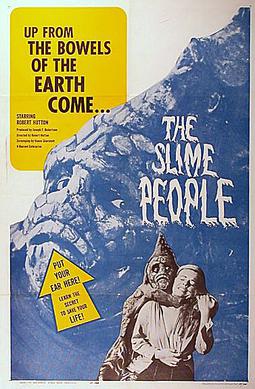
An old saying advises not to speak ill of the dead.  And I suspect this also applies to the living dead.  Night of the Living Dead (1968) is a classic horror film that represents the maturing of the genre.  Of course, it’s not the only horror film of the sixties, and I don’t mean to speak ill of it by suggesting that George Romero—who was used to working with a small budget—had seen The Slime People.  But I wonder if he had.  Directed by and starring Robert Hutton, The Slime People was released in 1963 and although it’s really bad, some of the scenes from this black-and-white groaner seem to have been borrowed five years later by the more able director.  The interviews by the newscasters and the driving country roads, and even the chasing of the angry mob could’ve served as direct inspirations.

The slime people are from subterranean earth, forced into action by underground nuclear testing.  Building a solid fog wall around Los Angeles, they take over the city while a pilot, a scientist and his two lovely daughters, and a marine, save the day.  Although the military had been fighting the monsters, they just couldn’t win.  The scientist really doesn’t help solve the issue but the pilot (Hutton) finds the creatures’ wall machine and the scientist is able to blow it up with a spear, saving the day.  This is one of those films so bad that it’s good.  The writing is poor and the plot makes little sense overall.  It doesn’t quite have the style of an Ed Wood film, but it participates in the aesthetic of watching bad movies.

Hutton isn’t a bad actor.  Hampered by a too-low budget (one of the signs that a movie might be one of the good bad ones), he couldn’t film the story he envisioned.  Much of the budget was reputedly spent on the slime people costumes, ensuring that Hutton drew no salary for his own role in his movie.  A couple of the other stars were veteran actors, and this prevents the movie from being a mere hack job.  I take some hope from the fact that many films like this eventually become cult classics.  Yes, sometimes it’s so that we can laugh at them, but I think there may be something deeper involved.  Those of us who watch bad movies might recognize something of ourselves in them.  We too struggle to tell our story, without big budgets and without studio support.  And yet we persist.


Wicker Wondering

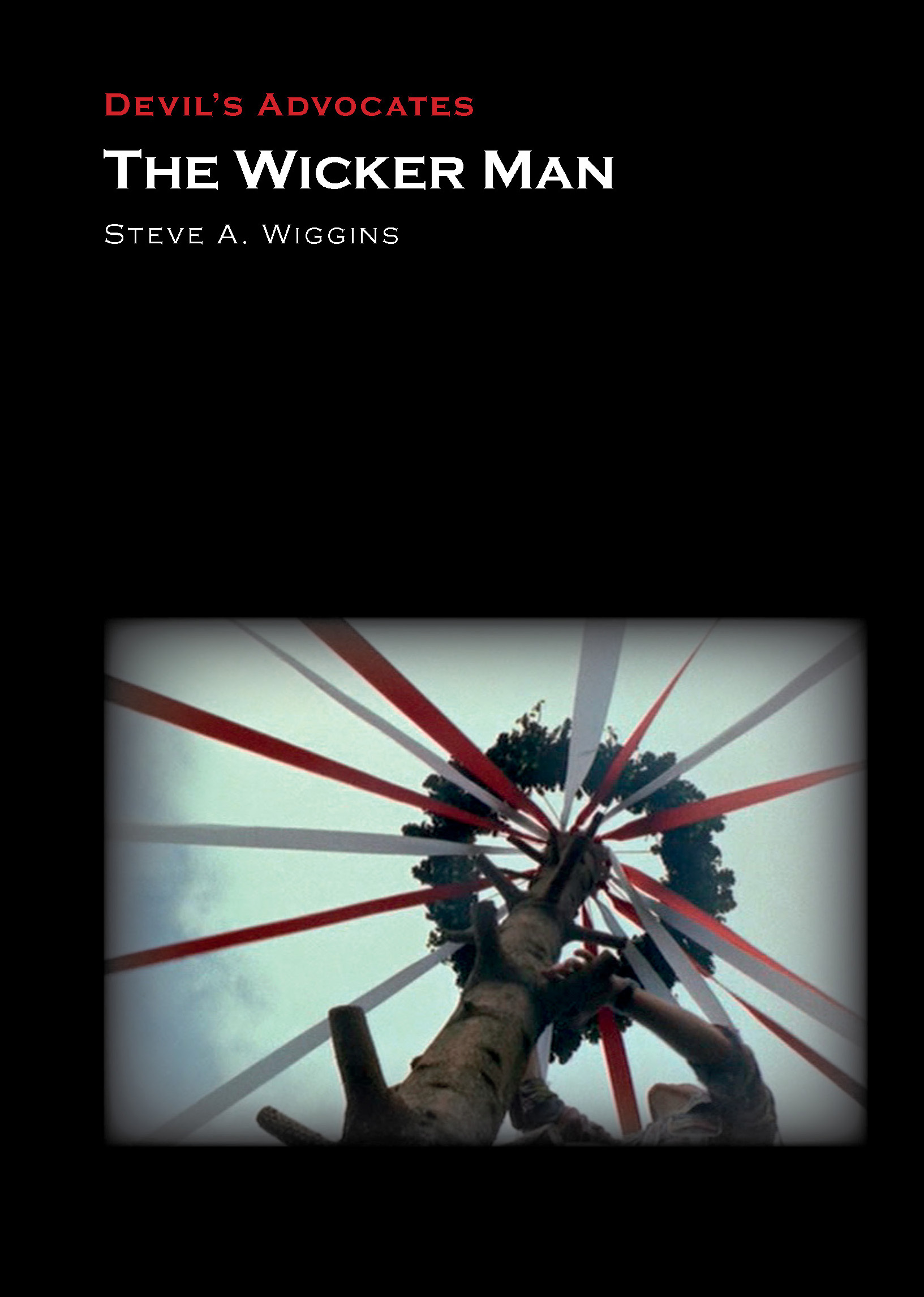
Why The Wicker Man?  It’s a fair question.  My book is now starting to appear on Amazon and other venues (it’s on Goodreads!), so it’s time to try to get the word out.  The BBC ran a recent story, “Why The Wicker Man has divided opinion for 50 years,” and that offers a springboard into the “why” question.  I’m not Scottish, but my wife and I lived in Scotland for a little over three years.  That’s one reason.  While there I did some research into Scottish folklore—historians of religion are curious people—and traveled widely, and that’s another.  As one of those writers who’s never been able to break out of the academic market, the third and most direct reason is that I’d begun a book on holiday horror.  A friend pointed the series Devil’s Advocates out to me.  Back then the series books were priced in the twenty-dollar range, but the pandemic put an end to that!

I’ve always thought The Wicker Man derived its fear from the strangeness of the holiday.  I’ve also often wondered why Anthony Shaffer and Robin Hardy didn’t make more use of “Beltane” in the dialogue.  Maybe the unfamiliar was too unfamiliar?  I suggest a different reason in my book, but I won’t reveal that here.  Writing a book on The Wicker Man would allow me the opportunity to share my thoughts about holiday horror without trying to convince an agent that people actually do like to read about horror as well as reading horror itself.  Come on, agents!  It’s called pop culture because it’s popular!

I pitched the idea and the series editor liked it.  So did the reviewers.  They were tired of hearing/reading about The Wicker Man as folk horror, as if there was nothing more to the movie.  Like most films that grow an afterlife, this one is complex and can be approached from many angles.  In fact, there’s another book, one by John Walsh, coming out on the movie just weeks after mine.  I wasn’t the only one who knew the fiftieth anniversary was on the horizon like a Beltane sunset on Summerisle.  For those who prefer a more television-like explanation, I’ve posted a video on The Wicker Man on my YouTube channel.  This blog, I realize, doesn’t get enough hits to drive traffic that way, but it’s nevertheless part of the package.  Why The Wicker Man?  The answers likely lie in several posts on this blog, a few years in Scotland, and a love of strange movies.


Coronation Bible

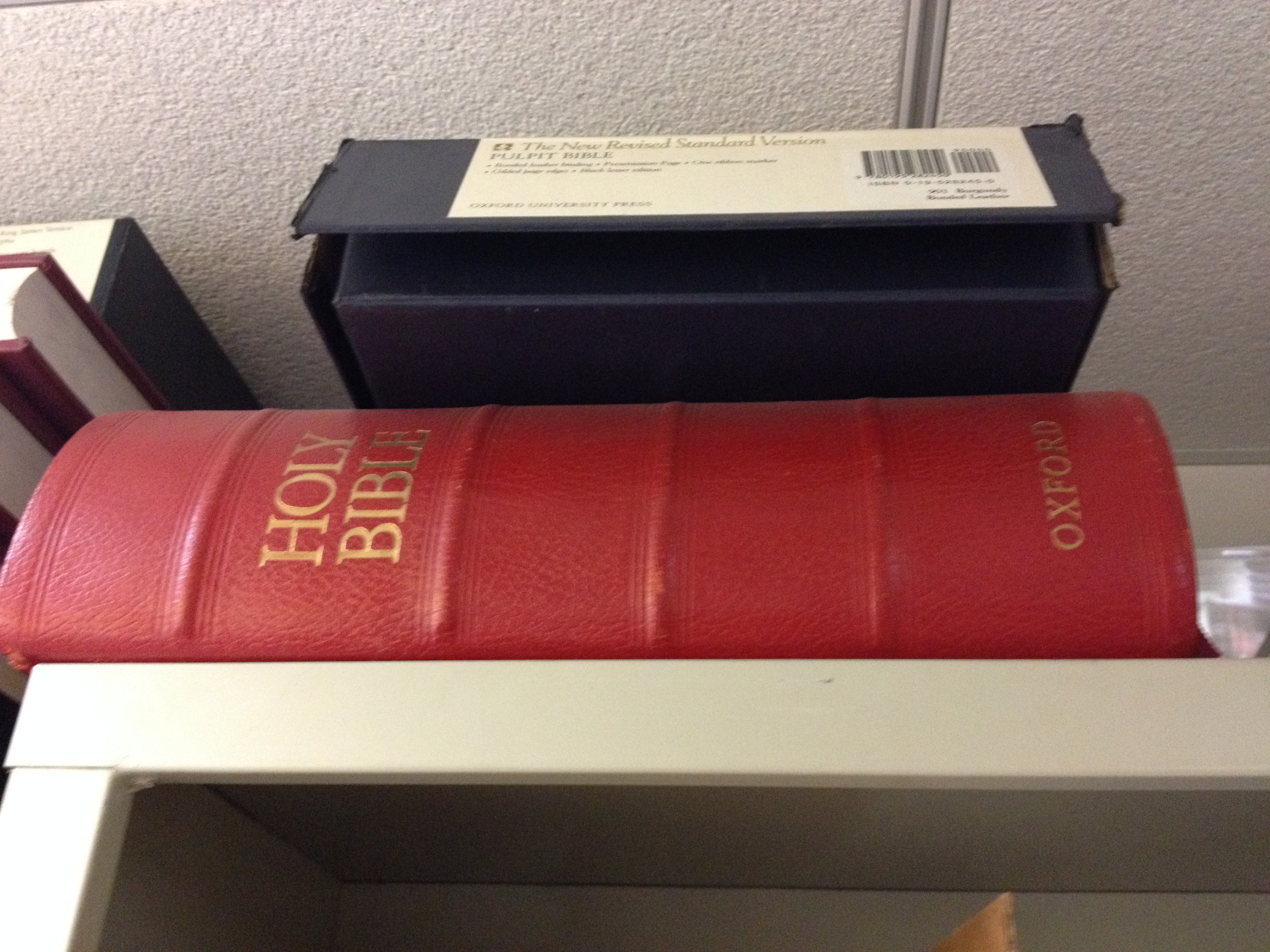
The scene from The King’s Speech doesn’t show it at all, but there was even more drama around the coronation of George VI than the movie reveals.  It may not be obvious, especially to Americans, but there is a great deal of prestige in being the supplier of a coronation Bible.  The two ancient presses in the United Kingdom, Cambridge and Oxford, vie for that honor.  In 1937 Oxford had won out.  Coronation Bibles are works of art and are extremely rare.  You’ll never find one at your local library’s used book sale.  As a recent Oxford University Press blog post indicates, the Bible at George VI’s ceremony was a last-minute replacement.  What could possibly go wrong with a ceremonial Bible, of all things?  Quite a lot, but this one had to do with an aging cleric.

Despite being the eve of war time, an elaborate Bible had been designed and manufactured.  Symbolism is important.  Britain faced not only the aggression of Hitler, but also the abdication of Edward VIII.  Instability was in the air.  In such times, as we’ve seen in American politics, leaders look to the Bible for support.  Printed on special paper, chased with gold on its cover, the coronation Bible was a work of art.  However, the Bishop of Norwich, Bertram Pollock, couldn’t lift it.  At 73 he wasn’t in the best of health, and he had a role in the ceremony.  At the last minute a lighter, replacement Bible was sent.  According to the OUP blog post, the Archbishop of Canterbury issued a rare apology to the press, but also noted “I cannot but wish that you had given some more consideration to the physical infirmities of those who would have to carry it.”

A big Bible

Swearing on the Bible is an archaism that seems likely to persist into the foreseeable future.  The future of the British monarchy (which I do not follow) itself seems in doubt, but to quote the Good Book, “The grass withereth, the flower fadeth: but the word of our God shall stand for ever.”  As long as many people believe this, such swearing will persist.  Even if such belief fades, the solemnity of swearing on a Bible is likely to continue.  The Bible has, in its tangible way, become a stand-in for God.  And as another archaism, a king, is sworn in today, it is to be hoped that the bishops involved have kept their muscle tone intact.  At least to heft, for a little while, a ceremonial Bible.


Insane Illusionist

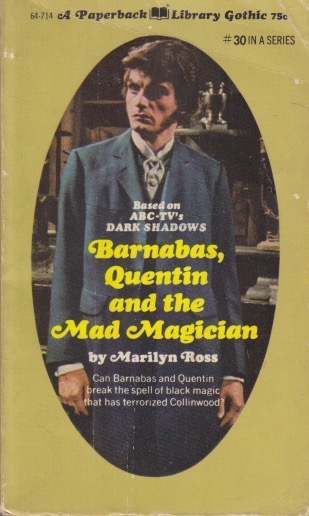
The Dark Shadows novels supplemented my early watching of the television series.  It’s funny, but when I remember watching the show, in my mind I watched it alone.  During a conversation with one of my brothers recently, he assured me that he had watched the show too, pointing to the selectiveness of memory.  What I do know is that I was the only one who read the novels.  I bought them when I could find them used, and I kept them in an old pasteboard suitcase (we had no bookshelves and my parents didn’t read).  I didn’t have the entire collection by a long shot and I can honestly say I don’t know which ones I read back then.  I am now, however, two novels from finishing the entire series—a project I began around 2006.

Barnabas, Quentin and the Mad Magician follows the usual formula, although this time around Barnabas is temporarily cured of his vampire curse and Quentin doesn’t turn into a werewolf at all.  They are on friendly terms and both are being set up by the rather obvious antagonist, the mad magician.  I guess you can begin to see the series winding down.  Most of the thirty-two stories are broadly similar and the writing is that rushed, breathless kind that seems characteristic of those who make a living delivering pulp fiction.  There have always been people like me who will buy it.  That’s the reason I typically use the phrase “guilty pleasure” when describing these novels.

As I note in my YouTube video on the phenomenon, Dark Shadows was quite popular in its day.  It’s what we might now call a cultural meme.  Television series, novels, two movies, comic books, lunch boxes—the whole coffin.  The monsters were likable.  That was true of some of the greats—you felt sympathetic toward them.  As horror began to “grow up” the monsters often became entirely reprehensible, with no redeeming qualities.  So as Barnabas and Quentin do their best to expose the true monster, their supernatural powers currently on hold, they have to rely on their money and connections.  Even at the end the “confession” is made suspect by the longer tacked on ending.  If you’ve read enough of these, you grow suspicious when there are ten pages left after the antagonist dies.  Stories such as this aren’t great literature, but they do fill a gap in the world of monsters that nostalgia leaves for those who knew Dark Shadows in the late sixties.


Surviving AI

A recent exchange with a friend raised an interesting possibility to me.  Theology might just be able to save us from Artificial Intelligence.  You see, it can be difficult to identify AI.  It sounds so logical and rational.  But what can be more illogical than religion?  My friend sent me some ChatGPT responses to the story I posted on Easter about the perceived miracle in Connecticut.  While the answers it gave sounded reasonable enough, it was clear that it doesn’t understand religion.  Now, if I’ve learned anything from reading books about robot uprisings, it’s that you need to focus on the sensors—that’s how they find you.  But if you don’t have a robot to look at, how can you tell if you’re being AIed?

You can try this on a phone with Siri.  I’ve asked questions about religion before, and usually she gives me a funny answer.  The fact is, no purely rational intelligence can understand theology.  It is an exercise uniquely human.  This is kind of comforting to someone such as yours truly who’s spend an entire lifetime in religious studies.  It hasn’t led to fame, wealth, or even a job that I particularly enjoy, but I’ll be able to identify AI by engaging it with the kind of conversation I used to have with Jehovah’s Witnesses at my door.  What does AI believe?  Can it explain why it believes that?  How does it reconcile that belief with the the contradictions that it sees in daily life?  Who is its spiritual inspiration or model or teacher?

There are few safe careers these days.  Much of what we do is logical and can be accomplished by algorithms.  Religion isn’t logical.  Even if mainstream numbers are dipping, many Nones call themselves spiritual, but not religious.  That still works.  We’ve all done something (or many somethings) out of an excess of “spirit.”  Whether we classify the motivation as religious or not is immaterial.  Theologians try to make sense of such things, but not in a way that any program would comprehend.  I sure that there are AI platforms that can be made to sound like a priest, rabbi, or preacher, but as long as you have the opportunity to ask it questions, you’ll be able to know.  And right quickly, I’m supposing.  It’s nice to know that all those years of advanced study haven’t been wasted.  When AI takes over, those of us who know religion will be able to tell who’s human and who’s not.

What would AI make of this?

Spiritual Alterations

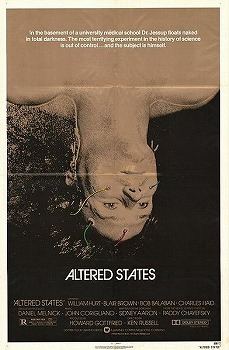
I’d been meaning to watch Altered States for quite a few years.  I suspect the reason (it’s been long enough that I can’t recall for sure) is that I knew it had a story line tied in with religion.  The tale follows Edward Jessup, a psychopathologist, who is attempting to understand schizophrenia.  He’s particularly taken by the religious nature of some schizophrenic delusions, and he uses sensory deprivation on himself to trigger something similar.  A trip among tribal Mexicans leads him to a psychoactive substance that he decides to combine with sensory deprivation to enhance the effects.  Along the way he explains to his girlfriend, and eventual wife, that his father was religious but died a horrible death.  He therefore became irreligious but his altered states of consciousness are often full of images from Revelation.

While the Bible theme eventually gives way to biological regression to pre-Homo sapiens, one of Jessup’s experiences has him coming to his dying father again and dropping a Bible on him which turns into the veil of St. Veronica on his face, which he then rips off and throws, flaming, to the floor.  Another instance of the Bible in horror, the film also uses crucifixes and hellish images to demonstrate the religious nature of these alternative states.  Jessup’s goal is to regress to the original thought, to encounter, as he puts it “God.”  This desire, combined with the potent Mexican drug, transforms him physically, and, in the end, emotionally.  Instead of being dissociated from his wife (whom he is planning to divorce), he realizes that love is the only thing that can save him from the terror of his experiences.

This is some profound stuff.  Paced like a movie from 1980, it has a quality not unlike 2001: A Space Odyssey.  The message seems to be sound—the need for encountering the “divine” ends up convincing Jessup (that may autocorrect keeps changing to “Jesus”) that love is really what it’s all about.  The transformation scenes, while not shown in the detail of An American Werewolf in London, are nevertheless convincing enough.  It’s a rare movie that treats religion respectfully.  Here Ivy-League scientists are motivated to understand it.  In real life, alternative states of consciousness are quite real, if poorly understood.  They’ve been part of religious practice from the beginning and are a far cry from sitting in the pew and singing anodyne hymns week after week.  The more movies I see, the more it seems that a sequel to Holy Horror will be necessary some day.  


Atomic Apocalypse

Avoiding Apocalypse, as the title suggests, is something most reasonable people would agree is a good thing.  This book by Jeff Colvin, a science advisor in the George H. W. Bush administration’s  Department of Energy, tells the story, in the words of the subtitle, How Science and Scientists Ended the Cold War.  Long time readers of this blog will know a couple things: I only comment on politics when I’m forced to by circumstances, and I’m an eclectic reader.  The latter point led me to this book and led to a bit of the former.  Nuclear war terrifies me.  Growing up in the seventies and eighties, when at times it seemed that we were a hair-trigger away from mutually assured destruction, I wondered why world leaders couldn’t see what all the rest of us did.  There may be some answers to this in Colvin’s book.

He initially makes the point that the only way for science to thrive is to have a democratic government.  (Think carefully, card-carrying Republicans, about running anti-democracy candidates!)  Colvin clearly shows how in the Soviet Union, repression and state-run thought-policing hampered scientific exchange and prevented Russian development.  It was only under the leadership of Mikhail Gorbachev that this connection was realized and dismantling of the Cold War was led by scientists, such as Andrei Sakharov, who was instrumental in the Soviet development of nuclear weaponry, but who was exiled for his activism in trying to prevent the apocalypse of the title.  The Soviet administration had to change enough to permit scientists to speak out before reason could enter the equation.

This is a scary book.  Democracy, which many of us advocate and which seems the best, even if flawed, system of government, is often captive to ideologues.  Even today anti-rational people adore Trump, despite the fact, as this book shows, he brought us dangerously close to annihilation by his sheer incompetence.  Tracing the history of arms control, and its great successes, leads to the little ray of optimism that shines through.  

One of the problems with the publishing world is its inherent slowness.  Although only published this year, this book was written in 2020.  I, for one, would be interested in the author’s take on things over the last year or so.  His understanding of what had been happening in Ukraine would, no doubt, shed some light on the tragedy going on there now.  One thing this important book makes abundantly clear is that democracies only work when, like scientists, people vote rationally, not with some gut feeling that a self-made messiah will lead us to bankrupt salvation.