Squidish

I was attracted to the Lovecraftian aspect of the title.  Of Tentacles, I mean.  I wasn’t aware that Into the Dark was a Hulu series of television shows based on holiday horror.  I watched Pure without realizing that.  Movies these days are complicated.  In any case, Tentacles caught my attention and although it isn’t a tier-one horror film, it’s fun in its own way.  Tara, a desperate young woman, is looking to buy a house.  She finds Sam, who’s trying to sell his parents’ place and seduces him into letting her renovate it.  The two fall in love and Tara reveals she’s being stalked by an ex.  Sam has, however, come down with an illness that doctors can’t identify.  Something is putting tentacles into his ears as he sleeps.  It doesn’t take long to figure out that Tara’s not what she claims to be.  She’s some kind of creature that originated in the ocean, but survives on land by taking part of her victims and slowly becoming their double.  The original, of course, must be disposed of.
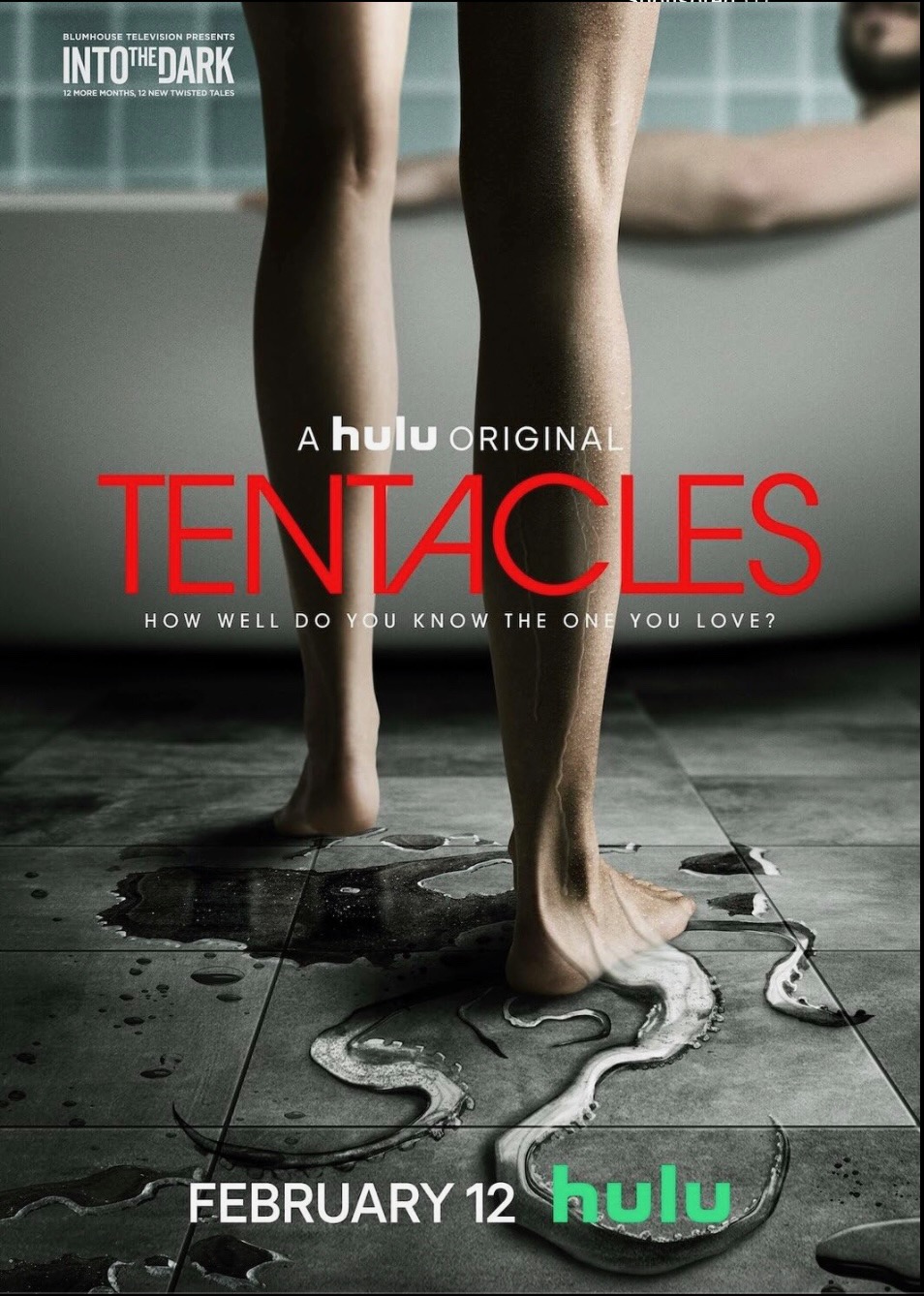
This is a serviceable little movie.  The acting is good, particularly on Tara’s part.  There’s enough mystery and energy to keep viewers engaged, despite the commercials.  It also made me realize that Into the Dark might be worth exploring a little more intentionally.  When I went to my usual places to find out more about what I’d just watched, it was a little tricky.  To find the write-up on IMDb you needed to find the series title first so that you could click onto the individual episode.  This is so different than either the major studios or independent filmmakers.  Streaming services, however, have been offering some good home-grown horror.  I’ve seen some notable examples from Netflix, Amazon, and, of course, Hulu.

Anything with tentacles seems to have a tangible Lovecraft connection these days.  In large part it seems to be because of the internet success of Cthulhu.  Those who spend lots of time online know who the Old One is without having ever read H. P. or having watched horror.  He’s become the monster with tentacles, something my college sci-fi professor would doubtlessly have commented upon.  Lovecraft himself would have, I suspect, enjoyed the notoriety but would likely have felt some disappointment regarding the point he was trying to get across.  (That’s more evident in Older Gods.)  The vacuousness of being alone in a meaningless universe was more his aesthetic.  Still, it inspired some fun films for a sleepy weekend afternoon, and its tentacles keep on reaching.

Reflecting Spirituality

I always find undergoing anesthesia a spiritual experience.  It’s too bad the the prep for things like colonoscopies is so stressful that it’s difficult to appreciate the fasting and how it changes your perceptions.  This is followed by the delicious blackness of a complete loss of consciousness.  If death’s like this we have nothing to fear.  I’ve written about this before, but chemical sleep is not like nighttime sleep.  You hear the anesthesiologist say, “You’re going to sleep now.”  Then you wake up, disoriented because no time has passed.  I blinked a few times, saw my wife’s coat on the wall, and thought it was a nurse.  I started to say “Stop, I’m waking up!”  But then I focused on my wife and wondered why they’d let her into the procedure room.  “Are they done already?”  I asked.  Where had I been for the last hour?

Spiritual experiences are sometimes only seen in retrospect.  They jar us out of ordinary time into an alternative time.  It doesn’t make up for the nasty taste of prep medicine, or the unpleasantness associated with it, but emptying yourself is a spiritual practice.  I need to try to remember that next time around.  I know people who are afraid of anesthesia.  I’ve only had it three or four times—oral surgeries, and my first such procedure as this—but there’s something mystical about it.  I don’t use drugs (never have) so perhaps I’m a neophyte, but looking back on the experience I know that something extraordinary happened.  Coming out of it is coming into a new world that is somehow strangely the same as the one I left.

Religion has always, at least partially, been about altered states of perception.  Organized religion succeeds in making it rote, but those who experience the naked phenomenon never forget it.  Anesthesia is, I know, potentially dangerous.  It so like a light being switched off that I’m always left in awe of it.  Mystical experiences are rare, which is one of the things that makes them so valuable.  I’ve had them—widely spaced—since childhood.  Sometimes it’s evident in the moment, but often some reflection is necessary.  I suppose few people look forward to any kind of surgical procedure, but there can be benefits beyond the physical health that we hope will result.  That’s the way spiritual events often take place.  Perhaps advanced practitioners (not always clergy) can bring them about intentionally, but any of us might recognize them afterwards, upon reflection.


Beautiful Vampire

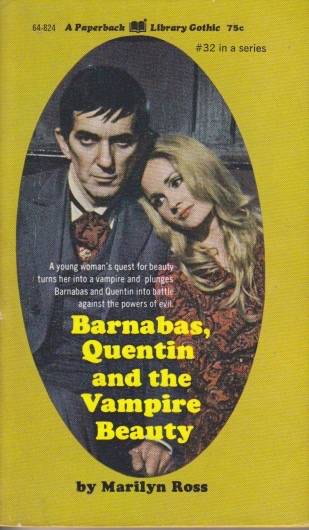
It’s been a quest years in the making.  I first found the Dark Shadows novels by Marilyn Ross at the Goodwill Store in Seneca, Pennsylvania.  The series had recently finished its television run and, as this was a used book bin, and limited in size, you could never tell what you might find.  My teenage self, fascinated by vampire lore, eagerly read those I could find.  I got rid of the volumes I had when I attended college and began to miss them when I was old enough to admit such things.  It took at least fifteen years to locate all of them, and now, for the first time in my life, I have read the entire series.  Barnabas, Quentin and the Vampire Beauty isn’t always easy to find.  I certainly hadn’t read it before.  Not that it’s high art—the campiness shows through the gothic setting from time-to-time—and yet it’s an accomplishment.

This particular story again shows some development from what had gone before.  The vampire beauty is a young woman tricked into having weight reduction surgery in Switzerland.  The surgery, naturally enough, transforms her into a vampire.  She needs help so she seeks out Barnabas Collins, which leads her to Collinwood.  From there a set of adventures head toward the typical climax of this series of books.  Nevertheless, W. E. D. Ross seems to have shown some improvement over the thirty-two novels in the series.  This story seems less similar to others in the series as a whole.  Quite a bit of effort is spent on trying to find a vampire cure, but for Adele Marriot rather that Barnabas Collins.

I have to wonder if Ross knew this would be the last Dark Shadows book he would write for the series.  He did write other gothic fiction, and even a novelization of the movie, House of Dark Shadows, but the initial series ends with a kind of knowing that we’ve reached the end of something.  Was he told by someone at Paperback Library, “Hey, we’re pulling the plug on the series” or did he simply run out of steam?  The daily television show ran for about 1225 episodes.  This original novel series had far fewer.  Still, the thrill of hunting all of them down, lining them on my shelf, and then reading them in order was a rare pleasure.  It was a recapturing of, perhaps even a completing of, part of my childhood.  It may have taken decades to accomplish, but an accomplishment is an accomplishment.


Gods and Crafts

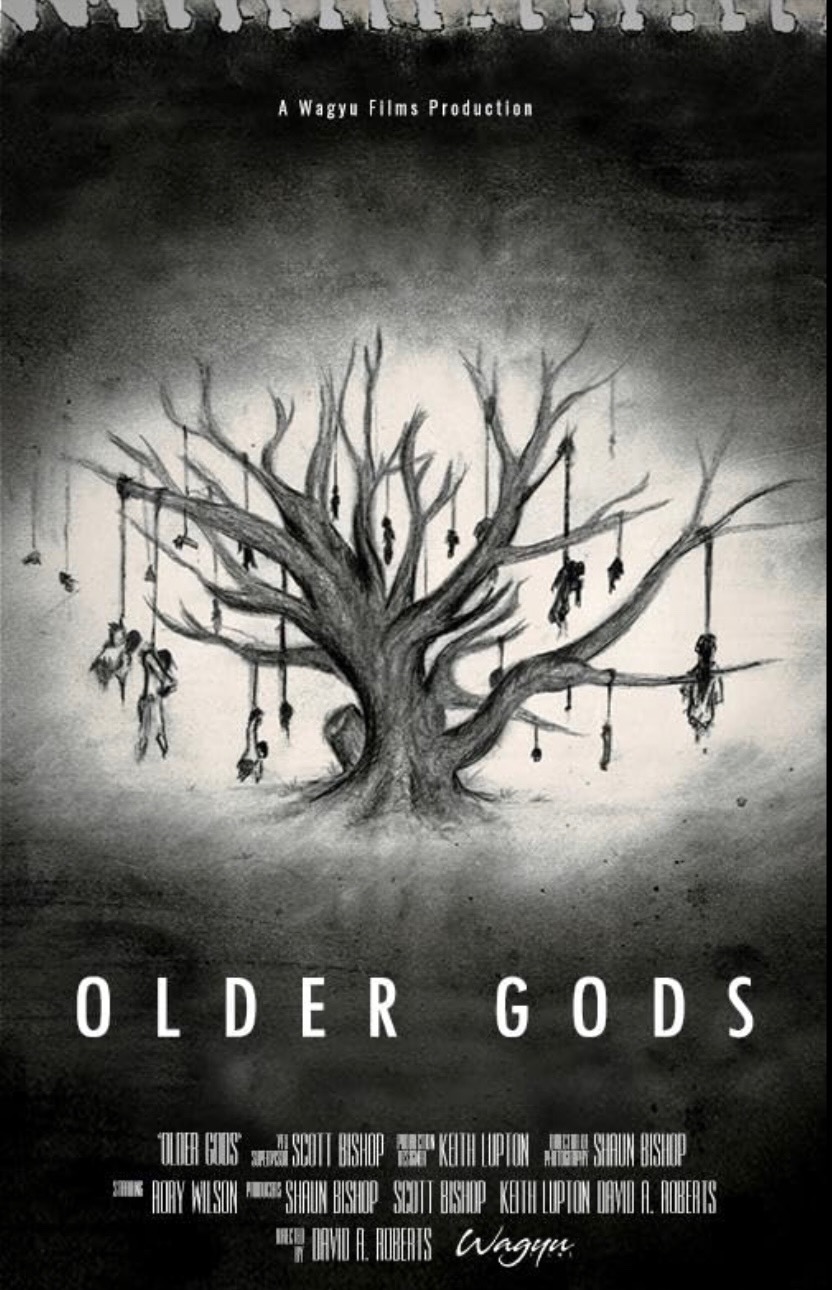
Those of us who write fiction, I suppose, often ponder what it would be like having a kind of writing named after us.  Knowing that’s not likely to happen we might cast an envious eye toward, say Lovecraftian horror, which has become a sub-genre in its own right.  When a friend pointed me to Older Gods, an independent Lovecraftian horror film shot in Wales, I was glad to see it already out on a free streaming site (with commercials, of course).  Winner of several accolades, the movie isn’t easily understood although the plot is fairly simple.  A man has gone to Wales to find answers regarding a lifelong friend’s suicide there.  A recorded message tries to explain what this friend had stumbled upon that led him to his extreme act.  A world-wide underground religion is attempting to awake one of the older gods to bring about the end of the world.

The problem is these devotees of the older gods—one deity in particular, called “The Origin”—hunt down anyone who learns about them.  They give them the choice to join or to have their families killed, followed by themselves.  If they do join, it hastens the end of the world.  In other words, the engine driving this movie is religion.  Shot with a very low budget over a very short span of time, it manages not to fall into the “bad movie” category, and actually edges into the “good” category.  The film crew, reportedly, numbered only seven (no extensive credit roll here), and the story is based on a premise introduced by H. P. Lovecraft.  The older gods, who care nothing for humans, are asleep beneath the sea, awaiting the signal to awake.

Since this movie was only recently released, not much in the way of online summaries is yet available.  The reason this might be important is that Lovecraftian narrators not infrequently go insane.  In other words, is our protagonist a reliable narrator or not?  Did he, like his deceased best friend, go insane?  This is never resolved.  Those devoted to the religion of the older gods are unrelenting.  Lovecraft, famously an atheist, knew the power of religious belief.  His nihilistic universe included a scary place for believers.  When these themes come together, with or without tentacles, we seem to be in territory named after its creator.  Older Gods is a slower paced, thoughtful film that leaves you unsettled.  And there’s no doubt regarding its true origin.


Waiting for the Sun

Waiting.  It’s difficult in the best of circumstances.  It’s even harder when dealing with multiple sources of delay.  For example: it has been unseasonably cool around here for a few months.  Looking at the US weather maps, it looks like we’ve got just about the coolest temperatures in the lower 48.  September is usually reliably a month where you don’t need the furnace in these here parts, but that’s not the case now.  A slowly moving weather system has blocked the sun for days and our poor old house just can’t warm up.  I feel like Noah waiting for some sign of hope.  The weather apps all say, “oh, two or three more days…”  Endurance, I remind myself.  Stoicism.  Still, we need some sun about now.  But that’s not all.

In addition to wearing three heavy layers and my fingerless gloves (in September—and this will last until May!), I’m also doing my prep for a colonoscopy.  In case it’s been a while—that means a liquid diet for a day.  I need to wait until this time tomorrow to have anything to eat and my teeth are on edge because the allowable fluids tend to be sweet and I really need something salty with a bit of crunch about now.  I see I’m allowed ice pops.  But did I mention that it’s cold in here?  If it were a normal year at least one of these two things wouldn’t been an issue at this point in time.  Nobody that I know of looks forward to a colonoscopy.  I know I’ll barely sleep tonight and the whole situation ends up looking downright Dickensian.  Chilly, hungry, persistent rain.  All I really need at a time like this is just some indication that the following days might improve.  Don’t look to the Weather Channel for support.  No, rely on your Stoicism.  Endure.

The trick I usually use on myself is to dangle a small carrot—lunch will be in just three hours!—to get through a long, chilly day.  (You’ll be able to eat something hot…)  I suppose giving up caffeinated beverages a few years back (when the last colonoscopy was well forgotten), might’ve been a poor decision.  I sure could use a Thermos of coffee right about now.  And one of those solar headbands that tricks you into believing you’re getting some sun.  Hey, September’s my second favorite month, after October, so shouldn’t waiting be just a smidge easier?  I’ve been waiting for September since last November.  And still I wait.  Such is the human lot in life.  Endurance is important, I know.  But a peek of sunshine (haven’t seen anything like it for three days) in September—is that too much to ask?  Or at least a hot meal.  What would Zeno do?  (Of course, he did live in sunny Greece…)


Banned Monk

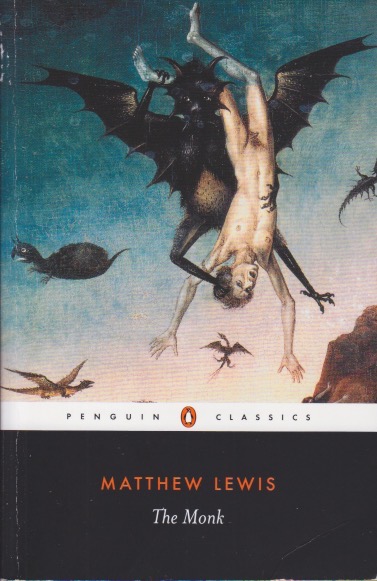
One of the strange things about gothic fiction is that, although often set on the continent, the early practitioners—inventors, if you will—were English.  Three names among them stand out in many treatments of the genre: Horace Walpole, Ann Radcliffe, and Matthew Lewis.  I’ve read the former two and have long supposed I should read the latter’s The Monk.  This 1796 novel made the author famous, but it is long.  And written in the often florid style of the age.  Still, there are plenty of swoons and thunder-plagued nights.  Set in Madrid with a cast of closely related characters, the novel has a twist ending that I did not see coming, which is pretty amazing considering that the book has been out for over two centuries.  (I may have read about the ending before, but had forgotten, if that was the case.)

The novel intertwines two stories that revolve around Antonio, the eponymous monk.  A paragon of righteousness, he heads an abbey in Spain and all are in awe of his piety.  Until sex breaks through his vanity (so we are told; his piety was based on too high a self-regard).  Once seduced, he can no longer maintain his status as chaste, and this sets in motion a tragedy that will leave innocent people dead and lives ruined.  Lewis, it’s famously known, used the novel to critique excesses of the church.  Its power, the novel demonstrates, corrupts.  Still, at the end I was left feeling sorry for Antonio.  He was set up by the Devil and his chances of winning were quite slim from the beginning.

Although PG-13 by today’s standards, the novel scandalized English society when it came out.  The sex scenes were too explicit for the day, especially since they involved the clergy.  The story has quite a leisurely layout, and only after 200 pages (in the edition I read) does the supernatural enter the picture.  Once it does the pace begins to pick up.  The weird thing is, despite its length, this story works.  It’s considered a classic—although often dismissed because gothic literature generally is—it nevertheless delivers.  Antonio is shown to be subject to weakness, and while vain, not inherently evil.  He’s a victim of human vulnerability.  Readers in the late eighteenth century couldn’t see beyond the sex, but there is a tragic human story here.  Castles, abbeys, ghosts, and subterranean passages, murder and torture, it’s gothic through and through.  Although it took most of September to get through it, it feels like I accomplished something worthwhile.  And I finished just in time for Banned Book Week.


Dental Dawn

Someone knowing my interest in religion and horror recommended Teeth.  A comedy horror film based on the concept of vagina dentata—an idea I first encountered in Neal Stephenson’s Snow Crash—it begins with a purity event.  Dawn, a teen leader in the abstinence movement, addresses other adolescents about the importance of maintaining, well, purity.  They all wear purity rings and vow themselves to chastity until marriage.  As might be expected, not all of them are able to uphold their pledges.  Being inexperienced, when Dawn finds herself in a compromised position with her boyfriend she learns she has, um, teeth.  Other guys, even when warned, can’t resist an opportunity and they too pay the price.  The point of the film seems to be female empowerment, but it’s also pretty funny.

After boyfriend number one has disappeared, Dawn again addresses the purity group only to have them quote Genesis 3 at her, clearly intimating that sin is the fault of women.  The Bible is there by implication and the sermonizing of the adult leader after Dawn has to leave the stage again takes up the religious outlook.  The underlying concept of purity movements is distinctly Christian.  While all religions have something to say about sex, generally the most negative about it is Christianity.  That’s not because other religions lack for spirituality, but Christianity tends to denigrate the body, and in the process tends to make natural things sinful.  This gives plenty of fuel to a movie like this where a woman has to make her own way in a man’s world.

What’s really interesting here is that no punches are pulled when it comes to the origins of patriarchy.  The Bible clearly views males as the standard of humanity and females as an adjunct.  That idea has had a death-grip on western society, particularly in America, from the beginning.  Teeth was written and directed by a man.  I suspect that the presumably well-intentioned use of an old mythical idea that makes females into monsters may not appeal to women writers or directors, empowering as it may be.  Nevertheless, if taken with the fun obviously intended from the opening playful music to the comically terrified responses of Dawn’s adolescent victims, the movie can still convey a positive message to women who might watch it.  Horror is often a repository of social commentary.  Not taken seriously by the mainstream, it nevertheless puts good messages out there.  And sometimes it bares its teeth.


Ravens and Autumn

In need of some diversion, and seeking some way to celebrate the equinox, we made our way to Mount Gretna.  With a population of less than 300 souls, Mount Gretna is remote and an area of natural beauty.  But that’s not why we’re here.  Each year the Mount Gretna Theatre—housed in an open-air playhouse—puts on an Edgar Allan Poe performance in the autumn.  I’m not sure if it’s always titled “Nevermore,” but it is this year.  And it’s a fine evening for an outdoor performance.  The show is a walking tour of seven Poe vignettes.  A guide starts the evening by telling us a murderer is on the loose and Dupin (for Poe invented the detective story genre) warns us to trust no one.  I’m thinking this will be a murder mystery, but the first vignette is adapted from “The Fall of the House of Usher.”  My favorite short story, I smile at the choice.

The next venue—we’re walking around the parameter of the playhouse now—is from “The Masque of the Red Death,” which has taken on new significance with Covid.  These, by the way, are single actor vignettes.  We’re then led to a saucy woman who performs “The Black Cat” with a subtle humor.  As she’s led away, a madman leads us to a corner of the building where he retells “The Telltale Heart,” and you begin to realize just how much Poe wrote about revenge and guilt and murder.  We’re then led to the only two-person vignette for a retelling of “A Cask of Amontillado.”  A haunted young man crying “Lenore” next recites “The Raven,” from which the evening takes its name.  The final vignette is the only unfamiliar one in the lot, based on Poe’s humorous—if politically incorrect—stories, “How to Write a Blackwood Article,” and “A Predicament.” (Set in Edinburgh, no less.)

It’s a beautiful September night in a delightful wooded setting.  The fact that it takes some effort to get here is part of the draw.  The actors clearly enjoy themselves and the stories are told in such a way that it doesn’t matter that we’ve read them all before.  Once back home, I learn that the playhouse is in a borough founded by the Chautauqua Society.  I think how times have changed and that it was quite a world that supported adult education institutes.  Chautauquas are found around at least the rural parts of the country.  Founded by a Methodist minister, Chautauqua was a wholesome competitor to Vaudeville, offering entertainment as well as education.  I feel I’ve been both educated and entertained as we climb back in the car in a Pennsylvania night on the eve of the autumnal equinox.


Early Ghosts

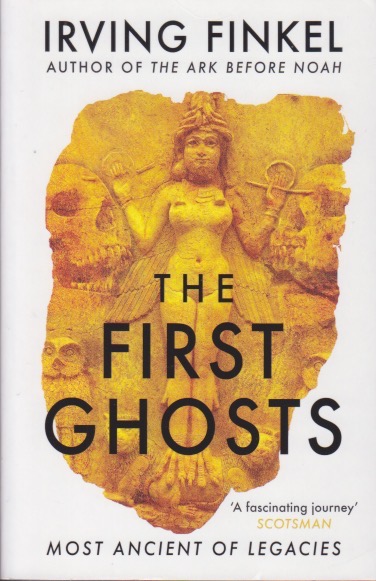
I’m not the most impulsive person in the world, but certain books I know, as soon as I see them, I will read.  Irving Finkel’s The First Ghosts was one of those books.  This wasn’t an easy book to get.  I’m guessing it was some minutiae about transAtlantic rights or some such nonsense, but it was announced a couple of years before it became available in America.  Then, of course, it had to wait its turn on my reading pile.  For those of you who don’t recognize his name, Finkel is a well-regarded Assyriologist who works at the British Museum.  Assyriology (which encompasses Babylonian and Sumerian studies as well) is, perhaps unavoidably, a highly technical field.  The languages are complex and a lot of that has to be explained before a reader can figure out what’s going on.  Some parts of this wonderful book are, unfortunately, technical.

The idea, however, is brilliant.  Ghosts have always been with us.  Finkel is well-placed to open the cuneiform world and he presents the earliest recorded ghost stories in history.  They’re not exactly modern horror, be warned.  Nevertheless, they demonstrate that from as soon as people figured out how to write, ghosts were one of their favorite topics.  Or at least, ghosts were assumed to exist and were written into many myths and legends.  Non-judgmental books like this are rare from academics; indeed, it’s difficult to imagine anyone else having written this particular book.  Even in the small world of academia not too many people read these languages and those who do are busy trying to impress tenure committees and businessmen deans.  (The reboot of Ghostbusters demonstrates this in a comical but too serious way.)

There are plenty of takeaways from this book.  A good general point in that myths do not reflect the everyday beliefs of individuals.  It’s easy to forget that.  Another striking idea occurred in his one chapter on the Bible where Finkel notes that the Good Book tends not to dwell on things considered “detestable,” such as foreign gods or demons.  That makes it an outlier concerning everyday information from antiquity.  After looking through that one window for so long, I suppose that’s why I focused by doctoral work on a “foreign” goddess.  If you can handle the technical bits and try to keep in mind multiple multi-syllabic names from forgotten languages, you’ll find a lot of really surprising and fascinating information here.  I’ve known for years that I’d be reading this book, and as autumn approached the time felt right to seek ancient ghosts.


Rocks and Philosophs

Porphyry is, apart from being a cool word, a kind of purplish stone that was prized for statue-making in antiquity.  It is also the name a Syrian philosopher gave himself in the third century of the Common Era.  Now, if you read widely about antiquity, as some of us have done, you’ll encounter the name Porphyry from time to time, but those of us who focused on older materials don’t pay him much mind.  I was reading about Porphyry recently, however, and did a little poking around to discover that he’d written a book called, in translation, Against the Christians.  Some historians speculate that Porphyry may have once been a Christian himself, but whether or not that’s true, he developed an antipathy to the sect.  I was curious about what his beef may have been only to discover that this book is lost.

Now lost works in antiquity are the rule rather than the exception.  Literacy may not have been widespread, but those who could write did write, and often prolifically.  Human history was very well documented.  But tonnes of it went missing.  Wars have been part of that history and wars are notorious for destroying written records.  Also, much writing was on perishable materials that, well, perished.  That wasn’t the case with Against the Christians, however.  Porphyry’s work was purposefully destroyed.  By this point Christianity had taken over the Roman Empire.  Rather than accepting the challenge of a philosopher, officials censored and destroyed his work.  Ironically, all that survives are quotes from books of theologians who were trying to refute him.

This made me reflect on the book bans that are currently all the rage among some “Christian” politicians.  Such rearguard actions belie the confidence that imperial religions showcase.  A religion that’s afraid others might see the holes raises many questions, does it not?  It seems to come down to the idea that nothing has changed in two millennia, even though Jesus didn’t have a cellphone—not even one of those old flip-open kind—and much of what we know of nature was still many centuries in the future.  The fact is that we only try to silence those who disagree when we fear them.  Book bans pretend that they can hold the hands of the clock still and that all will remain as it was decades ago.  Learning, however, is a genie let out of the bottle.  Back in Porphyry’s day powerful bishops and emperors ordered his book banned and destroyed.  And we are all the poorer for it.


At the Same Time

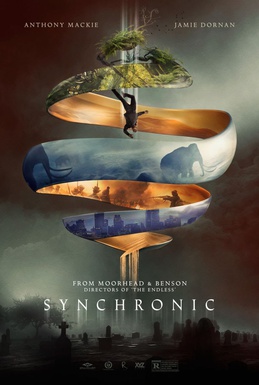
The philosophically adept movies by Justin Benson and Aaron Moorhead can be addicting.  At least for a certain kind of viewer.  These are independent films and they’re smart and worth the effort of tracking down.  Often they fall into both sci-fi and horror, but generally horror of the existential variety.  And they have social commentary.  Synchronic is gritty, delving into drug culture (as some of their other movies do as well) and taking its title from a fictional drug.  Synchronic, the drug, distorts the taker’s sensation of time.  If the user is young—their pineal gland hasn’t calcified—the drug physically transports them to the past.  Adults only experience it as ghostly images rather than physical displacement.  Two EMTs, Steve and Dennis, keep finding victims of the drug.  Steve is a black man with brain cancer that keeps his pineal gland from calcifying.  Dennis, a family man, loses a daughter to synchronic—she gets lost in time.  Steve decides to save her.

Here’s where the social commentary really kicks in (although it’s been there from the beginning).  A black man traveling back in time in Louisiana is at a distinct disadvantage.  Dennis is white but his brain won’t allow him to travel back physically.  Not only that, but it was Steve who took the initiative to find out how the drug works.  You spend only seven minutes in the past, unless you miss being in the right place when the drug wears off.  If you miss the return, you’re stuck forever in the past.  That’s where Dennis’ daughter is.  She’s caught in New Orleans in 1812.  Louisiana was, of course, a slave state.  Steve faces enslavement if he doesn’t make it back in time.  I won’t say how it ends, but it leaves you thoughtful.

Many “white” Americans feel that Black Lives Matter is too “woke” for them.  They seem to think everything is now free and equal.  It isn’t, of course, and those who are willing to look see that African Americans have an extra layer of struggles that they constantly face.  The movie addresses this as well.  When assisting an overdose victim after he misplaced his uniform, Steve is mistaken for a criminal by the police at the crime scene.  This despite the fact that the white officer who initially detains him, knows him.  A black man out of uniform must be up to no good.  I can’t believe that I went so many years without knowing about Moorhead and Benson movies.  Be careful if you start watching them—they can be addicting.


Quick Writing

On the very same day I saw two emails that began with phrases that indicated they were clearly sent by text.  One began “Hell all.”  This was a friendly message from a friendly person sent to a friendly group and I’m pretty sure the final o dropped off the first word.  The second seemed to have AI in mind as it read “Thank you bot.”  It was sent from a phone to two individuals (or androids?).  There’s a reason I don’t text.  Apart from being cheap and having to pay for each text I receive or send, that is.  The reason is that it’s far too easy to misunderstand when someone is trying to dash something off quickly.  Add to that the AI tendency to think it knows what you want to say (I’m pretty sure it has difficulty guessing, at least in my case, and likely in yours, too) and errors occur.  We write to each other in order to communicate.  If we can’t do it clearly, it’s time to ask why.

Those who email as if they’re texting—short, abrupt sentences—come across as angry.  And an angry message often inspires an angry response.  Wouldn’t it make more sense to slow down a bit and express what you want to say clearly?  We all make typos.  Taking the time to email is no guarantee that you’ll not mess something up in your message.  Still, it helps.  I think back to the days of actual letter writing.  Those who were truly cultured copied out the letter (another chance to check for errors!) before sending it.  There were misunderstandings then, I’m sure, but I don’t think anyone was suggesting someone else is a robot.  Or cussing at them from word one.

The ease of constant communication has led to its own set of complications.  Mainly, it seems to me, that since abbreviated communication has become so terribly common, opportunities for misunderstanding increase exponentially.  I’m well aware that I’ll be accused of being “old school,” if not downright “old fashioned,” but if life’s become so busy that we don’t have time for other people isn’t it time to slow down a bit?  Technology’s become the driver and it doesn’t know where the hello we want to go.  The other day I forgot where I put my phone.  I signed on for work but couldn’t get started because it requires two-step authentication.  Try to walk away from your phone.  I dare you.  Thank you bot, indeed.


Keeping Sentinel

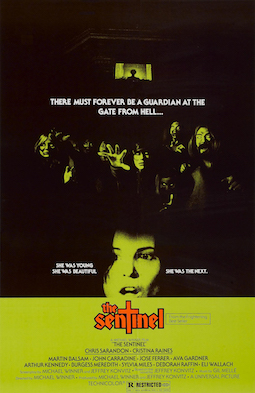
Not among the trinity of holy horrors from the late sixties and early seventies, The Sentinel takes its cues from religious horror but manages to fall into bad movie territory anyway.  While still cited from time to time, it’s largely forgotten among the films of the era.  It had a lot of competition in the seventies with The Exorcist, The Omen, and The Amityville Horror.  One of the reasons it seems to have fallen at the threshold is that it doesn’t understand the religion it tries to portray.  That religion is some form of Catholicism that involves a number of clerics who run around northern Italy wearing various liturgical vestments to oversee an apartment in Brooklyn Heights that’s actually the gateway to Hell.  They do this by way of an eponymous sentinel who lives in the apartment building that’s Hell’s portal.  The rest they, reasonably enough, rent out.

Alison Parker, a model, ends up renting the place while her boyfriend lawyer decides to have her killed—no particular motivation is given, although he had his first wife murdered too.  At the apartment Alison is disturbed by the other tenants, who are very strange.  And a mysterious priest lives in the apartment at the very top and never comes out.  (In case you haven’t gathered, the plot is pretty convoluted.)  It turns out that people who’ve formerly attempted suicide (like Parker) are targeted by the church to take over as sentinels to make up for their sin.  They have to “go missing” and reappear as a priest or nun and live in a particular apartment.  The strange neighbors, as you may have guessed, are demons trying to escape the watchful gaze of the sentinel.  Naturally, they stay in the same building.

The problem—or one of them, anyway—is that the Catholicism displayed doesn’t resemble Catholicism very much.  In the famous scene where the demonic entities are swarming on Alison and the dying sentinel she’s to replace, said sentinel carries a distinctly Protestant cross rather than a crucifix.  The mythology the film tries to construct is simply bizarre.  The classics of the period at least got the religion correct.  Catholicism in The Exorcist, Protestantism in The Omen, and, although fabricated, Satanism in Rosemary’s Baby.  Many filmmakers, it seems, think it’s easy to fake it when it comes to religion.  Looking at the movies that succeed on that front, however, and comparing them to those that become bad movies, it seems clear that doing your homework, or at least going to Sunday school, pays off.


Not for Profit

Non-profits are the backbone of our society.  In a world measured by “net worth” some of us are aware that people are more than figures, ciphers on a ledger.  Honestly, I’m impressed by plans for a universal basic income, which seems more humane to me than brutal capitalism with its new first estate.  Since that’s not likely to happen here, however, I look to non-profits and I’m impressed.  Despite the distorted narrative that states those who struggle to get by are lazy (hey, I don’t know many rich people up as early as I am daily!), our economy favors the greedy and the graspy.  That’s why non-profits are so important.  These are corporations or companies that work for something other than making money for themselves.  They have a more civil goal in mind.  They are, in a word, civilization.

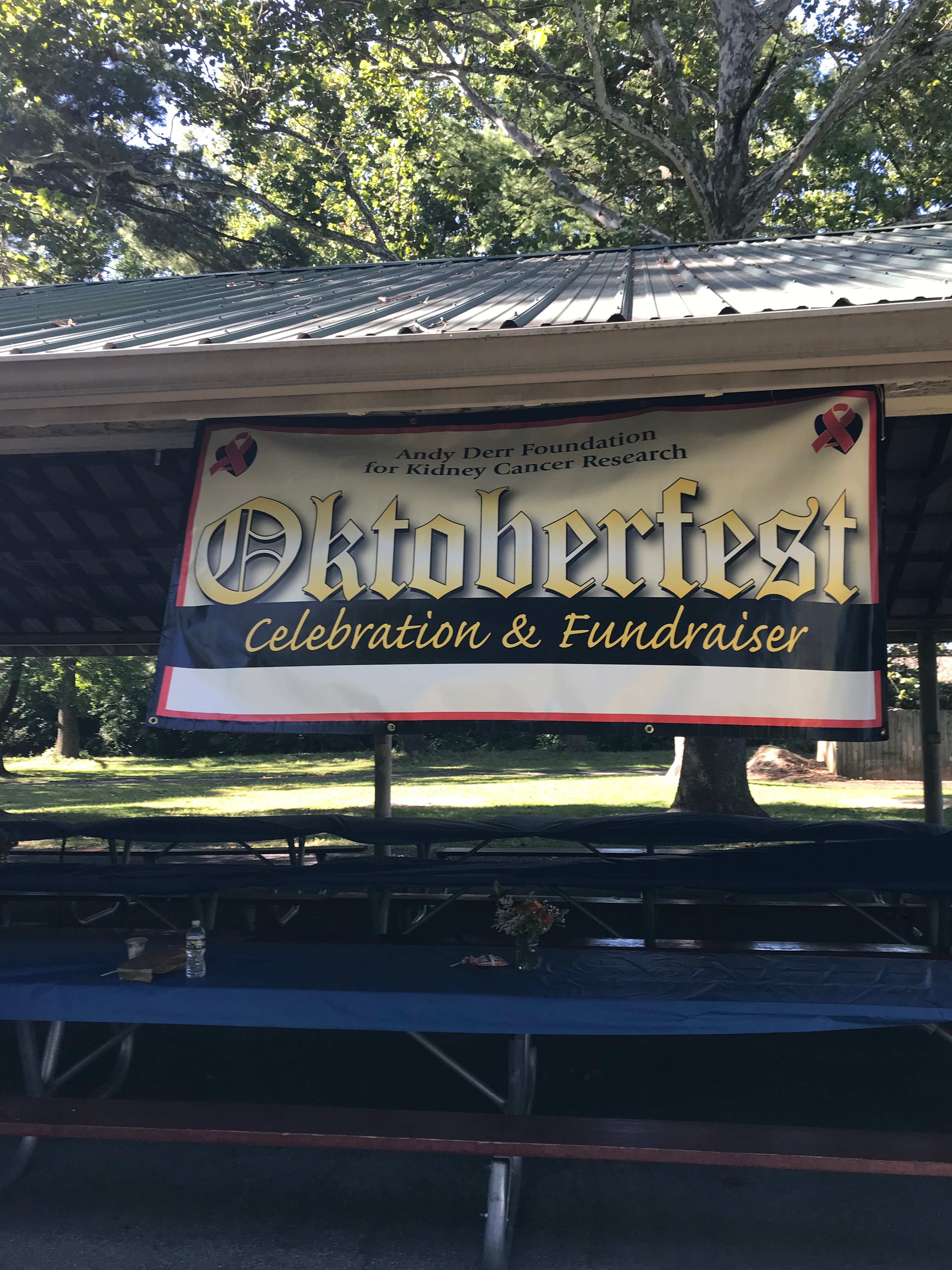
I recently attended a cancer research support organization Oktoberfest.  It’s for a small non-profit foundation, local to the Lehigh Valley, but it was amazing how much money it has been able to raise for research.  Like many such foundations, it was born of personal loss and the desire to prevent others from experiencing such loss.  Compare that, if you will, to a company whose business is, well, making money for itself.  See the difference?  One you can feel good about.  The other makes you feel like you should take a shower after work to wash the grime of selfishness from you.  I have worked for profit-making companies and non-profits and there’s no comparison.  Those with money as the only goal tend to be heartless.  If you ever want to feel like chattels, apply here.

Non-profits have to think quite a bit about money, of course, but there’s always more to the picture.  There are discussions of the larger goal, which is generally something for the good of society.  To help people.  I’m not naive enough to think that non-profits can’t get corrupt (lucre corrupts everything), particularly when they get large, but without them there would be so much more suffering in the world.  Becoming “civilized” has been a fraught exercise from the beginning, but it was an effort for individuals who are very different from one another to learn how to live together and cooperate for the good of all.  Capitalism is a means whereby some game the system for personal gain and the rest envy them and want to try too.  Thankfully into this moral morass non-profits have arisen, like oases in the desert.  They are the hope for our society.  Indeed, for civilization itself.


End the Stigma

I’ve been a lifelong fan of Edgar Allan Poe.  I bought books about him (and by him) from a young age, fascinated by a person who expressed himself so beautifully in the face of trauma.  Of  a different era, and mindset, was Rod Serling, creator of The Twilight Zone.  Another childhood hero of whom I made the assumption of some trauma.  One thing interesting about both of these influential writers is that relatives have written about them claiming that they weren’t as haunted as they seemed.  I wonder, however, if they write such things because we still, we are still stigmatizing trauma.  We’re great victim-blamers.  Perhaps it’s because we want to distance ourselves from the scary forces at play.  We fear that unhappy master, whom, in Poe’s words, “Unmerciful disaster followed fast and followed faster.”  We don’t want to attract such things to ourselves.

Reflecting on my father recently—I didn’t know him well at all—I was thinking about his experience in the Korean War.  I don’t know what happened to him there and I never had the opportunity to ask him about it.  But I do believe that, like Rod Serling, he may have been traumatized by combat.  War leaves trauma in its wake.  Few, I suspect, come out of such situations without deep scars that haunt them the remainder of their lives.  And still we fight.  I knew, already at a young age, that I could never be a soldier.  This despite growing up with G. I. Joe.  Some of us spend our lives trying not to harm others.  Trauma follows on from that since the world has its share of unmerciful disasters.

There are those who claim Poe wasn’t the experiencer of doom and gloom about which he wrote so eloquently.  He lost those close to him to disease.  Even now there are many stigmatized diseases.  That’s one of the reasons employers are insistent that conditions suffered by employees not be revealed.  Our whole medical privacy mindset plays into the stigmatizing those who face illness.  Tuberculosis was only one of many widespread diseases during Poe’s life, and it’s still widespread in parts of the world because companies like Johnson & Johnson and Danaher price gouge the well-understood cures to maximize profits.  And we blame the victims.  I return to Poe at intervals in my life.  I also watch episodes of The Twilight Zone.  And I think of my father.  There is trauma in the world, and some of it, at least, is preventable.  We must stop blaming the victims.