Author! Author!

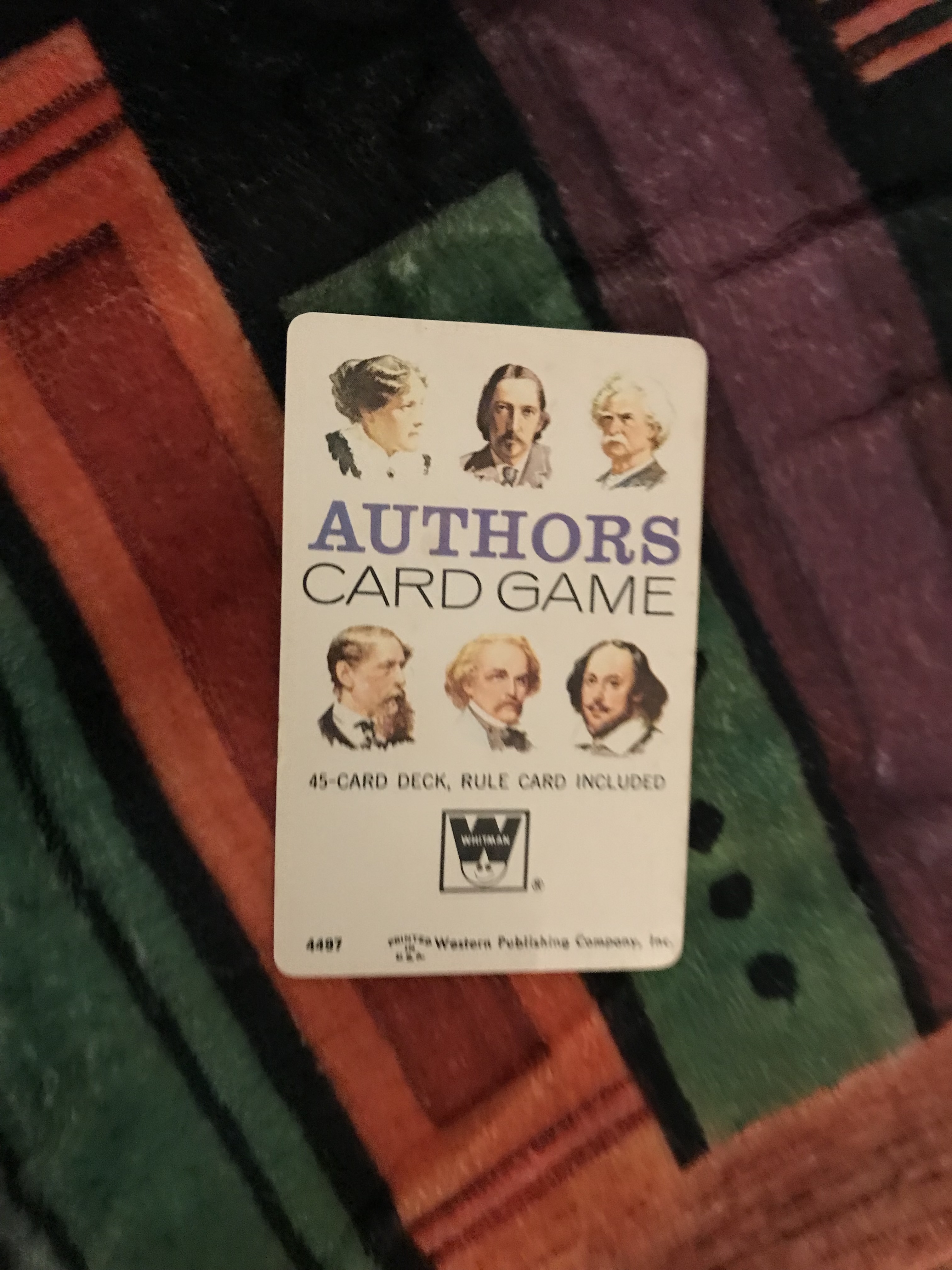
It happened in Salem.  In 1861.  The classic American card game, Authors, was published.  G. M. Whipple and A. A. Smith devised the game, which has remained available ever since then.  It’s one of the few games I remember having as a kid.  We, of course, had the Bible Authors game as well, which I’m kind of nostalgic for, but not enough to see if it’s on eBay.  The object of Authors, an early form of “Go Fish,” is to collect sets of four cards for each author.  Each card lists a different work.  Poets are represented by poems, of course, but prose authors mostly by books.  I have to confess to having eBayed this some time back and having beetlebrowed my family into playing it with me.  I noticed, however, a few curious omissions.

Edgar Allan Poe isn’t among their number.  Neither is Herman Melville.  Rather strangely, they included Shakespeare—centuries earlier than the others—and Alfred, Lord Tennyson.  The only female is Louisa May Alcott when there were perfectly acceptable Brontës in the room, as well as Jane Austin.  The game reflects its time.  A couple years back I was in Michaels—you know, the arts and crafts supplies store.  In fact, Michaels is one of those places for family outings, for families like mine.  (We tend to be creative types.)  While I’ve never been into scrapbooking, I walked down that aisle and found a set of stickers labeled “Literature.”  Two authors were represented: Shakespeare and Poe.  People smarter than me have argued that worldwide Poe is probably the best recognized American author.  I think it’s safe to say Shakespeare occupies a similar role in Britain.

Poe had fallen afoul of many in America because of an intentionally damning obituary by Rufus Wilmot Griswold, whom Poe had named his literary executor.  If it weren’t for Poe nobody would likely know Griswold’s name today.  In 1861, when Whipple and Smith were inventing their game, Poe wasn’t really considered worthy of emulation, largely because of Griswold.  He wasn’t the kind of guy you’d want your kids to be too curious about as you tried to teach them about literature.  Authors has gone through over 300 editions over the years.  I’ve never seen any of them (apart from Bible Authors) other than the Whitman edition from my childhood.  Each time I pick it up, smell the cards (go ahead—try smelling your Kindle), and thumb through the authors I feel like I’m missing something.  Go fish.

Beyond Reason

Emotions are tricky.  They’re an essential part of being human, but they don’t function rationally.  At least they don’t do so reliably.  And nobody is emotionally pristine.  People have anger issues (quite a lot of that, I know), insecurities, esteem problems (either too much or too little), abandonment concerns, and the list could go on and on.  The thing about emotions is that they’re difficult to fit with logic.  Sometimes it’s hard to believe that logic is an artificial construct and that emotions are just as important to survival as reason is.  Evolution gave us emotions.  Fight, flight, or freeze still operates in most human beings—I’ve seen all three responses when a threat arises.  Feeling sad when unfortunate events take place is normal and natural.  Dogs and other higher mammals feel it too, as has been amply demonstrated.

It’s easy to let our emotions speak for us, even when doing so causes damage we would never rationally seek to impose.  You push me and I push you back.  Something I realized long ago, and this is just to do with my own situation, is that I can’t easily let go of negative emotions.  I recently learned that a relative I never knew very well had a similar trait.  Such people have invisible scars that they bear their entire lives.  The logical mind says, “Let’s use chemicals to erase them.”  The artistic mind says, “Erase my emotions and you erase me.”  It’s important—vital even—that we don’t question a sincere person’s reasons for their emotional responses.  Most people are just trying to do the best that they can.

Religion is generally based on emotional need.  That’s not to say it’s bad or for “the weak.”  It seems that evolution has deemed it a valuable asset for human beings.  As someone who’s studied religion for many, many years, this aspect has become quite clear to me.  Religion is a coping technique and, in the best of circumstances, it contains some of the truth.  As I used to tell my students, nobody intentionally believes a false religion.  The stakes are far too high.  And we have no rational standards by which to measure which religion is right.  It’s a matter of belief.  Religions have to meet us emotionally where we stand.  During the nineteenth and twentieth centuries a shift took place where religions were supposed to be logically, literally true.  This was believed with intense emotion and it led to a situation we still face.  Emotion and rationality must work together, but some ways seem much more productive than others.


What Poe Saw

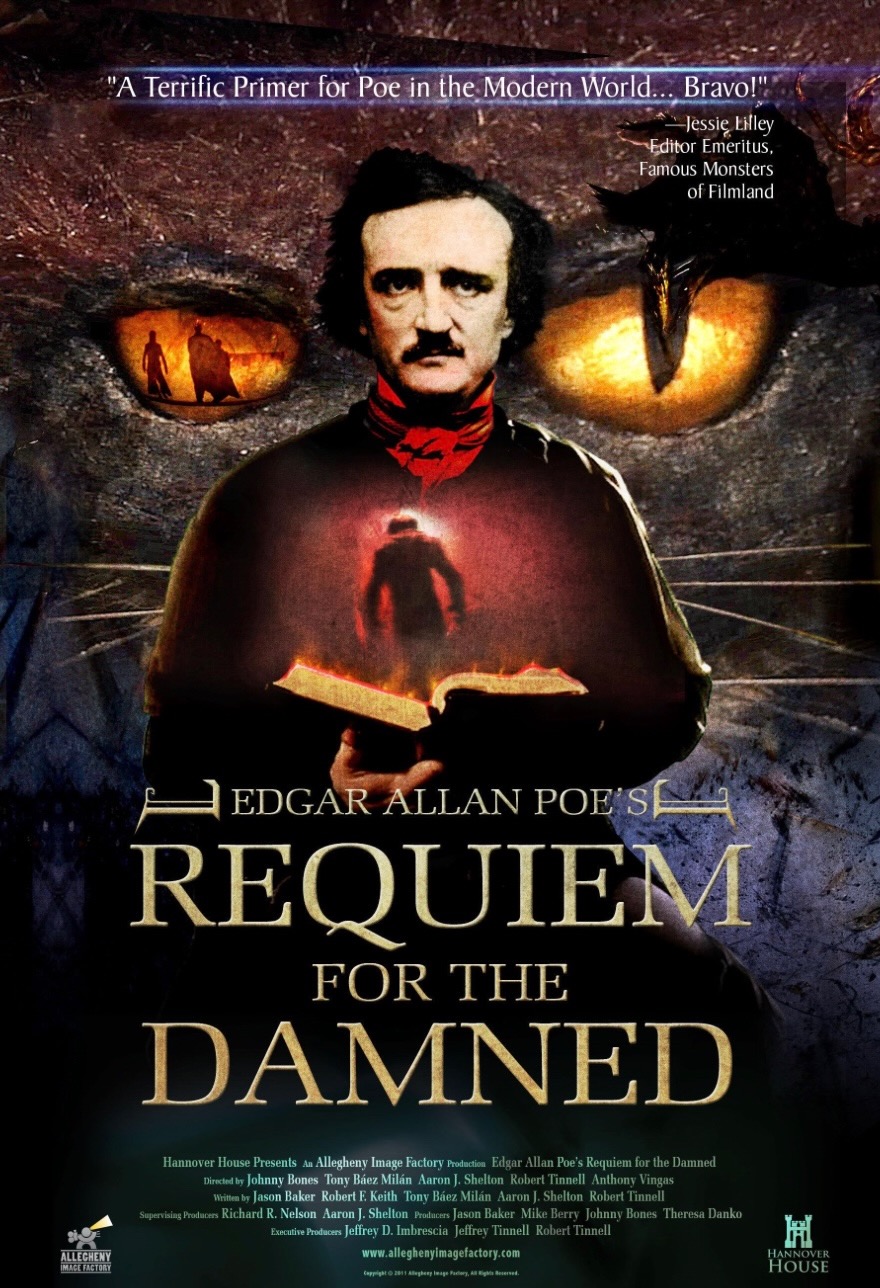
It must be quite a draw, making a film based on Edgar Allan Poe.  The psychology of his tales of terror is compelling and modern filmmaking offers endless possibilities.  I wasn’t looking for anything too heavy, so I watched Requiem for the Damned.  Vignette movies are like a box of chocolates (I’m sure you know how the rest of it goes).  This particular feature doesn’t seem to have had a theatrical release, perhaps because it is an independent film made by students and faculty at the Douglas Education Center.  The opening credits cite the Allegheny Image Factory, and when I think of Pittsburgh and horror my mind eventually wanders to George Romero.  The Douglas Education Center began as a business school south of Pittsburgh and it offers training in filmmaking.  And that seems to explain this particular film.

Five vignettes are taken from Poe’s “Fall of the House of Usher,” “The Tell-Tale Heart,” “The Black Cat,” “Murders in the Rue Morgue,” and “The Pit and the Pendulum.”  Only “The Black Cat” is set in Poe’s period and it is heavily CGI.  The rest are modernized versions of ideas inspired by Poe rather than following his plots.  “Usher” uses Poe’s characters and an introduced illegitimate son, to present the Usher curse—the unfeeling business practices that brought the Ushers wealth have made theirs a haunted estate. “Tell-Tale” has a modern urban legend feel as a guy starts seeing his ex-girlfriend’s broken heart everywhere he goes.  “Rue Morgue” is a lesbian revenge story involving an improvised gorilla suit.  “Pit” is a post-apocalyptic vision with almost no dialogue and a somewhat confusing resolution.

Horror anthologies seldom work.  Like edited volumes in the book world, they lack coherence.  Poe insisted that short stories should be single-sitting forms so that mood could be maintained.  Putting five together, each with different directors, writers, and styles, makes for a disjointed viewing experience.  A couple of the segments, “Black Cat,” and “Pit,” seemed to drag a bit.  The former because you already know the story and the CGI was so abstract that it interfered with the telling and the latter because you really don’t know what’s going on.  The visuals are impressive, but story seems to have been sacrificed.  I was looking for something not too heavy and I did find that.  I also learned about a place where filmmaking is taught and you don’t have to have connections to get in.  Who knows?  Perhaps in another life I might’ve gone that direction.  I tend to follow Poe.


Call Me AI

Let’s call them Large Language Models instead of gracing them with the exalted title “artificial intelligence.”  Apparently, they have great potential.  They can also be very annoying.  For example, during a recent computer operating system upgrade, Macs incorporated LLM (large language model) technology into various word processing programs.  Some people probably like it.  It might save some wear and tear on your keyboard, I suppose.  Here’s what happens: you’re innocently typing along and your LLM anticipates and autocompletes your words.  I have to admit that, on the rare occasions that I text I find this helpful.  I don’t text because I despise brief communiqués that are inevitably misunderstood. When I’m writing long form (my preference), I don’t like my computer guessing what I’m trying to say.  Besides, I type faster than its suggestions most of the time.

We have gone after convenience over careful thought.  How many times have I been made to feel bad because I’ve misunderstood a message thumbed in haste, or even an email sent as if it were a text?  More than I care to count.  LLMs have no feelings.  They don’t understand what it is to be human, to be creative.  Algorithms are only a small part of life.  They have no place on a creative’s desktop.  I even thought that I should choose a different word every single time just to see what this feisty algorithm might do.  Even now I find that sometimes it has no idea where my thoughts are going.  Creative people experience that themselves from time to time.

Certain sequences of words suggest the following word.  I get that.  The object of creative writing, however, is to subvert that in some way.  If we knew just which way a novelist would go every time, why would we bother reading their books?  LLMs thrive on predictability.  They have no human experience of family tensions or heavy disappointments or unexpected elations.  We, as a species tend to express ourselves in similar ways when such things happen, and certain words suggest themselves when a sequence of letters falls from our fingers.  LLMs diminish us.  They imply that our creative wordplay is but some kind of sequence of 0s and 1s that can be tamed and stored in a box.  I suppose that for someone who has to write—say a work or school report—such thing might be a boon.  It’s not, however, the intelligence that it claims to be.


Black Bird

Although we prefer typecasting—it’s so much easier!—Edgar Allan Poe had both depth and width as a writer.  He penned funny as well as scary, love poems and detective stories, even something like a scientific treatise.  One thing I’m sure he didn’t anticipate was his name being suborned for cheap horror movies.  Roger Corman is a Hollywood legend—a good example of a guy making it in the film industry on his own terms.  He paired Vincent Price with a number of Poe titles that had little to do with the actual works of the writer.  One that oddly stayed with me since childhood is The Raven.  This was well before I’d read the poem.  It’s funny how very specific things will stick in your mind.  I remembered the strange hat Price wore.  And I remembered—misremembered, actually—Price using a spinning magical device with sparklers.  Misremembered because that was Peter Lorre’s character, not Price.

That was it.  I didn’t remember that Boris Karloff was also in the film.  I was too young (as was he) to recognize Jack Nicholson as well.  Although I watched The Twilight Zone, I didn’t realize the script was by Richard Matheson.  This film was loaded with talent, but it really was goofy.  I recollected Price was a magician, but I didn’t know this was a rather silly battle to become chief magician.  Lorre’s ad libbed lines were surprisingly funny, even after all these years (I was about one when the film came out).  Surprisingly, the movie did well at the box office, despite its taking a sophomoric approach to perhaps Poe’s most serious poem.  

I’d avoided watching it again for all these years because of that sparkler scene.  I’m not sure why that particular moment wedged itself so firmly in my young brain.  It seemed so not Poe that I couldn’t get back to the movie, apparently.  With Price and Lorre camping it up—Karloff was, by all accounts, most professional as an actor—and Nicholson uncharacteristically timid, the cheap special effects, it’s obvious that viewers enjoyed a good laugh at this one.  It’s not true to Poe, of course.  It’s true to Roger Corman, however, a filmmaker who knew how to deliver cheaply and quickly and still earn some money at it.  I’d last seen The Raven about half a century ago.  I may be tempted to watch it again, after having seen it as an adult, but if I wait too long I’ll need to leave that duty to someone who’s read this and who isn’t afraid of sparklers. 


Intimate Thoughts

Although I haven’t had much time to devote to my fiction writing—I’m finishing yet another nonfiction title—I do have a Twitter account for my pseudonym.  I’ve always found it ironic that that Twitter account, which gets very little attention from me, has gained well over twice as many followers as the account in my real name.  On both accounts I follow back, but few notice the account where I post more often.  Strange.  Lately I’ve noticed that my pseudonym account has been getting attention from what seem to be cyber-prostitutes.  I’m not sure if that’s the proper name, but these users purport to be young women and they direct message you with solicitous intent (at least online).  Needless to say, I don’t respond.  It does make me wonder if that’s why Twitter is now known as X.

Social media has given new license to strangers, of course.  For a while there I accepted any invites I received on Facebook (publishers look at how many “followers” or “friends” you have on social media).  Many of these people I don’t know.  One, in particular, happens to be online quite early in the morning and has tried to video call me a few times on Facebook.  Those who do actually know me are aware that I spend less than five minutes a day on Facebook.  I post my post, check my notifications, and move on to other things.  In other words, anyone who knows me would never try to video call me through Facebook.  There are other ways to reach me.  I do have a blog, you know.  Social media has mediated a level of intimacy that I’m not ready to engage.

What am I doing here?

For all my daily shooting off at the fingers, I’m a pretty private person, really.  I’m shy—who knows? Maybe even on the spectrum—but also social.  Working in publishing I know that those who have the power to promote your book (and price it so mere mortals can afford it) want you to have internet exposure.  I guess that means some people will take it as an invitation to try to get sexy with you, or to call you at what is, in reality, the middle of the night.  I want people to get to know me first.  As much time as I spend writing, it’s a mere fraction of how I spend my days.  Intimacy should be reserved for friends.  At least I believe so.  Those who know me well know my pseudonym and its real-life counterpart.  For when I have time for that sort of thing.


After Effects

Every once in a while you find a book you wish had been published sooner.  The Exorcist Effect, by Joseph P. Laycock and Eric Harrelson is one of those books.  Although it covers many of the same films I talk about in Nightmares with the Bible, it does so with a different target in mind, and a lower price point.  Drawing on the observation that human recall is often accompanied by “source amnesia,” they explore the idea that famous horror films (and some less famous) get remembered as “facts.”  This seems to be a greater danger to those who don’t actually watch horror or who watch it uncritically.  Movies such as The Exorcist become the basis for what individuals believe about demons.  But it’s far more dangerous than that, because in a culture where everything’s politicized, horror movies become “the truth” for groups like QAnon.

Considering Rosemary’s Baby, The Exorcist, and The Omen as prime examples, they then move on to consider the fascinating, if weird, lives of Ed and Lorraine Warren, and Malachi Martin.  Popularizers such as these three influenced both horror films and general public opinion about demonic possession and exorcism.  The study moves on to the Satanic Panic of the eighties and nineties and how heavy metal music both utilizes and ties into the Exorcist Effect.  This important book ends by discussing the very real dangers of a society that elects presidents and others based on this Effect, which confuses reality and movies.  The book shows how many of the ideas behind conspiracy theories either misremember, or intentionally misuse, horror films.

Back in the days when I started Nightmares with the Bible there was comparatively little published in readable terms that discussed demons or, specifically, the portrayal of exorcism in movies.  Laycock and Harrelson’s book would’ve been a welcome contributor to that dearth of resources.  As someone who works on the fringes of the fringe, I don’t always hear the discussions other scholars have and I’m often left to my own devices when it comes to finding and reading information on horror films.  Without library privileges, it often means having to purchase the books to access them.  I was thrilled when I first learned about this book and I’m glad to have finally had the opportunity to read it.  I’m sure I’ll be coming back to it on occasion.  After writing Nightmares, I took a bit of a break from demons because being in the dark for too long can do odd things to a person.  But not knowing about them, as this book shows, might cause even greater problems.


Edge of Civilization

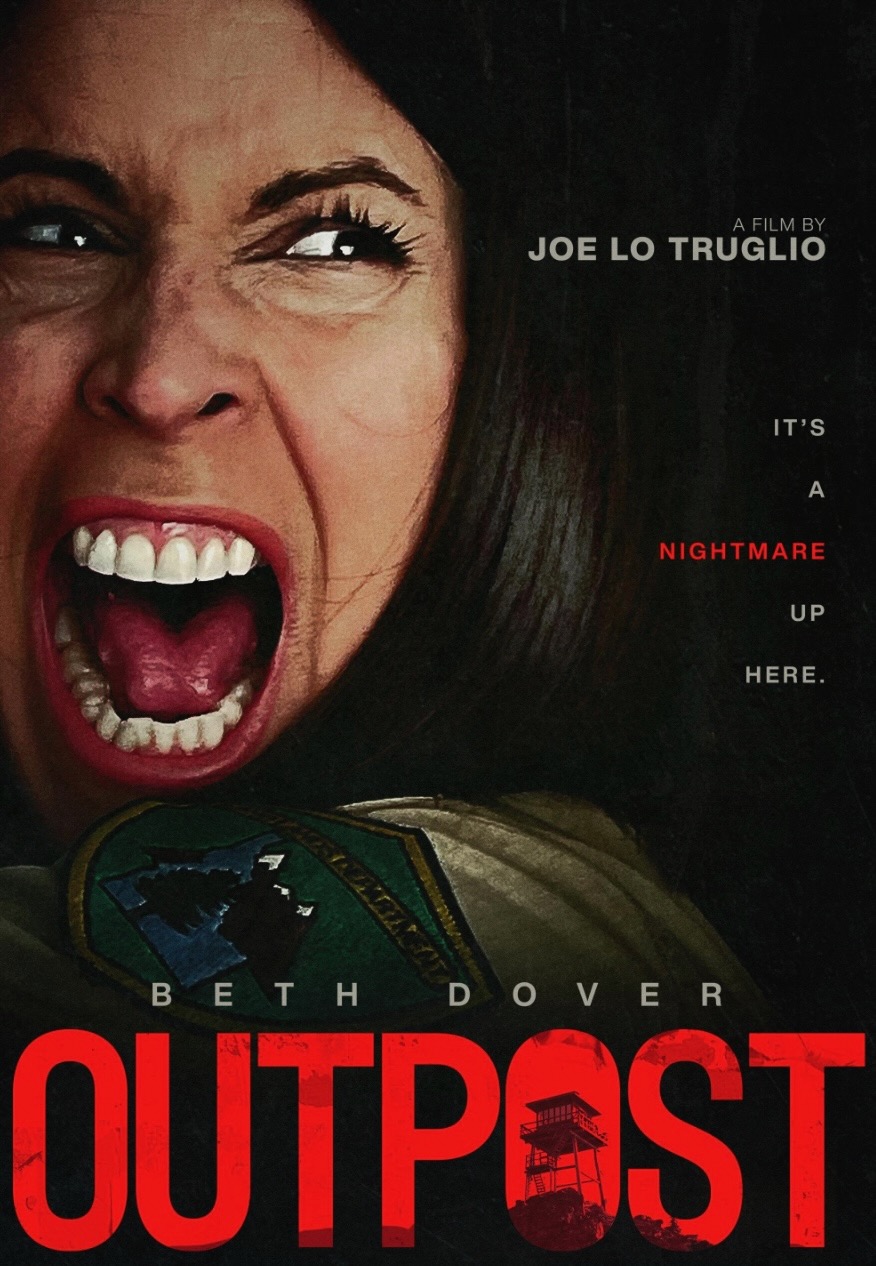
This is not a movie to be watched by someone with PTSD.  I watched Outpost for the scenery (I’ve been to the area it was filmed many times) and because the New York Times highlighted it.  It ended up being the scariest movie I’ve seen since The Shining.  I mean the kind of scary where your heart is still battering around your chest even after the credits roll.  As an indie horror film it may not be well known.  For clarity’s sake I need to say it’s the Outpost released in 2023.  The one about a woman who goes to spend a summer in a fire tower to recover from domestic abuse.  If you haven’t suffered PTSD, and you’re not as emotionally involved as I let myself become, you might guess by about halfway through what’s really going on.  But there are a bunch of people in the northern Idaho woods that you just don’t trust.

I’ll try not to spoil the ending, but here’s how it goes: Kate was beaten by her husband.  And sexually abused by an uncle when she was growing up.  Against the advice of her best friend, whose brother works for the forestry department, she takes a summer job on a fire lookout tower.  The locals at the store, all men, are threatening in her eyes.  Her new boss doesn’t think she’s a good fit for the post, but to help smooth things over with his sister, he lets Kate have the job.  Along with lighthouses, fire lookout towers are some of the loneliest places in the civilized world.  When a couple of young guys hike by, noting she’s all alone in the tower, your skin begins to crawl.  She keeps having flashbacks to the violence in her past.  Then she meets an older woman hiker who stays awhile and teaches her how to shoot.  A local retiree teaches her how to chop wood.

Kate still doesn’t trust the local retiree.  One of her colleagues from the forestry service has surreptitiously taken photos of her and ogles them.  And day after day after day she has to follow a routine and sees no one.  You get the picture.  I don’t want to give too much away, but for some of us this may be among the scariest movies we’ve ever seen, despite most of it being in the clear summer sunshine of northern Idaho.  The movie ends with a contact number for the National Domestic Violence Hotline.  Joe Lo Truglio, the director, is an actor known for comedy.  Outpost makes me think there’s something else behind the laughter.


The Gift

Each day, each hour is a gift.  With my mother’s passing two months ago, I’ve been struck by the sheer number of colleagues that have died this year.  Not all of them older than me.  I wrote some months back about Michael S. Heiser, a blogging buddy from days past.  An email about a potential author just yesterday sent me back to the Society of Biblical Literature necrology.  This author had died unexpectedly the day before.  Glancing over the top of the list, I saw that three people with whom I’d worked died in November.  This was quite a shock since two of them were younger than me and the other not much older.  The thing about professors is that you kind of expect them to grow old.  To be old.  Life is a gift, and it’s sometimes easy to forget that.

Both tenacious and tenuous, life is a mystery.  Perhaps it’s perverse, but this makes Shirley Jackson’s “The Lottery” seem like a metaphor.  In fact, those of us who read and watch horror generally do so with a purpose, consciously or not.  It helps us face difficult things.  Five colleagues in one year sounds like a lot.  Someone in my family, younger than me, had six funerals to attend this year.  Life can feel difficult at such times.  Horror can be a coping mechanism.  At least for some of us.  It can be profoundly hopeful.  The meaning of life can be elusive, which is why, the existentialists conclude, we must make our own.  Existence precedes essence, as they say.

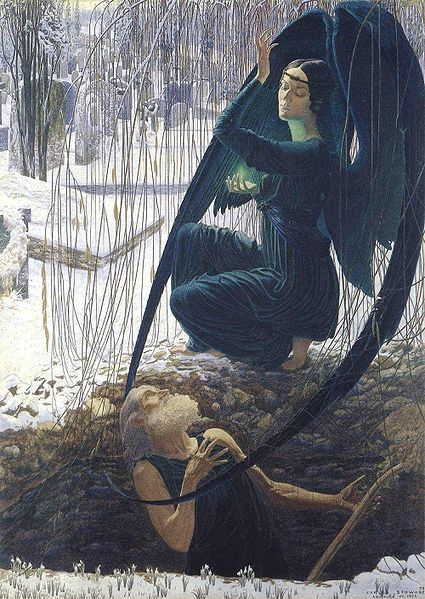
Carlos Schwabe, Death of the Undertaker; Wikimedia Commons

Other than profession, one of the few things these five fallen colleagues had in common was my perspective on them.  I don’t think they knew each other.  Had I not been an editor I likely wouldn’t have known three of them at all.  We live in a web of interconnection.  And I don’t mean the world-wide web (does anyone even use that term any more?).  Lives are gifts and gifts cross paths with other gifts.  Such information, all at once, can be difficult to process.  It makes me wonder why we allow wars.  Why we don’t think of consequences before we vote autocrats to power.  Instead, if we focus on that ephemeral gift we have, and how we might share it with others, appreciation rather than hatred grows.  To this lonely existentialist who watches horror for meaning, that just makes sense.


Who’s Knocking?

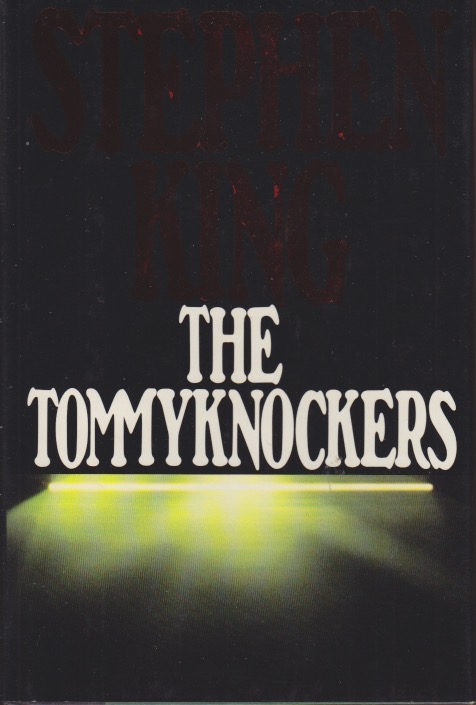
I’m by no means alone in enjoying Stephen King novels.  I’ve read a fair number over the years.  I was put on alert for The Tommyknockers by a scholar who pointed out some of the religious elements in it—again, not rare in King’s oeuvre—but I’d never heard of it before that.  I’m not really a good fan boy, I guess.  In any case, I saw a copy with the shiny copper of King’s name worn off at a library book sale for a buck.  It sat on my shelf for many months because, well, it’s long.  I finally pulled it down in October only to discover that it wasn’t my favorite King story.  For one thing, it’s simply too long.  For another, the characters aren’t the easiest to cotton onto.  If you’ve not read this one and you plan to, a spoiler of two might slip out but I’ll do my best not to ruin the ending.

I think horror when I think King, although I know it’s unfair to typecast authors like that.  Tommyknockers is more King’s hand at science fiction.  Well, at least it has a space theme, which is generally a cue for sci-fi in my book.  Bobbi Anderson discovers a buried flying saucer on her Maine property.  With the help of an alcoholic friend (Jim Gardener) she begins to excavate it.  The saucer, which has been buried for millions of years, is reactivated by their interaction with it and soon the entire town of Haven, except those with a lot of metal in their bodies—like Jim, are under its power.  They invent advanced gadgets (and weapons) using power from the ship and standard batteries.  They begin physically transforming into something less than human.  Jim, mostly immune, tries to help Bobbi out but he, along with a fairly extensive cast of disposable characters, are powerless to stop things.

Like most King novels, it’s well written.  Like some of his other material, it’s over-written.  Having had my own written work chopped down  (and, let’s face it, I’m now an editor), I see places where cuts could be made.  As with any long book, however, I’m left feeling a bit lonely now that characters I’ve read about nightly for many weeks are gone.  Even though I really had a difficult time evoking much empathy for them, hey, they’re people too.  Or so it seems.  Such is the magic of fiction.  Besides, there are bits of the old King horror still present in the book.  I know it won’t ever be my favorite King novel, but it won’t stop me from reading another, when I have the time.  Hopefully the next one will be a few pages shorter.


Saint Nick

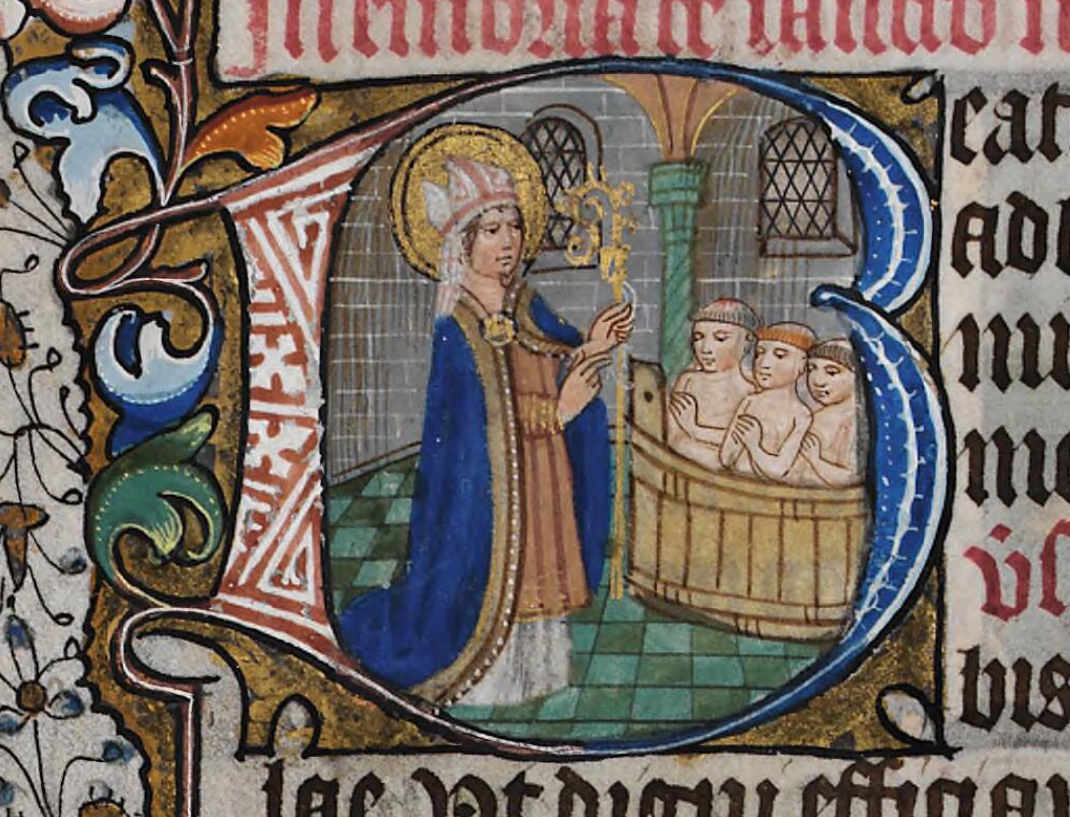
My wife and I have both noticed it.  December has been much busier than usual, and neither one of us works in retail.  We’re at the age when most people are considering retirement, but are both just settling into our careers.  But this is about December, not about us.  Today is December 6, Saint Nicholas Day to some.  What many people don’t realize is that this used to be “Christmas” for particular sets of folks.  You see, St. Nick was one of the many components of what would become Christmas.  His saint’s day was/is today and it was traditional among some early American communities to pass out gifts today because of the tradition that Nicholas was one of the more generous saints.  While at Nashotah House the rather somber Advent atmosphere was broken this day when the Dean would hand out gold coins.  Well, chocolate coins covered in golden foil, but you get the picture.

Image credit: National Library of Wales, public domain via Creative Commons CC0 1.0 Universal Public Domain Dedication

In our capitalistic zeal to get Christmas down to just one day off, if that, we’ve targeted the twenty-fifth.  Saint Nicholas was rolled into Santa Claus and we could keep on working nineteen more days.  “Santa” was known by many names—Father Christmas, Christkindl, and Kriss Kringle, among others.  They were expected at different times in December, even as the Catholic Church had decided on this month to be Jesus’ birthday, to counter Roman celebrations of Saturnalia and Kalends (both of which were more than one day, I might add).  December, in other words, should be a festive month.  Instead, it’s become a busy season for squeezing everything in before taking some time off work.  Do we ever sit back and consider how ridiculous such hectic living is?

Don’t get me wrong—I love the Christmas season.  I save up vacation days every year to give myself a mini semester break.  When I’m feeling exhausted with September’s onslaught, if I can cast my eye as far as December I can feel some relief coming.  And I’m not sure why we don’t get offered a few more days in December.  Remote workers can’t always make it to the office holiday party, so maybe December 6 might be a remote worker’s mini Christmas day off?  The weary struggle to make it to the official Christmas could use a little refreshment just about now.  I don’t recall a December ever being this busy on the work front.  For the economy’s sake, hopefully those in retail aren’t finding themselves bored.  One thing that all of us might wish for, however, is a visit from Saint Nicholas.


Hybrid

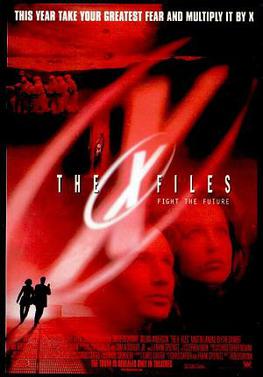
We really need a better category.  Beyond “horror,” I mean.  My wife and I have been re-watching the X-Files on DVD (we know how to stream but we bought these before streaming was a thing).  Having reached the end of season five, we knew it was time to slot in the movie, Fight the Future.  You see, in case your memory’s hazy, the X-Files were closed at the end of season five.  The X-Files movie shows how they reopened.  The X-Files has lots of monsters, some gruesome murders, and some spiritual elements.  It’s categorized in different ways, one of which is horror.  You see, horror and monsters are related.  Others prefer to call it science fiction but that doesn’t really help because sci-fi and horror are closely related and this isn’t exactly like Star Trek.  In any case, we saw the movie when we were first watching the series but I didn’t recall much of it.

As a hybrid—rather like an alien-human mix—it’s both movie and television show.  You could watch the movie without having followed the mythology up to this point, but you’d miss an awful lot.  And you can watch the television series without seeing the movie, since it’s episodic.  You’d also miss some detail that way.  It struck me as strange that this hybrid had trouble working for me.  Was this a movie or a television show?  Our minds (or at least mine) compartmentalize such things.  You know what to expect from television.  You know what to expect from a movie.  Mixing them perhaps adds to the mystique of the X-Files mythology.  The big-budget effects are only temporary, however.

A couple days after, we picked up with season six.  The first episode incorporates the movie into the long-running plot.  You see, movies may be a couple hours long, but a series that runs for several seasons is even longer.  And since the movie is about hybrids, it’s strangely appropriate.  I’ve always been disappointed that they never came out with a third X-Files movie.  It would’ve been nice if they’d wrapped up the mythology in a definitive way.  Although, I suppose, that was part of the draw for the series.  It was open-ended.  And Mulder’s poster said why.  It’s not “I believe,” but “I want to believe.”  That’s the way of the human psyche.  I’m glad to have watched the movie again.  The storyline is intriguing and I’m a fan of mythologies, both ancient and modern.


Nuts and Bolts

It all began with an innocent laugh at the local hardware store.  It was Saturday morning, around 8:30 and I had to get some nuts and bolts.  Literally.  From those neat little trays that separate out individual pieces that may be the last place on the planet you can spend just a dime.  These local stores have an honor system with little bags on which you write down how many of which piece you took and the price.  Also a dying breed, these bags are made of paper.  One other guy was there doing something similar and when I picked up my bag, another clung to it and slipped to the floor.  He laughed.  Then apologized.  He explained that he seldom made it through the day without some aspect of Murphy’s Law taking place.  I let him know I didn’t take his laugh wrongly and that I knew Murphy’s Law, perhaps too well.

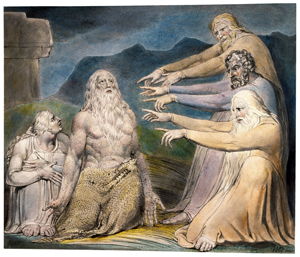
He then told me that he thought he’d write a book about it.  A novel, he said, like the book of Job.  My ears perked up.  Only this time, he suggested, God had to treat Job so that only bad things happened and used Murphy’s Law so that they would turn out good.  Every good thing God wanted to do would have to appear evil at first.  I encouraged this stranger to write this book.  I meanwhile couldn’t believe that I was having a conversation about Job with someone I didn’t know in a town where I’m still a bit of a newbie.  Do I have “former Bible professor” written on my forehead?  Even when I’m wearing a mask they seem to be able to tell.

Job, according to William Blake

But seriously, although I don’t get out much any more throughout my life I’ve had strangers approach me with religious issues for conversation.  Often at the strangest times.  I wonder if this happens to other people.  You can’t assume someone will know the book of Job, or what it’s about.  You can’t know that a stranger won’t take such a story idea the wrong way.  Me, I was counting out nuts and bolts.  Perhaps I was there to build my own Frankenstein’s monster.  Or some evil device to end the world.  Would Job calm me down or rile me up?  As it was, I was glad for the diversion.  8:30 on a Saturday morning is well into the day for me, having been awake for over five hours already.  And I’m glad to have an innocent laugh from a stranger.


New Gremlins

I haven’t seen the movie Gremlin in years.  I’m adding it to my Christmas list this year, however.  Probably because I watched Shadow in the Cloud recently.  And although that gremlin wasn’t cute, it led me on a journey of discovery, and that counts for something.  I have to admit, first of all, that I’d never heard of Roald Dahl before a kind family member sent us some of his books when our daughter was young.  We became rather hooked.  His novel The Gremlins was among those we read but there was something I didn’t know (one of trillions of somethings, of course).  And that is that Roald Dahl was probably the reason anyone outside the Air Force knew about gremlins at all.  Dahl was a pilot with the Royal Air Force.  His first children’s book was the aforementioned Gremlins.

Image credit: US Government, public domain, via Wikimedia Commons

I first learned about gremlins from The Twilight Zone.  “Nightmare at 20,000 Feet” came close to giving me literal nightmares.  (And Nope reminds us that there may be things in the atmosphere that we really know nothing about.)  That particular episode was based on a short story by Richard Matheson.  It was also incorporated into the 1983 Twilight Zone movie which I have, unaccountably, never seen.  Of course, I saw Gremlins in a theater back in my college days.  That was before I understood, or really had any interest in holiday horror.  This is one of those instances where the birth of a monster can be traced and its lore can be watched to grow, in real time.

Dahl took something he’d heard about—gremlins weren’t believed to exist by anyone—and made it literal, in the form of a children’s book.  Soon after, other vendors, such as cartoon creators, picked it up.  In the Twilight Zone it began its transition to horror.  Then a regular horror movie was made of them.  All of this has taken place since World War II and there are plenty of people alive who were around at the time.  Shadow in the Cloud was a reboot of a monster generally underused.  There are few times people feel as vulnerable as when they’re flying.  Heck, climbing a tall ladder is enough to give me the willies.  And the movies have shown us that even on the ground we’re not really safe from the monsters of our imagination.  That’s why it seems like a good idea to me to watch Gremlins again.  And to dream of the monsters we invented.


Wild Moose Chase

I don’t remember the details, but I’m pretty sure we didn’t ask permission.  It was summer and a seminary friend and I were going camping in Maine.  You see, Maine has always been my favorite state.  Not only does it have dramatic cliffs over the gray north Atlantic, it’s also home to moose.  I always wanted to see a moose in the wild.  So I talked a friend into camping in Maine so we could see a moose.  He was from North Carolina and hadn’t ever seen one either—moose are limited to the very northern states in the US, those that border Canada.  Like many seminary students, I worked during the summer, but weekends were made for Maine.  We trundled up into the wooded part (the largest part) of the state, and drove up an old logging road that looked like it hadn’t been used for quite a long time, and set up a tent.  We didn’t see any moose, though.

A few weeks later I was able to persuade my friend to try again.  This time we drove to Mooselookmeguntic Lake.  We stayed at a proper campground.  The very name of the place means “moose feeding place.”  We saw no moose.  The next morning we asked the park ranger if they we around that area.  “I saw two on my way home last night,” he said.  So it often is in life.  Things abundant to the locals are exotic to those from elsewhere.  I never did see a moose in Maine until my honeymoon many years later.  They are elusive creatures, large but shy, particularly around those “not from around here.”  Eventually my path crossed those of the majestic moose.  Mostly in Idaho.

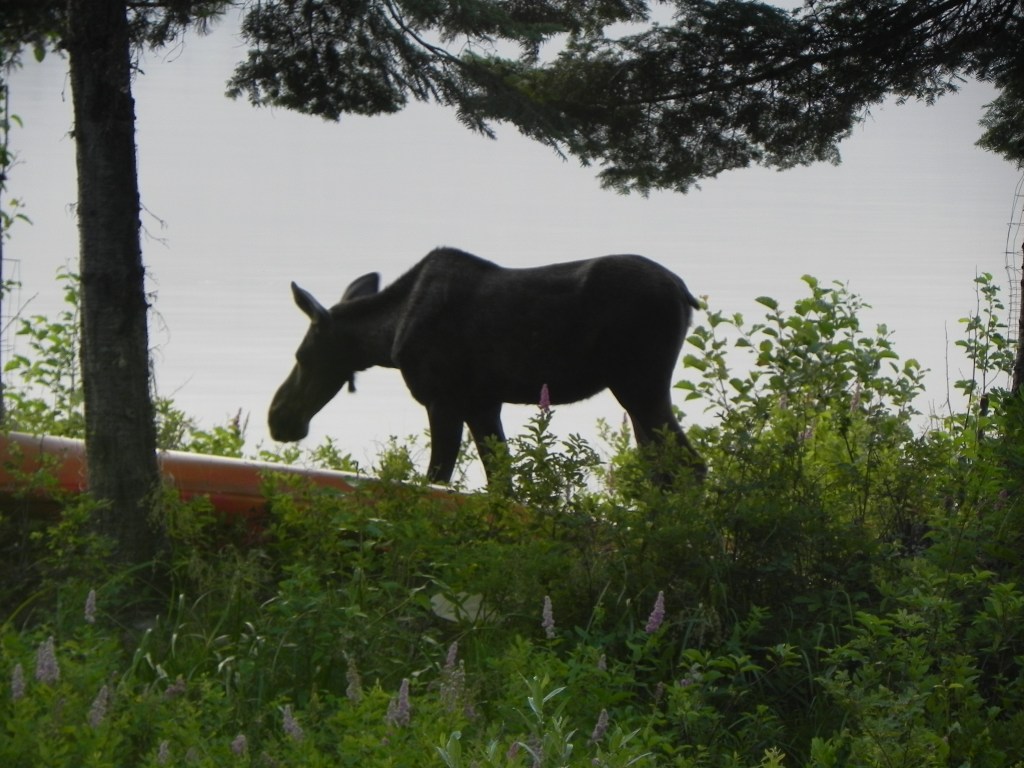
An Idaho moose

What’s behind my moose obsession?  I can’t really say.  I first became consciously aware of moose as a teenager and I knew that we didn’t have them in Pennsylvania (there are still, however, a few elk left in the state).  And besides, Maine was my favorite state.  That was because of childhood reading—there was no internet, and books are amazing for the imagination.  I suppose my love of Maine with its Dark Shadows and rocky coast may have spurred my desire to witness a moose in its chosen habitat.  There are giants in the woods of Maine.  They walk silently through the night.  For those fortunate enough to live in the state, they may be common.  For some of the rest of us, at least, they are transcendent.