Seasonal Poe

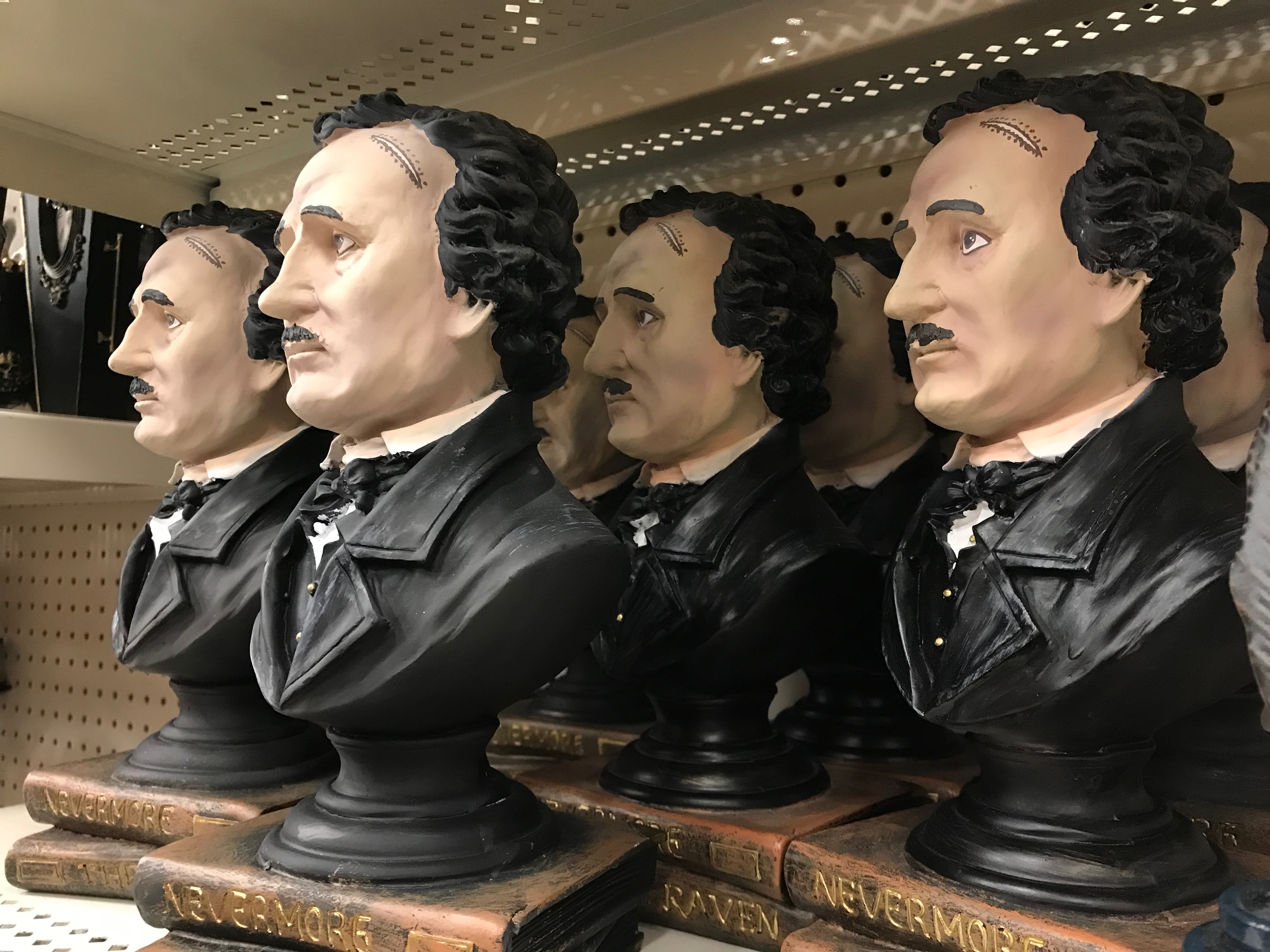
The more I read of and about Edgar Allan Poe, the more convinced I become that he wasn’t as associated with horror in his own mind as he has become.  As one of the earliest American writers, he has become the icon of those who wrote on the dark side.  His contemporaries—Washington Irving, Nathaniel Hawthorne, and Herman Melville—did as well, but it was Poe who became iconic.  On a recent trip to Michaels to take in the seasonal ambiance, Poe’s presence was difficult to ignore.  I wasn’t prepared to shoot a photo-essay (I’m not sure how they feel about such things in a store, in any case) so I didn’t photograph all the pieces.  “The Raven” is frequently referenced, with typewriters with the poem emerging and large, ominous black birds about, but Poe himself also appears.  There are, of course, painted busts of Poe.
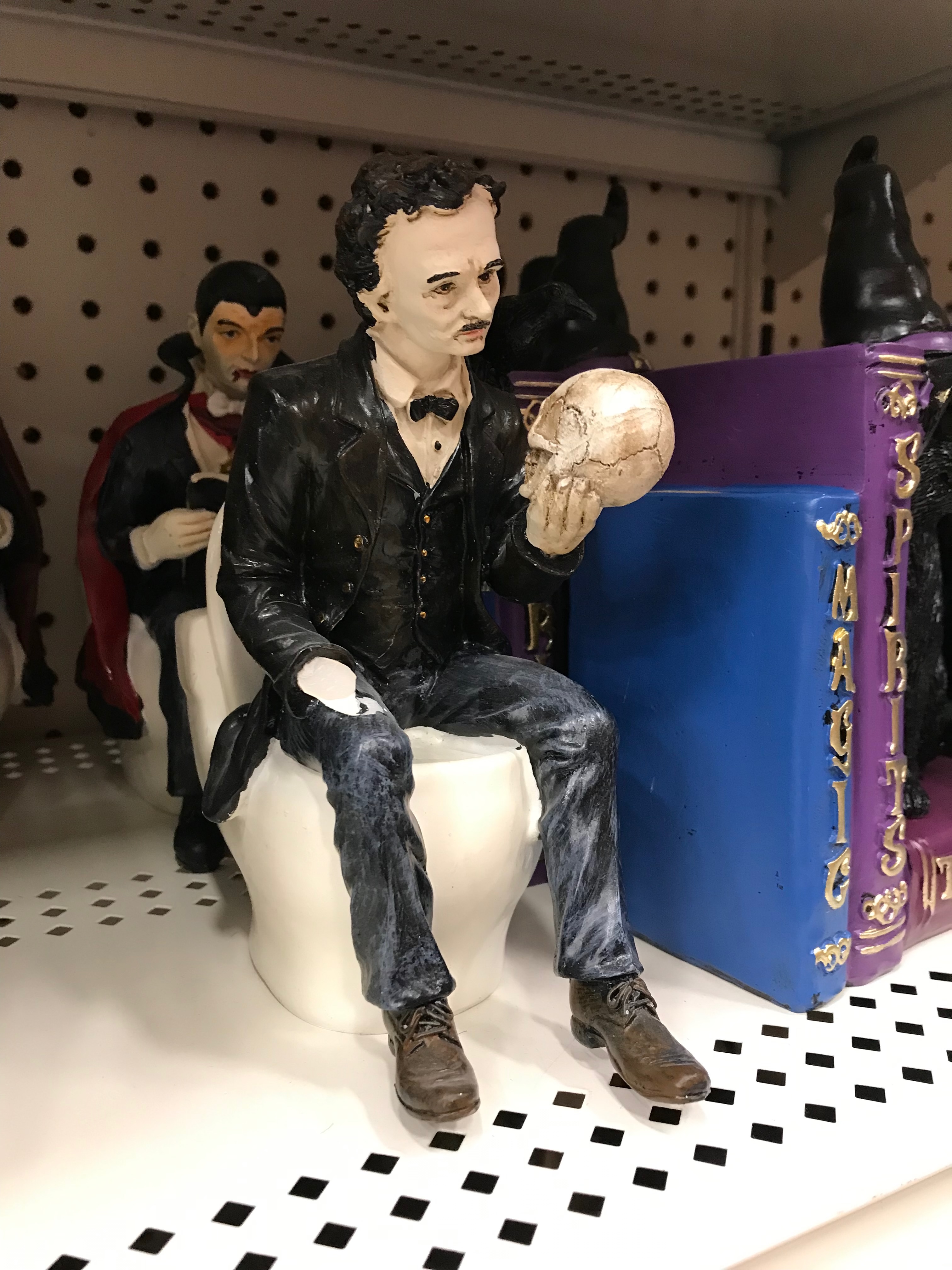
But Halloween has grown more whimsical over the years.  Arguably for my entire life it has been primarily a children’s holiday, but many have noticed that those of us who grew up with Halloween have retained adult interest in it.  Part of this is no doubt commercial since the captains of industry have learned people will spend more on Halloween than any other holiday except Christmas (I do discuss this in my forthcoming book).  And indeed, the Headless Horseman appears quite a lot as well.  Irving, however, isn’t there on the ground.  Poe is.  The whimsical part comes through in showing the humor of the season.  For example, although Poe is shown in the noble bust format, he’s also portrayed (fully clothed) on the toilet.
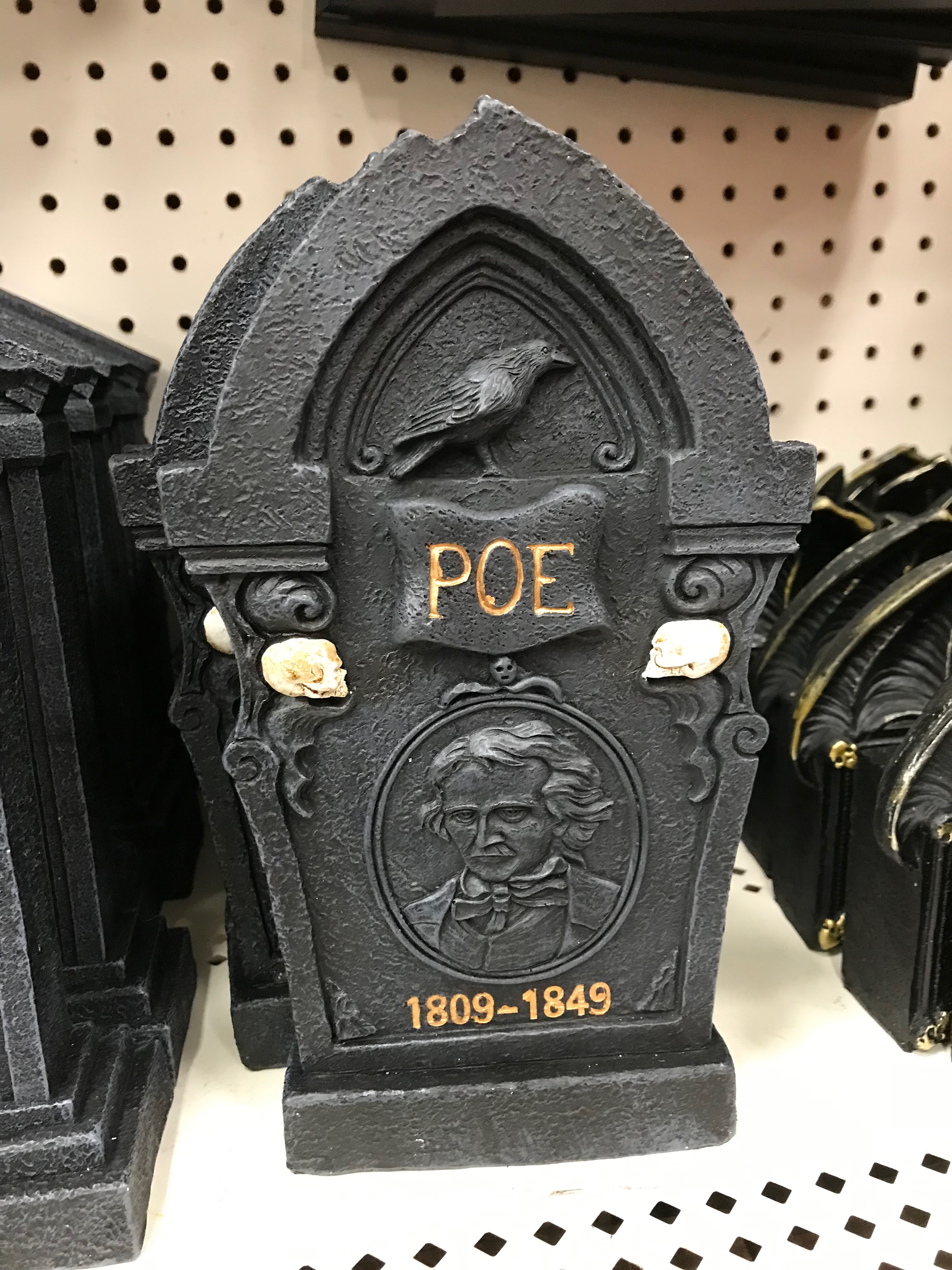
Finally, there were figurines of a fanciful tombstone of Poe.  They even got the dates correct.  Now, there’s more to be said regarding the comparison with Irving.  You can find the Headless Horseman on the toilet as well (along with Dracula).  You can find the Horseman in bust format as well.  When it comes to tombstones, however, the fictional Ichabod Crane shows up alongside the nonfictional Poe.  That casts a certain light on Irving’s most famous story.  I’ll save that for another post, however, since authors are expected to repeatedly plug their books.  I left Michaels strangely reflective.  Poe-themed merchandise is fairly typical any given year, but since we’re having our first Halloween party in some years, and since I’ve been exploring Poe’s range as a writer, this clear abundance of Poe as an icon gave me pause.  As if I were coming within view of the melancholy house of Usher. 

Haunted Space

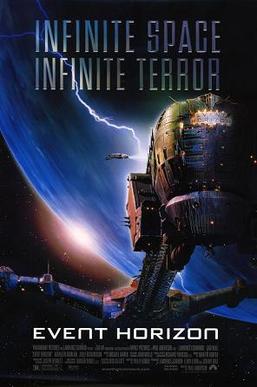
A haunted house film set in space.  That’s what I thought and then read the same words in a published description of what the writer and director were going for.  In that way it was a clear success, but in others it struggles.  The premise is good, if jarring.  Space travel, which is the most scientific of scientific enterprises (there’s a reason the rest of us say, “I’m not a rocket scientist”) collides with the traditional supernatural.  The results are worth pondering.  Event Horizon has become a cult classic, and like many older films, has been more positively reevaluated in recent years.  So the crew of Lewis and Clark is on a rescue mission to the ship Event Horizon, in a decaying orbit around Neptune.  Neptune’s atmosphere provides lightning for this haunted house.  The crew learns that Event Horizon has been through a black hole and has returned sentient.  Its crew has no survivors and it won’t allow Lewis and Clark to either escape or to destroy it.

Those of us who watch horror looking for religion—and even general viewers—can’t help but notice that Event Horizon ended up in Hell and returned.  It plagues the rescue crew with hallucinations of their regrets and failures.  Weir, the scientist who designed Event Horizon, is more or less possessed and stops at nothing to save the ship, which has brought Hell back to this dimension.  Again, it’s a bit jarring, like vampires in space.  (Yes, I know it’s been done.)  There’s even a point where Weir informs one of the crew that the crewman doesn’t believe in Hell.  Heck, they’re in outer space on a ship technology built.  But what if there is a spiritual reality—“dimension,” in the film’s lingo—out there?  What if some traditional religions are right?

The movie’s not apologetic, but it’s offering a reminder that to be human is to be spiritual.  No matter how much science “proves,” there’s always potentially more “outside.”  Hell in Event Horizon is beyond the bounds of the universe.  It is another place but a place it is.  It costs some of the crew their lives, but does it claim their souls?  Event Horizon is one of those movies that the studio ordered severely edited, and for which the edited footage was lost.  Movies ever only show us what directors, producers, and studio execs want us to see.  People crave stories.  And when a movie, like Event Horizon, raises more questions than it answers, viewers want to know—what really does happen in a haunted house in space?


Ever Hopeful

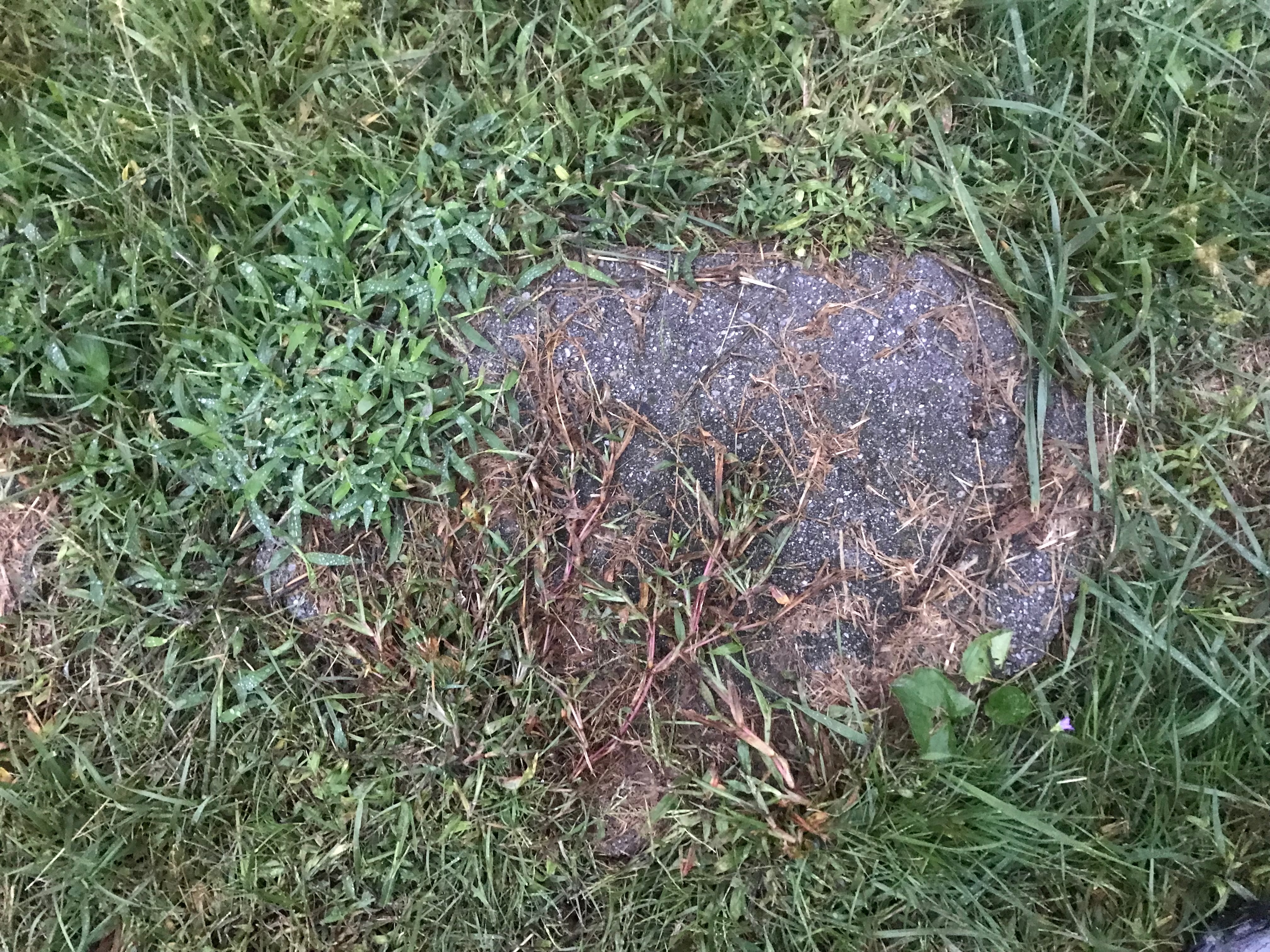
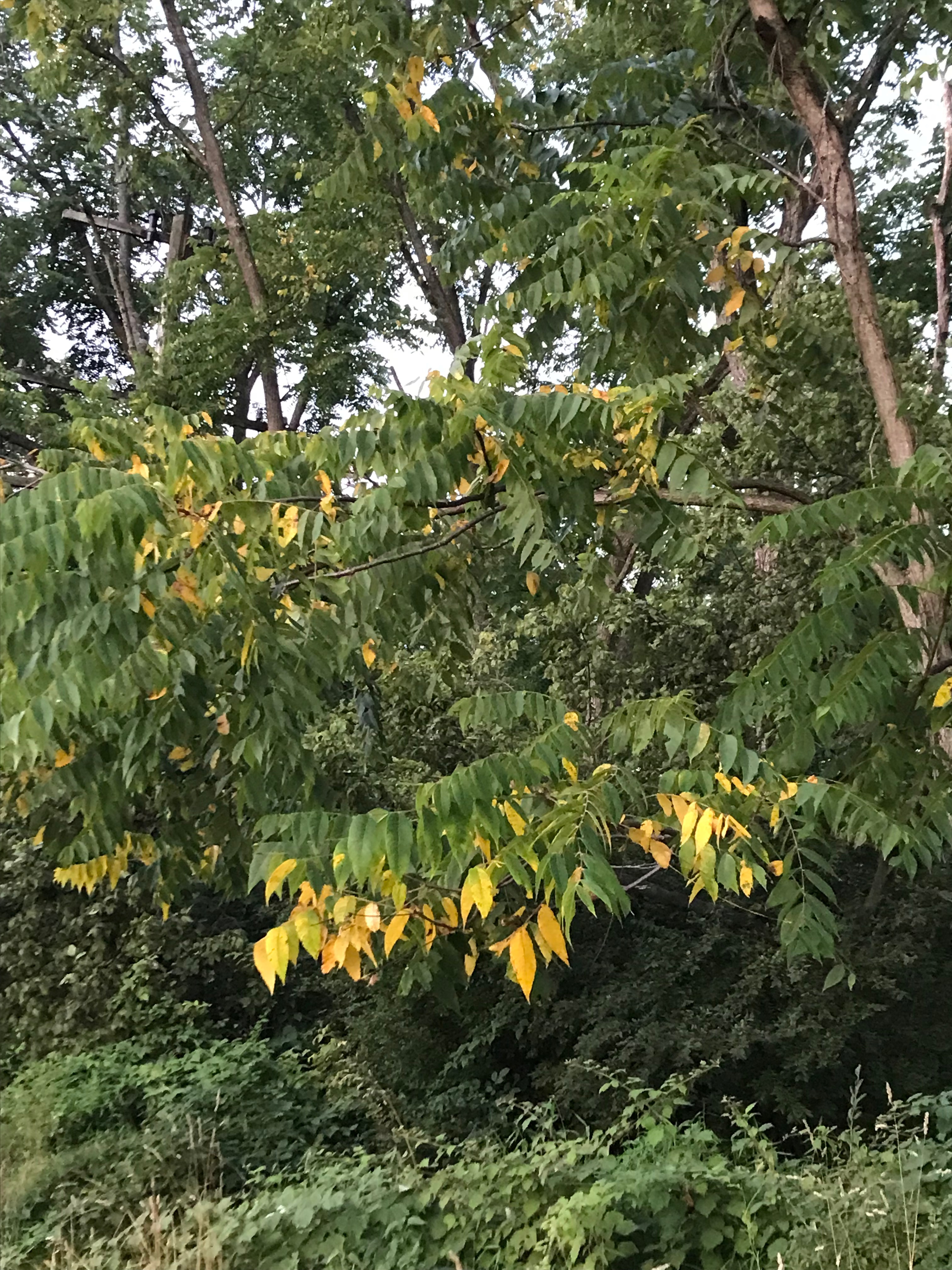
Plants are some of the most hopeful entities on the Earth.  As much as I’ve had trouble with houseplants, outside they seem to do fine.  Great, in fact.  Long-time readers will know that I struggle with lawn care.  It really didn’t enter my calculus of house buying—I was rather focused on the actual house, strangely.  We ended up with more yard than we required.  Thus, plants.  I’m not a fan of paving over greenery, but there’s a small strip of land between the sidewalk and the street—technically a “verge”—that’s difficult to mow.  Weed-eating it is also tricky because neighbors park their cars there practically 24/7 and some people don’t want a weed-eater that close to their showroom finish.  A couple years back I hauled some paving stones from our backyard out to the verge.  It decreased the grass by maybe 50 percent, but it still has to be whacked regularly.

I’ve been noticing over the summer into the fall that grass with a strong will to survive had begun growing roots over the top of the paving stones, intent on breaking them down.  That’s what plants do.  They work slowly, steadily, to achieve more room to grow.  This is always amazing to me.  Life is persistent.  Many animals see a stone as an obstacle—something to be stepped on or over.  Some plants see them as opportunities.  Our human obsession with allowing only certain kinds of plants close to our habitations, and those trimmed just so, seems an exercise in futility.  Of course, yard work isn’t my favorite activity, thus the paving stones in the first place.

After our species is done making a mess of the planet, plants will quietly take over again.  Especially anyplace near where someone once planted ivy.  We’ve got some very aggressive ivy in the back yard that I pull down year after year, and no matter how often I do it comes back with renewed vigor the next year.  And crabgrass.  That stuff won’t take no for an answer.  I can tell some former owners were trying to do some landscaping with, well, landscaping fabric and decorative gravel.  If you turn your back for a few weeks, the crabgrass gets in and its roots begin breaking the gravel down into soil.  I wonder how there’s any exposed rock in the world, or maybe my yard is a paranormal plant paradise.  I can imagine that without people here to “maintain” things, paradise (which is a garden) would return.  Perhaps there’s a parable of hope among the plants.


Must Be Autumn

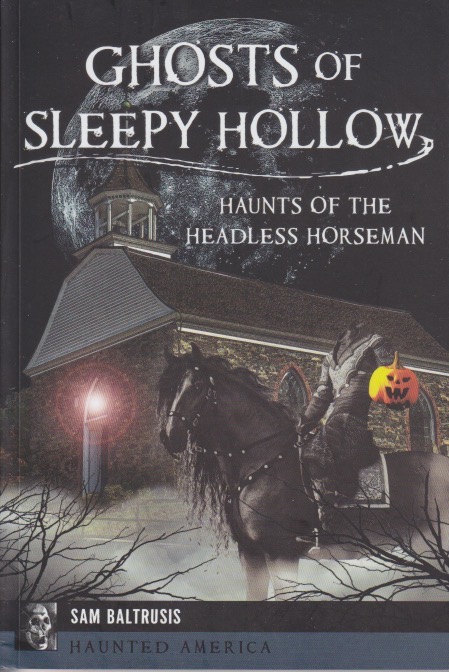
As it often goes, a friend pointed out to me a book on Sleepy Hollow that published just this week.  I preordered a copy that arrived on Tuesday and buzzed through it.  It’s what I describe to family as “one of those books”—you know, the local history, heavily illustrated quick reads from The History Press.  (I would note that I submitted what was then The Myth of Sleepy Hollow to The History Press, but they never even responded to the submission.)  In any case, Sam BaltrusisGhosts of Sleepy Hollow: Haunts of the Headless Horseman is really quite different from what I do in my forthcoming Sleepy Hollow as American Myth.  The History Press isn’t really regarded as such by historians.  I like their books nonetheless.  I was castigated by an academic journal editor early in my career for using one such book to illustrate local folklore.  (That was, by far, the snootiest rejection letter I’ve ever received.)

Aloft noses aside, there is a legitimacy in listening to what the folk say.  The tales in a book like this won’t convince skeptics, of course, but if you read them in the dark you’ll nevertheless find yourself glancing into the corner now and again, wondering if you saw something.  The book does cover the “Legend of Sleepy Hollow” and Irving’s life in a few pages—Irving was a complex man and the first truly famous American writer—before moving on to local haunts.  The thing that kept nagging at me was the easy shifting from fiction to fact.  Folklore does have a way of becoming reality (and who can definitively even say what that is?) for people.  No doubt, Sleepy Hollow has latched onto tourism in a big way.  Even more so than on my last visit there. And folklore draws on that shifting borderland between fact and fict.

One of my motivations in writing Sleepy Hollow as American Myth was that the story is largely ignored by academics and “sophisticated” readers.  It nevertheless remains important in popular culture.  Academics tend to be slow in picking up what general readers find fascinating.  I found a few academic articles on the subject, but my book was written for general readers as well.  I hesitate to say too much, otherwise, why buy it?  I have a handful of History Press (and similar) books on the region on my shelf.  I learn from them.  And I’m glad to see Sleepy Hollow getting more attention.  My only real regret about my book is that I’ll have to wait a couple of years before the price comes down.  In the meantime, those really curious about Sleepy Hollow will have this Haunted America version to read.


Some Body

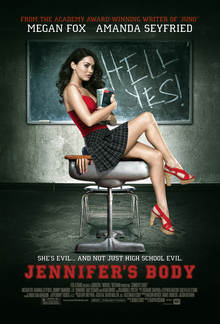
Many period movies are reevaluated and found better than originally critiqued.  (It feels strange to write that about a 2009 movie, but that was a decade and a half ago.)  I’d read about Jennifer’s Body before, but the title put me off from watching it.  Then, of all places, the New York Times recommended it last year during one of their autumnal forays into the horror genre.  Interestingly, it’s a possession movie with a few twists.  Demons are quite malleable monsters, of course.  So Jennifer and Anita (Needy) are best friends.  Jennifer is the girl all the guys want, and Needy, well, isn’t.  One night they go to hear a band at a local bar, and Jennifer leaves with them.  We later find out—spoilers about to appear—that their intention is to sacrifice a virgin to Satan to help them succeed as an indie rock band.  Jennifer’s no virgin, though, and demonic transference took place—i.e., Jennifer is possessed although the band gets their boost.

Then Jennifer has to eat people (high schoolers, of course) to survive.  She eventually tells Needy all of this, and her friend researches the occult and realizes her former friend is seriously dangerous.  And she decides to stop her.  I won’t give away the ending (it was only 15 years ago), but I will say that the overall result is somewhat unusual for a demon movie.  There’s plenty of religious imagery, but nothing really explicitly showcased.  For example, Needy’s mom has religious paraphernalia around the house.  There are no clergy in the story and Needy teaches herself what she needs to know about dispatching demons.  In other words, it’s a strangely secular possession movie.  And in the end demonic ability leads to justice.

The critical reappraisal is largely based on the feminist message and complexity of female relationships in the movie.  Both written and directed by women, those aspects aren’t unexpected.  And the movie is a horror comedy.  The funny parts tend to come from aspects of the dialogue since the acting is played straight.  This isn’t so much a scary movie as it is a smart one, which is probably why the Times critic recommended it.  Demons aren’t always scary monsters in horror, and what you end up being afraid of here is that the relationship between Jennifer and Needy might end since it seems to be the foundation on which two young women’s lives are built.  Is it a good movie?  Well, it’s not bad.  I tend to lean on the side of the reappraisers—it still has something to say. 


Borrowed Land

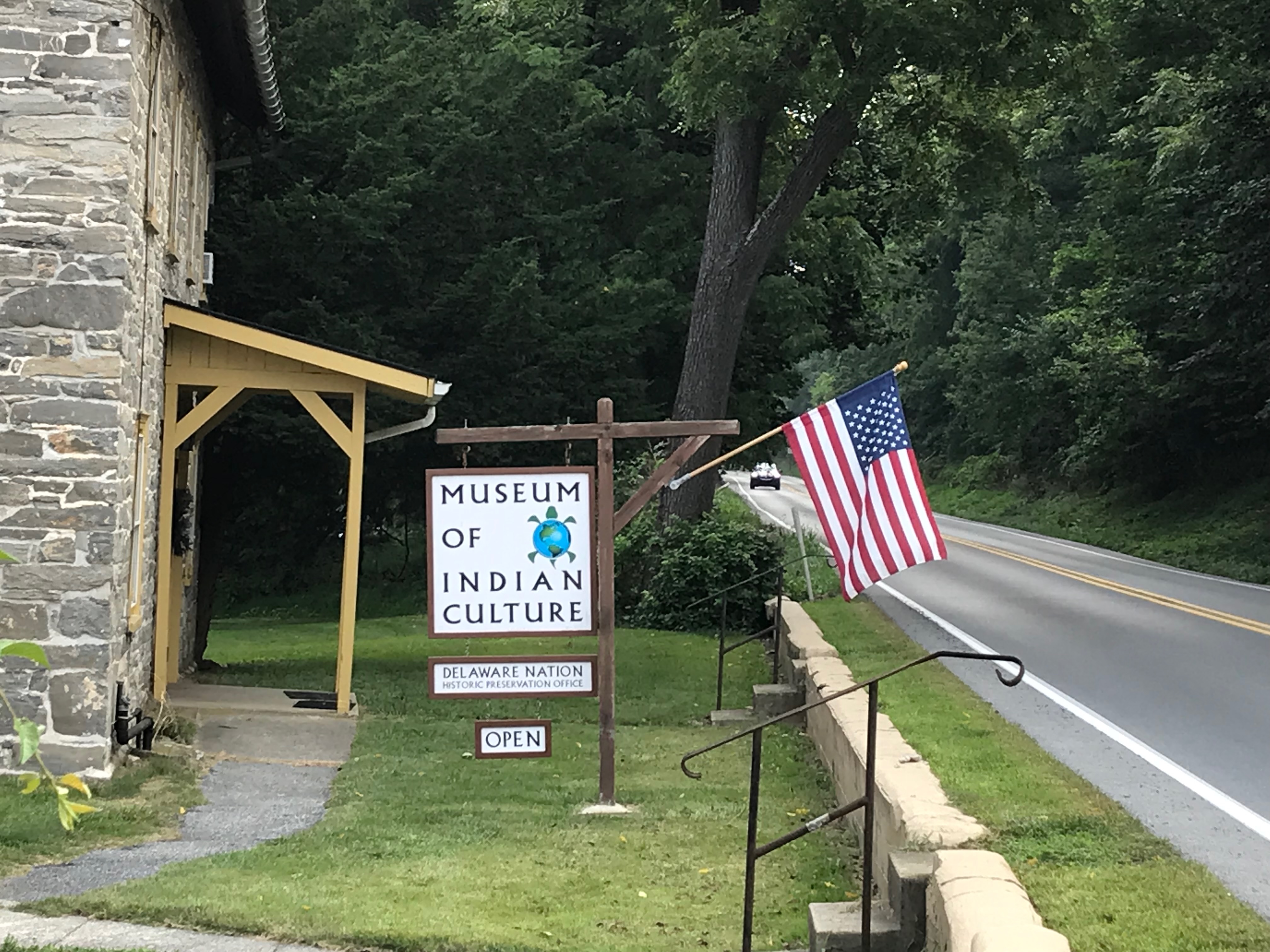
The thing about local attractions is that residents seldom have time to visit them.  Weekends are busy with the tasks you can’t accomplish otherwise with a 9-2-5 and being a “homeowner” is more like being owned.  Nevertheless, one Sunday afternoon we ventured to The Museum of Indian Culture, just south of Allentown.  I’d known about it for a few years, but wasn’t sure what to expect.  Occupying the house built by the Bieber family (not the singer, but the local bus-owning company that died during the pandemic) way back, the museum is small, but intimate.    The docents are unstinting with their time.  This is Lenape tribal land and the museum houses some local, and some national, pieces.  It also has a very extensive library.  

Often it’s difficult to feel proud of being of European extraction.  So many crimes were committed during the period of colonialism (and are still being perpetrated) that you just want to apologize over and over when you meet an American Indian.  The thing is, every native American I’ve met has been gracious and kind.  They still feel connected to the land in a way that seems foreign to Europeans.  Colonialists (and present-day capitalists) saw (see) the land as for exploitation.  We are slowly, hopefully, coming to realize that the indigenous way of living with the land is far more sustainable than the conquering attitude that metal smelting and gunpowder gave.  I kept thinking, what would it be like if people we didn’t even know existed showed up and just started taking everything for their own?  And claiming an all-powerful deity had given it to them?  Wouldn’t we fight back, just as the first Americans did?

I was especially hit by the hypocrisy of it all.  The code talkers helped win the Second World War.  As our docent said, at the Carlisle Indian School Indians were severely punished for speaking their native language.  They were being Christianized, of course.  Then, during the War the military realized we have a treasure-trove of languages that nobody else in the world speaks.  Suddenly their languages were an asset to be exploited.  Native Americans proudly served (and serve) in the military.  It is actually their land they’re defending.  We spent an educational hour in the small museum not far from property we “own,” according to a law code of “right behavior” drafted by others.  You might be able to leave places like this small museum, but they don’t leave you.


Word Undefined

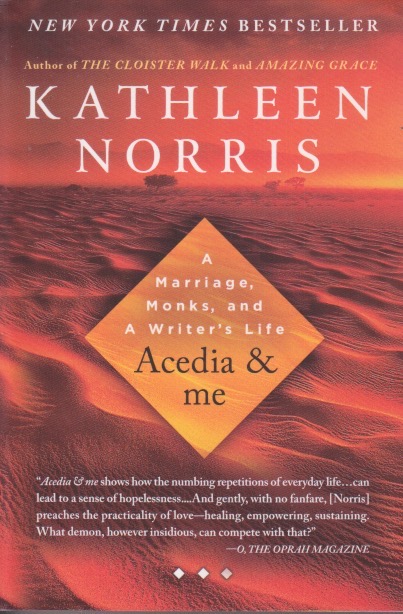
It’s one of those amorphous, uncommon words that can be devilishly difficult to define.  It’s also a churchy word.  “Acedia” was considered both a sin and a demon by various monastics, although the basic idea is listlessness.  Kathleen Norris has made her mark as a spiritual writer, and my wife and I have read a few of her books.  Dakota, her first non-fiction, was stunning.  We just finished Acedia and Me: A Marriage, Monks, and a Writer’s Life.  It revolves around this concept of acedia and for a writer to admit it, it seems, takes courage.  But the question that remains unresolved for me is whether it really exists.  It seems that acedia was devised by monks to name their ennui with monastic existence.  When all you do is pray there comes a time when you just don’t want to.  Or can’t.  They called it acedia.

There is a rich vocabulary for such states, reminding me of The Dictionary of Obscure Sorrows as well as the Existentialist literature I grew up reading.  I think of Kafka.  Of Kierkegaard.  Of angst.  Of boredom.  More to the point in Norris’ case, writer’s block.  This is a terribly personal book for her.  She describes the death of her husband and coping with widowhood.  And on top of it all, that dreaded block of inspiration that is a plague upon writers.  Interestingly enough, the book took me back to my Nashotah House days.  Norris, as do many monks, appreciates the slow reading of the Psalms.  One of the points of contention at Nashotah House—I kid you not—was how long to pause between the halves of the verses in the Psalter.  But is this a demon or only human nature?

“The noontime demon” was another common term for acedia.  This connects it to yet another of its aspects: depression.  We tend to think of depression as a clinical problem, but Norris explores the possibility that it’s a spiritual problem.  Some claim acedia as a sin, as I’ve noted, which shoves it back on the experiencer.  Norris has some interesting definitions of sin in her exploration.  Tellingly, in an appendix she presents the Webster’s Dictionary (1913) words related to acedia and there are over 100 of them.  And these words range from lust to world-weariness.  Is the word too promiscuous to be really useful?  For a writer like Norris, influenced by monastic practice, a poet by trade, and yet a writer of New York Times bestsellers, she makes the word fit.  There’s much to ponder here.


Another Host

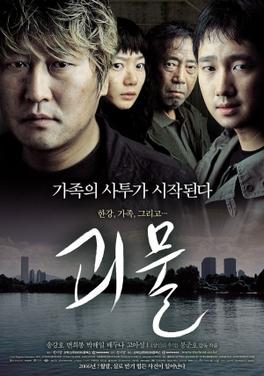
Several months ago I wrote about The Host, a movie I enjoyed but had watched by mistake.  By that I mean that someone had recommended The Host (2006) and I watched the completely unrelated The Host (2020).  (You can’t copyright titles.)  I waited long enough that the right Host became available on a service I use so it was, in essence, “free.”  This one is a Korean monster movie, directed by Bong Joon-ho.  I’d previously seen his excellent Parasite, and The Host didn’t disappoint in either the social commentary department or in the heart-felt monster tale.  In the latter department it has some common ground with Godzilla Minus OneThe Host begins with chemicals poured in the Han River causing a mutation that becomes a big problem.  This monster kills many, but the story focuses on the Park family where a ne’er-do-well father (Gang-du) disappoints his daughter and siblings.  Then the monster carries off his daughter.

The government, wishing to hide the origins of the creature (an American military facility did the chemical dumping) invent a virus story to keep people away from the river where they have trouble locating the monster.  Meanwhile Gang-du learns that his daughter is still alive, being kept as a future meal in the creature’s lair.   His father, sister, and brother all come together to try to find her, having to work around the corrupt government response to the crisis.  In other words, there’s a lot going on here.  The monster is believably rendered and its interactions with crowds of people don’t strain the imagination.  I do have to wonder if the creators of Stranger Things were familiar with this film.  Again, there’s some overlap there.  There are some holes in the plot, or it may be that I didn’t quite get everything (quite likely regardless).

It’s easy to see why the movie won so many awards.  The question that haunts me is whether this is a horror movie or not.  There are definitely horror aspects, but the overall feel is a meaningful monster movie, which isn’t really a recognized genre.  Monsters sometimes—often, in fact—bring out the best in people.  Without giving too much away, we can say that about this movie.  A family torn apart is reunited by a monster.  It doesn’t end well for them, but they have learned something by the experience.  And the movie is impressive from a cinematic perspective as well.  So now I’ve had two Hosts and although quite different from each other, both are recommended.


From God’s Mouth

If book banners would actually read the book they claim to protect, the Bible, they would run across the account of Jehoiakim and Jeremiah.  It’s in Jeremiah 36, if you care to follow along.  Jeremiah was not a popular prophet.  In fact, he was often in trouble for speaking what God told him to say.  He wasn’t wearing a “Make Israel Great Again” cap.  In fact, his message was that the kingdom of Judah had to fall in order to be restored.  So in chapter 36 he dictates his message, straight from God, to Baruch, his secretary.  Baruch reads the words in the temple and this comes to the notice of the royal staff.  They arrange for a private reading and it scares them like a good horror novel.  One of them reads the scroll to the king, Jehoiakim, who cuts off a few columns at a time and burns them in the fire.

My favorite part of this story has always been the coda: “Then took Jeremiah another roll, and gave it to Baruch the scribe, the son of Neriah; who wrote therein from the mouth of Jeremiah all the words of the book which Jehoiakim king of Judah had burned in the fire: and there were added besides unto them many like words.”  Many like words.  So we have book banners around the nation trying to stop children from reading.  The hope is they will become unreading adults because reading expands your mind.  Jehoiakim was a book banner—a book burner, in fact.  But the response from God himself is to write the whole thing over and add many similar words.  

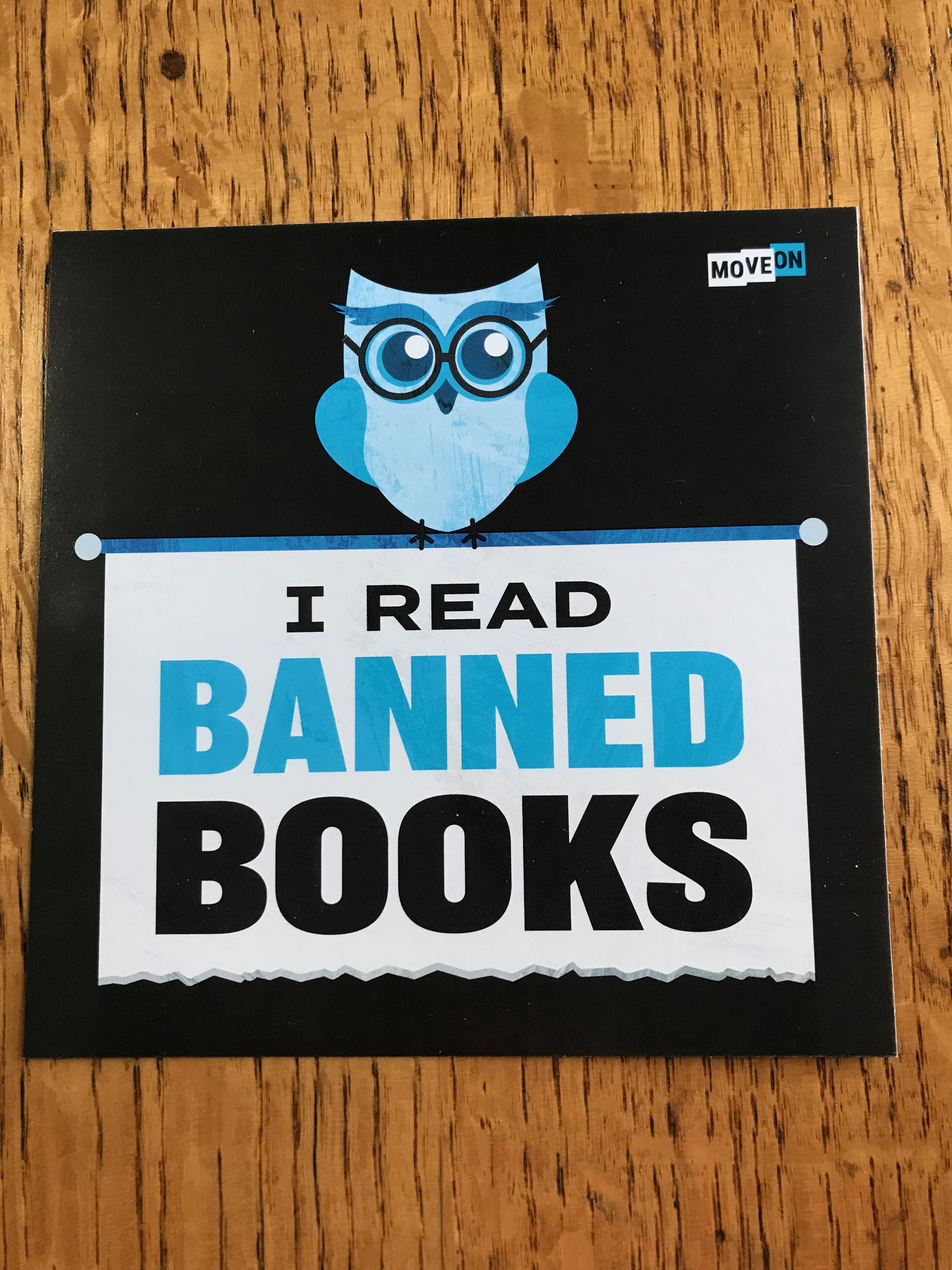
The Bible has been, and still is, fairly constantly abused.  What it seems to be is unread, at least by those who use it to stop other books from being read.  I came to believe, while majoring in religion in a conservative college, that if literalism was truly from God there would be no way to stop it.  I took a route unlike my classmates, who tended to go to the most conservative seminary they could find to have their minds further closed.  I figured that if it was true then testing it by reason couldn’t hurt it.  It’s pretty obvious the way that turned out.  I don’t stand with book banners.  This is Banned Book Week.  Read a banned book.  Stand up to those who do the banning.  And if you need something to convince them that their tactics don’t meet with divine approval, point them to Jeremiah 36.


Liminal Time

Considering the number of people who declare autumn their favorite season, the equinox receives pretty slim press.  This year it falls on the 22nd and, as always, it is one of the four quarter days of the pre-Christian European calendar.  Even among pagans it seems not to have had the same level of celebration as the other solstices and equinox.  I sometimes wonder if that’s because things are generally good already in September.  The intense heat of summer is over but the chill of October hasn’t yet arrived.  We stop using the air conditioning and don’t have to turn on the furnace.  It’s the Goldilocks month.  It’s part summer when living is easy, and part fall when the world is beautiful.  Like its fellow quarter days it is truly a liminal time.  

Liminal periods are always good for reflection.  No matter how much I want to savor this time of year, I have a feeling that it always catches me off guard.  There are changes afoot.  Starting Monday it will be dark more than it is light, and that will hold true until the sister equinox visits us in March.  These longer nights have traditionally made room for ghosts and goblins.  If we haven’t begun to store up supplies for winter, now is the time to start.  It’s the season when we all believe in magic, if just a little bit.  I’m one of those people who finds melancholy somewhat lovely.  It’s not depression (believe me, I know!), but a kind of happy sadness that the season itself is ephemeral.  Pretty soon people will be watching scary movies, but not quite yet.

Harvest is a joyful, spooky time.  Those trees that have been green since April now put on their colorful winter coats but soon will spend the colder months bravely naked.  Snow may come.  Fall is a prophetic season, warning us of what might come.  Monsters may be set free from their chains.  And yet there will be cozy indoor holidays when we can hunker down and recollect the year that has just been spent.  There’s a wisdom to seeing the quarter days as the spokes on the wheel of the year.  Like many wheels already rolling it’s futile to attempt to stop them.  They’re moving us to the next place that we’re meant to be.  It’s true that the autumnal equinox falls on a weekend this year, but it does seem to me a natural holiday.  And a time, like all holidays, for reflection.


Burial Zone

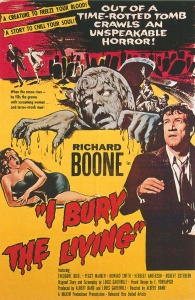
I don’t always believe the statistics.  Numerically, the number of horror films—depending on how the term is defined—declined into men (and sometimes women) in rubbery suits in the 1950s.  Indeed, it’s often opined that had not Hammer joined the horror business in the mid fifties that the genre born only twenty-something years earlier might’ve died out.  There seem to have been some good horror films made then, though, even if overlooked because of their B status.  A friend recently directed me to I Bury the Living, after reading my post about Carnival of Souls.  I have to confess to having never heard of I Bury the Living.  (Stephen King mentions it in Danse Macabre.)  Produced as a B movie it was itself buried among the various other efforts of the late fifties.  It’s not a bad movie, however.  In fact, it’s better than the title might lead you to believe.

The plot is something of a period piece—a well-respected department store supports a cemetery committee for Immortal Hills, the town’s graveyard.  Robert’s turn as chairman of the committee arises and he tries unsuccessfully to get out of the duty.  The caretaker, Andy, doesn’t want to retire, but he’s aging out.  The movie, however, revolves around the map.  The sold plots are marked with white pins while the plots already occupied have black.  When Robert accidentally puts black pins into newly purchased plots and the couple dies, he believes he’s cursed with an ability to kill those he black pins.  He substitutes a black pin for a white one at random.  The person dies.  In all, seven people succumb.  Convinced he’s murdered them, Robert decides to bring them back to life but putting the white pins back.  Only at this point does Andy confess that he’s been killing the victims in retaliation for being forcefully retired.

The ending is a little weak, but the psychological tension as it builds up is believable.  One critic compared it to an extended episode of The Twilight Zone, a comparison that has also been made for Carnival of Souls.  I would concur with that observation.  Although Twilight Zone wouldn’t air for another year, that kind of unsettling tale was already in the air.  No zombies appear, but the palpable belief that they might is what really makes the horror work in this instance.  The first half is an eerie story, but when Robert sticks in that first white pin a shift takes place.  Of course, modern viewers have been primed by Night of the Living Dead, so we know the possibilities.  Perhaps the power of Night gives life to older movies.  After all, anything can happen in the Twilight Zone.


Dancing with King

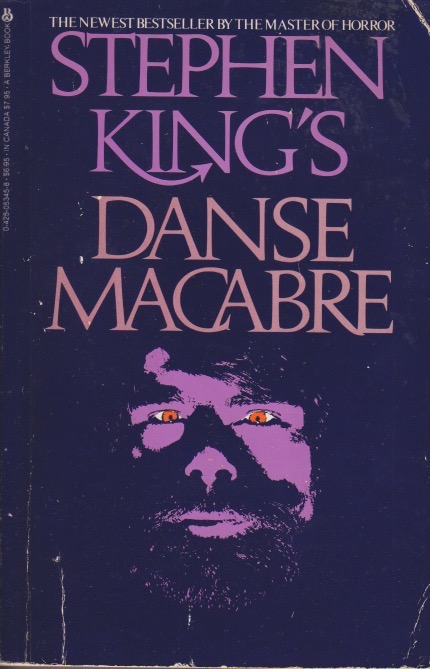
There are books you wait too late to read, but which you read at just the right time for you.  That’s how I feel about Stephen King’s Danse Macabre.  This book is endlessly cited in more academic treatments of horror and I knew I should read it.  And one thing I immediately appreciated is that even early in the eighties King expressed my long-term concern: many genres fall into horror.  He, perhaps rightly, considers horror a subspecies of fantasy.  Or course, fantasy has come to mean something quite different in the intervening half-century.  Still, the reader is treated to thrillers, sci-fi, and weird fiction.  There’s also a dose of the gothic and speculative as well.  King sets his four classes of monsters early: the vampire, the werewolf, the thing without a name (Frankenstein’s creature), and ghosts.  These are all very broadly conceived.

It will become clear in coming weeks, for anyone who’s interested, that the movies I “review” here have been influenced by King’s list.  And in the longer term, the books as well.  And I tend to agree with King’s antipathy toward television, although I disagree with his assessment of The Twilight ZoneDanse Macabre is a book of its time, of course.  I would be curious as to the master’s reaction to such more recent classics as The X-Files.  I loved that he treated Ray Bradbury as a sometime horror author and it becomes clear that each of us finds different things scary.  The thing was, I found myself anticipating my too scarce reading time each day for the month it took me to read the book.  I often start books that I soon find myself approaching with a kind of duty to finish.  Love him or not, King is a talented writer and will keep you coming back, just like birds to a feeder.

I learned that King, too, appreciates bad movies.  He grew up about a decade and a half before I did, but the small-town culture I experienced as a child was not so different, although Sputnik was already up and the Cold War already on.  I guess what I find so engaging here is that this is a guy who speaks my language.  My tastes differ, of course, but there’s something comforting about whiling away the pre-dawn hours with a guy who can say “The Thing” and you know immediately what that vague phrase means.  And it was strangely reassuring to be reminded that the world of the seventies, which I experienced as a teenager, was just as scary as the world is right now.  And if King ever looked me in the eyes, I think he’d recognize something about me, although a sometimes critical fan.


Science of Convenience

One thing I’ve noticed about employers is that they’re all for science, except when science contradicts capitalism.  Then they become all mystical.  I had a situation illustrate this particularly well with one of my many employers.  Touting everything to be “evidence based,” they liked to refer to the science behind their reasoning.  Then a study came out demonstrating, scientifically, that more breaks actually increase efficiency in learning and working.  Suddenly silence from management. Crickets chirped.  This observation was just as “evidence based” as daily operations, but it was ignored because, well, it would be giving too much to employees.  You see, science that benefits the upper levels of management is one thing, but by the time it trickles down, well, you know.

American culture is based on the premise that you need to drive people to work as hard as possible.  Perhaps anecdotally, the Covid-19 pandemic showed that workers at home were just as, if not more, productive than they were after enduring an often horrendous commute to get to the office.  Once pandemic strictures began to lift, however, it was all “we want you back in the office.”  Bosses like to look out over seas of employees in their cubicles and feel the surge of the galley master with his whip.  You need to keep workers in line, you understand.  That’s the way capitalism works.

I often wonder where the world would be if superpowers didn’t have cultures based on greed.  One of the seven deadly sins, or capital (!) vices, the worship of personal gain stands behind capitalism as we know it.  And we’ve seen the results.  A shrinking middle class as those with all the wealth make plutocracy out of what was intended to be a democracy.  (Of course, the wealthy founders of the country probably didn’t have a real grasp of what life was like for the poor, even at the start of things.)  Capitalism is good at using aspects of all human endeavors in order to increase its reach.  Science is one such tool.  Religion is another.  Science says more time off is good, and can increase productivity in our current world.  Religion says greed is evil.  These are the parts we’d like to ignore.  Even the Harvard Business Review suggests a four-day work week is beneficial.  Business leaders are skeptical, of course.  Skepticism is one of the elements of science.  And science can be very profitable, if it favors those who hold the reins of power.

Photo by Alex Kondratiev on Unsplash

Other Worlds

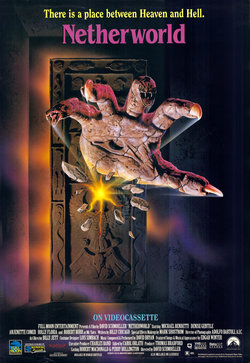
There are any number of movies out there, and you find some that have evaded much comment by checking out the freebies on Amazon Prime.  That’s how I found Netherworld.  It’s not a great movie.  In fact, it’s about the opposite, but it is more southern gothic and since I’ve been watching Louisiana horror, well, why not?  It was free.  The story doesn’t make a whole lot of sense, which is a pity because the ideas seem to have some potential.  So, Cory Thornton has inherited his father’s Louisiana estate.  He didn’t know his father and the estate is run by an improbable staff of one.  (One suspects a low budget had something to do with that.  For the film, not diegetically.)  The estate abuts a brothel where one of the employees turns evildoers into birds with the help of magic.

Meanwhile, the young master finds hints how to raise his estranged father from the dead, which, for some reason, he decides to do.  There are dream sequences and perhaps shades of Papageno.  Lots of birds in this film.  Cory—not very bright—only discovers late in the movie that his father was evil.  Hm, no hints of that in his admitted sexual dalliances and his desire to be resurrected.  No siree, none at all.  By the end I wasn’t surprised to learn that it was released directly to video.  But I was led down the rabbit hole by David Schmoeller, the director.  Schmoeller has received notice of such people as Stephen King, and has given the world some notable cult movies.  It’s fair to say he never made it big in Hollywood, but he worked on some films of repute, even drawing in Klaus Kinski at one point.

There are several tiers to the creative life.  There are those who attain fame, and layered down from them, those who produce movies, songs, novels—any kind of creative output—to those most of us have never heard of.  I find this profoundly hopeful.  Nobody is known to every single person on this planet.  Even the famous aren’t known by everyone.  I like to think I’m reasonably informed, but I keep on hearing about celebrities in art forms I don’t follow and have no idea who they are.  So before watching Netherworld I never paid attention to David Schmoeller, but then I learned he’d nevertheless made a career out of doing what he enjoyed, without becoming a famous director along the way.  There are some practical obstacles, of course.  Getting that first book published, or first movie distributed, but if you can get over that wall there may be a possibility of doing what you like.  It may not make you rich, but you’ll have accomplished something important.


Slow and Spry

Businesses seem to want to move at light speed.  At least some do.  When I see that happening I think, “their strategy must be to make a fortune quickly so that when the unthought-through idea collapses they can move on to the next thing.  When I hear words like “agile” being tossed around I translate “reckless.”  Just over a century ago my ancestors were scraping out a living farming, and they got along okay.  Our acquisitiveness has outstripped our sense.  I read quite a bit about being satisfied with little.  Of course, I work in the “business world” where such ideas are anathema.  Even universities have decided to jump on the Titanic.  What could possibly go wrong?  My experience at Nashotah House was decidedly mixed.  One thing I always appreciated was the contemplative (i.e. slow) pace of things.  I may not be orthodox but I’m hardly reckless.

Perhaps buying the farm isn’t such a bad idea.  I’m afraid that I don’t have enough practical knowledge to raise my own food, even though I’m a vegan.  You see, for the things you can’t raise in the soil you need to sell surplus so that you can buy things.  Or rent movies.  And that takes business sense.  And businesses want to move at the speed of light.  I may be neurodiverse, but it takes me a while to process things.  I watch older movies.  I read slowly.  I think things through.  I do believe that businesses that last a long time have survived by moving a bit more slowly.  Like a tree.  By thinking things through.  The Vatican has been in business for a couple thousand years and they seem to be doing okay.  I could be Catholic were it not for doctrine.

I’m not the smartest guy around—not by a long shot—but I am a strategic thinker.  Strategic thought can be deep.  And counterintuitive.  And it doesn’t always lead to the desired results.  (I don’t even have a small college post, so that much is obvious.)  I’m content to let people pass me on the highway.  I don’t have to be first to market, as the saying goes.  I’m more in it for the long haul.  It hasn’t landed me wealth or fame, but I can spend a little time writing every day.  I get to watch movies that make me feel good.  I even get a book or two out the door.  Being agile is fine, but only, imho, if you think it through.