Out of Time

I don’t know about you, but I seldom think of Venezuelan cinema.  I feel a strange satisfaction, however, that the highest grossing movie produced in that country was a horror film.  It’s possible to find The House at the End of Time in streaming services, with subtitles.  And it’s worth doing.  It’s a movie that will stay with you.  Intricately plotted and having a lot of heart, it’s a story of loss and redemption.  After an apparent break-in at her house, Dulce is accused of killing her husband and son, and is sent to prison.  We’re shown, however, that she found her husband already dead, or nearly so, and that her son had been stolen away by a mysterious force.  After three decades, given her age, she’s released to house arrest.  A neighborhood priest becomes interested in her case, believing that she’s innocent.  It’s the house, it seems, that is haunted.  Previous families who lived there experienced similar fates.
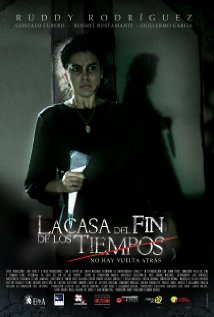
I won’t spoil it for you, but this is a horror film with heart as well as smarts.  It also explores the life of the poor and learning to live with past mistakes.  It’s a story about a family.  Unlike many horror movies, the protagonists aren’t “all things being equal,” middle-class people.  In this regard, it reminds me of The Orphanage and The Devil’s Backbone—also both Spanish-language horror films.  And there’s a verisimilitude about the poor as the ones suffering the effects of haunting.  Now even that has become a trendy commodity.  A house haunted sometimes increases in value as ghosts become gentrified.  Obviously, ghosts can haunt anyone, but there’s almost a parable aspect to them.  Sometimes ghosts are all that the poor have.

That may be one of the reasons that The House at the End of Time is also Venezuela’s most internationally distributed movie.  And the reason that an American production company is working on a remake (presumably in English).  The ghosts here aren’t what we’ve come to expect, but religion plays a large part in the movie since the priest pays special attention to Dulce.  The reason why is eventually explained, but he is a non-judgmental cleric.  He attempts no exorcism.  Instead, he researches and seeks to find an explanation for what is happening at this most unusual house.  Catholicism is a large part of the culture in Venezuela, and I do hope that the remake doesn’t remove it.  A sympathetic cleric is often difficult to find.  And in this case, one that really pays off.


Festival Spirit

Festivals.  These common events, often outdoors, are ways to be around other people while not really seriously engaging them.  I spend a lot of time by myself, or alone with family.  We don’t know many folks locally (I’m pretty sure very few locals read this blog), so online community is often how I connect.  Still, even we introverts crave the human touch now and again.  In October we attended the Covered Bridge and Arts Festival in Bloomsburg, Pennsylvania.  It is one of the largest free festivals on the east coast, and just a couple of hours from us.  While there, we learned about the much smaller Riverfest in nearby Berwick, held the same weekend.  We decided to stop there on our way home.  The thing about craft fairs is that you get used to seeing pretty much the same kinds of things over and over.  That’s fine, because we’re here for the atmosphere.

At one of these events, while my wife and daughter were examining the wares, an owner came up to me (I was just outside the tent) and said, with a bit of surprise and wonder in his voice, “You have the spirit of God.  You can tell someone who does.”  Now, this can be a sales ploy, of course, but he seemed sincere.  He really didn’t nail my spirituality, but he was correct that I am a very spiritual person.  Given his talk of Jesus, I suspect he’d have been put aback if I told him that horror films are one form of spiritual practice for me.  So I remained relatively noncommittal until he turned to my wife to tell her about the products in his tent.  Still, the encounter left me reflective.  I don’t think myself any kind of spiritual guru, but I have been singled out by a number of people over the years and I wonder what it is that they see.

Some New Agers suggest we all have auras.  That’s generally considered paranormal, of course.  I’ve known people, however, who’ve been accurately “read” by strangers who seem sensitive to such things.  Or are extremely good at cold reading.  When I go to a festival I don’t mean to have my aura showing.  I spend a lot of time alone, so maybe I’m hiding my aura in my house.  No neighbors have complained about the light pollution, in any case.  I admire those who see something special in strangers, even if it’s an attempt to get them to buy something.  That’s why we go to festivals, I guess: to have a kind of spiritual experience that comes from being with others.


Bodies Cubed

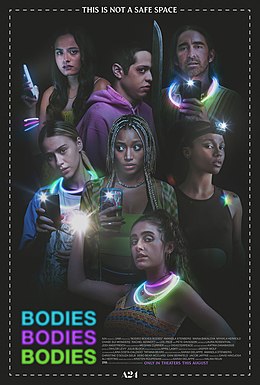
It’s difficult to know where to start with Bodies Bodies Bodies.  It was on my watchlist because it was distributed by A24.  I’ve come to trust them for smart horror, and then I saw that the movie was soon leaving one of the streaming services to which I have access.  Nothing like “leaving soon” to make a decision for you.  An ensemble cast of twenty-somethings (or so they play) gather for a hurricane party at the mansion of one of the group.  They do a lot of drugs and drinking and then decide to play Bodies Bodies Bodies—one of those games where one player is the killer and everyone else has to figure out who the “murderer” is.  They’re about ready to start the next round, but the power goes out in the hurricane.  The accused “killer” in the first game is found, dying for real, outside.  The only car on the property has a dead battery and the friends turn on each other, unsure who the murderer might be. (No bodies are actually cubed.)

All of this is interlaced with internet culture and the panic that ensues when the wifi goes out.  Now, this is categorized as a horror comedy, but the comedy is pretty subdued until the remaining four begin to accuse each other, using trendy jargon to describe relationships and psychological conditions.  The film opens with a couple of girlfriends, Sophie and Bee, who are the last to arrive for the party.  As the morning dawns the two of them are the only survivors, but they have become distrustful of each other because of things said during the hurricane night.  There is a twist ending but the house is full of bodies, bodies, bodies.

Written and directed by women, this horror film again demonstrates how intelligent the genre can be.  As for me personally, I found it pretty good.  I wouldn’t say it’s great.  That’s because of some of my own triggers—one of the trendy words they throw around.  Mainly, in my case, because of the drug scene that makes up the reality of the friends (I’ve never been part of that) and that the game resembles too much my all-time-most-feared childhood game, hide-and-seek.  The friends, convinced that one of them is a murderer, creep around the mansion in the dark, fearful of being found.  This leaves open the potential for jump startles, of course, and I’m not a great fan of surprises.  That having been written, this is a smart movie and the ending does make you think.  And perhaps wonder how well we really know anyone after all.


Paranormal Religion

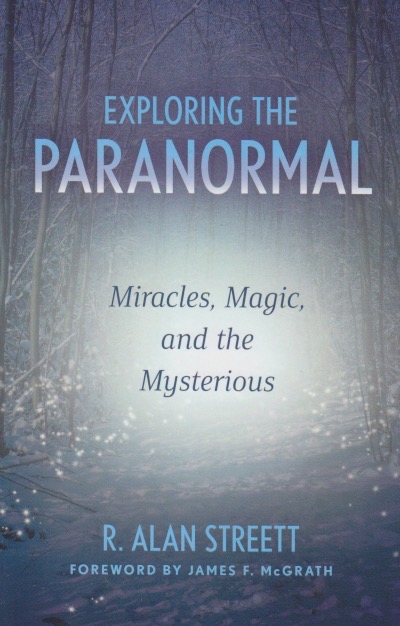
I remember well what it was like to be an evangelical.  Measuring everything by what I thought the Bible said, fearing those things that seemed to come from outside.  Being very concerned with salvation and its opposite.  At the same time, I was fascinated by the paranormal.  As I child I was teased for these interests and subsequently buried them.  Then I had a slow, protracted, and continuing waking from dogmatic slumber.  So it is natural that I would want to read R. Alan Streett’s Exploring the Paranormal: Miracles, Magic, and the Mysterious.  I didn’t know how he would approach the subject, and I didn’t know where on the evangelical spectrum he fell.  Still, I’m always interested to see how others handle what we all know—strange stuff happens and there is no real explanation for it.  Scientific method may one day be able to address some of it, but at the moment it generally falls outside the bounds.

Streett’s book is somewhat autobiographical, from his non-religious childhood, believing in parapsychology, through seminary and having an evangelical awakening, to the point that he stopped supposing such things were demonic, and on to where he stands at the moment—thinking that most such things can be explained by brain science and alternative states of consciousness.  There are a number of interesting situations and concepts described in this book; I learned quite a bit when he discussed different brain states.  I understand his theological rejection of potential realities behind the phenomena he discusses (mostly mediumship, but also reincarnation and faith healing) but don’t always agree with the conclusions.  There is much in the world that theology can’t explain.

Something that is perhaps overt between the covers, is that the paranormal is something that happens to evangelical, liberal, Muslim, Jew, Hindu, Buddhist, atheist, agnostic, and none alike.  What differs is the interpretation, based on various faith traditions and their tolerance for that which is outside.  Evangelicalism is a worldview, perhaps more so than it is a theological position.  Non-divine miracles, or whatever you want to call paranormal occurrences, don’t fit comfortably into that worldview.  Other interpreters, also raised in Christian traditions (Catholicism, for example, is quite open to mystical happenings that can fall into the paranormal category), might approach the question in a different way.  Dialogue is important, however, and trying to make sense of this world we live in, in my humble opinion, has to reach outside the reductionistic view that brains alone account for human experience.  Streett’s account offers a reasonable perspective on the issue from an evangelical outlook.


Hiding Kirk

I recently saw—don’t ask where—a U.S. Space Force officer dressed in camouflage.  How fitting for a Trump-era agency.  I should think a Space Force uniform should be all black, maybe with little white dots on it.  Rather like my black lawn furniture that got in the way when I was cleaning my paint sprayer full of white paint.  I often wonder about our love affair with feeling safe.  Perhaps my own phobias have reached such a level that they’ve cancelled each other out.  If I was trying to hide in space, I think I’d try to look small, and dress in black.  Camouflage, which is based on colors found down here, probably wouldn’t do so well for the other planets of our solar system.  Or even the moon, for that matter.  And I personally think I might trust the aliens not to have earth-like issues.  After all, we think it’s okay to let machines think for us.

I grew up quite the sci-fi fan.  I read lots of books in that genre and enjoyed science fiction movies almost as much as my beloved monsters.  I used to watch that show, UFO in the 1970s.  The one with the interceptors with a huge missile on their noses.  I wasn’t really worried about aliens trying to invade.  Perhaps these days I think it might be better than the tedium of daily existence in the 9-2-5 world.  In any case, if we must have a Space Force, ought they not dress for the job?  I’m pretty sure I’ve got some tin foil in the kitchen with which to construct my hat.  Let’s look the part—that’s all I’m saying.

Photo credit: NASA

While all this is going on speculation has been growing about water on Mars.  There’s a good chance we may find it.  (We can always hope that if Elon Musk makes it to the red planet that he will take Donald Trump with him.)  If we are looking for invaders, though, we probably have to go further afield.  That’s alright, dynamic duo, we’ll get along without you.  Perhaps in the interim someone will realize that, dressed in earth green camouflage, our Space Force will surely stand out against the surface of Mars, or wherever they might go.   Unless it’s a planet very much like earth.  That houses intelligent life.  Maybe the beings there feel safe, knowing that their space force—for surely they will have one—is dressed in black.  Or at least, their life really is intelligent.


Hunting

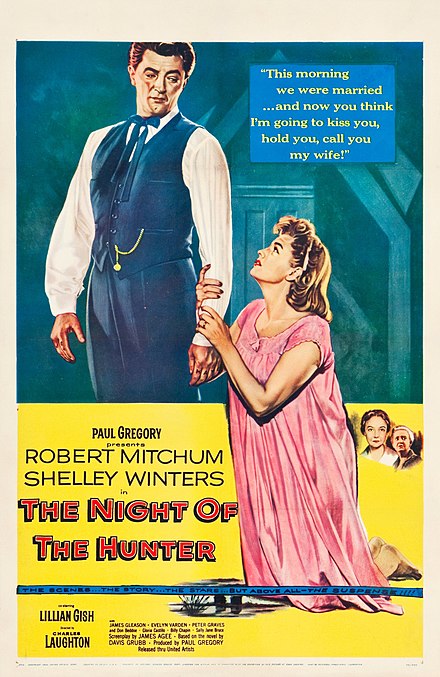
Every once in a while, I see a movie I should’ve seen a long while ago.  The Night of the Hunter is one such film.  Knowing little about it, I watched and was floored.  Not only could I have used it in Holy Horror (oh boy, could I have!), it uncovered a bit of cinema history for me.  Even just the words “love” and “hate” tattooed on Harry Powell’s knuckles have been referenced in so many places that I felt like I’d been missing a vital clue all along.  Since the movie’s now available on free streaming services, there’s no reason not to see it.  Although not generally considered horror, it is one of the genuinely scary movies of the period.  And it’s a strong blend of religion and horror, even if classified as a “thriller.”

Taking inspiration from a true story, the “Bluebeard” character of Harry Powell is a serial killer.  Styling himself as “the preacher,” he murders widows for their money.  An avowed misogynist, he’s driven purely by greed and love of violence.  Yet everyone accepts him—except children—for what he says he is during the Depression era.  He gives sermons, sings hymns, and leads revivals and even his victims come to believe what he says about himself.  This is such a good commentary on the thoughtless acceptance of religion that it’s no wonder that it was a flop in the fifties.  Since then it has become considered one of the greatest movies of all time by many.  The seamless weaving of terror and religion hearkens once again to the wolf in sheep’s clothing.  Some lessons we never seem to learn.  Nobody likes to admit to having been fooled.

In character, the closest comparison I could make would be Cape Fear, which stars the same Robert Mitchum as villain.  That movie I saw in time to include in Holy Horror.  In this one, the only adult who seems capable of seeing through Powell’s lies is a religious widow who informally adopts stray kids during the Depression and raises them with the Bible.  She also keeps a shotgun handy, just in case.  The image of the preacher slowly approaching, singing “Leaning on the Everlasting Arms,” is the stuff of nightmares.  I suspect that one reason that seminaries developed in the first place is that the laity weren’t encouraged to trust self-proclaimed religious teachers.  Of course, the town turns on the preacher once they learn, because of the children, who he really is.  If, like me until today, you haven’t seen Night of the Hunter, I can recommend it.  Especially if you have an interest in how horror and religion cooperate so nicely.


Vlad Fest

I may or may not have read at least part of this book before.  When I found it at a used book sale somewhere, it looked familiar.  Having read it, I’m not sure if it was the same one as before.  There are certain parts that I would’ve thought a high schooler would have remembered.  I recognize the names of the authors, Raymond T. McNally and Radu Florescu.  You see, one of my senior term papers in high school was on vampires.  Unable to afford books, my research was done in the school library and this book is old enough to have been in the collection.  While the subtitle, A True History of Dracula and Vampire Legends, may seem to indicate a book primarily about vampires, In Search of Dracula is mainly about Vlad Tepes, or Vlad the Impaler.  I can’t imagine myself wading through all the Romanian history in high school.

You see, I remember reading a book on the history of vampires.  The strongest memory is of reading it in our church sanctuary.  Lest you get the wrong idea, I was very involved in our youth group.  We occasionally had chaperoned sleepovers at the church and I had already had a leadership role, serving on church committees and district and conference-level events.  Nobody had a problem with me sitting in the sanctuary.  On one of the sleepovers, I awoke early (as I have always tended to do), and I went to the sanctuary to read the book by the dawn’s early light streaming through the stained-glass window.  I have kept a look out for the book, and I thought this might have been it.

I’m pretty sure it wasn’t.  While this history does have a good summary of vampire customs and even movies, it takes a stout stomach to read the material about Vlad III’s reign.  Although he is a Romanian hero, he was a cruel man and his infamy was well established during his own lifetime.  I’m pretty sure that he would’ve been diagnosed with a mental disorder, had psychology existed then.  This book does trace his history and surveys various places associated with him.  One thing that might’ve been helpful would have been more maps.  The authors are clearly well versed in Transylvanian geography, but the average reader may not be able to find some of the many place names on the one map they include.  Otherwise, this is quite an informative book, mostly about Vlad, but with useful chapters on Bram Stoker and the vampire in the media up to the early seventies.


Locating Yourself

How do you come to where you spend your life?  It could be where you’re born.  I was born in Franklin, Pennsylvania.  Neither of my parents were.  On my mother’s side we had a tradition of wandering.  We eventually moved to Rouseville, a refinery town not too many miles from where I grew up initially, but very different in character.  I knew I wanted to get away.  I lived in Grove City next, only as a student.  For a short while I resided with some friends in the South Hills of Pittsburgh before moving to Boston to attend seminary.  Like many who go to Boston for school, I wanted to settle there.  I did so for about a year after graduation, making a living, such as it was, selling cameras.  My next move was precipitated by love.  I moved to Ann Arbor, Michigan to be with my fiancée, but I’d already been accepted to Edinburgh University, so an international move was imminent.

Roseville

Edinburgh, like Boston, is a spiderweb.  We would’ve stayed if we legally could have, but with a job market for academics already tanking, we headed back over the Atlantic.  My wife was a grad student at the University of Illinois, so we moved first to Tuscola (family there), then Savoy (on the outskirts of Champagne-Urbana).  Meanwhile I commuted to Delafield, Wisconsin, home of Nashotah House.  We eventually moved to Delafield and stayed until I was no longer wanted.  Our move to Oconomowoc was necessary to keep our daughter in the same school.  The possibility of full-time employment drew me to Somerville, New Jersey.  We would stay there until my daughter had a chance to graduate.  Depression convinced me that I’d run out the clock in that apartment, but a financial advisor suggested Pennsylvania, where I was born.  Thus we ended up in the Lehigh Valley.

I’ve liked every place I’ve lived.  If I had my druthers, however, I would’ve ended up teaching at a small college in Maine.  Several friends have moved to Maine as I’ve jealously watched.  The places we spend our lives, at least in my case, are determined by a measure of fate.  Nashotah House was the only job I was offered from Edinburgh.  Gorgias Press was the only job I was offered after the seminary.  Moving to my home state was volitional, of course.  As a couple we’d have been content in Massachusetts, Michigan, Wisconsin, or New Jersey.  Economics, of course, has a heavy hand in all of this.  I sometimes think that, if I could ever retire, moving to Franklin again would be a way of coming full circle.  But then, life is change and we end up, it seems, where we’re meant to be.  Perhaps Canada?


Not Fantasy

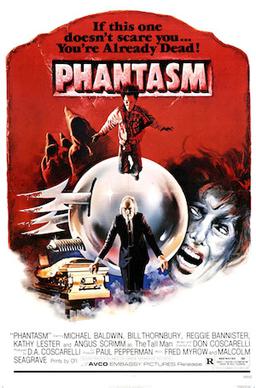
There’s a reason I watch horror.  One of the many things you can’t find online is how popular movies were before the internet days.  This is an issue for me because I only just now found out about Phantasm, which was released in 1979.  Granted, I lived in a small town, but I did know about The Amityville Horror—everyone knew about The Amityville Horror.  The films were released the same year, but Phantasm was an indie production and probably didn’t have reach into my local region.  Nobody talked about it at school and I only became conscious of it a few weeks ago.  I learned that it was quite a box office success, but the critics didn’t care much for it (and I can see why).  It was, however, rediscovered and has become a cult classic.  I can see that too.  The thing is, it is a bad movie.  I’m learning to appreciate such things.

Part of the reason the film bothered me is that I really dislike “but it was all a dream” endings.  Even though there’s a final suggestion that some of it “really happened,” or Michael is dreaming within a dream, such endings always make me shrug.  Horror, to really work, has to be in that liminal zone between believability while on screen and the deeper knowledge that it’s fiction.  Phantasm just had too many strikes against it to be believable.  The dwarves were lifted straight from Star Wars’ Jawa.  The Tall Man isn’t scary (this is from a current-millennium perspective, granted) and while you’re just trying to get into the horror mood (the music is appropriate) a flying ball of death, a sudden sci-fi element, is thrown in.  Of course, the plot takes a kind of sci-fi turn near the end.  It didn’t, however, do any heavy lifting.

I was surprised to learn that it became a franchise, no members of which I’d ever heard.  It is interesting that speculation exists that the creepypasta stalwart, the Slender Man, was developed from the Tall Man concept.  Given that I was seventeen when this movie came out it might be someone of my vintage—but from a different vineyard—would find Tall Man scary.  Of course, if I’d seen it when it was first out, and in a theater, I might’ve gotten some chills from it.  I could have included it in Holy Horror since there is some Bible in it, but it isn’t used to its full extent for a movie that mostly takes place in and around a funeral home.  There is some comfort in knowing that even if your work isn’t great, it can still be rediscovered if enough time passes.  And there’s good reason to watch it.


Firebrands

Although I’ve never lived there, I believe I have a fairly good idea of life in Ithaca, New York.  I’ve spent many, many days there over the past few years, often pondering how it is a city that would be an especially good fit for me, despite the fact I’m unhireable at Cornell and Ithaca College has never showed any interest.  It’s a liberal college town where even the street people appear to be educated.  The money of Ivy League students keeps it fresh and evolving.  And the shops in Ithaca Commons are set at eleven.  So it was that a headline in Publishers Weekly some months back caught my eye.  (I’m not behind only on movies, it seems.)  It showed a historical plaque for Firebrand Books, on the Commons.  The story stated that the plaque had to be placed on public land since the owner of the building where Firebrand started has a Christian prejudice against homosexuality.

I suppose I ought to take a step back and give a little history.  Firebrand was established as a feminist and lesbian publisher.  Its offices were on Ithaca Commons, but when the founder, Nancy K. Bereano, retired the press eventually found a buyer in Ann Arbor, Michigan.  (I have also lived in Ann Arbor, but for less than a year.  Likewise, it is the kind of place I felt instantly at home.)  Ithaca, meanwhile, wished to honor its contribution to literature and elected to put up a commemorative plaque.  The objection, however, was based on a particular reading of the Good Book.  (It must be stated that lesbianism is never explicitly forbidden in the Bible.)  To make a statement, the owner forced the plaque to the public domain.

We have a way of letting our prejudices become biblical.  I recently re-read 1 Corinthians—one of the infamous “clobber” texts for any number of people—and realized just how many of the words assumed to refer to “homosexuals” are words of uncertain Greek connotation.  King James, who seems to have preferred the company of gentlemen himself, was apparently not bothered by the text he had translated.  Of course, kings will be kings.  Our concern with sexual behavior is one of the hallmarks of our species.  We’re very concerned about how other people do it, even if it’s no business of ours.  And we consider it one of the highest moral concerns and a source of constant shame.  That was another thing that struck me while re-reading 1 Corinthians.  I wondered why Paul keeps coming back to it.  Maybe he was just being a firebrand.


Alien Invaders

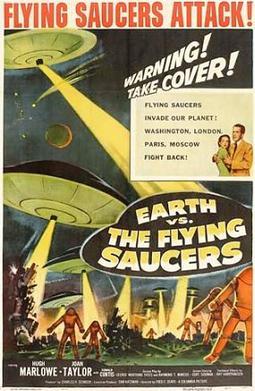
I’ve been pondering genre for some time now.  And since Stephen King assures me (not personally) that Earth Vs. the Flying Saucers is horror, I figured I’d give it a try.  In fact, given the various themes of the movie, I’m surprised I hadn’t seen it before.  The title pretty much gives it away—aliens try to take over Earth with a swarm of flying saucers.  Two scientists figure out how to make their saucers stall, and even though the aliens have a disintegration ray that pretty much destroys anything, the earthlings prevail.  Having summarized it all in less than a hundred words, is there really anything worth comment here?  I think so.

Like many older movies this one makes use of stock footage to fill in action sequences and to keep the budget reasonable.  So there are big guns going off and rockets being launched.  (This was a pre-Sputnik movie and it depicts America having eleven satellites in orbit.)  But the additional footage that stayed with me was a scene of two planes colliding and crashing.  It was clear these weren’t models and the footage was authentic, apart from the flying saucer shooting the planes.  It turns out that this scene was indeed real, and that the pilots of both planes died in the crash.  During an air show outside Spokane, Washington in July 1944 this collision was caught on film by a Paramount news crew and it was reused in this film.  This got me to thinking about war footage—something that really only became possible in the Second World War.  And what we now see today in real time on the internet because the world is wired.

It’s as if those who wage war are fine with it as long as people with a conscience don’t know what happens.  There’s even a phrase used to excuse unspeakable barbarism during combat: the haze of war.  This we know about our species—there’s a tipping point beyond which rationality shuts off and we’re no longer responsible for our behavior.  We also know that war puts people in that zone.  It was fine as long as only surviving warriors were left to tell the stories of their bravery.  Photographing, particularly in motion pictures, combat revealed a much darker truth.  Well, at least in Earth Vs. the Flying Saucers the enemies under attack were fictional.  Except.  Except, some of the casualties were real people whose final moments were caught on camera.  Be sure to get out and vote today, if you’re in the United States.  There’s a party even less understanding than aliens out there, desiring to take over.


Thinking about Vampires

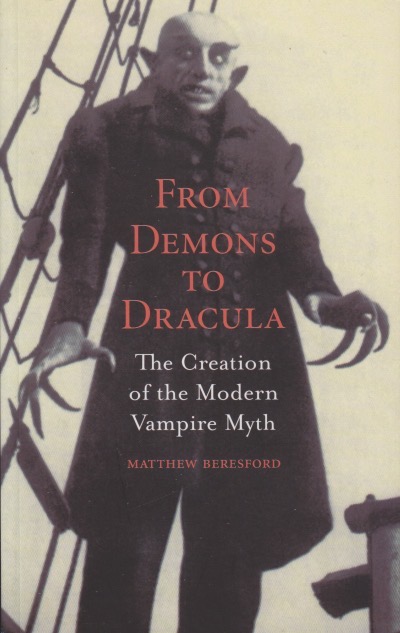
Any book on vampires has to be limited.  I first read Matthew Beresford’s From Demons to Dracula: The Creation of the Modern Vampire Myth back in 2009.  It has lots of information, but it was long enough ago that much of what I’d learned had grown fusty with age.  I began re-reading it as Halloween approached, and am glad I did.  The thing about vampires, however, is that you do have to compare sources.  Like many explorations of the vampire, Beresford’s notes that there are ancient analogues, but nothing precisely like we think of vampires today.  From my own perspective, I tend to think that our modern vampires, like our demons, come from movies.  Starting with F. W. Murnau’s Nosferatu, but more clearly from Tod Browning’s Dracula, our idea of what vampires are have been mediated by the silver screen.

This book ranges widely across time, region, and genre.  It discusses early reports that clearly considered vampires an actual threat, as well as movies made purely for entertainment.  One thing that I noticed this time around is that the author, being British, seems not to have noticed the tremendous influence Dark Shadows had on the popularity of vampires prior to Anne Rice’s Interview with the Vampire.  I suspect that soap operas were not widely known internationally, and even if they were, they were likely not taken too seriously.  Dark Shadows was different, however, and it made vampires chic in a way they simply weren’t before the early seventies.  At least in the United States, Barnabas Collins helped define the vampire.

Beresford makes the point that there is no single defining characteristic that applies to all vampires.  Early European vampires didn’t necessarily drink blood—they were revenants (they’d returned from the dead) but they weren’t always after blood.  In the nineteenth century bloodlust became the defining feature of vampires.  There are historical points on which to quibble with the argument here, but overall this book is a good overview of how ideas like vampires have been around for quite some time.  As someone who specialized in ancient literature for a good part of my life, I would not have called the various ancient analogues pointed out “vampires.”  Beresford is making the case that they lay the groundwork for what later became vampires.  And Vlad Tepes of Wallachia played his part as well.  As did the ancient Greeks.  It seems to me there’s more rich ground to explore here and this book provides a very good starting place.


Vampire or Not?

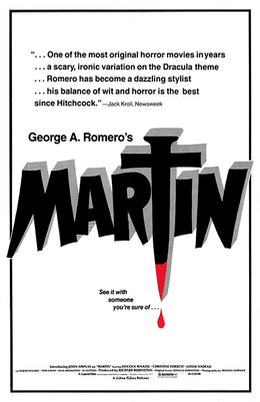
I’d heard that Martin was a depressing movie but I felt I should watch a Romero film that wasn’t about zombies.  I’d read bits and snatches of what happens, but I didn’t know the storyline in total.  Now that I’ve seen it, I’m still not sure what to make of it.  Martin is a young man who believes himself to be a vampire.  He does drink blood, murdering his victims, but there are no fangs, no “magic stuff” as Martin himself calls it.  It seems pretty clear that he’s mentally unbalanced, but he’s brought into his older cousin’s house in Braddock, Pennsylvania.  Cuda, his cousin, believes him to be a vampire, calling him “Nosferatu.”  He has protected his house with garlic and crucifixes, but Martin demonstrates that such things (magic stuff) doesn’t work.  

Daylight and eating regular food don’t bother him.  His cousin gives him a job at the grocery store he runs, while constantly warning Martin about looking for victims in Braddock.  Shy around women, he only has sex with his victims, after he has drugged them.  (This is a pretty violent movie, and the tone is downbeat throughout.)  Since he has no friends, he calls into a radio talk show to discuss the problems of being a vampire, and people love listening to him.  Meanwhile, Cuda arranges for an exorcism on Martin, which doesn’t work.  There are black-and-white sequences that aren’t really explained—either as fantasies or as past memories for a real vampire.  After his cousin becomes too suspicious, he stakes Martin to death and buries him in his back yard.

There are many unanswered questions about this movie.  If Martin is a vampire just about everything in traditions about them is wrong, apart from needing to drink human blood.  When Martin begins an affair with a troubled housewife, his bloodlust lessens, but he still gets “shaky” and has to find victims.  For those of us who tend to find ambiguity both beguiling and confusing, this is a vexing movie.  It makes you wonder what a vampire really is, and, as with most of Romero’s work, there’s a fair bit of social commentary—intentional or not.  Life itself has its fair share, perhaps more than its fair share, of ambiguity.  The only real certainty that Martin gives is that his victims die and he himself dies in the end.  Is his cousin correct?  Is Martin himself correct?  He may be mentally ill, but society is too.  And the working-class people of Braddock should know who the real vampires are.


Consciousness Conscience

Not so long ago—remember, I read old books—living to 60 was considered a full life.  I’ve passed that and while I’m in no hurry to shuffle off this mortal coil, I often think of how improved medical practice has prolonged many lives.  This is a good thing, but it does make death a more difficult fact to deal with.  If there is any good that came from my Fundamentalist upbringing, it was that it taught me early on to think about death with some frequency.  I’m not a particularly morbid person, but since we all have to face this, avoidance seems to lead to grief, shock, and acute mental pain.  I tend to consider watching horror movies a spiritual practice.  Little reminders, in case I forget to consider my own mortality today.

Our faith in science is a little bit misplaced.  Sure, it helps enormous numbers of people live longer, healthier lives.  But it may also detract from the necessity of attending to our spiritual lives.  I don’t care if you call it consciousness, your soul, psyche, or mind, but we have a life we’re accountable to, and it’s not all physical.  Since consciousness feels neutral enough, let’s go with that.  We don’t know what happens to our consciousness after death.  There are plenty of theories and ideas about it, but no certain knowledge.  There may be faith, and there may even be some evidence, but it is always disputed.  It does seem to me that facing death squarely on may help take care of at least some of the anxiety.  Fear of the unknown is probably the greatest fear our species possesses, so pondering it may take the edge off a bit.

Some people claim to remember past lives.  Sometimes I wonder if they might be tapping into the great unknown: consciousness.  Perhaps consciousness survives without a physical body.  Perhaps it’s large—expansive—and encompasses far more than we can imagine.  Maybe some people can access part of that consciousness that includes the past lives of others.  We have no way of knowing, but it seems worth thinking about on this All Souls Day.  Of course, I have the advantage of having lived what used to be considered a full life.  In it I have set aside at least a little time each day to consider what happens after this.  Do I have a definitive answer?  No.  I do have faith and I do have beliefs.  And I’m always reflective on All Souls Day.

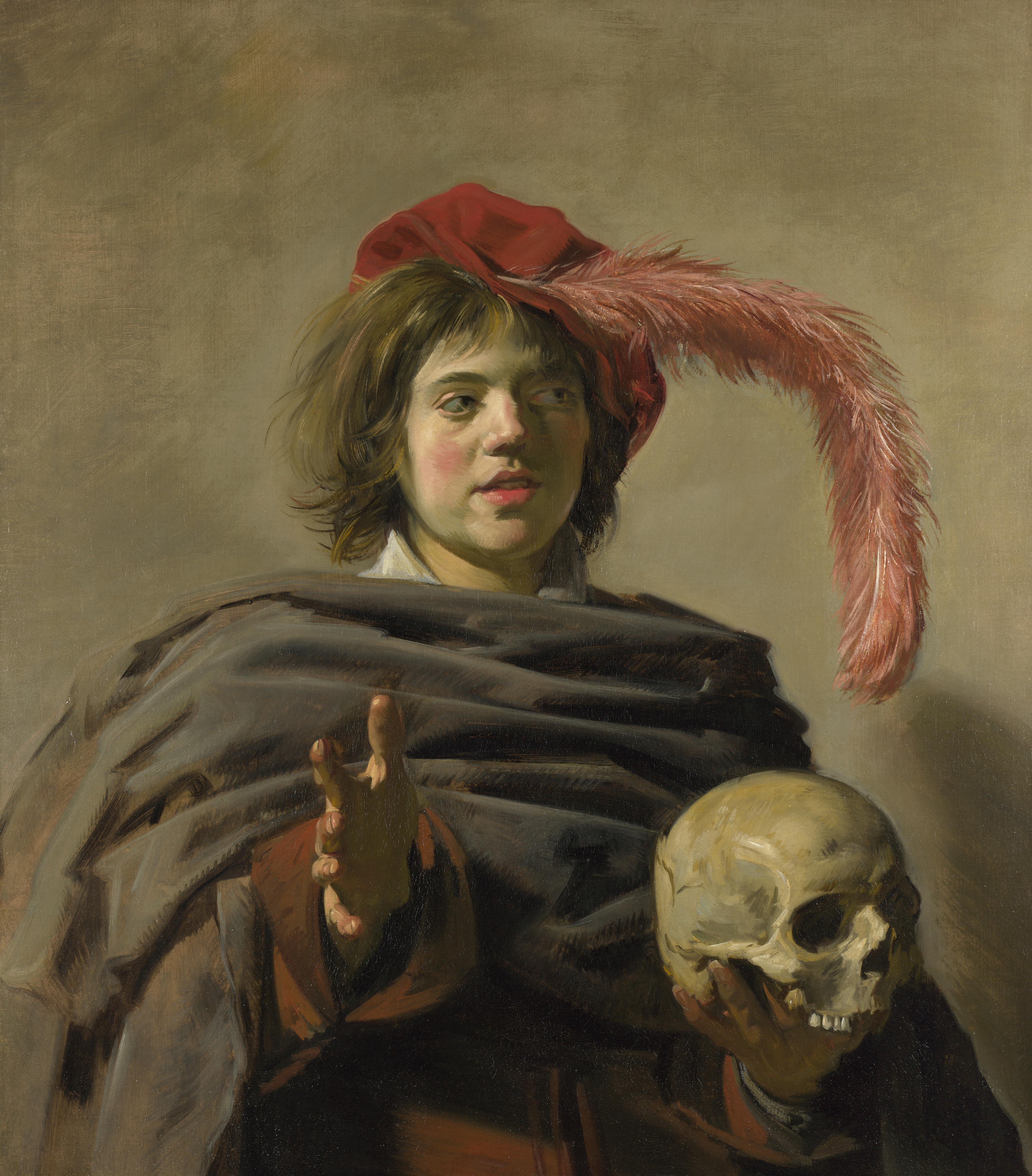
Frans Hals, Young Man holding a Skull (Vanitas), public domain via Wikimedia Commons


Pan Pandering

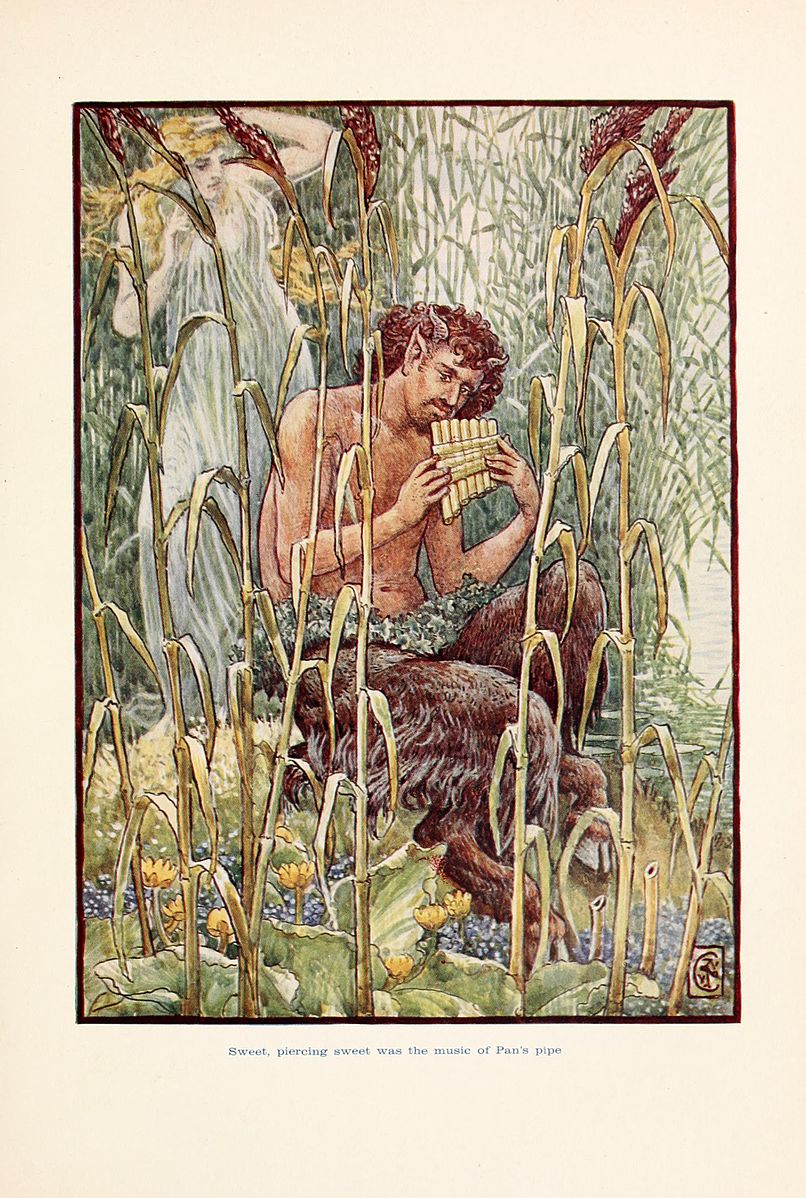
The Greek god Pan has had a rough go of it.  And I don’t mean that his name is a homophone for an essential kitchen item in English.  No, Pan was mistreated by early Christians, made evil, and then good, before finally being largely forgotten.  We’ll start with the bad and move to the good.  As I discuss in one of my publications, Pan was considered evil by medieval Christians for a few reasons, apart from being a “foreign god.”  First, he was associated with nature.  Early Christians weren’t naturalists.  They were looking to escape the world (a trait that continues to be manipulated by politicians even today).  Not only that, but Pan had goat legs and horns.  While horns could be used to represent any deity, including Yahweh, the combination with goat legs suggested Pan might be demonic.

Image credit: Walter Crane, public domain via Wikimedia Commons

Nobody knew what demons looked like.  They are incorporeal, after all.  As I point out in Nightmares with the Bible, the fact that the rarely used Hebrew word for demons is roughly translated to “hairy ones” added to Pan’s sins.  This was a common Hebrew phrase for goats, and over the course of many centuries, when people had the irresistible urge to draw the invisible, they gave Satan the Pan treatment.  Goat lower half and horns on his head.  In many esoteric groups the goat, i.e., Pan, became a symbol of demons.  All of this has a rich and detailed history and it literally demonized Pan.  Yes, he was all for free love, but he was a musician, after all.  Then something interesting happened.  

When the King James Version of the Bible was first printed, the biblical books each began with an illuminated letter.  The book of Psalms began with an L.  This letter was inscribed with an image of Pan.  What the devil was he doing in the Good Book?  Well, by 1611 Pan was considered a type (or foreshadowing, if you will) of the good shepherd.  And we all know who the Good Shepherd is, right?  Not only that but his name, “Pan,” translates to “all” in English.  Since Jesus is “all” to Christians, it was appropriate that he be symbolized by Pan.  This ancient force of nature had gone from being the Devil to representing God.  Indeed, he could, at the same time, be symbolic of both.  Now this is quite an accomplishment for any entity, let alone a rustic god who was never an Olympian.  Pan isn’t much discussed in Christianity today, but he had a fascinating place in its view toward goats, both bad and good.