Reading Unwritten

There’s a style of writing—I’m not sure what it’s called—where an author keeps revealing new, and necessary information on nearly every page.  The effect on me, as a reader, is almost as if the book is backwards; too much wasn’t revealed up front and that kept me from understanding the story as it unfolded.  I confess that the fault is mine.  I’ve always appreciated a narrative that begins with much of what you need to know and then reveals unexpected things along the way.  This unwieldy preamble is to say that I had trouble getting into the otherwise delightful fantasy The Library of the UnwrittenA. J. Hackwith is a solid writer, but since this is fantasy there’s some introduction to the unfamiliar world that readers like yours truly needs.  At least a bit more than is on offer here at first.

This is a fun book with a fun premise.  Books in Hell’s library are unwritten and restless.  If not watched, their characters come to life and the book goes missing.  The idea of the unfinished also applies to paintings and other creative endeavors.  At first I thought this was going to be like Jasper Fforde’s Tuesday Next novels (several of which are discussed on this blog; you’ll have to use the search function) but the character from a book quickly gets swallowed up in a larger story involving demons with backstories slowly revealed, as well as a librarian and a muse, also with baggage that we only see once the train has left the station.  About halfway through, the story really starts to move and becomes quite enjoyable.  I guess I need more orientation than some readers.

The novel unfolds into a potential battle between Heaven and Hell, but those aren’t the only realms in play.  There’s Earth, of course, as well as Valhalla, and some nameless realms where the gods have died out.  And it focuses on a library.  It’s this final aspect, I suspect, that leads many people to categorize this novel as an example of Dark Academia.  Indeed, that’s where I discovered the book, on a display table with that label.  Although written with a light hand, and often somewhat funny, there is a deeper meaning here, a narrative about the importance of books that faces the reality that some would rather destroy them than read them.  I’m sure there are some religious folk that would see this book as promoting satanism and darkness, but instead it emphasizes loyalty and goodness.  I’ll be pondering it a while.


Burn Out

The Los Angeles fires are terrifying.  In my case, I can’t help but think of the Peshtigo, Wisconsin fire of 1871.  I read two books about it, the first because my daughter, in late elementary school in Oconomowoc, heard about the fire in class.  Embers of October by Robert W. Wells is one of the scariest books I’ve ever read.  After we’d safely moved out of Wisconsin I read Denise Gess and William Lutz’s Firestorm at Peshtigo.  Frightening stuff.  I feel for those suffering from the Los Angeles fires.  America is particularly vulnerable to such things since, according to books I read when writing Weathering the Psalms, the western half of the nation exists in, for the most part, a perpetual drought.  (Those who live in Seattle may disagree.)  Rain doesn’t fall evenly across the country.  I grew up in the relatively moist eastern part (we get a lot of rain), but even here fires are a possibility.  We had a very dry October, and a very dry May the year before.

Image credit: Mike McMillan/USFS, public domain as a work of the US government, via Wikimedia Commons

Global warming will only increase the problems, I fear.  Too long too many people in power haven’t taken it seriously enough.  The weather is a large, extremely complex phenomenon that we still don’t understand.  I sit shivering at my desk on a cloudy January day looking at weather apps that tell me it’s sunny outside.  One thing we do know about it is that if we tamper with it in one place, it affects the weather everywhere.  What if, instead of posturing and fussing with people who live in other countries, with larger entities trying to control them, we all turned our attention to that sky we hold in common?  Trying to understand its needs and temperaments?  Realizing that if crops fail in one country there will be shortages everywhere?

The fires aren’t just Los Angeles’ problem.  Large nations posturing about who has the biggest leader has proven ineffective time and again.  We need cooperators and collaborators, not nationalists.  Embers of October, especially, paints a Hell on Earth.  One that couldn’t be escaped by many of the people in this small town that was utterly wiped out by a natural disaster.  Such things should be required reading.  Instead, small-minded people ban books claiming ignorance is bliss.  Trying to avoid a metaphorical Hell, they introduce a real one here on earth.  And yet, some use even this to divide people against each other.  And people who have no will to help one another is Hell indeed.


Upstate

Unrequited love is sometimes tragic.  Other times it’s merely sad.  People are attracted to places.  Or at least the idea of places.  I was born in Pennsylvania, but to a wandering family.  I keep looking for roots—my tribe.  I didn’t know my father well growing up, but my mother’s family, before taking on that rootless search for greener pastures, was from upstate New York.  For several generations.  I’ve tried many times to land a teaching post somewhere upstate, but in vain.  Even when I knew the people in the department and had been to campus, like that time at Syracuse University.  It was raining when I visited, back in my Routledge days.  I was taken by what I experienced there, never to be welcomed myself.  My family was from a bit further north, around Albany, the head of the Hudson Valley.

At the time I wasn’t aware that my childhood hero Rod Serling was born in Syracuse.  My daughter was at school in Binghamton, which is where Serling grew up.  That I knew.  Nor did I know that Dan Curtis, creator of Dark Shadows—that other childhood staple—had gone to college at Syracuse.  Something about upstate.  I’ve remarked to my family that when traveling in this part of the country I catch glimpses of familial facial features in some strangers.  A passing glance suggests that they might be distantly related.  My unknown tribe.  Economics, however, have always kept me away.  Even when I explained in my cover letters that I felt that special connection my applications were summarily brushed aside.  Probably by folk who knew who their tribe was.  Probably from somewhere else.

In this world of internet loneliness, we long for connection.  We lived in Wisconsin for over a decade.  The only people I really got to know were those I knew from Nashotah House.  And this was even with years of involvement with the PTO, serving on the building committee, and even being president one year.  People were busy even back then.  I was thinking perhaps I’d found my tribe in Wisconsin. But then…  The move to New Jersey put me close to my ancestral state, but not in it (my mother was born in Jersey).  Economics, that dismal science, dictated that a move had to be back to Pennsylvania, where I was born among strangers.  Our nation is one of many tribes, including those we sought to exterminate to steal their land.  We have plenty of space, but we value economics over belonging.  You may buy the presidency, but you can’t buy your tribe.


Car Talk

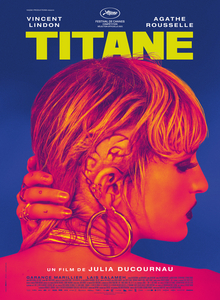
Body horror isn’t my favorite sub-genre, but Titane (French for titanium) had been recommended in several places.  Body horror directed by women takes on a particular cast, especially since pregnancy is, I imagine, kind of scary.  Certainly from a male perspective it can be, so I suspect such major body changes must involve some psychological adjustments for women as well.  The story is strange.  Alexia, after a childhood car accident, has a titanium plate in her skull.  After being released from the hospital, she starts to really love cars.  I mean, really love.  She works as a car model and ends up making love to her showroom car one night.  After that she becomes pregnant.  Emotionally distant from most people, including her parents, she becomes a serial killer.  She’s not a complete sociopath, however, because she realizes this is wrong.

Wanted by the authorities after killing everyone at a house party, she tries to change her identity by cutting her hair, breaking her nose, and wrapping her torso in body tape to pass herself off as a man.  A firefighter chief whose son has been missing for a decade, believes Alexia is his son and he takes her in.  She won’t speak, which he supposes is part of the trauma.  He gives Alexia work among the other firefighters, who are generally sexist and not a little suspicious.  Especially since the chief gives Alexia preferential treatment even though she doesn’t know what she’s doing.  In one scene he tells the firefighters he is God to them and Alexia is his son.  One of the firefighters quips later, that Jesus is white and gay.  (Alexia is pretty and the broken nose only makes her appear androgynous.)

Her painful pregnancy, which involves motor oil, eventually forces her father to acknowledge that she’s not his son, but the lonely man still vows to care for her.  When it’s time to give birth the baby is part titanium (as is Alexia’s distended belly).  She dies in childbirth but her “father” accepts the hybrid baby as his own.  This art-house Euro-horror won several awards.  Exploring issues of both sexism and women’s body changes during pregnancy—particularly an unwanted one—the movie has something to say.  And it’s something that a male writer-director simply couldn’t do.  There are no jump-startles here, and the horror is a slow dread as the viewers’ sympathies tend to be with Alexia.  The first murder we’re shown is when a fan attempts to make love to her (it doesn’t go as far as rape), despite her lack of interest.  She has a motivation and it doesn’t seem evil.  And, of course, there’s a good deal of fantasy at play.  Like most Euro-horror, it leaves you thoughtful.


Measuring Books

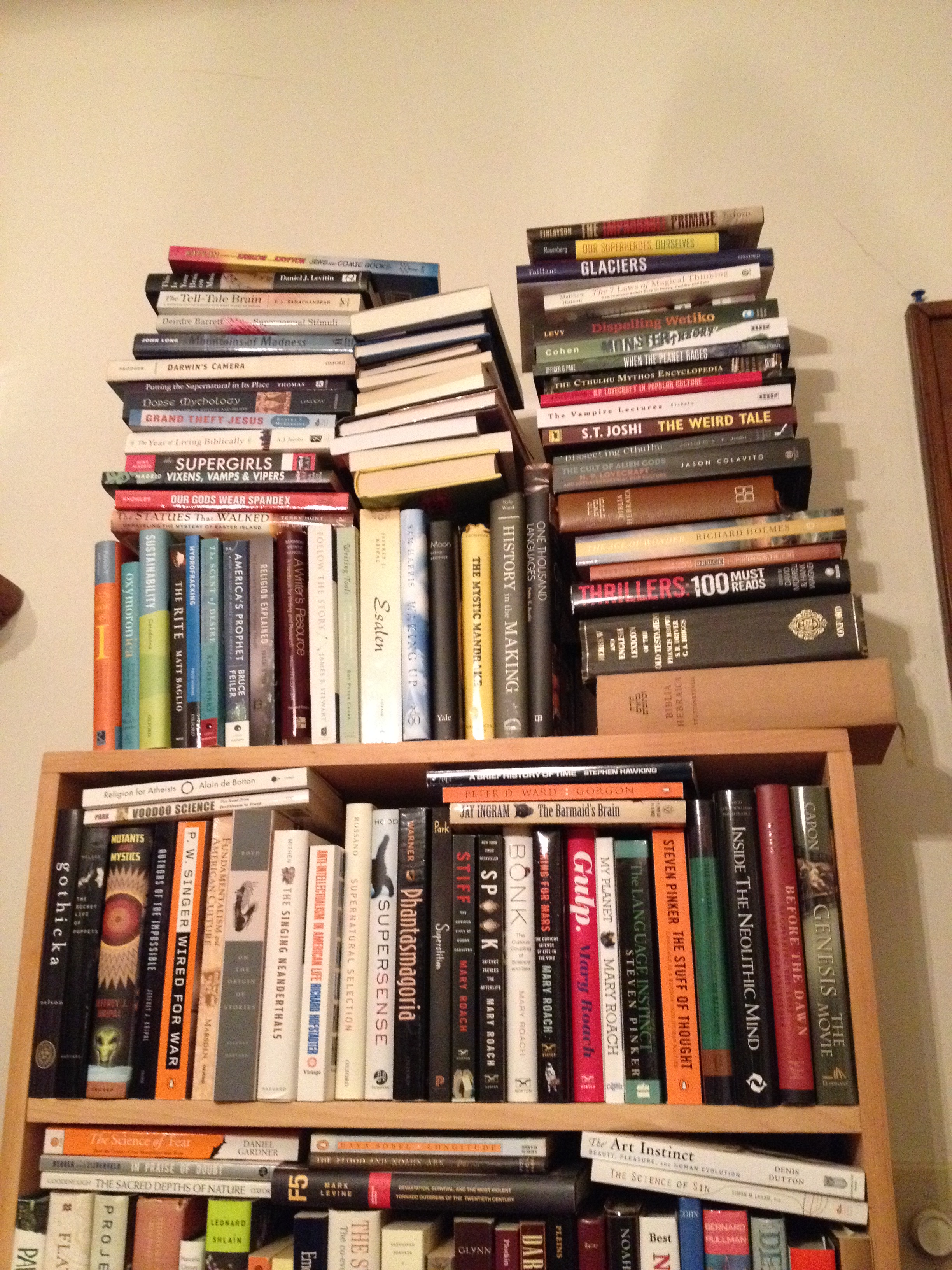
You know how some email servers stock your inbox with ads?  I almost never pay attention to them.  Then one for Books by the Foot showed up.  I had to click.  The basic idea is simple enough: you want to look smart so you fill your shelves with books by a company that sells them by the linear foot.  You can get color coordination, rainbows, old books, you name it.  Now this isn’t a free ad.  In fact, this is a rather sad state of affairs.  I’m sure their antique books have been vetted for any real treasures, but the fact that people want to buy books just for display evokes, well, melancholy.  I’m pleased that books retain their cachet as symbols of pride, but these are not books for reading.  I’m left with mixed feelings.  The website states that they have over 5 million books on hand.

At least they’re not selling ebooks.  I love books.  They are a wonderful symbol and I suspect they are among the most noble things that humans achieve.  I grew enamored of books as I entered my tweens.  I was terribly shy by that point.  We had moved to a new, and rough small town where I really didn’t know anybody.  Life, which hadn’t been exactly a picnic to that point, seemed to be getting scarier.  So I read.  And I never really stopped.  Ironically, during my professorial days I had less time to read entire books.  Those who’ve dabbled in higher education know that at even the hint of organizational skill you get bumped into administration, whether you want to or not.  And administration is busy work.  Yes, even professors have it too.  In any case, when I got bumped back down to being a mere adjunct, I started reading a lot again.

One time one of my bosses asked me how many books I had.  This was early in the pandemic when we were seeing inside each other’s houses for the first time, via Zoom.  My office is one of my main book repositories.  (Along with the attic and the living room.)  I answered truthfully that I’ve never counted.  I started using Goodreads in 2013 to keep track of the books I read.  In those early days I didn’t put everything in there (who hasn’t read a book they’re embarrassed to admit to once in a while?), but when I started the reading challenges in 2016 I did.  Mine has been a life defined by books.  Starting with the Good Book, and including many quite the opposite, I have earned books by the foot.  But I’m not selling.  Symbols have value beyond cash, at least in my mind.


Meanwhile, on Earth

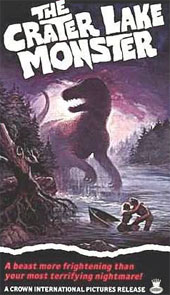
Low budget doesn’t always translate to cinematic disaster, but in The Crater Lake Monster, it unfortunately does.  I have a soft spot for those who attempt to make movies but don’t succeed the way that they’d hoped.  The Crater Lake Monster is poignant in that respect as the production company, Crown International, apparently messed up the financials and insisted on cutting scenes that helped to make a bit more sense of the story.  The actors are certainly not those at the top of their game, but the stop-motion plesiosaur isn’t half bad.  The story itself doesn’t seem to support its tonnage, however.  A meteor crashes into Crater Lake (not the famous one).  Some months later a monster begins attacking people after it eats up all the fish.  There are a handful of characters who are concerned, and some just casually passing through.

The sheriff, at first skeptical, becomes a believer after seeing with his own eyes.  The doctor, who examines a victim’s body, thinks there’s something in the lake.  A couple passing through on their way to Vegas see the monster up close and survive, but their trauma is so great that they can’t talk about it.  A pair of guys who rent out boats to fishers are having trouble because there’s no fish left.  And a pair of archaeologists from “University Extension” insist that the creature should be kept alive since, well, you don’t often come across dinosaurs.  They also figure out that the hot meteorite incubated a fertile plesiosaur egg that had been at the bottom of the lake for millions of years.  There’s even a story of a liquor-store robber thrown in.  The robber’s only tied to the plot by getting eaten by the monster.  The monster is finally killed by the sheriff with a bulldozer.

Some of the people that worked on this film, especially the stop-motion crew, had some recognizable chops in the biz.  One of them had worked on that childhood Christian kids’ show Davey and Goliath, and another was concurrently working on Star Wars and went on to work on Jurassic Park.  Meanwhile, Crater Lake is so bad that it’s a bit surprising that it hasn’t really become a cult classic.  Creature features are a guilty pleasure.  With a bit of coaxing, and financing, this one might’ve been made passable.  Who doesn’t like to see the underdog achieve some success?  Of course, it did come out the same year as Star Wars, with its budget, and clearly couldn’t compete down here on Earth.


Steve or Stephanie

I know gender is a construct, and all.  I even put my pronouns (he, him, his) on my work email signature.  I haven’t bothered on my personal email account since so few people email me that the effort seems superfluous.  But I’m wondering if the tech gods, aka AI, understand.  You see, with more and more autosuggests (which really miss the point much of the time), at work the Microsoft Outlook email system is all the time trying to fill things in for me.  Lately Al, which I call Al, has been trying to get me to sign my name with an “@“ so people can “text” me a response.  No.  No, no, no!  I write emails like letters; greeting, body, closing.  People who email like they’re texting sound constantly disgruntled and surly.  Take an extra second and ask “How are you?”  Was that so hard?  But I was talking about gender.

So Al is busy putting words in my fingers and every time I start typing my closing name it autosuggests “Stephanie” before I correct it.  It’s starting to make me a little paranoid.  It does seem that men and women differ biologically, and I identify with the gender assigned to me at birth.  I’m pretty sure Dr. Butter said “It’s a boy,” or something similar all those years ago.  Now I’m not sure if Al is deliberately taunting me or simply going through the alphabet as I type.  Stephanie comes before Stephen (which isn’t my name either) or Steve.  The thing is, I type fairly fast (I won’t say accurately, but fast) and Al has trouble keeping up.  But still Al is autosuggesting Stephanie for me every time.  I’ve been using computers since the 1980s; shouldn’t Al know who I am by now?

Of course, when Al takes over such human things as gender will only get in the way.  I guess we have that to look forward to.  Gender may be something socialized, I realize.  For those of us approaching ancient, we had gender differences drilled into our heads growing up.  I recently saw one of those cutesy novelty signs that resonated with me: “Please be patient with me, I’m from the 1900s.”  I’m not a sexist—I have supported feminism for as long as I can remember.  But I don’t like being called Stephanie.  What if my name was Stefan?  That isn’t autosuggested at all.  I know of others whose names are even earlier, alphabetically.  Maybe Al is overreaching.  Maybe it ought to leave names to humans.  At least for as long as we’re still here.


Re-untold

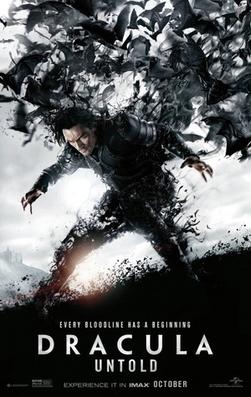
In retrospect, Universal’s Dark Universe, itself a shadowy concept, could have been a thing.  With the budget behind it, Dracula Untold could’ve been spectacular.  As so often happens, however, poor writing seems to have brought Vlad the Impaler to his knees.  I suppose it was rather tacky of me to fall asleep during it when a friend showed it to me shortly after it was available on streaming.  My excuse was that we started late and I’m a very early riser.  Finding it on a network to which I have access, and on a free weekend, I decided to give it another try.  I didn’t fall asleep the second time, but I did end up disappointed.  Action-horror is a tough sub-genre to pull off well.  As some critics pointed out, if Dracula could defeat 1,000 men singlehandedly (which he does shortly after being turned), then why does he not do so when it’s crucial?

What I did find intriguing is the older vampire that lives in Broken Tooth Mountain.  What is his backstory?  And why, if Dracula can just die, does the older vampire not do so himself, when he clearly wishes to?  He just has to step out on a sunny day.  The menace of the classic vampire isn’t on the battlefield, but in the one-on-one situations.  At night, when you’re sleeping.  Or otherwise unable to protect yourself.  The movie does have some good moments—and with a budget like that, it should have—but overall it struggles.  

Part of the difficulty is understanding Vlad the Impaler being, at heart, a nice guy.  Although he impaled thousands of people, he really just wants peace and a domestic life with his wife and son.  He’s reluctant to challenge the Turks until one taunts him upon taking his son hostage.  He tries to protect his people, but when they help save him (as vampires that he personally has turned), he destroys them all when it’s over.  The question of motivation hangs unanswered over the whole thing.  Dracula is never evil, not even when he declares himself the son of the Devil.  He attacks only in self-defense and although he does shed unnecessary blood, it is only in the fog of war.  And the motivation issues also apply to his pre-vampiric allies.  They don’t seem to be able to make up their minds whether Vlad is a good guy or not.  They try to kill him then they fight next to him.  There’s a lot going on here—maybe too much—and it seems that the story wasn’t thought out well enough to make it all work.  Vampires, it seems, don’t always cooperate.


Finding Vampires

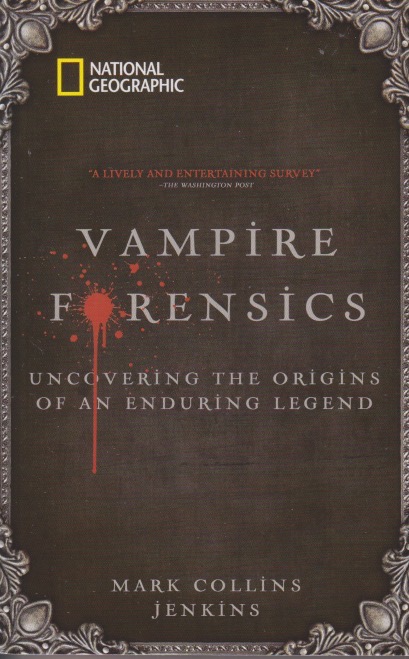
Parents always dread when their child will ask them the inevitable question: where do vampires come from?  A number of people have undertaken to answer that question, and Mark Collins Jenkins attempts it with aplomb.  Vampire Forensics: Uncovering the Origins of an Enduring Legend is quite a romp through the fields of the undead.  Ranging from the chewing dead through epidemics, Montague Summers, movies, Varney the vampire, the origin of the word “vampire,” where zombies come from, and practices of dealing with corpses, this study may not convince the reader that the mystery has been solved, but it will provide lots of information.  I’ve been pondering vampires lately, and this book ties many of these loose threads together well.  Jenkins has a talent for beginning a chapter on an apparently unrelated topic and then weaving it into the growing, ever expanding vampire tapestry.

I’ve read, many times, that vampires have ancient origins.  That really depends on how you define “vampire.”  This book explores those ancient roots, but unflinchingly points out that our modern idea of the walking dead drinking the blood of the living springs from the Balkan peninsula, largely in the eighteenth century.  This isn’t a strictly chronological study, and it isn’t limited to Europe and the lore that grew from that region between Asia Minor and Western Europe.  That doesn’t stop Jenkins from going back further in history.  It was a journey on which I learned much.  I also confess that I was nearly grossed out a time or two.  The vampire requires a stout constitution to study.  Interestingly, it seems that the word “vampire” might’ve derived from a word denoting “heretic.”  Religion and horror belong together, as I’ve said many times.

There’s always a danger with wide-ranging studies, since it’s not possible to turn a specialist’s eye toward all the cultures and historical periods under scrutiny.  Those who’ve tried it, such as James Frazer (of Golden Bough fame), come to be viewed with suspicion by later specialists.  (I discuss this in my little book on The Wicker Man, by the way.)  Jenkins does rely on Frazer a time or two.  Writing a general history on this subject almost necessitates that, however.  Even with the internet and “experts” being those who can gather the largest followings, academia has rightfully demonstrated that to get the real story you need to bury yourself with resources around a very small subject and be willing to live and breathe it for years.  Even then you might get it wrong.  But I digress.  This is a fine study of vampires and their possible origins.  It was a learning experience for me and I now have a better idea how to answer that dreaded question.


Scary Things

I recently set myself the challenge to come up with the scariest movies I’ve seen, up to 1979.  The date is the publication date (I think) of Stephen King’s Danse Macabre, which gave me the idea.  Book publication dates can be difficult to decipher; I have the Berkley Trade paperback edition, which is copyrighted 1981 and published in ’82.  So, let’s just say 1980.  Now, I would never challenge Mr. King, who is older, and wiser (not to mention much better known) than me.  And I suspect, if I understand writers at all, his views may have changed since then.  Several of the films he discusses are thrillers.  And, of course, each person’s viewing history is unique as their thumbprint.  So let’s give it a try.  First, I need to say there are different kinds of scary.  We all have our triggers, and I’m going for things that frightened me.

Photo by Stefano Pollio on Unsplash

Since we’re using 1980 as the cutoff, The Shining has to be on the list (of course King wrote the novel).  Like most of these movies, I saw it at home and the theatrical experience would’ve made an even bigger impact.  The Exorcist also has to be on this list as well.  For older fare, Eyes Without a Face certainly qualifies.  The Haunting, based on Shirley Jackson’s The Haunting of Hill House is among those in this period but it isn’t terribly scary.  I watched a number of King’s movies—many of which I’d never seen—and found some frightening ones among them.  Night of the Hunter, which makes me add the original Cape Fear, should be included.  So is The Bad Seed.  Something all of these have in common, apart from perhaps The Exorcist, is that they derive their terror from psychology.  There may be some supernatural involved, but the mind is the truly scary part.

Growing up—and even in the present—I’m not really looking to be scared.  I have no trouble getting to that state all by myself, thank you.  The monster movies of childhood thrilled with the unusual, and the realm beyond the everyday.  The haunted house movie held its own frisson for a similar reason.  Of course, children are often not developed enough to understand the nuances of psychological horror.  The more I ponder it, the more it seems that “horror” is the wrong name for what I’m after.   We gain bragging rights by watching scary movies.  And I don’t count jump startles as truly frightening.  I’m more of an existential dread kind of guy.  But I do love monsters.  Even this little exercise made me realize how difficult ranking such movies can be.  Perhaps I should bow to the King.


LA Story

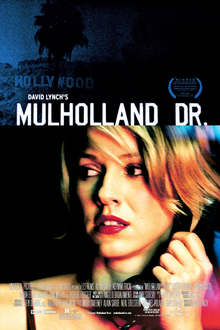
David Lynch movies aren’t always easy to understand.  Last year we watched Twin Peaks, including the movie Fire Walk with Me.  Some time before that I’d watched Eraserhead.  My earliest, and unwitting, experience with one of his movies was Dune, which I saw in a theater in 1984.  I had no idea of who Lynch was at that time, however.  As I began exploring the horror genre I found a contingent strongly denying that Lynch directs horror.  Still, there were enough elements in Twin Peaks and Eraserhead that some viewers do move in that direction.  Now, I’d heard of Mulholland Drive many times over the years and I’d seen it classified as horror a time or two, but mostly as a thriller.  Over the holidays I actually had time to sit down and watch it.  And I’m still not sure how to classify it.

I’m not even sure that I can say what it’s about.  Since I watch movies alone most of the time, I turn to the internet to have “discussion” about them.  IMDb and Wikipedia are often good starting points.  There is a tremendously long article in the latter on this film.  Quite often Wikipedia provides not a ton of information about films, but here’s a case where contributors simply can’t say enough.  And none of them know for sure what it’s about either.  I suspect that’s why David Lynch is so highly regarded as a film maker.  He’s an artist.  What artist can explain what their work really means?  Lynch has been notably tight-lipped about what he intended this movie to say, but if you’ve watched Twin Peaks through, you get an idea of what you might expect.  It’s certainly an intellectual experience, and a surreal one.  But is it horror?

One of the terms often used to describe the movie is “nightmare.”  That seems like a horror-laden word, doesn’t it?  It’s often a matter of the characters not knowing who they really are (and the viewers don’t know either).  The thing that ties most of them together is that they’re involved in a movie in some way.  I’ve come to believe that things like books and movies and songs—things we mentally “consume”—become part of our minds, just like food becomes part of our bodies.  Some of the films we see are like junk food—fun, but all fluff.  A David Lynch movie will give you something of substance to chew on.  And finally having seen Mulholland Drive, I’d say it’s a much horror as Lynch’s earlier work has been, however you interpret that.


Finding a Spot

Sometimes you’re not born among your tribe.  I live where I’ve moved out of economic necessity, not where my family’s located.  My family’s not quite sure what to make of me anyway, so I seek my tribe.  At first it was among the United Methodists, but when I was in seminary they let me know what they really thought of me.  The Episcopalians seemed more welcoming to my academic aspirations and my doctorate led me to believe my tribe was those who studied ancient West Asian religions.  I wrote papers, led conference sections, knew people.  When I had to step out of academe, however, they tended to fall away.  (Ironically my most-read work, according to Academia.edu, is my dissertation, revised edition.  It has had over 8,000 views.)  I still have many scholar friends, but I’m clearly no longer part of the club.

That’s why I turned to horror (as a field of study).  I was seeking my tribe.  I wasn’t at all sure Holy Horror would get published.  I was encouraged when The Journal of Religion and Popular Culture published “Reading the Bible in Sleepy Hollow.”  Then I discovered other academics (still not part of the club) were studying religion and horror.  Ironically, it was people on the horror side, rather than the religion side, who made me feel most welcome.  In the meantime, I wrote some horror stories (still do) but the fiction publishing tribe seems to be at war against the rest of the world.  You can’t breach their bulwarks.  I’ve been trying for a decade and a half.  So I continue to write books that move more toward horror, and move away from religion.  Still, hard-core horror fans don’t really pay much attention to my books, still I try, but as an outsider.

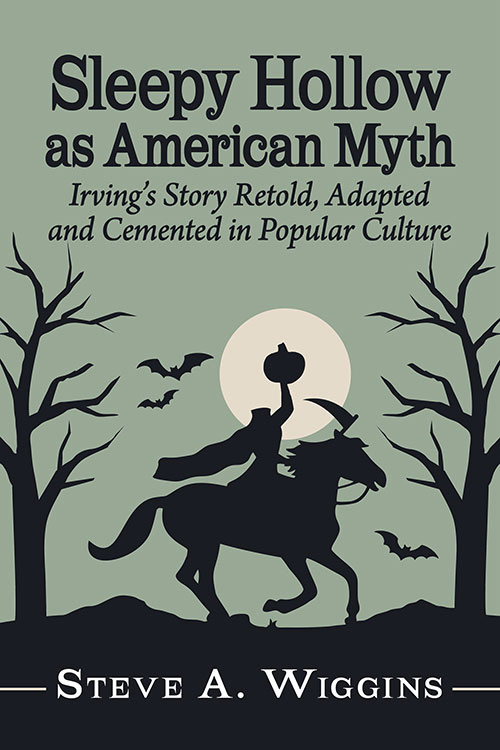
Since Sleepy Hollow as American Myth is in production, I’m working on my next projects.  I’ve been indulging in fiction again, where I’d really rather be, for a host of reasons, but unless I succeed as a double agent, I’ll remain unpublished.  My tribe, I think, would welcome more nonfiction like I’m writing.  These books haven’t been selling well, but they may eventually get referenced.  Now, many years after the fact, the ancient West Asian studies tribe cites my work and asks me to contribute more.  I’m afraid that island was abandoned years ago, former tribe-mates.  I was lonely and so I rowed across the ocean into horror territory.  If you’re looking for a tribe too, I’ll be glad to try to introduce you around.


Motorcycle Trip

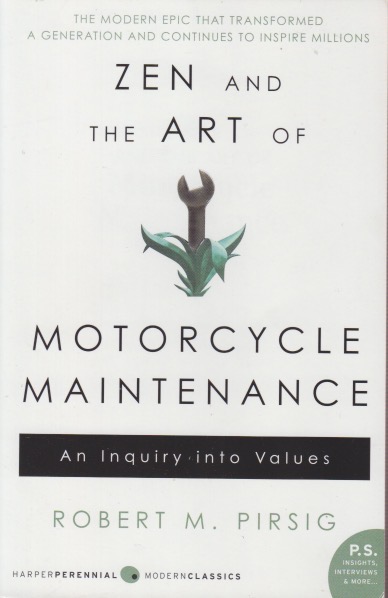
Among my introductory lectures to students was one that covered genre.  I recall saying something along the lines of “when you read something your expectations of genre influence how you understand it.”  Strangely, my own writing sometimes defies easy categorization, but I find it disorienting to read something without an idea of whether it’s fact or fiction or whatever.  I suspect I’m not alone in this.  When my wife suggested we read Robert M. Pirsig’s Zen and the Art of Motorcycle Maintenance together, I wanted to know what it was we’d begun reading.  The BISAC code (the category on the back cover of a book) simply said “Philosophy.”  I took almost enough philosophy in college to minor in it, so I had a general idea of what philosophy might look like.  Then I remembered reading Nietzsche’s Thus Spake Zarathustra and found myself back at the question of genre again.  Was this philosophy, autobiography, or a novel?  All of the above?

Now, I’ve known about this book from college days on.  It was in the college bookstore and I’m pretty sure it was assigned in some classes (not the ones I took).  What threw me was the autobiographical part.  Was this fiction?  The philosophy parts were pretty stout stuff.  And was Phaedrus real or imaginary?  Of course, you start getting some inklings that Phaedrus and the narrator are the same.  And that the latter isn’t a particularly good father.  The edition we read came with a helpful introduction that suggested that Phaedrus was the one with a correct outlook all along.  And an afterword that told how Chris died during a mugging when he was only 22.  There was pathos all over this tale.  Even when we finished I wasn’t quite sure what we read.  It’s sometimes classified as an autobiographical novel or philosophical fiction.

Rejected over 120 times, the book became a national bestseller when one editor took a chance on it.  (That is how publishing works.)  Perhaps the most poignant part of the book is the author.  What’s more, Pirsig wrote the book by getting up and writing at the same time slot that I use, so he could work a regular day after.  And he had been in a psychiatric hospital and had received electroshock therapy for schizophrenia.  Clearly a lot was happening behind the scenes for this most unusual tome.  Among the academic publishing crowd it’s common to hear that Stephen Hawking’s A Brief History of Time was a book that many bought and never read.  I did find that one a bit rough going too, but I do wonder how many engage with the philosophy in Zen and the Art of Motorcycle Maintenance.  There’s heady stuff here to ponder.  And I’m glad for that one editor who thought differently from all his colleagues.


Going Below

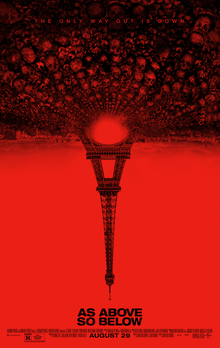
Indiana Jones in National Treasure, in found-footage horror format.  That’s the feel of As Above, So Below.  Only Jones is a woman.  There’s plenty of religious imagery in this movie, but the story’s not that great.  One of the reasons is that it’s too difficult to swallow, although it does score serious points on the claustrophobia scale.  At the beginning I wondered if I was going to make it through since Dr. Dr. Scarlett Marlowe’s cell phone is constantly moving as she continues her father’s search for the philosopher’s stone.  Surviving the situation in Iran, the remainder of the film takes place in Paris, especially the catacombs.  My level of impressedness went up when I learned that the movie really was shot in the catacombs.  Unfortunately it didn’t really help the story.

Alchemy, as part of esoterica, is purposefully difficult to understand.  Marlowe is continuing her dead father’s search for the philosopher’s stone that can change things into gold.  Her friend George (who repairs the clockwork for the bells at Notre Dame) is forced into the catacombs with her and her cameraman Benji.  They’re led by three Parisian cataphiles and some shots look like they were lifted directly from Indiana Jones and the Last Crusade, including the use of her father’s notebook.  Instead, the group enters the gates of Hell.  There are lots of scary things down there, many of them unexplained.  Some reflection reveals that they are all having to confront their pasts—or at least some of them are.  One of the cataphiles is killed before we learn her secrets.  And one of the survivors has no real backstory.  Six go in and three come out.

The movie plays with some interesting ideas, but it’s hard to swallow that an actual bona fide archaeologist would go on an illegal treasure hunt.  And that she knows of a secret chamber in the catacombs that has remained undetected by specialists.  I began scratching my head.  And when the group (or some of them, anyway) begin finding artifacts from their personal pasts in the catacombs, credibility is strained even further.  The idea that it’s important to come to terms with your past is a good one.  But once the young people begin dying and the rest have to keep going deeper and deeper to get out, the illusion is broken by Marlowe just dashing back to get a different stone to save George.  If it were just a matter of popping back, wouldn’t they have tried that earlier?  There are some Bible quotes, making this a candidate for the also unlikely Holy Sequel.


Perhaps More?

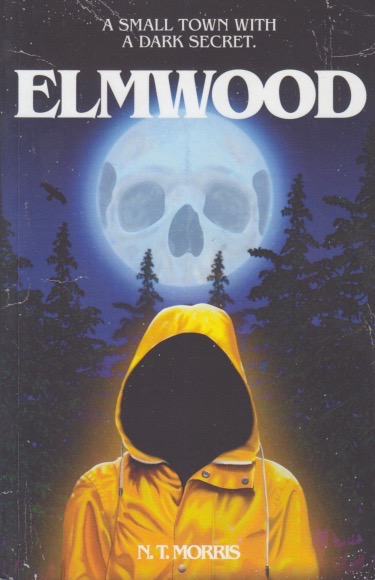
Publishers use the term “deep backlist” to refer to titles that they published long ago.  That’s always the phrase that comes to mind when I browse my “to read” list.  That list was started, in its current online repository, a decade-and-a-half ago.  When I delve into the “deep backlist” of items I placed on the list years ago I sometimes can’t remember where I learned about them.  Such was the case with N. T. Morris’ debut novel, Elmwood.  Someone recommended it years ago and I finally came into possession of it.  A moody tale about a town haunted by a cult, it is a nice effort as a self-published horror novel.  If you read a lot of fiction you start to notice some of the signs with self-published work (and there are many good reasons to go that route).  Morris offers a well-designed and aesthetically pleasing book.  The story does end with some loose threads, however.  There may be spoilers below.

Aidan Crain finds the victim of what appears to be a serial killer.  His difficulty coping with it leads his wife Laura to suggest that they get away from it all in the little town of Elmwood.  They rent out a house she found online, but it turns out to be haunted.  The people of Elmwood aren’t terribly friendly to strangers, but since the goal is to get away from city life, the young couple doesn’t much mind.  Except the ghosts in the house are accompanied by a dark presence in the woods that keeps calling to Aidan.  One of the tricky bits for me was determining what were dream scenes and how they related to waking scenes.  This is often part of speculative fiction, but a solid editor would lead you in the right direction in such situations.

The story tries to fit a lot in, leading me to think—rather uncharacteristically—that it needs to be longer.  The house was owned by a serial killer who’s part of the cult that killed the victim Aidan found many miles away.  The cult has been culling both locals and visitors for years and the police department appears to be complicit.  As do some local business owners.  The darkness in the woods, which is defined more or less as evil itself, seems to control the cult and it wants Aidan to join.  Some of the loose threads at the end suggest that Morris’ next novel will be a sequel to this one.  I can’t recall how I learned about Elmwood, but I’m glad to have finally read it.  It’s a good shot at becoming a horror writer from my personal deep backlist.