Pet Theory

We don’t have any pets.  At least not beyond the spider near the sink that I don’t have the heart to release outdoors in winter temps.  But I have had.  I think the reasons our pets mean so much to us is that they’re like people in so many ways, but nonjudgmental.  They accept us with all our quirks and despite occasional—generally unintentional—neglect.  A recent family text chain about the sad occasion of having to put a dog down got me musing about my history of pets.  We get remarkably attached to them.  Growing up we had dogs, cats, birds, turtles, guinea pigs, fish, and we tried a short-lived attempt at hamsters.  My wife grew up with a cat but became allergic after leaving home, so we had to avoid furry pets when my daughter was young.
We had fish, hermit crabs, and a bird.  The bird, a parakeet named Archie (short for Archaeopteryx), was with us at a difficult time.  Things weren’t going well at Nashotah House, but I had no idea that I was in the cross-hairs.  Archie was a suspicious bird.  We tried to get him to talk (mostly “nevermore”) but he wouldn’t.  I tried to get him to perch on my finger—my Mom could get birds to do it—but he only ever bit me.  Still, he was part of the family.  When the seminary axe fell, he moved to two different apartments with us, remaining solitary but stolid in tumultuous times.  In the second apartment he stopped singing.  My daughter thought something was wrong, but we knew from a previous trip to the vet that we couldn’t afford another.  I was unemployed and my wife had to look for a better-paying job.  Then I found Archie dead.  That day is still, all these years later, very difficult for me to think about.  How we cried.  How we snuck back onto land owned by the seminary to bury him in the woods.  How empty our small apartment felt.

Emotions are difficult things, but they’re what bind us together as humans.  We all know loss and sadness.  Many of us have poignant memories of pets who, although we supposed we’d outlive them always thought they’d be there at least another day.  Is there anything that brings us more together?  We think anyone who doesn’t shed a tear at Old Yeller is somehow not really human.  Certainly less human than our adopted animal family members.  How wonderful not to be judged by someone who knows us perhaps better than we know ourselves.

The Search Continues

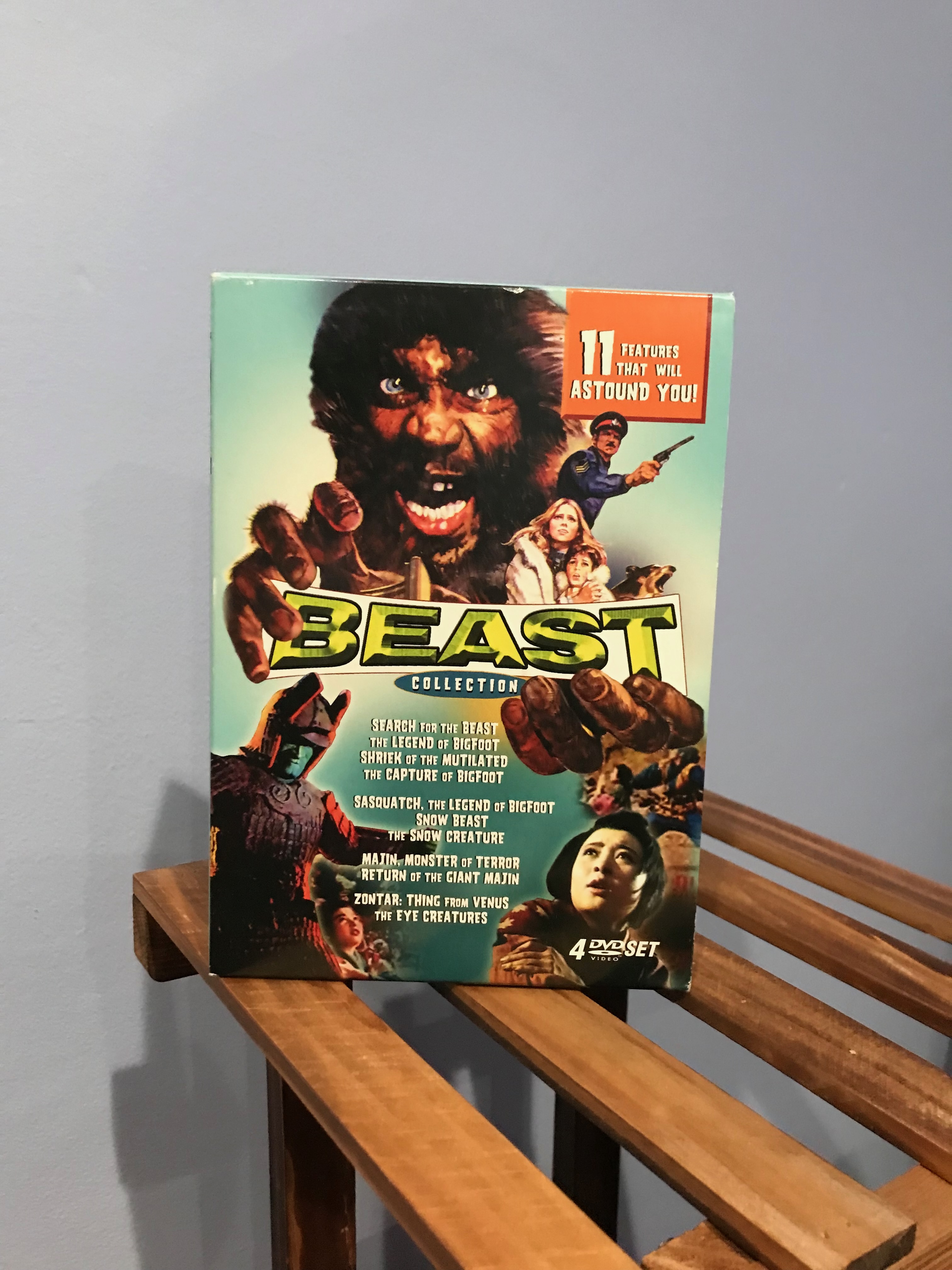
This movie’s so bad there’s a backstory.  Years ago I was really wanting to see Zontar: Thing from Venus.  This was before streaming, and I found it as part of the “Beast Collection,” a set of 11 movies for less than the price of one regular first-run DVD.  I watched a few other movies in the collection, but before long it got shoved to the back of a shelf and forgotten.  I remembered it recently because another collection I have was missing a movie, Snow Beast.  I wondered if it might be part of this otherwise forgotten set.  It was (this really encouraged me because maybe my memory is still much better than I sometimes suppose).  In any case, one of the other movies—one I’d never seen—was Search for the Beast.  I figured, why not?  This is a film that fails on every level.  And I mean every single one.  It really should merit a Wikipedia page, just for being so bad.

So, a professor in Alabama goes in search of the beast in the Okaloosa mountains.  The budget for the movie must’ve been a matter of pocket change.  Anyway, the beast has been “killing” anyone who ventures into the mountains and the professor wants to prove it exists.  He’s backed by a guy with money, who isn’t explained at all, and his university office is less well equipped than an average undergrad’s dorm room.  He takes a female grad student with him but his financier, unbeknownst to the benighted professor, hires a bunch of beefy guys with assault rifles to go along, although they’re only going to take pictures.  Of course the professor sleeps with the grad student but then the head of the tough guys kidnaps her as the beast kills off the tough guys’ heavily armed posse.  Turns out the local hillbillies are, apparently, trying to mate the beast with the women who come into the woods.  It’s worse than I’m describing it.

There is some chatter on the internet about this groaner, so I’m sure that I’m not the only one who’s seen it.  Someone recently asked me how such movies even get made.  Well, anyone with a camera can shoot a movie.  Of course, getting paid screen time (or video distribution) is another story.  I doubt the makers of this film made much money off of it, but since other suckers like myself have discussed it online, the producer, director, writer, and actor Richard Arledge, has the last laugh.  His work is being talked about, no matter if nobody has a good thing to say about it.  Of course, I wouldn’t have ever seen it at all, if I hadn’t had a hankering for Zontar: Thing from Venus all those years ago. 


Weather Bugs

In one part of my life (ahem) I’m compelled to use Microsoft Windows products.  (In my personal life I’ve used Macs since before 1990.)  On a recent update they’ve added little, frequently changing icons in the lower left end of the task bar.  It took me a few days to figure out how to stop it from sending distracting news and sports updates (I don’t need these, and they disrupt my concentration).  They also send weather updates.  I couldn’t figure out how to turn off the weather, so I let it stand.  Perhaps it’s a sop thrown to workers who now spend more hours a day on the job because commuting is becoming less of a thing, a bit of relief from staying on task.  Something to make you feel connected.  Fine and good.  But does it have to be so alarmist?

Some of us can’t ignore sudden changes on the screen (much of advertising relies on this).  When the weather icon shifts, which it does periodically, it draws my eye.  It uses the language that’s become typical to dramatize the weather.  Temperatures will “plummet” on Saturday, for example.  I looked at a more sober weather website.  The high would be ten degrees lower than it was for that day.  Hardly a “plummet.”  Or it will tell me, in rather heightened tones, that four inches of snow are coming on Wednesday.  The more sober site says possibly one inch.  An hour or so later, the icon humbly admits maybe it’ll just be one inch.  The question is, do we really need these constant updates?  With theatrical exaggeration?  I turned off news and sports, otherwise the work day would include an almost subliminal news feed that goes from boot-up to log-off.

I get through these difficult days by mostly ignoring the news.  I don’t ignore the weather—it seems more real than what’s happening in Washington.  Besides, I wrote a weather-oriented book once upon a time, and I haven’t lost the interest.  We’re going through the time of year when spring and winter are duking it out.  Every few days it snows or ices, and in-between I find wasps inside that think maybe it’s time we should just be getting on with this.  Meanwhile, each day, all day, I’m sent weather updates meant to shock and awe me.  Into what?  Yet more panic?  I’ve noted before that in some respects I have a monastic personality.  I prefer calm, most of the time, without too much extraneous stimulation.  I go for hours each day without even glancing at my phone.  And for the weather, I prefer just to look out the window.


Old Vampyr

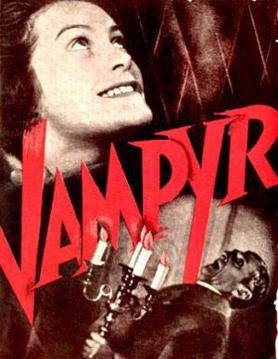
Early movies are fascinating.  I learned of Vampyr, a 1932 production by Carl Theodor Dreyer, from Raymond T. McNally and Radu Florescu’s In Search of Dracula, where they praise it.  I’d never heard of it before.  There are probably a few reasons for that.  One is the movie was considered not very good when it was released, and it never garnered much of a reputation.  Another is that the original prints, including the soundtrack, had been lost.  Three language versions had been shot—German, French, and English.  Since this would obviously lead to lip-syncing problems, there is very little dialogue.  The movie as it exists today is accessible in the German version, and it tends to fall into that category that includes work by directors such as Ingmar Bergman and Stanley Kubrick.  It has art house elements and the story requires some pondering.  It isn’t bad, although in today’s viewing culture, it might seem dull.

It is a vampire story based on the works of Sheridan La Fanu.  The star, and also financier of the movie, was an actual Baron from France (in real life), Baron Nicolas de Gunzburg.  He plays a student of the occult who happens upon a gentry-class family plagued by a vampire.  Interestingly enough, this kind of character is distinctly Lovecraftian, and there is a passing resemblance between de Gunzburg and H. P.  The acting isn’t great, but the story is good.  It includes shadow people who assist the vampire—a female, in this case—and a kind of mad doctor who helps her reach her victims.  The occultist and the household servant of the gentry family locate the vampire’s grave and stake her.  And in a scene that may have inspired Witness, they suffocate the mad doctor in the bin of a flour mill.

Like many vintage movies, Vampyr has received a more positive reevaluation over time.  While some consider it great, the consensus seems to be more at the “very good” level.  It is an early vampire movie, apparently filmed before Tod Browning’s Dracula.  While not scary by today’s standards, there are some definitely creepy scenes.  Particularly when the elder daughter of the gentry family begins to become a vampire, leading to some quite effective facial expressions.  McNally and Florescu weren’t film critics by any stretch but they felt that, up to the early seventies, this was the best vampire movie made.  I might not go all the way with them, but I would suggest it is certainly worth viewing by those who like old cinema, and who appreciate vampire stories.


Low Stakes

Elsewhere on this website I refer to myself as an “unfluencer.”  This quasi-serious attempt at humor does bear a kernel of truth.  It’s difficult to get your voice heard on the internet.  By the time I began blogging, vlogging had already become a thing and people prefer watching to reading.  (I do have a few YouTube videos out there, but they take an awful lot of time to put together and I’m kinda busy trying to write obscure books.)  The reason I mention this at all is to make a point.  People sometimes wonder why a guy who has a doctorate in religious studies wastes his time with horror.  There’s a good reason.  People will pay attention when the stakes are low.  Is horror important?  I think it is, but most people don’t.  Genre fiction is easily dismissed as being off in fantasy land, despite the growing number of voices suggesting we should be paying attention to how it influences (unfluences?) religion.

Those who delve in such blue collar things sometimes grow to be taken seriously.  I suspect—since I wouldn’t know—that it’s a matter of sticking with it long enough, and producing enough content that people have some standard for comparison.  And the interesting thing is, you often notice fascinating features along the way.  While working on my next book the other day, I realized a major gap in the study of history of religions.  I can’t say what it is here, of course, because someone without a 9-2-5 may scoop me.  But the gap is clearly there.  And I would never have noticed it if I weren’t spending my time writing about low-stakes monsters.

I’m a blue-collar thinker pretty much through and through.  Talking it over with my brother the other day, I realized that despite the years and years of higher education, I was brought up working class and I look at the world through those lenses.  When I was actually a professor that began to change, but in retrospect, I think that’s why my students liked what I did in the classroom.  I wasn’t some child of privilege handing down tired observations meant to impress other children of privilege.  I’m just a peasant trying to figure things out.  I can point to no highly educated forebears—neither of my parents finished high school.  No, I have been fortunate enough to have clawed my way through three higher degrees only to realize that people only listen if the stakes are low enough.  And I’m alright with that since I get to spend the time with my beloved monsters.


Black History

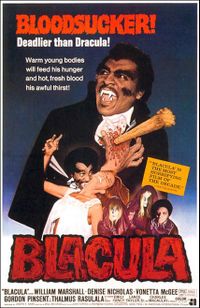
The first of the “blaxploitation” movies, Blacula is a period piece.  In 1972 vampires were still all the rage, following from Dark Shadows and the continuing Hammer hammering of the monster.  They even produced Dracula AD 1972, not to put too fine a point on it.  American International Pictures wanted in on the action and produced the first Black vampire in cinematic history.  Rather than a remake of Bram Stoker’s novel with a Black cast, the story begins with Mamuwalde, an African prince, entreating Dracula (whom he doesn’t know is a vampire) for help ending slavery.  Instead, Dracula turns Mamuwalde into a vampire that he names “Blacula,” and places him under a curse.  In the seventies, a homosexual couple purchases Dracula’s castle, intending to sell the contents on the antique market.  One of those antiques is a locked coffin.

Once he’s freed in America, Blacula quickly runs into Tina Williams, the spitting image of his long-deceased wife.  Meanwhile Tina’s friend Dr. Gordon Thomas, suspects that there is a vampire on the loose in LA.  Although the opportunity for camp is clearly present, this movie is played straight.  Mamuwalde is a monster—he kills several people—but his real motivation is to regain his dead wife, whom, he is convinced, is Tina.  When Tina is shot by a trigger-happy cop in the tunnels below a chemical plant, Blacula turns her into a vampire.  When she is staked, Mamuwalde tells the doctor that he need no longer pursue him.  He voluntarily climbs into the sunlight and dies.

Now, this wasn’t a great movie but it does seem to have a reasonable bit of social commentary.  It was the seventies, but racial and orientation slurs were still widely accepted.  And people dressed like, well, it was the seventies.  The Black characters, however, are portrayed with dignity, and Mamuwalde is presented as nobility.  Perhaps more importantly, this movie opened the doors for further horror films featuring African-American lead characters and plots.  A few decades later Blade, based on a comic book hero, would once again foreground a Black vampire who’s on the side of good.  It’s still some distance from Black Panther, but the process had to begin somewhere.  Watching Blacula was like watching history, and I suppose viewing movies is like a selective piece of history.  By this point AIP was well established, and influential in its own way.  I’d heard about Blacula since childhood, but until streaming it never really came across my screen.  Nevertheless it remains an important piece in this country’s ongoing vampire mania.


Bibliographer for Hire

Why is bibliographer not a job?  Why can’t a person make a living categorizing knowledge?  I ask this because I see YouTube videos of people saying your job should be what you enjoy doing.  What if you enjoy creating bibliographies?  You see, my research methods are a bit unconventional.  They kind of have to be since I have no institutional support for my writing, and yet I want it to be intelligent and informed.  That means I have to locate my own sources and inevitably, when I’m compiling a bibliography, I’m happy.  Even if it means ferreting out obscure sources and trying to learn where something was originally published, I’m still at the top of my game.  (Yes, this is one of those things that the longer you’ve been doing it, the better you get at it.  These days it means learning to engage the internet for research.  Since it’s more of a money-making venture geared towards entertainment, that can be tricky.)

I remember those days of typing out bibliographies by typewriter, smearing White-Out all over, or trying to use that ribbon stuff that was supposed to be able to type over mistakes.  My friends and fellow students hated bibliographies.  Secretly, and perhaps perversely, I was enjoying myself.  You see, a bibliography is gathered knowledge.  When I finish reading a nonfiction book, particularly one where I want to do further reading myself, I go through the bibliography.  I want to know the origins of ideas.  There’s an irony here since my last few books have featured quite a few of my own ideas supported by what I’d read.  And I know that unless I provide a precise footnote, anyone who might read my work might wonder “how I know” what I’m writing.  It’s increasingly becoming one of those “pay attention to your elders” sort of thing, I guess.

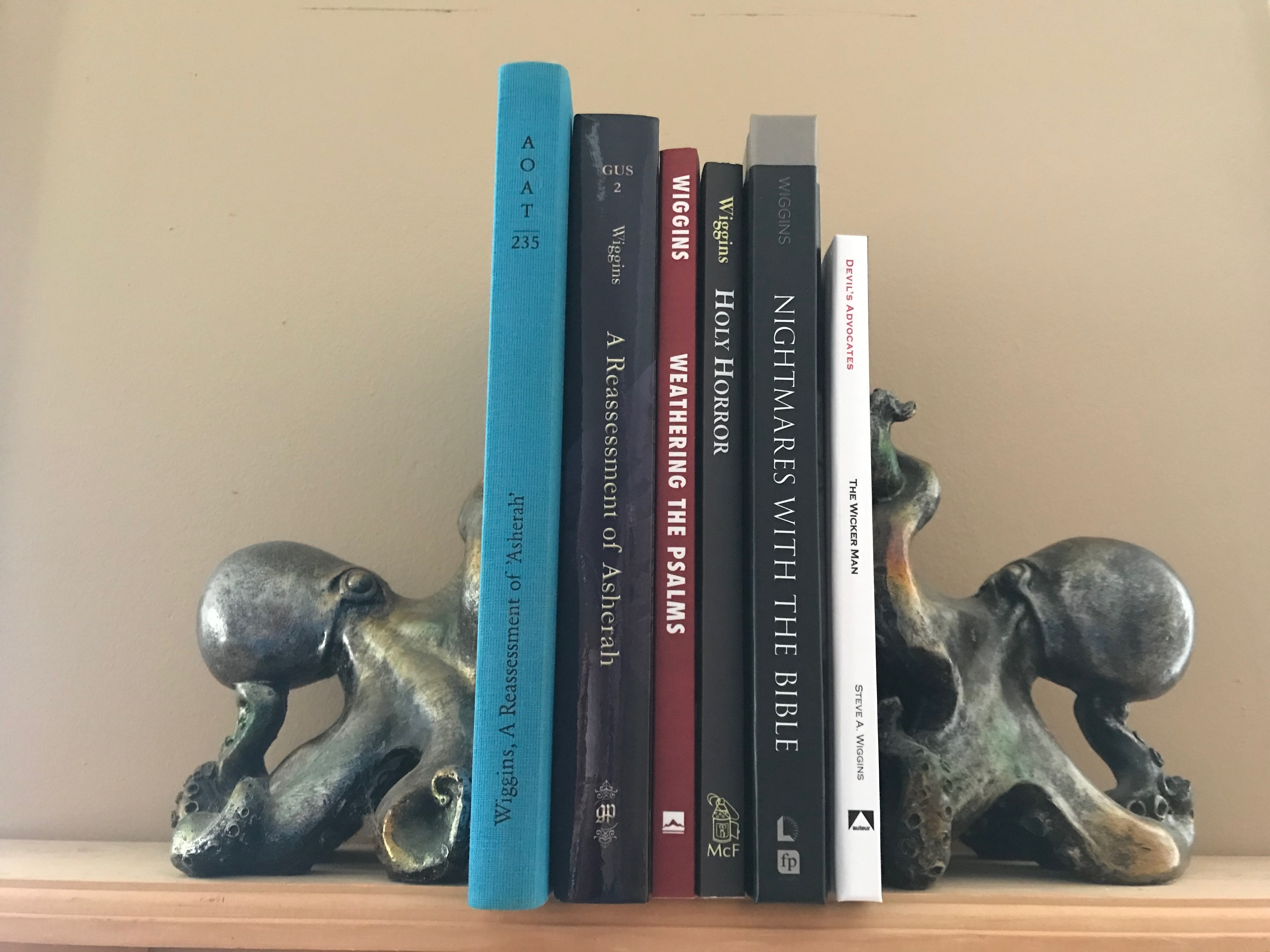
But the bibliographies I could compile!  The really tricky part when writing The Wicker Man was the word limit.  I know authors who struggle bringing the bibliography down to required length, and I feel for them.  I really do.  You see, a bibliography is a record of what it took to get me to write this book.  These are the things I was reading, pondering.  Or found along the way.  There’s an art to a bibliography as well.  Some topics seem to attract authors with last names beginning with a certain letter, for instance.  Or others seem to have a dearth of another letter.  I may be the only person who finds such things fascinating, but can’t that be a paying job?  It is most interesting work, and categorizing knowledge is a full-time job.  If only it was a paying one.


Red Dress

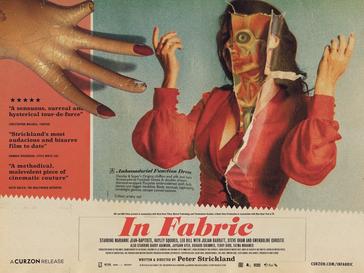
Horror sometimes takes a creative turn.  In Fabric is an art film as well as a horror offering.  The basic premise is that a certain red dress, sold at a bizarre fashion store, causes the death of those who wear it.  Sheila, recently divorced and having trouble with her adult, at home son, buys the dress for a date.  After leaving her with a rash, the dress leads to an arm laceration, a German Shepherd attack, an attack on her son’s girlfriend, and finally, Sheila’s death in an auto accident.  The dress is then picked up by a guy as a stag party prank where the groom has to wear it.  His soon-to-be wife finds it and wears it also.  The man, Reg, loses his job as a washing machine repairman and has no luck finding another.  While Babs, his wife, is shopping at that same strange shop, Reg’s furnace malfunctions, killing him with carbon monoxide.  Babs is trapped in the shop as it catches fire and burns down.  All those killed by the dress are shown working on new ones at the end of the film.

The movie is also called a dark comedy and there are some funny bits.  The sales clerk, Miss Luckmoore, speaks in cryptic, quasi-poetic style, never giving a straight answer to anyone.  The shop’s owner does the same.  And some of the scenarios are amusing.  Although horror, the movie isn’t really scary, but it is stylish.  Unlike some horror comedies, the tone isn’t really funny, but more wry.  And it’s a bit confusing.  The overall story arc is easy enough to follow, but some scenes just confound.  I kept waiting for an a-ha moment when everything would fall into place.  Of course, ambiguity is a hallmark of many intellectual films.

Something that I’ve been noticing, no matter the era that it’s from, is that films really need to justify that last half-hour, if they’re going for 120 minutes.  Maybe it’s just that we’ve become accustomed to the 90-minute feature, but I’ve notice that most two-hour movies (not all) seem to suffer from some pacing issues.  Of course, an art-house movie will defy conventions.  For example, the point of view is Shelia’s for about the first half of the film, then she’s killed and new characters are introduced.  Yes, this shows that the dress goes on killing, but another approach might’ve been to have the protagonist learn about past killings and realize the dress is coming for her.  But then, that might’ve been less creative.


Major Drum

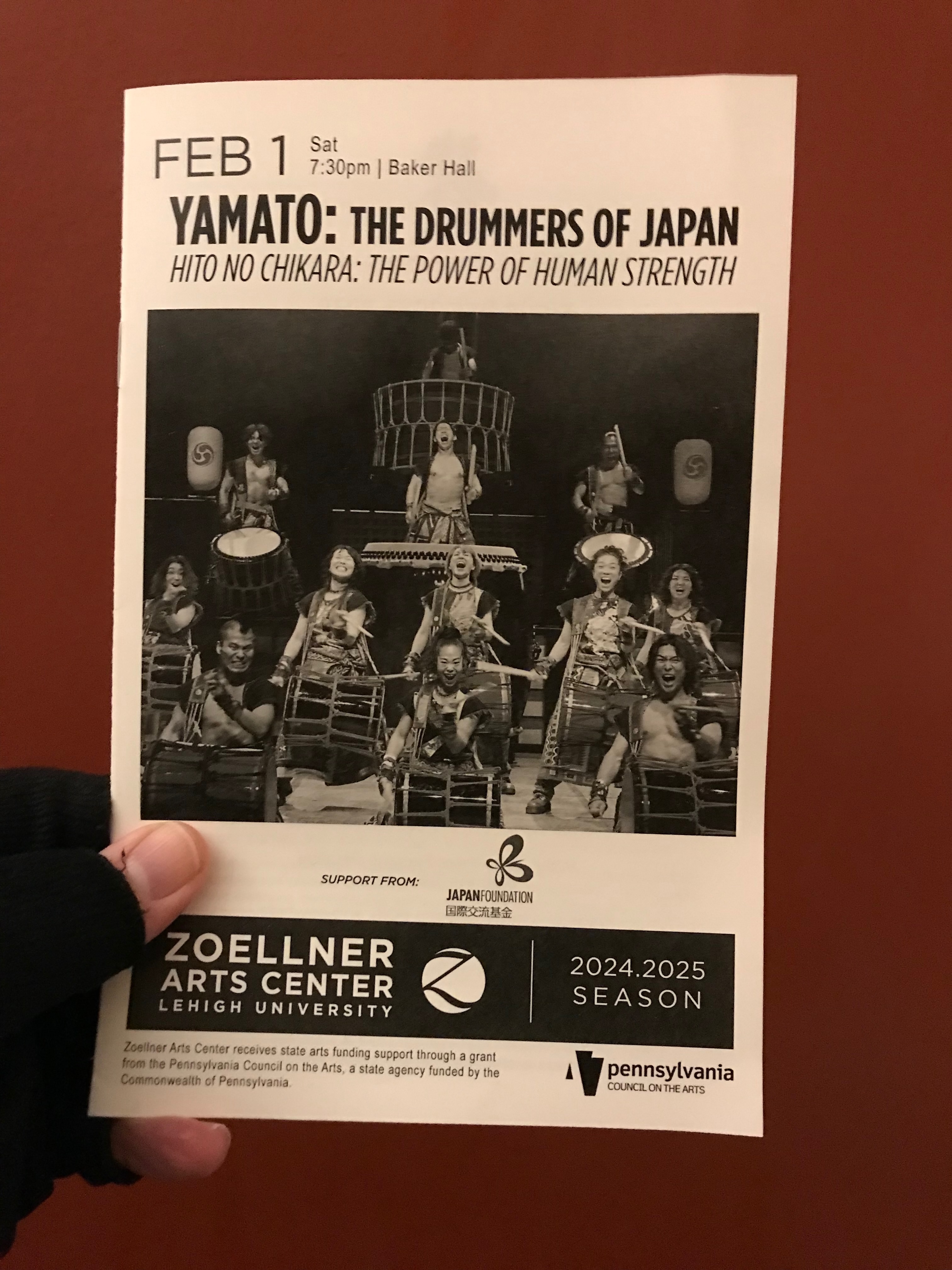
We don’t get out much.  Live shows can be expensive and these cold nights don’t exactly encourage going out after dark.  Living near a university, even if you can’t officially be part of it, has its benefits, though.  Over the weekend we went to see Yamato: The Drummers of Japan.  Our daughter introduced us to the concept while living in Ithaca, a town that has a college or two, I hear.  These drummer groups create what might be termed a sound bath, that is profoundly musical while featuring mainly percussion.  Now, I can’t keep a beat for too long—I’m one of those guys who overthinks clapping in time—but that doesn’t mean I can’t appreciate those who can.  The timing of the members of Yamato was incredibly precise, and moving.  At times even funny.  It’s a show I’d definitely recommend.

This particular tour is titled “Hito No Chikara: The Power of Human Strength.”  Now this isn’t advertising their impressively well-toned bodies, but is a celebration of human spirit under fire from AI.  The program notes point out some recurring themes of this blog: to be human is to experience emotion, and to know physical limitations, and to be truly creative.  Would a non-biological “intelligence” think to wrap dead animal skins around hollowed out tree trunks, pound them with sticks and encourage hundreds of others to experience the emotions that accompany such things?  I live in a workaday world that thinks AI is pretty cool.  Humans, on the other hand, can say “I don’t know” and still play drums until late in the night.  We know the joy of movement.  The exhilaration of community.  I think I can see why they titled their show the way they did.

Bowerbirds will create nests that can only be called intentionally artful.  Something in biological existence helps us appreciate what they’re doing and respond in wonder.  Theirs is an innate appreciation for art.  It spans the animal world.  Japan is one of many places I’ve never been.  I’ve never played in any kind of band and you don’t want me setting time for your pacemaker.  If a computer keeps such precise timing we think nothing of it.  It’s part of what humans created them to do.  When a group of people gets together, stretching their muscles and working in perfect synchronicity, we sit up and take notice.  We’ll even pay to watch and hear them do it.  Art, in all its forms, is purely and profoundly biological.  And it is something we know, at our best, to appreciate with our emotions and our minds.


Grown-up Jane

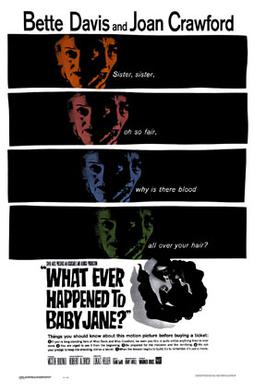
Watching Stephen King’s list of scary movies in the 30 years prior to 1980, I’ve found one or two that hardly strike me as horror.  Some of the others remain remarkably effective today.  I had the wrong idea about What Ever Happened to Baby Jane?;  I’d supposed from the title that it had to do with an abducted child, a topic I generally avoid.  When looking up yet another movie on Tubi that was free, but only in Spanish, I saw Baby Jane on offer and decided to give it a try.  I was pretty impressed.  It’s overly long and drags a bit, but the story is good.  One thing about horror films from the period is that they relied on story because the special effects really didn’t exist to make movies such as many we now see—splashy, but shallow.

In case you’re even more outdated than me, Baby Jane was a successful child actor whose sister grows up to outshine her.  Blanche, the sister, is crippled in a car accident that has been blamed on Jane for the last couple of decades.  Jane really can’t act, and once her sister is disabled, the two live on Blanche’s money until Jane’s growing insanity threatens her wheelchair-bound sister.  Trapped upstairs without any means of communicating with anyone who might help, Blanche is tortured and starved by her sister.  There’s an incredible amount of tension, even if the events begin to seem unlikely as the two hours roll on.  There are a few dropped subplots—the neighbor who harbors no suspicions at all, and the musician Jane hires who discovers her secret—but overall the tension keeps building.

One thing that occurred to me was that part of the plot involves leaving a phone extension off the hook to prevent Blanche from getting help.  I pondered how some young people who only know phones as personal devices might not understand this.  How, when I was a child that if you left an extension off the hook no calls could go in or out.  And that the annoying “off the hook” tone didn’t yet exist.  Ironically, now you could watch the movie on your personal phone that you carry with you at all times.  While this isn’t a perfect movie, it is an engaging one on many levels.  The sisterly rivalry, the growing insanity of Jane, and the helplessness of an invalid all work together to create some frightening moments.  Technology sure makes life convenient, but it cuts off some avenues for horror.  Of course, as Unfriended shows, it opens new venues.  I agree with King—this is one of the actually scary films from before the eighties.


Poking Around

I’ll always prefer indies but ever since James Daunt took over Barnes & Noble it’s become a much better place.  I unfortunately didn’t get to any of Daunt’s stores while living in the UK, but unlike most corporate types, he gets books.  He understands book buyers and, I like to think, he reads.  I happened to need to stop into a local B & N recently on a Saturday morning.  I got there a little early and I saw a line at the door.   Naive as ever, I supposed it was a reading or writing group that’d be meeting there.  The queue had one thing in common: they were all males between thirty and fifty years old.  Who says men don’t read?  I went in and got what I was after, and even browsed a bit.  When I got to the register they were in line.  Hands empty.

Then I noticed that as each one stepped to the register, the sales clerk would step back to a place behind the counter and come with the same thing for each one.  As I got close enough, I saw that they were after Pokémon Prismatic Evolutions.  The Prismatic Evolutions Poster Collection released just the day before when they were probably at work.  The game sells for about a Franklin and the shelf was nearing empty by the time I finally reached the checkout.  I looked back.  At least five more guys had come in and immediately joined the line, no products in hand.  I’ve never seen the appeal of Pokémon but I couldn’t feel smug because I was there because of an obsession as well.  I didn’t buy a game, or cards (one guy bought 14 packs of the same card set, clearing that rack), but I was guilty nevertheless.

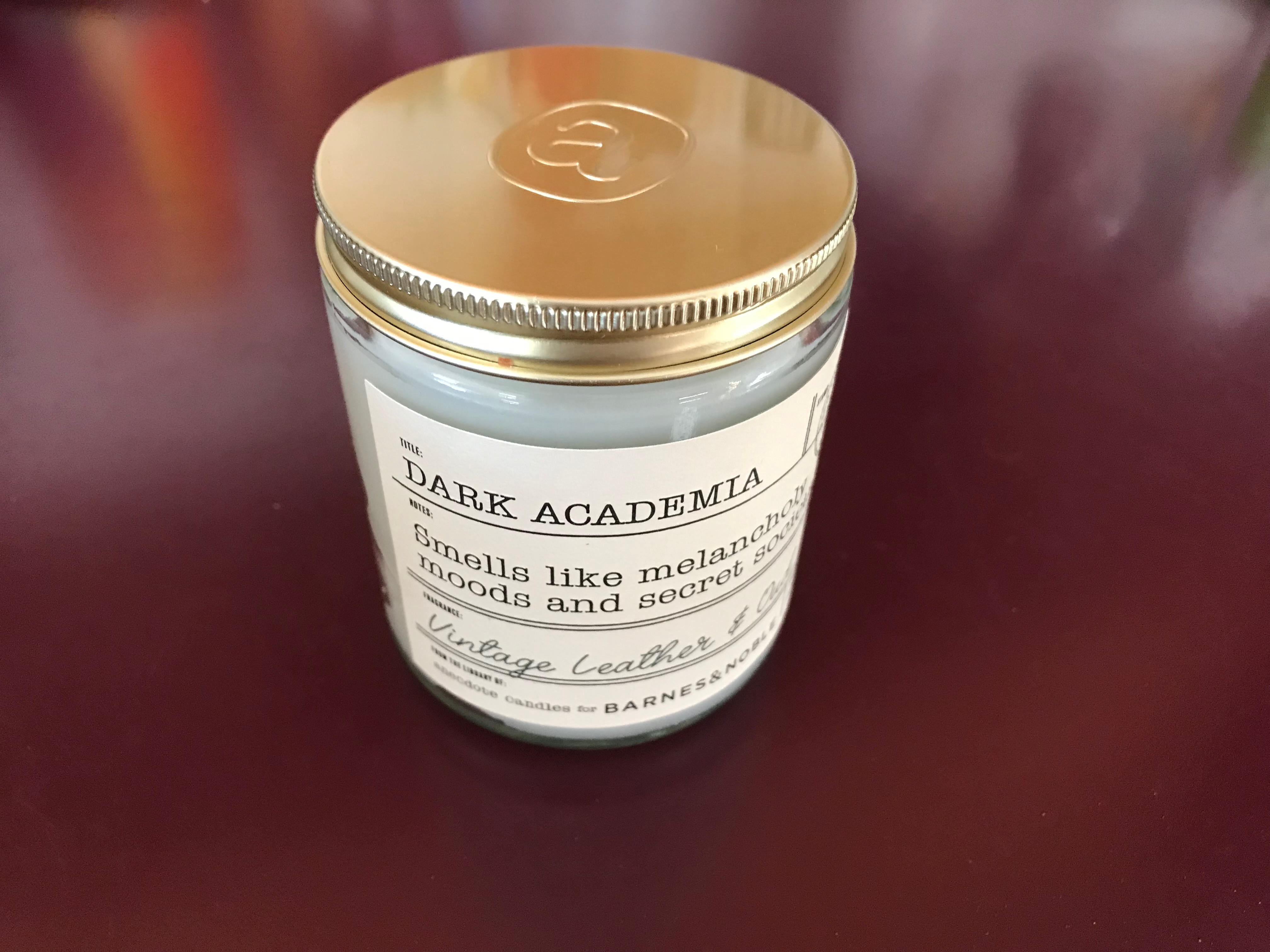
I’ve been fascinated by Dark Academia for some time now.  That week, when I had also been at work, I realized that one of the books I had in that genre had been destroyed in what we refer to as “the flood.”  (The story is here on this blog, but the short version is when we moved into our house, the movers stacked our boxes in the garage because they were complaining it was so late.  Before I could move the boxes into the house—the day after the next, in fact—a torrential rain fell and many of the boxes got wet, destroying at least 100 books and some other items that can’t be replaced.)  I was missing that particular book and it was old enough that I was pretty sure the local indies wouldn’t have it in stock.  Daunt’s B & N did.  So the line that morning contained a bunch of obsessive guys, but one of us, I have to confess, was over sixty.


Like Father

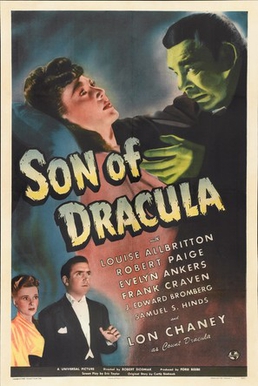
There’s just something about old movies.  After Universal discovered that Depression-Era people would still pay to see scary movies, they made a kind of industry of filming new monsters (for them) or spinning off of their successes.  Several years ago, when Universal was selling collections of their famed monster line up on DVD, I bought a few.  I realized recently that I had never watched Son of Dracula, included in the Dracula DVD set.  While it’s not a great movie, it’s by no stretch a bad one.  The story is complex and soulful, and even though Bela Lugosi’s not in it, the film participates in the ever-growing vampire lore.  It also introduced the world to Alucard, a character that would take off in Japan as a vampiric character in video games and manga.

Katherine, a well-to-do southern belle, met a Count Aculard while traveling in Eastern Europe.  He’s now visiting her in America, much to her fiancé’s chagrin.  A local doctor and friend of the family comes to expect that Alucard, Dracula spelled backwards, of course, may be a vampire.  He brings over a professor acquaintance from Hungary to test his hypothesis.  Meanwhile, Alucard, Dracula’s son, marries Kay and in so doing inherits her estate.  She becomes a vampire, which was her plan all along.  She, however, plans to turn her fiancé into a vampire, after they kill Alucard, so they can spend eternal life together.  The doctor and professor figure out what’s going on, but the local police don’t believe them and are ready to commit the doctor as insane.  Frank, the fiancé, refuses to go along with Kay’s plan, so he kills the Count by destroying his coffin before daybreak, and then also immolates Katherine as well, ridding the New World of vampires.

This is definitely a period piece, but it manages to have a southern Gothic appeal.  The black folk are all servants, and the Hungarian doctor sounds just like Peter Lorre, but the story is complex enough to retain interest.  Lon Chaney, as Alucard, doesn’t have as much screen time as you might expect, but there’s a lot going on in various subplots.  The movie was released in 1943, when there was still a ban on horror movies in war-time England.  The concern about invading foreigners is pretty clearly spelled out but the story is fairly well-told, even with some small holes remaining in the plot.  All of this makes me think I’d better check my other Universal monster DVDs.  There may be some other good bits that I’ve been missing.


Not Afraid

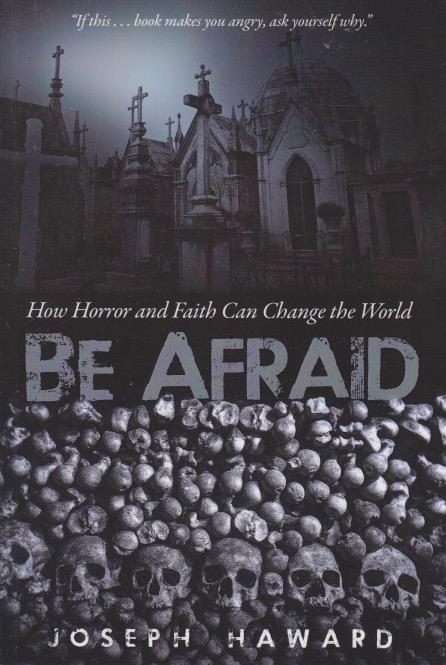
It’s something many of us do.  Trying to explain why, while religious, spiritual, and moral, we find horror fascinating.  I read Brandon Grafius’ Lurking under the Surface, and when I learned about Joseph Haward’s Be Afraid: How Horror and Faith Can Change the World, I figured I’d better read it too.  Haward is a British Baptist minister who seems to support progressive causes.  He also enjoys horror.  He even finds it prophetic.  I have to admit that when I read the foreword by John E. Colwell I was afraid that this would be one of those books.  You know, the kind that only half-likes horror because their religion tells them so.  Colwell is no horror fan, and his foreword doesn’t set the tone for what follows.  Haward finds horror homiletical.

When I was young I used to see movies and analyze them theologically with my friends.  This was in college and seminary, mostly.  We’d discuss the implications of movies—sometimes horror—and how they fit into our Christian worldview.  This book is like that.  It’s Haward’s reading of various horror films, some television, and some novels, integrating them into his theological outlook.  The book is more about theology than it is about specific horror films, although it does mention quite a few.  The discussion is sometimes hard to follow because the paragraphs are so incredibly long and the style is very theological.  I got the feeling that Haward would be an interesting person to have a conversation with.  His book didn’t really do it for me, however. Some things are simply better in person. (I do know Brandon Grafius, and enjoy our talks.)

I’m not into horror for the violence.  Haward tends to point to that element, but I’m generally looking for the mood.  And avoidance.  Also when I was young I learned the truism, “He who lives to run away, lives to run another day.”  I like to think that I’m brave, but violence really bothers me.  My family finds me a contradiction; I won’t watch movies that are based on “true events” unless they’re speculative.  I don’t need reminding that people can be horrible to each other.  I know that from scanning the headlines and from watching the election results.  No, I use horror to help me cope.  And it works best when I know there’s something supernatural going on.  I’ve grown out of theologizing about movies.  I took plenty of theology courses in college and seminary, but they seemed a bit too abstract to be helpful.  Then I’d go out with my friends and watch a horror movie on the weekend so we could talk about it.  There’s a bit of that nostalgia here.