Seeing Seagulls

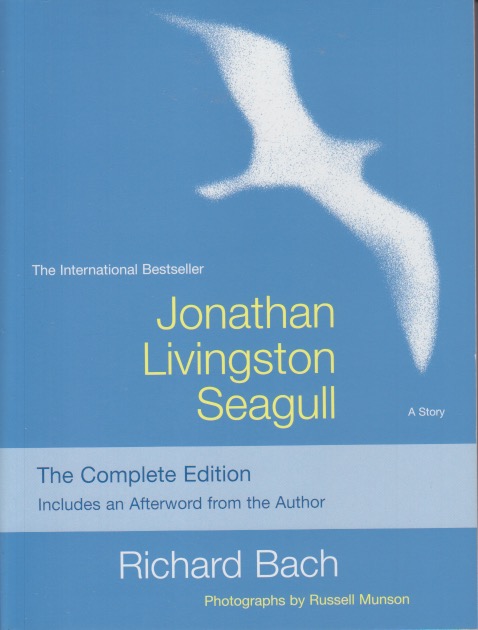
It was a seventies thing.  Even though I lived in a small town, even I had heard about Jonathan Livingston Seagull.  At first I didn’t know it was a book.  (A similar thing happened to me in the nineties with a character named Harry Potter.)  It was probably in college that I learned this was a book I should read.  I did, and I followed it up with Illusions, also by Richard Bach.  Now, this was unorthodox stuff.  These novels consider what some would call superhumanities and others self-deification.  The two are related.  In any case, Jonathan Livingston Seagull is a story about a seagull that overcomes limitations.  An inspirational book.  The publisher had no great expectations for it but it ended up becoming a number-one bestseller without any real marketing support, largely through word of mouth.  You’d have had to have been living in a cave in the seventies not to have heard people mentioning Jonathan Livingston Seagull, whether bird or book.

I got a hankering to read it again but alas, it was one of the books destroyed in the flood.  I went to a local bookstore and was disappointed to see that it was out in a new edition—larger, and, of course, more expensive.  Longing eventually overcame reluctance and I bit the bullet.  I’m glad I did.  The story is still as empowering as I remembered it, but the fourth part, the new one, strikes me as very necessary.  In it, rumors of the disappeared Jonathan Livingston Seagull have turned him into a god.  A god, moreover, whose followers are more interested in the orthodoxy of ritual than what he taught.  This was published before Trump’s first election, but it accurately describes what “Christianity” has become under his two-pronged reign of terror.

The idea of Christianity itself has become deified to the point that Jesus—what he did and taught—have become completely irrelevant.  Now, you don’t have to walk all the way with Richard Bach (I read the two books after Illusions as well, The Bridge Across Forever and One), but this book has a message that still rings true after all these years.  The book is over half-a-century old now and I am glad that it’s having a small resurgence.  The message, when the book ended at part three, was perhaps a little lighter.  We still, however, have to learn to overcome limitations.  And there’s a fair amount of wisdom in this little book.  Even though it was a seventies thing, it remains a good thing.


Blushing Brides

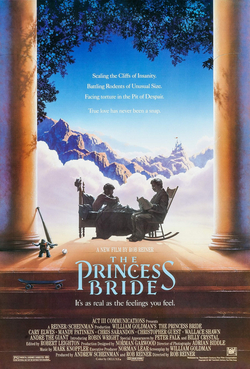
Death does strange things.  But first I have a confession to make: I had never seen The Princess Bride before recently.  Since it is a favorite film of many people and since Rob Reiner had been murdered earlier that week, my wife wanted to see it again (for her).  Given the timing, she must have seen it shortly before I proposed to her, or maybe shortly afterwards.  Perhaps I owe a debt of gratitude to the movie.  I entered into it not knowing anything about the story or even the genre.  Rob Reiner was eclectic in his tastes, directing everything from comedy to horror, Spinal Tap to Misery.  As for Princess Bride, it felt like a light fantasy, generally comedic but with no laugh out loud parts.  It’s a sweet story with intriguing characters.  And a cast of big names.  I have to assume that since I may have been the last person on the planet to see it that the plot is already known.

The fact that it is based on a book makes me want to read it, but I understand it is quite long.  One of the debates that constantly seesaws in discussions of pop culture is whether it’s better to read the book or see the movie first.  Typically I fall on the book side (but you already guessed that).  I think that might’ve enhanced my experience here.  I do try to enter movies fresh, without reading about them in advance or watching trailers.  But then again, I tend to watch horror films as a kind of default.  In The Princess Bride, things turn out alright.  Definitely better than they ended up in Game of Thrones.  Fantasy is a genre that I sometimes read, but the sword and sandal scene isn’t my favorite.  The comedic aspect, however, makes Princess Bride work.

I also wonder if the initial impact had something to do with the cultural moment.  1987 stands out in my mind as a year of cultural significance.  It was a formative year in my life: I went to Israel that summer to work on an archaeological dig.  Pop culture was also in an odd place.  In my mind this mostly tracks with music of that year.  U2’s Joshua Tree came out early, and I recall a number of albums I purchased that were formative to me as a twenty-five-year old.  The one that most spoke to me, as a dark fantasy was Bruce Springsteen’s Tunnel of Love, which I still listen to every October.  I saw a lot of movies that year, but Princess Bride wasn’t one of them.  I feel like I have, in a small measure, temporarily caught up.


In Praise of DVDs

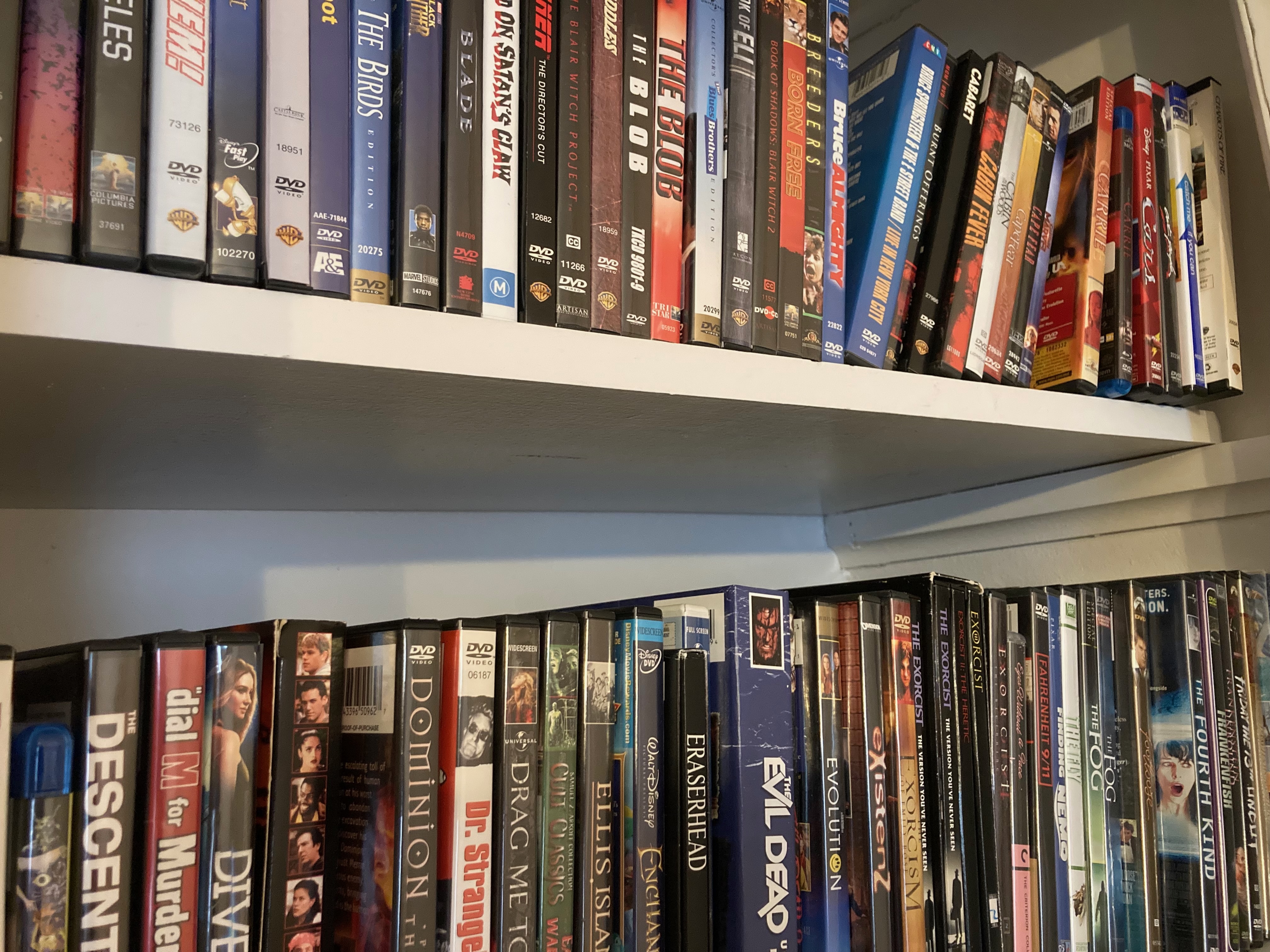
Streaming has made movies very widely available, which makes my life easier.  Since I’ve been writing books about horror movies and such, being able to see them now that video rental stores have disappeared, helps.  (At least when they’re available.)  But I’m not ready to stop singing the praises of the DVD just yet.  (Or Blu-ray, if you roll that way.)  They definitely have their advantages, at least until the disc goes bad.  When you watch a movie as a form of research, and you haven’t been taking adequate notes, you might need to stop afterwards and watch a scene again.  What I’ve noticed with streaming services that include commercials is that if you rewatch you have to be subjected to two minutes of commercials first.  And if you only vaguely remember where the scene was you may need to sit through four or six minutes of advertising.  Maybe more.

The humble DVD had the chapter menu.  And no commercials that you couldn’t skip.  My books have involved using DVDs whenever possible for that reason.  Quite a few of the movies discussed in Sleepy Hollow as American Myth had to be viewed via streaming.  Going back and finding that exact scene where the question mark lingers can be quite time consuming.  There’s a reason you can only write a limited number of such books!  The DVD was, naturally, an improvement over the VHS tape with its endless rewinding.  Of course, streaming has reintroduced having to scan back through a movie to find a spot instead of picking a chapter close to where you remember the scene.  First world problems, I know, but no less annoying for being so.  It’s the world in which I live.

Then there’s the bonus of extras.  I know some streaming services offer side menus with additional information, but those of us who are focus-challenged need to watch the story.  Extras were for afterwards.  Does anybody else feel old for having grown up with the only way to see movies being either the theater or a grainy black-and-white small rendition on television several years later?  Now movies are whipping past me through the ether all the time.  Landing on devices and beginning to play if your cursor hovers too long on the spot.  I used to avoid going to movies alone—they were a social occasion as well as an entertainment one.  Now I stream alone, often at the price of commercials, and during those interludes I’m thinking of DVDs, and how they were made for research.  A strange thing to say for a guy who used to trust only books.


Dark Library

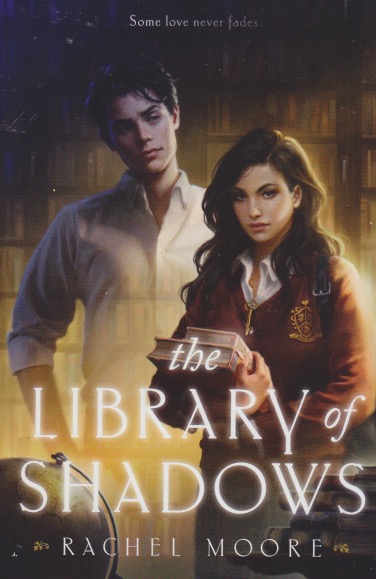
Although it’s booming, I’m not a romance reader.  Not in the modern sense, anyway.  I’m a big fan of the Romantic Movement, which gave us the gothic novel, but the distant descendant of the latter is dark academia.  And dark academia is what brought me to Rachel Moore’s The Library of Shadows.  That, and ghosts.  I’d read somewhere that this novel (probably classified as young adult as well) brought dark academia and ghosts together and indeed it does.  I’m finding dark academia to be quite liberating.  I may no longer be a card-carrying member of Club Academe, but that setting is never far from my mind.  Enough about me.  Here’s the story: Este is a student at Radcliffe Prep, reputed to be the third most haunted school in the country.  She doesn’t come from money, however, since her father, a former Radcliffe Prep student, died prematurely and her mother has gone in search of anything that might remind her of him.

Este, unlike her wealthy cohort, isn’t sure how she fits in.  She doesn’t believe in ghosts.  Until she falls in love with one.  (This isn’t really a spoiler since it’s on the back cover copy and you can infer as much from the cover art.)  The story revolves around how to resolve that tension.  I’m sorry to admit that I’m not sure if “fades” are a traditional kind of ghost or if they were invented for this story, but they are behind the somewhat-horror elements to the tale.  Moore lays out the rules for her ghosts: they can’t walk through walls (so they can be locked out of a room), they tend to be not seen in natural light, but artificial light brings them into view, if they want to be seen.  And those that inhabit the library at Radcliffe, have bodies that can affect the physical world, but they can’t connect with anything living.  The fades are much worse: they kill mortals.

Moore’s story is a romance and a fantasy, but it is fun to read.  As a first book it has the freshness that somehow fades when writers become too jaded with the system.  (As someone who has tried repeatedly to get fiction published, believe me, I know.)  I suspect those looking for serious adult fiction might find it on the light side, but romance does have its attractions.  Since this is for younger readers there’s nothing too explicit here.  Just a story that keeps you interested as the pages turn.  And if romance has ghosts, and fits dark academia, I wouldn’t rule out reading more.


Togetherness

Over the holiday break I watched three very good movies and I noticed that Domain Entertainment was one of the production companies for each of them.  The final one I saw (after Sinners and Weapons) was Companion.  I’m going to have to look into Domain a bit more.  In any case, Companion is sci-fi-ish horror with a somewhat comedic twist.  I say sci-fi-ish because we are rapidly approaching the point where this is possible.  What is this?  A sexbot that functions like Siri but who’s better in bed.  Josh and Kat have been planning to murder Kat’s very wealthy boyfriend and to blame it on Josh’s bot Iris.  Iris doesn’t know she’s a robot.  Viewers learn that Josh has tampered with her programing a little, allowing her, for example, to attack a person in self-defense (violating Asimov’s rules for robots).  When Kat’s boyfriend tries to rape Iris, she kills him.

Josh and Kat will blame the robot, with their friends Eli and Patrick as witnesses to corroborate their story.  Since the deceased boyfriend has 12 million dollars in cash lying about his house, it won’t be missed.  But Iris, it turns out, has a conscience.  She escapes.  It turns out that Patrick is Eli’s sex bot, and he is sent to bring back Iris after she kills Eli, also in self-defense.  A police officer who finds Iris is killed by Patrick, complicating matters.  Then, Josh changes Patrick’s programming and he accidentally kills Kat.  Planning to blame all of this on Iris, Josh calls the robot’s maker to have Iris returned.  The technicians see the holes in Josh’s story and one of them restores Iris after Josh shoots her.  Iris then confronts Josh.

This will give you a taste of the story without giving away the ending.  This is a smart, sympathetic treatment of technology, including AI.  From the beginning, before it’s revealed that Iris is a robot, the viewers’ sympathy is with her.  She seems to be the wronged party and Josh is slowly revealed to be pretty much an all-round scumbag.  While not the most profound film of this genre, Companion nevertheless raises many of the issues that merit discussion when technology outraces ethics.  We see this unfolding in real time with artificial intelligence companies deciding on profits over any sense of what is good for society, or people in general.  What makes the movie so interesting is that the robots seem to be far more morally concerned than the humans are.  Although I turn this around the other way, I do wonder if sometimes that may be the case. Especially in the context of a movie that’s barely science fiction.


Literalism

I struggle with literalism.  It may be naïveté.  I’m not sure there’s a difference.  I grew up being unsure of anything.  This isn’t unusual among those in an alcoholic family.  It’s probably the reason I spent my teenage years, praying as fervently as John Wesley for certainty with my faith.  My gray matter simply wouldn’t allow it.  I’m skeptical, with advanced training in critical thinking, but still terribly naive.  A family member recently told me something that sent me into a mini-panic.  It was only when I realized that he was being ironic that my ruffled feathers began to smooth out into flight readiness.  And that’s just one instance.  I used to tell my students, when we pick up something to read the first question in our minds is one of genre.  What is this?  Is it fact or fiction?  Serious or satire?  With interpersonal interactions it’s not always so clear.

People are natural actors.  They have to be.  Family time is quite different from alone time.  At least it is for me.  I try to shelter those I love from the darkness, but sometimes it surfaces.  I literally don’t know who I am.  There’s a certain continuity to the “Steveness” of my everyday existence, and that essence, for lack of a better word, accepts many things literally.  I trust people I know.  For the most part, I trust those I meet in their professional capacities—the store clerk, the mechanic, the professor.  I realize that they have inner lives as well, and they may or may not be unfurling the banner for all to see.  We all have filters.  Some use them more regularly than others.

My knee-jerk literalism generally lasts only a second or two.  My brain catches up and says, “this is where your critical thinking should kick in.”  Often that works, but it’s tied in with emotion as well.  The human thought process is certainly not all logic or reason.  Even the most Spock-like among us have emotion constantly feeding into our thoughts.  That’s one reason that artificial intelligence isn’t possible.  Those who think they can logic their way through falling in love are sadly mistaken.  We can’t explain it because we don’t understand it.  And we’re nowhere near being able to.  For business dealings we expect literalism.  But then there’s always the fine print.  I’m not that naive.  I do struggle with my literalism.  It’s set me on the wrong path before.  But certainty still eludes me.


Interiors

I first started reading Stephen Graham Jones after hearing him do a reading on YouTube.  I’ve always had a great deal of respect for Native Americans and his style was so sincere and down to earth that I was immediately drawn in.  Jones is now a well-established horror writer.  I’ve read a couple of his books and I have a couple more on my shelf, waiting.  Mapping the Interior is an early novella that has recently been repackaged and re-released.  You get the sense that even established authors have to prove themselves and then people will go back and read what they wrote before becoming somewhat famous.  In any case, it’s a haunting story about loss, growing up, and belonging.  At least that’s the way I read it.

Junior, the narrator, lives with his mother and younger brother in a modular house, off the reservation.  They are just barely getting by, Junior’s father having died and leaving them to live on one modest income.  But then Junior, who sleepwalks, sees his dead father in their house.  He becomes convinced that his father is victimizing his younger brother, Dino, who has a disability, in order to gain a body again.  Meanwhile, the kids at school all pick on Dino and the next door neighbor doesn’t like having Indians living so close.  He has mean dogs and an attitude.  Tension grows throughout the story as Junior has second thoughts about his father, whose death was never really explained to him.  There are some frightening scenes in this short book.  And a kind of matter-of-fact sadness.

Jones is a compelling writer.  He reminds us that American Indians know very well that they were wronged, but also have little or no recourse to justice.  The characters here keep on keeping on because that’s all you can do.  The end of the story does have a twist that is wrenching, especially after reading all that Junior has done to help his brother.  I read a fair amount about and by indigenous writers—the kinds of things many of those in power would like to ban and deny.  The experience of those whose heritage includes being colonized or/and enslaved is very important to know and to hear.  These are people who’ve been victimized and their stories need to be told.  I’m glad to have discovered this particular book, even as I’m awaiting the time to take on his longer, more recent work.  His is a voice worth listening to.


Second Wednesday

Season two of Wednesday isn’t quite as fresh as season one, but it is still chock full of monsters and fun.  The rest of the Addams family is more present in this season, but it is still focused on that dark academic Nevermore Academy.  The Poe connection comes up more than once as well.  I am curious what they will do in season three, besides rescue Enid, that is.  The concept of the series, it seems, wouldn’t really be possible without dark academia.  Nevermore clearly draws from Hogwarts, but Harry Potter is in the dark academia universe as well.  And this season brings a new threat to the Hyde, the nemesis monster of season one.  The presentation of the Adamses is, in many ways, superior to that in the television series with which I grew up.  I’ve only seen one of the movies.

The whole premise behind the show goes back to a series of cartoons drawn by Charles Addams in the late 1930s.  The television show from the sixties was in reruns by the time I grew up, and we didn’t watch it religiously.  I did enjoy the weird aspects of the family, but I didn’t get behind the mythology.  Of course, the mythology really began to grow with the big-budget films of the 1990s, which edged into comedy-horror territory.  Wednesday moves things into the realm of monsters with a dash of the X-Men thrown in.  Even so, the show works.  Wednesday continues to build the back story of various family members, and does so well.  The basic idea of the season is that Gomez’s roommate, a mad scientist, is reanimated and is attempting to cure his mother from being a Hyde.  This clashes against the Addams family.  Also, the new principal at Nevermore is a conman.  Hmm, wonder where they got that idea?

I’m fascinated by the growth of such phenomena in popular culture.  Tim Burton has a way of bringing dark Americana into his orbit, and this is another example.  The thing is, this set of cartoons began what has now become a large franchise.  You never know when you put something out there, whether it be a poem (“The Raven” is clearly a major part of American culture), a story, an obscure novel, or cartoon, if someone in the future might not see the potential in it to make it a big thing.  And since dark academia is having a moment, the time is right for Wednesday and the growth of more dark Americana.


Being Saved

Historians of media will have much to contend with now that streaming services, such as Hulu, Netflix, and Amazon are producing their own feature-length films.  There are movies I’m still waiting to catch up on, but freebies on services already available are enticing, economically.  So it was that I watched Hulu’s No One Will Save You.  It’s an unusual horror film that has, as many recent ones do, a message.  Personally, I find home invasion films and alien films particularly frightening and this one does scare pretty consistently for the first half or so.  For me, anyway, at that point questions start to arise and curiosity about what’s going on starts to overcome the fright.  The movie is heavy on symbolism, almost to the point of being a parable.  The main character speaks fewer than ten words of dialogue in the film, another unusual feature.  The story, with spoilers, goes like this.

In chronological order (not as presented in the film) Brynn accidentally killed her childhood best friend in an argument.  She has remained in the area, living in an isolated house, and making a living as a seamstress.  Then the aliens come.  Brynn, among those in the rural area, is the only one to have successfully fought them off.  The alien home invasion is about as scary as that in Signs.  As the title already warns viewers, nobody is going to save Brynn.  She manages to kill three of the aliens, but they want to explore her mind.  They do so, finding the isolation and sadness because of killing her best friend.  She forgives herself and the remainder of the townsfolk, controlled by the aliens, welcome her back into society.

One of the features that stood out to me was that when the police chief—his daughter was the girl Brynn killed—refuses to help, Brynn goes to the church.  For all its problems, Christianity is based on the principle of forgiveness.  The problem is that the church is locked and Brynn can find no salvation there.  When forgiveness does come, it is through the manipulations of the aliens.  In the end, the people of the town are the ones who have to change their behavior and accept the one who has learned to forgive herself.  This is why it feels like a parable.  At the same time, it works as a horror movie.  It was better than I had anticipated it might be.  Even though it wasn’t on my list of films I need to watch, I’m glad I did so.


Can’t Read?

Andrew Laties has lived a remarkable life.  He runs Book & Puppet, a local bookstore in Easton, Pennsylvania.  He’s run other bookstores before this one, but now that he’s in the Lehigh Valley he started the Easton Book Festival.  I’ve blogged about his previous books here and here.  In addition to running a bookstore and book festival, he’s also a musician and puppeteer.  In the current climate of book banning, things aren’t exactly easy for those who live literature.  My wife and I just finished reading his latest book You’re Telling My Kids They Can’t Read this Book?  These are the thoughts of a book seller about book banning.  Beyond the many other hats he wears, Andrew is also an activist.  It makes me tired just thinking about all of this.

I remember when the US government promoted reading.  I grew up when we were concerned about Russia and the arms race.  I was alive for (but don’t remember) the Cuban Missile Crisis.  The response, from both parties, was that Americans needed to be educated.  And that meant reading.  Reading is fundamental, so the saying went.  Since 2016, and especially 2024, we’ve taken a 180.  Book banning is in vogue although anyone who reads knows it doesn’t work.  Still, those who sell books can either sit back and worry or choose to do something about it.  Andrew is one of those who is doing something.  Reading is the way we improve human lives.  Daily I read about how some people are preferring books “written” by AI—which has never been and never can be human.  And right-wingers around the country are carrying out their war on books.

Andrew and I talk about publishing whenever I visit Book & Puppet.  His first book got picked up by Seven Stories Press, but he, like the rest of us who have jobs for a living, hasn’t found sympathetic agents or publishers, as he describes in this book.  That hasn’t stopped him from writing or from achieving remarkable things.  I was fortunate enough to be involved in the first Easton Book Festival, and a few after that.  It is wonderful to walk around a town where book events are going on all over the place.  Like much that is good, the event took a hit during Covid, but it still goes on.  And it does so because of something that reader and writers have: vision.  Part memoir and part a call to action, You’re Telling My Kids They Can’t Read this Book? deserves to be widely read.


Orkney

The Orkney Library and Archive was one of my first followers on Bluesky.  (I tend to follow back.)  I’m not sure why they followed me, but I am grateful.  I’m grateful to all followers on social media.  Or at least those that aren’t out to scam or stalk me.  In any case, seeing the Orkney Library posts always takes me back to the two vacations I took to the Orkneys and I thought it’d be nice to plug a little tourism with personal recollections.  

My wife and I lived in Scotland for a little over three years.  As grad students we didn’t have a lot of money, but we did have the presence of mind to realize that as we got older and settled into family and career that just picking up and going somewhere would become more complicated.  I’ve also been a firm believer that travel is a form of education and that people who go places learn by doing so.  Hopefully they learn to accept difference rather than to fear it.  In any case, after my wife began to work and figure out the British tax system, we found out we had enough money to go somewhere exotic.  The Orkney Islands.

The Orkneys are the antiquities-rich, once Viking-inhabited islands north of mainland Scotland.  You can either fly or take a ferry to get there.  Since we’d had a small windfall, we flew.  That was a mistake, given my history with small planes, but I recovered once we landed.  One of my fond memories was hiring (renting) a car in Kirkwall, the largest city.  When I went to unlock it the dealer said, “It’s open.  Nobody locks doors.  We live on an island.”  That comment has stayed with me all these years.  Orkney represented what happens when population size (the islands have only about 22,000 inhabitants) doesn’t grow to the point of creating natural stresses that lead to “big city problems.”

No place is perfect, of course, but Orkney impressed us so much that we returned, with friends, a few months later.  This time we took the ferry and, thankfully, they drove.  We visited antiquities, met locals who were open to outsiders, and saw some of the most spectacular scenery that the British Isles has to offer.  Seeing the posts of the Orkney Library and Archives on Bluesky always takes me back to a happy place.  It’s one of the good things social media has to offer.  And since I check it in the morning, it starts my day off well.


In the Yard

The search for “free” horror has a few more reasonable offerings, it seems, if you follow the reviews.  I try not to read about movies in advance, and I avoid trailers.  The Woman in the Yard had higher scores than several movies streaming on the services I use.  It’s Blumhouse horror, so it has a bit of substance.  Substance but also some confusion.  Trying to make sense of it will involve spoilers.  Here goes: Ramona and David have moved into the country because Ramona found the city suffocating.  Once there, however, she doesn’t take to farm living and becomes depressed.  She tells her husband this and on their way home from a restaurant, he dies in an accident while she’s driving.  Ramona, herself injured, tells Taylor and Annie, her son and daughter, that their father was driving.  She lives with the guilt and is still struggling with depression.

A mysterious woman shows up in the yard.  Draped in black, including her face, she tells Ramona “Today’s the day.”  Feeling threatened, Ramona tells the kids to stay inside, but it becomes clear that this woman is supernatural.  The power is out and no phones work.  The car won’t start and the nearest neighbors are a couple miles away.  The family, alone, grows frightened and the woman’s shadow begins to manipulate items in the house, threatening them all.  Ramona confesses to Taylor that she was responsible for his father’s death.  When the woman’s shadow attacks they have to get into the dark where her shadow is powerless.  Ramona is drawn through a mirror where David is still alive, but frees herself to get back to her children.  The woman tells her that if she kills herself, which she’s been praying for the courage to do, her children will thrive.  Without showing the death, the family is back together and the power comes on, only it is the mirror world.

A few things to note.  There are a few scary moments but the movie as a whole isn’t that frightening.  It is, however, dealing with suicide—it actually has, in the final credits, a note urging anyone contemplating suicide to seek help.  There’s no clear indication of what happens but the ending might be interpreted rather darkly.  Depression is difficult for those of us who struggle with it.  The movie seems to indicate that the woman in the yard is the flip, pro-suicide version of Ramona.  She appears to resist and overcome the depression, but it’s really left open at the end.  Still, this isn’t bad for “free” horror.  It’s thoughtful, if not exactly cheering.  And it gives viewers something to think about.


Stories in the Snow

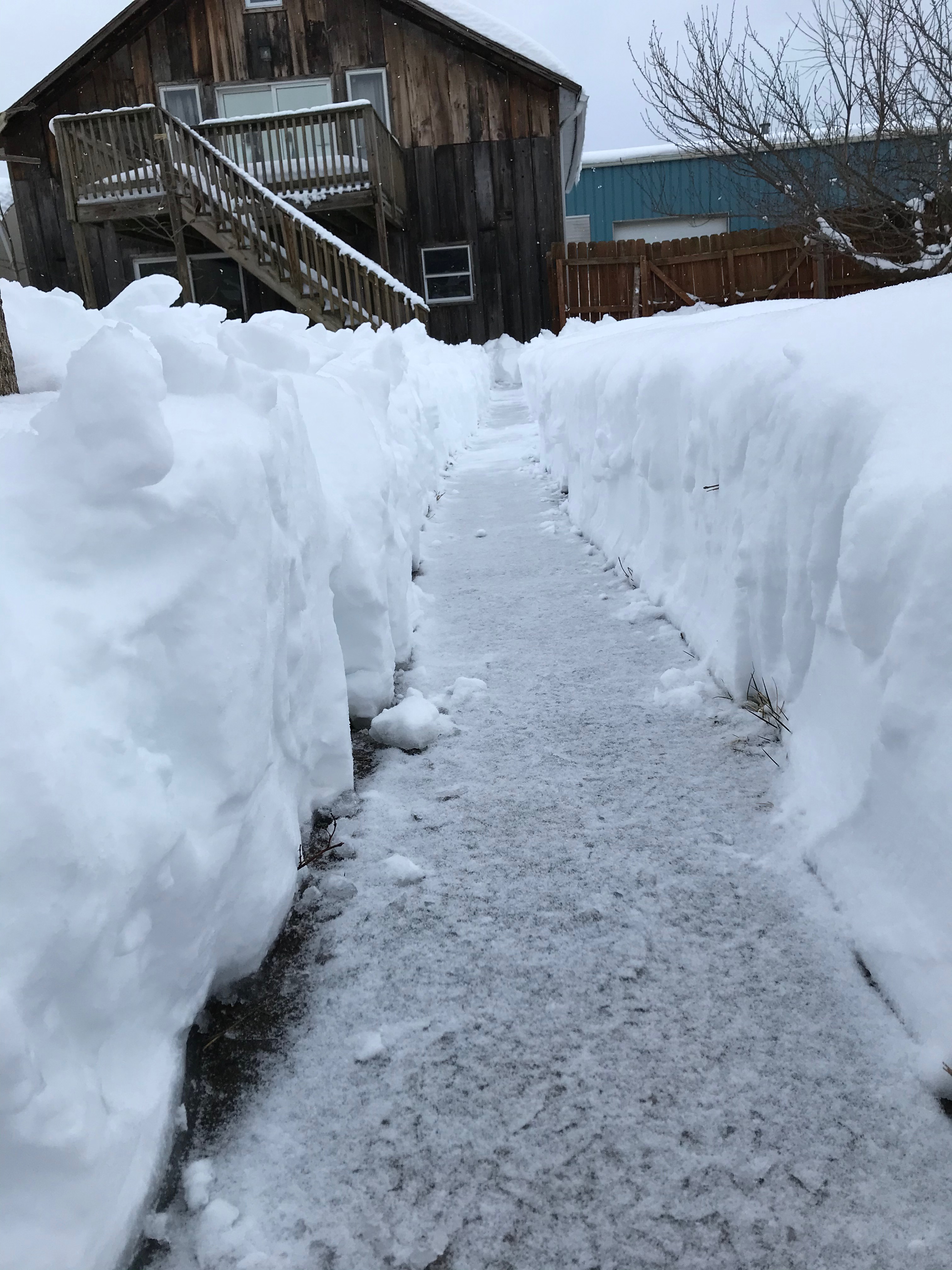
Birds are quite capable creatures, but some have learned that by hanging out around human dwellings, some of our species give handouts.  For me, the sight of a cute little junco shivering outside the window leads me to break up the hardened bread slices that I save for them and toss them outside when things are either buried in snow or ice.  This year we’ve had a bit of ice and some snow on top of it, which makes a kind of canvas for seeing who’s come to visit our crumbs.  My daughter pointed out to me that we had some feather prints as well as footprints, so I thought I should go ahead and record them.  If this were mud and a few million years had passed we’d perhaps have ended up with fossilized feathers.  And nature’s canvas is endlessly beautiful.

I imagine people tend to be partial to birds because they look so delicate and fragile.  Well, at least the little ones do.  Our natural sympathies make us feel sorry for them when nature makes finding food difficult.  The survivors among them, however, are tough.  Birds skirmish over food and can be quite aggressive around both a bird feeder or a crumb pile.  They were, after all, once dinosaurs.  And around here winter locked in before Christmas and has stayed around for quite some time, temperatures barely rising above freezing for many days in a row.  And I look for feather prints in the snow.  Try to find the beauty in the starkness of harsh weather (while looking askance at the energy bills).  Our animal companions can teach us much about life.  Their stories leave traces for us to follow.

Our species has often tried to advance itself at the expense of others.  I think of the tremendous environmental damage that we’re willing to inflict to enable AI.  What pollution we’re willing to dump out for using fossil fuels.  How much forest we cut down for our own use.  We drive vulnerable species extinct.  This makes me think of those creatures that have adapted to us.  Who speaks highly of rats, pigeons, or cockroaches?  Even sparrows, which can be quite aggressive, or even mean, reflect our attitudes toward the rest of nature.  I’m sure some sparrows come for the crumbs, even though I put them out with the juncos in mind.  Those that appear here in winter have likely migrated from even further north.  They handle cold I have difficulty tolerating.  And they leave art in the ephemeral snow.


House of Catherine

A blend of horror and dark academia.  That’s how I’d classify Catherine House by Elisabeth Thomas.  For some time I’ve been pondering the connection between the two genres, and this novel is one of slow-building dread.  I’ll attempt to avoid spoilers, but I will say there’s a somewhat optimistic ending to the tale.  The eponymous Catherine House is a three-year college.  Well, not exactly a college.  It is a highly selective school that works with something called plasm.  Only the most select of those admitted are permitted to work in the department that handles plasm.  The others pursue different academic fields.  When they’re done, they’ll be connected for life and will succeed because of the many Catherine graduates who’ve shared their intensive program and reached positions of power.  The novel follows Ines, a girl who had a rough upbringing and who isn’t sure how she ended up at such a school in the first place.

The tip off to the unsavory part of the House is the secrecy.  Students cannot leave campus for their three years.  Their families are not permitted to be in touch and the students are encouraged to forget about their past lives.  Their thought process is influenced by plasm pins.  They are given a freedom many college students would crave—alcohol is freely available and sex is encouraged.  They also have a very rigorous course of studies.  Students do fail out.  Ines, finding close friends for the first time in her life, has trouble believing that she belongs here.  She’s not bright enough to work with plasm, but her boyfriend is.  And then Ines discovers a dark secret.  One that forces her to a very difficult decision.

The dark academia aspect is more pronounced than the horror one.  In fact, the horror is more by implication than by direct narration.  We’ve got an academic setting where something has clearly gone wrong.  We don’t ever really learn what plasm is, but it becomes the ultimate concern, to borrow language from Paul Tillich, for those who research and work with it.  It seems to have supernatural attributes.  Catherine House explores what it means to be young and learning about relationships, and love, and the harder lessons life gives.  At first Catherine House seems like a noble academy, but soon suspicions begin to build into a quiet horror.  An existential variety of horror more than the kind induced by monsters or people that are purely evil.  The characters are likable but flawed.  It’s the system, however, that introduces the darkness at the House.


Weaponry

For all of its problems, 2025 was a great year for horror films.  And they’re beginning to gain the respect they deserve.  I found an affordable copy of Weapons and discovered that it was as good as the hype.  The haunting image of the children running is, in itself, distinctly creepy.  The film does a great job of obscuring what is happening until the right moment, not making it feel over two hours long.  Weapons never really explains what the monster is, but gives hints that allow viewers to draw their own conclusions.  I’ll try to explain a bit more without spoilers, but the intricate plot may mean that some information might inadvertently be revealed.  The movie begins with a mystery.  One night seventeen children—all but one in Justine Gandy’s third-grade class—disappear simultaneously.  Some doorbell cameras catch them leaving their houses and running into the night.

The people of the fictional Maybrook, Pennsylvania, suspect Justine, their teacher.  Some of the parents, especially Archer Graff, are vocal about their suspicions, going as far as to paint the word “witch” across the doors of her car.  Graff decides to confront her during his own investigations—he thinks the police aren’t pursuing this actively enough.  As he accosts her, the principal of her school, running like the children, attacks and tries to kill her.  This convinces Archer that Justine isn’t responsible, and between them they identify the house of the one remaining student to be at the center of the mysterious disappearance.  The story is told from the point of view of six of the characters’ experience, ending with Alex, the one boy remaining.  His house is the focal point.

We learn that his great aunt came to stay shortly before the children disappeared.  I shouldn’t say any more, I suppose, for fear of giving away the ending.  The story is effectively told with memorable images in the service of the story.  Although it has a kind of justice in the end, the resolution is not a cheerful one.  Like some of the other acclaimed horror of 2025, it makes you think.  Interestingly, while not filmed here, this is another horror film set in Pennsylvania.  Having grown up in this state I’ve always known that odd things tend to happen around here.  Maybe word has gotten out.  In any case, Weapons is a haunting film, well worth seeing.  And while some are reluctant to call it horror, the critics agree that this movie is worthy of note.  Perhaps, someday, horror will be treated with a bit more respect and the critical weapons relaxed a little.