Anthropocene

The word “Anthropocene” has been showing up quite a bit lately.  For a period of many years I was an avid, self-taught amateur geologist.  In my dreams I still am, I guess.  My interest in the ages of rocks began when I, like Charles Lyell, began to consider the implications of their extreme longevity.  The Bible, of course, famously intimates we live in a comparatively new neighborhood.  Having grown up believing that literally and firmly, and also having started a modest fossil collection, I failed to see the conflict.  I mean, there were fossils right down there by the river.  Tons of them.  Some Young Earth Creationists had already begun, by that point, to suggest they’d arisen because of Noah’s flood, but dinosaurs still seemed to be a problem.  In many ways rocks broke me out of my fundamentalist stupor.

While at Nashotah House I taught electives on Genesis 1-11.  I read about the geologic ages of the planet and would fall into Devonian dreams of a world entirely different from ours—a world in which there was no Bible for there were no humans to make God in their image.  I knew that we lived in the Quaternary Period of the Holocene Era.  I don’t think the term Anthropocene was in wide use then.  Parsing it is simple enough—it is the “human age.”  The age in which the planet was, has been, and is being altered by human behavior.   There’s no agreed-up start date for the Anthropocene, but it will likely be set in the twentieth century; the twentieth century in our way of counting.  There have been millions of centuries before that.

A couple of weekends back I attended a church program on plastics.  These useful polymers are deeply, deeply integrated into our lives and are promoted by the far too powerful petroleum industry.  The problem with plastics is that they break down and invade the bodies of animals and humans.  And although they do decompose it takes many centuries for them to do so.  Naming the Anthropocene is an effort to get us to see that a human perspective is far too brief to deal with the many issues we raise.  Our practices on this planet will likely not destroy the earth, but they may very well make it uninhabitable by us, or by creatures we like to see.  Life is persistent, and rock lasts for eons.  Even stone’s not eternal, however, and the idea of the Anthropocene is to get us to look at ourselves and realize that our use of this planet, as toxic as it is, is shortsighted.  We will someday be the fossils under a bridge long crumbled to dust for those in the future who know of no such thing as Genesis.  Perhaps we should act like it.


Conservation?

I am not a conservative.  There, I’ve said it.  You have very little control over who your parents are or how they raise you.  As I confessed here many times, I was raised in a conservative Christian home of the fundamentalist stripe.  Like most kids scared of Hell I took it all very seriously.  It is the reason I followed the career path—or perhaps career swamp trek—that I have.  In any case, the other day I was looking through a Baker Academic catalogue.  Baker, in case you don’t follow the high drama of the publishing industry, is one of the many Christian publishing houses with roots in Grand Rapids, Michigan.  Like most publishers in that collective, it tends toward the conservative end of the theological spectrum.  As I flipped through I noticed bio after bio of authors with Ph.D.s from Edinburgh, Cambridge, and other prestigious universities in the United Kingdom.

I hadn’t been warned, you see.  Many conservatives who want a doctorate study in the UK because they can do so without taking all those classes that will make them examine the Bible critically.  That’s not why I went to Edinburgh, but I can see how it might look like that from the outside.  I went to Grove City College—a bastion of conservatism.  (I was raised that way, remember?)  My next educational move should give the lie to my attempt to remain conservative; Boston University School of Theology was considered the most liberal United Methodist seminary in the pre-Internet days.  I attended for that very reason.  Edinburgh, my true alma mater, was selected because they offered a scholarship that made it possible for a poor kid to finish a doctorate.  I wasn’t conservative when I went, and I wasn’t conservative when I came out.

I didn’t get the memo, I guess.  The sneaking suspicion that I might be conservative has dogged my career.  My dissertation can be read that way, but it’s not a conservative argument.  I merely suggested the decision to marry Yahweh off to Asherah was a bit hasty, based on the actual evidence.  I’m all for married deities—they tend to be less frustrated toward humanity.  Maybe the Almighty could speak to Mrs. God about correcting these worries about what I “really believe.”  I went to a conservative college to learn—there were a fair number of attempts to indoctrinate there, but if you thought about things you could see through them, even with a fundie upbringing.  But as I thumb through the catalogue I can see how perceptions can work against you, especially when your first job is at a conservative seminary, eh, Mrs. God?  


Snow in September

One of the trendy things when I worked in United Methodist youth camp was “Christmas in July.”  Although not quite six months out, the idea was to inject some fun when it was starting to feel too hot out and, as evangelizing efforts go, to talk about Jesus.  The origins of this tradition predate me, actually.  Even secular camps were using the idea in the mid 1930s.  By introducing the mystery of the unexpected, I suppose it might’ve helped to deal with camper homesickness, a perennial problem.  It worked, in my experience, because nobody was really thinking about Christmas in July.  It was a ploy.  Just after the summer solstice, Christmas would have to wait until after the winter solstice to materialize.  Now this past week we observed the autumnal equinox.  I usually write a post about that, but I’ve been kind of distracted lately.

Over the weekend I had to head to a big box home goods store.  I prefer to visit our local independent hardware store, but they don’t carry lumber and I needed some.  I walked in to find the store decked out for Christmas in September.  This was just a bit disturbing.  It’s not even Halloween yet.  In fact, it’s not even October!  For many people in temperate regions autumn is their favorite season.  Harvest themes, apple and pumpkins, turning leaves, falling leaves, and Halloween.  Putting on the occasional sweater for the first time after a long and hot summer.  Big boxes are leaping past all that to get to your Christmas bucks, even while you still have to mow the lawn when you get home.

Okay, so I’m not the only one to grouch about the premature appearance of Santa Claus and the extreme commercialization of Christmas.   I know that Bethlehem is called “Christmas City,” but as we wandered to the Celtic Festival underway downtown, people were sweating in the eighty-degree heat.  The leaves have begun to turn around here, reminding us all that Halloween and Thanksgiving are coming.  The holiday season.  I enjoy it as much as anybody else, but I don’t want to rush it.  I suspect the internet has accustomed us to instant gratification.  You want it?  If you can type it and click on it, it can be at your doorstep in two days.  You don’t need to wait for Christmas to catch up any more.  Meanwhile our landfills overflow with the stuff we throw away from Christmases past.  Christmas in July I think I get.  Christmas in September is just a little too much.


Flipping

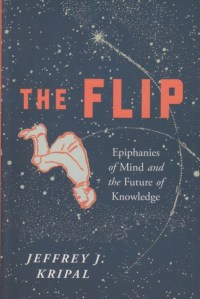
The mind-blowing book I mentioned last week is here unveiled.  I discovered Jeffrey Kripal’s work years ago, and have subsequently had a few conversations with him.  The Flip: Epiphanies of Mind and the Future of Knowledge is a challenging and necessary book.  In a way that only full-time academics can, Kripal examines the large picture.  When I say “large” I mean cosmic in scale.  He does so through the lens of the humanities and, especially, religious studies.  If anybody’s going to make religious studies cool, it is he.  The world is full of weird things.  If we’re honest most of us will admit to having had strange things happen to us.  Often we’ll filter them out or explain them away, but at other times we will stop, scratch our heads, and wonder what just went on.

The Flip is not a book of such anecdotes (and I, along with the author, am willing to take anecdotes seriously).  There is some strange stuff in here, but there is also a lot of science.  Historically the humanities, as understood by ancient Romans, included what we would call sciences.  Humanities, in other words, were attempts at understanding the world.  Today religious studies is among the humanities while science is separated out into STEM.  Kripal takes science seriously.  In fact, much of what he discusses here is the application of quantum physics to the macroscopic.  (I’m probably not explaining this well, but then, I guess you’ll have to read the book!)  In other words, science and the humanities need to come together again.  It’s not either/or, but both/and.

Holding out a hand across the aisle is uncomfortable.  Religion has done a great deal to disgrace itself of late, and it’s no wonder respectable folk want to keep their distance.  To understand what we are, however, requires a willingness to admit that humans are both deeply intellectually curious and deeply religiously inclined.  We can be both.  In fact, it is unlikely we can be any other way.  Anomalous occurrences aren’t generally welcome in religious studies any more than they are in the sciences.  That doesn’t stop strange stuff from happening.  This little book of big ideas uses that disjunction to lead the reader into spaces where the future might faintly be discerned.  Wide-ranging and provocative, this book needs to be read.  It is a strange world where two different approaches to knowledge so often decline to speak to one another.  Here they do, and their conversation is mind-blowing.


Grasses and Bans

It’s been so busy that I didn’t realize it was Banned Books Week until yesterday, when there was but one day left (today).  I usually make a point of reading a banned book during this week, but I suppose I read so many of them normally that the observance might lose its edge.  But that’s just an excuse—in this world of uber-corrupt governments, preventing censorship is a sacrament.  We’ve seen just this week how dictators try to silence those who expose them.  Banned books, whether we like what they say or not, should be available for reading.  This is an amazingly bipartisan holiday.  Some places have banned the Bible, to which true believers in the principles of Banned Books Week would respond “Even books we might disagree with should be made available.”  Censorship seeks to cut off discussion.

Although I won’t finish in time, after work yesterday I quickly grabbed my unread copy of Walt Whitman’s Leaves of Grass to begin to make up for my oversight.  Leaves of Grass has been called America’s homegrown Bible and it has an almost religious following, as it has for decades now.  Poetry has a way of moving people that frightens autocrats.  It taps into something that skirts around our conscious mind at times, opening up possibilities that censors would rather keep closed.  Over the past couple of years books of poetry have again begun to appear on the New York Times Bestseller list.  People read to be moved.

One element banned books tend to have in common is that they’re honest, even when they’re fiction.  Honesty is a source of great anxiety for many.  We don’t like to let our true selves be seen because, truth be told, we feel vulnerable.  Banned books take us into uncomfortable places.  And sublime places.  Not all books are great literature, of course.  Even I have been known to part with a book after reading it because it simply didn’t speak to me in the way I like to be spoken to.  Still, I’m loath to give such a book a negative review.  It didn’t speak to me, but it spoke to the author and the publisher, obviously.  It is a voice that deserves to be heard.  That’s what Banned Books Week is all about—defending the right of human expression.  I may not finish my banned book by the end of today since weekends tend to be busier than many work days.  Still, I’m looking forward to my encounter with America’s other Bible.


Time To Meet

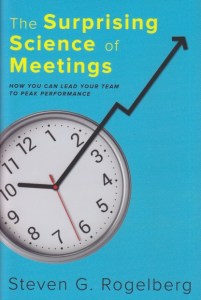
I feel compelled to state up front that this wasn’t the mind-blowing book I was writing about in yesterday’s post.  One of the perks of working in publishing is the occasional offer of a free book.  (It’s not as generous as you might think, so when one is offered I always say “thank you.”)  The Surprising Science of Meetings, by Steven G. Regelberg, isn’t exactly “mind-blowing.”  The realization that some people make a living studying meetings was certainly, well, surprising, but the corporate world is all about returns on investments and boring stuff like that.  We all hear of companies that value innovative and exciting ideas, but most of us know the feeling of being desk drones parked behind a soulless monitor all day.  At least I’m no longer confined to a cubicle.

The academic world I once knew was the stimulating environment of learning for its own sake.  The academy has followed the business world to its own form of perdition and as Rogelberg points out, there are millions of meetings any given day.  Many of them are poorly run.  This book is for those who want meetings to flow more effectively, to better the bottom line.  Still, I found the chapter on servant leadership particularly hopeful.  I couldn’t help but wonder if Rogelberg was aware that servant leadership was something that developed in the church, out of the effort to imitate the way Jesus was said to have led his flock of disciples.  The point was not to aggrandize himself (this is a chapter 45 and his ilk should read) but to help others to be their best.  This is the kind of leadership—rare, to be sure—that the church has always, at least vocally, promoted.

It didn’t take long for ecclesiastical organizations to start running like businesses, however.  The bishop became a boss rather than someone who reluctantly had the crozier forced into his (or her) hand.  I’ve always believed you should have to take a pay cut to become a bishop.  That would immediately weed out most of the climbers.  In fact, if servant leadership is really the ideal, and the good of the company is really the goal, pay cuts should be expected as you climb the corporate ladder.  Can you imagine a business world where workers were well compensated, and those who really had vision sought promotion because their motivation wasn’t their own bottom line?  It’s an intriguing idea, to be sure.  I’d like ponder it more, but I’ve got a meeting to get to.


Moral Compass

Recently I was introduced to The Poor People’s Campaign, in its most recent iteration.  I was drawn in because I was raised in a poor family and have struggled to make up the shortfall my entire adult life.  Those raised in middle class (and above) households often don’t realize that when you start below zero, in a humanities-based career it may take literally decades to catch up, if you ever do.  There’s no safety net and there’s no inheritance.  You begin with years of higher education debt and sub-standard pay in your profession.  But I digress.  The Poor People’s Campaign: A National Call for a Moral Revival is non-partisan and it is about more than just the poor.  It’s about restoring true morality to our political system.  Organized by the Rev. William J. Barber II, it has had some success in presenting the plight of the poor to a congress that has largely failed to care.

Politics is full of dirty money and lobbying to the point that many people are cynical and convinced that morality has no chance of survival in this city set on a hill.  The pony and puppet show in a White House run by an entrenched narcissist shows just how far concerns for justice are from the aims of our government.  Barber and his colleagues actually read from the Bible (which, it turns out, advocates justice) rather than just saying that they do.  Compared with Martin Luther King’s 1968 campaign by the same name, The Poor People’s Campaign today is smaller, but growing.  More and more citizens with a conscience realize that our government requires rescue if any semblance of fairness is to throw its hat into the political arena.  We’ve become the victims of to government’s bread and circuses, but without the bread.

The most disturbing aspect of our current political spectrum is the complete lack of a moral compass on the side of politicians who cynically use issues to win elections only for personal enrichment.  We have an Oval Office occupant who refuses to divest himself from his own business interests while using his position to increase his own wealth.  Others in his party follow suit.  The Poor People’s Campaign is non-partisan because corruption easily crosses the political aisle.  At least one party seems to be aware that the poor really do suffer even as the White House tells them tax breaks for the wealthy will make everything better.  When a government proposes “camps” for the homeless to get them off the streets, we should see that we’re clearly in trouble.  And unless someone sounds the alarm the wealthy will never bother to take notice. 


Not so Hollow

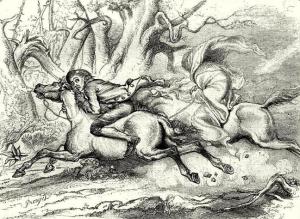
It is difficult to say how an idea might grab you.  I really have no idea why Washington Irving’s “The Legend of Sleepy Hollow” took my childhood imagination prisoner and has kept it stoutly locked up over all these years.  Perhaps it was the Disney version seen as a child that left me with shivers of wonder akin to a species of joy.  The autumnal setting, the implied ghost, the ambiguity of the final scene.  I used to be as avid a philatelist as one can be in a small town, and the Sleepy Hollow stamp of 1974 held me transfixed long before I ever encountered Tim Burton’s vision of the legend.  After having watched the silent Headless Horseman a couple of times, I went back to The Sketch Book of Geoffrey Crayon, Gent., and read the original again.  This time I followed it up with the appendix in my edition, written a decade or two after the story by an older Irving.

The 1922 movie runs fairly close to the literary original (for the most part), especially when you add the appendix.  The appendix (in the edition I have—The Modern Library, 2001) is an essay titled “Sleepy Hollow.”  It reflects on Irving’s recollections of what Sleepy Hollow was like in his youth (he returned to the area to settle later in life).  The village church, which features in “The Legend,” provides a source of much of his reverie and this is incorporated into the early cinematic version as well, in the Sunday morning scene.  I also noticed how frequently psalmody enters the original story.  The tale does not mention the Bible, but psalmody was an early form of church music, and “The Legend” has Ichabod use it when he’s afraid as well as for teaching students to sing, for a few shiny shillings.

Washington Irving is sometimes credited with the invention of the short story as a literary form.    His younger contemporary Edgar Allan Poe worked in that format, and the two of them contended with making a living (the former more successfully) purely as literary writers.  Irving’s spooky tales, however, often have something of the comic about them.  His story-telling style uses folksy, folkloric exaggeration and humor to prevent it from becoming too dark.  Poe would snuff the candle and let the fear be unhindered.  I knew of Sleepy Hollow before I discovered Poe, and this recent resurgence is perhaps a way of exploring my own literary roots.  It’s nearly half-way through September already, and Tarrytown beckons. 


The New Purple

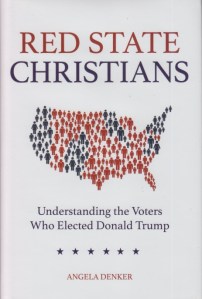
Those of us who grew up Evangelical hold an unusual place among our liberal peers.  We’re often able to peer around, over, and under that wall that has been built between those who want a faith-based nation and those who want a free one.  Angela Denker is a fellow traveler on this road, and her book Red State Christians: Understanding the Voters Who Elected Donald Trump is a useful roadmap.  Some of us fall further from the tree than others, but one of Evangelicalism’s more endearing traits, when taken seriously, is the love of those who are different from you.  That love is often forgotten in the political rhetoric daily whipped into a froth by an unstable president being used by his party to install agendas that hardly fit the moniker “Christian.”  That’s why books like this are so important.

I confess that reading studies such as this make me uncomfortable.  Uncomfortable because my Evangelical past haunts me worse than any ghost, but also because Denker is clearly right that basic humanity is being left in the garbage as battle lines are drawn up in what could be a great, diverse nation if a leader were determined to work for unity.  I recently wrote about lunar landings.  Kennedy was a Catholic who had to work to bring a nation together around a common goal.  Instead of tearing the country apart for his personal aggrandizement, he pointed to the moon.  Sure, there was a xenophobia concerning the Soviet Union, but at least in this pocket of the world there was a sense that we should work together.  When religion entered politics with Richard Nixon and his followers, a deep rift opened up.  The two topics you were never to discuss—religion and politics—were now in the same bed.

Red State Christians is an extended road trip on which Denker interviews people who largely fall under the Evangelical umbrella.  Some of them are Catholic.  Some of them are Hispanic.  Some of them are less concerned with social issues, but are hard-working laborers often overlooked by the Democratic Party.  The resulting pastiche is one in which Americans are cast not in sharp relief, but rather with the hazy edges that are a far more accurate way of understanding human beings.  Many, it becomes clear, elected Trump out of fear, or out of fear of his opponent.  These aren’t bad people, but they are people afraid.  This wasn’t an easy book to read, but it is an important one.  And those who want to work for a future that might include realms beyond the moon might find this work a small step in the right direction.


Masked Reality

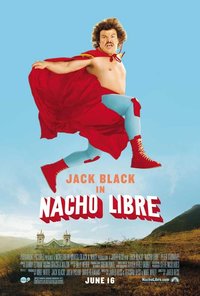
Before I make my confession you need to consider that I spent much of my professional life as a seminary professor.   Never ordained, I nevertheless donned the cassock and taught future priests what they’d be assumed to know (the Bible) while trying to earn an academic reputation through my publications.  It was a double life in which one half involved the church.  Shortly after that job ended I saw trailers for Nacho Libre, a movie in which Jack Black plays a monk who moonlights as a luchador, a Mexican professional wrestler.  I never saw the film, but I had been raised on a white trash diet of World Wrestling Federation fandom, back in the day when that involved gathering around the television to watch grown men posturing and preening while knowing that none of it was really real.  I secretly wanted to see Nacho Libre.

Recently I visited friends who had the movie.  They warned me that it was corny, but I had already supposed that.  What I didn’t realize until after it was over (for movie viewing is now followed by internet viewing) is that it is based on a true story.  “Based on a true story” doesn’t mean, of course, that a movie accurately portrays events, but I had no idea that a Mexican priest had actually supported an orphanage for over two decades as a masked wrestler under the name of Fray Tormenta.  I followed up the movie with a little web research because the film was remarkably respectful of the church.  The character of Ignacio never criticizes Catholicism, and he clearly cares for the orphans for whom he serves as the cook.  His wrestling winnings go toward purchasing better food for them.

Earlier in the day we watched the movie I’d talked to one of my friends about how religious life, no matter how seriously it’s taken, involves acting.  People generally put on masks before going to church (or any other function in which they interact with others).  Religion requires a level of piety impossible to sustain in the real world.  Early in the history of Christianities it became clear that the church would hire some religious specialists to try to take on the lifestyle toward which all faithful should aspire.  I’ve trained many priests.  I’ve seen them when they’re in mufti.  I know that in the vestibule, at the altar, or in the pulpit they’re wearing masks.  Many of them have the heart of Nacho Libre, but outside the church doors they still have bills to pay and family and friends who know them as they really are.  As we slipped the DVD in I didn’t know what the movie might be like, but it was based on a true story in more ways than one.


Somebody’s Coming

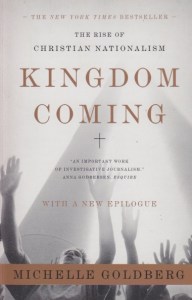
Sometimes updates don’t help.  That’s because evil is so good at masquerading as righteousness that constant vigilance is required.  Michelle Goldberg’s Kingdom Coming: The Rise of Christian Nationalism was recommended to me by someone at a local church.  I’ve been giving educational talks to help people understand what Evangelicalism is, so I figured I’d better read it.  The optimistic epilogue to this otherwise excellent book allowed relief after the 2006 midterm elections.  Of course, nobody back then could’ve believed an even less intelligent president than W could ever be put forth by the GOP.  That doesn’t mean Kingdom Coming shouldn’t be read.  It should.  And it should be required reading (aw, gee!  Homework?).  There have been many studies that have demonstrated repeatedly that Christian Nationalism is highly organized and well funded.  Meanwhile intellectuals scoff that religion is dead.

I spent most of the last week in a kind of panic.  I have another public talk coming up, and I needed to read Goldberg before that.  Yes, it is dated.  But yes, we have Trump’s bumbling form of “leadership” with a well funded, highly organized Evangelical subculture calling the shots.  Forget the politicians—they’re only interested in money—it’s everyone else who suffers from America’s growing fascism.  The fact that the GOP won’t stand up to 45 shows that we’ve already turned the corner toward das Vaterland.  Anyone the Republican Party elects from now on could be the new dictator.  Christian Nationalism stands behind this as journalists scratch their heads.

Goldberg’s book has likely been shelved because eight years of Obama made it seem like the threat was gone.  The problem is, silence works to the benefit of Christian Nationalists.  Perhaps the most frightening thing about all of this is that many intellectuals simply don’t take the threat seriously.  At the same time I was reading this, I was also reading about Nazi Germany (because I’m such a cheerful guy).  The parallels are blatant and entirely too obvious to miss.  Christian Nationalism has an agenda and it is fascist in nature.  Even obeying the words of Jesus takes second place to the political objective of making America in their own image.  This may sound alarmist, but it’s based on solid information.  The Devil, they say, is most powerful when people don’t believe in him.  Those who would make America into a theocracy would claim to follow the other guy, but looking at their tactics, it’s pretty clear who’s really in charge.


Horror Homeroom

With a happy coincidence I discovered a website called Horror Homeroom.  Featuring articles and podcasts and reviews on horror films, I felt its siren call.  Then I learned it is run by a professor at nearby Lehigh University, making it even closer than I initially supposed.  I wanted to be part of the conversation.  You see, after years and years of being a Bible scholar and having to fight to find any kind of interest whatsoever in what I had to say, I’ve found the horror community extremely welcoming.  Perhaps because we all know at some level that horror is considered transgressive—it isn’t unusual to find critics who still claim it’s debased—we find each other.  There’s an aesthetic to horror, and it isn’t about gore and violence.  Horror, when done well, is an excellent marker of what it means to be human.

Life always ends in death.  Many people spend as much time as possible trying to avoid thinking about it.  There is, however, great creativity in facing squarely what you cannot change.  Well, that’s a good sounding excuse anyway.  All of this is by way of announcing my guest blog post on Horror Homeroom.  A few weeks back I was quite taken with The Curse of La Llorona.  Not that it was a great movie, but it had a way of coming back to haunt me.  Part of it has to do with the poorly understood way that local customs blend with imperialistic religions.  Faith is a local phenomenon.  Once you switch off the televangelist, you’ll begin sharing beliefs of your neighbors.  There’s no such thing as a pure religion.  Pure religion is one of the most dangerous myths there is.

Those of us who study religion professionally have been taught to call the blending of religions “syncretism.”  I’ve stopped using that word for it because it assumes that there are pure forms of religion.  Religion always takes on an individual element.  We make it our own when it gets translated into our personal gray matter.  The idea that there is a pure form of any religion requires an arbiter of greater rank than any here on earth.  You can always say “but I think it means…”  Horror, I suspect, latched onto this truth long ago.  Without some hint of doubt about your own individualized belief system, it’s difficult to be afraid.  Horror need not be about blood and gore.  Often it isn’t.  Often it’s a matter of asking yourself what you believe.  And once you answer it, opening yourself to asking questions.


Building on Water

I try to keep up.  Really, I do.  Although my specialization is in ancient religions, at heart I’m an historian of ideas and I try to keep up with the origins of the many Christian denominations.  You see, with so many competing versions of the one correct way to please God it pays to hedge your bets.  Thing is, there’s so many options and some seem to spring out of nowhere, like toadstools after the rain.  The other day I attended a local community event.  One of those kinds of affairs where local organizations set up tents and sometimes sell food.  Many of the tents were for churches.  As supporters of community values (mostly) this isn’t unusual, even with the declining numbers in the mainstream.  Then I heard a voice.

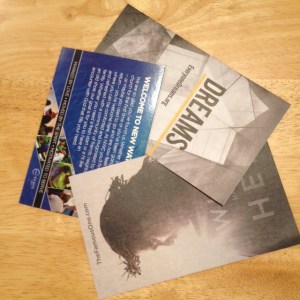
“Do you read?” the man asked.  I confess to having a bookish look, so I admitted I do.  “We want you to have a free book,” he said, handing me a plastic bag (warning sign one) containing a small paperback and several fliers.  Now, I was here to look around and maybe get a bite to eat, so I thanked him, tucked the bag under my arm and walked on.  Only on the way home did my wife look at the contents.  The church—for it had to be a church giving such things away—was one of which I’d never heard.  This would’ve been disorienting if it weren’t for the fact that ever since college—where I learned quite a lot about denominations—I’ve been noticing new varieties of Christianities, cropping up somewhat frequently.  Each seems to believe it has found the answers, despite the threadbare denominations that have been around for centuries.

I make fun on nobody’s search for meaning, or the truth.  It is, after all, a lifelong quest.  I am suspicious of those who claim to have already gotten there, however.  For those traditions that declare they’ve found the answer centuries ago, the passing years with their constant changes have worn on them.  Especially if they’re awaiting a divine cataclysmic ending to it all that’s been delayed for a couple of millennia now.  Others are, apparently, wanting to pump some fresh air into these tired lungs.  This group featured a website “the famous one [all one word].com.”  I was surprised and a touch saddened to see Jesus relegated to the role of a media celebrity.  But then again, I can’t keep up like I used to.


Turin Turnabout

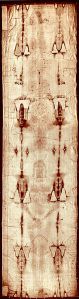
Turn about, they say, is fair play.  Turin, on the other hand, is a city in Italy.  Its claim to fame is a shroud housed there that is believed by many to be Jesus’ burial cloth.  Tests have been done over the years, most authoritatively a carbon-dating done by three independent laboratories, with the results suggesting a medieval origin to the cloth itself.  In case your chronology is a little hazy, the medieval period comes centuries after the time Jesus lived.  Now, some thirty years after the definitive study, some scientists are questioning the results.  They’re being skeptical of the skeptics.  Turn about.  According to a story in The Catholic Register, a Freedom of Information Act request, honored only by one of the three labs (the one at Oxford University) has revealed that the bits of the shroud subjected to analysis were the worst possible parts of the cloth to test.  Herein lies the rub: scientists like to poke holes in credulousness—what do you do when your science is itself the subject of skepticism?

The Shroud of Turin, like Donald Trump, is one of those utterly arcane artifacts that unites Catholics and Evangelicals.  When I was growing up these two groups were the cats and dogs of the theological world.  They united under the umbrella of conservative social causes during the Bush years and have been sleeping together ever since (while both convinced that the other is going straight to Hell when it’s all over).  You see, the Shroud is a Catholic possession and allegedly bears wounds that support the Catholic narrative.  (The Vatican has never declared it an authentic relic, however.)  Evangelicals see it as proof positive that Jesus was resurrected, and so they tend to go further than the Catholics in citing it as proof.  We live in odd times when believers successfully out-skeptic the skeptics.

Since the other two laboratories (the University of Arizona and the Swiss Federal Institute of Technology) haven’t released the raw data, the grounds for a conspiracy theory grow fertile.  When information is kept secret, that’s a natural enough response.  The conspiracy-prone mind asks why the data isn’t being made public.  They do have a point.  The claims of religion are often hoisted on the petard of “no evidence” and when evidence (such as the lab results) exists but isn’t shown, that suggests somebody’s hiding something.  I have no vested interest in the authenticity of the shroud, but we all should have such an interest in getting at the truth.  The turnabout in this case, however, was completely unexpected.


Religious Studies

Prominent public intellectuals, as opposed to us obscure private ones, often brashly castigate religious thinking.  They may be aware that the vast majority of the world’s population is religious, but there’s  a kind of arrogance that comes with public adulation, I suppose.  I was just reading about the European Middle Ages and I was reminded once again just how seriously religion was taken and how the very foundation of civilization is based on it.  During said Medieval Period everyone knew—note I don’t say “believed”—knew that human beings had eternal souls.  They also knew there were eternal consequences to our actions and therefore correct religion was absolutely essential.  The Enlightenment began to change some aspects of received wisdom, but not all.  Many intellectuals who led the charge still believed in God and Heaven and Hell.

Whenever I consider the sorry state of academic religious studies today, and look at how politics are unfolding, my thoughts turn to history.  Just because we no longer think in a certain way is no reason to forget just how formative religion is to human life.  The Republican Party has cynically accepted this as a means to power.  While leaving left-leaning intellectuals to debate their choices, they roll toward electoral victory.  They acknowledge that people are religious, and that’s what it takes to win their trust.  Where was Dawkins when Brexit was decided?  It may not have been religiously motivated, but nationalism is closely tied to religious thinking.  While religious thought may be gullible it’s not necessarily so, and without those who think religiously there’s no way to a true majority.

I’ve always had more questions than answers, and one of my largest unanswered ones is why prominent public intellectuals don’t think studying religion is important.  Religious thinking isn’t going away just because they say it is.  In fact, the data show exactly the opposite.  The Middle Ages are quite instructive for understanding the way people behave.  Although belief in the religious structures may be eroded, people still want to find a way to continue their impact beyond their earthly lives.  Modern Nimrods are just as concerned with image as religiously motivated Nimrods were.  To understand where we are it’s necessary to look back.  Looking back entails a certain comfort level with ways of thinking that many moderns find embarrassing.  Religion is part of who we are.  Looking around we can see the consequences of denying it.