Imagining Things

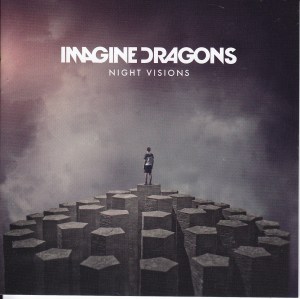
Having a child in college is one way for me to stay attuned to popular culture. You can absorb quite a lot by simply paying attention while on campus. For example, on the last several visits I’ve heard the song “Demons,” by Imagine Dragons, being piped into various venues. Given the biblical language of the song, I wondered about its origins, but, like many a distracted parent, had too much on my mind to pursue it. Well, on a recent visit, the song got stuck in my head. Partially this was because during an a cappella concert the Christian group did a cover of the song. This sent me to the internet—the only place where information on contemporary culture is instantly at your fingertips—to do a bit of poking around. Secular groups, after all, frequently use biblical references unnoticed.

When I learned that two members of Imagine Dragons were from Brigham Young University, I just had to know if they were Mormons. From what I’d seen of concert photos, white shirts and ties were rather conspicuous by their absence. Indeed, it turns out, according to the web, that the group does have some LDS in its bloodstream. I’m not so naive as to think that being of a particular religious background makes rockers religious. The debates raged in college over whether U2 was a Christian group because some of them were Catholics. I don’t recall seeing any crucifixes on the album art. This is all especially intriguing because Christianity and rock-n-roll are considered by many to be natural enemies. The origins of rock in the sexually suggestive blues had many 1950’s parents quite worried.

Religion changes, however, once you get away from the parents. I’ve known Mormons that I couldn’t identify as such until they told me. I’ve known Catholics about which I still harbor doubts. Religious affiliation is sometimes purely cultural. That won’t prevent you from being excluded from consideration for a teaching position at any of their schools, however. Scholars of religion can be the greatest believers of fiction to be found. Still, I have to admit to myself that the song “Demons” does keep me coming back. I wonder if the Christian group performing the song was aware of its Mormon tinge, or if they even cared. Sometimes theology can be had for a song.

ImagineDragons


Uisce Beatha

The idea of a state church, I have to admit, sometimes seems not so bad. Before you click off this page in disgust, please let me explain. Once in a great while, I think about what state churches really are. From the most ancient of times, religious institutions supported governments and governments gave money to state religions. It isn’t a perfect system, but the reason it sometimes appeals is that it might prevent the kind of religious quarreling that we see in the run-up to every election: whose religious vision will govern us? I get theological whiplash. Wouldn’t it be easier to have a state church and be done with it? After all, those who live under state churches really aren’t obligated to believe in the teachings, but just to pay for them.

I’m only being facetious here, of course. We all know that in reality where religions and governments get too intertwined human misery results. The Reformation should have taught us that, if nothing else. The crimes of ISIS continue to show that religious belief makes a poor basis for government. Another case that my wife recently pointed out to me is in the quiet and civil nation of Ireland. Ireland has the stereotype of being Catholic, but according to an article in The Guardian, more than 90 percent of state-run schools there are under the control of the church. For some residents, like the family featured in the article, this becomes a conflict when schools won’t admit the unbaptized. Admissions committees with holy water may be a concept that many people find strange, but the fact is churches can set rules just as strict as secular bodies. No baptism, no confirmation, no matriculation.

I would, I think, be concerned as such a parent. Once my child was admitted and enrolled, would not the teaching go against what was being taught at home? Do governments have the right to decide a child’s religious outlook? Here is the dark underbelly of the apparently benevolent state church. Belief, of all things, is an intensely private matter. Many church goers do not understand the deep beliefs of their religious body, and since we seldom stop to think about religion we just do as we’re told. Education, it seems to me, should be very much aware of religion. Instead we see the opposite happening, at least in this country. If we pretend religion doesn’t exist, it will just go away, right? There is a reason that the church teaches that baptism is symbolic drowning. Only for those, however, who pay attention.

Angel's view of Ireland?

Angel’s view of Ireland?


An Apple a Day

Corporate logos are among the most instantly recognizable symbols in the world. Even in “developing” countries, kids know what the golden arches represent. Not a real fan of large corporations, I still buy things not knowing who the manufacturer is, if it is something I need. I find the frenetic need of non-profit organizations—even colleges and universities—to “brand” themselves vulgar and distasteful. Why do those who truly have something to offer feel like they have to snuggle up to Wall Street and its resident demons? Still, the corporate logo has a way of drawing attention to products. And sometimes we look for more significance in them than they actually have. Keep in mind corporations’ goals are merely to separate you from your money. Often it doesn’t take much thought.

IMG_2585

When I was a child I thought the golden arches were supposed to be french fries. And when I started to use computers—always Apple—I wondered if their logo might not be the most infamous bitten apple of all, the apple of Eden. Forbidden knowledge. It seemed to fit perfectly. Too bad it’s incorrect. Interviews with Steve Jobs, Steve Wozniak, and various marketing designers have revealed that the Bible had nothing to do with it. The original Apple logo was Isaac Newton under an apple tree with the apocryphal fruit falling toward his head. It was felt that this detailed and complex logo didn’t have the instant recognition that a trademark requires, and so a marketing firm came up with the apple we all recognize. Initially it was a rainbow apple, but now the mere outline tells us what we need to know.

But what’s with the bite mark? Surely that must be a throwback to Eden? No, apparently not. We don’t know that Newton ate his apple, but a stylized apple looks a lot like a stylized cherry. The bite mark was added to the logo for scale. You don’t want to confuse the buyer. Corporate logos are markers that say, “place your money here.” Non-profit organizations used to exist to provide valuable services—services that couldn’t be rendered in matters of dollars and cents. Now there is no other way to show value. We have followed the false idol of corporate thinking and the only way we can imagine to draw attention to what we offer is to brand ourselves. So it has always been with cattle, where branding was much more obvious. Yes, those who follow corporations should remember that the brand began with red-hot iron and it left an indelible scar. Of course, I’m writing this on an Apple computer.


Secular Family Values

Fear of social disruption runs deep. Things may not be perfect, but people would rather keep things the way they’re used to them being rather than to face radical change. This is natural enough. During the dark days of the Cold War, when nuclear annihilation constantly hung over our heads, atheism was a mark of the Soviet threat. “Godless communism.” Intellectually, however, a kind of atheism was already part of American society as well, although few people talked of it. With our national history of encouraging Bible reading and prayer in public schools, our self-presentation was of the faithful. Those who hold to “old time religion.” In fact, many had moved on, but those of us growing up in small towns or rural settings had no way of knowing that. Life before the internet was primitive in that way.

A recent Op-Ed in the Los Angeles Times asks “How secular family values stack up.” In this age of Nones many are worried that the social fabric has already begun to unweave and that our ethical clothes have become threadbare and see-through. The statistics, however, don’t really bear that up. Written by Phil Zuckerman, it is no surprise that the piece takes a positive view of a faith-free value system. The fact is, the social disruption that has been widely hyped, especially by Neo-Con pundits, has simply not occurred because of secularism. As Zuckerman points out, the largely secular European society has handled ethical situations admirably well. Even in the United States, non-believers in jail populations are an astonishingly small demographic, and divorce rates run lower than those who report being more religious. Those who don’t believe tend to be more empathetic and to have closer family ties than many religious families do.

Tolerance of those with different outlooks is important. In a nation that was at one time considered a melting pot, such difference of opinion is only to be expected. In practical terms, people in the United States knew nothing of Buddhism or Hinduism until late in the nineteenth century. Other religions were simply outside of the experience of most. And those who lived in different religious traditions were also moral. Biologists who study the development of moral sentiments find that apes, certainly not religious by any standard, are often inclined toward positive social values (although clearly not always so—there are dangers in extremism). It is time that we overcame our distrust of those who, for whatever reason, cannot believe. Being human is sufficiently religious to make us concerned about our fellow person. It is only the drive and insatiable hunger, ironically, of godly capitalism that leads to unfeeling disregard of human need.

FullSizeRender-2


School Bible

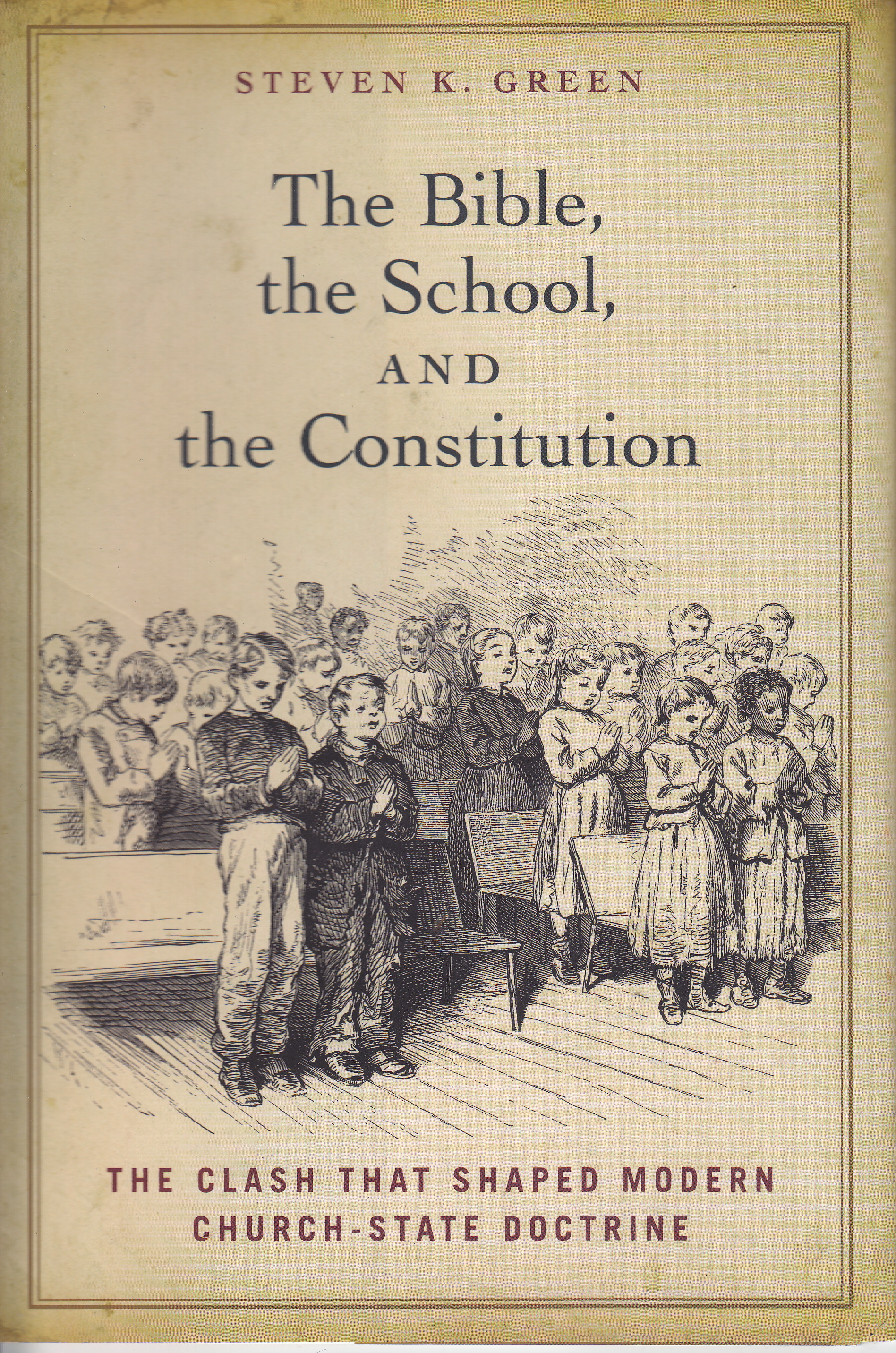
BibleSchoolConstittnAs a very young scholarlet, I recall the horror expressed when some form of prayer was expelled from public schools. It had to have been in the late ’60’s. Maybe early ’70’s. The nation, it seemed, was headed for Hades in a hurry. Little did I know that this was part of a long, drawn-out—tired, even—battle. Steven K. Green’s The Bible, the School, and the Constitution: The Clash that Shaped Modern Church-State Doctrine gives pretty close to the full story. Bible reading in public schools was foundational, in the beginning. In the early days of public education, the Bible was ubiquitous. It was considered non-sectarian since practically everyone was a Protestant. When the religious mix of the country began to diversify in the mid-1800’s, a new dynamic emerged. People got upset. There were riots. People were killed. Legislation was proposed that would explicitly add God—Jesus even—to the Constitution. Who knew?

Green’s study takes a close look at the various cases that arose around the time of the Civil War regarding the Bible in school. Protestants, it seems, didn’t appreciate that Bible reading, in the King James Version, without comment, violated Roman Catholic policy. The first to challenge Bible reading in public schools were Christians. Secularists only joined the fray later. I’m oversimplifying, of course. Some Catholics wanted equal time, the reading of the Douay Bible instead of King James. Others wanted Catholic schools to receive state funding. Nobody was really aware of other religions such as Hinduism or Buddhism. It was a country of limited religious imagination. Various groups tried in various ways to get God—their God only—into schools as the default deity. And so the fun continued.

For me, it was eye-opening to realize that all of this isn’t new. The legislation, since long before my grandparents were born, has been heading in the direction that led to the aggrieved tears in my youth. Green points out, however, that the conflict has never been completely resolved. School vouchers and a long spate of evangelical presidents have had their impact on our children. The Hades that we feared has only come with the weaponizing of our culture, largely by those who want Bible reading back in the schools. The thing we fear finds us through the thing we love. Ironically the issue never seems to be education. God or guns—it’s the power that we want. The early debates revolved around morality. How could kids be moral without Bible reading? How the definition of morality has changed. We, as a nation, still can’t figure out religious freedom or how to let kids be kids.


Buying the Kingdom

Who doesn’t admire the presidential wannabe who can take a personal hit without flinching? We are, after all, a nation of tough-minded individualists who think they know quite a lot about God and the way the universe works. So Donald Trump has been, according to Steve Benen on MSNBC, been saying the Bible is his favorite book. As Benen notes, when asked to point to some specifics, the ultra-rich contender prevaricates, recently saying that of the Testaments, he liked both equally. I wonder which verses are really his favorites? I’m guessing Proverbs 11.28 must be among them: “He that trusteth in his riches shall fall; but the righteous shall flourish as a branch.” Or 28.22, “He that hasteth to be rich hath an evil eye, and considereth not that poverty shall come upon him.” Or maybe Ecclesiastes 10.6, “Folly is set in great dignity, and the rich sit in low place.” It could be that the New Testament has a slight edge over the Old. “Then said Jesus unto his disciples, Verily I say unto you, That a rich man shall hardly enter into the kingdom of heaven,” (Matthew 19.23) must be right up there. Or Luke 6.24, “But woe unto you that are rich! for ye have received your consolation.” Maybe James 5.1, “Go to now, ye rich men, weep and howl for your miseries that shall come upon you.”

Actually, a near constant vexation to those who try to take the Bible seriously is it’s refusal to take one position on wealth. Written by many people over hundreds of years, it is clear no single viewpoint emerges. Wealth is considered both a blessing and a curse. One thing, however, that the Bible refuses to countenance is the presence of great wealth while poverty still exists. Those who have riches are expected to make sure everyone has enough before enjoying their surplus. Who among the one percent, no matter how much they claim to give away, can ever honestly claim the Bible as their favorite book? There are places where the rich are let off easy, but they are few. Wealth corrupts, and those who have riches in great abundance don’t come off looking good. Still, you can’t be a presidential candidate without the Bible. And money.

I can think of no better use of the Bible as an iconic book than Trump’s claims to valuing it as his favorite, if private, book. This is a Bible containing no words. It is a hollow leather shell that can be used to buy votes—spiritual currency of the highest market value. When is the last time someone could be a non-religious candidate for the highest office in the land? If you can buy your way into the White House, you can surely buy it into Heaven as well. Every god has his price. If I were a rich man running for the presidency, I’d put my money in needles. If I were a literalist, I’d have one cast so large that I could easily walk through. This would be my best chance to inherit every possible kingdom through the use of money.

IMG_0322


Credo

One of my seminary professors, who shall remain nameless, averred in class that Christianity in the first centuries was popular because it was exclusive. Like a country club. If just anybody can get in, why would you want to join? I’ve come to disagree with said professor’s analysis, but I have to admit there are cases where the idea does apply. Country clubs, for example. Organizations that intend to improve society, however, have it in their best interest to have doors as wide open as possible. Otherwise it’s a kind of hypocrisy. If Christianity wanted to make a better world, it soon realized, all takers should be welcome. That paradigm broke down fairly quickly, but at the beginning, I have the sense that all were welcome. So I was pleased to hear that the Boy Scouts have dropped their ban on gay troop leaders. Making a group that sets out to do a good deed a day exclusive heterosexual seems awfully backward. After all, gay leaders are nothing new. Why try to be exclusive?

Of course, the Scouts continue to disallow atheists. This is a fairly common, if medieval, marker of personal integrity. The Elks, last I heard, had few entrance requirements. One of the few stipulations, however, is that you have to believe in God. I don’t know how that plays out for Hindu Elks. Perhaps the more the merrier. Somehow, I doubt it. Exclusive belief entry requirements are a way of weeding out questions before they’re raised. Sheltering those inside from baleful influence among hoi polloi. We are better because we are different. Granted, these organizations go back to a time when theism, of sorts, was virtually a given in American society. Times have changed. Boy Scouts, it seems, are dragged into the future kicking and screaming.

I’ve always been impressed, by contrast, with the Girl Scouts’ openness. No creedal requirements are in place. Atheist girls, Buddhist girls, girls who climb on rocks, any girls are allowed to join. The last three presidents (including Obama) have been Boy Scouts. Two prior presidents have been as well. You might think the organization could meet its pedigree requirements with ease. In my view, they might look to the girls to take a cue on how to make the world a better place. When I was growing up, I knew no atheists. I remember attending a funeral of a family friend who hadn’t been a church goer, and that was pretty traumatic. As an adult I know many atheists and I trust them as much, if not more than, some of the religious I know. Would they be able to lead Boy Scout troops well? I have a suggestion—why not ask the Girl Scouts and find out?

IMG_2405


Excavating Religion

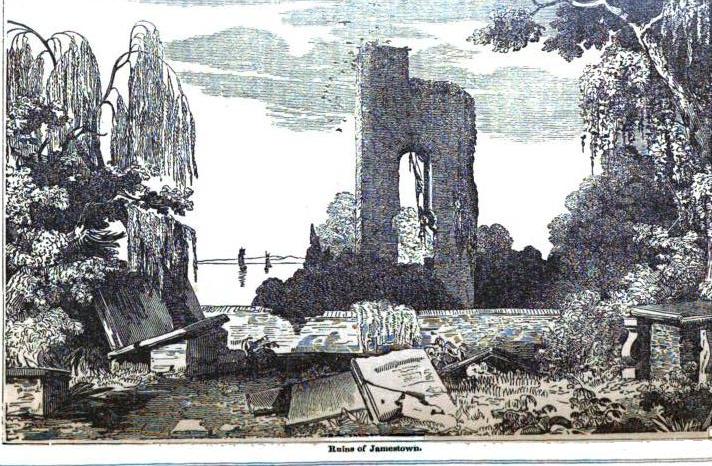
Jamestown, Virginia has the distinction of being the first British American colony to have survived. I’ve only been to Jamestown once, and that was about two or three years before the site was scheduled to celebrate its four-hundredth anniversary. William Shakespeare was still alive back in the home country. The King James Bible was not yet available. It was a gray day when we drove to the site and there were no other people around. Without a guide there was not much really to see—just a sense of being in touch with history by standing where the first English would eventually remake the land in their own image. Even the pilgrims tried to reach Virginia, but missed and landed in Massachusetts instead. Jamestown, however, lays a claim no other site can make.

A recent BBC article describes four graves lately found at the site. Located in the church, those buried were men of status. One of them was Reverend Robert Hunt, a clergyman of the Church of England and the first Anglican minister in North America. Interestingly, the BBC story points out, the Church of England was only half a century old at the time. Having spent many years among the Episcopalians at Nashotah House, I learned a great deal of the church’s history. The fact that the Episcopalians made it to America so shortly after their establishment is something I never heard emphasized. Concerned that the Catholic Church, under Spain, was collecting so much territory, the C of E wanted to stake a claim in the New World early on. Partially because of their persistence, we speak English even today. Church and empire were hand-in-glove in those days, and both the church in Spain and in England were state sponsored. Having God on your side can be pretty handy when you want to claim something that really doesn’t belong to you.

The reverend was buried west, facing the people he served, and, according to the article, this helped initially identify him as clergy. The church, in the service of the government, supported the conquest of new lands. The implicit belief that God was on the side of the strong has never really gone away. Mega-churches measure their spiritual assets in terms of fiscal influence. There are those today who believe that the Almighty wants the righteous to be rich, of course, at the cost of the wicked. Jamestown may have, at least partially, set the tone for a new nation that wanted to take more land than it needed. Land that others had occupied, and indeed, still lived upon. Only with the backing of a deity could such claims be made. The biggest god, after all, wins the day. Jamestown tells us more than we might suppose about what we’ve become as a nation. The early years are often the most formative of all.

Jamestown_Virginia_ruin


For the Sake of Fighting

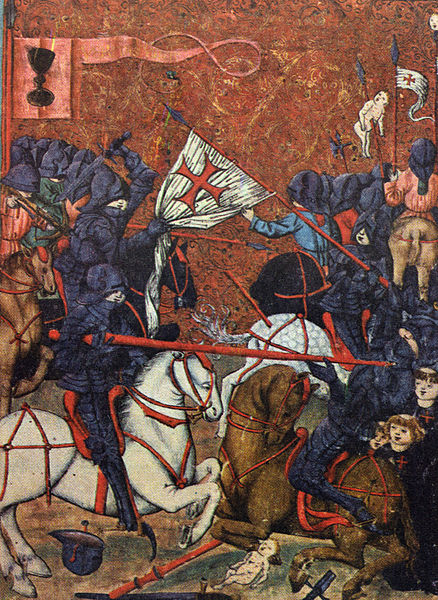
Different opinions can be used for discussion or destruction. In the formal context of government, the declaration of war is—or should be—an option of last resort. Increasingly language of belligerence is status quo ante when religion is the topic. “Culture Wars” is a thinly veiled reference to the profound disagreement between social conservatism, associated with Evangelical Christianity, and progressive policies, often affiliated with nones and mainline Christian traditions that don’t wish to be left behind. For years, decades, no one side can declare victory, for example, in the debate over whether America was founded as a Christian nation. Two news stories I saw this past week addressed just that question. Fox News ran a story about a Baptist Church in Shelby, North Carolina, that has decided to fly the Christian flag over the stars and bars until, well, I guess the Second Coming. Protesting the legalization of gay marriage, the congregation wants the message, aided by Fox News, to spread that in at least this corner of the country, God comes first.

The other story, on CNN, asks the question directly: “Was American Founded as a Christian Nation?” With five professors answering the question there’s bound to be differing opinions but all agree that this isn’t a simple yes or no answer. The even larger question, it seems, is how can the founders’ religious orientations help us to avoid cultural wars? Isn’t the fact that we’re still searching historical documentation over two centuries later an answer in itself? Maybe they didn’t tell us directly because it was none of our business. Washington, Franklin, and Jefferson are quoted on both sides of the debate. Their cultural context was Christian, but as all the five scholars agree, the question didn’t become a live one until the nineteenth century. Seems that we got along a century without knowing.

The “Culture Wars” may have been there, of course, but the need for a term only arose in the late 1980’s and early ’90’s. The divide had been simmering since the end of the ’50’s, however. Leave it to Beaver versus Star Trek: the Next Generation. The media has never been shy about telling us what to think. Difference of opinion is as natural as a pre-frontal cortex. Peaceful coexistence, however, doesn’t sell newspaper or commercial airtime or space. We want the thrill of danger, the chance to declare that, unlike the adversary, we are clearly in the right. Maybe if we changed the metaphor the rhetoric might catch up. In the meanwhile, battle comes to mind. Ironically, the Bible is a place that suggests peaceful solutions to many disagreements, but neither side thinks to look there for guidance.

438px-Husité_-_Jenský_kodex


Forbidden Words

800px-Norsemen_Landing_in_Iceland

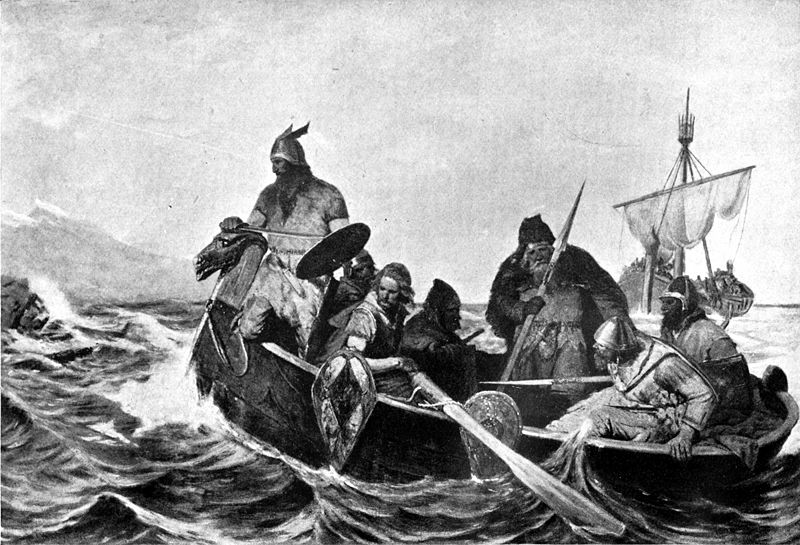
In keeping with the spirit of freedom, just before July 4 the BBC broke the story of Iceland’s blasphemy laws having been struck down. Although the state Church of Iceland (Lutheran by denomination) supported the move, other churches have been grumbling. It’s an odd notion, that blasphemy should be illegal. Part of the oddity revolves around disagreement of what blasphemy is. Even if taking the name of God in vain is used to define it, several questions remain. Which name of God? Certainly “God” is not a name, but a title. Is taking the title of God in vain blasphemy? What does it mean to take a name in vain? If you don’t mean it? I’ve surely heard many invoking the divine in curses that were most certainly sincere. Were they blaspheming? Does blasphemy really mean failing to believe in God? And, pertinent to Iceland, which god is protected under such laws?

Religious pluralism is the clearest threat to those supporting blasphemy laws. Underlying to very proposition is the idea that there is only one true God and that is the God of Christianity. Judaism might be tacked on there, as might a reluctant Islam, but the notion of blasphemy does not seem to bother the deities of other cultures as much. Honoring and respecting belief in deities is fine and good. In fact, it is the decorous way to behave. Still, privileging one deity as the “true god” protected by state statutes is to bring politics into theology. Since when have elected officials really ever understood what hoi polloi believe? In Iceland the old Norse gods have recently come back into favor. Should they be respected to? Why not as much as the Christian God?

It is perhaps ironic that the Pirate Party put forward the successful bid to strike down the law on blasphemy. According to the BBC, the Pirate Party began in Sweden and has now established itself in 60 countries. Since it’s fight for accountability and transparency in government, it’s sure to have a hard time in the United States where bullies can run for President unashamed. What is clear is that although governments make and enforce laws, the will of the people seldom makes itself heard. We may have won some victories in recent days, but there are many entrenched ideas that benefit those in power and not their underlings. Sounds like the Pirate Party may become the Democratic Party of tomorrow. If it does, however, when it loses sight of the ideals that launched it, we may need a new party to board the ship and ask for the people to be heard. Politely, and without swearing, of course.


God, As a Hobby

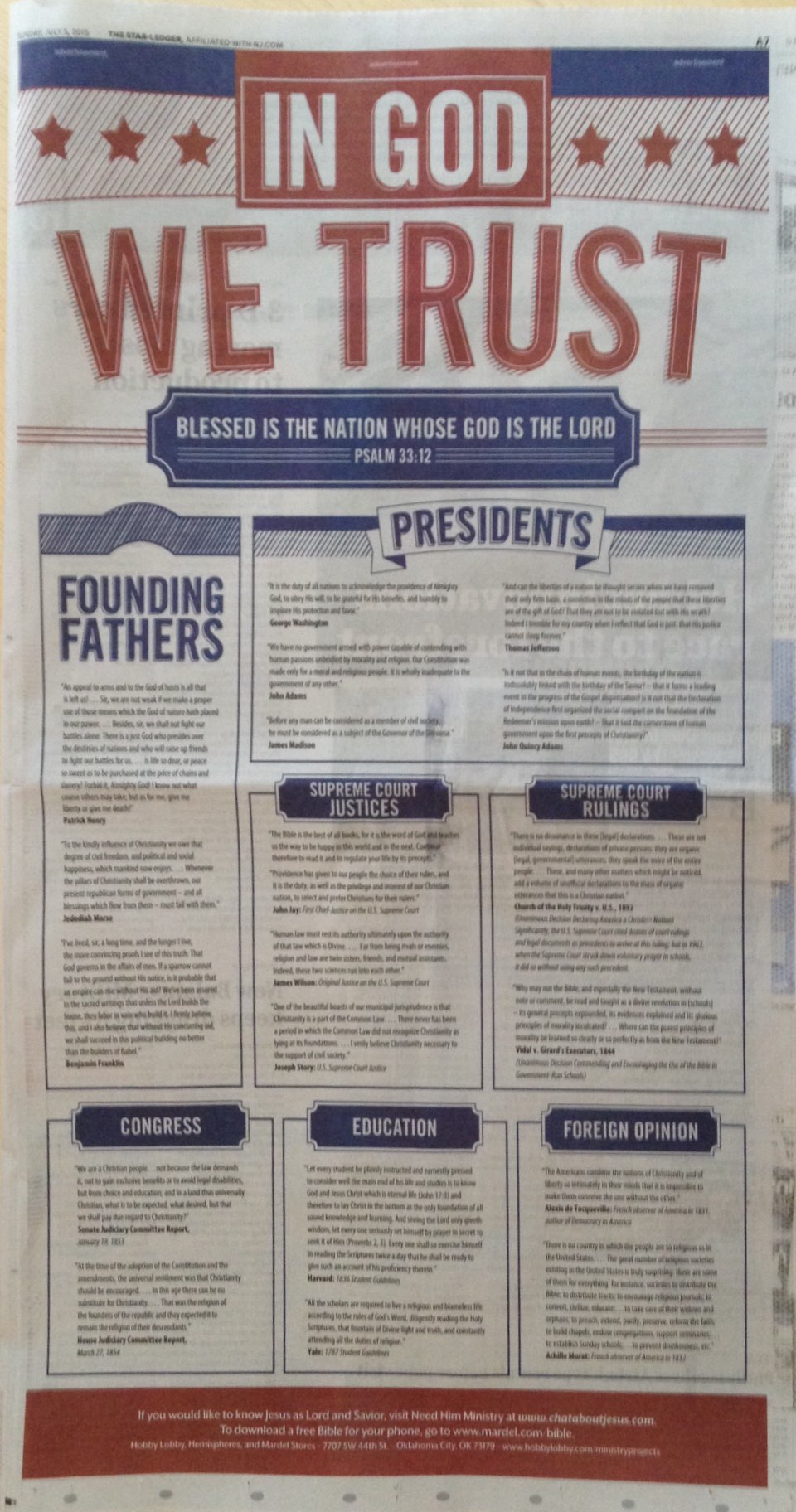
Just as I was awaking from a night of loud fireworks and multicultural bonhomie, my wife showed me a full-page ad in the New Jersey Star-Ledger. A red, white, and blue page entitled “In God We Trust,” the ad wants nothing more than to convert the nation to conservative Christianity. It is sponsored by Hobby Lobby after all. Dividing the quotes that spangle the page into “Founding Fathers,” “Presidents,” “Supreme Court Justices,” “Supreme Court Rulings,” “Congress,” “Education,” and “Foreign Opinion,” prooftexted quotes are given inadvertently showing by their grasping nature that America is a godly country. The Hobby Lobby is not known for its critical reading of either Scripture or history. George Washington, Thomas Jefferson, and Benjamin Franklin, Deists all, are quoted at the height of their rhetoric, making it seem as if they were evangelicals out to build a Christian nation.

new doc 10_1

When I was growing up, there were no Hobby Lobby stores in my area. Although I was a religious child, I would have found it a bit odd that hobbyists were not focusing all their attention on the weighty matter of eternity. Instead, making money seems to be the name of the game, and once you’re comfortably over-compensated the Lobby part of the name comes to play and God reenters the picture. We all know that the Hobbyists wish to have the Bible right next to the capital, if they can’t get it prominently placed in the Oval Office. Policy (the ad cites all three branches of government, as well as education) should be based on the Bible, although we think of ourselves as a land of opportunity. Opportunity for whom?

Starting with a quote ripped from the context of Psalm 33 (“blessed is the nation whose God is the Lord”), the ad doesn’t exegete this at all. Nationalism as we know it did not exist when this Psalm was penned. The author had what would become Judaism in mind, not evangelical Christianity. But then, appropriation of other peoples’ pasts is kind of a hobby. Pick and choose. Take what you find attractive and leave the rest behind. It works for history as well as for the Bible. After all, it doesn’t take historical probity to lobby the government. All that’s required is a surfeit of money. And the best way to achieve that, it seems, is to take up a hobby rather than trying to think through the issues with a mind honed by a solid education in Bible and history.


Magic Faith

MakingWe all like to believe we don’t believe in magic. In this day of sophisticated materialism, the idea that unseen forces might work upon the world seems terribly naive and not a little embarrassing. Randall Styers’s Making Magic: Religion, Magic, and Science in the Modern World has been on my reading list for a few years now. Not so much a history of magical thought, Styers offers a history of thought about thought on magic. There are several takeaways from a study like this. One is that magic and science share common ancestors. In fact, some theorists trace the origins of science to magical thought. The height of alchemy was also the period when experimental analysis of the natural world was blossoming. There was a mysterious sense to what we now think of as impassive particles whirling around for no particular reason. Making Magic makes clear that we can’t divorce developed thinking from magical outlooks. In many ways it is difficult to distinguish religion from magic.

Not that Styers advocates magical thought. He does, however, invite us to think about it. Another takeaway from this study is that magic, when described by religious writers, is a foil. Magic is used to show how the unenlightened think about things. Those of us here in the true light would never think such backward thoughts. Indeed, magic, as Styers makes clear, often served as a kind of social control. Lower classes think magic works wonders. The upper classes know that power lies in exploitation. Magic, in other words, can’t be divorced from politics. Those in the know would only encourage magical belief to continue. Invisible forces indeed.

Magic as a regulatory force is indeed the thesis with which Styers is working. The difference between prayer and magic is somewhat effaced when closely examined. Religious belief is seen as benefiting society while magic is for selfish benefits. I do wonder, however, where the modern magical religions, such as some branches of Wicca, would fit into this scheme. They also seek the good of society. Magic need not be selfish. Making Magic is concerned with the analysis of magic by scholars who’ve shown a surprising interest in the topic. It doesn’t really address those of today who, after finding the atomic world strangely vacuous, have turned to magic to re-enchant a world grown dull and dry. Whatever one may say about magic, it still exists, and its believers are among us. Our world with its solemn, feelingless answers could, at times, use a little such conjuring.


High Places, NJ

The “high place,” in the Hebrew Bible, was a source of constant vexation to the “orthodox.” Scholars have long puzzled over what was meant by the term, the assumption early on being that they were geographically the highest points around. Although that interpretation no longer holds the sway that it once did, the concept of the high place has remained. I suspect that’s because there’s something mystical about being at the highest point around. July 3 was a rare holiday for everyone in the family, so this year we headed to High Point State Park. High Point is the geographical highest point in the state of New Jersey, up near the New York border. It’s not as high as the mountains you might see in the western part of the country, but at the top there is a panorama that gives unbroken visibility in 360 degrees. Except for the tower.

DSCN5093

Towers are just as biblical as high places. They are very human and always contain at least a small element of hubris. Nature may have said thus far and no further, but we can go higher. And those of us with the inexorable will to climb, must go up. The view from the top isn’t very good since the windows are steamy and the mildew makes you a little leery of getting too close, but the climb is intensive, even for those used to stairs. Nevertheless, a kind of light-headed giddiness attends standing at a point higher than which you cannot go. I pulled out my altimeter to discover we were 1690 feet above sea level. In New Jersey you can’t get any higher. Were there angels up here? How close to Heaven were we? Towers are irresistible as the mythical builders of mythical Babel knew. And although we couldn’t see Manhattan from here, I knew that just across the river taller towers stand.

DSCN5109

One World Trade Center stands at a symbolic 1776 feet, higher than we were at the moment. It was, after all, the requisite holiday to celebrate independence that brought us here in the first place. The vistas that we could see, however, were relatively undeveloped, a rarity for the state of New Jersey. If we had the time, we might have been able to get out into nature itself instead of these structures that humans build to mask the fact of our own limitations. Maybe that’s what high places were all about in the first place. Every day I walk past the Empire State Building on my way to work. I can see it if I find an office with windows. Over my head up here, on the very top of New Jersey, I see a bird soaring. I think of Melville, and Ahab, and Manhattan. Slowly I begin my walk down to lower places.

DSCN5099


American Bible

BibleInAmericaAny book that sets itself the task of addressing American culture has, it seems, a built-in obsolescence.  Culture shifts are radical and swift, and it would seem that distance is necessary for any serious analysis.  I am reminded of historian Barbara Tuchman’s opinion that history cannot be written without the passage of at least a half-century. We’re simply too close to the subject matter otherwise.  The Bible in America, edited by Nathan G. Hatch and Mark A. Noll, does not claim to be an analysis of the current situation, but it stands as a representative of how much has changed since the 1980’s.  The era in which the book was written is stamped all over it like the Preppy look or Doc Martens.  American culture was very different then.  Some of the contributors noted that the Bible, as we’ve often been told, is on its way out.  Elections of the new millennium would give the lie to that observation, and we might now argue the same, but I wonder if our view is long enough.
 
The source of my wonder is a basic observation.  The Bible was foundational for the idea of the United States.  Those who have joined the “melting pot” (willingly or unwillingly) have been brought into a soup whose stock is Bible flavored.  I’m not naive enough to think that it is undiluted or even anywhere near its original form, but as a former biblical scholar I’m sensitive to the motifs and themes of the Bible and I see them daily in undiminished numbers.  Transmutation is not the same as exodus.  I make no judgment whether this is a good or bad thing.  It simply is.  Those who think it is an exaggeration to put such prominence on the Bible in American culture should read the first couple of essays in this book.  It may have been that without the Bible the will to cross the dangerous water to an uncertain (and to many, catastrophic) future would not have been so pressing.
 
Like most collections of essays, this little volume has a grab bag of wisdom.  Reading it is like taking a stroll through the ’80’s again.  We seemed to know things with a certainty then that has all but vanished these three decades hence.  The Fundamentalist movement provided a Tea Party appropriate to Mad Hatters and White Rabbits alike.  Presidents declared that we were on Crusades again.  Megachurches have the budgets of small developing nations.  I’m not about to make any predictions for the future of the Bible here.  An observation, simple, but fairly obvious, will have to suffice.  Since colonial times, Americans have always had their Bible.  It hasn’t always been the same book, and it hasn’t always been interpreted in the same way, but it hasn’t ever gone away.  I can’t say about the future, but right now I’m about ready to put on my Ray-Bans listen to some Madonna.


Once and Future Bible

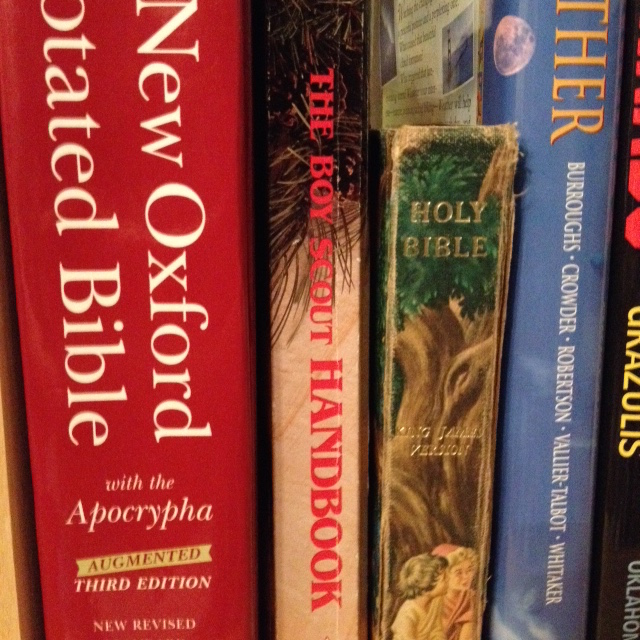
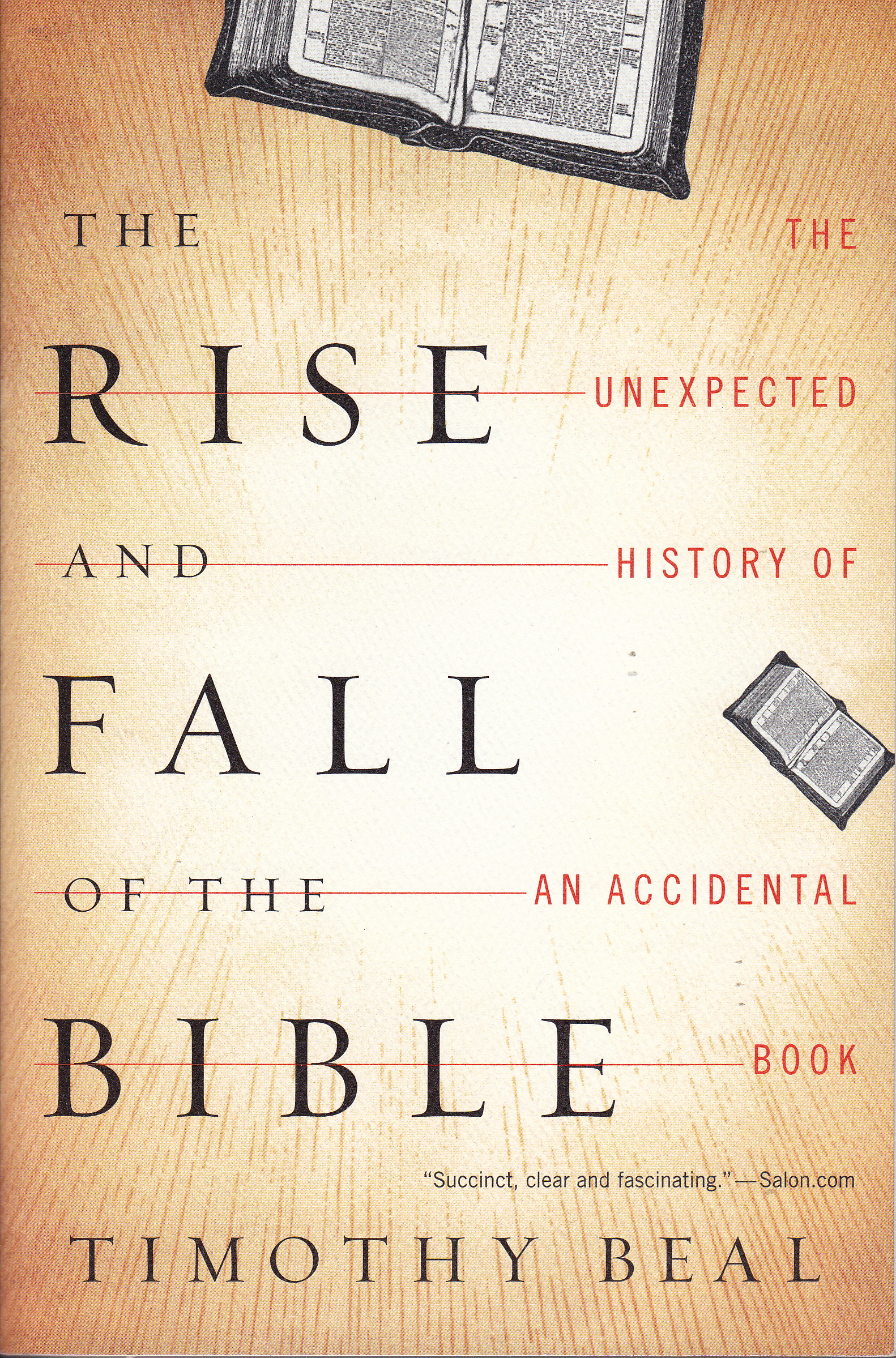
RiseFallBibleWhile I may not share Timothy Beal’s view that print culture is on its way out (I harbor hopes every time I see vinyl records making appearances in stores), he is certainly correct most of the time in The Rise and Fall of the Bible. Written for non-specialists, this book nevertheless gives his fellow biblical scholars pause to stop and think. Beginning with an eerily similar childhood experience (although mine was considerably more dysfunctional and appears to be veering back in that direction by career exigencies), Beal recounts how he came to study the Bible with a critical eye and to observe a number of important things. One of the scholars associated with the Iconic Book movement, he shows how our biblically illiterate society still values the symbolic nature of the book in various ways. We still buy, for example, lots of Bibles. We still want elected officials at least willing to swear on one. We still think it has some special kind of power.

Beal gives a brief history of “the Bible” as an idea. It is essential, as he notes, to realize that as a “thing” the concept of Bible is fairly recent. Certainly nobody in Jesus’ day thought of it as we do. What’s more, and more to the iconic element, Bible sellers have been looking for “added value” to boost the sales. Biblezines (of which I’d not heard) and Manga Bibles are only two examples of the many “extras” Bible vendors add to their texts. In essence they are making new Bibles. Beal wonders how much buyers read the actual biblical text as opposed to the other, more eye-catching material in these books. Bibles are made trendy and hip, decorated, dissected, and dolled up. And we feel virtuous for purchasing them. We play right into Big Dan’s hand, if you get my meaning.

A fascinating collection of interesting bits about the way the Bible has been re-presented to the same public for over two centuries, The Unexpected History of an Accidental Book is an appropriate subtitle here. Those who fueled the Bible craze—those that we now routinely call Fundamentalists—are among those most distressed by the indignities perpetrated upon what was once considered a sacred text. What can be more fundamental than making money off people’s beliefs? Still, for Beal and his colleagues who have managed to land the rare positions teaching Bible, there is an urgency about this whole enterprise. “These jobs,” in Bruce Springsteen’s words and my own experience, “are going boys, and they ain’t comin’ back.” Meanwhile our culture will continue to make love to its holy book, even though they may not recognize who they wake up next to in the morning.