Reflecting Thanksgiving

Thanksgiving, the newest holiday horror movie, was released last Friday.  No, I haven’t seen it—I barely have time to do whatever it is that I do normally.  I suspect, however, that many will object because Thanksgiving is still a quasi-religious holiday.  If we’re giving thanks we must be giving it to someone, or something, that may or may not govern our lives.  Ironically, in many business calendars it is the only annual four-day weekend.  Christmas could come on a Wednesday, so we can’t go giving time away!  Ironically, Thanksgiving was fixed as the fourth Thursday of November (moved from the last Thursday) to ensure about four weeks of shopping time before Christmas.  Me?  I’m just glad to have a couple days off.  2023 has been a challenging year on a personal level and having a couple days out of the office is just what the doctor prescribed.

Photo by Priscilla Du Preez on Unsplash

It may seem strange to be thankful for horror movies, but I know I’m not the only person whom they help.  I also believe that the genre has been misnamed.  When you think of all the different kinds of films that get lumped under the moniker it really is odd that we have any idea at all what we’re talking about.  What are horror movies, then?  The common equation with slashers is patently wrong.  There’s nothing slash-like in the old Universal monster movies that started the whole thing.  Time and again critics point out that “horror” is generally intelligent, and often funny.  And not infrequently therapeutic.  Yet it has a bad name.  Some even consider it satanic although it produces good.  Being satanic is a matter of how you look at things.

Thanksgiving is a time for reflection.  Reflection without the distraction of work constantly trying to poke holes through our concentration.  The holiday season properly starts at Halloween and sadly ends at New Year.  It’s our reward for having made it through another one.  The holidays that fall into this season all have a great deal in common.  Early Americans celebrated Independence Day, Thanksgiving, and sometimes Christmas and New Years.  We’ve reached the point now where we have a distinctive string of holidays like stones across a rushing river.  We can just make it from one to the next.  From Halloween we can see to Thanksgiving.  From today Christmas is on the near horizon.  New Years follows only a week after.  And it’s a time for reflection and thankfulness.  Even if what we appreciate isn’t the same as everyone else.

Not Quite Christmas

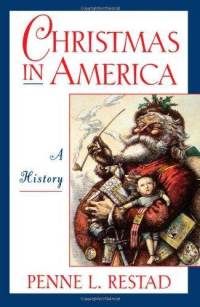
Holidays have always fascinated me.  Although we grew up poor, I always have cozy memories of childhood Christmases.  It was a combination of things—being out of school for a couple of weeks.  Presents.  Christmas trees.  Time outside ordinary time.  I’d read Penne L. Restad’s Christmas in America: A History years ago.  So many years, in fact, that I forgot that I wrote a blog post on it before.  That was back in 2012, in my early days of commuting to New York City, and early days of blogging.  Sometimes I have to come back to a book, however, and rereading this one reminded me of why.  There’s a lot of good stuff in here.  It mostly focuses on the nineteenth century, but it does go back before that and steps into the twentieth century (when it was written) toward the end.  I’d forgotten a lot of what I’d learned before.

This time through, having worked as an editor for a decade and a half now, I could tell that it was originally a dissertation.  It’s pretty hard to remove that completely from any book project.  Nevertheless, it’s engagingly written and full of facts.  I’d forgotten that Santa’s red clothes were not, in fact, Coca-Cola’s invention.  And that Washington Irving played quite a role in introducing Americans to the holiday.  And just how interconnected Christmas is with Thanksgiving, New Years, and yes, even Halloween.  Of course, no book can be adequately summarized in a brief blog post.  My previous one highlights some of what I found here, but this reading brought out other interesting features.  I spend quite a bit of my energy anticipating holidays.  Some years they’ve been minimized due to circumstances, but they are definitely the fixed points around which my life revolves.

One of the interesting things I noticed this time, introduced literally on the second-to-last page, was that the book mentions holiday horror.  Restad’s focus is on America so she doesn’t really delve into the British tradition of telling scary stories at Christmas.  (I do discuss this in The Wicker Man, I would note.  Although set on May Day, it was released in December, fifty years ago.)  These kinds of interconnections fascinate me.  Our culture reflects who we are and American culture includes Christmas for any who want to take part in it.  In fact, the book makes the point that becoming secular helped Christmas spread goodwill to people of all religious persuasions, or none at all.  It’s not really even a Christian invention.  It’s a blending of traditions that bring light to the darkest time of year.  And here I am like a kid, eagerly awaiting it again.


Not What It Seems

Now for the local news.  The ironic thing is I know very few people locally and even though folks are friendly around here nobody really wants to get to know you, it seems.  But that’s not unique to this area and it’s off point.  No, locally some months ago The Satanic Temple (which I’ve written about before) tried to start an after school club in an eastern Pennsylvania school in response to an explicitly Christian after-school club receiving sponsorship.  Of course it caused local furor.  That’s what the Satanic Temple intends to do.  The members do not believe in, let alone worship, Satan.  They exist to try to counter Christian hegemony, often in the form of courthouse lawn Christian imagery, or, as in this case, biased treatment to Christian groups wanting to use public property, such as school facilities, to promote their religion.

The reason I’m bringing this up is to show how the Christian agenda raises your taxes.  According to the ACLU, this school district, after challenged in court, has agreed to pay $200,000 and it must allow the Satanic Temple to meet if it allows Christian groups to meet.  That hefty chunk of change (enough to buy a house in this area) has to come from taxpayers because the school board (until a recent election) was controlled by a right-wing group that played the Christian narrative and apparently supposed the Satanic Temple was really a Satan-worshipping group.  It’s not.  The Satanic Temple is a national organization whose goal is to maintain freedom from religion in government and publicly funded spheres.  “Satanic” causes shock and panic and the sheep scatter.  And local citizens foot the bill.

Although I understand what they’re doing, I really don’t like to see my taxpayer dollars having to be spent to coddle the egos of groups who spread the narrative that Christianity is the only religion allowed in America.  In fact, one of the truly fascinating things about this country is the wide varieties of religions that exist in it.  Although the melting pot metaphor has fallen on hard times lately, I’ve always felt this was one of America’s biggest charms.  We’re a Frankenstein’s monster of a nation that’s just like the creature—not really a monster, but not like anything else you’ve seen.  Cookie-cutter populations seem to lead to wars and hatred.  Celebrating difference, indeed, encouraging it, leads to peace and shared prosperity, if we’ll let it.  It’s only when we want to keep all the good stuff for ourselves that things begin to break down.  And your local taxes go up because a faulty narrative is on the agenda.


A Century of Horror

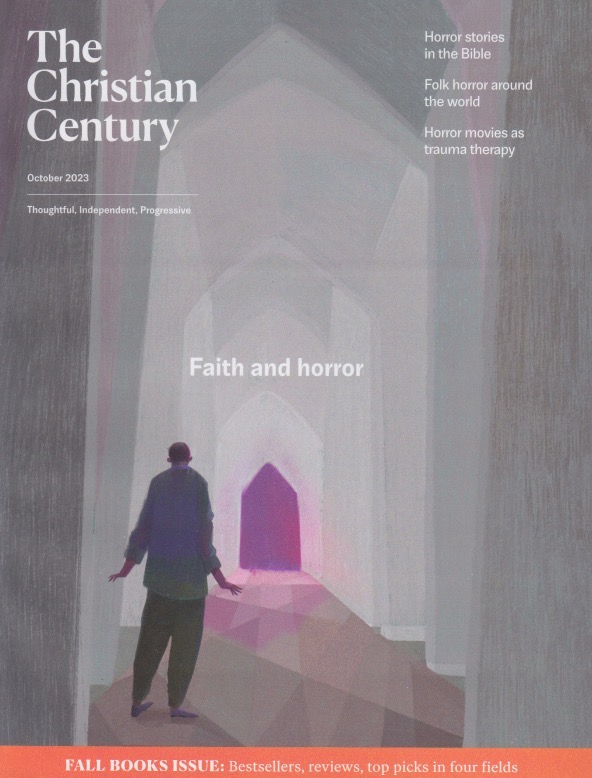
I’m not a magazine reader.  When I go to a waiting room (which is quite a bit lately), I tend to take a book.  The October issue of The Christian Century, however, caught my eye.  As a more mainstream/progressive Christian periodical, CC used to circulate in the office of one of my employers since it features books, the way progressives generally will.  This October, however, it featured five articles on “faith and horror.”  I had to take a look.  I know three of the five authors, one of them without realizing he was a horror fan.  An article by Brandon R. Grafius, “The monsters we fear,” discusses the commonalities between fear and religion, ground that he treats in Lurking under the Surface.  “The wisdom of folk horror” was written by Philip Jenkins—I didn’t know his horror interest—and it engages, briefly, The Wicker Man.  He’s making the point that folk horror is often about somebody else’s religion.

It was “Horror movie mom” by Jessica Mesman that really hit me.  Mesman was traumatized in her youth, and like many of us who were, has turned to horror for therapy.  This is a moving piece and is worth the cover price of the magazine.  Gil Stafford’s “A theology of ghosts” also gave me pause.  Stafford is an Episcopal priest who considers ghosts to be more than just woo.  In this very personal piece he thinks about what that means.  The last feature, “God’s first worst enemy,” is by Esther J. Hamori, one of the colleagues who talks monsters with me.  The piece is adapted from her recent book, God’s Monsters.  Taken together these pieces are quite a mouthful to chew on.  While numbers in mainstream Christianity are declining, Christian Century is still a pretty widespread indication of normalcy.

When I wrote Holy Horror I only knew about the work of Timothy Beal and Douglas Cowan as religion professors writing on monsters and horror.  That book admitted me to a club I didn’t know existed—the religion and monster crowd.  Since I’m not welcome in the academy, I’m particularly drawn to pieces like Mesman’s since she’s writing from the heart (as is Stafford here).  I’m just glad to see this topic getting some mainstream coverage.  I know I’m a guppy in this coy pond, but I do hope they’ll consider, over at the Century, turning this into the theme for their October issues in coming years.  If they do, they can count on at least one extra counter sale.


The Good Lurid

It takes a lifetime to make a reputation.  In high school my teachers and classmates knew mine well: religious and full of integrity.  Going on to do three degrees in religious studies confirmed all that (at least the former).  Something that nobody seemed to pick up on was that I liked watching monster movies.  I did less of it in college, but still watched some heavy-duty fare (including David Cronenberg) when I was in seminary.  Once I married life looked more optimistic and I really didn’t feel the need to watch what is called “horror” any more.  Sure, we occasionally saw films everyone was talking about, but in general I moved away from the genre.  It took Nashotah House and its aftermath to bring me back.  In any case, my reputation seems to be such that now when people who know me see religion and horror together they think of me.  I’m touched.

A regular reader of my blog sent me an article from The Guardian titled, “Schlock horror! Meet the family who made lurid movies for the Lord.”  It should be pretty clear, if my integrity is intact, that what I’m trying to do is figure out how these things fit together, religion and horror.  That they do is obvious, but how?  In any case, this article plugs a book by journalist Jimmy McDonough, The Exotic Ones.  The book explores the Ormond family and their odd filmmaking.  The father, mother, and son triad, made a living producing cheap, questionable films.  After a plane crash, which they survived, they became religious only to find their minister wanted them to keep making their bad movies for evangelistic purposes.  The films they produced for the church had religious themes, but used well recognized horror tropes, anticipating, if you will, Left Behind and its ilk.  Like a Thief in the Night scarred many of my generation.

I’m probably not alone in not recognizing any of the movies the article discusses.  If I’m reading correctly, Tim Ormond, the son and sole surviving family member, stopped making these films after the death of his parents.  In any case, I have been developing a fascination with bad movies.  The fact that they’re even made and released is incredible to me (mostly the released part).  Many of us end up reacting to life rather than following the plans we had for it.  Fate—call it what you will—has a way to stepping in.  For one family, however, fate led them to a church that paid them for what they wanted to do.  Many of the rest of us find just the opposite and we end up watching horror to try to understand.


Halloween Spirituality

October, well September and October—actually June through October, took many unexpected twists this year.  I’ve had to lean heavily on Halloween spirituality to make it through.  That’s good because we haven’t had time to decorate for the holiday.  We haven’t had time to get out just to appreciate the leaves, to go to a farm for pumpkins, let alone carve any.  Or come up with a costume.  I couldn’t even get to the theater to see The Nun II, despite having written an article on the universe to which it belongs.  Halloween spirituality works in times of less-than-optimal circumstances.  Anyone who reads this blog more than once or twice knows that struggle is a fairly constant theme.  Halloween spirituality comes to those who need it, and it helps us to get through.  

With the death of my mother this month, I’ve been thinking a lot about family.  My family is where my spirituality began.  I’ve been haunted by the truth since I was a child.  I need to know what’s true.  It’s one of the few non-negotiables in my life.  Halloween is true because it’s honest.  We wear masks, but we do so all the time.  On Halloween we have the courage to admit it.  Some of us are scared little boys or girls inside, trying to find meaning in a world that makes no sense.  A world that is run by the ambitious and greedy—those who are powerful because others fear them (Halloween is honest, my friend)—and who make rules by which the rest of us must live.  Halloween says it’s all right to be scared.  Yes, the monsters are real.  And most of them would treat you far better than you might expect.  Trick or treat.

Halloween spirituality is about hope.  It’s a pivot point around which the year revolves.  I look forward to it each year once it has too swiftly passed.  In the slow change of progress, I hope that it will eventually be recognized as a national holiday.  I find the holidays a season of hope.  For me that season begins with Halloween.  From here it’s almost possible to see Thanksgiving and from there Christmas isn’t far off.  I save vacation days to be able to take a mini semester break—something in every teacher’s blood—that allows me to reboot.  Halloween spirituality is one that anticipates rest and quietness, celebration and reflection.  It’s a time when busyness must wait its turn.  When the dark is allowed to utter its peaceful sighs into a world where too much is happening all the time.  By the way, I decided on my Halloween costume: AI, disguised as a human being.


Not Grant

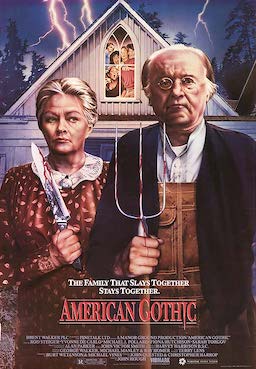
Grant Wood’s painting, “American Gothic,” is undoubtedly his most famous work.  The image is so evocative and suggestive that countless interpretations have been offered for it.  The idea of debilitating isolation suggests itself.  An unhappy self-reliance that has taken its toll on an aging couple (some say the woman is his daughter) often comes to mind.  For some it suggests a movie.  Normally I like horror films from the seventies and eighties.  There’s almost an innocence to them that gets lost in the new millennium.  On a rainy weekend afternoon when I couldn’t be mowing the lawn I found American Gothic on Amazon Prime and it had received four stars and even IMDb showed it as better than average.  The longer I watched the more I was inching toward “bad movie” territory, but I had to see how it ended.

Six young people, four of whom are distinctly unlikeable, have plane trouble and get stranded on a lonely island in the Pacific northwest.  They discover a house furnished from the twenties and it turns out there’s an older couple there who don’t really cotton onto strangers.  As the plot unfolds it turns out they have three adult children who think they’re still adolescents.  And—this is the good part—they are a very religious family (in part.  Again, as often happens in such films, the writers really don’t understand religion).  In any case, the predictable killing off of the kids starts to happen when they continue to be rude and insult the family.  Since we’re in slasher territory here, there’s a final girl—one of the two sympathetic women—who ultimately takes over the house.

Part of the problem with the film is the utter paranoia with which it treats mental illness.  The family clearly has problems and, in a way typical for the genre, they turn toward killing.  Ironically, Pa, when he finds his family has been killed by the one mentally ill visitor (everyone with psychological problems in this movie turns to murder), renounces God and sells himself to Satan.  Interestingly, he doesn’t survive long enough to do anything about it.  Reading about this movie after watching it I came across a new word: hixploitation.  Exploitation movies are familiar to anyone who watches much in this genre, but I’d never considered that Deliverance and company exploit “hicks.”  It’s all about how others look at you.  And, as a movie made in Canada and the UK, it shows us what others see when they look at us.  There’s some ground to explore here in a sequel to Holy Horror


Frightening Legacy

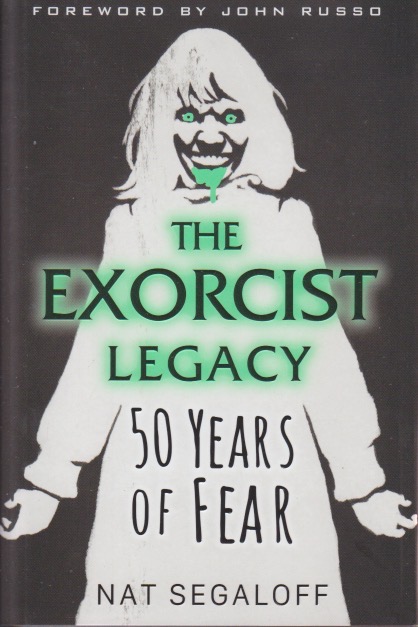
Like The Wicker Man, The Exorcist also turns fifty this December.  I was caught up in this half-century mania and so I got ahold of Nat Segaloff’s The Exorcist Legacy: 50 Years of Fear right away.  The reading was disrupted by life events, but I’d been enjoying it, as time permitted.  Written by a movie insider (as opposed to an ex-academic wannabe), this is a fairly full treatment of the film.  It’s actually not unlike what I tried to do with Nightmares with the Bible, but it is yet another testimony of the importance of The Exorcist to our understanding of demons.  Although one book can’t really be one-stop shopping for any worthwhile movie (there are plenty of books out there on the subject), this one is well worth reading.  For those who enjoy learning about cultural phenomena with a bit of horror tossed in, this is a very good introduction.

One of the things I’ve learned as I’ve tried to break into film reading is that a lot more goes on in making a film than most of us imagine.  And when we see a movie we miss an awful lot.  I’m no shill for Hollywood, but watching a movie multiple times brings out things that writers, directors, and producers didn’t even notice.  Think of the Bible, for comparison.  Readers two thousand years later are still finding new things to say about it.  The Exorcist has influenced religious outlooks in extremely important ways.  Our modern ideas of demons and possession largely go back to this film.  Details may change over time, but even the church has had to respond to it, and actual exorcists reference it.  The Bible says little about demons (again, Nightmares), so we have to pick such knowledge up from elsewhere.

The one part I found somewhat thin was, not surprisingly, parts of the final chapter, “The Mystery of Faith.”  It tends to show when a writer really knows religion.  William Peter Blatty, who wrote the novel and screenplay (the latter at least partially), knew Catholicism cold.  One of the things I’ve been yammering on about for years is that understanding religion enhances our understanding of horror movies.  I’m certain that the connection goes even deeper than that, but books written on horror mention religion often in amateur ways.  If we want to get at what’s really going on here, it’s going to be important to listen to those who understand religion as well.  None of that detracts from this fascinating book that will throw new light into shadowed corners.


Horror Therapy

It’s Friday the 13th.  Like Barbra and Johnny I’m driving to rural western Pennsylvania to visit a cemetery.  It must be October.  I’m not a magazine reader (this has probably hampered my development as a writer [I prefer books]), but the October issue of The Christian Century is devoted to religion and horror.  This morning I watched an interview with Jessica Mesman on her article on horror as therapy.  In it she discusses her mother’s death.  Since we have this in common, I was intrigued.  Mesman states that studies substantiate that watching horror functions as therapy for people with PTSD.  It has been suggested to me more than once that my career malfunction at Nashotah House led to PTSD.  It may be no coincidence, then, that I started watching horror after that happened.  When The Incarcerated Christian podcast was still going, I was interviewed three times and the topic was, broadly, how horror acts as therapy.

Until today I’ve had to work daily and then make arrangements for an unplanned trip to celebrate my mother’s life as I could.  I’ve never met Jessica Mesman, but I sense that she would understand what I’m going through.  As I grapple with grief, loss, and relief (my mother was ready to die, but I had been unable to see her for a few years because of the pandemic and other circumstances) what I feel I really need is to watch a horror movie or two.  I have found—and 2023 has been a traumatic year for me—that when I’m feeling overwrought, taking ninety minutes to watch a horror film can get me back on track.  It helps me cope.

None of this is intended as any disrespect for my mother, whom I love deeply.  Although she didn’t read my books, she knew I watched monster movies as a kid.  She occasionally grew annoyed with me when such things made me too clingy—she had two other sons and her own dying mother in our home and she was trying to keep it together with my father gone.  Looking at photos of my young self, I wonder if that early loss of a parent translated to a kind of childhood PTSD.  Once I’d successfully (?) made it to adulthood, Mom told me—“you were the one I worried about; you seemed to have difficulty adjusting.”  I sought therapy in religion.  I’ve dedicated my life to it.  Until it too became a source of grief, horror, and pain.  As I prepare to drive to her funeral, I’m pretty sure that Mom understands.


Calculating Christians

I know some calculating Christians.  I use “Christian” as religion scholars do—it is the way people identify themselves, not necessarily what they are.  For example, I grew up learning that Christianity was God’s excuse for throwing a bunch of unknowing people into Hell.  Laughter all around!  Then I did something radical.  I started reading the Bible.  Spoiler alert: as you start to get near the end, you learn that Jesus and his early followers (except maybe Paul) promoted the idea that God is love and the only correct response to that is to love other people.  Of course, a religious founder, deity or not, can’t control what his/her followers will do.  Christianity quickly became judgmental.  “I’m going to Heaven and you’re not!”  Laughter all around!  In my life I’ve been the recipient of calculating Christians more than once.

Calculating Christians are those who, like ein U-boat Kapitän, try to figure out the best way to do the most damage to those they don’t like.  They will destroy your career—torpedoes away!—and then get on their knees to thank their vengeful god for sinking a satanic vessel.  And all the lives of Christians onboard are counted as collateral damage.  God’s good at sorting things out.  Laughter all around!  I’ve also known “Christians” who will target a family member when he’s down, and stressed out to the max, only to tell him he’s going to Hell and they’re just fine with it.  Laughter all around!  They do this without ever asking about the two seriously ill people in a family of three, or how you’re doing with that therapy you’ve had to start.  Jesus would do no less than kick a confessing sinner when he’s down.

There’s a reason Christianity is developing a bad name.  With the first compassionate Pope in centuries we find doctrinaire Catholics condemning his compassion.  Among the Fundamentalist camp we find those who would gladly die for the most hate-filled politician ever elected on these shores.  Calculating the end of the world is, after all, a tiring activity.  No matter that you’re wrong (you never consider the possibility and you never, ever try to weigh the facts), you calculate how to blow it up for everybody.  Laughter all around!  The only thing that keeps me sane, I believe, is knowing that many actual Christians out there know that such actions are taking God’s name in vain.  And that, they know, is against the commandments so prominently placed on courthouse lawns.

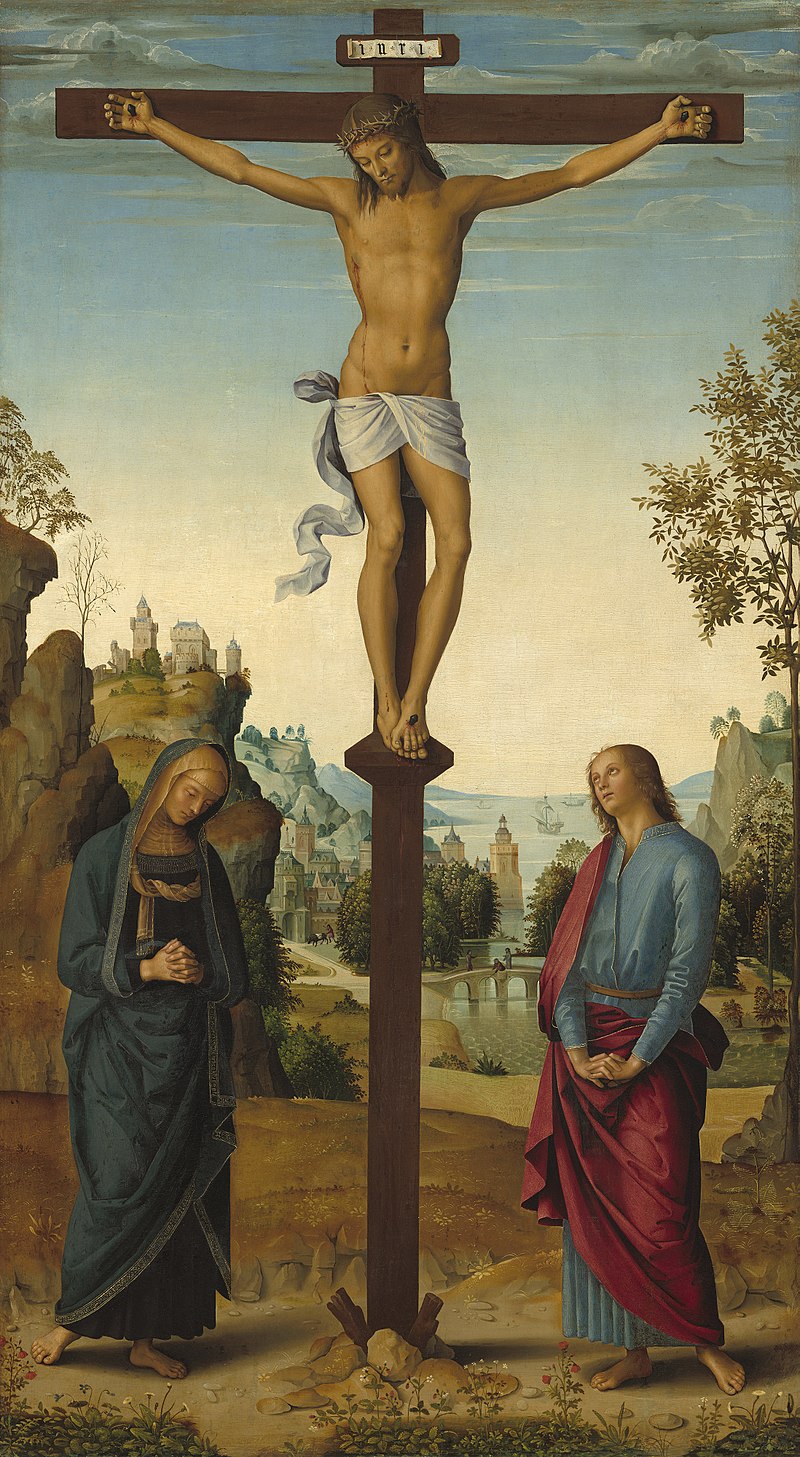
Pietro Perugino, The Crucifixion with the Virgin, Saint John, Saint Jerome, and Saint Mary Magdalene [middle panel], public domain, via Wikimedia Commons

Down to the Sea in Ships

On the final day of our Charleston odyssey we toured the USS Yorktown, an aircraft carrier dry-docked at Point Pleasant.  One of my uncles served on the Yorktown between the Korean and Vietnam wars and was able to show us around.  What really struck me, as often does with military matters, is just how advanced our engineering is when it comes to war.  The aircraft carrier was invented to meet a belligerent need: to convey aircraft close enough to other nations to support air strikes against “targets” there.  These targets consist of living, breathing human beings, at least in part.  But the technical problems, where I’d rather focus this post, were formidable.  How do you land a plane moving at 200 miles per hour on a moving ship with limited runway?  And how do you do it without tearing the plane apart from the sudden deceleration?

Carriers have steel cables stretched across the landing strip.  A tail hook on the plane, or later jet, would catch a cable, wound several times below deck to increase the ratio of force (as with a pulley), to add enough play to stop a plane without the forward motion tearing it apart.  Five cables stretched across the deck and the ideal was to catch the third one for an optimal landing.  Each landing (which could take place 30 seconds apart) was filmed and analyzed for improvements.  Listening to the technical nature of all this, and knowing that such things had been invented some eighty years ago, made me wonder, yet again, at how creative human beings are.  And made me ponder why so much of our creativity goes toward war machines.  Just think of the problems we could solve if we all worked together!  Instead, Putin covets Ukraine, Trump covets everything, and we fall in line behind them.

I’ve written on such topics before.  I took a self-tour of the USS Midway while in San Diego as part of a business trip back in 2014.  The tech there was perhaps a bit more advanced as this was a nuclear carrier.  Standing on this deck, however, thinking how this one ship costs more than I will earn with a lifetime of education and employment, leaves me a bit reflective.  Those who push for wars are often those on their knees praying for the second coming.  The rest of us, content with the first coming, think how the message of love and peace seems to have been swallowed by a whale.  But this ship is larger than any whale, and, I’m told, much, much more expensive.


Dental Dawn

Someone knowing my interest in religion and horror recommended Teeth.  A comedy horror film based on the concept of vagina dentata—an idea I first encountered in Neal Stephenson’s Snow Crash—it begins with a purity event.  Dawn, a teen leader in the abstinence movement, addresses other adolescents about the importance of maintaining, well, purity.  They all wear purity rings and vow themselves to chastity until marriage.  As might be expected, not all of them are able to uphold their pledges.  Being inexperienced, when Dawn finds herself in a compromised position with her boyfriend she learns she has, um, teeth.  Other guys, even when warned, can’t resist an opportunity and they too pay the price.  The point of the film seems to be female empowerment, but it’s also pretty funny.

After boyfriend number one has disappeared, Dawn again addresses the purity group only to have them quote Genesis 3 at her, clearly intimating that sin is the fault of women.  The Bible is there by implication and the sermonizing of the adult leader after Dawn has to leave the stage again takes up the religious outlook.  The underlying concept of purity movements is distinctly Christian.  While all religions have something to say about sex, generally the most negative about it is Christianity.  That’s not because other religions lack for spirituality, but Christianity tends to denigrate the body, and in the process tends to make natural things sinful.  This gives plenty of fuel to a movie like this where a woman has to make her own way in a man’s world.

What’s really interesting here is that no punches are pulled when it comes to the origins of patriarchy.  The Bible clearly views males as the standard of humanity and females as an adjunct.  That idea has had a death-grip on western society, particularly in America, from the beginning.  Teeth was written and directed by a man.  I suspect that the presumably well-intentioned use of an old mythical idea that makes females into monsters may not appeal to women writers or directors, empowering as it may be.  Nevertheless, if taken with the fun obviously intended from the opening playful music to the comically terrified responses of Dawn’s adolescent victims, the movie can still convey a positive message to women who might watch it.  Horror is often a repository of social commentary.  Not taken seriously by the mainstream, it nevertheless puts good messages out there.  And sometimes it bares its teeth.


Rocks and Philosophs

Porphyry is, apart from being a cool word, a kind of purplish stone that was prized for statue-making in antiquity.  It is also the name a Syrian philosopher gave himself in the third century of the Common Era.  Now, if you read widely about antiquity, as some of us have done, you’ll encounter the name Porphyry from time to time, but those of us who focused on older materials don’t pay him much mind.  I was reading about Porphyry recently, however, and did a little poking around to discover that he’d written a book called, in translation, Against the Christians.  Some historians speculate that Porphyry may have once been a Christian himself, but whether or not that’s true, he developed an antipathy to the sect.  I was curious about what his beef may have been only to discover that this book is lost.

Now lost works in antiquity are the rule rather than the exception.  Literacy may not have been widespread, but those who could write did write, and often prolifically.  Human history was very well documented.  But tonnes of it went missing.  Wars have been part of that history and wars are notorious for destroying written records.  Also, much writing was on perishable materials that, well, perished.  That wasn’t the case with Against the Christians, however.  Porphyry’s work was purposefully destroyed.  By this point Christianity had taken over the Roman Empire.  Rather than accepting the challenge of a philosopher, officials censored and destroyed his work.  Ironically, all that survives are quotes from books of theologians who were trying to refute him.

This made me reflect on the book bans that are currently all the rage among some “Christian” politicians.  Such rearguard actions belie the confidence that imperial religions showcase.  A religion that’s afraid others might see the holes raises many questions, does it not?  It seems to come down to the idea that nothing has changed in two millennia, even though Jesus didn’t have a cellphone—not even one of those old flip-open kind—and much of what we know of nature was still many centuries in the future.  The fact is that we only try to silence those who disagree when we fear them.  Book bans pretend that they can hold the hands of the clock still and that all will remain as it was decades ago.  Learning, however, is a genie let out of the bottle.  Back in Porphyry’s day powerful bishops and emperors ordered his book banned and destroyed.  And we are all the poorer for it.


Dials and Destinies

Indiana Jones and the Dial of Destiny didn’t do well in theaters.  I’m afraid that Indy fans, like Harrison Ford, may be aging out.  Although anthropologists are loathe to admit it, Indiana Jones was a boon for archaeology.  He made it cool, back in the eighties.  We’re four decades older now and for some of my generations, Indy’s still a draw.  The energy of Raiders and Final Crusade, however, has dissipated a bit.  I don’t watch trailers, so I learned that the eponymous Dial of Destiny was the Antikythera mechanism, curiously called “the Antikythera” in the film.  Or Archimedes’ Dial.  The film starts off with a religious artifact, the lance of Longinus, but it’s a fake.  The Dial, however, is real, if broken.  In order to make the Indy magic work they had to make a remarkable scientific device into something occult.

While I watched I thought about how the move away from religious artifacts into secular is a sign of our times.  The original trilogy involved Christian and Hindu symbols.  (It was only a couple years back that I realized Temple of Doom was set before Raiders, when Ford was young enough to pull that off.)  Crystal Skull was a mix of religious and secular.  We don’t know, historically, what the crystal skulls were for, but clearly they could have had religious significance.  The film spun them all widdershins into paranormal playthings.  The Dial, as it’s called, has no religious implications at all in the current film.  The 1960s Nazis want to travel back in time, which is what the Antikythera, we’re told, predicts (letting interested parties know the time and place of time fissures).  A Hitler wannabe plans to do World War II right, so that Germany wins.  They end back at Archimedes’ time, however, and the world is saved.

As I’ve noted with other pop culture franchises, when a series begins with a religion plot and then drops it, things start to unravel.  I suspect many screenwriters and directors underestimate the power of religion for generating compelling stories.  Belief changes things.  Dial of Destiny demonstrates that substitutes really don’t engage viewers to the same level.  This is a perfectly serviceable Indiana Jones movie.  Lots of adventure and PG 13-level violence.  Getting the girl may not have the same urgency with an octogenarian archaeologist, and Helena seems undecided what she wants, in any case.  What’s really missing, however, is the pizazz that religion brings to stories of finding ancient artifacts.  Archaeology, embarrassingly for some, began in West Asia for religious reasons.  Acknowledging that is simply staying true to history.


Cabin Stories

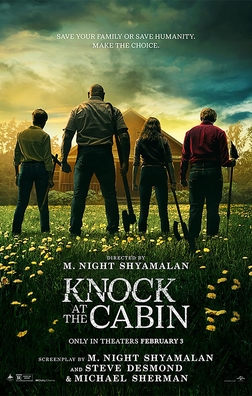
Almost always I come out on the same side of the debate.  The book is better than the movie.  The book allows things to be explained more fully and is the way the story is “supposed to go.”  Maybe it’s because I found the novel open-ended and I like closure, but M. Night Shyamalan’s Knock at the Cabin, in my humble opinion, is better than The Cabin at the End of the World by Paul Tremblay.  Now, the author’s title is better, but Shyamalan’s explanation is clearer.  In short, I think the movie works better.  If you’re not familiar with the story, four apocalypticists, responding to visions they’ve had, break into an isolated cabin occupied by a vacationing family of two daddies and an adopted daughter.  Shyamalan characteristically shifts the cabin’s location to Pennsylvania and, yes, before you think it’s all Philadelphia, there are some very isolated places in my home state.

These weaponized apocalypticists subdue the family and inform them that unless they decide which one will be sacrificed, and then carry out the deed, the world will end the next day.  The adult couple tries to explain rationally how crazy this all is.  How could four people be given this hidden knowledge and be tasked with saving the entire world?  It seems more likely that they’ve targeted a gay couple and are trying to break up their family.  One of the things the movie makes explicit that the book doesn’t is that the intruders are correct.  This is the end of the world.  In order to achieve this, Shyamalan had to rewrite the ending to remove the ambiguity.  For some of us, that really helps.

The movie, in a way that a brief blog post can’t replicate, includes quite a bit of dialogue about religion.  Religion and horror are often bedfellows, and this is one of those movies that relies on religion to fuel the fear.  Interestingly, the cabin invaders aren’t stereotypical conservative Christians.  In fact, they appear to be mostly secular everyday people who have come together around a vision that they all had in common.  In the novel there’s always some question whether this is an elaborate hoax whereas the movie makes it clear that the death of each individual apocalypticist unleashes a plague.  Indeed, they are, as the couple finally realizes, the four horsemen of the apocalypse.  Since I’m still here to tell you about it, the end of the world has obviously been avoided.  This movie is worth seeing, even if the novel has a better title.