Fishers of Cars

The car was drunkenly weaving across lanes in substantial traffic along Interstate 80. Erratic driving that, although not breathalyzer confirmed, suggested impaired operating. It’s something you never like to see. We stayed behind the vehicle, knowing that it was safer to keep such a car in view rather than attempting to overtake it when the driver veered into the left lane. Since the same muted colors recur on vehicles these days, we needed a quick way to identify this driver at a glance. The Jesus fish on the rear served the purpose well. This situation struck me as a kind of parable, although it really did happen. One of my brothers is a driver by profession. He often tells me that if someone cuts him off in heavy New Jersey traffic, more often than not the car bears a Jesus fish. WWFD?

The ostensible purpose of the Jesus fish is to witness to the world “here is what a true Christian does.” While the New Testament, if I recall, indicates that the true believer puts others before him or herself, the rule of the road is somewhat less spiritual than that. None of us are saints when we get behind the wheel. We’ve got places to go and the drive isn’t really much fun with thousands of other cars bunging things up constantly. Still, if you take the extra effort to put that Jesus fish on your car, aren’t you signaling that this driver holds her or himself to a higher standard? Or maybe the fish is a talisman, like “Baby on Board,” that will somehow protect from the careless, aggressive driver thinking only of self.

The irony here is not that the driver is making poor, or aggressive decisions behind the wheel—let the one without sin cast the first stone—but rather that s/he implicates Jesus in the act. There’s a ready, steady market in evangelical paraphernalia. The WWJD bracelet keeps the question within sight much of the time—but keep your eyes on the road! One of the main problems with the Ichthys symbol is that it is generally on the rump of your car. Out of sight, out of mind. As you finish that last drink before climbing in behind the wheel, the fact that your personal Lord and Savior is being announced to the world may just slip your sodden mind momentarily. The real question is whether a car is the best place to announce your religious commitments. It was the the man in front of the fish, after all, who said “do unto others as you would have others do unto you.” Except in heavy traffic, of course.
Scaping By

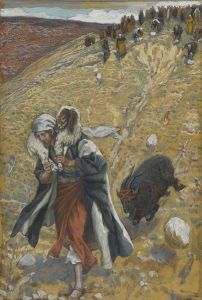
Failure is a part of life. We don’t like stories about failure, however, unless the protagonist goes out with a memorable bang. So it is that when we fail we start looking for a scapegoat. Now it’s a little too early to tell if Ken Ham’s Ark Encounter can be considered a failure. According to a story on Friendly Atheist, “Ken Ham is Now Blaming Atheists for the Economic Failures of Ark Encounter,” the ark may be loaded with dinosaurs, but not money. People need their myths, yes, but myths that take themselves too seriously often fail to convince. Atheists, even the friendly variety, have always been convenient scapegoats. I wonder how many scapegoat species are in the Ark Encounter.

I don’t know about you, but I’m curious about the Ark Encounter. I don’t want to go because I don’t want them to have any of my money. As I’ve told academic friends who visit—I just can’t see contributing to their cause. Although the Right seems to implode when it reaches power (there are far too many selfish people in the Party, and selfishness leads to easy splintering) one thing that it has is money. Think about it, the extremely wealthy are on their side. If I was given a free pass I might find it worth my while to wend my way back down to Kentucky. Who doesn’t like a spectacle? And I would like to see how they represent scapegoats in their dioramas. Besides, with sea levels rising from “fictional” global warming it might not be a bad idea to get a few tips on how to build an ark, no matter what you believe.

You only fail when you fail to try. That was a phrase a friend used to repeat to me before disappearing from my life. A friend from college once told me that I had to stop admitting my failures if I wanted to move ahead in life. There is a danger in easy appearances of success, however. Failure can be a very noble teacher. There are mornings when I’m walking across Manhattan, passing the homeless in their blankets on the street, and I realize that I would not be where I am were it not for failures. I could hide them, but if I haven’t learned from them they’ll only burst out of the closet again when it gets too full. Is Ken Ham’s Ark Encounter a failure? It’s far too early to tell. One thing we know for sure, however, is that scapegoats will never be an endangered species even if there’s a world-wide flood.

James Tissot,Agnus-Dei: The Scapegoat (Brooklyn Museum via Wikimedia Commons)


The Birds

While waiting for the bus, now that it’s light out that early, I like watching the birds. They have complex interactions and so many different styles of flying. They have ways that are a closed book to our species. From human eyes they seem so playful that it’s difficult to believe they participate in a struggle for survival. Evolution tells a different story, of course. Living not far from the great human nest of Newark’s Liberty Airport, it’s not unusual to see an engineered flying machine soaring high over their avian heads. Which, I wonder, are the better fliers? Birds, after all, evolved. Flying wasn’t planned, as far as we can tell. Although not so much around here, some birds don’t even fly.

I once read—many years ago and I can’t recall where—that if a person were to fly they would need an enormous chest to beat the very large wings they’d need for lift-off. Birds, apart from being naturally aerodynamic, have hollow bones which make them a touch fragile, but less tied to gravity. Our planes and jets, unlike the escape vehicle in Chicken Run, don’t flap. Bernoulli’s law keeps them aloft, along with some meticulous engineering and heavy fuel consumption. Humans may imitate nature, but they supersede it when they can. Still, I have to wonder why, if birds were a special creation as our literalist friends claim, God didn’t make them more like a plane.

Holding your wings out stiff all day, I’ll allow, would get pretty tiresome. Still, if you’re designing a critter to fly you might as well go with the best parts available, right? If not, I’m going to have a talk with my mechanic and ask for some of my money back. Birds, for all their charm, are very good illustrations of evolution at work. Dinosaurs taking to the air is so poetic that it has an organic feel. Flying is a great way to escape your land-bound predators. That step from long leaping to flying may be a doozie, but it seems to explain the shape of birds better than any intelligent design. Among bipeds, though, only one claims the place of being god-like in shape. Having said that, there are some flaws that a good biomechanical engineer might address. But then, who said God majored in engineering? When I went to college I was firmly under the impression that he’d majored in religion. And that, as many engineers might suppose, is for the birds.


Keeping Pace

I had no idea my life was in danger. I was out for a weekend walk with my wife, when suddenly, there they were. Snails. In case you think I’m over-reacting, take a look at Christopher Jobson’s piece on Colossal titled “Why Knights Fought Snails in the Margins of Medieval Books.” One of the main points is that the snails were symbols. We tend to forget the power of symbols today. Even modern vampires no longer react to crucifixes—what are we supposed to do? For those who are willing to linger a moment instead of rushing on immediately to the next thing, snails give us quite a bit to contemplate. In a world that hates slow-pokes, “consider,” as my friend Ecclesiastes might’ve said, “the snail.”

As highly evolved cousins of the snail, we suppose we were cut out for greater things. We build towers. We make new nations. We watch them both crumble. On the ruins of those walls we find snails. They have very little to do and expend no worries about getting there on time. Nobody emulates them, although some masticate them. They tend to disappear when the sun is hot. They don’t like the limelight. Yet snails contribute to our world in ways we simply don’t take the time to contemplate. Our time has been commodified. We’re told when to sleep and when to wake for our jobs. Then we’re told none of it matters anymore since 45 has decided to change the rules with his latest tweet. And still the snails crawl.

Before I learned to fear them, I remember happy childhood moments finding snails. This was generally not at home since we rented even then, and landlords have a weird compulsion about landscaping. When wandering far enough from home I’d find snails crawling on stalks of damp grasses early in the morning. They fascinated me. If I plucked them off, they’d pull in their eye-stalks and retreat into their shells. So secure. So symbolic. Eventually I learned that I was obligated to move fast. Keep pace. Be measured by my productivity. Pharaoh’s watching, after all, and that quantity of bricks required isn’t getting any smaller. Not many, I would learn, share my appreciation of snails. It takes a great deal of confidence to go slowly. Those who routinely ignore speed limits won’t understand my symbolism here, I know. Still, I can’t help but think we have a great deal to learn from our cousins who remind us that time isn’t everything after all.


Light and Dark

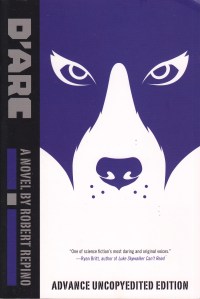
Prophets, mothers, messiahs. A new religion for a new world. While these may not be main themes of Robert Repino’s new novel D’Arc, they’re clearly there in the background offering verisimilitude to a world turned upside down. Continuing the diegesis created in his previous two novels Mort(e) and Culdesac, Repino again shows an uncommon awareness that when survival becomes difficult people (and animals) turn to religion. Many fiction writers create worlds under stress and pretend that characters simply forget the religious option. That may be realistic on an individual level, but as history shows, not on a societal one. People—and mutated animals—are meaning-seeking beings. D’Arc doesn’t shy away from this fact. In a wildly integrated world of different species coping with consciousness and opposable thumbs in various ways, religion naturally arises.

If you haven’t been initiated into Repino’s universe, it begins with a virus and/or a plot—themselves religious—which allow animals to become bipedal and to grow human hands. They can talk and reason and they show us a true reflection of who we are. D’Arc, the female companion of Mort(e), finds her way in a world under threat. Planning to speed up global warming in a dramatic way, the aquatic antagonists conspire to melt the ice caps to flood the entire world. Repino knows the value of the flood story and uses it to full advantage. Along the way we meet beavers who’ve developed a religion that functions between water and dry land. Indeed, as a species their religion defines them as much as their engineering skills. This is a world that’s just been through war and instead of reconciling all species, there remain those (most notably humans) who can only live with their own superiority. This is a complex universe.

The hero of this tale, D’Arc, is sympathetic to the religious sensibilities that have sprung up around her. She herself is a character prophesied in this world where Mort(e) is messianic. There’s a scripture in the background somewhere and theirs is a world without embarrassment about it. There’s also plenty of action and adventure—the war with no name is really not over—but there’s a subtlety to the narrative as well. When things go awry many people do assume they’re alone in the universe and try to find their own way. It’s equally true that many look for meaning in a structured form of belief where all of this has been foretold. Such worlds, to me, seem to be more honest to the human condition, even when the characters are cast as talking animals.


Human Omniscience

This might take some thought, but please bear with me. I’ve been reading about how some scientists are eager to promote rationality only as the true understanding of the universe. The flaws in this logic are immense. The greatest gaff here is assuming that evolved biological creatures with only five senses have come to comprehend the vastness of a universe in which we matter very, very, very, (and some scientific notation may be helpful here) very little. And we assume that’s all there is to know. Consider that when you want to spot the Pleiades in the nighttime sky, the best way to do it is not to look directly at the constellation. Our rods, which are far more sensitive than our cones, are not concentrated in the center of our field of vision. That means, in some circumstances, you see something better by looking slightly away from it. Don’t take my word for it, test it yourself on a clear night.

We also know that some animals have senses that we don’t. When’s the last time you picked up the earth’s magnetic field? We know it’s there and we know that some animals sense it. We don’t. Or consider the ant. If ants make you itchy, any hive mind will do. There are creatures right here on earth that think collectively, not as individuals. As humans we’ve evolved to think that our limited experience tells us everything there possibly is to know about truth. We don’t know how living under water influences perceptions because we can’t do it. No, we’re a race of surface dwellers. (There’s a metaphor there for those of you who believe in such things.) We’ve learned some basic laws of physics and suddenly we preside over the courtroom of the universe since our evolved logic is the only and the best the cosmos has to offer.

Evolution, however, also made us religious. If logic is at all what it seems we have to admit that study after study has shown the benefits of religious belief to the beleaguered human psyche. If we try to measure it empirically it crumbles in our fingers. Only logic would tell us simply to ignore it then. I’m no enemy of reason. It’s the best way we have of getting along in this world. I love science and support its evidence-based health. It’s just that as I’m standing here in the dark wondering where the seven sisters are, I sometimes have to trust my rods instead of focusing on what I can see plainly with my everyday sight. Logic tells me there are other things outside my sensory range as well.

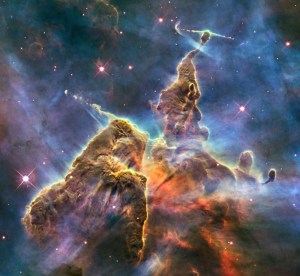
Photo credit: NASA


An Elephant’s 100 Percent

When I walked out of that dissertation defense, still a little unsure whether I’d passed or not, I thought my testing days were over. My early memories of struggling with exams—I wrote that a sphere was a kind of weapon on one vocabulary test I recall—made me anxious for an end of the process. Hadn’t I proved myself time and time and time again? People are funny that way. We’re suspicious of those who pass. Are they really as smart as that, or have they learned to game the system? (Admittedly, with what’s going on in Washington these days doubts about intelligence have definitely earned their keep.) Tests, however, have become less common these days, at least in the fearful exam room context. Now we’re giving them to animals.

It has long been clear to me that animals are quite intelligent. When that mouse, cat, squirrel, or robin pauses in front of you, looks you in the eye, then decides its course of action, it’s clearly thinking. Of course, some animals are more on the GOP scale of intelligence, such as deer that bolt out in front of cars, while others—ironically including elephants—show up 45 in tests we assign. An article in The Independent describes how elephants are far smarter than we’ve given them credit for being. Jealousy, perhaps, makes the elephant’s own party withdraw protections from endangered species. We’ve got to be sure nobody shows us up. At least not while we’re on camera.

Animals have greater thinking abilities than we’ve been willing to admit. For being so highly evolved, we’re an awfully petty species. We don’t want to share our great accomplishments with others. We’ll call the amazing architecture of the bowerbird “instinct” rather than admit they can build homes better than many in the Appalachians can. We’ll kick over anthills rather than face the fact that a hive mind is a terrible thing to waste. We’ve known for decades, if not more, that all life is interconnected. Because we’ve got opposable thumbs and reasonable cranial capacity, we’re the best thing this planet could hope to evolve, so we tell ourselves. What has made us so insecure? Why do we find the prospect of animal intelligence so frightening? It’s terribly hard to give up the role of being lord and master, I guess. Or if we were to switch it to a classroom analogy, we always want to be the teacher, never the student. But after walking out of that dissertation defense twenty-five years ago I learned that the testing had only begun.


Dog Daze

I read quite a bit about animals. One reason is that when you’re counting all the species on the planet we’re pretty clearly among the animal part. Having grown up with many pets, the dogs particularly stand out. We tended to have only one dog at a time and they were so full of personality that it obviously wasn’t a matter of projecting to understand that one was more or less optimistic or joyful than another. Some could be mean while others were loving. There was quite a bit of buzz about W. Bruce Cameron’s A Dog’s Purpose back in January. For Modern Mrs. Darcy’s 2017 Reading Challenge the book fit one of the categories for me, and so I found myself reading about animals again. The thing about buzz is that I listen with only half an ear. I didn’t know much about the book except that it was a novel narrated from a dog’s point of view.

A couple of things struck me as I got into the story. One was that the protagonist ended up still believing that humans were more important than dogs. I suppose there’s some kind of evidence for that, from a dog’s viewpoint, but it doesn’t seem very strong to me. After all, we’ve bred wolves into pugs and cockapoos with an intentionality that even Mr. Darwin would’ve recognized as unnatural selection. Left to their own wolves would’ve adapted, but they’re pack animals and while dogs may think us the alphas, they’re each an important part of the group. They are giving, but that’s the nature of being in a pack. It’s also something that elected officials in Washington could stand to learn. When there aren’t rifles and traps, pack animals prosper.

The second thing that stood out about A Dog’s Purpose was reincarnation. The idea scares me. Life’s been a long challenge this time around and, unlike Nietzsche I’m not sure I could face it this exact way again. In any case, reincarnation only works if there are souls to pull it off. Cameron posits that for Toby to become a fully developed Buddy four cycles of reincarnation are needed. Like a good Platonist, our protagonist recalls the important lessons from each previous life and is able to develop into a more fulfilled dog each time around. The karma here is good. Cameron does seem to “get it” from a human-projected dog’s point of view. It can be fun, and it can be sad. The important lesson, for me, is that animals are who we are and to be a successful pack we need to look out for the good of each other.


Animal Fights

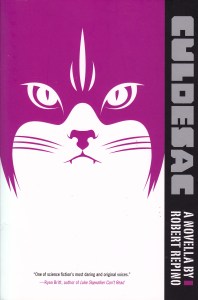
What does it mean to be human? The answer’s not as straightforward as it might seem. Reading Robert Repino’s Culdesac, that question came back to me time and again. This novella takes off from the story of Mort(e), about which I blogged shortly after its publication. Humans and animals that have acquired some human characteristics are at war. Most see those on the other side as inferior and that can make a human being reading the tale just a touch uncomfortable. We don’t have a great track record when it comes to dealing with non-human animals. We are all, after all, members of the same “kingdom.” Even down to the level of phylum and genus many of us show more general similarity than stark differences. Culdesac is a morphed bobcat who remembers all too well how humans treated animals before the war. And memory is a powerful thing.

Repino has a way of sweeping the human reader (here the enemy) into the story and making those foundational questions ring as if struck with a hammer. What does it mean to be human? Granted, reading such provocative work under the current administration adds a layer of poignancy that wasn’t there when Mort(e) stood alone. In fact, it is a question that we have to ask just about every day when we see the headlines. There’s no leadership on this point coming from above. The idea of other humans as chattels has a long and disgraceful history. You can differentiate anyone on some basis or another: female or male or intersex, black or white or brown, rich or middle class or poor, large or average or small. Differences working together might be the very definition of culture. Culdesac shows what can happen when one sees only the distinguishing characteristics rather than the commonalities. It’s a parable.

Education, the one weapon in our arsenal that actually dismantles prejudice and intolerance, was one of the first targets our government sought to dismantle after 11/9. Indeed, the antipathy—if not downright hostility—toward education has been a characteristic of which Americans have long been unduly proud. We are not self-made, none of us. We all had our teachers. We all had our books. As we stand on the rim of this smoking crater and wonder how hatred toward one’s own species could be allowed to be nominated, let alone win, I believe the answer lies in our personal belief in education. We must all use the opportunities we have to educate. Get caught reading a book. Or helping a stranger. Or just being kind. As Culdesac emphasizes, wars are long-term events. Results won’t change after only one skirmish. If we all valued education—reading, learning—enough such aberrations as this could never happen. If you’re casting about for something to read that will make you ponder things at a most human level, I would suggest Culdesac.


All There Is To Know

I’m sorry, I didn’t mean to be rude but I just had to laugh. A friend sent me an article from Science Alert titled “A Physicist Just Explained Why the Large Hadron Collider Disproves the Existence of Ghosts.” Intrigued, I read, “there’s no room in the Standard Model of Physics for a substance or medium that can carry on our information after death, and yet go undetected in the Large Hadron Collider.” One of the reasons, I believe, science has trouble among hoi polloi is such arrogant statements as this. I don’t know about ghosts, and for a very good reason. There is no experimental way to test for that which doesn’t exist in the material world. The LHC may tell us all we can know about the world that we perceive (although I doubt it) but it can’t tell us about that for which there is no measure (e.g., consciousness). I don’t mean to get all complex here, but let’s stop and think about this for a moment.

What we know of the universe is what we can perceive and extrapolate from that perception by reason. We, however, don’t perceive everything. Our five senses evolved for one purpose and one purpose only—to survive in this particular environment. That’s a trait, hate to admit it as much as we might, that we share with other animals. It helps to be able to see, hear, touch, taste, and smell things clearly. These traits give us valuable information about the world around us—is that plant poisonous? Is this heat going to kill me? Should I avoid approaching that large, angry-looking bear? Things like that. What our senses don’t tell us is the aspects we didn’t evolve to perceive. We understand everything about nothing. Put another way there is nothing that we understand completely. Entire books can be written about the concept of zero and that’s just an abstract. We only experience a small piece of this universe.

That’s the problem with being in the backwater of the galaxy. I grew up in a backwater so I know what I’m talking about. Things might be different if we lived near the galactic hub, where beings with different senses may well exist. We know, for example, that even on our planet some animals perceive magnetic fields. Who knows what kinds of abilities might have evolved on worlds that posed different challenges to survival than our own? Who are we to say that here in our basement on earth we have a machine that can uncover every possible permutation of anything in the known universe? I don’t know about ghosts, but, I suspect, they’re laughing too.


Excarnation

To those raised in the Christian tradition incarnation is a familiar concept. The idea, more complex than it sounds, is that God becomes human. In a world of DNA and general disbelief in anything non-physical, it boggles the mind how disincarnate “matter” (for lack of a better word) might bond with the double-helix in order to create something new. Since science can’t explain such things spiritual, believers have long hung the cloak of mystery here and passed on to more practical matters. But what about excarnation? It’s actually not the opposite of theological incarnation, but it does involve spiritual practice. A friend sent me an article on Vintage News (much better than fake news, in my humble opinion) titled “The Towers of Silence: Ancient reminders of an eerie Zoroastrian burial ritual.” This was a nice find because I’ve been reading about the Zoroastrians again recently, and if ever there’s been a case of an important religion going underground, their’s is it.

I don’t mean to sound patronizing about it, but Zoroastrianism has been one influential religion. Having roots in the world between Vedic and Semitic religions, it had an impact on both. In my teaching days when I covered Zoroastrianism my Hindu students remarked on how similar the concepts were to their tradition. More reluctant were those of the Judeo-Christo-Islamic side to see that key concepts such as Heaven, Hell, the Devil, and Armageddon have their ultimate roots in the dualism that Zoroastrianism put on offer. Thus spake Zarathustra. We know very little about this founder of the religion. We do know that he set out to create a “systematic theology” that explained the world he saw. The result has changed the world many times over.

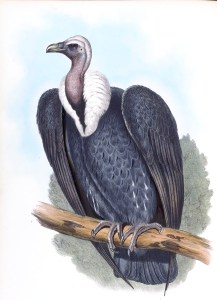
Those of you drawn in by catchy titles may be wondering what excarnation has to do with it. Believing dead bodies to be inherently corrupt, burial wasn’t the best Zoroastrian option since it only polluted the ground. The response was the ultimate in up-cycling—expose dead bodies until the vultures eat all the polluting flesh and then handle the dry bones afterward. This practice is arguably the most natural way of disposing of human remains, but it’s distasteful to many people. Who wants to be eaten? Unless, of course, you’re a believer in incarnation. For in that tradition God incarnate told his followers to eat his body and drink his blood. The more squeamish have done what religions have always excelled at—they turned earthy reality into a metaphor. Even vultures have to eat.

Image credit: John Gould, HC Richter, Wikimedia Commons

Image credit: John Gould, HC Richter, Wikimedia Commons


Lunar New Years

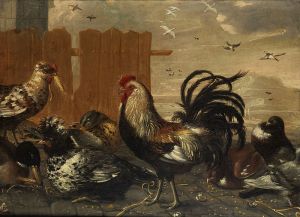
Celebrating the New Year in the middle of winter is a strange idea, at first glance. As I have discussed before, January 1 is “Circumcision-style New Year,” based on the projected date of Jesus’ circumcision after the church had settled on December 25 as his birthday. In actuality, a winter New Year date is due to its proximity to the winter solstice, and the other popular contenders for the honor of the head of the year, historically, have been the spring and autumnal equinoxes. The matter gets more complicated when a culture has a lunar calendar since the sun and moon don’t see eye-to-eye when it comes to their timing. That accounts, obviously, for a shortened February, but also for why a full moon doesn’t occur on the same day of each month. Now, I know little of Chinese culture, but I do know that Chinese New Year fell on January 28 this year, initiating the year of the rooster. Considering what had happened only eight days prior, this feels incredibly apt to me.

800px-hahn_im_huhnerhof_flamisch_17jh

Cultural diversity is a wonderful thing, and this nation is rich in it. You can, to pick a trite example, sample cuisines from around the world in a moderately sized town. Here in New Jersey getting onto a public transit bus will almost guarantee that you’ll hear at least one non-English conversation going on. Nevertheless I do have to confess that I don’t know what the year of the rooster represents in a Chinese context. As concepts cross borders they take on new associations and those who assign those new associations don’t represent those from the original land. So let it be here. Not knowing what the rooster symbolizes in China, I turn to its American expression—the cock. This is its year. The newspaper headlines read like a fortune cookie, in this distorted view of things.

To shift this metaphor to yet another cultural context—originally Jewish, but now appropriated by Christians around the world—think of Passover. For Jesus a night of betrayal. Peter, arguably Jesus’ best friend, denied three times in one night that he even knew his BFF. Cursing and swearing, according to the Gospels, he said, “I don’t know that man.” The cock crowed. It was around the spring equinox. A new year had begun. Within 24 hours, according to the story, Jesus was dead. We have much to learn from other cultures. The concepts change, however, when they’re stopped at the border.


Animal Ways

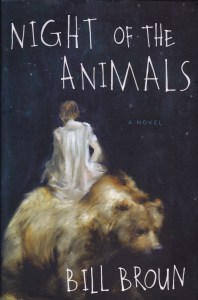
nightofanimalsNoah’s Ark has a way of showing up in many literary forms. Familiar to many from Genesis, it actually predates the Good Book by hundreds of years. On the backside, it keeps recurring in literature as diverse as Neal Stephenson’s Snow Crash, Jonathan Carroll’s The Ghost in Love, and Margaret Atwood’s MaddAddam trilogy. It also shows up in Bill Broun’s debut novel Night of the Animals. Set in a future that’s becoming present faster than Broun likely anticipated, the story revolves around an addict who hears animal voices. The story stubbornly refuses to let you get any grip on a slippery reality, so the reader’s left guessing even at the end. In the 2050s Britain is under a fascist regime that seeks to keep the wealthy happy and everyone else servile. (Keep reminding yourself this was written before 11/9.)

Cuthbert, the protagonist, believes the animals—most of which are extinct in the wild—are calling him to release them from the London zoo. As an addict his perception of reality is constantly in question. His sense of mission, however, is not. One of the stranger elements in the tale (and that’s saying something!) is the revival of Heaven’s Gate. This cult, instead of wiping itself out, has gone international. The approach of a comet sets the Neuters (as they’re called) on a mission to wipe out earth’s remaining animals. Many of them are in the London zoo, which brings Heaven’s Gate into direct conflict with Cuthbert, who is busy trying to release as many talking animals as possible. London literally becomes a zoo and Heaven’s Gate openly attempts a coup.

All of this sounds wild and fantasy-prone, but like 1984, fiction sometimes peers deeper into reality than science. Is it science fiction? It’s set in the future, but it’s difficult to say. What has all this to do with Noah’s Ark? The novel itself draws the parallel—the zoo that preserves the last of their kind is, by default, an ark. The Ark. Floating on a world-ocean of irrational turmoil where might (read wealth) makes right after all. Religious imagery interlards the story. Cuthbert becomes St. Cuthbert. His possible granddaughter (the reader is never sure) manifests as the Christ of the Otters. There’s even a kind of Second Coming. This is a novel that feels like altered reality. That illusion is given the lie when you close the book and turn on the news.


Elephants and Snakes

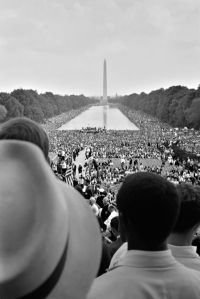
I try to be a good son. As good as you can when living a few hundred miles from home. I call my Mom every week and when the mood’s right, we reminisce. During a recent conversation I was recollecting my first trip to Washington, DC. My grandmother, who lived with us, had been born there and wanted to see it again before she died. I don’t remember much about the trip. I would have been maybe 5 or 6, possibly 7. The Washington Monument I remember because I was terrified of heights and didn’t want to go up. The sharpest memory, however, involves the motel.

We didn’t have much money and very, very rarely stayed at motels. In fact, this is the only time I remember it happening before I went to college. It was one of those cheap places where you park right outside the door to your room. In the morning, bright and sunny as only childhood mornings can be, I remember racing around the oval, gravel drive with my brothers. We had our favorite stuffed animals with us. Mine, ironically, was an elephant. I remember that elephant well. I remember running with him under my arm and laughing and having one of the most carefree moments of my entire life. Now I think of elephants in Washington, DC and the magic is gone. We never had much money when I was growing up, but my other favorite stuffed animal was a long, black snake. It was as long as I was tall and I loved the fact that snake and my name began with the same letter. I loved him so much that his eyes came off and my mother sewed large purple buttons in their place. At that time I had no concept of how apt the symbolism might be.

400px-march_on_washington_edit

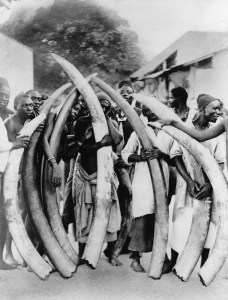
The snake and the elephant are two of the most feared creatures on land. (There is a bit of symbolism here, so please don’t be too literal.) In the biblical world the serpent can stand for good but more often it represents temptation, danger, and treachery. I loved that snake as much as I feared its real-life counterparts. And now I find myself headed to DC again. I’ll shortly be on the train to join the Women’s March, my first official protest. I don’t know that I’ll have internet access the next couple of days (I hear Washington’s a swamp) so I may not post again until the work week starts. This time I’m not taking either elephant or snake. They exist already in abundance in our nation’s capital.


Twice Bitten

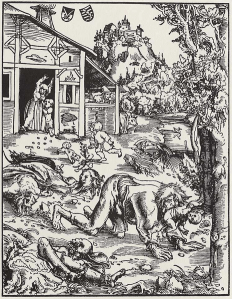
I should be aware of what happens next. I’ve seen it in movies often enough. Man gets bitten by a wolf, and he turns into a werewolf at the full moon. That gives me two days. And it wasn’t a wolf, but a pit bull. I fear what I might become. You have to understand that after a long commute—they’re doing construction along a stretch of a major artery where my route passes—and having been awake since 3:30 (a.m.) when I get off the bus I’m not always thinking clearly. I’ve done some calculating and it turns out that apart from work, commute, and sleep (or at least trying to sleep) I’m left with three and a half hours per day to do my own stuff, like write these blog posts, eat breakfast and supper, and pay bills. So when I get off the bus for my short walk home, my main concern is getting across a busy street where New Jersey drivers routinely ignore the state law that they must stop for pedestrians in a cross walk. But last night the dogs were out.

The sidewalks in my town are narrow. Nine days out of ten I meet no one on my way home. There’s one guy with a tiny dog that’s feisty and it is amusing how the little guy—just a puppy—growls and barks its tiny barks and strains to get at me. Dog owners around here pull their dogs off the sidewalk to let walkers pass. It’s a friendly town that way. Last night the young woman was no match for the two pit bulls she was walking. The street was unusually busy since two guys had just walked past me, one, commenting on the dogs, said “I don’t take my beasts out any more.” The woman pulled the dogs off the walk and they barked and snapped and as I walked past one lunged and bit me. Tore a good pair of pants. The woman they owned was aghast and offered to pay. I didn’t want her to know how cheap my clothes were. Besides, I couldn’t hear her over all the barking.

It’s been years since I’ve been bitten by a dog. This was really just a scratch and the frantic woman assured me the dogs had had their shots. But I’ve seen the movies. I know what happens next. Two nights from now I’ll be roaming the streets after dark, half human, half dog. The Hunter Moon (the official name for October’s full moon) comes on Sunday. I can’t blame the dog—it was only doing what aggressive dogs are bred to do. My commute, however, has a new hazard. Not only do we deal with construction zones, I now have to arouse myself to watch out for werewolves on the way home. It must be October.

Me, in two days.

Me, in two days.