
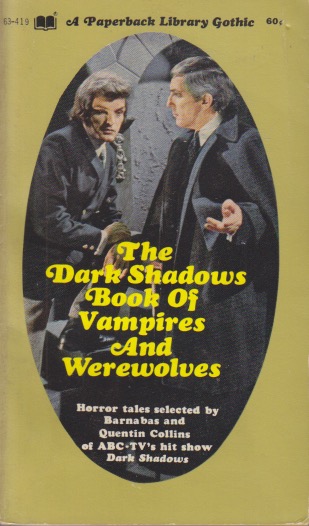
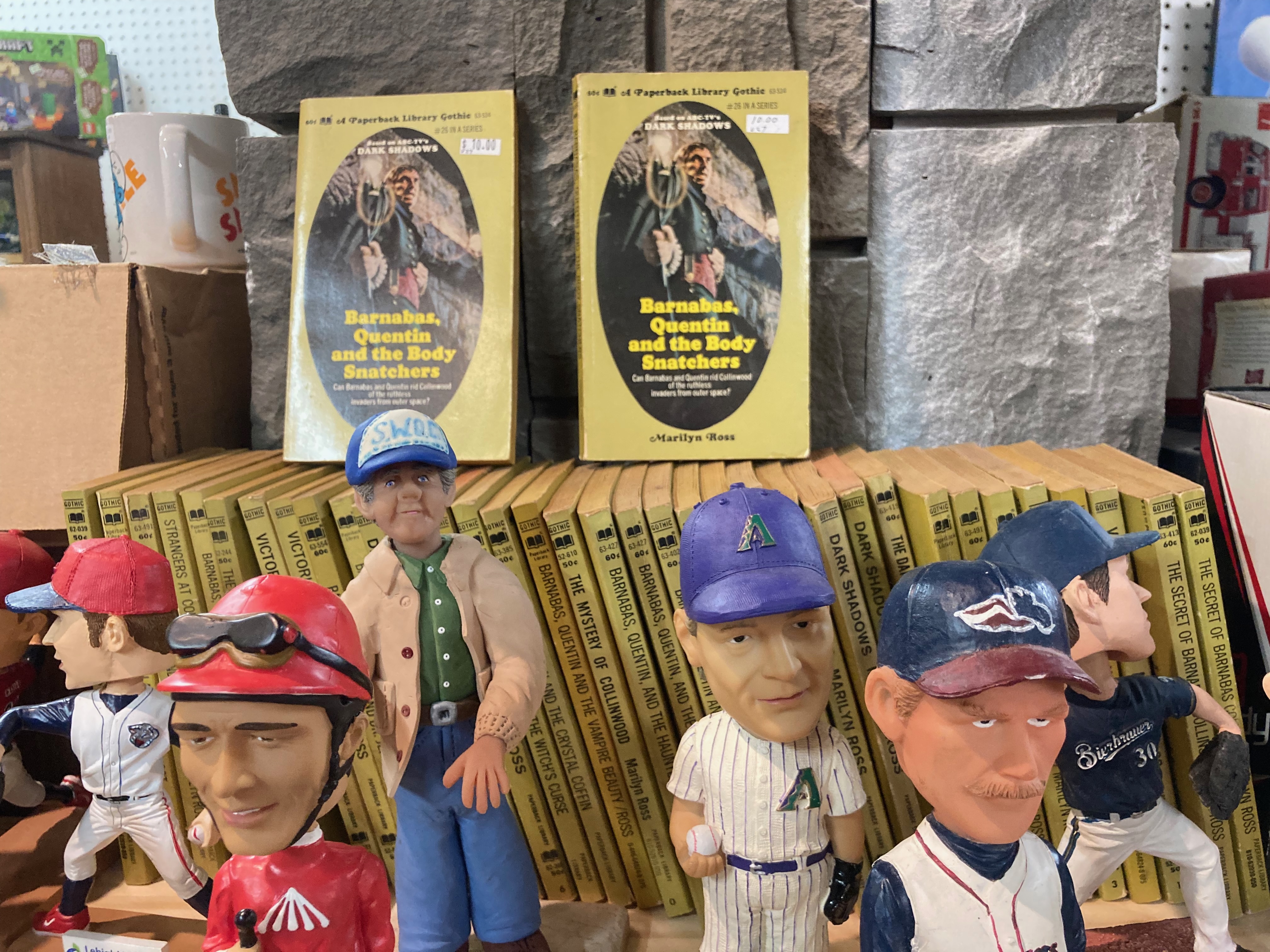
On a recent diversion to a curio shop we like, I found that one of the “Dark Shadows” paperbacks they had was one I hadn’t read. Dark Shadows had, of course, spurred a pretty amazing franchise for its day. It’d sunk its fangs into many young people who would not have otherwise been inclined towards soap operas. I’ve written several times about the spin-off books by Marilyn Ross. That series encompasses much of my childhood. This particular book was a knock-off with the same branding titled The Dark Shadows Book of Vampires and Werewolves. Now, to be fair, the asking price was about the same as a trade paperback price today—a little less, even—and the collection included, I saw at a glance, Polidori’s “The Vampyre.” So now it sits on my shelf next to the other Dark Shadows books. Apart from the gimmick of listing the book as edited by Barnabas and Quentin Collins, it is actually a nice period piece.
In addition to Polidori, eight stories I’d never read. Two of them make the claim of being non-fiction, and a third maybe. The tales, which favor vampires over werewolves, also include what are some little gems. One is a story by M. R. James (“Count Magnus”). Other noteworthy members are “Wolves Don’t Cry” by Bruce Elliott and “The Vampire Nemesis” by “Dolly.” “For the Blood is the Life,” by F. Marion Crawford, is also good. In other words, the collection was better than I suspected it would be. I’d not read any of these before, so they were all new to me. I was particularly intrigued by “Dolly.” Apparently the author of The Vampire Nemesis and Other Weird Tales of the China Coast has remained anonymous since its 1905 publication. The book has been rediscovered in modern times, and I’m now curious about it.
Although I like to think myself immune, I am sometimes susceptible to branding. For whatever reason, that olive-green oval-cutout cover design, when spotted in the wild, makes me ecstatic. My childhood wasn’t ideal, and I remember when I started to find these books used. It was a very challenging phase in my younger years. I knew even then that these cheap paperbacks would take me away from my troubles for a while. And they would transport me back to an even more troubling period of my childhood when I would watch the show after school with my brothers. A visit to the curio shop from time to time may be just what the doctor prescribes.
 Steve A. Wiggins