Q’s and P’s

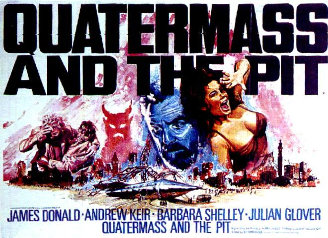
I finally had to break down and buy it.  Quatermass and the Pit has been on my “to see” list probably longer than any other single movie.  I managed to stream the first two of this telinema series for free, so I guess it was like getting three movies for the price of one.  Aired in the United States as Five Million Years to Earth, this isn’t the greatest sci-fi-horror movie ever, but it isn’t bad.  The pacing is a bit slow but the story is intriguing.  Rocket scientist Quatermass gets involved in the excavation of what turns out to be a buried rocket ship from Mars.  Surrounding the ship in the five-million-year-old matrix are the remains of apparently intelligent apes.  The scientists discover that the apes were artificially enhanced by insectoid martians that resemble the devil.  It’s pointed out that any time digging has taken place near Hobb’s End, strange phenomena occur.  It’s noted that Hob used to be a nickname for the devil.

This detail leads to a perhaps unexpected connection to religion and horror.  Quatermass and Barbara, a scientist who has the ability to “see” the creatures via collective memory, realize that the hauntings that have taken place around Hobb’s End for centuries may have been the image of demons, or the devil, emanating from the evil of these would-be invaders.  At one point a priest argues that their influence is essentially demonic, but the scientists realize that these modified apes are actually the creatures from which humans evolved.  All the human tampering with the ship eventually frees the spirit of the martian insects, resembling a devil.  The way to destroy it is with iron, relying on folklore which, in this instance, works.

The four Quatermass movies (I don’t plan on seeking out the last) were theatrical reshoots of television serials.  The last movie is essentially the TV series stitched together as a movie.  From at least the seventies on (Quatermass and the Pit was released in 1967) the first and third installments were considered fairly good horror films.  They aren’t always available in the United States, probably due to digital rights management.  It seems ridiculous that in this day and age that companies still restrict access, even to those willing to pay a modest fee, for movies that are essential parts of the canon.  Hammer (all three Quatermass movies are Hammer productions) films are still difficult to access in the United States.  At least, with the willingness to wait half a century, I’ve finally be able to see Quatermass and the Pit.


Alchemy

While reading about alchemy (surprised?  Really?), I found myself learning about Jakob Böhme.  His name was familiar—he’s one of those many people I know vaguely about but having been raised in an uneducated household really knew nothing concerning him.  In any case, Böhme is considered a mystic who began as Lutheran, but who came to trust his own spiritual experience (the latter being more or less the definition of a mystic).  I read about how one day he experienced a vision while staring at sunlight reflected off a pewter dish.  Now, I have had visions but you’ll need to get to know me personally if you want to hear about them.  But at that moment Böhme believed the spiritual structure of the world had been revealed to him.  I couldn’t help but think of what had happened to me at the foot of the Mount of Olives.

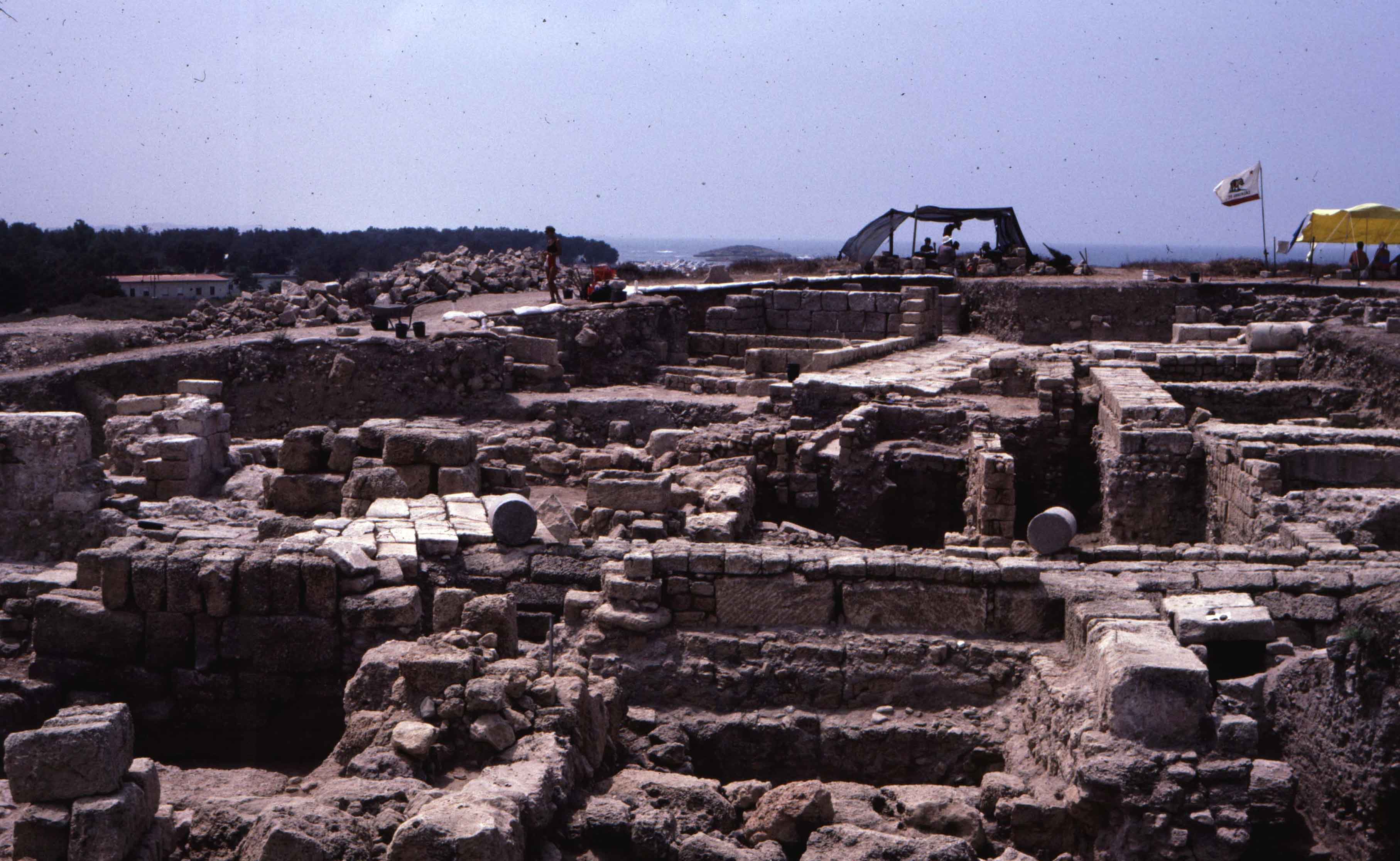
It was 1987 and I was a volunteer on the dig at Tel Dor.  Visiting Jerusalem one weekend with friends, we came to the Church of All Nations, built around the traditional garden of Gethsemane.  It was hot and I was feeling tired and I went inside the church to sit.  I spied a purple stained-glass window high overhead with the sun shining through it, in a shadowy alcove.  In an instant of rapture, everything made sense to me.  It was as fleeting as it was shocking and to this day I cannot articulate the certainty I experienced in that one brief moment alone in a church.  It was an assurance that, despite all outward appearances, this does indeed make sense.  This experience has never been precisely replicated in my life, but those who know me know that there is a certain color of glass that, if I see the sun through it, instantly brings me serenity.

Sunlight can do such things.  One morning while out jogging at Nashotah House, the rising sun struck me directly in the eye.  Immediately stopped running, holding my head against a migraine that had suddenly developed.  I was sick the rest of the day, lying in a dark room with a damp washcloth over my eyes, head splitting apart.  I’ve been cautious with the sun ever since.  Some things are so full of glory that to see them directly is to invite danger.  Yet we’re compelled to look.  I felt that I understood Böhme.  And I know that if the sun is right, and a certain color of glass is at hand, and if I’m brave enough, I can almost get back to that place.


Going Below

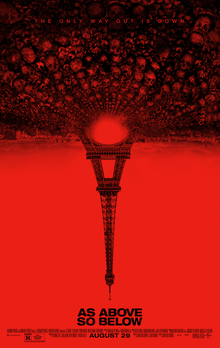
Indiana Jones in National Treasure, in found-footage horror format.  That’s the feel of As Above, So Below.  Only Jones is a woman.  There’s plenty of religious imagery in this movie, but the story’s not that great.  One of the reasons is that it’s too difficult to swallow, although it does score serious points on the claustrophobia scale.  At the beginning I wondered if I was going to make it through since Dr. Dr. Scarlett Marlowe’s cell phone is constantly moving as she continues her father’s search for the philosopher’s stone.  Surviving the situation in Iran, the remainder of the film takes place in Paris, especially the catacombs.  My level of impressedness went up when I learned that the movie really was shot in the catacombs.  Unfortunately it didn’t really help the story.

Alchemy, as part of esoterica, is purposefully difficult to understand.  Marlowe is continuing her dead father’s search for the philosopher’s stone that can change things into gold.  Her friend George (who repairs the clockwork for the bells at Notre Dame) is forced into the catacombs with her and her cameraman Benji.  They’re led by three Parisian cataphiles and some shots look like they were lifted directly from Indiana Jones and the Last Crusade, including the use of her father’s notebook.  Instead, the group enters the gates of Hell.  There are lots of scary things down there, many of them unexplained.  Some reflection reveals that they are all having to confront their pasts—or at least some of them are.  One of the cataphiles is killed before we learn her secrets.  And one of the survivors has no real backstory.  Six go in and three come out.

The movie plays with some interesting ideas, but it’s hard to swallow that an actual bona fide archaeologist would go on an illegal treasure hunt.  And that she knows of a secret chamber in the catacombs that has remained undetected by specialists.  I began scratching my head.  And when the group (or some of them, anyway) begin finding artifacts from their personal pasts in the catacombs, credibility is strained even further.  The idea that it’s important to come to terms with your past is a good one.  But once the young people begin dying and the rest have to keep going deeper and deeper to get out, the illusion is broken by Marlowe just dashing back to get a different stone to save George.  If it were just a matter of popping back, wouldn’t they have tried that earlier?  There are some Bible quotes, making this a candidate for the also unlikely Holy Sequel.


Sudden Monoliths

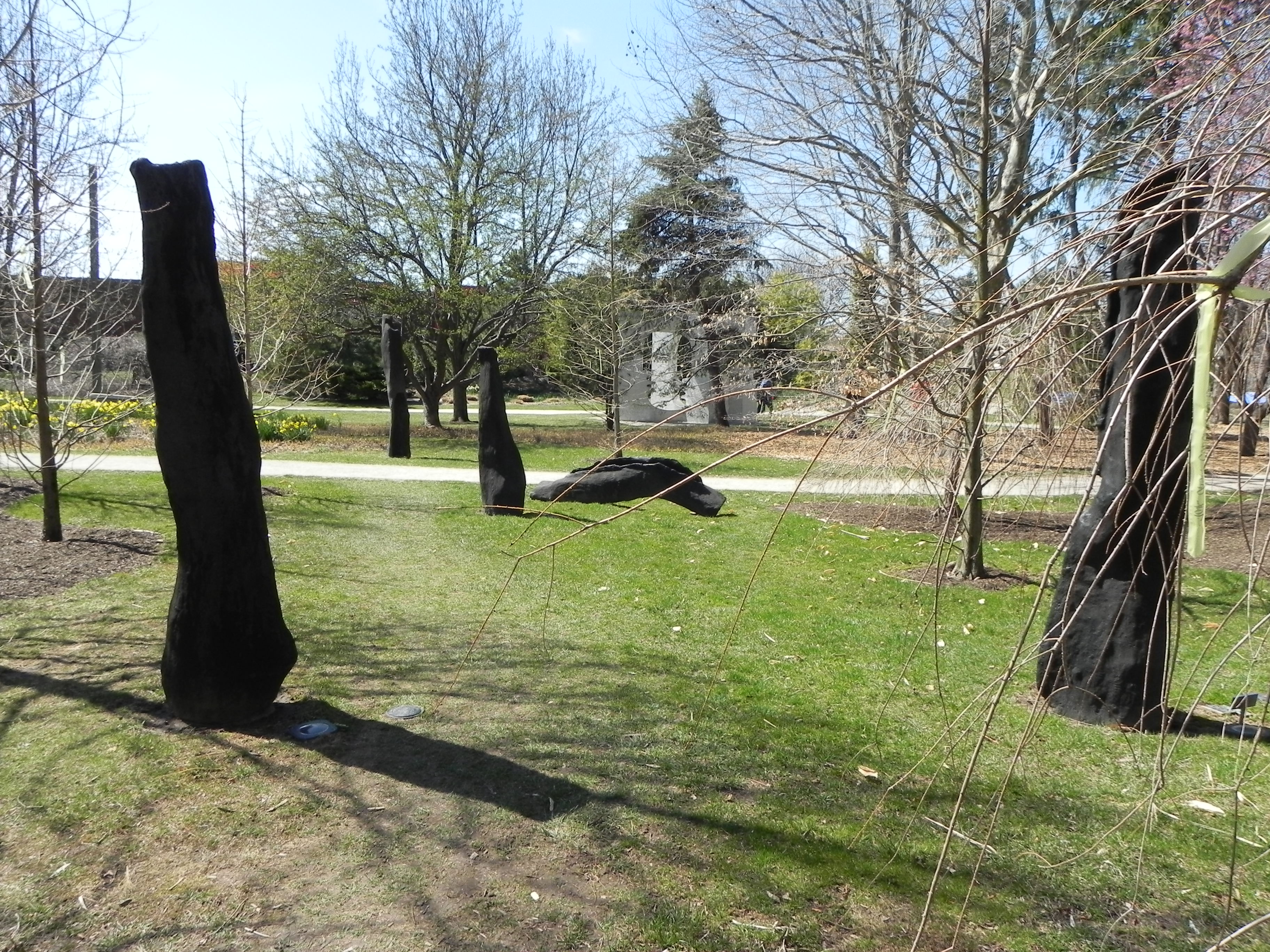
Okay, so I’ve been captivated by the monoliths.  You know, the ones that even make the New York Times.  These artistic pieces show up, unexpectedly, and unexplainedly, around the world.  The trend began in 2020 in Utah, as far as anybody knows.  These shiny pillars are excellently meme-worthy and are darlings of the internet.  And their history goes back before 2020.  Even before Stanley Kubrick.  You see, most news stories point out that Kubrick’s 2001: A Space Odyssey—one of the most influential movies ever made—established the idea of monoliths as being alien beacons (a favorite kind of beacon).   People instantly know what a monolith symbolizes.  Or at least they think they do.  But monoliths have so, so much more to offer.

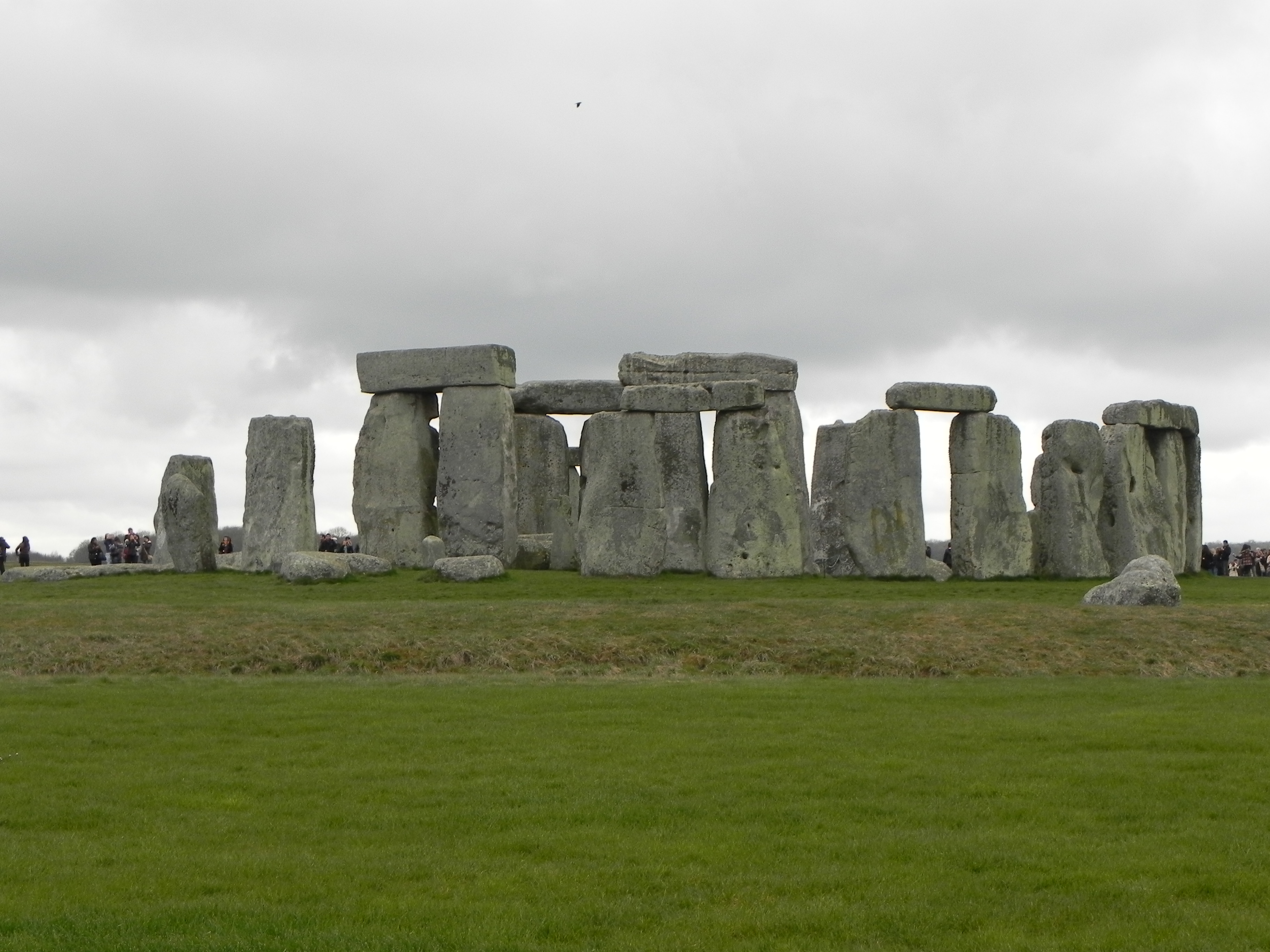
Perhaps the most famous monoliths in the world are found at Stonehenge.  Mysterious and beautiful, this monolithic ring has captured the imagination for generations.  When my wife and I lived in Scotland, we made a point of seeing as many stone circles as we could.  Way up in the Orkney Islands the Ring of Brodgar was probably the most impressive of them, owing to, in large part, its remoteness.  Standing next to these tall monoliths makes you realize how small people are but also what they can achieve when they cooperate.  While the UK may be better known for its monolith circles, even older ones appear elsewhere.  Rujm el-Hiri, for example, in Israel.  Although not a circle, the monolithic pillars at Göbekli Tepe should be rewriting history books.  Why the monolith?

Freudians would point to Tuto Fela in Ethiopia or other phallic architecture, but my mind tends toward Rapa Nui, or Easter Island.  The human being tends to stand taller than wide.  Evolutionary biologists tell us that was to help us see over the tall grass of the savannah.  (And if you doubt grass gets that tall, visit my yard sometime in the summer.)  These monuments seem to symbolize more that the procreative architecture of male human anatomy.  They seem to point to our ability to see over the obstacles in our way.  They seem to say, when people are divided against each other the plains remain barren.  When they decide to work together, Stonehenge emerges.  I don’t know the motivations of these modern artists.  I do admire their ability to put these monoliths into remote locations without leaving evidence of how they did it.  I really appreciate those creatures that stand tall and have a spirit of cooperation, even if others just don’t see the point.


Sodom Returns

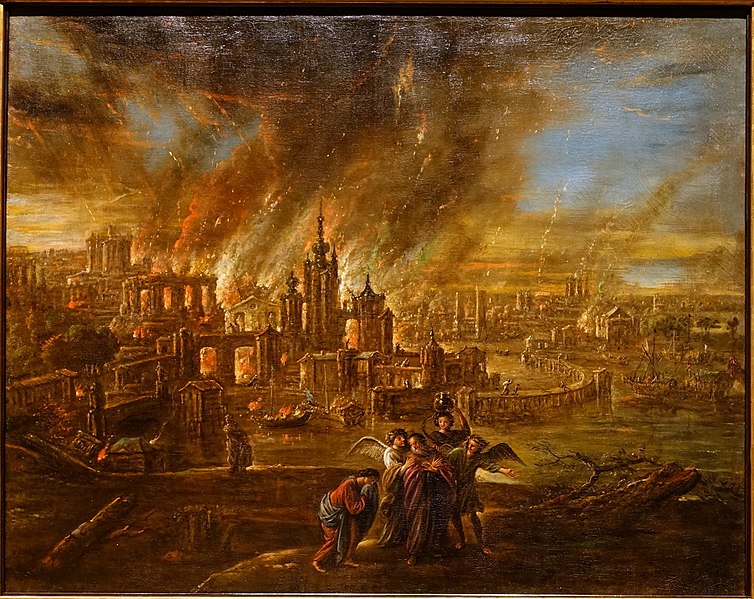
Somebody really ought to write a book.  It’s not me, but when new archaeological discoveries with large explanatory value emerge, they begin to paint an interesting picture.  Archaeologists have determined that Tall el-Hammam, a city in Jordan of about 8,000 residents, was wiped out by a cosmic airburst, or meteorite.  If you missed it in the headlines it may be because this happened in 1650 BCE.  Barring volcanoes and other melting phenomena, since they don’t get hot enough, the cosmic airburst is the best theory.  Given that Tall el-Hammam is not far from the Dead Sea, it has been posited that the sudden destruction of this city led to the biblical story of Sodom and Gomorrah.  This makes sense to me.  Just like the theory that the flooding of the Black Sea by the Mediterranean led to stories of the flood.

Sodom and Gomorrah afire, by Jacob Jacobsz. de Wet; image credit: Daderot, public domain via Wikimedia Commons

People who had no other ways to explain such things would naturally consider them forms of divine punishment.  Deep-seated guilt seems to be a universal of human psyches, sometimes for good reasons.  In any case, an entire city wiped out by a meteorite looks like the finger of God just as much as lightning does.  Biblical scholars have long supposed that the story of Sodom and Gomorrah was an etiology, or origin story, of the formation of the Dead Sea.  This is partially based on the famous salt pillars, more than one of which bears the name “Lot’s wife” or the equivalent.  And the Dead Sea is unlike any other body of water on the planet.  

I suspect that over time other biblical stories may find logical explanations in ancient catastrophes.  I haven’t found convincing those that try to explain the “plagues of Egypt” based on a scientific daisy-chain of events, although they are interesting.  There’s no doubt that between the expulsion from Eden and the arrival of Moses there were dramatic events narrated by Genesis.  If these were ghosts of memories of ancient tragedies that makes sense to me.  They’re moralized, of course.  Aesop’s Fables also ended with the moral of the story.  We still like to know what a story means, and a good movie or novel will have some kind of message to convey.  There’s no way to prove that Tall el-Hammam’s destruction led to the biblical account, or that memories of a catastrophic flooding of the Black Sea led to tales of arks.  But still, somebody ought to write a book.  I’d read it.


Dials and Destinies

Indiana Jones and the Dial of Destiny didn’t do well in theaters.  I’m afraid that Indy fans, like Harrison Ford, may be aging out.  Although anthropologists are loathe to admit it, Indiana Jones was a boon for archaeology.  He made it cool, back in the eighties.  We’re four decades older now and for some of my generations, Indy’s still a draw.  The energy of Raiders and Final Crusade, however, has dissipated a bit.  I don’t watch trailers, so I learned that the eponymous Dial of Destiny was the Antikythera mechanism, curiously called “the Antikythera” in the film.  Or Archimedes’ Dial.  The film starts off with a religious artifact, the lance of Longinus, but it’s a fake.  The Dial, however, is real, if broken.  In order to make the Indy magic work they had to make a remarkable scientific device into something occult.

While I watched I thought about how the move away from religious artifacts into secular is a sign of our times.  The original trilogy involved Christian and Hindu symbols.  (It was only a couple years back that I realized Temple of Doom was set before Raiders, when Ford was young enough to pull that off.)  Crystal Skull was a mix of religious and secular.  We don’t know, historically, what the crystal skulls were for, but clearly they could have had religious significance.  The film spun them all widdershins into paranormal playthings.  The Dial, as it’s called, has no religious implications at all in the current film.  The 1960s Nazis want to travel back in time, which is what the Antikythera, we’re told, predicts (letting interested parties know the time and place of time fissures).  A Hitler wannabe plans to do World War II right, so that Germany wins.  They end back at Archimedes’ time, however, and the world is saved.

As I’ve noted with other pop culture franchises, when a series begins with a religion plot and then drops it, things start to unravel.  I suspect many screenwriters and directors underestimate the power of religion for generating compelling stories.  Belief changes things.  Dial of Destiny demonstrates that substitutes really don’t engage viewers to the same level.  This is a perfectly serviceable Indiana Jones movie.  Lots of adventure and PG 13-level violence.  Getting the girl may not have the same urgency with an octogenarian archaeologist, and Helena seems undecided what she wants, in any case.  What’s really missing, however, is the pizazz that religion brings to stories of finding ancient artifacts.  Archaeology, embarrassingly for some, began in West Asia for religious reasons.  Acknowledging that is simply staying true to history.


Ancient West Asia

You know what they say about old habits.  While various people are protesting things like critical race theory, there are still some scholarly holdouts for colonial terminology.  I know the area of “Ancient Near Eastern” studies fairly well.  The problem is that “Near East” is a comparative term.  Near whom?  Europe, of course.  Long ago scholars stopped using “oriental” to describe East Asia.  “Oriental” means eastern.  East to whom?  Europe.  You see the problem?  These terms assume European centrality, and the entire world can be divided up according to a colonialist perspective, rather like those novelty maps of the United States from a New Yorker’s point of view.  East Asia and South Asia are now in common use, but it’s still “Near East” and even “Middle East.”

What are the alternatives, did I hear you ask?  For decades now there has been a move to use “Ancient West Asia” instead.  It’s descriptive rather than imperial.  There have been objections, mostly from older white men.  It’s disruptive to change names, and besides, “West Asia” isn’t technically correct.  The area under study includes Egypt, and that’s Africa!  As Egyptology has grown, however, Sudan has increasingly entered the picture.  In other words, our picture of the ancient world is changing.  West Asia may not be precise, but it conveys the idea.  Cultures don’t always neatly follow borders, ancient or modern.  The people of ancient Israel borrowed from both Egypt and Mesopotamia.  Is it so wrong to try to use a non-Eurocentric title?

 Also, consider East Asia—it’s a fuzzy descriptor.  As is South Asia.  Although China and India are the largest respective states, these are modern political borders.  Yes, ancient people had borders too, but generally only emperors (men) went to great lengths to take someone else’s land on a large scale.  Terms like “Ancient Near East” perpetuate, often under the radar, this Euro-normativism.  Too much change too fast, I know, creates many problems.  A large part of the Trumpian reactionary mindset is based on fear of too much change.  Still, who pays attention to “Ancient Near Eastern” studies anyway?  It certainly isn’t a growing field.  The area under study is wide and sprawling.  It includes Turkey and stretches down to Yeman.  It can reach over to Iran and Afghanistan—to the very borders of India.  If we were to agree in principle that a Eurocentric term should be avoided, we might consider using Ancient West Asia.  Or we might, like the emperors of old, keep on doing things our own way.  It’s a habit, after all.


Lost Civilizations

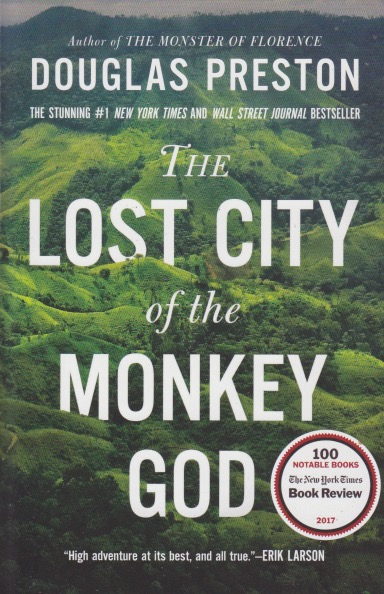
At the rate rain forests are being decimated for our lust for beef, it seems amazing that there are any unexplored regions left at all.  That’s what makes Douglas Preston’s account of visiting the fabled Ciudad Blanco, a lost Honduran city, so compelling.  Like most intelligent people, Preston is ambivalent about the discovery he chronicled.  The pristine jungle he encountered had to be cleared, at least in part, to allow for exploration of a lost civilization.  But what an adventure it was!  The danger of drug lords, a volatile government, large poisonous snakes, and ruins discovered by lidar combine in a true tale of danger and fascination.  As with Rudolf Otto’s description of the holy, this is something that fascinates and terrifies simultaneously.  And it’s controversial.

The Lost City of the Monkey God crosses several boundaries.  It discusses not only “Indiana Jones”-style archaeology, it involves one of the last unexplored places on earth.  It doesn’t sugar-coat the genocide initiated by Europeans—in fact, Preston describes some of the diseases in graphic detail—and he doesn’t excuse the guilt.  The book also addresses global warming and the possibilities of a global pandemic (the book was published in 2017).  Preston contracted Leishmaniasis while in the jungle and notes that as the globe warms up, it is making its way north.  The descriptions aren’t for the faint of heart, nor are his descriptions of the politics of treatment.  The first part of the book, describing the people and the set up of the base-camp show Preston’s chops as a thriller writer.  His encounter with a fer-de-lance had me checking the floor in the dark when I got up in the morning.

The civilization of the city, now known by the more respectable title City of the Jaguar, was unknown.  It was not Mayan.  The city was likely abandoned because of disease brought to the Americas by Europeans.  Even so, his description of the society in which the ruling classes keep their power by displaying their own sanctity that the average person doesn’t question rang true.  Societies from the beginning have used that playbook.  Convince people that the gods (or God) has revealed certain things that they (the ruling class) understand, and everyone else falls in line.  We see it even now as the messianic Trump following falls for it yet again.  This is a quick read, written much alike a thriller.  A few years ago I read Preston’s engaging Dinosaurs in the Attic.  I’m thinking now that some of his thrillers should also be on my list.


Forgotten Goddess

It’d’ve been nice if someone had told me.  If you’re not a professor, though, you’ve lost your importance.  I’ve only written a book on the subject, after all.  Grousing aside, the headline from the Israeli newspaper Haaretz (“The Land”) read “7,500-year-old Burial in Eilat Contains Earliest Asherah.”  Since my dissertation and first book and several articles were on Asherah, I do still have an interest in the old girl.  I’m curious when new material shows up, even since I wrote my book.  Professors, you see, have the time and resources to keep up with things like that.  When your job is acquiring books in a different field, well, who has the time?  I do keep an eye out for headlines, though.  Skimming a newspaper article now and again I can still manage.

So what’s going on in the resort town of Eilat?  According to the article by Viktoria Greenboim Rich, a rescue operation for expansion going on in the city, led to the discovery of a pre-Israelite burial site.  Among the artifacts discovered was the stump of a juniper tree, upright in what appears to be a cultic setting.  In case your chronology’s even rustier than mine, the Israelites show up on the scene roughly 3,300 years ago.  This sanctuary has been carbon dated to nearly twice that age.  We don’t know a ton about what asherahs (lower case) were, other than that they were made of wood, they stood upright in sanctuaries, and they angered Yahweh.  So was this an asherah that was found?  Are they really that old?

It’s an intriguing question.  Writing hadn’t really been invented that long ago.  There were some rudimentary efforts in that direction, perhaps, but Sumerian, the earliest attested written language, wouldn’t show up for a couple of millennia yet.  That means artifacts are unlabeled and there aren’t any texts to describe what they are when we find them.  Did Asherah have a prehistory that early?  We just don’t know.  The trend even since before I was researching the goddess has been to suggest any upright wooden object found in a cultic context is an asherah.  You can hardly blame archaeologists for suggesting that, since wooden objects don’t survive that well in the levantine climate.  We naturally like to fill the gaps.  If this is an asherah then it would’ve been called by a name we don’t know.  Hebrew hadn’t yet evolved by then, as far as we’re aware.  But why else, so the thinking goes, would anyone stick a tree in the ground before telephone poles (those modern asherim) had even been invented?


Heat Pump

We’re preparing our home to welcome a new resident.  It’s not human.  Those of you who are home owners know how you move from crisis to crisis, paying to repair this just in time to start paying for that.  Our current issue is a dead dryer.  We knew it wasn’t long for this world when we moved in.  The previous owners, as most working class folk do, let things go until a machine forces  the issue by dying.  Being concerned for the environment, we like to replace appliances with more environmentally friendly ones, if we can.  They are, of course, much more expensive.  With the dryer it was also a space issue.  Snuggled together like young lovers in bed, the washer and dryer leave less than an inch clearance total from either wall.  The first issue we faced—modern dryers are bigger.

Small and energy efficient is what we wanted.  I learned about heat-pump dryers.  They don’t require a vent and they’ve been used for decades in Europe because of both space issues and environmental friendliness.  Here they cost more and you’ll have to wait because they’re in demand.  We decided to side with the environment.  Then there’s the problem of the old vent.  I gingerly walked out the old dryer and was amazed at the detritus I found.  Now, I’m an archaeologist at heart, so instead of sweeping it all in the trash, I sorted through it.  I found a dollar bill.  And 32 cents—this helps defray the cost of the new dryer.  Three guitar picks and a heap of cosmetics.  A box of rubber bands for braces.  There was ancient history in this pile!  The lighting’s bad in that corner so I put on a headlamp like a phylactery.  Let there be light.

I had to use most of my tools to tug the old vent out.  You have to stuff the hole with insulation and put some furring strips in place to hold the new drywall.  Cut out the patch to fit the hole and mud the whole thing up.  Why bother painting where nobody will see?  By the end of the weekend we were ready for our new resident.  It still wouldn’t be here for at least a couple of weeks.  The clothesline is strung in the backyard where the even better method of using nature’s dryer is free.  For those days without sun and on which we have time to do a load, we’ll be glad for our heat-pump dryer.  Particularly when the weather starts growing cold again and global warming enacts its chaos.  Hopefully we’ll have a stop-gap solution by then.


Mining for History

An article by Matti Friedman in this month’s Smithsonian got me to thinking about the Bible’s iconic status again.  Titled “An Archaeological Dig Reignites the Debate Over the Old Testament’s Historical Accuracy,” the story’s about a decidedly non-biblical trope—King Solomon’s mines.  That phrase, as the article makes clear, comes from the title of H. Rider Haggard’s nineteenth-century novel, not the Bible.  As the piece demonstrates, however, many people suppose it to be biblical.  Our society isn’t as biblically literate as it is biblically motivated, so the question of proof keeps coming up.  It’s almost as if historical veracity is far more important than any spiritual truths the Good Book may be attempting to establish.  Those who need the assurance of history (those we tend to think of as literalists) often miss the message in the quest for certainty.

Reading the article makes it clear that archaeologists have discovered good evidence for copper mining in the Arabah.  This is in no way surprising.  Ancient people of biblical times smelted copper and used it to make bronze.  At issue here is the historicity of Solomon’s opulent kingdom, evidence for which we lack.  Archaeologists have been digging for well over a century now, and the magnificence of David and Solomon doesn’t really show up in the archaeological record.  Of course the issue is politicized because land claims are involved.  American literalists tend to support Israel because of its role in “end times prophecy.”  Eager to be done with this wicked old world, they require the assurance of history.  Interestingly enough, that doesn’t seem to have bothered Jesus of Nazareth very much.

Long ago biblical scholars realized that the biblical view of history isn’t the same as what we might term scientific history.  Any history, as those who specialize in it know, isn’t “what really happened.”  Objectivity is impossible.  Histories are versions of what likely might’ve happened, based on the sources consulted.  At the very least there will be the perspective of the other side.  There are facts, of course.  The Holocaust, for example, did happen.  The fascist government of Germany orchestrated and implemented it.  When trying to reconstruct that history, however, differences of opinion often arise.  That’s the nature of history.  Unfortunately we’ve seen the rise of these self-same biblicists denying the known facts of more recent history in order to make themselves appear more righteous.  They want to shield themselves from the genocide of American Indians and the evils of slavery.  Yet they are inspired by such headlines that hint that the Bible might have a tint of historical accuracy after all.  It’s all there in the passage about King Solomon’s mines.


Celts and Gods

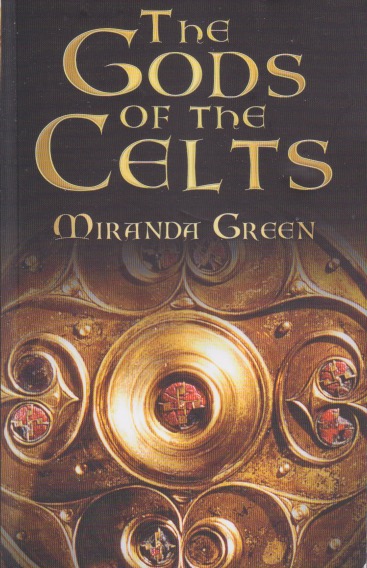
We’re accustomed to religions being written out.  Indeed, many world religions have sacred texts from the Avestas to Dianetics.  Some ancient cultures, however, didn’t have written traditions and when they disappeared, as all cultures eventually do, their religion became nearly impossible to understand, or reconstruct.  Miranda Green has tried to provide, in written form, a summation of her understanding of The Gods of the Celts.  Celtic mythology, interestingly, had long ago caught the attention of New Religious Movements, as well as the New Age movement.  Much of the Wiccan calendar is based on Celtic religion and many New Age practices trace their roots to the ideas of Ireland, Scotland, and Wales lost to the mists of time.  What we actually do know about these cultures is about as fascinating as what’s been reconstructed.

Green’s study shows us a religion that grew out of profound respect for nature as well as human prowess at fighting.  (The “fighting Irish,” indeed may touch on an historical pulse.)  Celtic gods reflected a large swath of thinking throughout western, and parts of eastern, Europe.  Their names may be less familiar to us, and some may well have been lost to the vicissitudes of time, but there was a vibrant devotion to them that went as far as human sacrifice.  We know that it occurred, but it probably wasn’t frequent.  Although polytheistic, Celts were moral in their own understanding of their world.  Morals tend to come from human understanding of their place in a world they didn’t create.  How do you live in somebody else’s property?

Unlike the more literate Greeks, or even the Semitic religions on which they drew for their stories, we have no narrative Celtic mythology.  We have fragments and glimpses.  Nobody had a recorder while sitting around the fire, recounting the activities of the gods.  Later, sources such as the Mabinogion were written down, which surely held some memories of such fireside tales.  The originals, however, we’ll probably never have.  Such is the way of conquered peoples.  What the Romans started the Christians finished.  We’re left with some deities, such as Brigit, made into saints, but their stories forgotten and not originally written down.  Our time looking back isn’t ill-spent.  It teaches us who we are and guides who we might become.  Our own violent politicians, threatening to murder those who are different, clearly have learned nothing from history, ancient or modern.


Sodom

Look!  Up in the sky!  It’s a bird!  It’s a plane!  It’s an asteroid coming to wipe out a city!  One of the cottage industries outside biblical studies is the interest in finding historical events to explain Bible stories.  A few years ago it was proposed, with some degree of probability, that the flooding of the Black Sea by the Mediterranean, validated by archaeology, led to the story of Noah’s flood.  I recently saw a story suggesting that the destruction of Tall el-Hammam by an asteroid about 3,600 years ago might’ve been the basis of the story of the destruction of the cities of the plain, Sodom and Gomorrah  most prominent among them.  The piece by Christopher R. Moore in The Conversation describes the moments of horror—mercifully brief—as the space rock exploded above ground and wiped the city from the face of the earth.

Since this happened near the location of Jericho, the destructive shock waves knocked its walls down, leading to another biblical tale.  I often wonder about these “theories.”  They show just how deeply biblical our society is.  The frame of reference is already there.  People know about Sodom and Gomorrah.  They know about the flood.  They know of naked Adam and Eve and a snake wrapped around a tree.  When a disaster happens in the right region, and before the biblical story was written, it is suggested as the etiology of the tale.  Many have tried to explain the plagues of Egypt using similar methods.  Our culture seems to long for some skyhook on which to hang our biblical hat.  Some indication of why people put such strange stories in the Good Book.

Biblical scholars look too, but with a different perspective.  Etiologies are stories of origins.  Traditionally the Genesis account of the cities of the plain is understood as an etiology of the Dead Sea.  A unique geological feature of this planet, it is, in a word, weird.  The story of Abraham’s nephew Lot seems to explain it.  The article makes a compelling case for a heavenly fireball at about the right time that wiped out a settlement of about 8,000 people.  Genesis wasn’t written yet at 1600 BCE, the time of the event.  Since the impact site wasn’t far from the Dead Sea it seems to fit  the bill for a valid etiology.  None of these events proves biblical stories true, but they do show possible avenues of transmission.  This one definitely has me wondering.

Image credit: Daderot via Wikimedia Commons

Ancient Near Ideas

Looking backwards has its issues.  I still think about the Ancient Near East.  My reputation on Academia.edu is based entirely on it.  (From the user stats, nobody’s really interested in my horror writing there.)  Let’s face the facts, though.  If you an expert in a field (mine is Ugaritic mythology, a form of history of religions), you can’t just write things off the cuff for publication.  I need to be very precise and accurate.  I like to think that’s why my articles on Academia get attention.  To do that kind of writing you need time—when I was a professor most of my “free time” was spent reading in that field—and either research funding or an incredible library.  Professional researchers (i.e., professors) get paid to do that kind of thing.  I don’t do it anymore but that doesn’t mean I don’t think about it.

The other day I saw an article about Mehrdad Sadigh.  Although this antiquities dealer operated mere blocks away from where I worked when I commuted to Manhattan, I’d never heard of him.  It turns out that he had (has) a full-scale forging operation right in the city that never sleeps.  He has made a living, allegedly, for years by selling fake antiquities as genuine.  The story is tragic, but it underscores the point with which I began—people are interested in antiquity.  We want to be in touch with the past.  I can attest that there’s nothing quite like the thrill of being the person who unearths something on an archaeological dig.  Touching an artifact than no human hand has touched for two or three thousand years.  Looking back.

Looking back makes it easy to get distracted.  As much as I enjoy and appreciate my friends who still get to do Ancient Near Eastern studies for a living, I sometimes think how it’s good to move on.  Who knows, maybe I have another Ph.D. left in me yet.  Moving on increases the breadth of your knowledge.  Since university jobs are as mythical as the texts I used to study, doing a doctorate for a job is a fool’s errand.  Doing it to learn, however, is something I still heartily recommend.  There’s nothing like immersing yourself into a single topic for three-to-five years so that you come out with more knowledge than is practical about it.  I still think about the Ancient Near East.  I’m still tempted to buy new books that come out on the topic.  Instead, I watch horror and think it might be fun to earn a doctorate in monsters.


Durable Goods

So you bought something that worked.  It was a simple thing, but you bought it many years ago.  Then something happened and the thing got broke.  (This could be just about anything here, so please bear with me.)  You go to replace said item that worked so perfectly for your needs, only to find fashions have changed and your item is no longer in style.  In fact, not even Amazon has anything like it.  Or eBay.  What is one to do?  This recently happened to me again—it doesn’t matter what the item is—and I once again reflected on how changing styles make it difficult to live a life not encumbered by having to keep up with change.  Some things need not change styles to be functional, but they do nevertheless.  And trying to replace them with exact duplicates can be difficult.  Perhaps the solution is to buy two of everything.

The speed of change is amazing.  Head-spinning, in fact.  Having studied ancient history, I often ponder how civilization got along with minimal change for well beyond a lifespan of an individual.  Or generations, even.  Take pottery, for example.  Innovation was so slow with pottery that—along with its extreme durability—it can be used as a means of dating events in antiquity.  There was very little improving an ancient bowl.  Its shape was functional and served its purpose well.  Why change it?  When it was discovered that, say, a rim, made spillage a little less common, that innovation spread and stayed in place for centuries.  Until perhaps someone discovered a spout would make for easier pouring.  Again, no other “improvements” for centuries.

Today things change, it seems, just for the sake of change.  I tend not to replace things unless they really aren’t functional any longer.  (That’s how I can afford to buy books, I guess.)  My car is old.  So is our furniture.  To me it seems more eco-friendly to keep things than to be constantly throwing them away to upgrade them.  Then something breaks.  If that particular item was an impulse purchase in some forgotten store in another state decades ago, good luck trying to replace it.  It may be out there somewhere on eBay, I suppose, but hours spend searching for that purchase that was almost an afterthought shouldn’t take hours and hours, and it likely will be even more expensive than anticipated if actually found.  Such is the nature of fashion.  Some durable goods are just fine the way they were.