Comet Tales

Göbekli Tepe, apart from being impossible to pronounce correctly, is a site of embarrassment to historians. First of all, this archaeological site in Turkey is too old. Abandoned around 9000 BCE—some 5000 years before the Sumerians show up with their writing—Göbekli Tepe had already gone through several phases of elaborate building and willful destruction. A large “temple” has been unearthed there with elaborately carved plinths that suggest a mythology at which we can only guess. Conventional wisdom states that the state came first, then organized religion. Göbekli Tepe suggest that it was the other way around—religion came first. We have no writing to go by here, however, just towering monoliths that make us scratch our heads in wonder. We are the apes.

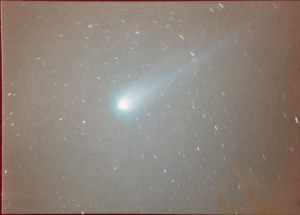
Hyakutake, 1996. My first comet.

A friend pointed me to an article in New Scientist that suggests one of the Göbekli Tepe “carvings show comet hit Earth and triggered mini ice age.” That’s a lot of ice. And eisegesis. Part of the problem here is that old scientists tend to sweep anomalous evidence off the table. It’s an admitted part of the empirical method. If a single anomaly stands against a host of conventionally expected results, the anomaly goes into the bin as an outlier. Göbekli Tepe, as real as it is, is an anomaly. Reputable books on it written in English by archaeologists and historians do not exist. Embarrassed turning away and staring at shoes ensues. The site is just too old, too sophisticated, and too far outside convention to be dealt with rationally. You can read a lot into an isolated carving, especially when accurate information is lacking.

To give you some perspective: the great pyramids of Egypt date from the Old Kingdom of Egypt, after 3000 BCE (remember, we’re counting backwards here). Stonehenge’s main phase (the famous blue stones) was a couple of centuries later than the Great Pyramid of Khufu (Cheops). Göbekli Tepe had closed up shop some 6000 years prior. By comparison, more time had passed between Göbekli Tepe and the Great Pyramid than between the Great Pyramid and us. We, with the internet in our pockets and humans walking on the moon, preparing to go to Mars, are only less than 5000 years from jolly old Khufu. Göbekli Tepe, with its inscrutable carvings, shouldn’t be there. And yet it is. Standard procedure suggests it be ignored. So far, conventional historians have done just that. And in my opinion that’s worse than an ice age brought on by comets written on a stone that nobody can read.


Death Challenged

Long before the Walking Dead, and even before Twilight or Buffy the Vampire Slayer, people took the undead seriously. Now, I know ratings are important (they attract advertisers and their money, after all), but when the fear is reality the stakes are upped a bit. Two readers sent me a Guardian story this past week of Yorkshire villagers mutilating the dead. In the Middle Ages, that is—it’s perfectly safe to die in Yorkshire now. The story by Maev Kennedy describes how archaeologists have been studying deliberately defiled corpses, well, actually the bones from those corpses to be precise, to solve a centuries-old mystery. Their conclusion? Medieval folk really did fear the dead coming back from the grave.

Now, Easter’s just around the corner and resurrection’s on a lot of minds. Outside the context of the Bible, however, resurrection of the dead is one of the most ancient and persistent of human fears. Nobody’s quite sure why. Dreams and visions of the recently departed are extremely common. Belief in ghosts is ancient and fairly universal. The destruction of the bodies of people already dead is not. We treat our gathered ones with respect. To me it seems to come down to the puzzle of consciousness. Call it a soul if you like, but I have a feeling things would be getting rather crowded in here if too many distinct entities claimed this body as home. Mind, soul, spirit, psyche, consciousness. We don’t know what it is because it can’t be studied empirically. We know that something like it exists and opinions of what happens to it after death vary. The body, we can all agree, has a more prosaic end.

That’s what makes fear of the undead so fascinating. They are only bodies. Bodies without souls. Rather like leaders of the Republican Party. We fear them because when we look into their unblinking eyes we see no vestige of human warmth or sympathy. Those who walk among us and who don’t care about those of us not yet undead remain a perennial fear. In the case of the Yorkshire corpses these were people already buried. Putting them back in their graves seemed kind of pointless when they would only climb out again. We don’t know what it was like on the ground in the Middle Ages. History, however, has an ironic way of repeating itself. We’re entering a new age when I suspect we’ll want to make sure the remains of some remain well and truly gone once they’ve finally given up the ghost.


Terms of Interment

In an early episode of The Simpsons Marge is commissioned to paint a portrait of Montgomery Burns. Angry with him because of his constant treatment of others as beneath him and his glib superiority granted by wealth, she paints him old and feeble, naked as he climbs from the shower. The crowd present for the unveiling is appropriately shocked. Marge explains her motivations for the painting and one of the voices in the crowd affirms, “He is evil, but he will die.” That scene was brought back to mind by an article a friend sent me on Archaeodeath. As someone who’s volunteered on an archaeological dig, I understand that the past is a history of death as well as of life. We read what historians choose to preserve. And, as Professor Howard M. R. Williams points out, the tomb often tells a tale that requires some subtlety in reading.

Never a great fan of the wealthy, some years ago I visited Sleepy Hollow. It was before the television series began, back in an October when the mind begins naturally to turn to death. I’d always liked the story by Washington Irving that had made this quiet town famous and it’s really not hard to get there from New Jersey. While in town we visited the famous cemetery, in search of Irving’s grave. Others are buried there, too. High on top of a hill stands a palatial tomb to some Rockefeller. As Prof. Williams makes clear, all must die and all tombs lie. Those who insist on the most opulent tombs are those who routinely overestimate their personal importance. So it is my mind turns from Montgomery Burns to Cyrus the Great.

There was a time when world conquerors possessed a dose of humility. It may seem strange in today’s world that an Iranian (in the days before there was an Iran, designed as it was by Europeans) would be considered a benevolent dictator. Cyrus reversed the deportation rules of the Babylonians and Assyrians. Subject peoples were permitted—encouraged even—to return to their lands. He even federally funded the building of temples and, to translate, centers for the arts. Cyrus understood that grateful people make good subjects. When Cyrus died, after being king of the world, he was interred in a decidedly understated tomb outside Pasargadae where, according to one account his inscription read, “I am Cyrus, who founded the Persian Empire. Grudge me not, therefore, this little earth that covers my body.” Archaeologists uncover the dead. Those who bill themselves grandly, as the diggers understand, seldom deserve the glory bestowed by their own minds. Marge Simpson, as usual, is a voice of wisdom.

Some president’s tomb


Big Dreams

giants_and_freia

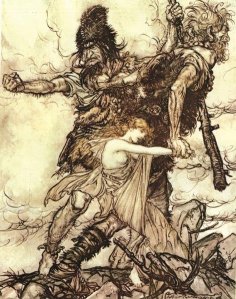
The giants are back! Or at least they were here. According to the internet, and we know that that never lies. Every now and again a story breaks that some discovery of giants has been found in some archaeological or paleontological context. A little poking around, maybe a visit to Snopes, and I go home disappointed. It’s the Cardiff Giant all over again. Still, the stories are fun. A friend sent me a piece from Ancient Code entitled “A GIANT footprint has been discovered in China.” The pictures look impressive until we get to the one where the footprint is as large as a fully grown man. We are back in the land of modern myth.

The idea of an era of giants is strangely compelling. The Bible isn’t the only ancient document to suggest this scenario. In fact, Holy Writ seems to have borrowed the idea. Fast forward just over a millennium and Geoffrey of Monmouth will tell us there were giants in Britain before the more civilized genus of our own arrived and treated the giants to a Brexit. Such tales permeate history with the fanciful period of really big guys from the past. We’re not half the men we used to be. Literally. Just don’t look too close at the Photoshopped evidence. We live in a world where “Photoshopped” is actually a word. A world where visual evidence is like a cow plop. It’s there, but what you want to make of it is up to you. I was never a big newspaper reader, but at least you knew if a reputable rag paid to have millions of copies printed the story had a good chance of being true. I wish there had been giants. Reading the news today, we seem very petty indeed.

Any number of explanations have been proffered for why ancients believed in giants. Perhaps they found fossilized dinosaur or mammoth bones. Admit it, except for to a biologist, a femur looks pretty much the same whether it comes from a giant reptile or a moderate-sided primate. Economics of scale. Or look at those Egyptian pyramids. Sure looks like they had a hand from a really big brother. But in our strangely less and more gullible age, lingering doubts remain. The Bible says there were giants on the earth in those days. The mechanics of gods mating with human women are blamed, no matter which laws of physics have to be broken. For the literalists way down along the Paluxy River in Texas we were walking with dinosaurs back in the day. Too bad no fossilized cameras have yet been discovered.


Finite Gods

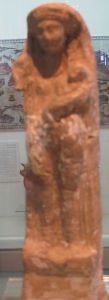
Just how many gods are there, anyway? Well, that’s not really a fair question. For one thing, do I mean “real gods” or gods that people believe in? Do I mean “believe in” or made up? Do I mean “made up” or intentionally fabricated? And the nesting questions could go on and on. Over the years in my professional capacity as an erstwhile teacher, I accumulated books listing the deities of various cultures with brief descriptions. I once even argued that using “god/goddess of” (the divine-genitival construct) as a phrase distorted ancient concepts of divinity. The fact is people have believed in many gods in many different ways. As modern scholars of religion we’ve only begun to reach the heavens (or underworld, or anywhere in between, for deities may be found anywhere). This issue comes to mind because a friend recently shared a story from IFL Science about a new Etruscan goddess. The piece by Ben Taub mentions a stone recovered from Poggio Colla, a site in Italy, written in Etruscan. The stone seems to mention a new “fertility cult” goddess. And once again religion and science have met, but not quite kissed each other.

Photo credit: Jastrow (2006), Wikimedia Commons

Photo credit: Jastrow (2006), Wikimedia Commons

Let’s begin with the Etruscans. Before the Romans, Etruscans lived in Italy, giving Tuscany its name. We know very little about them, as their language (Etruscan) is rarely found and imperfectly understood. Some of the classical gods may go back to Etruscan originals, and the Etruscans seem to have known of at least some of the cultures of the ancient Near East, or ancient West Asia. We have no idea how many deities the Etruscans recognized. Polytheism, for all its heathenish exuberance, never had a problem with adding more gods. Interestingly, the “new” goddess mentioned here, Uni, is someone I used to talk about in my Rutgers classes on ancient Near Eastern religion some five-plus years ago. Pardon my crowing—I seldom get to suggest I was ahead of my time.

What really interests me here is that websites that advocate science still take an interest in religion. Although belief is relegated to inferior minds (generally) science does admit, from time to time, that it’s interesting. The study of religion, in at least some schools, is a scientific enterprise. No, we don’t put gods under microscopes (telescopes might be more useful) but we use the same techniques as empirical studies of nature use in order to try to draw some conclusions about religion. Despite the fact that the vast majority of humans on the planet are believers, higher education has consistently under-funded or disbanded departments who apply rational thought to religion. We suppose that someone else can pick it up and study it, coming to useful conclusions without putting in all the homework. Don’t mind me, though. I’m just basking in the light of having known about Uni years before she was discovered.


Foiled Again

Few things travel as well as curses. Or so it seems in a news report from Serbia. Archaeologists in Kostolac, according to The Guardian, have excavated skeletons nearly two millennia old. That’s not news, since people have been dying as long as there have been people. What makes the find extraordinary are the gold and silver metal foils that have been found at the gravesite. Inscribed in Aramaic with Greek letters, these tiny missives were rolled and placed in lead tubes to be buried with the dead. Although translations of the inscriptions aren’t given, the fact that they contain the names of demons would suggest these might be curses against anyone seeking to disturb the tombs. Such devices go all the way back to the Pharaohs, and perhaps earlier. Nobody likes to have their sleep disturbed.

Serbia, for those unfamiliar with geography, isn’t exactly next door to ancient Aram. The burials and inscriptions seem to fall into the Roman Period, however, a time of cultural diversity. When cultures come into contact—in the case of Rome and prior empires, through conquest—new ideas spread rapidly. And sometimes old ideas. The Romans, in general, didn’t like competing religions. Then again, their idea of religion was somewhat different than ours. Ancient belief systems were more or less run by the state. They served to support political ends—at least they were upfront about it. Your offerings and prayers were to be given in support of the king, or emperor, and beyond that nobody really cared. Unless, of course, you were making curses.

Curses, it was believed, really worked. Even today in cultures where belief in curses persists people tend to be physically susceptible to them. We don’t want others to wish us ill. Perhaps that’s the most surprising thing about politics today. Our society has taken a decided turn towards the more secular. Candidates for political office, even if they personally believe nothing, can still cast curses on those who are different. They can claim support of their “faith” to do so as well. Words, in ancient times, were performative. They meant something. Curses were taken seriously because if someone were serious enough to say it, they probably meant it. They could be written down and preserved beyond death. Today, however, words are a cheap commodity. You can use them to attain your personal ends and discard them once they’ve outlasted their usefulness. Perhaps we do have something to learn from the past after all.

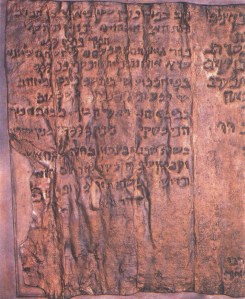
Copper scroll from Qumran, replica. Not a curse, just an illustration.

Copper scroll from Qumran, replica. Not a curse, just an illustration.


Avoiding Ritual

IMG_0100

While on my current British kick—not really intentional, but sometimes life gives you limes—I thought I’d mention another piece sent to me by a friend. This one falls under BBC Earth, and it’s about “Why Ancient Brits threw out their most valuable possessions.” You can find the story by Amanda Ruggeri at the link. The basics are pretty simple: some people with a metal detector discovered what turned out to be a Bronze Age “hoard” in Lincolnshire. You have to understand that, in a way that makes me totally jealous, the United Kingdom has tonnes of ancient artefacts still undiscovered. While my wife and I lived there it wasn’t unusual to read about such finds in the newspaper. (Newspapers still existed then.) People had been smelting in the British Isles for a long time. The Phoenicians actually popped round the pub to get their tin—which can be one of the main ingredients for Bronze. What the article somewhat embarrassingly addresses is the nature of the hoard.

Hoards are where a large number of (usually metal) objects are discovered, after having been deliberately buried. These are not uncommon, what with Phoenicians, Romans, Angles, Saxons, Franks, Vikings, and others invading all the time. The issue that embarrasses is the “r word.” Ritual. While we don’t know the reason, the fact that people deliberately deep-sixed their valuables, routinely, suggests a ritual. As the article makes clear, professionals try to avoid the r word. Ironically, such deliberate burials, often with items purposefully broken, is also known from the ancient Levant, often predating the hoards of the prehistoric UK. Intentionally broken items—often of clay, and not infrequently depicting perhaps deities—were buried in biblical times. We don’t know why, but scholars suggest they could’ve been offerings. After all, breaking something potentially useful is an act of faith.

I’m not suggesting a direct connection here. I took a sound scholarly thrashing some years ago for suggesting a tale I heard on the streets of late twentieth-century Scotland had its origins in ancient Sumer (grad students are prone to such thinking). Still, it might not hurt anthropologists to cast a wider eye now and again. People had similar rit— well, let’s just say strange habits, in a land far away. Just cross the Channel and make a left. When it starts getting arid head south. The ancient world may have had more of an “internet” than we think. While that pathway may not always be marked by material remains, we now know ideas travel fast. Even something such as putting a daily post on a blog might become a ri—, strange habit.


Latin Lessons

IMG_1134

The Romans are coming! The Romans are coming! No, wait. They were already here. Here, that is, if you’re European. And more specifically, a Londoner. The Guardian recently posted a story about the oldest writing in the United Kingdom being unearthed as Roman missives—originally written on wax that overlaid boards, Roman style—are being unearthed at the site of the new London headquarters of Bloomberg. Having spent many years of my life learning to specialize in ancient writings on original media, it always does me good to see hoi polloi getting excited about old texts. These Roman notes are so old that the marks on the wax have only survived by etching faintly onto the underlying wood, the wax having long ago deteriorated. The mundane writing wouldn’t have lasted had it relied on the original medium.

Even with their penchant for irony, the British don’t seem to have made much of the fact that the oldest writing in the UK has been located beneath what will become the headquarters of the media giant, Bloomberg. We will pay handsomely for good media. Anybody can coat a piece of wood with wax and scratch away. Almost nobody will read it. If it survives long enough after you die, it becomes a media treasure-trove. All the sudden we can’t wait to find out what Londinio Mogontio ate for dinner last night. Such mundane things we write about. Just to clarify, I’m talking about the Romans, not Bloomberg. Trenchant media information is, after all, what we live for. We must know what others think this commodity is worth. They’ll pay good money for that.

Tibullus will repay Gratus—it’s right there on wood. These guys were also worried about the exchange of commodities, it seems. And while nobody gives a Roman denarius anymore, we can get people’s attention by saying yes, the Romans were here. Sitting in this very spot before the cross has grown cold, making sure that accounts have been settled. The last thing you want is a Roman at your door demanding restitution. One does have to wonder what Junius the cooper thought about all this. Junius is the one with an office across from the house of Catullus. His barrels may have been broken down to make more planks for writing. The fourth estate gone wild. All that hard work would’ve gone unnoticed too, had not a major media giant decided, literally, to rake the muck under old London where before even the original tower was built friends, Romans, and countrymen were lending each other denarii. And one suspects, their beers, if Domitius Tertius Bracearius is who we think he is.


Good Goddess

This past week Asherah has been on my mind. Some of my readers will know that I wrote a book on Asherah, based on my doctoral dissertation. Those who’ve read it (admittedly few) will know that in it I lament the easy association of generic goddesses with a mythological figure with a distinct background and character. The complication has a number of sources, but became particularly acute when inscriptions reading “I bless you by Yahweh… and his asherah” were discovered at Kuntillet Ajrud a few decades back. Since then it has become neo-orthodoxy that Asherah was Yahweh’s wife and she represented trees, lions, goats, fertility, water, wisdom, and any number of other phenomena. Those who question this are called “conservatives” and evidence deniers. Those who write popular books on this assumption end up on news programs and some start appearing at conferences in very nice clothes.

Photo credit: Deror avi, Wikimedia Commons

Photo credit: Deror avi, Wikimedia Commons

So why am I thinking of Asherah? A friend sent me the news story of a female figurine discovered in an accidental find at Tel Rehov in Israel. Upon seeing the story, I was awaiting the inevitable equation with Asherah, but was surprised to read that Amihai Mazar, the archaeologist consulted, suggested it might be Astarte, or someone else. You see, figurines of naked females were quite common in ancient Israel. No consensus has arisen as to which goddess is represented, if any. They don’t have names inscribed, and they may have been like, ahem, action figures for the woman hoping for a child, or for the safe delivery of a child. We simply don’t know. The other reason I’m thinking of Asherah is that I recently read a book where it was simply assumed that Asherah was Yahweh’s wife.

Don’t get me wrong—I’d like to see Yahweh as happily married as any other god. In fact, I think it would be odd if nobody thought he was. There is a difference, however, between thinking this makes sense and grasping at minimal evidence to declare it a fact. If someone were to discover an unambiguous inscription reading, for instance, “Asherah and Yahweh sitting in a tree, k-i-s-s-i-n-g,” then I’d be the first to say mazel tov. I have no theological bias against it. The problem is we simply do not know enough about the goddesses of antiquity. We know there were many. And we know there were women who didn’t claim divinity as well. Who these figurines represent, we just don’t know. Perhaps Yahweh, even now out on a date with Asherah, is smiling down knowingly. If so, I wish them well. Until I see some unambiguous evidence, however, I will be a doubter.


Digging to Look up

Ancient technology is a growing field of interest. A couple years back I gave a talk about ancient technology at a local Steampunk convention. The smallish audience that attended had lots of questions about how ancient people accomplished marvels such as the Antikythera Mechanism, or even the pyramids of Egypt. As new discoveries continue to show, our antique forebears had access to knowledge we have always assumed to be beyond them. An article in Gizmodo tells the story of how Matthieu Ossendrijver, an astroarchaeologist (and hey, this was simply not a job description I ever found in a college catalog, for the record!) at Humboldt University, has been studying an Akkadian clay tablet (the article doesn’t specify which one, beyond “text A”) that demonstrates that the Babylonians understood one of the principles that led to calculus. Tracking the movement of Jupiter, the Babylonian priests knew that measuring the area under a curve could provide the distance traveled by an object. This principle, in the annals of science, wasn’t discovered until about 1350, C.E. Babylonians knew it over a thousand years earlier.

Jupiter_and_its_shrunken_Great_Red_Spot

Although we marvel at the engineering of the ancients, we tend to think of them as superstitious. After all, they believed in gods and things like that. As Maddie Stone points out in her article, however, priests were also astronomers. Believing that messages from the gods existed among the stars, peoples of ancient times kept careful track of the heavens. Apart from romantic couples looking for time alone, how many people spend an evening under the stars, looking up at a universe that is so much larger than the internet that it can actually made you shudder? There is a wonder out there that can’t be replicated electronically. People knew that the sky and the gods somehow belonged together, and they knew this millennia ago.

Given that many of us hold doctorates in reading ancient, dead languages (too many, perhaps), you’d think all the clay tablets found would’ve been read, catalogued, and neatly stacked away by now. This is far from the truth. Tens of thousands of tablets were excavated back in the days before archaeology became an endangered practice in places like Iraq and Syria. Crates full of these tablets were shipped to museums and few have been transcribed, let alone translated. There is ancient knowledge stored away among the receipts and chronicles and myths of people who lived in the cradle of civilization, and now that information remains buried in museum basements because it is deemed not worth the money spent to provide jobs for those who can read them. As is often the case, however, when we are willing to listen to others, even long dead, we are amazed at what we can discover.


To the Tower

A recent article in The Independent shows once again how deep our human need of magic can be. The Tower of London, among the oldest buildings in the city, and often considered the most haunted, was apparently protected by magic. Archaeologists have discovered ritual marks on the support timbers of the representative of the Queen’s residence that they believe were intended to keep the devil out. Given that building has been around for a few hundred years, that’s really not all that surprising. The amazing aspect, at least to me, is that the signs are a rare admission on the part of those in power that they are occasionally not in charge. In any case, now that Halloween is in the air, it seems appropriate to think about how even the most rich and powerful aren’t secure from spiritual anxieties. It’s no wonder that bishops were so powerful, back in the day.

IMG_0338

Since I’m writing a paper that discusses grimoires, magic has been on my mind lately. Anyone who follows the books I post on either this blog or Goodreads might easily discern that. The concern that Medieval people had with witches was their supposed ability to work magic. Ironically, historians of science are now suggesting that the study of magic may have led to what we now think of as science. In order to manipulate the physical world, you have to understand how that world works. Magic might have had some benefits for society after all. And we are still prone to magical thinking. It is deeply embedded in the human psyche. Magic, like miracles, can be fortuitous, but the prudent know better than ever to count upon them.

The Tower of London was the, or one of the, castle(s) of the city. Political prisoners were held there and often left with their heads in separate compartments. Even a regular tour of the grounds will include references to ghosts. A city as large and as sophisticated as London still can’t escape the past. The hex marks found by archaeologists may date from the early modern period—the time of the Reformation and thereabouts—but the human mind has not much changed since then. While we may not put secret marks on our buildings any more, we still instill them with a sense of magic. And people move out of haunted houses so often that some states have requirements to reveal troubling histories of properties before someone decides to buy. We are a society enamored of technology and future progress, and yet we stop and wonder when Halloween is in the air.


Henging Our Bets

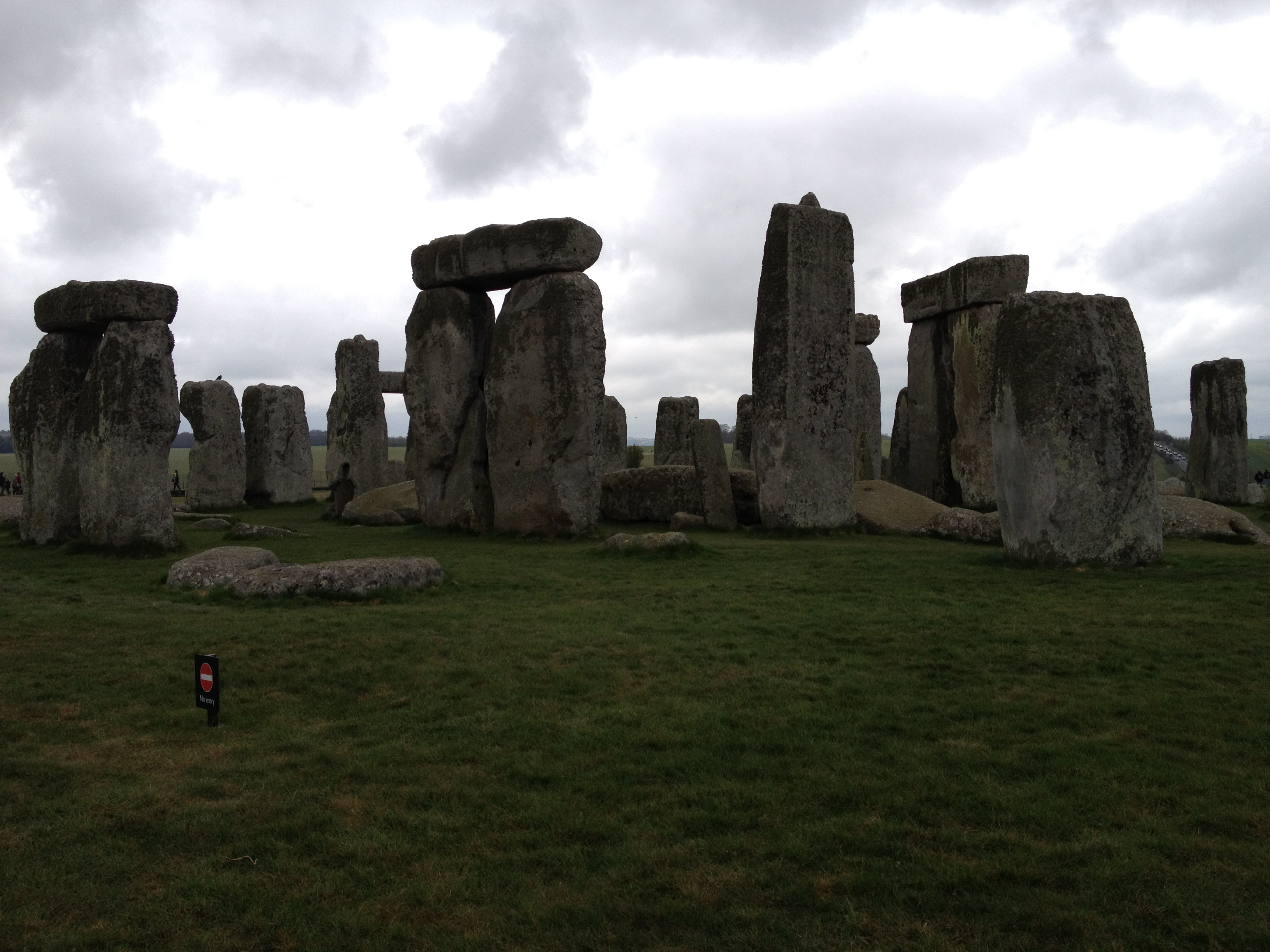
With the discovery of Göbekli Tepe, the history of civilization has received an unexpected prologue. In the view of the archaeologists involved in the excavation, the site can only be religious in nature, indicating that the earliest communal efforts of humans were not for mutual protection or for the benefits of growing crops, but for worship. In an era of angry atheists and nones, this isn’t really welcome news. Many people are ready to flush religion once and for all, claiming that it inspires only terrorists and fanatics to more and more extreme deeds. Well, I suppose Göbekli Tepe can be considered a form of extremism. Massive amounts of energy were required for the building of the site. And it was buried, intentionally, when the builders were finished with it. The news of a new component to the much later Stonehenge complex, the Durrington Walls, has recently been presented. Stonehenge, in England rather than in Turkey, and much closer in time to us than Göbekli Tepe, is a site that has touched the human imagination in a profound way. Still primitive at the time of its construction, Britain was a land already brimming with religious monuments. The new discoveries make it even more intriguing.

IMG_0234

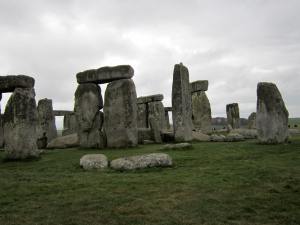
Stonehenge is only a small part of what is now being called the Durrington Walls super-henge. Those who visit Salisbury Plain know that Silbury Hill and West Kennet Long Barrow are both impressive in their own right, and not far from the more famous sarsen stones that appear on everything from coffee mugs to tee-shirts and in movies and television shows of all genres. This part of prehistoric England seems to have been a sacred site many hectares in extent, with various “temples” and monuments dedicated to a religion we simply don’t understand. What is clear is that massive human energies were put into the building, expanding, upkeep, and functioning of this site. People have a deep, and very passionate urge to answer the religious longing that even sophisticated engineering can’t placate.

It could be argued, of course, that we’ve outgrown our childhood need for parents in the sky. Science and rational thought have shown us the way forward and although ancient monuments might be a fun diversion, they really mean nothing. I would disagree. Places like the Durrington Walls super-henge indicate what it is to be human. Clearly, given that even Stonehenge fell into disrepair and lay neglected for centuries, it was not a continuity that stretches, uninterrupted to today. Nevertheless, the effort expended to fill a void we feel should tell us something about what being conscious creatures is all about. Life doesn’t always make sense. The rational cannot explain everything. It would be naive to try to make Stonehenge reveal its secrets, but even standing at a distance (which is the only way you can gain admission any more) you have the sense that you are among those who knew what the human spirit required. Even if pagan and illiterate, they have spoken to us through the ages and we can only continue to wonder at what we’ve lost.


Doubt No Alleles

Image credit: Zephyris, Wikimedia Commons

Image credit: Zephyris, Wikimedia Commons

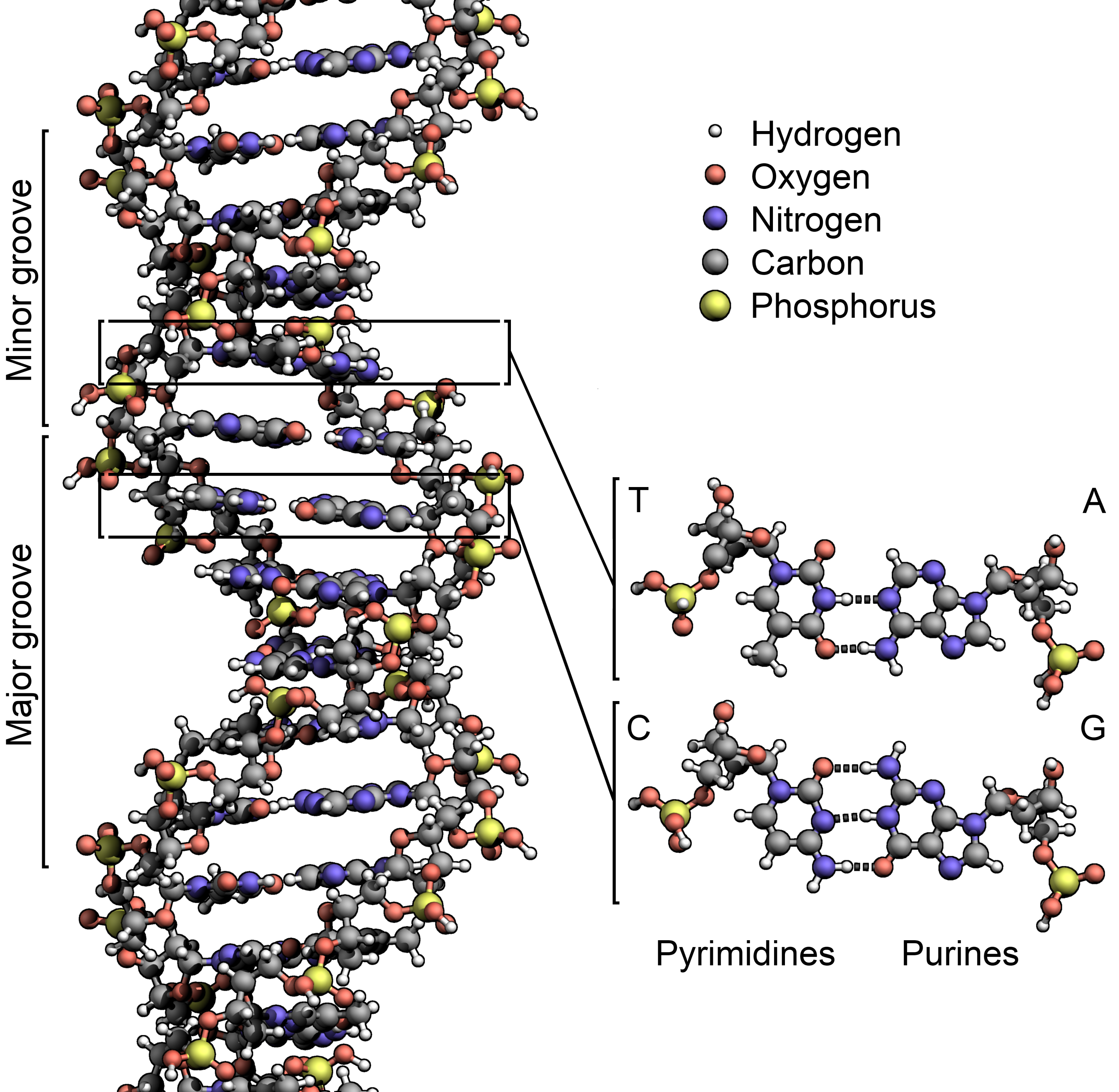
DNA. Is there anything it can’t do? For many decades anthropologists have built painstaking methods to trace developments in human culture. Those of us who’ve studied linguistics in any fashion remember well the many times instructors corrected our false cognates and pointed out family trees of languages that showed who came from whom, based on subtle shifts of orthography or some other aspect of philology. Entire careers could be made in ancient Near Eastern studies by shuffling around the way words were formed and speculating about how they influenced one another. Then DNA. A recent story in the New York Times demonstrates that DNA studies now tell us whence came the Europeans. Among the three groups that eventually settled in Europe were agriculturalists from the Near East, coming along at just about the same time as the Sumerians show up in southern Iraq. They joined the hunter-gatherers already in situ. Their languages, however, did not dominate as a third group, from western Russia showed up and gave (according to DNA) many of the groups their base languages. And here I thought Latin and Greek and Anglo-Saxon had something to do with it.

No doubt we’ve benefitted much from learning about DNA. We can fight diseases that were mysterious, if not divine, in previous centuries. We can learn how closely we’re related to other animal species, or even the neighbor next door. Sneaky fathers can be determined with a precision that sometimes puzzles, such as the recent story of twins who had different biological fathers. Without DNA such a thing could only have been a myth. I wonder, however, what we’re losing in terms of humanity. I suppose we’ll still need a few archaeologists to dig up the remains for scientists to date. And many traditional cultures will still insist that the human remains uncovered be reinterred and not probed and prodded, even after death. We’ll call them backward and superstitious. We’ll consult the genome and decide who to marry.

Meanwhile some hopeless romantic will insist on sitting off in a corner and composing sonnets to the woman he irrationally loves. Looking at the nighttime sky, he may compare her to the beauty of the moon. We know it is a lifeless rock trapped in our own gravity, mechanically reflecting the light of a burning ball of hydrogen and helium 93 million miles away. And if she’ll run this cotton swab across the inside of her cheek we might well be able to tell if she’s a good choice for mating purposes. We’ll also be able to determine the origins of her ancestors and remove a great deal of the mystery about her—there! Won’t that be better than having to woo her and find all that out for yourself? And when your children grow up you’ll point them to the STEM disciplines, since that is the only direction in which there is any human future. And the anthropologists can join scholars of religion as we wait for someone to put the soup in our bowls.


Middle Eastern Idol

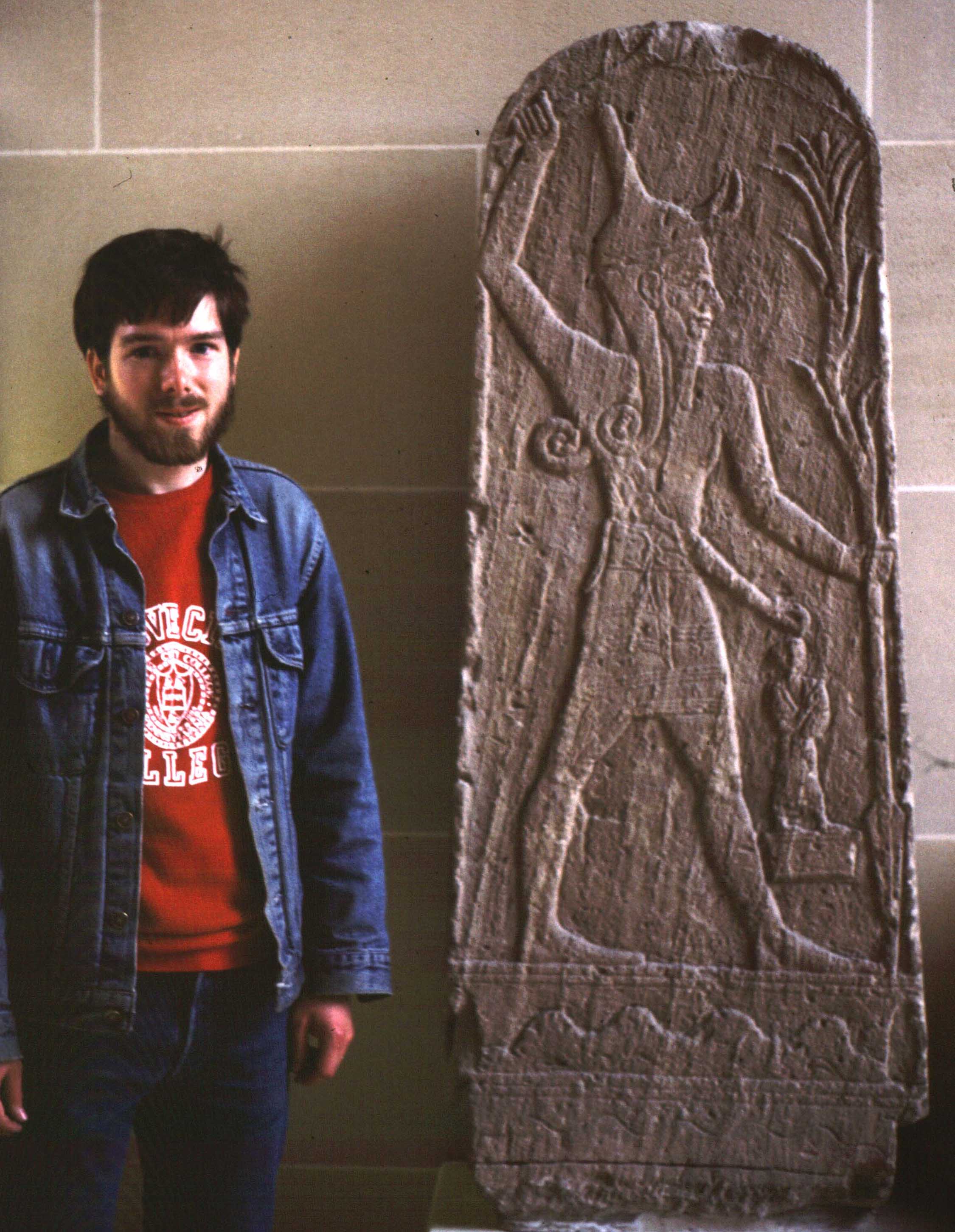
As the Passover-Easter complex of holidays approaches, our stern, scientific face turns toward the more human sensibilities of religion and its impact on our lives. PBS recently aired the Nova special The Bible’s Buried Secrets (originally aired in 2008) and when a colleague began asking me about it I figured I’d better watch it. As an erstwhile biblical scholar there wasn’t much here that was new to me, but one aspect of the program bothered me. Well, to be honest several things bothered me, but I’ll focus on one. When referring to the gods of the Canaanites, among whom the program readily admitted the Israelites should be counted, they were invariably referred to as “idols.” The problem with this terminology goes back to an issue I frequently addressed with my students—the term “idol” is a way of demeaning the gods of a different religion. Implicit in the word is the assumption of the monotheistic worldview and its attendant problems.

The Bible’s Buried Secrets seemed to adopt an overly optimistic view of the monotheistic religions sharing the same god while everyone else worshipped idols. The view is as fraught as it is simplistic. Historically Judaism, Christianity, and Islam are certainly connected. Each recognizes in the others a glimmer of its own theology and outlook, but the concept of deity has shifted somewhat at each development. Judaism and Islam are rather aniconic, especially compared to many varieties of Christianity where images are allowed, or even encouraged. It is difficult to grab the attention of the magazine-reading public with an image of invisibility on the cover. It should come as no surprise that some Jews and Muslims believe Christian images to be, well, idols.

An idol moment?

An idol moment?

The word “idol” is by nature pejorative. Ancient people were sophisticated polytheists. That statue that represented a deity was not thought to be that deity in any absolute sense. Rituals assured the ancients that they were instilling some aspect of divinity into the statues they used, making them sacred in the same way a Christian consecrates a church building. What’s more, it is natural for people to seek a visual focus for its devotion. It is difficult to conceptualize the Almighty as a person without giving it (often him) a body. Islam, especially, has been adamant that this can’t be done, and looking back at Christian practice it is sure to see idols abounding. As the holy days begin for our vernal celebrations, we should perhaps use the opportunity to rethink such religious vocabulary since every orthodoxy is someone else’s paganism.


To See the Sky

Stonehenge. The very name evokes mystery and myth. Although archaeology has revealed more about the monument than any mere visual survey, we are still very much in the dark about its origin and purpose. With one exception: we know it was something religious. When we discover artifacts that required a tremendous outlay of human effort in pre-industrial periods, the motivation, according to our current understanding, is almost always religious. Modernity has come to us with a cost. In any case, a recent story in The Guardian highlights the view of Julian Spalding, erstwhile museum director, that Stonehenge might have housed a platform on top of which the real action took place. As might be expected, experts disagree. With its precise solar alignment, one wonders if a roof might have been superfluous, but then again, there is the sky.

IMG_0129

When I begin to feel depressed working in the belly of a concrete bunker with no windows, indeed, no view of the sky at all, I find my way to a room with a view of the outside. I’ve always had a celestial orientation, and looking at the sky—especially on a day with some blue showing—can cure my sadness in a way almost supernatural. I suppose that was part of the reason I wrote Weathering the Psalms; there is just something about the sky. In that book I couldn’t really verify what it was. I still can’t. I know it when I feel it, however, and this perhaps the feeling the Julian Spalding is asking us to explore at Stonehenge. Ancient people directed their worship upward, not toward the ground.

Like all universal statements, however, there are exceptions. Some ancient religions recognized our place as children of the earth. The celestial sphere, however, is part of the package. Our atmosphere makes our world habitable. While the moon is beautiful and Mars inspires wonder, their lack of air spells their hostility toward those who need to breathe deeply and look up into the blue once in a while. Almost Frazerian in its archetypal view, Spalding’s idea has a beauty of its own, whether or not the evidence bears it out. People of ancient times had a talent we lose in our cubicle-infested, results-obsessed world. We all exist because of the atmosphere above us. And when modern views become too much for me, I head outdoors where, sun or not, I find my solace in the sky.