Here Comes the Bride – Maybe

Kuntillet

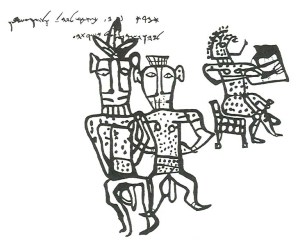
This is one of my favorite doodles from the ancient world. Its rich ambiguity lends to its appeal — some see it as salacious, while others see it as sacred. For those of you unfamiliar with the graphic details of the Asherah debate, this image is an ancient graffito from a desert way-station called Kuntillet Ajrud, a one-period site from the eighth century BCE. Like any number of other ancient drawings, this one would have probably remained in the obscure curios-portfolio of ancient scholars if it hadn’t overlapped an inscription that mentions “Yahweh of Samaria and his asherah.” Discovered in 1975–1976, this inscription, along with a couple others, revolutionized many scholarly assessments of ancient Israel’s religion. Yahweh had a soft side after all, a wife no less, the old god!

I’ve taken some flak in my circumscribed academic career for suggesting that this inscription, and a perhaps somewhat similar one from Khirbet el-Qom, are ambiguous. Sure, I’d like to see Yahweh happily married as much as the next guy, but is that what is going on here? Yahweh and Asherah, sittin’ in a tree? My doubts don’t stem from a squeamish conservatism (come on!) but from a concern of over-interpreting ambiguous evidence. Asherah, as a goddess, was rediscovered with the excavation of Ugarit. Forgotten by time with only cryptic references in the Hebrew Bible to some kind of cultic item called an “asherah,” scholars were excited to learn that she had a body and a personality. Many aspects of that personality fit, circumstantially, with a lovely pairing with Yahweh; wherever Asherah appears she is the consort of the high god, she is royal, matronly, and never showy.

The image above, however, has nothing to do with the inscription it overlaps. The two larger figures in the foreground are clearly Bes, the minor Egyptian protective deity. The characteristics are so clichéd that only the will to see Yahweh and Asherah arm-in-arm suggests anything different. Scholars like a happy ending just as much as anybody else, but I am obligated to state that, taken objectively, Asherah simply isn’t in the picture here.

For God and For Gold

The Associated Press today released a story about an Anglo-Saxon treasure hoard discovered in England this summer. The trove, which likely contains at least 1500 items, many of silver and gold, is calculated to cause substantial reassessment of Dark Age England. Leslie Webster, a former curator at the British Museum, suggested that given the nature of the artifacts, new light could be cast on the relationship between warfare and Christianity.

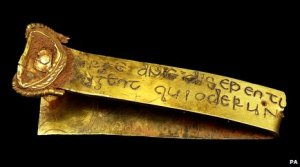
Apart from the obvious deliria of daydreams of wealth that such finds always drag in their cloaks, this treasure once again underscores the connections between religion and violence. The Anglo-Saxons, Germanic invaders of England following the decline of the Roman Empire, had been early converts to Christianity. Even Alaric the Goth was a good Christian, although he had little patience with the oversight of Rome. The recently uncovered hoard contains mostly military trophies, but among the finds was a gold strip reading “Rise up, O Lord, and may thy enemies be dispersed and those who hate thee be driven from thy face” (Numbers 10.35). Already bloggers are drawing comparison with Jules’ quote from the fabricated Ezekiel 25.17 in Pulp Fiction, but the connection of Christianity and conquest is much more intimate than that. Once Christianity became the official Roman religion under Constantine, the imperial imperative took over. It became a religion of conquest. A similar phenomenon occurred after the advent of Islam. The zeal of the converted should never be underestimated.

I'm trying really hard to be the shepherd

I'm trying really hard to be the shepherd

So, what are we to make of this scriptural quote among sword knobs and doom sticks? Is it simply more evidence that religions, like the Roman Empire (according to Octavius) “must grow or die”? Those who believe carry a deep-seated fear that their religion might be proven false. On it ride serious (and often eternal) consequences. One way to ensure the quelling of that fear is to silence the heretics who decry the one true faith: take up your swords and nukes and threaten the infidel. The road less traveled, however, is to rise above our insecurities and simply enjoy the ride.


Bosnia Jones meets Egypt Jones

Scholarship is a remarkable human achievement; so many people from countless backgrounds sparring over ideas with comparatively little bloodshed should be applauded. In the political and religious worlds where armaments are often thrown into the mix, well, the results are colorful but often less kind. I was reminded of this when one of my students recently showed me a copy of a letter regarding a somewhat outlandish claim by Sam Osmanagic (see Momma Maya: Is It the Apocalypse Already? for more on him). Osmanagic, who is studying for a doctorate, has recently added another hapless cause to his dossier of unlikely mysteries of the human past. Investigating Visocica, a hill in Bosnia, Osmanagic has concluded that it is really a pyramid.

The letter to which I referred, written by the irrepressible head of the Antiquities Council of Egypt, Dr. Zahi Hawass, is very gentle. Hawass, a kind of self-styled Egyptian Indiana Jones, notes in a letter to Archaeology magazine, “What was found there is really just a mass of huge stones, evidently a natural geologic formation.” He does, however, also note “His [Osmanagic’s] previous claim that the Maya are from the Pleiades and Atlantis should be enough for any educated reader.” Interestingly enough, Osmanagic is a self-styled Bosnian Indiana Jones, and he has written a book arguing for the pyramid option. Meanwhile, most serious scholars are more circumspect about the claims of any Indiana Joneses. After all, to quote Raiders of the Lost Ark, “archaeology is not an exact science.”

I am sometimes challenged by those who discover that I read such things as Drosnin (see Edoc Elbib Eht) or Osmanagic, but despite my objections to their conclusions that I inevitably reach, I want to hear them. Scholarship suffers from silencing the maverick voices. I have never ascribed to the principle that a person has to have a Ph.D. to be credible; often the reverse is true. I have met many Ph.D.s barely worth listening to while some of the most profound thoughts I’ve encountered came while I was working as a janitor’s assistant, listening to my boss. He was a man who engaged in physical labor that afforded him time to think. No, I do not buy Drosnin or Osmanagic’s conclusions, but I applaud them. Scholarship would be dull if not for those willing to take chances out there on the edge of credibility. (And wearing cool hats while doing it.)