Don’t Stop Moving

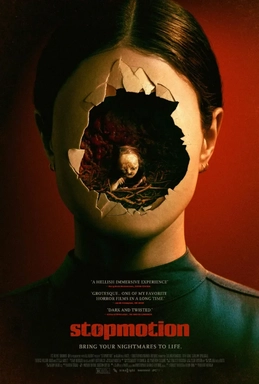
Stopmotion is a strangely affecting horror movie.  Body horror as well as Euro-horror, it follows the dream-like world of Ella, a stop motion animator.  She learned the trade from her mother who, suffering from arthritis, has Ella do the work for her.  After her mother has a stroke, Ella continues working on her final film but in a new location.  Tom, her boyfriend, gets her an apartment in a run-down building where Ella meets a precocious and odd little girl who tells her she should film a different movie and proceeds to tell Ella how it should go.  To her chagrin, Ella has to admit that the little girl’s story is better than her mother’s.  With the girl’s help, Ella animates a monster, the Ash Man, who is pursuing a girl lost in the woods.  Then Ella starts receiving visits from the Ash Man, or at least she believes so.  She ends up in the hospital. Spoilers follow.

Tom, who visits her there, is worried that Ella has let this go too far.  He threatens to delete the film while she’s immobile in the hospital.  Ella’s mother dies and with the little girl’s help, Ella gets back to her apartment to finish the film.  When Tom, and his plagiarizing sister, come to return Ella to the hospital, she kills them both.  She then, with the girl’s help, finishes the film.  The film results in her own death, or at least that’s the way she sees it.  The film features quite a lot of stop motion animation although the movie itself is live action.  It’s a very artful, if gross, film.  The little girl is never seen by anyone else, nor explained, suggesting that she’s a younger Ella following her own creativity.  And paying the price for it.

I can’t claim to understand everything that happens in this movie.  That doesn’t make it bad, but worth pondering.  Those of us who live creative lives experience dry patches, and often, self-doubt.  I know that when I compare my writing to that of others, I suffer in the very comparison.  When Stopmotion first ended, I felt both confused and intrigued.  Euro-horror of recent years, to generalize, emphasizes the art of the craft.  There was a lot of symbolism in this movie, some of which I couldn’t connect to the action.  I suspect repeated viewing might bring some of this to light.  My family has often told me that with my focus and interests, I would’ve been a good stop motion animator.  I certainly have the creating monsters part down pat.  It’s just a matter of deciding which narrative to follow.


Precedes Essence

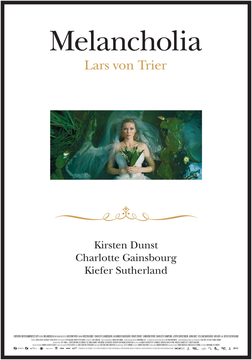
Lars von Trier makes existentialist art films that sometimes veer into horror.  Antichrist was such a film, and one of the more disturbing that I’ve ever seen.  Melancholia was initially welcomed in a kind of reserved way, as I recall, when released in 2011.  A few years ago I sat down to watch it and didn’t quite make it halfway through.  The pacing wasn’t terribly moving and the story depressing.  These days Melancholia has been upgraded to one of the best movies of this century, so far.  It was a rainy Saturday and I decided to steel myself to try again.  It is an art movie, but not horror.  There are horror elements, but it is more about the torment of existence—existentialism again—as two sisters anticipate and face the collision of the earth with a rogue planet called Melancholia.

The ultra-slow montage at the beginning lets the viewer know that earth will not avoid or survive this collision.  Then Justine, one of the sisters, is shown heading toward her wedding reception.  She’s already depressed and the first hour or so of the movie shows the troubled interactions at the reception.  When things finally begin to wind down near dawn, she refuses to consummate the wedding and sends her new husband away.  Cheerful stuff.  The focus then shifts to Claire.  She and her husband John, and their son, are enormously wealthy.  They are also aware that Melancholia is approaching.  John insists that the calculations show it will be a near miss, but one nobody would want to miss seeing.  Claire isn’t so sure.  Justine comes to stay with them.

As the effects of the larger planet’s proximity begin to be felt, John realizes the calculations are wrong and dies by suicide.  Claire and Justine have opposite views of the impending end, with Justine declaring life is evil and should be wiped out (again, existentialism).  Then worlds collide.  This is a disturbing, but beautifully shot film.  I found out that it is, after Antichrist, the second of von Trier’s “Depression Trilogy.”  As someone seeking joy in melancholy, I’m glad to have seen the film.  I knew the planet collision plot, but I try not to read about movies in advance, so I wasn’t sure if this would be horror or not.  It was pretty clear from Antichrist that von Trier suffers from depression.  Melancholia confirms this and is a poignant cry of distress at being helpless in an uncaring universe.  And it invites viewers to ponder this as well.


Painting Sleepy Hollow

Not being an art critic, I’m in no place to analyze John Quidor’s The Headless Horseman Pursuing Ichabod Crane.  Having written a book about Sleepy Hollow, however, there are a few things I might point out.  I should begin by noting that this post was spurred by a jigsaw puzzle.  Normally I only work on said puzzles around Christmas time.  Several years ago friends told us about Liberty Puzzles.  They’re made of wood and are heirloom quality.  My wife took the hint and she generally orders one, on behalf of Santa Claus, each year.  We have a few now but since we only do them once a year (and usually only one of them at the time), I had forgotten that we had a Liberty Puzzle of Quidor’s painting.  The original is located in the Smithsonian and I really didn’t discuss it in my book.  The painting is dated 1858, almost forty years after the publication of Irving’s tale, but while Irving was still alive (he died the next year).

John Quidor, The Headless Horseman Pursuing Ichabod Crane, public domain via Wikimedia Commons

The painting is correct in displaying a pumpkin that isn’t a jack-o-lantern and it presents one of the obvious difficulties of painting a nighttime scene.  The painting is fairly dark.  One of the benefits of working on a puzzle like this is you look closely at the scene.  My first thought was that it seems odd that the lightest part of the painting is Gunpowder’s rump. Next is the path.  The path draws the viewer’s eye back to Gunpowder and an understated Ichabod Crane.  I realized that the lighting is meant to reflect the moon’s rays, as the orb is just peeking through the clouds at the upper left.  And, of course, Quidor was not painting from real life.  On the right lie some small buildings, including the Old Dutch Church.  The Headless Horseman blends into the dark, which is exactly how Irving describes him in the story.  There’s no bridge, however, at least not yet.  All of this matches the wording of the legend.

Quidor painted mostly scenes from Washington Irving’s works.  Having been born in Tappan, during Irving’s lifetime, that makes sense.  He was also painting before the Disney cartoon came out.  One of the cases I make in Sleepy Hollow as American Myth is that the image most Americans have of the story comes from Disney.  The painting has no sword, and indeed, neither does Irving.  The one dramatic effect Quidor allows is the raising of the pumpkin before the bridge.  That takes place later in the chase.  In a sense this painting is perhaps the most authentic visual interpretation of Irving’s story before it made the transition to celluloid.  It’s puzzling.


Framing

Have you ever gone into one of those art museums where the frame of a painting is so lavish that you notice it almost more than the art it contains?  It certainly says something about me (or where I shop), that I prefer simple frames.  Those that ideally pick up and emphasize something in the picture.  I recently critiqued a book on this blog because the framing seemed off.  Not a week afterwards I found myself going down an internet rabbit hole (the topic isn’t important) because someone had framed a speech so that it seemed to be reading things one particular way.  With that framing, I watched the speech and was astonished.  Then I sent it to one of my brothers and he pointed out that it could be understood a different way.  At first I was embarrassed and defensive (to myself), but I went back and listened again and realized he was right.  I’d accepted the framing uncritically.

We are incapable of seeing everything.  From the shape of our eyes to the limits on our distance vision, we can only take in so much.  That’s what frames are for.  We put them around paintings, photographs, posters, windows, and mirrors.  The demarcate the limit of something.  This image goes only so far.  Televisions used to do that, although now they seem to take up a wall instead of a framed corner space.  But even so.  Movie screens too.  They provide important context.  We know, looking at that screen, that something limited to that screen will appear.  We know that what’s caught in the picture frame can’t reach beyond it, physically.  (I am excluding some modern art, of course.)  Framing is important.

I am glad for this recent object lesson.  I was letting myself get worked up over something I may have viewed the wrong way because I had been primed to do so.  It involved one of my deepest wishes, so emotion definitely played a part in it.  Critical thinking involves looking at the frame and thinking about it as well as what’s inside.  Those who excel at creating content make you forget the frame is there.  The artist isn’t painting to fill a frame, the frame contains the art.  We all know this on some level, I suspect.  Nevertheless, when someone presents us anything with the interpretation built in, we need to ask ourselves if that interpretation is inherent in the object or is it simply part of the frame.  And if it’s the frame, no matter how fancy, we need to remove it and look from a different angle.


Museum Life

Allentown is the third largest city in Pennsylvania after Philadelphia and Pittsburgh.  Here in the Lehigh Valley it abuts Bethlehem and is just a few miles from Easton.  Getting an early jump on Memorial Day this year my family visited the Allentown Art Museum.  My daughter had been there before and let us know that it’s not huge, but certainly worth seeing.  They do have a Rembrandt among their collection, and a few Medieval pieces, including a tapestry that I could swear I saw on a book cover once.  In any case, I would recommend it.  We’re still fighting with rain around here, so it was a great Friday diversion.  We’re museum people, and I’ve pursued creative outlets my entire life.  I like to look at those good enough to be on public display.  As I told my family, when I was young I was curious about art and checked out books from the library on the great masters so that I could learn to identify paintings I hoped some day to see.  And as a bonus, the Allentown Art Museum is free.

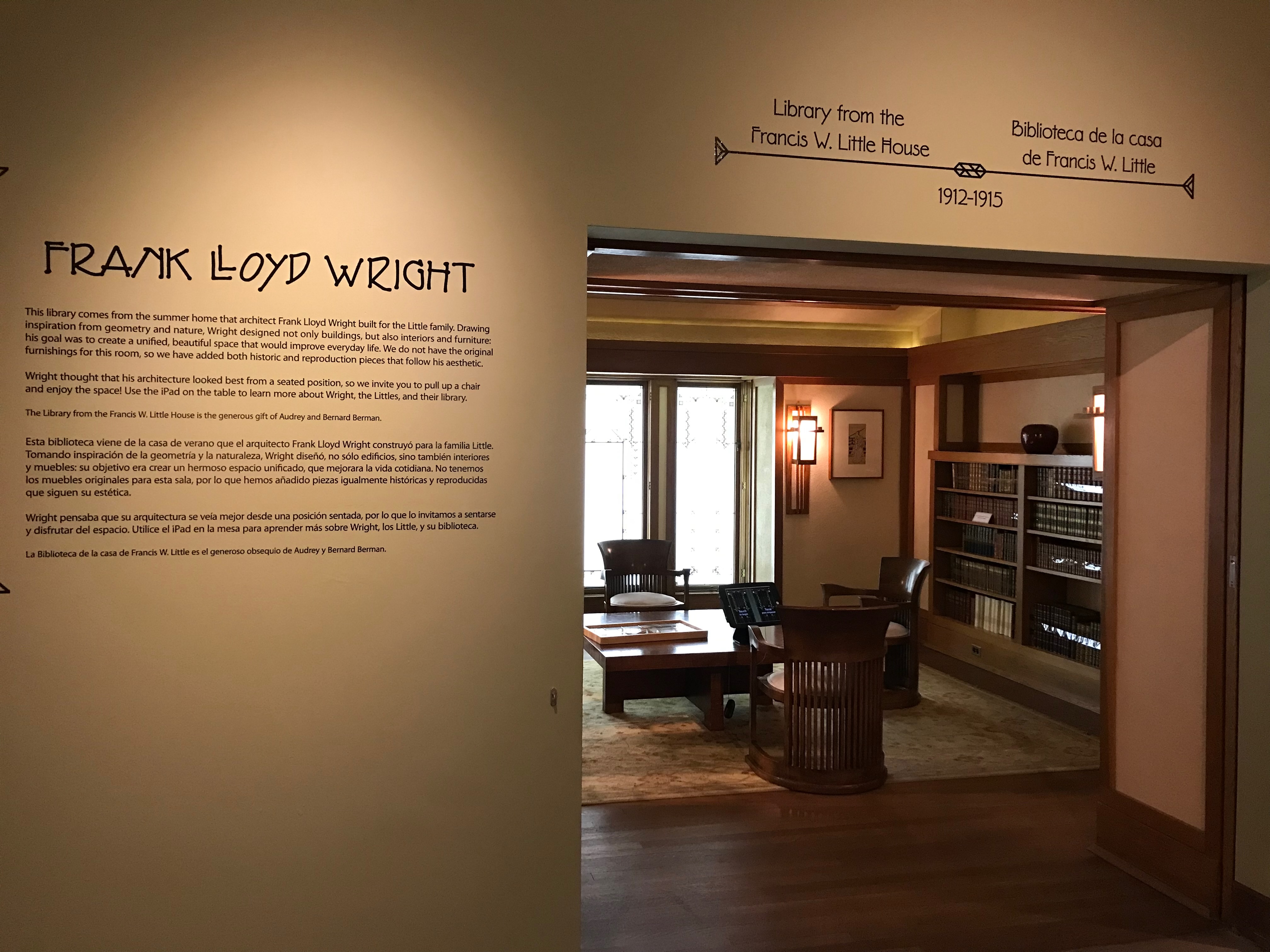
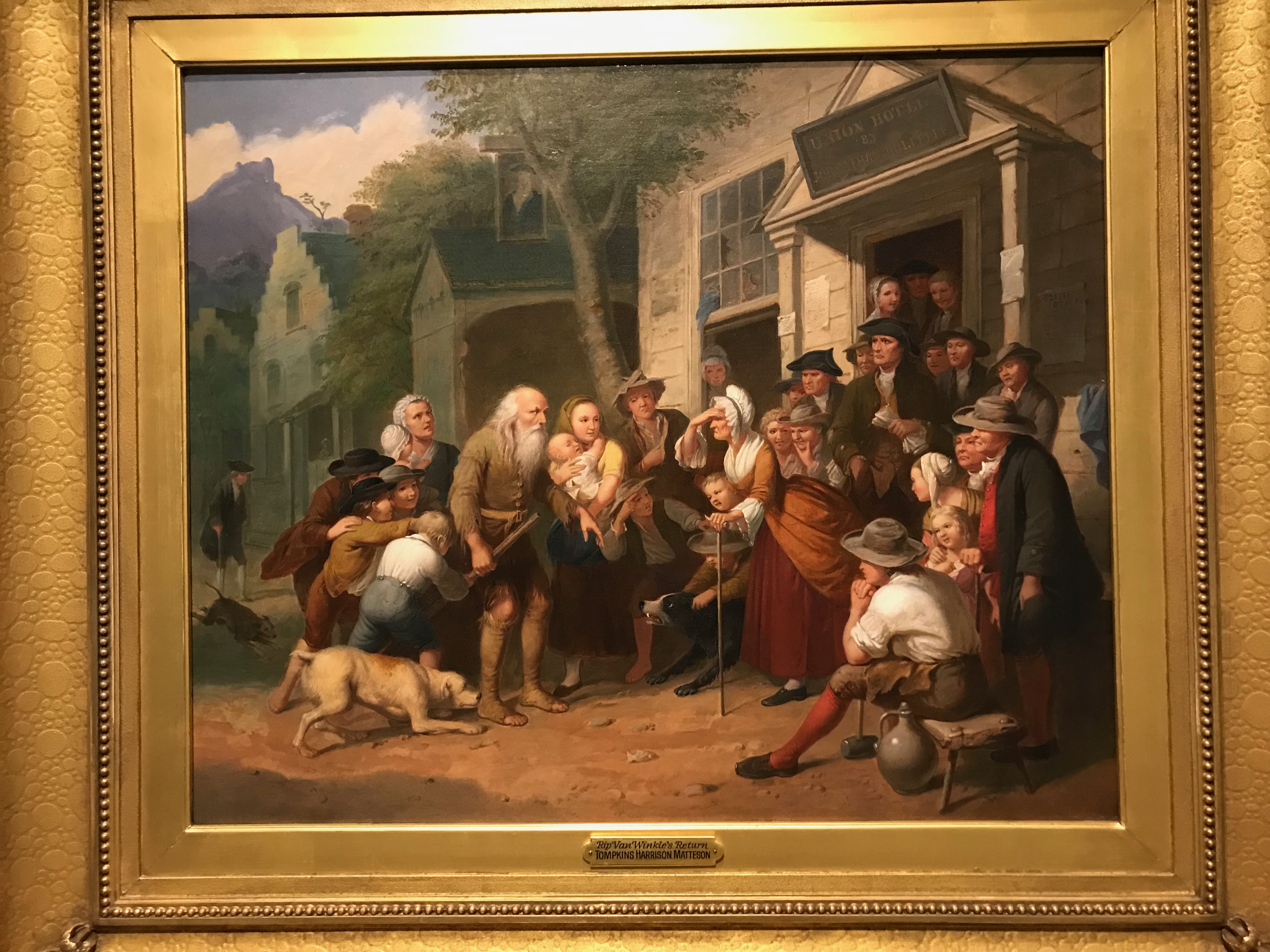
One of the features of the facility is a personal library designed by Frank Lloyd Wright.  The books on display aren’t his actual books (I don’t think), but being a book person I had to look over the titles.  Washington Irving was well represented.  Since Sleepy Hollow as American Myth will be out shortly, I was curious to see if they had The Sketchbook of Geoffrey Crayon, Gent.  This is the book in which “The Legend of Sleepy Hollow” first appeared.  It seems they have all of Irving’s books because I did indeed find the Sketchbook.  Such an unexpected connection was a bonus on what was already an enjoyable visit.  I wandered out into the paintings again and found Tompkins Harrison Matteson’s “The Return of Rip Van Winkle.”  As I discuss in the book, “Rip Van Winkle” is also in the Sketchbook.  Not for the first time, I’d made a personal connection with art.

Visiting art museums always leaves me in a liminal space.  For a while my soul was mingling with those of others driven by creativity.  I’ve made a few art works myself over the years but I’ve really had no training.  I did take a drawing and painting class in college, but I kept none of my output.  I enjoyed making it, however.  My daughter asked why I don’t do more and the issue always comes down to time.  Work takes the lion’s share and now weed control (they love the rain) takes most of the rest.  And writing, of course.  That’s why I need to go to museums.  To become fully human again.


Imagine Monsters

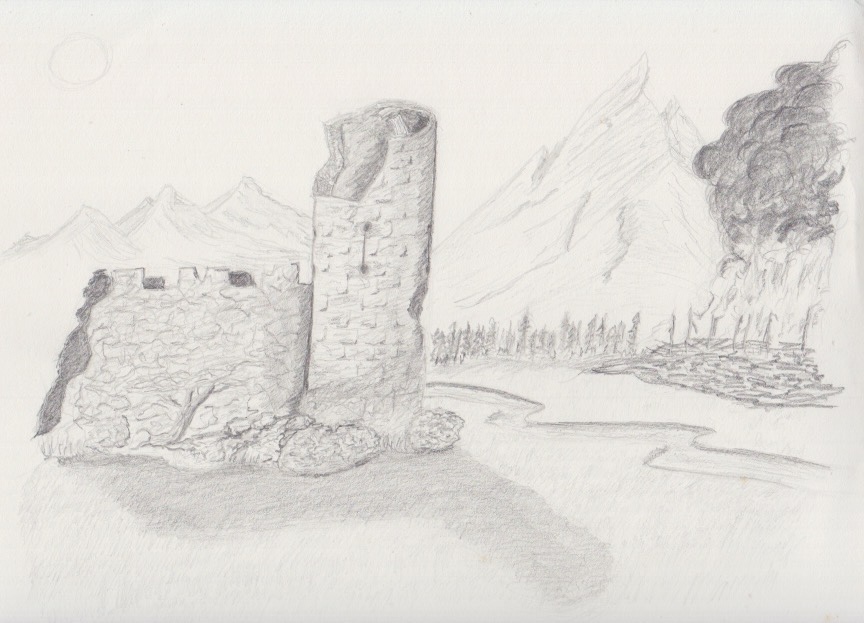
Adulthood is where you begin to recognize the folly of growing up.  Like most people, when I “matured” I was ashamed of things I made as a child and, regretfully, threw them away.  This came back to me recently as I was thinking of a sketchbook—actually a scrapbook that I repurposed in my tween years.  I love to draw.  I don’t do it as much now as I’d like (thanks, work!), but I was encouraged in it by art teachers throughout school who thought I had a little talent.  The sketchbook, however, was only ever shown to my brothers, but mostly only looked at by me.  This particular project was where I was making up monsters.  As with my writing, I’d never taken any drawing classes, but I had an active (some say overactive) imagination.  (That’s still true.)  

In any case, a discussion with my daughter brought back memories of this book I’d discarded by the time I went to college.  I still remember some members of the menagerie I’d concocted.  Even now that I’ve seen hundreds of monster movies, most of those I’d fabricated as a child have no peers that I’ve seen.  These weren’t monsters to be incorporated into stories—they were purely visual.  Although, I can say that my first attempted novel (probably around the age of 15) was about a monster.  I got away with being interested in monsters in high school, but college was a wholesale attempt to eradicate them.  Even so my best friend from my freshman year (who left after only a semester) and I made up a monster that lived in the library.

As an academic, until very recent years, monsters were off limits.  If you wanted to be sidelined (and in my case it turns out that it wouldn’t have mattered) you could explore such outré subjects.  Now it turns out that you can get mainstream media attention if you do (as a professor, but not, it seems, as an editor).  I’m sitting here looking back over half-a-century of inventing monsters, with a sizable gap in the middle.  The interest was always there, even as I strove to be a good undergrad, seminarian, and graduate student.  Now I can say openly that monsters make me happy.  I can also say, wistfully, that I’d been mature enough to keep that sketchbook that preserved a part of my young imagination.  It was tossed away along with the superhero cartoons I used to draw.  And the illustrations of favorite songs, before music videos were a thing.  Growing up is overrated. 

A surviving drawing, unfinished

Major Drum

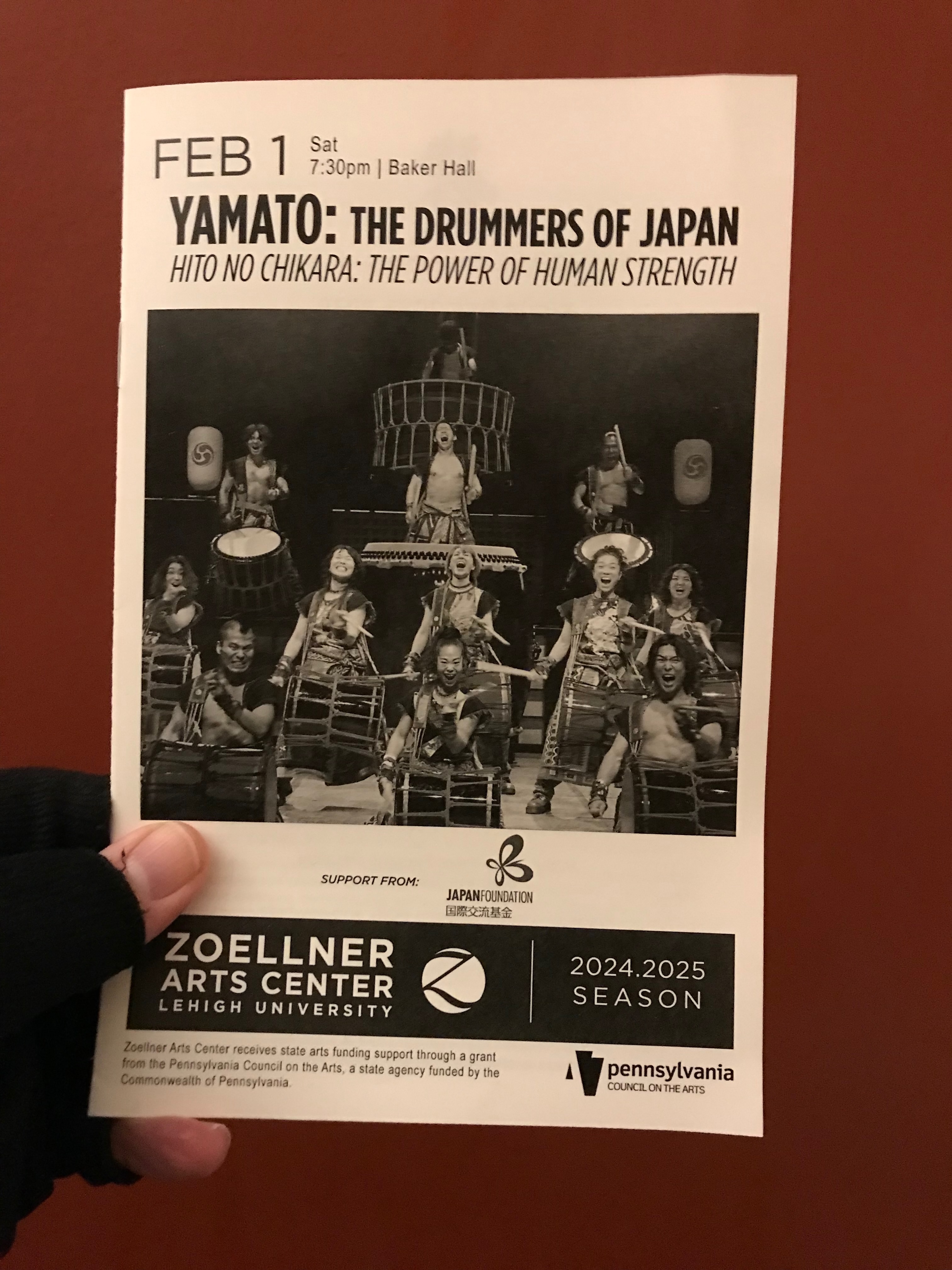
We don’t get out much.  Live shows can be expensive and these cold nights don’t exactly encourage going out after dark.  Living near a university, even if you can’t officially be part of it, has its benefits, though.  Over the weekend we went to see Yamato: The Drummers of Japan.  Our daughter introduced us to the concept while living in Ithaca, a town that has a college or two, I hear.  These drummer groups create what might be termed a sound bath, that is profoundly musical while featuring mainly percussion.  Now, I can’t keep a beat for too long—I’m one of those guys who overthinks clapping in time—but that doesn’t mean I can’t appreciate those who can.  The timing of the members of Yamato was incredibly precise, and moving.  At times even funny.  It’s a show I’d definitely recommend.

This particular tour is titled “Hito No Chikara: The Power of Human Strength.”  Now this isn’t advertising their impressively well-toned bodies, but is a celebration of human spirit under fire from AI.  The program notes point out some recurring themes of this blog: to be human is to experience emotion, and to know physical limitations, and to be truly creative.  Would a non-biological “intelligence” think to wrap dead animal skins around hollowed out tree trunks, pound them with sticks and encourage hundreds of others to experience the emotions that accompany such things?  I live in a workaday world that thinks AI is pretty cool.  Humans, on the other hand, can say “I don’t know” and still play drums until late in the night.  We know the joy of movement.  The exhilaration of community.  I think I can see why they titled their show the way they did.

Bowerbirds will create nests that can only be called intentionally artful.  Something in biological existence helps us appreciate what they’re doing and respond in wonder.  Theirs is an innate appreciation for art.  It spans the animal world.  Japan is one of many places I’ve never been.  I’ve never played in any kind of band and you don’t want me setting time for your pacemaker.  If a computer keeps such precise timing we think nothing of it.  It’s part of what humans created them to do.  When a group of people gets together, stretching their muscles and working in perfect synchronicity, we sit up and take notice.  We’ll even pay to watch and hear them do it.  Art, in all its forms, is purely and profoundly biological.  And it is something we know, at our best, to appreciate with our emotions and our minds.


LA Story

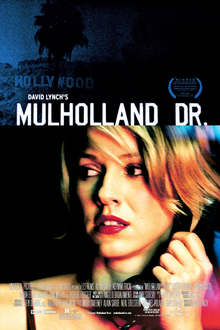
David Lynch movies aren’t always easy to understand.  Last year we watched Twin Peaks, including the movie Fire Walk with Me.  Some time before that I’d watched Eraserhead.  My earliest, and unwitting, experience with one of his movies was Dune, which I saw in a theater in 1984.  I had no idea of who Lynch was at that time, however.  As I began exploring the horror genre I found a contingent strongly denying that Lynch directs horror.  Still, there were enough elements in Twin Peaks and Eraserhead that some viewers do move in that direction.  Now, I’d heard of Mulholland Drive many times over the years and I’d seen it classified as horror a time or two, but mostly as a thriller.  Over the holidays I actually had time to sit down and watch it.  And I’m still not sure how to classify it.

I’m not even sure that I can say what it’s about.  Since I watch movies alone most of the time, I turn to the internet to have “discussion” about them.  IMDb and Wikipedia are often good starting points.  There is a tremendously long article in the latter on this film.  Quite often Wikipedia provides not a ton of information about films, but here’s a case where contributors simply can’t say enough.  And none of them know for sure what it’s about either.  I suspect that’s why David Lynch is so highly regarded as a film maker.  He’s an artist.  What artist can explain what their work really means?  Lynch has been notably tight-lipped about what he intended this movie to say, but if you’ve watched Twin Peaks through, you get an idea of what you might expect.  It’s certainly an intellectual experience, and a surreal one.  But is it horror?

One of the terms often used to describe the movie is “nightmare.”  That seems like a horror-laden word, doesn’t it?  It’s often a matter of the characters not knowing who they really are (and the viewers don’t know either).  The thing that ties most of them together is that they’re involved in a movie in some way.  I’ve come to believe that things like books and movies and songs—things we mentally “consume”—become part of our minds, just like food becomes part of our bodies.  Some of the films we see are like junk food—fun, but all fluff.  A David Lynch movie will give you something of substance to chew on.  And finally having seen Mulholland Drive, I’d say it’s a much horror as Lynch’s earlier work has been, however you interpret that.


Sudden Monoliths

Okay, so I’ve been captivated by the monoliths.  You know, the ones that even make the New York Times.  These artistic pieces show up, unexpectedly, and unexplainedly, around the world.  The trend began in 2020 in Utah, as far as anybody knows.  These shiny pillars are excellently meme-worthy and are darlings of the internet.  And their history goes back before 2020.  Even before Stanley Kubrick.  You see, most news stories point out that Kubrick’s 2001: A Space Odyssey—one of the most influential movies ever made—established the idea of monoliths as being alien beacons (a favorite kind of beacon).   People instantly know what a monolith symbolizes.  Or at least they think they do.  But monoliths have so, so much more to offer.

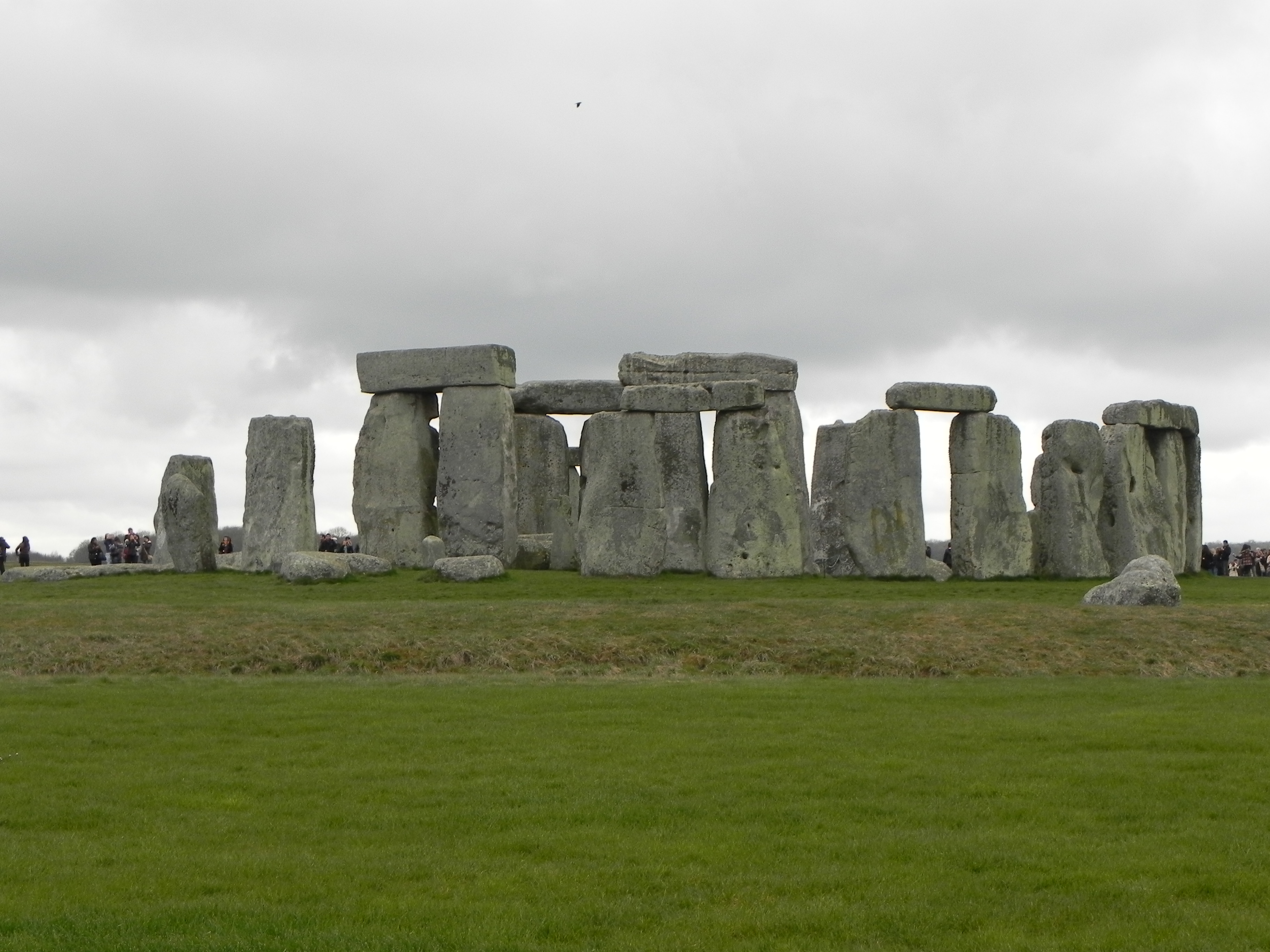
Perhaps the most famous monoliths in the world are found at Stonehenge.  Mysterious and beautiful, this monolithic ring has captured the imagination for generations.  When my wife and I lived in Scotland, we made a point of seeing as many stone circles as we could.  Way up in the Orkney Islands the Ring of Brodgar was probably the most impressive of them, owing to, in large part, its remoteness.  Standing next to these tall monoliths makes you realize how small people are but also what they can achieve when they cooperate.  While the UK may be better known for its monolith circles, even older ones appear elsewhere.  Rujm el-Hiri, for example, in Israel.  Although not a circle, the monolithic pillars at Göbekli Tepe should be rewriting history books.  Why the monolith?

Freudians would point to Tuto Fela in Ethiopia or other phallic architecture, but my mind tends toward Rapa Nui, or Easter Island.  The human being tends to stand taller than wide.  Evolutionary biologists tell us that was to help us see over the tall grass of the savannah.  (And if you doubt grass gets that tall, visit my yard sometime in the summer.)  These monuments seem to symbolize more that the procreative architecture of male human anatomy.  They seem to point to our ability to see over the obstacles in our way.  They seem to say, when people are divided against each other the plains remain barren.  When they decide to work together, Stonehenge emerges.  I don’t know the motivations of these modern artists.  I do admire their ability to put these monoliths into remote locations without leaving evidence of how they did it.  I really appreciate those creatures that stand tall and have a spirit of cooperation, even if others just don’t see the point.


Free Cookies

The principle is a simple one.  People, being what they are, want more than just a nibble of something good.  Bakers know that giving away a free cookie generally leads to the sale of several cookies.  Most businesses realize this and give away freebies in hopes of selling more.  Something I don’t write much about (and this is related) is my artistic pursuits.  I love to draw and paint.  The fact is, were I able to do so I’d probably do that all day long just about every day without tiring of it.  The problem is I don’t have time for drawing or painting anymore.  Work demands increasing numbers of hours per day and writing is a time-intensive hobby.  I dream of illustrating my own blog since I know the kinds of images I’d like to use.  I just don’t have the time.  So I often use Unsplash.

I discovered Unsplash in 2020, during the pandemic.  A website of free photos, you can search and download and reuse them for free.  And give the photographer credit.  They benefit from the exposure and you get a nifty free image to use any way you like.  Now it’s beginning to seem that was a free cookie.  (I told you the topics were related!)  Lately, when I visit Unsplash, more and more images appear with a “plus” in the upper right-hand corner.  The plus images are those you pay for.  If you scroll long enough you come to the free images, but only after you’ve seen the ones that look especially polished.  Hey, you’ve been eating free cookies for years, don’t you think it’s time you paid your tab?  Well, I don’t make any money from this blog—in fact I pay WordPress for the privilege of writing here—so I’ll settle for what’s still free.

The truly valuable things in life seem to be those under threat since the pandemic.  I skulk about the nonprofit world—I’ve never been interested in making money for money’s sake.  I see valuable institutions struggling to stay afloat because the free cookies are gone and nobody seems to want to pay for a dozen anymore.  In fact, we’ve come to expect some things for free.  And we’re not about to start paying now.  I still use and support Unsplash.  I give the artists exposure here (such as it is) and hope that they’re getting hired for their talents.  I know that if I had the time these daily posts would come with hand-drawn art from yours truly, but I see it’s time to get to work.


Ravens and Autumn

In need of some diversion, and seeking some way to celebrate the equinox, we made our way to Mount Gretna.  With a population of less than 300 souls, Mount Gretna is remote and an area of natural beauty.  But that’s not why we’re here.  Each year the Mount Gretna Theatre—housed in an open-air playhouse—puts on an Edgar Allan Poe performance in the autumn.  I’m not sure if it’s always titled “Nevermore,” but it is this year.  And it’s a fine evening for an outdoor performance.  The show is a walking tour of seven Poe vignettes.  A guide starts the evening by telling us a murderer is on the loose and Dupin (for Poe invented the detective story genre) warns us to trust no one.  I’m thinking this will be a murder mystery, but the first vignette is adapted from “The Fall of the House of Usher.”  My favorite short story, I smile at the choice.

The next venue—we’re walking around the parameter of the playhouse now—is from “The Masque of the Red Death,” which has taken on new significance with Covid.  These, by the way, are single actor vignettes.  We’re then led to a saucy woman who performs “The Black Cat” with a subtle humor.  As she’s led away, a madman leads us to a corner of the building where he retells “The Telltale Heart,” and you begin to realize just how much Poe wrote about revenge and guilt and murder.  We’re then led to the only two-person vignette for a retelling of “A Cask of Amontillado.”  A haunted young man crying “Lenore” next recites “The Raven,” from which the evening takes its name.  The final vignette is the only unfamiliar one in the lot, based on Poe’s humorous—if politically incorrect—stories, “How to Write a Blackwood Article,” and “A Predicament.” (Set in Edinburgh, no less.)

It’s a beautiful September night in a delightful wooded setting.  The fact that it takes some effort to get here is part of the draw.  The actors clearly enjoy themselves and the stories are told in such a way that it doesn’t matter that we’ve read them all before.  Once back home, I learn that the playhouse is in a borough founded by the Chautauqua Society.  I think how times have changed and that it was quite a world that supported adult education institutes.  Chautauquas are found around at least the rural parts of the country.  Founded by a Methodist minister, Chautauqua was a wholesome competitor to Vaudeville, offering entertainment as well as education.  I feel I’ve been both educated and entertained as we climb back in the car in a Pennsylvania night on the eve of the autumnal equinox.


Outgrowing Fear

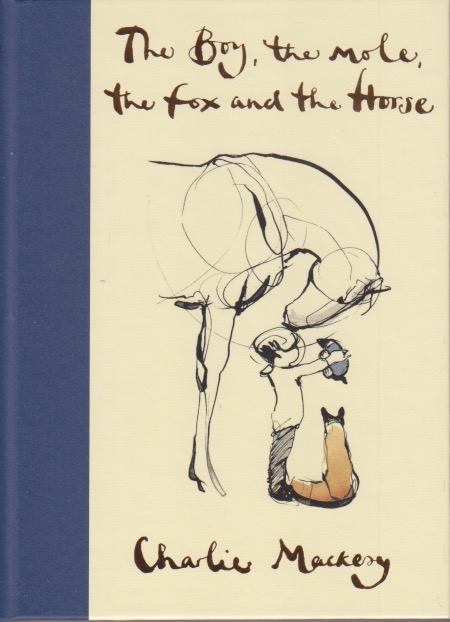
A friend, during a time of trouble, quoted from Charlie Mackesy’s The Boy, the Mole, the Fox and the Horse.  I immediately ordered a copy.  The word “magic” gets thrown around a lot, but this book holds real magic.  It is perhaps the wisest book I’ve ever read.  Do yourself a favor—if you haven’t read it, find it in a library, or order it from Bookshop.org or Amazon.  Visit a local bookstore, and if they don’t have it, ask them to order it.  If people read books like this we’d never need to worry about things.  And if everyone read it and took it to heart, we’d never need to worry about anything again.  There’s much to be said about believing in yourself and believing in the power of love.  At the end of the day they speak for themselves.

The book is for any age reader.  Handwritten and illustrated, it’s written at the level of a children’s book that takes less than an hour to read.  Its message feels almost radical, however.  That having been said, the young adult generation, I’m given to believe, grew up with the kind of outlook Mackesy offers.  The book struck me particularly relevant and necessary, something for those of us in the over forty crowd.  I understand the tendency to grow more conservative as we age and I believe it’s because we’re afraid.  Ironically, the book addresses the issue of fear, pondering how life might improve if we could get beyond being afraid of things.

The artwork is beautiful and the words are inspired.  This is an eminently quotable book.  Mackesy has been an artist by trade.  We can learn so much from such humble artists, if we’re willing to listen to them.  Kindness, love, and simplicity are gifts we often wish not to accept.  It’s very easy to hate and selfishness comes naturally to people.  And when we get together we tend to complicate things.  Once in a while we should set aside the complexities of life and make time for a simple story that reminds us of what’s really important.  Of course, those of us who read are prone to thinking of ways the world could be a better place.  Being open to love instead of hate, trust instead of fear, and hope instead of dread doesn’t come naturally.  That’s why it’s so helpful to have books to remind us of this.  Especially when such a book won’t even require an hour of your time.  I’ll be coming back to it time and again.


Skin Deep

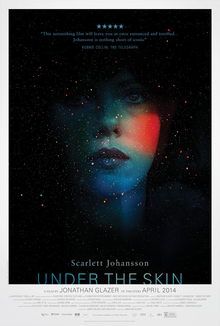
The thing about art-house movies is they’re meant to be discussed.  I spend a lot of time alone and I watch most of my movies alone.  There’s a kind of danger in that, I suppose.  Under the Skin was recommended by one of the books I read, analyzing horror.  I knew nothing about it and it became clear from the opening that director Jonathan Glazer had been heavily influenced by Stanley Kubrick.  In particular, 2001: A Space Odyssey.  There’s also the question of genre—is it science fiction or horror?  Art-house goes without saying.  The story is minimal and the movie is about images.  Even so, Glazer spent years working on the script.  The results won critical acclaim but box office failure.  We know the feeling.

So what is Under the Skin about?  Quite a bit is implied rather than stated outright.  The woman—the characters are generally unnamed—is an alien trying to learn about, while living off of, humans.  Early on she learns that sex appeal will nearly always entrap men so that they can be used for food.  Much of the film involves her driving around Scotland, seeking victims.  She has a co-conspirator who goes around making sure she leaves no traceable clues.  Conversation is minimal and shots linger to a point that viewers might feel the need for some explanation.  When she finds a victim with a deformity, the woman begins to learn empathy.  This victim is apparently set free, but is rounded up by her companion.

The woman tries to befriend a kindly man who tries to help her.  She can’t eat human food and doesn’t know to wear a coat in a Scottish winter.  The intimacy scares her and she comes across a logger in the forest with rape on his mind.  When he discovers she’s not human, he burns her to death.  Her companion, apparently seeking her, has no idea where she’s gone.  Roll credits.  As I say, the story is conveyed by the images and they stick with you.  The beautiful Scottish scenery can’t help but appeal to someone who’s lived there for a time.  The movie leaves you reflective and in the mood for conversation, the way art-house films do.  It’s also another example of Euro-horror.   This has captured my attention of late since it’s generally intelligent and light on the violence.  It makes you think.  Critics loved it, but the paying public didn’t want to hand over cash to see it.  That means, in my private calculus, that it’s well worth watching.


Paperback Reader

Sometimes I wonder why I do it.  Horror is a strange category for books and films, but one thing that may be a draw is that they take me back.  Life, it seems, is cyclical.  I liked monsters as a kid, and grew out of it when college and graduate school taught me to be serious.  As a working academic this genre can spell death to your career, so when my career died anyway, I was left grasping at my childhood to try to make any sense of this.  Grady Hendrix’s Paperbacks from Hell took me back.  Not that I’ve read all the books listed here—I came away with a list I want to read—but the lurid covers are a reminder of the kinds of things that caught my young imagination.

Subtitled The Twisted History of ‘70s and ‘80s Horror Fiction, this is actually a very fun book to read.  Hendrix has a light touch and had me nearly laughing out loud (quite an accomplishment) a time or two.  And I learned a lot.  Although I write books about horror, the genre is a large and sprawling one and this book takes a clear focus at the paperback market.  Just a reminder: paperback originals were designed to be sold and consumed quickly.  No waiting around for 18 months while profits from the hardcover roll in.  Hendrix really knows what he’s talking about when it comes to the history.  It also seems like he may have read more horror than is necessarily good for you.  He clearly knows how the publishing business works.

Several of these books were big enough that I knew about them.  He starts off with Rosemary’s Baby and The Exorcist.  (And The Other, which I’m now obligated to find and read.)  In fact, the first chapter focuses on religion-themed horror.  This is something that only began in earnest in the late ‘60s.  While the horror paperback market may have tanked in the ‘90s, the film side of the genre has been doing quite well and continues to do so.  The late sixties also got that kick-started.  It seems that when people stopped running from the fact that religion is scary, horror itself grew up.  I was shielded from that part as a child, but now, looking back, I can see that things weren’t quite what they seemed.  This full-color, grotesquely illustrated book has great curb appeal.  And if you’re not careful, you can learn a thing or two as well.


The Magic of Cairns

They’re one of those things, my daughter explained, that people do that make them so likable.  She was talking about building cairns.  Cairns are piles of stones, but not exactly the kind a farmer might make at the edge of a rocky field.  Cairns are intentionally built.  And they have been for millennia.  The thing is, while people could choose to knock them over, instead most people add to them.  When we’re out hiking we add rocks to cairns, and we’ve started our own from time to time.  I first became conscious of them in Scotland.  While out with some friends we spied a carefully stacked pile of rocks—I think it was at some remote location on the northern Scottish coast—and they told of of the tradition of adding to them.

While recounting this, I also recall seeing a pile of rocks—it wasn’t called a cairn at the time—at Walden Pond.  Some friends from seminary and I went to visit Thoreau’s famous site and although his cabin hadn’t survived, other pilgrims had started a rock pile.  It was, if I correctly recall, conical because the stones weren’t flat.  Most cairns involve the flat kinds of rocks that break off of bedding planes.  They are fairly easily stackable and they quite often tumble due to the forces of nature.  I recall building or adding to cairns in Ithaca, near Ithaca Falls.  Such cairns would be fortunate to survive the harsh winter and torrents of the spring thaw.  And yet still we build them.

While on the red trail at Bushkill Falls, where picking and taking items is forbidden, we found cairns.  There were isolated stacks along the river, dotted here and there.  Then, at about the halfway point we came across a field of cairns.  Alongside the trail, cairn builders had obviously seen the beauty of repeated patterns.  Other hikers were snapping pictures there as well.  It was clear that this was a joint venture that had spanned years of cooperating with strangers.  Nobody asks your race or gender or orientation when you add to a cairn.  In fact, those who start them are unknown and leave them for other strangers to carry on the work.  This is frequently the case with human ventures, but when they involve money we become very specific about who might be considered a proper owner.  Stones are common, and although useful are generally not valuable.  Make them into a stack and they become a symbol.  And that symbol can be a guidepost for future travelers, left in the spirit of cooperation of those we don’t know.