Asteroid

So, that asteroid.  Good thing Trump won’t be in office in 2032.  Well, it’s only a three percent chance it’ll hit us, but chances are things can’t get much worse anyway.  It might be a good idea to make some plans now—but wait, we currently deny science is real and spend our time renaming bodies of water.  Hmm, quite a pickle.  If science were real it would tell us that an asteroid is not the same as a meteor, although it can become one.  Back in high school astronomy class—yes, our Sputnik-era high school had its own planetarium—I learned that the difference between a meteoroid, a meteor, and a meteorite.  Want to go to school?  Here’s the quick version: a meteor is something in Earth’s atmosphere (thus, meteorology).  A meteoroid is a space rock, or even dust, in the solar system somewhere.  Once it enters our atmosphere it becomes a meteor.

Most meteors burn up as shooting stars and never hit the ground.  Yes, that atmosphere is a pretty good idea.  If a piece does make it to the ground, that piece is a meteorite.  Although your chances of being hit by a meteorite are minuscule, they can be impish.  Not far from here, a few years back, a meteor smashed through the backseat window of a car after a couple had just put their groceries inside.  The meteorite stopped inside a carton of ice cream.  The window had to be replaced, and I can just imagine the conversation with the insurance company.  Or take that meteorite heard on a recording for the first time.  In Charlottetown, Prince Edward Island, a doorbell camera caught a meteorite strike just outside someone’s house.  Both of these were tiny critters, though.

Our 2032 friend is quite a bit bigger.  Sometimes when large meteors heat up, they’ll explode in what is called a bolide.   In western Pennsylvania back in January of 1987 (if I recall correctly) my brother and I were working on a jigsaw puzzle during the holiday break when our house shook.  A loud bang had us worried—we lived in a refinery town, and explosions weren’t a welcome report.  We ran outside to find neighbors also outside looking around.  We later learned that a flaming fireball had gone overhead before exploding, a bolide.  The actual explosion took place quite a distance from us, but sound travels in our atmosphere.  So a possible near miss is scheduled eight years from now.  Let’s hope people show some sense at the polls before that happens. Or we could just rename it MAGA and hope that it hits somewhere else.
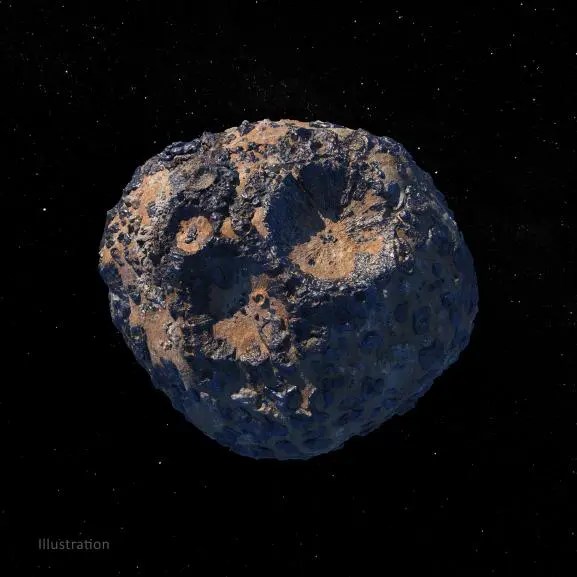
An asteroid. Image credit: NASA, public domain

Eclipsing the Earth

We need a new word.  One for the high an eclipse brings you.  I’m finding myself having difficulty coming down from it.  It seems so mundane to have to do something as ordinary as work after experiencing totality.  We only caught very brief glimpses of the moon over the sun through small breaks in the clouds, but we did get to experience totality.  How do you come down from that?  The next day we had a several-hour drive to get home so that we could all be at work yesterday morning.  What could be more ordinary than that?  And the eclipse happened on a Monday, not an unusual day for a holiday.  Only it wasn’t a holiday, but a “vacation day.”  So was the driving day.  At my age you need a day to recover from all the driving too.

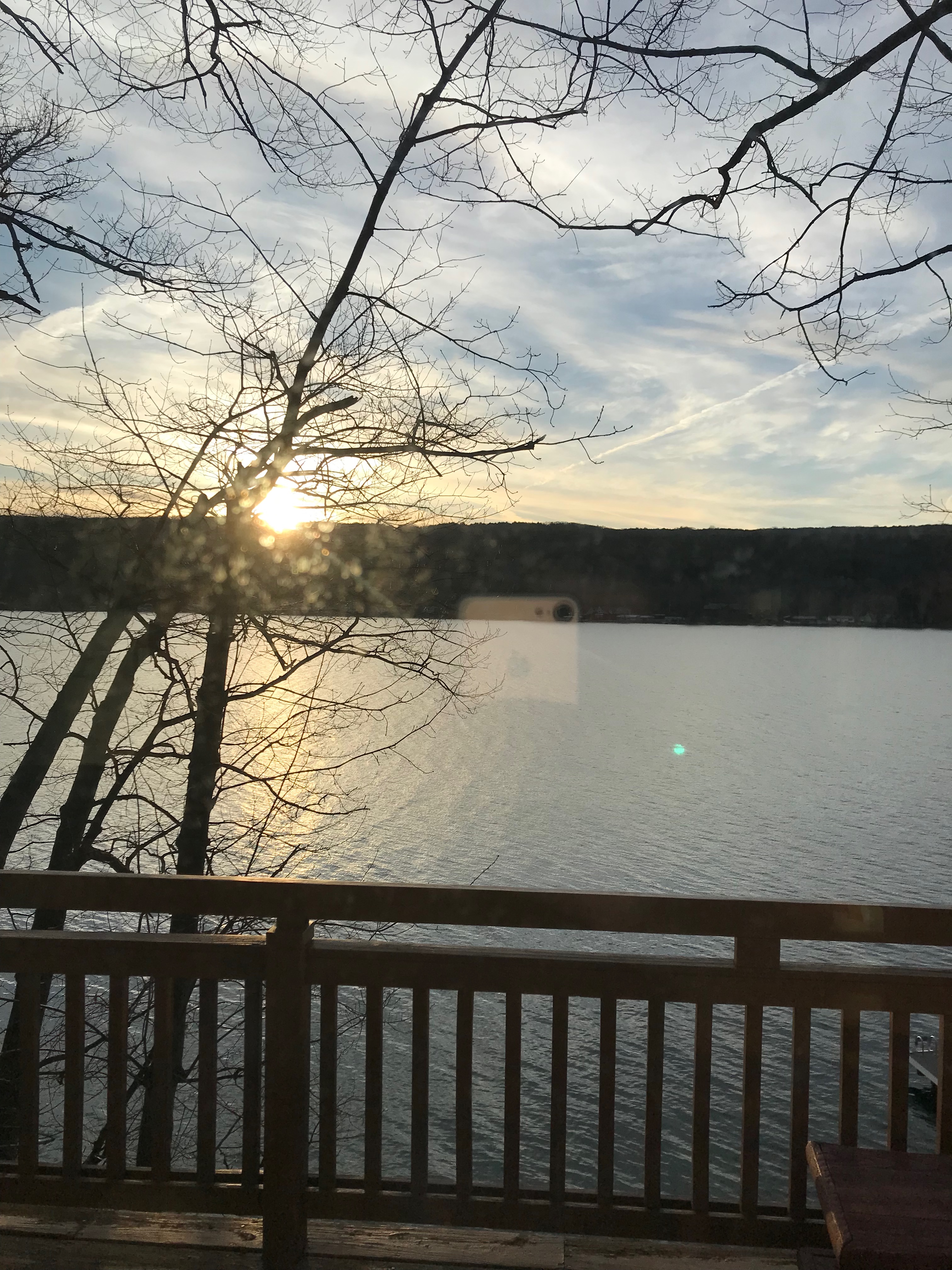
Several friends have posted their amazing photos and videos of the event, so I’ve decided to “release” my video to the wild.  A few explanatory notes: we were in upstate New York, on the shore of Lake Ontario.  It was chilly and we were bundled up (we came home to 80-degree temperatures, which was quite a shock).  The video may seem to have not much happening for the first couple of minutes and this is because electronic cameras tend to “even out” the light (film photography is much better).  When I started filming this it was getting dusky but the phone smilingly tried to make it look like normal daylight.  That wasn’t the case.  (Be patient—drama takes time to build!)

It occurred to me that many people (who had clearer skies) thought totality was all about the moon over the sun.  I take a more Buddhist approach.  The Buddha admonished not to mistake the hand pointing at the moon for the moon itself.  The real experience of an eclipse is what is going on down here on earth.  My video shows how the sun faded, and then went completely dark and back again in a matter of minutes.  My experience of this was quite a spiritual one.  If I’d been looking up I very well might have missed it all.  In other words, being in a cloudy situation, totality was an opportunity to take in what was happening on earth, in real time.  There is a lesson in this.  Life tends to deceive us into thinking the most important thing is the peripheral one.  Experiencing an eclipse is all about being, and living, on earth. 


Eclipse 2024

Eclipses.  They’re fully explainable.  Or are they?  Yesterday’s solar eclipse, with totality within driving distance of many Americans, led to an inexplicable need to see it.  April, we’re told, is the cruelest month and upstate New York is known for its “ever-changing skies.”  I admit I was skeptical.  Together with some friends we arranged to meet near the umbra, in Penn Yan, and to drive from there to totality up on Lake Ontario.  As is typical in New York, the day started out fair, with a few high clouds.  It was chilly, but this is April.  Our destination: Fair Haven Beach State Park.  The location was nice; we arrived early and found a good spot.  The clouds, however, were willful and wanted to remind us, like last week’s earthquake, that we’re not really in charge here.

As the day went on—totality for us was 3:20 p.m.—more and more people came into the park.  To its credit, with what must be a limited state budget, it absorbed many eclipse seekers without any trouble.  By 3:00 the cloud cover was heavy-ish.  Our friends had heard a sponsored eclipse speaker, however.  Totality was nothing like even 99%.  This would be of a different magnitude, even with clouds.  I remember three previous eclipses.  One in school with the pin-hole method where you really don’t see anything, one in Wisconsin after teaching one morning at Nashotah House, and the 2017 which I saw in midtown Manhattan.  None of this prepared me for totality.  Around 3:18 it started to look dusky.  We could catch glimpses (but no photos) of the crescent sun.  Within seconds it was completely dark.  It was another of those transcendent earthly things, like the earthquake three days earlier.

Perhaps I’m getting old enough to realize that you can’t really describe such feelings.  Maybe I’m getting sensible enough to understand such things are called ineffable for a reason.  All the planning, worrying, anticipating, was for this moment.  Yes, there were clouds overhead, but the park was full of cheering people.  They too had come here for something extraordinary and to my surprise I found tears in my own eyes.  I captured no photos of stunning clarity, but I had experienced something I’d heard about since childhood but had only glimpsed in the most crude of facsimiles before.  We were able to experience a kind of rebirth that comes only after night.  Conditions weren’t ideal, but are they ever?  And an encounter with the numinous always comes on its own terms.

The sun, hours before being eclipsed

Asking Questions

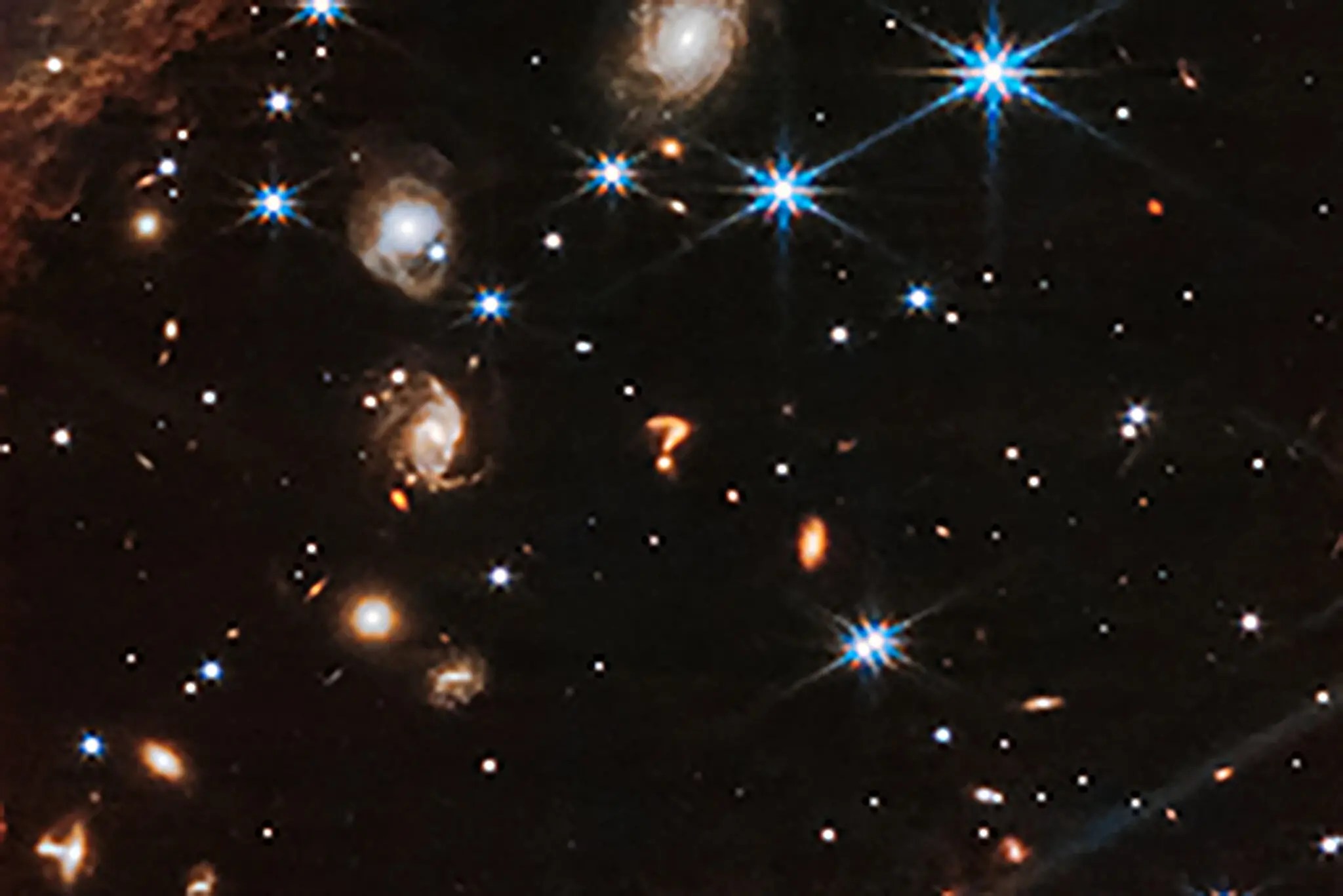
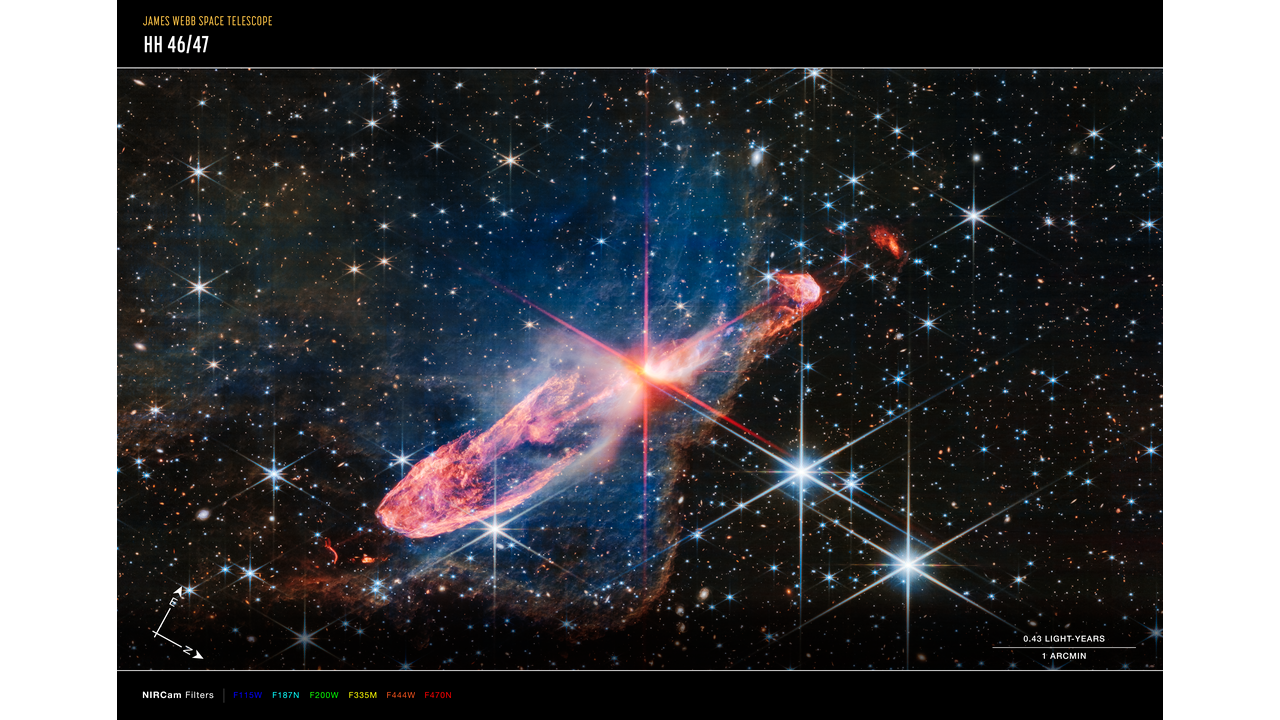
Strangely appropriate pareidolia is one of those oddly specific things that generates a lot of internet interest.  I was late to find out about the “question mark” in space photographed by the James Webb Space Telescope.  Okay, a couple of things: photographs, like the one below, taken by U.S. Government agencies are in the public domain (thanks, NASA!).  This one can be easily enlarged on the James Webb Space Telescope webpage.  To see the “question mark” you need to start from the center red star and look down to the two bright blue stars just to the left of center.  The image I’m using has been enlarged so that it’s obvious.  Serious news outlets have discussed this, but it’s clearly a case of pareidolia, or the human ability to attribute specific meaning, or design, to something that’s random.  We see faces everywhere, but question marks are somewhat less common.

Photo credit NASA: public domain

Given the state of the world—people like Trump able to continue scamming millions of willing believers for his own benefit, hurricanes hitting California, Putin going to war against the rest of the world, capitalism, war in the Holy Land—it’s no wonder that people like to think a big question mark is hanging over everything.  Looking into the sky we expect to see God.  Isn’t it a little disconcerting to see a huge query instead?  I, for one, think it might be best if we learn to recognize false signals rather than seeing some giant message tucked away in some small corner of the universe in the hopes that we’ll turn our seeing-eye telescope that way.  What font is it anyway?  Does it violate some cosmic copyright?

Some signs are, I’m convinced, for real.  I think they tend to be on a much smaller scale.  Way down here where  we can see them.  What appears to be, from our viewpoint, a question mark may be seen as an exclamation point from a different angle.  It’s all a matter of how we look at things.  One of the most important lessons of life is that people see the same thing from different points of view.  If we can accept that, others don’t seem so threatening and strange.  In a small planet plagued with xenophobia, it’s important to discover strangely appropriate pareidolia every now and again to get us thinking about the deeper issues.  We may not find the answers, but often asking the question is the more important thing to do.


Little Bang

I’ve always been interested in the sky.  At times it feels like I’m in love with it.  Having attended a Sputnik-era high school—a rural high school with an actual planetarium!—I took the offered astronomy course.  Buoyed up by this, I also enrolled in a college astronomy class only to discover that that career track involved far too much math for my humble abilities.  Still, I learned a lot about the nighttime sky.  I’ve also been a lifelong reader of lay science.  I very much appreciate scientists who write so that nonspecialists can understand them.  So it was that I was glad to see a New York Times letter by Adam Frank and Marcelo Gleiser titled “The Story of Our Universe May Be Starting to Unravel.”  I’ve mentioned Gleiser here before because I’ve read a couple of his wonderful books.  But this article was mind-expanding.

Frank and Gleiser suggest that the Big Bang Theory may, eventually, need to be replaced.  They point out that small inconsistencies have crept into it over the years (keep in mind that it was really only “confirmed” within my lifetime, back in the sixties).  Most of these have been patched up with quilt-work astrophysics, but the James Webb Space Telescope is making some of those past patches strain a bit at the seams.  Fully formed galaxies are being spied too far back in time (for stargazing is looking into the deep past) for the standard model.  They shouldn’t be there, but they are.  The letter interestingly raises the point that the scientific study of quantum physics, as well as that of consciousness, also strain the standard models.  Perhaps it’s time for a rethinking of reality?

Image credit: NASA, public domain

Isn’t this breathtakingly exciting?  To be alive when a major leap of understanding the universe we call home may be discovered?  The authors point out that cosmology and philosophy often have to interact.  Our understanding of the universe is a human understanding, not sacred writ.  The scientific method is built to be falsifiable.  If it’s not, it’s not science.  (This often separates it from some religions which declare themselves unfalsifiable, and therefore likely wrong.)  New scientific discoveries are made daily, of course, but new paradigms only tend to come on the scale of lifetimes, or several generations.  We don’t see them all the time.  I guess it’s heartening to see that the system works.  When science becomes orthodoxy, we run into similar problems that we encounter with religions.  A bit of humility and a ship-load of wonder can go a long, long way.


Parthenogenesis

It’s only a matter of degree, isn’t it?  I mean between reptiles and mammals.  While our common ancestor was quite a bit older than Lucy, we’re still fam, right?  I’m not the only one, I’m sure, who read with interest the New York Times story about the female crocodile who recently gave birth without the help of a male.  It’s called parthenogenesis and, according to the article, it’s not as rare as we might think.  Birds and amphibians do it.  Some fish even change gender under reproductive pressure.  And if you’ve seen Jurassic Park you know the implications might be larger by an order of magnitude or two.  My mind, however, wanders to mammals.  Then primates.  Then humans.  If our distant cladistic cousins can do it, can we?

The key appears to be males leaving females alone long enough.  As Malcolm says, “life will find a way.”  Life amazes me.  While we can’t count on it happening for each individual, life has a way of reemerging when you think it’s gone.  Previous owners of our house neglected a green ash tree growing in a location far too close to the house itself for many years.  Granted, it was on the north side where you seldom have any reason to go, but that tree sent out progeny that I’ve had to try to eradicate for five years now.  As much as I love trees, when they’re growing into the foundations of your house, they’re a bit of a problem.  I snip off the water shoots whenever I find them but they keep coming back.  I’m sad to cut them but I admire their persistence.  Life’s persistence. It’s will to carry on.  It continues even when we think it can’t.  Never forget the water bears!

Just a few days later the Times ran an article about the strong possibility of life on Enceladus, one of Saturn’s moons.  Personally, I wouldn’t be surprised.  I’m absolutely certain there’s life elsewhere.  It makes no sense for it not to be.  Life evolves to a point, it seems, where the “intelligent” variety seems to become arrogant.  I embrace our reptilian and amphibious and piscine cousins.  Even our insect and arthropod family.  Our plants and fungi.  Life is amazing and we seldom stop to ponder just how wonderful and mysterious and resilient it is.  A lonely female crocodile decides to have a family.  Phosphates spewing from an ice-cold moon whirling around a colossal planet that wanted to be a star.  Life!  How can we not be stunned into trying to admire it in its many, many forms?


Solstice Wonders

It’s difficult to tell where summer begins and spring ends.  Transitions are like that.  Today’s the summer solstice.  Since I’m an early riser I keep track of when the sun comes up so that I can go for a jog.  Actually, I tend to get out just before sunrise when twilight is enough to see by.  You see, the solstice is a day of hope.  My jogging path is on the edge of town and it borders some woods that, all things considered, are quite shallow.  There’s development on the other side of the river, although you can’t see it from here.  As I’m out before most other crepuscular exercisers I often see critters along the trail.  I’m not sure I can catalogue all the animals I’ve seen but a partial list includes fox, coyote, raccoon, bald eagle, raven, ducks, herons, and the ubiquitous rabbits, squirrels, and deer.  Last month I saw a doe giving birth as I jogged by, something I felt it inappropriate to watch beyond a passing glance.

At times when it’s too dark to go before work I have occasionally gone on a slightly later schedule.  Then I’ve seen groundhogs, a snapping turtle, and red efts (newts).  The thing is these woods are rather thin and they support (along with the towns, I’m sure) a variety of creatures, many of which I don’t see.  Appearances can be deceptive.  Things that appear certain are often wrong.  Those who wake later and don’t spend their evenings on the trail (and animals, I expect, are shy after people have been out all day) may not believe there is so much fauna in the area.  I know there’s even more: opossum, bear, and frogs among them.  I believe they are there.  And believing is just as important as knowing.

Summer is thought of as a more relaxed time, but that’s really only an appearance as well.  It’s actually quite a busy time—what’s relaxed is our capitalistic drive for work.  We realize the warmer days (hopefully not too rainy) afford us the opportunity to do the things the long, dark, cold months prevent.  And those of us in northern latitudes tend to think of it as a magical time.  Shakespeare’s A Midsummer Night’s Dream captures the traditions of fairy activity during this short night with long, sunny days either side of it.  A family member recently reminded me of this connection, and it seems to me that we should be reminded once in a while of the miracles that surround us.  The solstice is one of them.  It’s a matter of believing and a cause for hope.


Inventing Chaos

A recent (in my personal interaction with time) article from the New York Times recounts two bad inventions by Thomas Midgley Jr.   Namely, leaded gasoline and the practical use for chlorofluorocarbons.  Besides making me interested in Midgley, the article got me thinking about inventors and inventions.  We never know, in real time, if innovations are good ideas or not.  We have no crystal ball and what seems like a good idea now may prove to be a catastrophe.  I’ve given a couple of talks on the Antikythera mechanism.  If you’re not familiar, it is essentially an analogue computer invented in the first century.  Experts suggest there were likely multiple such devices, but they never caught on and transformed society.  Why?  Nobody saw the practical benefits.

A replica of the Antikythera mechanism

The Antikythera mechanism was made essentially to predict eclipses and track the movement of heavenly bodies.  The fact that such a thing existed within a century of when Jesus of Nazareth lived and died is mind-blowing at first.  Still, it makes a point.  We never know when an invention will take off and change the world.  And we never know if that change will ultimately be good or bad.  There are many who suggest that the invention of agriculture was a mistake.  We eat less healthily than our hunter-gatherer ancestors, and they may have been much happier (in general) than we are.  Still, agriculture (despite creating desk jobs) has its benefits.  We live longer.  We have medical science.  And we can entertain ourselves with clever people on YouTube.  While we sit around too much and eat things that really don’t benefit us, we seem to be doing okay.  We’re living longer, at any rate.

The problem, it seems to me, is when capitalism takes an idea and blows it up into a huge money-making venture.  People just can’t take their eyes off that shiny, shiny gold.  And ideas, when they start making unreasonable demands (a new cellphone every other year?  Really, is that necessary?) tend to lead to the same results as leaded gasoline and chlorofluorocarbons.  If they can be monetized, ideas will push themselves into this unbroken feedback loop we call economy.  Often at the price of ecology.  Inventors are both necessary and dangerous.  Their efforts often make the world more comfortable, more convenient.  They might, however, cause immense harm.  Being a vegan, I’d have a difficult time surviving as a hunter-gatherer.  Gathering is more my style, in any case.  If only I had a way of tracking the movement of heavenly bodies, I might just be content.


Pondering Origins

I’m not a numbers guy.  I never had any interest in statistics, and I tremble when I see my accountant’s number pop up on my phone at tax time.  But exponential sequences have an inherent fascination.  Think about your ancestry (I recently wrote about genealogy and that got me pondering).  You have two parents.  And they each had two parents.  By the time you get back to ten generations (eight greats before grandparents) you have 1,024 ancestors of roughly the same generation.  That’s a lot of people just to make one individual.  Think of all the circumstances that might’ve led to any two of them having been kept apart—then where would you be?  Of course the numbers double each generation which is where my reasoning capacity shuts down.

At some point, doesn’t it seem, that there wouldn’t be enough people available to make you?  I know that’s not true—you’re reading this and that proves this false—but it does make each individual life a thing of wonder.  Or even at the level of your own parents.  If you have siblings you know how different even biologically similar people can be.  And there are many others who could’ve been conceived instead of you or me.  The chances are astronomical that we’re here at all.  I often wonder if such circumstances are why our minds seek religious answers.  People are meaning-seeking creatures.  And against such long odds, it seems that maybe we’re a miracle after all.  Naturally, a driving force behind it all suggests itself.

Photo credit: NASA

Science has been a real boon for the billions of us alive today.  There’s no doubt that dispassionate, rational thought can lead to amazing outcomes.  At the same time, the doubt creeps in that this is the only explanation.  It occurs to me when watching the birds in the spring.  How do they know their own species and with whom to mate?  Is all of this driven by that notorious fudge factor we call “instinct”?  I have no answer to what the source of that will to keep life going is.  Biology tends to be among the slipperiest of sciences.  Life is difficult to define when we don’t even know everything that’s out there in our infinite but expanding universe.  The numbers are just too massive.  All I know is that by the time you get back to twenty generations (eighteen greats) it took over a million people to make just one of us.  And that’s by the numbers.


Birthing Stars

Fusion.  The recent breakthrough with fusion announced so close to Christmas hardly seems a coincidence to me.  I have to admit to having been interested in fusion since high school.  One of my school term papers was on what was then called a “magnetic bottle”—a theoretical device capable of containing a fusion reaction.  The hydrogen bomb, of course, had already demonstrated that fusion was possible.  Controlling it was, at the time, the difficulty.  Now, I’m no scientist.  I’ve read quite a bit of lay science over the years and even worked on a project about the relationship of science to religion.  Still, you can’t follow everything.  I’d lost contact with fusion until the announcement this week that scientists have finally demonstrated that it’s possible to get more energy out of a controlled fusion reaction than it takes to get the reaction started.

In case you know even less about science than I do, fusion is what powers stars.  Unlike fission, it’s a “clean” nuclear reaction and one, as far as we can tell, that has made life possible on this planet.  Star power.  We’ve known for many decades that this could be the solution to humanity’s energy needs.  Of course, big petroleum has tried to slow such research down—there are personal fortunes to be lost and what is life without a fortune?  Now, with technology far beyond my comprehension, a fusion reaction was born that showed promise that we’re on the right track.

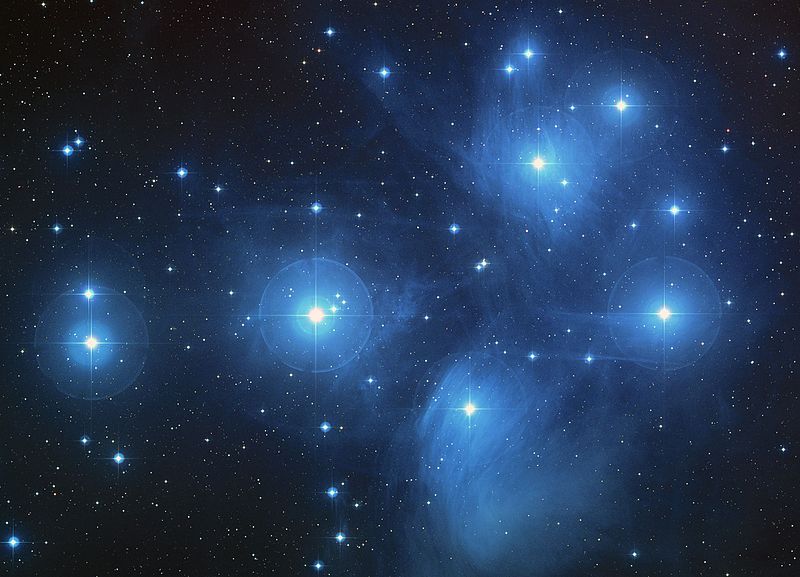
Photo credit: NASA, via Wikimedia Commons

Since it’s been rather gloomy around here this December, the thought of more sunshine cheers me.  Living in the Lehigh Valley, of course, my thoughts turn toward the Bethlehem star.  It’s such a crucial element to the Christmas story that we’d hardly know what to do without it.  Stars are our guides through the dark.  Winter nights are often clear and are opportunities to see the nighttime stars, even as we light up our artificial ones here below.  Light encourages light.  In a laboratory somewhere scientists are busy making stars.  I have to believe it’s satisfying work.  Perhaps the kind of job you’re eager to get back to the day after Christmas.  Although fusion would be used for power in general, one of the functions would surely be the giving of light.  As we move toward next week’s solstice and light our Yule logs, encouraging light to return, women and men in white smocks are designing and using complex equipment to help it on its way.


Earliest Sunset

Welcome to the day of the earliest sunset of the year.  “But how can that be?”you may ask, “since the winter solstice is many days away?” I’m no wizard when it comes to numbers or math, but I do know tomorrow’s sunset will be a minute later than today’s.  It’s the other end of the day, however, that continues to increase darkness.  Sunrise will continue to creep later and later until on January 16 it will be at its latest.  Mornings will then become longer, very, very slowly.  Combined, the shortest day will be on the 21st, almost two weeks from now.  Then sunlight will begin its slow crawl back to majority.  And so the seasons eternally negotiate on a planet that sometimes seems to spin too fast.

Those awake early, sensitive to sunrise, need to wait a bit longer than those wanting longer evenings.  There’s no taking without reciprocity here.  For those in the northern half of the northern hemisphere, winter has begun its settling in process.  Morning frost on the rooftops augurs the coming of snow.  The almost preternatural stillness of a cloudy late afternoon anticipates what’s to come.  Those of all religions, or of none at all, alike await a glimmer of lengthening days in this season of long nights.  It pays to become comfortable with the darkness in the meantime.  Dark need not equate to evil.  It invites rest and renewal.  Perhaps our culture that valorizes action and movements blurred with speed might learn from the hours of diminished light.

Walking into an early morning room with a light switch on a far wall is an act of faith.  If done before any artificial lights are engaged, it’s always surprising how much light crowds in on the dark.  The luminescent clock.  The power strip on button.  The ever-watchful router.  Darkness is seldom absolute, as much as the tenebrous circumstances might suggest such extremes.  Light and darkness need each other to find any kind of definition at all.  Starting tomorrow, there will be incrementally longer moments of day stretching out into night.  Mornings will grow more reluctant to release their light for another month or so.  In the midst of this we snuggle down into the darkness and learn from it.  Learn to slow down.  Learn to listen instead of always looking.  Learn to breathe slowly and accept that the darkness can comfort.  The solstice is coming, in good time.  Until it arrives, be in the twilight of the moment and trust it.


Unidentified

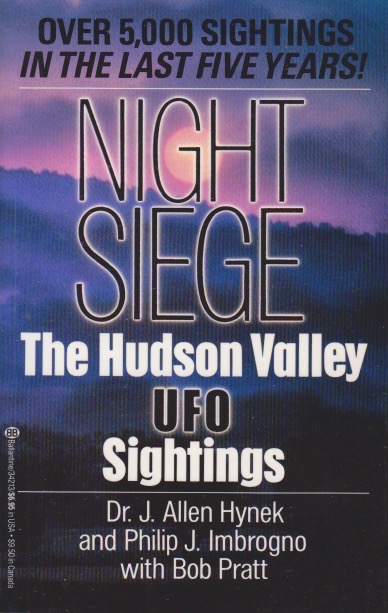
Some places are quite ordinary.  Once you get to know the people, however, you begin to find some oddities.  That’s all normal.  Other places, however, are strange for one reason or another.  One such region is the Hudson Valley in New York.  With all the UFO news the past couple of years, I grew curious about the sightings in the Hudson Valley from about 1983 to 1986.  This was a period when hundreds of sightings were reported of an object flying low and slow, and even hovering, over several locations throughout the region.  They were investigated by J. Allen Hynek and Philip J. Imbrogno, and written up with the help of Bob Pratt.  Night Siege: The Hudson Valley UFO Sightings was published by a mainstream house (Ballantine, a division of Random House).  Not exactly belles lettres, the book is pretty bare bones.  It contains some interesting information, however.

Hynek, who worked for years with Project Bluebook and who was a bona fide scientist, was ailing as the book was written.  Indeed, he died before this book was published.  His name is the big draw, however, since he was a respected authority in the field.  Some questions have been raised about Imbrogno’s accounts of himself, but that shouldn’t take away from the data collected on the Hudson Valley phenomenon.  In short: in a period of mostly two years (1983 and 1984) several “flaps” of reports came in regarding an object that was described in similar terms by hundreds of people, many of them well-educated professionals.  The authorities trotted out mundane explanations that don’t fit the evidence, although even noted skeptics stated that the sightings were unexplainable.  Part of the weird Hudson Valley.

But not just there.  In 1997 a large number of people in Phoenix reported a similar object over Arizona.  This one made national news and even led to stunts by uncomfortable politicians.  We’ve become such an arrogant species that we’re reluctant to admit there are things we just can’t understand, it seems.  Or that there might not possibly be anyone smarter than us anywhere in this vast—indeed, infinite—universe.  I don’t pretend to know what people were seeing in the Hudson Valley, or in Phoenix, but I also don’t pretend that ruling out logical possibilities will give an answer.  I tend to think that when large numbers of people see something that’s unexplained, it’s an insult to our collective intelligence to make up something and refuse to consider the options.  The solution, to me, seems to be to read.  Widely.  Even if it only raises more questions.


Eclipsed

Shooting the moon.  It’s such a simple thing.  Or it should be.  I don’t go out of my way to see lunar eclipses, but I had a front row seat to yesterday’s [I forgot to post this yesterday and nobody apparently noticed…].  I could see the full moon out my office window, and I’m already well awake and into my personal work before 5:00 a.m.  When it was time I went into the chilly morning air and tried to shoot the moon with my phone.  It’s pitiful to watch technology struggle.  The poor camera is programmed to average the incoming light and although the moon was the only source of light in the frame, it kept blurring it up, thinking, in its Artificial Intelligence way, “this guy is freezing his fingers off to take a blurred image of the semi-darkness.  Yes, that’s what he’s trying to do.”  

Frustrated, I went back inside for our digital camera.  It wasn’t charged up and it would take quite some time to do so.  Back outside I tried snapping photos as the phone tried to decide what I wanted.  Yes, it focused the moon beautifully, for a half second, then decided for the fuzzy look.  I had to try to shoot before it had its say.  Now this wouldn’t have been a problem if my old Pentax K-1000 had some 400 ASI film in it.  But it doesn’t, alas.  And so I had to settle for what passes for AI appreciation of the beauty of the moon.

Artificial Intelligence can’t understand the concept of beauty, partially because it differs between individuals.  Many of us think the moon lovely, that beacon of hope in an ichor sky.  But why?  How do we explain this in zeros and ones?  Do we trust programmers’ sense of beauty?  Will it define everyone else’s?  No, I don’t want the ambient light averaged out.  The fact that my phone camera zoomed in to sharp focus before ultimately deciding against it shows that it wasn’t a mechanical incapability.  Sure, there may be instructions for photographing in the dark, but they’re not obvious standing out here and my freezing fingers can’t quite manipulate the screen with the nimbleness of the well warmed.  There were definite benefits to having manual control over the photographic process.  Of course, now that closet full of prints and slides awaits that mythic some day when I’ll have time to digitize them all.  Why do I get the feeling that the moon isn’t the only thing being eclipsed?


First Images

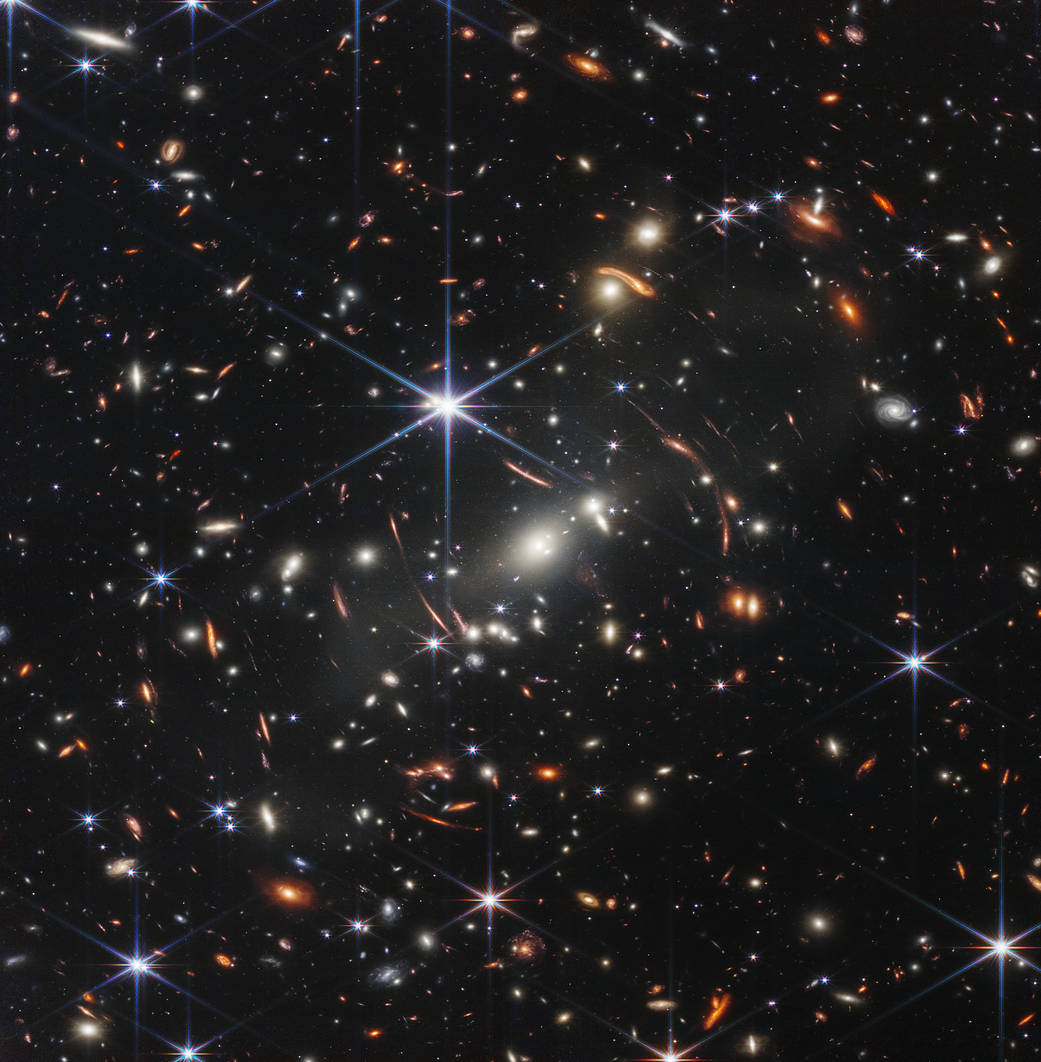
I awoke to an image from the James Webb Space Telescope.  Looking at the universe at it was 4.6 billion years ago is a humble and terrifying experience.  Our universe is so incredibly vast and we are tiny.  As we on this planet bicker and kill and destroy, out there something truly wondrous looms.  Those tiny pinpricks of galaxies.  Our own galaxy so massive that we can’t comprehend it.  Our own midsize star large enough to hold more than a million earths.  Our own planet big enough that no human being can see it all in a lifetime.  What in the world are we fighting for?  This image is just a patch of sky about the size of a grain of sand held at arm’s length.  How many grains of sand would it take to fill the visible sky?

Many people argue that such things are a waste of money.  Yes, there are very real, human-created problems right here on earth.  The siren call of space, however, has the potential to save us.  If we look into that immense universe just out there and realize that we are part of something larger than ourselves, we can stop fighting and hating and electioneering.  Keep looking up instead.  Costs, after all, are relative.  Our entire economic system is arbitrary.  We decide what’s valuable and what’s not.  We make rules that allow individual human beings to control the lives of countless others based on nothing more than agreed-upon principles.  Food could be freely distributed.  Medicine could be given to the sick.  What’s required is perspective.  If looking at the universe doesn’t provide perspective, what can?

I often wonder about life in those distant galaxies.  Given the sheer numbers it’s practically impossible that life evolved only here.  We’re told that teleological thinking is wishful and naive, but looking at the way life behaves I have to wonder if that’s true.  Life may be seeking goals.  If it is, than intelligence may be among them.  We’ve got billions of years and billions of lightyears to work with.  And when I look at the headlines I find those of the James Webb Space Telescope to be the most hopeful of all.  Galaxies are all about possibilities.  Stars being born where the outcomes may be better than one gender assuming it’s better than another.  Or that the “right to bear arms” means  stockpiling assault rifles to kill others in a fit of pique.  No, this money’s not wasted if only people might listen and pay attention to the stars.


Many Moons

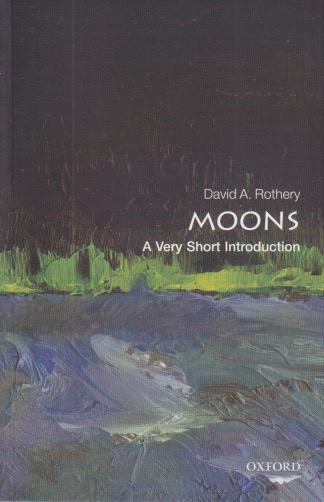
Once you get beyond the very basic level, astronomy quickly become all about numbers.  It’s both fascinating and a shame.  Fascinating because scientists have been able to send probes millions of miles away, calculating, for example, where the multiple moons of Jupiter and Saturn will be so that they can fly by for an interplanetary peek.  The shame is that many people star-struck by the concepts can’t pursue it as a career.  That’s where books like David A. Rothery’s Moons: A Very Short Introduction come in.  I’ve read a number of books on the moon, but I’ve fallen behind on what we’ve learned about the moons of the outer planets.  This short treatment covers them in just enough detail.  I certainly learned a lot by reading it.

Rothery points out that apart from Earth, in our solar system the likeliest candidates for life are actually some of the moons of Jupiter and Saturn.  Heated by tidal action and volcanism, and having under-surface oceans, conditions may be right for such worlds to spawn life.  Even if microbial, finding life elsewhere would confirm what this dreamer has supposed all along—we’re not alone in the universe.  As Rothery also notes, there are far more moons than planets in our solar system, so that may also apply to other systems as well.  Exoplanets have been discovered for decades now.  If other suns have planets and those planets have moons, who knows what might be out there?  And all this has been happening for billions of years, whether or not we notice it.

For me, it’s concepts such as these that make astronomy so fascinating.  Also, as the book points out, there are all kinds of oddities in our own astronomical back yard.  Asteroids that have their own moons.  Moons that have unusual geological (or lunar) features that haven’t been explained.  Moons that have been torn apart by their host planet.  Moons that have been captured in orbit when passing by.  Probes have been landed on moons other than our own, and the ethics of doing so (since we might transmit microbes unintentionally) are topics of discussion.  There’s a lot crammed into this brief study.  I also can’t help but wonder what amazing things the next generation will discover.  Our knowledge of this universe, impressive as it is, doesn’t even break the crust of ice moons out there, where there is nitrogen ice and methane ice.  Parameters beyond imagination.  It may all come down to numbers in the end, but moons are so much more than that.