More Morons

There’s an aesthetic to bad movies.  Some are so bad that they’re good.  Others are just plain bad.  Many years ago, during some Amazon movie sale or other, I purchased a DVD of Morons from Outer Space.  Now, horror comedy is a recognized genre, but sci-fi comedy is a bit harder nut to crack, even though horror and sci-fi are siblings.  Morons sat on the shelf for at least a decade, in case of need.  Having been scammed out of our life’s savings, a Friday evening when my wife said “Pick whatever you want, I’m likely to fall asleep anyway,” scanning the shelves my eye landed on it.  The movie had been distributed by MGM, how bad could it be?  Worse than anticipated, it turns out.  I don’t recall ever seeing an intentional comedy where the entire laugh potential was so misaligned.  There were one or two spoofs that worked, but mostly it dragged and begged to be put out of its misery.

Three aliens, anatomically human, crash land on earth after leaving a crew-mate behind on their deep-space vehicle.  The extended scene of their spaceship tooling down the highway might’ve been funny had it lasted maybe a tenth of the time.  The knock-off of Close Encounters’ use of music to communicate was a little funny.  The alien interrogation missed several potentially humorous opportunities.  The aliens eventually become celebrities while an American commander insists that they be killed because of their threat to life on earth.  Ironically, I’ve often wondered how it would be if aliens who came to earth were badly behaved members of their species.  I can honestly say that that would be better than the way this movie played out.

Meanwhile, the abandoned alien gets a lift with a spooky-looking alien.  In perhaps the funniest scene, the spooky alien asks the human alien his sex.  That part was funny on a couple of levels and showed the potential that the movie might’ve had.  He ends up on Earth and tries to connect with his three shipmates, who are now, literally, rock stars.  When they finally meet up, they summarily dismiss him again, only to be hauled off back to space by a closing Close Encounters parody.  I confess that I am still trying to appreciate bad movies on their own aesthetics.  I’ve seen so many that I added a “Bad movies” category to this blog.  Bad movies are often unintentionally funny.  It’s a different beast when a comedy is unfunny.  Particularly when there was potential there, if it’d only been effectively used.


Fly by Night

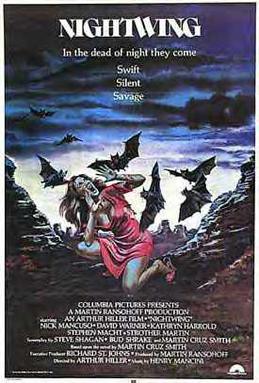
Nightwing is a movie I learned about by reading Stephen King’s Danse Macabre.  The idea has merit but falls below the expected level of any horror film of the era—and I’m a fan of seventies horror.  Those in the know suggest that this was supposed to be Jaws with vampire bats in the era when horror movies started to re-realize the dangerous potential of nature itself.  A basic problem underlies the dull pacing, non-indigenous actors playing Indians, and fatally overstuffed plot: vampire bats aren’t dangerous.  Bats are highly advantageous to the ecosystems in which they thrive and the idea that six or seven bites could drain a person of blood is ridiculous on the surface and looks rather silly in execution.  At least the later movie Bats (also bad) had genetically mutated mammals.  Eco-horror can be effective.  Natural bats are difficult villains, though.  

So, on Hopi lands an elderly priest summons the end of the world.  Releasing a god, the bats form the precursor to a native apocalypse.  Two tribes with differing views of white drilling rights on their lands argue over this while killer vampire bats attack.  They kill a group of Quaker missionaries.  Luckily, a British vampire bat killer is after the swarm.  He travels around killing bats, which, he says, are pure evil.  The deputy of the “good” tribe, which resists white incursion, eventually teams up with the bat killer because he saved his girlfriend who was going to leave him for medical school.  For some reason, two kinds of plague (including bubonic) are released but when the tribal priests all die during a rain dance it’s because of natural causes.  The leaders of the two tribes keep trying to catch each other out.

As the movie plods along, making the viewer root for the bats, the several dropped plot lines are left dangling like so many participles at the end.  The plagues?  Red herrings.  The tribal conflict?  Unresolved.  The special poison brought in to kill the bats?  Unused.  Total number of people killed to justify a wholesale bat massacre?  Nine.  Anytime I’m viewing a horror movie and I find myself repeatedly glancing at my watch, I know that something’s off.  It’s October and bats are a typical aspect of Halloween decor.  Nightwing, however, just doesn’t make them scary.  The movie was based on a novel which I’m now strangely tempted to read.  By all accounts, even though the author was partially credited with the screenplay, the book, as usual, is better.


Reptile Puppet

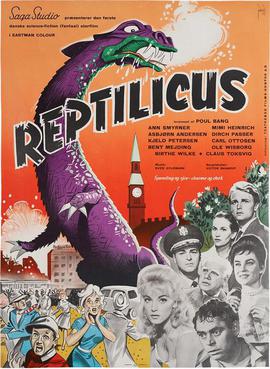
I read about Reptilicus, but I can’t remember where.  A monster movie shot simultaneously in English and Danish in 1960, with two different directors, it was universally panned.  Some times you just have to see a bad movie.  This one qualifies.  I actually laughed out loud a time or two.  The idea behind the story holds promise: some animals can regenerate lost limbs, or even entire bodies from a severed piece.  What if a giant reptile could do the same?  The film’s problem is in the execution.  So, a team drilling for copper above the arctic circle—they’re sweating and working with their sleeves rolled up in a temperate forest—hits a frozen animal in the permafrost under the tundra.  Taken to an aquarium in Copenhagen, the animal’s tail is kept frozen until someone leaves the door open overnight.  When it thaws it begins to regenerate.

Once fully formed—and nobody could see this coming—it breaks out and terrorizes Denmark.  There are some scenes thrown in to show off Copenhagen, and the film makes liberal use of stock footage from military exercises.  The dialogue, poorly written, is delivered with wooden earnestness by actors who struggle to be convincing in their roles.  The monster, Reptilicus, is so obviously a puppet that it could scare no-one.  But it’s a monster movie!  Those of us who grew up on such fare sometimes feel a need to go back to the well.  To appreciate a bad movie, I always approach it with a certain hopefulness.  Here I am, over six decades later, watching the film.  If that can happen, perhaps someone will see that publishing my novels isn’t the worst you could do?  It makes for a crooked kind of logic.  

The main thing Reptilicus has going for it is its near indestructibility and its ability to regenerate.  How is it finally destroyed?  We’re not shown.  In one scene the general asks the head scientist, something like, “If we can knock it out, you can kill it?”  Receiving an affirmative answer, they drug the monster and send the scientist off to do his work (after he’s suffered a heart attack).  I’ve read novels where it seems pretty clear that the author was unsure how the resolution actually goes—I’ve painted myself into that corner a time or two, so I know how it feels.  If you’ve got a budget and backers, however, you have to deliver something.  The movie performed reasonably well at the box office, which shows just how indestructible some monsters can be.


Nibbles

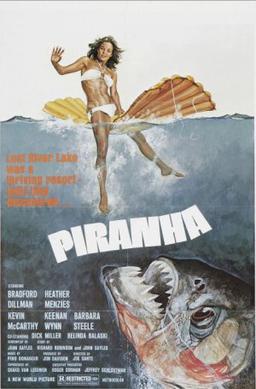
With a career as prolific as Roger Corman’s was, it’s difficult to keep up.  I knew his horror movies mostly from the sixties and maybe early seventies.  Having stumbled upon Humanoids from the Deep, which he produced rather than directed, I was pointed to Piranha.  I knew about this movie, of course, but never had a reason to watch it.  Well, Corman rabbit holes are easy to tumble down.  Corman was the executive producer of Piranha and since I was already splashed with water-themed horror, well, why not?  As with Humanoids, it has a different feel from movies Corman directed, but some of the trademarks are there.  Piranha has so many shark-sized holes in it it’s not difficult to believe that it was exploiting the popularity of Jaws.  In fact, the movie opens with one of the characters playing a Jaws video game.

So the government had been weaponizing piranhas to help in Vietnam but when the war ended they kept the program going.  A woman who finds missing persons releases these fish into a Texas mountain stream.  Anyone on the river is in danger and, of course, it flows past a new resort that is having its opening weekend downstream.  The government wants a coverup because the colonel in charge has invested heavily in the new resort.  You get the picture.  Lots of people screaming in the water and a gratuitous use of movie blood and a story that keeps the viewer asking “why?” The film has a way of somehow steering just clear of bad movie territory.  Also, it becomes obvious, that even without appropriate music cues, this is a horror comedy.  I lost track of how many unanswered questions there were within the first fifteen minutes.

Piranha is a sort of fun knockoff from Jaws.  There’s nothing really profound here, although one scene did make way for a little social commentary.  When Maggie (the skiptracer) wants to distract an army guard with her feminine wiles, she wonders if he might be gay.  This was in 1978, well before “don’t ask, don’t tell,” and she asks with a pre-Trumpian nonchalance that it’s downright refreshing.  Otherwise it’s pretty much your typical exploitation film.  The concept has led to a couple of remakes, so watching swimmers getting nibbled to death obviously has some appeal.  The plot is so outlandish that there’s nothing scary here, even though it’s clearly horror.  There’s even a scene with some stop-motion animation of a creature in a subplot that’s simply dropped.  There are worse movies for summer escapism, given that we’re now post-pre-Trump again.


Cut-Rate Black Lagoon

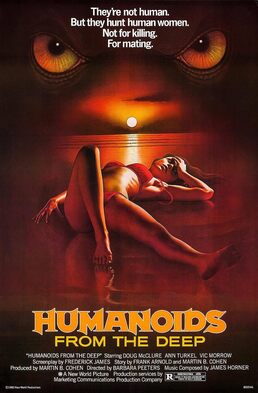
I stumbled upon Humanoids from the Deep while looking for a different film on Tubi.  I had to make a quick decision (don’t ask) and I saw that Humanoids was a Roger Corman movie and figured I knew what I was getting into.  In a sense I was, but B movies can surprise you sometimes.  As the story unfolded my first thought was “this doesn’t look like a Corman movie.”  Indeed, the direction didn’t come from Corman but from Barbara Peeters.  But that wasn’t the end of the story.  What is said story?  Well, it’s a kind of ecological Creature from the Black Lagoon, but with a bit more of a disjointed plot.  A large cannery wants to open in Noyo, California and the local fishermen all like the idea except the American Indians.  Pollution has been driving off the fish and the cannery will make things worse.  From the beginning humanoid creatures have been stalking the town at night.

The creatures start killing the men and raping the women.  The female scientist brought in speculates that a certain hormone intended to grow larger salmon faster had leaked and coelacanths that had been eating the modified salmon became humanoid and felt the need to reproduce with human women.  The creatures were inspired by the Gill Man but have ridiculous tails that give them a kind of Barney vibe.  During a local festival the creatures attack the town en masse and a real melee breaks out, but the creatures are defeated with a combination of high-powered rifles, gasoline on the water set ablaze, and a kitchen knife.  It’s all a bit of a mess.

Apparently Corman felt the movie wasn’t exploitative enough and hired another director to spice it up a bit, having it edited together without the director’s knowledge.  To complicate things, a second, uncredited director had already been involved, so the film has three.  That might help to explain why the story doesn’t really hold together.  As a cheap creature feature it’s not horrible.  It borrows ideas from Alien, Prophecy, and Jaws (and apparently Piranha, which I’ve never seen).   It turns out to be rather nihilistic when it’s all said and done, but the creatures, apart from the tails, aren’t that bad.  There are a couple of legitimately scary moments.  Those of us who watch Corman movies might know to expect some deficiencies, but I was caught off guard by some of the cinematography and even some of the acting.  Not bad for a movie picked with only a few minutes to decide.


Quatermass Again

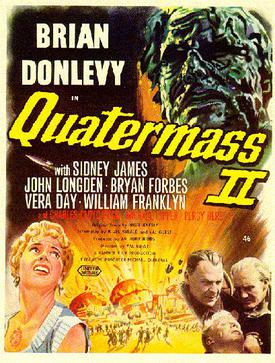
Quatermass, as I’ve noted before, is a name I knew from boyhood, but with no frame of reference.  Having watched The Quatermass Xperiment, and still seeking Quatermass and the Pit, I found a freebee of Quatermass 2 on a commercial streaming service.  Hammer films are notoriously difficult to find in the United States, unless you’re willing to pay serious money for them.  In any case, Quatermass 2 is a passible bad movie in the sci-fi-horror genre.  Quatermass is supposed to be a likable character, but for the film versions American “tough guy” Brian Donlevy played Quatermass in the first two movies.  But I need to take a step back.  Quatermass was a BBC television serial.  There were four series, each eventually made into movies.  The first three were reshot and the final one (The Quatermass Conclusion) was cobbled together from the serial rather than being refilmed.

Of this set of movies, The Quatermass Xperiment and Quatermass and the Pit are considered proper horror.  Brian Donlevy doesn’t garner a ton of sympathy in Quatermass 2.  This is mainly because of poor acting and a small budget.  Reputedly suffering from alcoholism, Donlevy has trouble with his lines and often appears curt and short-tempered (he was replaced in Quatermass and the Pit).  Even so, Quatermass 2 has monsters and some reasonably scary moments.  Here’s the story: alien invaders are taking over a secret government plant preparing for moon colonization.  Quatermass discovers the base and finds that everyone acts odd.  Interestingly, they’ve stolen his plans for the base.  The aliens take over people, body-snatcher style.  Quatermass and an angry mob manage to get into the base where the alien-infected fight them.  Eventually the huge monsters break loose and Quatermass has his own rocket converted to a bomb to destroy the mothership in geosynchronous orbit.  The infected people return to normal.

It’s fairly easy to see why few people comment on Quatermass 2.  I wouldn’t have watched it had I not stumbled across a clip showing some of its horror chops.  I’m glad, in a strange way, that I saw it.  I knew Quatermass was a telinema [link to Fire Walking]  product, but I wasn’t quite sure how the television serial fit together with the movies.  Quatermass 2 was bad enough to make me look it up.  From all my reading about horror movies, Quatermass and the Pit is the scariest of the four.  At least at this historical moment it’s not available on streaming services.  And that, I submit, is why we still need DVDs.  Digital rights management is rather like an alien invader…


Rabbit Hole Crawl

Rabbit holes can be fun.  They can also leave you scratching your head.  David Schmoeller directed some third or fourth drawer horror films, among which is Crawlspace.  Having fallen down the Schmoeller rabbit hole, I found it streaming at the cost of frequent commercials.  Hey, that’s how I watched movies as a kid, so why not?  I was drawn to the movie by Klaus Kinski.  He is arresting on camera and directors knew it.  He was also famously difficult to work with.  Schmoeller apparently tried to get Kinski fired from Crawlspace, but without him it would’ve been a nearly complete waste of time.  That’s because Schmoeller’s story (he also wrote it) doesn’t make a ton of sense, even if it introduces some fascinating themes.  So Gunther (Kinski’s character) is a landlord.  He rents rooms in his house to young women that he murders, after spying on them through the eponymous crawl space.

Why does he murder?  Because his father was a literal Nazi and Gunther has tendencies in that direction.  He’s conflicted, though.  A medical doctor, he saved lives.  He also killed.  Caught up with the God-like power of determining life and death, he explores it at the expense of young women.  And their erstwhile lovers.  And occasional visitors.  Kinski pulls off this double life persona, making him believable.  Even so, the story doesn’t have much other depth.  There’s a lot of crawling around HVAC vents and inventing of insidious ways of murdering and tormenting people.  When Gunther finally loses it and puts on make-up and dresses as a Nazi it’s clear that this is the endgame.  I won’t spoil the ending, but I can say there’s a bit of irony there.

I first became aware of Klaus Kinski through his mesmerizing performance in Werner Herzog’s Nosferatu the Vampyre.  His is one of the best vampire portrayals in all of cinema, in my opinion.  I wonder at the confidence of someone so difficult to work with and yet who appeared in more than 130 films.  I’ve been fired for doing a good job at least three times.  But then, I’m not a professional actor.  At least two of the directors Kinski worked with (Herzog and Schmoeller) made documentaries about how difficult he was.  There were rumors that both wanted him killed.  And yet he made a living acting.  (He was also married, and divorced, thrice.)  I’ve seen him in a handful of films and he does, in what makes it through to the final cut, command attention.  Without him Crawlspace would simply be a hole in the ground.


Eye Eye

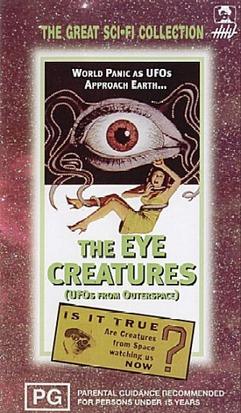
When trying to be conscientious about not spending too much money on movies there’s always the risk of seeing something cheap.  In the case of The Eye Creatures, not only was it cheap, but it was also a throw-back to childhood.  I remember seeing this one in my younger years, and, not yet old enough to be critical, loving the costumes.  Rewatching it as an adult, where some critical faculties remain, reveals it to be a bad movie.  Poorly written, poorly acted, and poorly financed, it ticks all the boxes.  It’s actually a remake of an earlier American International Pictures film, and AIP wasn’t known for its lush budgets.  To be fair, the film is supposed to be a sci-fi horror comedy, but the comedy isn’t that good.  The unintentional gaffs are.

So, the Air Force is concerned about keeping flying saucers secret.  When an “unfriendly” one lands where the teens all go parking, the Air Force investigates while the eponymous eye creatures terrorize the local kids.  Specifically, they seem bent on revenge against Stan Keyton and his girl, because they ran over one of the creatures.  Keyton gets arrested for manslaughter because the creatures substitute the body of a drifter they killed for the corpse of their own comrade.  The police don’t believe in aliens, of course, and the Air Force denies everything.  Keyton and gal decide, after discovering the the eye creatures explode when exposed to light, to round up the necking kids and wipe out the aliens with their headlights.  They figure nobody will believe them anyway.

Some movie monsters stick with you for decades.  The eye creatures are one example of this.  Simply seeing the movie title reminded me of them, although the only plot point I could remember was that they exploded in the light.  I didn’t recall all the voyeuristic watching of teens making out that the Air Force officers did.  Or the tedious revisiting of the Old Man Bailey character.  One of schlockmeister Larry Buchanan’s films, it was released the same year as his other cheap childhood favorite, Zontar, Thing from Venus.  As much as people like to make fun of makers of such cheap movies, Buchanan gained recognition in the New York Times (as have other makers of schlock such as Roger Corman and William Castle), so there is something to these movies.  For one thing, those of us who grew up in the sixties remember them.  And, if we also remain cheap, we can see them again as adults, and relive a bit of cinematic history.


Remembering Winter

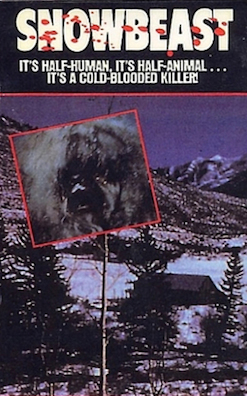
There’s a deep satisfaction at attaining a goal, no matter how low the bar.  Having rediscovered the “Beast Collection” after looking to see if Snowbeast was on it—it was missing from another DVD collection I have—I determined to watch my way through.  It took two or three months, maybe four, but I finally finished it out with Snowbeast itself.  One of a spate of Bigfoot films from the seventies, this was a made-for-television movie.  Many retrospectives show a movie going up in critical estimation over the years, but this one seems to have sunk down into the “bad movie” category.  But still, of the seven (!) Sasquatch films in the pack, it is clearly the best.  A low bar, as I say, but still, it has the advantage of being relatively well written.  Joseph Stefano, who wrote the screenplay, was one of the minds responsible for The Outer Limits.  He also had credit for writing the screenplay for Psycho

Decent writing can help redeem bad movies.  But more than that, you can actually care for the characters.  In some bad movies you have a difficult time raising any feeling for the people portrayed—that’s true for more than one of the other films in this collection.  Here are people that doubt themselves, but have good hearts.  The story isn’t complex (one of the reason modern critics scorn it).  A ski resort in Colorado—much of the movie shows people either skiing or snowmobiling—a young woman is killed by the eponymous snowbeast.  When the owner of the lodge insists on keeping it open for a festival, the current manager (her grandson) is reluctant to kill something that’s so human.  There’s a bit of a moral quandary here, which provides some traction on a slippery slope.

The beast then kills a member of the search and rescue team, and they know they have to destroy it.  The principal characters track it down, and after the beast gets the sheriff, they shoot it.  As I say, not much of a plot, but the characters have some depth.  It’s not a great movie by any stretch, but it doesn’t leave you feeling as if you’d have more enjoyed doing your taxes.  And that’s saying something for a collection of movies that cost less than most single DVDs.  Now if that makes me sound old, keep in mind that this movie was from the seventies.  And even if most re-appraisers think it has grown worse over time, I’m willing to disagree.  After all, I just accomplished something by watching it.


Father of Yeti

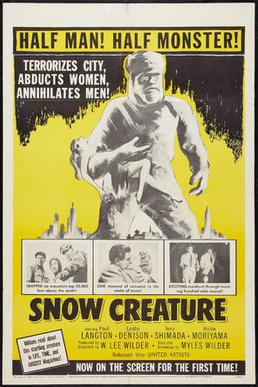
“Always steals women.”  So Subra mutters high in the Himalayas.  Perhaps one of the most unintentionally funny bad movies, The Snow Creature does hold a place in history.  It was the first abominable snowman, or yeti, movie made.  It’s also incredibly cheaply made with a costume that most twelve-year-olds could’ve fabricated better.  As the antepenultimate movie in the “Beast Collection,” I felt obligated to watch it one snowy weekend.  Spouting colonialist and sexist values like a Republican, the story is tedious even at eighty minutes.  But funny at times also.  So a botanist travels to the Himalayas to study plants at 10,000 feet.  His fun is interrupted when a yeti kidnaps the head sherpa’s wife, causing the sherpa to take charge and start to hunt the beast.

The American scientist decides to capture the yeti instead so that he’ll have something to give the foundation sponsoring the expedition.  Leaving behind a female and baby yeti, both killed, he drugs the snowman until a special refrigerated container can be built—gee whiz, Americans can do anything!—to bring the beast back.  And they fly west from Bombay to California, where, when they land the beast is held up in customs (I kid you not).  There’s a debate about whether he’s human or animal and while the debate goes on, the creature escapes.  The hapless police can’t find a seven-foot tall yeti wandering around Los Angeles at night, harassing the women.  Finally they figure he’s using the storm sewers.  They trap him but, alas, have to shoot him.  At this point they completely lose interest in the corpse and exchange meaningless banter as they drive off.

This movie seems to be what the Trump administration wants America to revert to.  Bossing around BIPOC people in their own countries, women being helpless without men to rescue them, and corporations buying what is arguably a human being.  Sounds like a playbook to me.  Also, it was extremely cheap.  What amazed me is that United Artists distributed it.  People must’ve been pretty hungry for entertainment back in 1954.  Having said that, it is worth watching for a laugh.  Now that streaming exists, you can find this free on various services.  If you like very wooden acting, and superior Americans having their way in Asia just because they’re, well, Americans, you might find this a passable way to spend a snowy weekend (wait til winter to watch it; it’ll keep).  Only a word of advice: be sure to lock up your women before you do, because the beast always steals women.


Pseudo-documentary

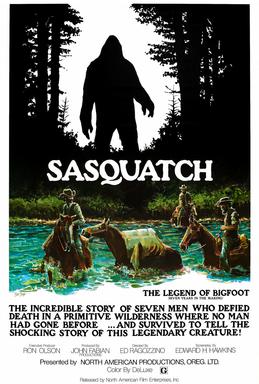
Documentaries have an honored place in visual education.  Of course, there are some who want to spice them up a bit with dramatic re-enactments.  These are sometimes called docudramas.  Then there are those who fake the documentary style to make mockumentaries, generally as a species of comedy.  Sasquatch: The Legend of Bigfoot is none of these.  A pseudo-documentary, it comes with “The Beast” collection I’ve mentioned before a time or two (mainly to excuse my bizarre viewing).  It presents itself as a documentary, but pretty much everything about it is fake.  The only real people are Roger Patterson—the movie shows his famous Bigfoot film—and perhaps the miners at Ape Canyon.  Oh, and Teddy Roosevelt.  In any case, the movie follows seven men as they make their way into remote British Columbia where “the computer” tells them sasquatch likely live.

The pseudoscience is easily enough spotted early on, but the movie never lets up its purported intent to bring low-budget proof back from the wilderness.  I’m not sure how the actual wildlife footage was captured.  In this slow-paced horror film there is quite a bit of actual nature thrown in.  I also wondered how they managed to get a cougar to attack a horse train and a bear not to maul one of the incompetent actors.  These two scenes aren’t special effects, and it strikes me as being either foolhardy or that trained animals were used.  It doesn’t seem to have had the budget for the latter, but a real mountain lion does land on one of the horses before quickly making an escape.  Although shot at night, the bear attack doesn’t seem entirely fake.  These things kept me wondering.

After about two months of horseback riding the crew makes it to the computer-predicted sasquatch homeland.  Bigfoot attacks the camp at night—no question that this one is fake—and after all these weeks of riding they decide to leave the next day.  Getting there is, apparently, most of the fun.  Fun, however, isn’t a word I’d use to describe this movie.  The hokey caricature characters (the old-timer, the dopey cook, the injun, the scientist—who does nothing but measure a thing or two) are worth a pseudo-laugh or two but the story struggles to keep the viewer awake on a cold weekend afternoon.  I kept wondering, in the Pennsylvania chill, how the weather in northern Canada was better in late September than it was around here in April.  I had to remind myself that Bigfoot was big in the seventies.  Big enough to handle both documentaries and fiction, and movies that are the latter, pretending to be the former.


Capture and Release

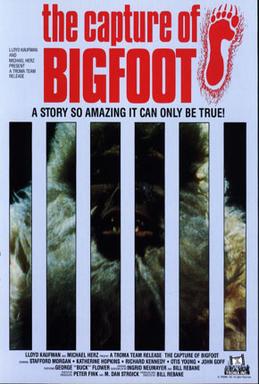
Waste not, want not.  I place some stock in old sayings.  With the way things are going, prices are sure to rise and so saving a penny or two may be wise.  So I turned back to my boxed set of “The Beast” for my horror fix.  As I’ve explained before, I bought this DVD set before streaming was a thing, and I was feeling nostalgic for Zontar: the Thing from Venus.  Being a fan of bad movies, it was worth every cent.  The set is actually (mostly) themed around Bigfoot.  I’ve talked about a few of these movies before, and trying to be frugal, I’ve determined to watch the whole set, no matter the cost.  Besides, there’s an aesthetic to bad movies.  The Capture of Bigfoot, no doubt, is a bad movie.  Knowing this before I slipped the disc in, I have no business acting outraged at the poor acting, directing, writing, or any cinematic sins.  Except one: a horror movie can’t be boring.  And Capture is b-o-r-i-n-g.  If you like movies about people slogging through knee-deep snow, this may be for  you.  

What really amazes me is the talent the compilers of such collections have at locating truly obscure bad films.  Now, I have a soft spot for 1970s horror.  Nostalgia carried me through, floating on those seventies’ vibes.  The clothing, especially.  And more particularly, the winter coats.  Although set and filmed in Wisconsin, the winter coats the kids wear in this movie are just like those everybody was wearing in Pennsylvania at the time.  And yes, I trudged through knee-deep snow my fair share of times.  That part just opened the flood gates of memory.  So, the story goes like this…

An evil businessman (I lost track of how many people he killed, or tried to), wants to capture Bigfoot (shown early, in winter white) to put the town on the map.  Paying stooges to go get the beast, he finally builds an elaborate trap that succeeds.  The local game warden, with his girlfriend/wife and her little brother, decide the creature isn’t evil.  Using Batman-style tying skills, bad guy’s henchmen assure that most of his enemies escape to trudge through the snow some more.  A mysterious Indian character tells the game warden that the creature must be set free, which it is.  The evil businessman dies in a fire inside his wicked mine where he’s keeping the beast.  In the end, two families—the warden and the Bigfoot—pay mutual respect.  I do wonder about the mentality of someone making a movie like this.  But then, some forty years later, here I am writing about it.  Win-win. 


Bad Taste

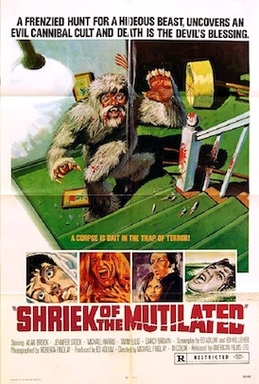
There is a reason for watching bad movies, apart from the fact that they’re often found streaming for free.  Sometimes that reason is that they’re so bizarre that they’re almost surreal.  And sometimes the circumstances surrounding them are equally strange.  Michael Findlay’s Shriek of the Mutilated was included in the set of movies I bought for Zontar: Thing from Venus.  Not one to be wasteful, I’m finally dutifully watching these before allowing myself to purchase new fare.  Given the fact that this had a theatrical release, I’m surprised that it’s not compared more often with Ed Wood’s oeuvre.  In any case, this is a very convoluted story and spoilers will follow.  You’ve been warned.

An international group of demon worshipping cannibals have a member who’s a professor that takes students on a “yeti hunting” expedition every few years.  The students are all killed but one, so that the yeti story can continue.  Viewers (if any) aren’t clued in to this until the last few minutes of the film but early on you can spot the cannibal theme.  So four students in the professor’s Mystery-Machine-like van, go on a hunt while staying with a “colleague.”  Naturally the students start getting killed.

Using some of the worst dialogue ever written, the clueless coeds keep allowing themselves to be led into situations no sane person would.  The chosen “survivor” discovers the plot and is amazed that the creature was (blindingly obviously) a guy in a suit trying to scare them to death.  The cannibals prefer their meat with no bruises.  Much more could be said about the ineptitude of the movie but it ends up having an interesting, if tragic, coda.

Michael Findlay, who made exploitation films with his wife Roberta, was actually sliced to death in a helicopter accident on top of the (then) Pan Am Building in Manhattan.  This happened three years after this movie was released.  In those three years he’d directed eight more films, so his last movie before being mutilated was not the one in my Beast collection.  Quite often when I watch bad movies I have trouble finding any discussion of them at all.  Shriek of the Mutilated is discussed at some length in two books—not surprisingly published by McFarland (they have great pop culture titles).  Until I discovered this movie, in with ten others in a collection, I’d never heard about it.  Of course, the theatrical release was for drive-ins and was limited to Texas, Florida and California.  There can be a lot of information to dig out when people stoop to talking about bad movies.


Not Quite

There’s a debate among horror nerds that goes like this: “Blumhouse or A24?”  If this is Greek to you, Blumhouse and A24 are entertainment production companies that both make notable horror films.  I’ve always leaned a bit toward A24, to the point of making a list of their horror films and watching them when I can find them on streaming services.  Since I generally don’t read about movies before watching them, I wasn’t sure what Climax was going to be.  Distributed by A24, I figured it would be intelligent horror and it may have been.  Honestly, it was a little difficult to tell.  Nihilistic and non-scripted, it’s a movie with a very slight premise: a French dance troupe holds an after-practice party in which somebody spikes the sangria with LSD.  The entire first half of the movie, practically, is dancers doing their stuff to an incessant techno-beat.  I honestly don’t know why I kept with it.

Since it’s unscripted, most of the young people talk about sex, and occasionally other topics.  They begin to get paranoid when the acid kicks in, and throw one of the dancers out in dangerous winter conditions where he freezes to death.  They think he spiked the drink.  The troupe manager, also a suspect, has a young son that she locks into an electrical closet for protection, with predictable results.  Since she also drank the sangria, the troupe supposes she must be innocent.  A third non-drinker, who is pregnant, also gets accused.  Meanwhile some dancers keep on dancing while others start to pair off, all of them but the pregnant one, tripping hard.  In the end the police arrive and find dead or stoned dancers and really that’s about it.

How is this horror?  Psychologically, mostly.  There is a little body horror, but mostly it’s just viewers wondering what is going to happen.  Which, it turns out, is not much.  There are some religious references in the movie, which maybe offer a little depth, but really this is largely a filmed rave-like dance with a minimal storyline tossed in for good measure.  Also, it’s in French, meaning subtitles are important for following whatever plot there is.  Wikipedia leads me to believe Gaspar Noé, the “writer”-director is fond of making polarizing and controversial movies.  There’s nothing surprising about young people being interested in music and sex, nor, for that matter alcohol and drugs.  All of this is entirely conventional.  It isn’t enough for me to lose faith in A24, but it does make me wonder what they were thinking.


Littlefoot

A film is an object.  Just like a book, a film exists and waits for someone to discover and promote it.  The vast majority of both don’t make the cut and exist in obscurity.  The Legend of Bigfoot by Ivan Marx is one of those obscure films.  I only knew of it because it was included in the DVD pack called “Beast Collection,” which I’ve already mentioned a time or two.  This set of movies is united by a few different themes which have little to do with one another.  The “Bigfoot Terror” disc includes Marx’s Legend although there’s no terror here and it presents itself as a documentary.    Interestingly, this movie actually had a theatrical release.  Of course, the mid-seventies were a high-water mark for Bigfoot interest in general, prior to the current phase.  Marx followed up his movie with a couple sequels and to his dying day claimed that his Bigfoot footage was authentic.

As far as the movie goes, it is just plain bad.  The wildlife footage, shot by Marx, is actually impressive a time or two.  Most critics dismiss his Bigfoot footage as a hoax, a view supported by the fact that the bona fide Bigfoot researchers he worked with eventually distanced themselves from him.  The movie is rambling and dull but intriguing at the same time.  It’s amazing, for example, that he was able to get this into theaters at all.  But what drove the producers of “Beast Collection” to include it, beyond it perhaps having been cheap and bit of filler on a disc claiming “approx. 5 hours of yeti scares”?  Well, it’s an object.  And it fits the theme of “yeti” but not really that of “Terror.”

There’s not a ton of information on Ivan Marx online.  IMDb has a mini-bio of him, noting the others who worked with him.  Even his wife, Peggy, who appears in the film, gets a little IMDb notice.  Such movies as this are hopeful artifacts.  Those of us who struggle against obscurity can take heart that, although probably a hoax, a movie that would otherwise likely have been forgotten made its way into a schlocky collection of horror movies to be purchased by the gullible and the hardcore.  As I mentioned in my post on Search for the Beast, I bought the collection to see Zontar: Thing from Venus, which, at the time, was available nowhere else.  I got what I wanted, and oh so much less.