Institutionalized

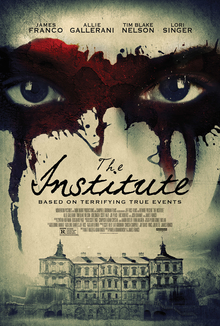
When movies set out to present a different period, a bit of historical research can go a long way.  Someone like Robert Eggers offers such verisimilitude that you feel like you were at the intended time.  Others are less successful.  The Institute claims to be based on true events, and, apparently human trafficking did take place at the Rosewood Institute for a number of years.  The movie, however, gets many period details wrong and suffers from a labyrinthian story.  Also, it is shot so dark that even with brightness at full it’s difficult to tell what’s happening much of the time.  So what are these allegedly true events?  Wealthy women are admitted to the fashionable institute to recover from mental stresses.  At least that’s why Isabella Porter is there.  Drugged by the fictional Aconite Society, she is trained to be impervious to pain, erase her identity, and believe she is fictional characters to act in plays.  A strange premise.

Her brother suspects something is wrong, but under the influence of wolf’s bane, Isabella kills him.  The women are repeatedly tortured and dehumanized, ultimately to be sold to the wealthiest elites of Baltimore as slaves.  The true part of the true events is quite slim, and it’s never explained why Isabella is trained to believe that she’s Young Goodman Brown, and paired off with another woman as his wife Faith.  Also, there are Satanists involved.  With all the stops pulled out, the whole begins to sound rather silly.  It’s unfortunate since there does seem to be the core of a good idea here.  It needs a little less rather than more.

If all the storylines came together into a coherent whole, there might’ve been some takeaway.  As it is, layers of a secret society cover other layers and when you get to the center there’s nothing there.  Movies about mental institutions are difficult to pull off well, particularly when they’re based on true stories.  While a wolf-bane drinking society of the uber-wealthy does sound plausible, it leaves unanswered why they want their female patients to act out stories when they could easily afford to attend plays with professional actors.  ’Tis difficult to fathom.  The satanic aspect is never really explained but again, I wouldn’t put it past the rich.  The acting is good, from what I could see of it, except for the institute’s doctors, all of whom were woodenly portrayed.  Perhaps this was intended to be a parable, or maybe a retelling of “Young Goodman Brown.”  There was a bit of Poe thrown in as well, so all was not completely wasted.


Somehow Inevitable

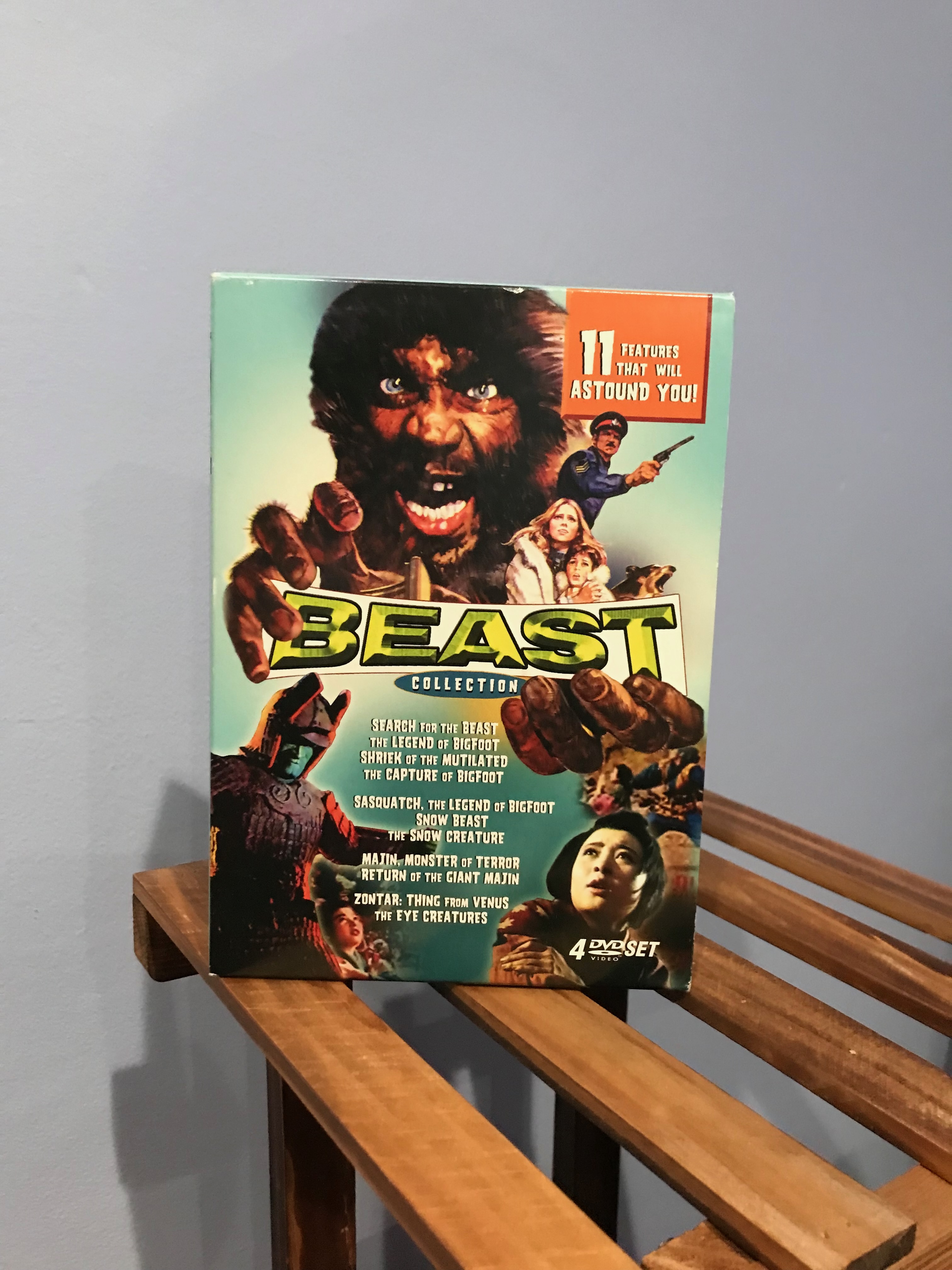
You had to expect me to write about Zontar: Thing from Venus.  I bought the “Beast Collection” set to see it many years ago.  In those days I tried to watch the movies through, in order but I didn’t make it through the first disc, even.  Well, now my perspective has changed—I figured I bought this to see Zontar, and Zontar I must see.  You do know that he controls people, right?  Zontar is a notoriously bad movie.  I saw it on television as a kid, and it may have even been close to the first run since it was made for television.  It’s actually a remake of a cheap Roger Corman movie, so it is a cheap remake of a cheap original.  Nostalgia, however, does funny things to a guy.  Although I saw it half a century ago, I remembered some lines precisely.  Television does funny things to young minds after all, I guess.

In case none of the injectapods has found you yet, it goes like this: Zontar, from, well, Venus, is a bat-like monster with three eyes.  He befriends an earthling outsider scientist, through laser communication, and commandeering a satellite, which becomes a passable flying saucer, lands in  a cave from which he takes over the small town of Jackson, which has a military base and plans to take over by having a general assassinate the president.  Meanwhile, his scientist friend directs Zontar to the four people that he needs to take over the world: said general, the sheriff, the mayor, and his best friend scientist, Curt Taylor.  Things don’t quite go Zontar’s way, despite most of the movie’s running time showing him totally in control.  It feels like it’s a lot longer than its 80-minute running time.

Still, I have to agree with the TV Guide review that says it isn’t as bad as everyone says.  Yes, it is a bad movie but it does have a few redeeming features.  Some of the scenery is nice, and you even begin to care for some of the characters.  The rogue scientist’s wife—despite her constant nagging—is the first person who tries to kill Zontar, and she does this for love.  When Zontar gets her you feel a little sad.  At least I did.  You see, the injectapods haven’t reached me yet and I still have human emotions.  Ironically, it is just such things that drive me to rewatch movies like Zontar all these years later.  And the movie ends with a voice-over moral of the story.  Those 80 minutes weren’t completely wasted.


The Search Continues

This movie’s so bad there’s a backstory.  Years ago I was really wanting to see Zontar: Thing from Venus.  This was before streaming, and I found it as part of the “Beast Collection,” a set of 11 movies for less than the price of one regular first-run DVD.  I watched a few other movies in the collection, but before long it got shoved to the back of a shelf and forgotten.  I remembered it recently because another collection I have was missing a movie, Snow Beast.  I wondered if it might be part of this otherwise forgotten set.  It was (this really encouraged me because maybe my memory is still much better than I sometimes suppose).  In any case, one of the other movies—one I’d never seen—was Search for the Beast.  I figured, why not?  This is a film that fails on every level.  And I mean every single one.  It really should merit a Wikipedia page, just for being so bad.

So, a professor in Alabama goes in search of the beast in the Okaloosa mountains.  The budget for the movie must’ve been a matter of pocket change.  Anyway, the beast has been “killing” anyone who ventures into the mountains and the professor wants to prove it exists.  He’s backed by a guy with money, who isn’t explained at all, and his university office is less well equipped than an average undergrad’s dorm room.  He takes a female grad student with him but his financier, unbeknownst to the benighted professor, hires a bunch of beefy guys with assault rifles to go along, although they’re only going to take pictures.  Of course the professor sleeps with the grad student but then the head of the tough guys kidnaps her as the beast kills off the tough guys’ heavily armed posse.  Turns out the local hillbillies are, apparently, trying to mate the beast with the women who come into the woods.  It’s worse than I’m describing it.

There is some chatter on the internet about this groaner, so I’m sure that I’m not the only one who’s seen it.  Someone recently asked me how such movies even get made.  Well, anyone with a camera can shoot a movie.  Of course, getting paid screen time (or video distribution) is another story.  I doubt the makers of this film made much money off of it, but since other suckers like myself have discussed it online, the producer, director, writer, and actor Richard Arledge, has the last laugh.  His work is being talked about, no matter if nobody has a good thing to say about it.  Of course, I wouldn’t have ever seen it at all, if I hadn’t had a hankering for Zontar: Thing from Venus all those years ago. 


Meanwhile, on Earth

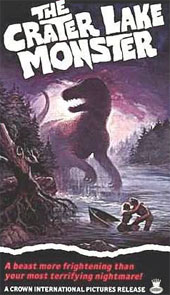
Low budget doesn’t always translate to cinematic disaster, but in The Crater Lake Monster, it unfortunately does.  I have a soft spot for those who attempt to make movies but don’t succeed the way that they’d hoped.  The Crater Lake Monster is poignant in that respect as the production company, Crown International, apparently messed up the financials and insisted on cutting scenes that helped to make a bit more sense of the story.  The actors are certainly not those at the top of their game, but the stop-motion plesiosaur isn’t half bad.  The story itself doesn’t seem to support its tonnage, however.  A meteor crashes into Crater Lake (not the famous one).  Some months later a monster begins attacking people after it eats up all the fish.  There are a handful of characters who are concerned, and some just casually passing through.

The sheriff, at first skeptical, becomes a believer after seeing with his own eyes.  The doctor, who examines a victim’s body, thinks there’s something in the lake.  A couple passing through on their way to Vegas see the monster up close and survive, but their trauma is so great that they can’t talk about it.  A pair of guys who rent out boats to fishers are having trouble because there’s no fish left.  And a pair of archaeologists from “University Extension” insist that the creature should be kept alive since, well, you don’t often come across dinosaurs.  They also figure out that the hot meteorite incubated a fertile plesiosaur egg that had been at the bottom of the lake for millions of years.  There’s even a story of a liquor-store robber thrown in.  The robber’s only tied to the plot by getting eaten by the monster.  The monster is finally killed by the sheriff with a bulldozer.

Some of the people that worked on this film, especially the stop-motion crew, had some recognizable chops in the biz.  One of them had worked on that childhood Christian kids’ show Davey and Goliath, and another was concurrently working on Star Wars and went on to work on Jurassic Park.  Meanwhile, Crater Lake is so bad that it’s a bit surprising that it hasn’t really become a cult classic.  Creature features are a guilty pleasure.  With a bit of coaxing, and financing, this one might’ve been made passable.  Who doesn’t like to see the underdog achieve some success?  Of course, it did come out the same year as Star Wars, with its budget, and clearly couldn’t compete down here on Earth.


Bottoming Out?

It was an honest mistake, I swear!  I had remembered reading in Stephen King’s Danse Macabre that The Creeping Unknown was worth seeing.  I’d known about this movie under the title The Quatermass Xperiment since I was a tween.  The problem when you grow up with no money in a small town is that you don’t have access to such things.  Then a friend gave me a DVD of The Creeping Terror.  I thought it was The Creeping Unknown.  The disc hadn’t spun too many revolutions before I realized I was watching what may be the worst movie ever made.  Many reserve that for Plan 9 from Outer Space, but believe me, this is much worse.  The story of a couple of aliens sent to eat people to transmit to their superiors what our weaknesses are, it seemed to me that the main weakness is nobody thought to run from this slow-moving monster, except one guy who just abandoned his girlfriend to it. (Apparently girls don’t run.)

Like that other baddie, The Beast of Yucca Flats, the audio was not preserved so nearly all of the film is a voice-over by an authoritative-sounding announcer.  There are a few dubs, but they aren’t well done.  And then extended scenes of young people at a dance (have you ever heard of just filling up time?) are intercut with perhaps the slowest monster attack in history.  There’s so much not to like here.  The poor acting.  The plot nearly as dimwitted as Trump.  The stock footage of a rocket launch run backwards to make it look as if it’s landing.  The sheriff making out with his wife in the patrol car while “on a break” from looking for the monster.  The instrument panels from beyond our galaxy with Arabic numerals and Latin letters.  You find yourself hoping for the Apocalypse so you won’t have to watch the rest, and it’s only 74 minutes long.

Somehow it comes as little surprise that the director (also producer, editor, and star), under the name Vic Savage, disappeared never to be heard of again.  The film’s main financier, had to try to put the movie together for release.  (He also had a role in the movie.)  There is, as I’ve mentioned often before, an aesthetic to watching bad movies.  I’ve ended up seeing many of “the worst of all time” in my spate of movie viewing over the past three or four years.  This is the first time it has happened by mistake.  I do have to say that it’s easier to appreciate a bad movie when you can see that it’s coming and prepare yourself accordingly.  The Creeping Unknown remains elusive.


Ending the Cycle

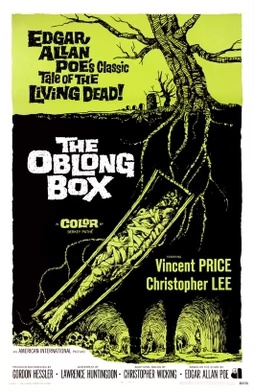
Curious to finish out the “Poe Cycle” of American International Pictures, I looked up The Oblong Box.  The only thing similar to Poe’s tale is the title, as viewers must’ve come to have expected even in 1969.  Poe was the marketing to sell the film, but not much more.  Okay, the theme of premature burial has Poe’s fingerprints all over it, but that’s not part of his story “The Oblong Box.”  Now, as for the movie, it has several subplots and a pretty high body count.  Its ending isn’t really explained, but after starting out as seeming racist, it comes out justifying the actions of the Africans at the beginning.  In the middle it’s a muddle.  Pacing is completely off and some sub-plots, such as the police investigation, are summarily dropped.  Apart from the positive view of Black people, which is important, the film is a confusing criss-cross of unsavory motivations.

The Markham brothers own an Africa plantation and the trampling of a slave by a horse leads to revenge on the part of the slaves.  The scarred brother, Edward, is driven insane and he escapes his brother Julian’s care by being buried alive.  Grave-robbers, however, want him so Christopher Lee can experiment on his corpse.  Edward escapes again and dons a scarlet mask, but his insanity leads him to kill a variety of people, looking for the witch doctor who can cure him.  Meanwhile, an unscrupulous lawyer is cashing in on the brothers’ wealth but ends up being killed by Edward.  There’s a rather pointless bar fight, and, after killing Lee, Edward and Julian finally face off with Edward getting shot but biting his brother before he dies.  The witch doctor raises Edward from the dead, buried in his coffin, and Julian now has his brother’s scarred face (and presumably, his insanity).

The movie was the first to feature both Vincent Price and Lee.  The film had a change of directors, pre-production, and a script that was added to by another writer.  The plot verges on tedious and it’s difficult to feel sympathy for any of the characters, apart from the women, who don’t seem out to hurt anyone.  Price (Julian) also plays a “good guy” until the reveal near the end, but Edward dominates the screen time, all the while wearing a mask.  The “Phantom of the Opera” reveal is shot in the dark, however, and the results are not so grotesque.  And those who’ve read Poe’s story wonder where the ship might be.  This is the only Poe Cycle film not directed by Roger Corman, and he, as well as Poe, are both missed.


Not Plan 9

Dementia 13 is a strange little movie.  It’s Francis Ford Coppola’s directorial debut, and it was produced by Roger Corman and released by American International Pictures.  Like many Corman/AIP movies, it was low budget and quick.  It seems that Corman had some money left over in the budget from a previous movie and he offered Coppola the opportunity to direct a film shot quickly and funded by the leftover funds.  With a script written in three days (and it shows), he set out to film what was intended to be a Psycho knock-off.  The title might give that away, although I’m not sure what the 13 has to do with it, other than being “unlucky.”  Shot in Ireland with mostly American actors, the film is suitably gothic, but the original start to the movie is a red herring.  So what’s it about?

A rich heiress has never recovered from the death of her young daughter, who drowned in the rather sizable pond on the estate.  One of her three sons dies early in the film, setting up a subplot that goes nowhere.  The two remaining sons, unaware of their brother’s death, keep the ritual of the annual acting out the sister’s funeral.  While the widow of the deceased son tries to work her way into the will, she is axe-murdered, bringing this into the horror genre.  The family doctor suspects something’s wrong (although viewers are led to suspect him), and finally solves the crime after another bit character is beheaded.  Part of the problem is the film is too brief to develop the ideas properly.  Released at only 80 minutes, with a 5-minute gimmicky prologue, you really don’t have time to absorb the psychology of the characters.

The influence of Psycho is pretty obvious, the wet woman slowly chopped to death while in the water, is the scariest scene in the movie.  It’s shot in such a way that it’s not obvious that she’s actually being struck until the end of the act (a budget thing, I suspect).  The wealthy widow drops out of the story as the family doctor becomes the self-appointed detective.  Of course, the previous deaths have been undetected, so no actual police come.  In sum, creepy (but not too creepy) Irish castle, siblings working at cross-purposes, a scheming daughter-in-law, and the irruption of the past into the present, along with the black-and-white filming, ofter a quick gothic thrill.  Otherwise, it seems more like homework than an example of foundational horror, but still, it has had inspired a remake, and that’s saying something for a three-day script.


Not Fantasy

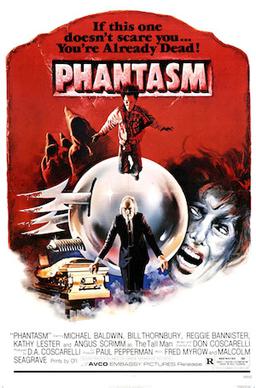
There’s a reason I watch horror.  One of the many things you can’t find online is how popular movies were before the internet days.  This is an issue for me because I only just now found out about Phantasm, which was released in 1979.  Granted, I lived in a small town, but I did know about The Amityville Horror—everyone knew about The Amityville Horror.  The films were released the same year, but Phantasm was an indie production and probably didn’t have reach into my local region.  Nobody talked about it at school and I only became conscious of it a few weeks ago.  I learned that it was quite a box office success, but the critics didn’t care much for it (and I can see why).  It was, however, rediscovered and has become a cult classic.  I can see that too.  The thing is, it is a bad movie.  I’m learning to appreciate such things.

Part of the reason the film bothered me is that I really dislike “but it was all a dream” endings.  Even though there’s a final suggestion that some of it “really happened,” or Michael is dreaming within a dream, such endings always make me shrug.  Horror, to really work, has to be in that liminal zone between believability while on screen and the deeper knowledge that it’s fiction.  Phantasm just had too many strikes against it to be believable.  The dwarves were lifted straight from Star Wars’ Jawa.  The Tall Man isn’t scary (this is from a current-millennium perspective, granted) and while you’re just trying to get into the horror mood (the music is appropriate) a flying ball of death, a sudden sci-fi element, is thrown in.  Of course, the plot takes a kind of sci-fi turn near the end.  It didn’t, however, do any heavy lifting.

I was surprised to learn that it became a franchise, no members of which I’d ever heard.  It is interesting that speculation exists that the creepypasta stalwart, the Slender Man, was developed from the Tall Man concept.  Given that I was seventeen when this movie came out it might be someone of my vintage—but from a different vineyard—would find Tall Man scary.  Of course, if I’d seen it when it was first out, and in a theater, I might’ve gotten some chills from it.  I could have included it in Holy Horror since there is some Bible in it, but it isn’t used to its full extent for a movie that mostly takes place in and around a funeral home.  There is some comfort in knowing that even if your work isn’t great, it can still be rediscovered if enough time passes.  And there’s good reason to watch it.


Alien Invaders

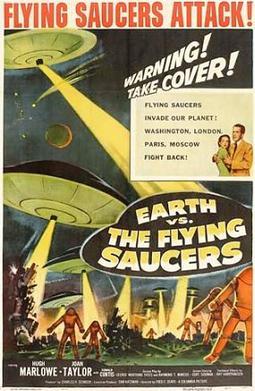
I’ve been pondering genre for some time now.  And since Stephen King assures me (not personally) that Earth Vs. the Flying Saucers is horror, I figured I’d give it a try.  In fact, given the various themes of the movie, I’m surprised I hadn’t seen it before.  The title pretty much gives it away—aliens try to take over Earth with a swarm of flying saucers.  Two scientists figure out how to make their saucers stall, and even though the aliens have a disintegration ray that pretty much destroys anything, the earthlings prevail.  Having summarized it all in less than a hundred words, is there really anything worth comment here?  I think so.

Like many older movies this one makes use of stock footage to fill in action sequences and to keep the budget reasonable.  So there are big guns going off and rockets being launched.  (This was a pre-Sputnik movie and it depicts America having eleven satellites in orbit.)  But the additional footage that stayed with me was a scene of two planes colliding and crashing.  It was clear these weren’t models and the footage was authentic, apart from the flying saucer shooting the planes.  It turns out that this scene was indeed real, and that the pilots of both planes died in the crash.  During an air show outside Spokane, Washington in July 1944 this collision was caught on film by a Paramount news crew and it was reused in this film.  This got me to thinking about war footage—something that really only became possible in the Second World War.  And what we now see today in real time on the internet because the world is wired.

It’s as if those who wage war are fine with it as long as people with a conscience don’t know what happens.  There’s even a phrase used to excuse unspeakable barbarism during combat: the haze of war.  This we know about our species—there’s a tipping point beyond which rationality shuts off and we’re no longer responsible for our behavior.  We also know that war puts people in that zone.  It was fine as long as only surviving warriors were left to tell the stories of their bravery.  Photographing, particularly in motion pictures, combat revealed a much darker truth.  Well, at least in Earth Vs. the Flying Saucers the enemies under attack were fictional.  Except.  Except, some of the casualties were real people whose final moments were caught on camera.  Be sure to get out and vote today, if you’re in the United States.  There’s a party even less understanding than aliens out there, desiring to take over.


Why, Cathy?

Learning to appreciate bad movies is a skill like any other.  It takes practice.  “Why?” I hear you ask?  Why climb a mountain?  Actually, there is a motive for seeing bad movies, apart from the good feeling they can leave you with.  (I might’ve actually done it better!)  That’s because they’re often free streaming.  If I had an endless budget I might well be able to avoid bad movies, but what’s the fun in that?  I found out about Cathy’s Curse because I was looking for a movie about a cursed doll.  (Don’t ask.)  I’ve seen many, of course.  Child’s Play and the whole Annabelle series.  But I felt I was missing something.  Wikipedia actually has a page on haunted doll movies, and Cathy’s Curse stood out to me.  Yes, I was forewarned, but I was also curious.

A Canadian horror film from 1977, Cathy’s Curse has become a cult classic.  The story line decidedly makes no sense.  Cathy, a young girl, moves into her grandparents’ house with her father and mother.  Her father’s father had died in a car crash with his daughter Laura, about Cathy’s age, some 30 years earlier.  Cathy’s parents are troubled, her mother having recently had a nervous breakdown.  Laura’s vengeful spirit possesses Cathy through a doll the latter finds in the attic.  For some reason, Cathy kills the housekeepers and attacks other children.  She tries to drown herself.  She kills the handyman’s dog.  The dog, which is clearly male, is explicitly said to be female in the movie, perhaps because one of the favorite words of the writer is “bitch.”  After about an hour and a half of running around screaming, the opening of the cursed doll’s eyes suddenly brings normalcy to the house.

There are some genuinely good things about the movie.  The late fall-early winter mood is nicely framed.  Why people hang out outdoors without coats in freezing weather is never really explained, though.  Neither the writing nor the acting are stellar.  And have I pointed out that the story makes no sense?  But still, there’s something there.  The idea of possession, a young girl under threat, the scary old mansion—these are classic tropes.  It’s unclear why, when Cathy’s father is fixing breakfast, he immediately sends her to bed and it’s suddenly night.  Or why the detective calls him by the wrong name.  Or why nobody can take a doll away from a little girl.  Ah, but that’s it, you see.  The haunted doll.  You have to learn how to appreciate these things, you know.


Virtual Head Sickness

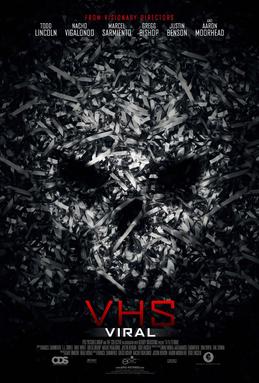
I think quite a lot about the nature of reality.  Our brains—no, our minds—create reality for us.  I’m reminded of this when I get motion sickness from watching a movie.  I am not actually moving, and I even look away from the screen frequently, but if I don’t realize it soon enough, I become quite ill.  There really should be an advisory warning for people with my condition since I have occasionally lost an entire day recovering from such an experience.  Most recently it happened with V/H/S Viral.  I had not watched any of the V/H/S franchise; indeed, I didn’t realize it was a franchise.  I was watching it under the false impression that it was a Justin Benson and Aaron Moorhead movie.  Well, it partially is.  They were responsible for one of the segments—it’s an anthology film.

I made it through an hour and ten minutes, with only eleven minutes to go, when I realized, “I’m going to throw up if I don’t shut this off.”  So I did.  Now, if you have the condition I do, there’s little that you can actually do when the process starts.  You can’t move your eyes much, and even moving your physical body has to be done slowly.  (My sister-in-law, who is a physician, once tried a “tough love” cure when I got motion-sick from a small plane ride.  It didn’t work.  I ended up laying in the dirt by the side of a camp road in Idaho for about half an hour before I could open my eyes and walk, very slowly, back to the cabin.  Once there I slept the rest of the day.)  You might understand why I resent when a movie does this to me.  After maybe an hour, I tried to read.  I was actually reading “Hans Phaal” by Edgar Allan Poe at the time, the part where Hans is hanging upside down outside the balloon.  I had to put the book down.

Although I’d almost gone too far, after a couple of hours I could stand to scroll a bit.  (That often makes me mildly ill, so I need to be careful.)  Then I realized that V/H/S is an anthology series and that various filmmakers are invited to contribute.  Thus the mention of Benson and Moorhead that drew me in in the first place.  I had been trying to complete my viewing of their films.  They aren’t a franchise, but I realized, post-nausea, that I had already seen all of their feature-length collaborations.  They’re philosophical movies, and leave me questioning reality.  The fact that my mind makes my body motion-sick when it’s not moving also does the same thing.


Dancing with King

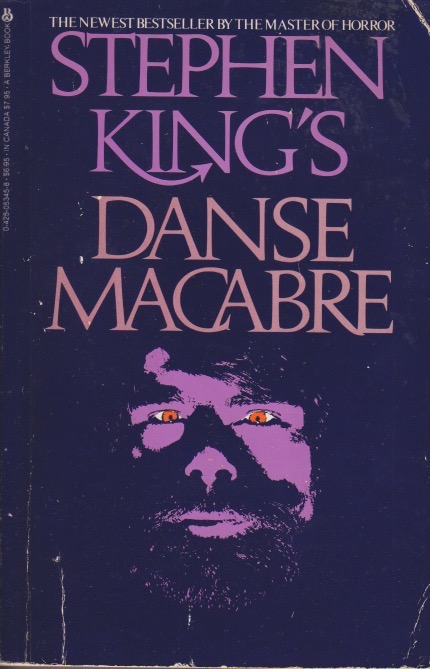
There are books you wait too late to read, but which you read at just the right time for you.  That’s how I feel about Stephen King’s Danse Macabre.  This book is endlessly cited in more academic treatments of horror and I knew I should read it.  And one thing I immediately appreciated is that even early in the eighties King expressed my long-term concern: many genres fall into horror.  He, perhaps rightly, considers horror a subspecies of fantasy.  Or course, fantasy has come to mean something quite different in the intervening half-century.  Still, the reader is treated to thrillers, sci-fi, and weird fiction.  There’s also a dose of the gothic and speculative as well.  King sets his four classes of monsters early: the vampire, the werewolf, the thing without a name (Frankenstein’s creature), and ghosts.  These are all very broadly conceived.

It will become clear in coming weeks, for anyone who’s interested, that the movies I “review” here have been influenced by King’s list.  And in the longer term, the books as well.  And I tend to agree with King’s antipathy toward television, although I disagree with his assessment of The Twilight ZoneDanse Macabre is a book of its time, of course.  I would be curious as to the master’s reaction to such more recent classics as The X-Files.  I loved that he treated Ray Bradbury as a sometime horror author and it becomes clear that each of us finds different things scary.  The thing was, I found myself anticipating my too scarce reading time each day for the month it took me to read the book.  I often start books that I soon find myself approaching with a kind of duty to finish.  Love him or not, King is a talented writer and will keep you coming back, just like birds to a feeder.

I learned that King, too, appreciates bad movies.  He grew up about a decade and a half before I did, but the small-town culture I experienced as a child was not so different, although Sputnik was already up and the Cold War already on.  I guess what I find so engaging here is that this is a guy who speaks my language.  My tastes differ, of course, but there’s something comforting about whiling away the pre-dawn hours with a guy who can say “The Thing” and you know immediately what that vague phrase means.  And it was strangely reassuring to be reminded that the world of the seventies, which I experienced as a teenager, was just as scary as the world is right now.  And if King ever looked me in the eyes, I think he’d recognize something about me, although a sometimes critical fan.


Other Worlds

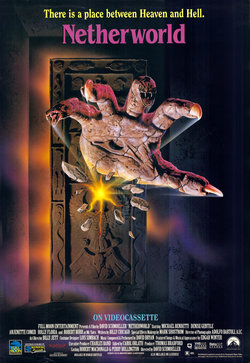
There are any number of movies out there, and you find some that have evaded much comment by checking out the freebies on Amazon Prime.  That’s how I found Netherworld.  It’s not a great movie.  In fact, it’s about the opposite, but it is more southern gothic and since I’ve been watching Louisiana horror, well, why not?  It was free.  The story doesn’t make a whole lot of sense, which is a pity because the ideas seem to have some potential.  So, Cory Thornton has inherited his father’s Louisiana estate.  He didn’t know his father and the estate is run by an improbable staff of one.  (One suspects a low budget had something to do with that.  For the film, not diegetically.)  The estate abuts a brothel where one of the employees turns evildoers into birds with the help of magic.

Meanwhile, the young master finds hints how to raise his estranged father from the dead, which, for some reason, he decides to do.  There are dream sequences and perhaps shades of Papageno.  Lots of birds in this film.  Cory—not very bright—only discovers late in the movie that his father was evil.  Hm, no hints of that in his admitted sexual dalliances and his desire to be resurrected.  No siree, none at all.  By the end I wasn’t surprised to learn that it was released directly to video.  But I was led down the rabbit hole by David Schmoeller, the director.  Schmoeller has received notice of such people as Stephen King, and has given the world some notable cult movies.  It’s fair to say he never made it big in Hollywood, but he worked on some films of repute, even drawing in Klaus Kinski at one point.

There are several tiers to the creative life.  There are those who attain fame, and layered down from them, those who produce movies, songs, novels—any kind of creative output—to those most of us have never heard of.  I find this profoundly hopeful.  Nobody is known to every single person on this planet.  Even the famous aren’t known by everyone.  I like to think I’m reasonably informed, but I keep on hearing about celebrities in art forms I don’t follow and have no idea who they are.  So before watching Netherworld I never paid attention to David Schmoeller, but then I learned he’d nevertheless made a career out of doing what he enjoyed, without becoming a famous director along the way.  There are some practical obstacles, of course.  Getting that first book published, or first movie distributed, but if you can get over that wall there may be a possibility of doing what you like.  It may not make you rich, but you’ll have accomplished something important.


Not What It Says

The title sounds promising.  Gothic Harvest.  But the movie in no way lives up to it, even with its vampires vs. voodoo theme.  So, during Mardi Gras a group of four coeds decides to party in New Orleans.  Of course, this is the capital of American voodoo.  While drinking themselves to oblivion, one of them gets picked up by a local and taken back to the family home.  There, of course, she’s kept as food for the “vampire.”  An aristocratic woman who fathered a child with a slave has received a curse—she and her child remain alive, she aging, while the rest of the family is arrested at their present age.  (Really, the story makes little sense, so don’t ask.)  They need young blood to keep the aristocrat alive so that they can continue living.  In the right hands such a story might’ve made a passable horror film.  These weren’t the right hands.

It’s a good thing I’m trying to develop an aesthetic for bad movies.  The acting is bad, the dialogue is bad, the writing is bad.  Is there a moral here?  Don’t go partying during Mardi Gras since you might get picked up by a family under an ancient curse?  And  would it really hurt to do a second take of scenes where an actor stumbles over their lines?  I don’t know about you, but to me the title Gothic Harvest suggests that lissome melancholy of October.  You can start to smell it in the air in August and you know something is coming.  Honestly, I’m not sure why more horror films don’t capture that successfully.  I’m always on the lookout for movies that will catch my breath in my throat with the beauty and sadness of the season.  They are few and far between.

So, like a clueless coed during Mardi Gras, I’m lured into movies whose titles promise such things.  One of the movies that I, inexplicably, saw when I was young was the James Bond flick, Live and Let Die.  Roger Moore had taken the reins from Sean Connery but that film set my expectations for both the Big Easy and voodoo.  I’ve only been to New Orleans once, and that during a conference.  It was before the revival of my interest in horror.  Successful horror has been set there, of course.  The one thing Gothic Harvest gets right is the evocative nature of Spanish moss.  And the opportunity to try to learn to appreciate bad movies.


Terrible Comedy

Frankly, I expected better.  The Comedy of Terrors seemed to have a lot going for it.  With my current interests in American International (AIP), Vincent Price, Jacques Tourneur, and Richard Matheson, watching it for free was a no brainer.  And I mean, no brainer.  Maybe it lacked the Roger Corman touch.  The premise is cute enough, bring together horror icons and have them take the mickey out of Shakespeare’s Comedy of Errors.  Peter Lorre and Boris Karloff join Price and Matheson scripts generally don’t disappoint.  Tourneur had a string of great horror movies behind him.  But the magic just isn’t there.  Comedy horror, or horror comedy, is difficult to pull off well.  Particularly if it’s deliberate.  What Young Frankenstein got right just went wrong in Comedy.

All of this makes me more conscious of just how impressive a great movie is.  With so many moving parts, films leave plenty of gaps where things can go awry.  The vast majority of movies perish with little notice, of course.  Success—earning more than it cost you (still waiting for that with my writing)—comes to some, and that’s what has me vexed here.  Tourneur was a talented director.  The actors all had proven themselves repeatedly.  Matheson brought life to so many horror and sci-fi movies and television shows.  Even AIP had a number of hits after starting out as notorious for their low-budget approach.  The jokes in Comedy aren’t funny and the horror’s not scary.  Some have opined that the sarcasm is spot-on, but it didn’t seem so to me.  There’s even some disagreement as to whether the film earned its budget back or not.

Horror movies come in all stripes.  And spots.  Even solids.  Comedy horror isn’t my favorite, but some of the gems of the genre (Rocky Horror Picture Show, Gremlins, Shaun of the Dead, Ghostbusters) show that the combination can work but ought to serve as cautionary tales.  (Both Ghostbusters 2 and Gremlins 2 failed to capture the magic of their forebears.)  If everything falls together just fine, step back and bask in wonder.  Trying too hard (of which I’ve been accused) sometimes doesn’t work while you’re attempting to be funny.  It’s pretty clear that Nicholson and Arkoff thought bringing all of this talent together was a recipe for success.  Of course, there are plenty of moving parts and a director, or even a producer, is entitled to a blunder or two.  I like a good laugh as much as the next guy, and after seeing this flick I could use one.