Mad Homework

Watching movies can be studying.  It’s all a matter of what the exams are.  I studied enough when I was young to know that Vincent Price was a horror star.  Probably I had no conscious idea what “horror” was yet, contenting myself with terms such as “scary movies” or “monster shows.”  The Mad Magician was one of his earlier efforts and not really a great film.  The Prestige, of course, makes any magician film pale in comparison.  Still, many special effects were new in 1954 and gimmicks could be used to lure audiences in.  Many of these movies, such as Mad Magician, are ironically difficult to locate these days, having had their distribution rights bought up by various companies who know that some of us still have homework to do.

Although classified as a horror movie, there are really only a few tense moments in the whole.  It seems pretty clear who’s going to be magiced to death before it happens.  One does wonder how you avoid massive blood splatter when cutting someone’s head off with a buzz-saw.  (It might’ve made quite a 3-D effect, had they decided to put it on camera.)  Audience tolerance (and the Hays Code) wasn’t up to that level in the fifties.  It seems there was a lot of learning going on in the day.  How to make a movie frightening without violating strict rules regarding what might be shown?  Of course, the combination of writers, directors, producers, and actors have to combine just right to make a winning film and stories that rely too much on 3-D tend to show.

The villain in this case, as is often true in early Price movies, has justification.  The murders begin because his sponsor insists that any trick he invents, on or off company time, belongs to him.   Many modern employers try to institute similar terms—their salary buys you, in essence—while claiming to offer a good work/life balance.  That’s a new and foreign concept to our farming ancestors, I suspect.  People (and corporations) like to own other people to do the hard work for them.  Our awareness of this too-human tendency led to the necessity of unionization and other ways for employees to push back against the machine.  In other words, there is a bit of pathos in this early Price horror film.  There isn’t much horror but there is some social commentary.  And, of course, Price would move on to other films that could better showcase his talents.  Not all studying feels rewarding, but it’s necessary.


Not Really Free

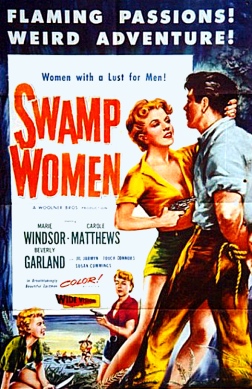
I admit that I’m a cheapskate.  When you grow up poor, that comes naturally.  For some of us the myth of scarcity is less of a fable than it is for others.  Perhaps that’s why I like Roger Corman movies.  Or usually do.  And it’s also the reason that I bought the Classic Features Horror Classics DVD set years ago.  50 movies!  And cheap!  Now, in my defense, I bought this collection before streaming was a thing.  I’d become somewhat addicted to horror movies and renting was pricey and hey, fifty movies!  Of course, they’re public domain.  Some of them are pretty bad.  You can stream most of them for free, but with commercials.  I was in the mood for my fellow cheapskate Roger, so I decided to try Swamp Women (it’s in the collection).  Now, why it was considered horror I don’t know.  It must be pretty difficult to find that many public domain movies in any category.  It was just over an hour and I thought of it as homework.

Three tough-talking cons break out of prison with the help of an undercover cop.  They’re all women, of course.  The cop is there to make sure the stolen diamonds they hid are found.  And to get out alive.  This was a very cheap movie.  The writing is puerile and there are plot holes large enough to row a boat through.  Still, it’s a Corman film.  The only real horror comes from an alligator and a snake—it seems that couldn’t afford more than one of each—and it ends up pretty much as you’ve pegged it will once the endless stock footage of Mardi Gras is over.  What I found interesting, after reading a history of American International Pictures, is that even though co-founder James Nicholson was helping Corman raise money for the film AIP didn’t serve as the production company.  After seeing it, it’s pretty clear why not.

The critics gave this a pretty tough time back in 1956, sometimes noting that it did at least attempt some female psychology.  Really the only psychology on display was who might end up with the one guy they decide to keep as a hostage.  When his girlfriend drowns after trying to steal the only boat, he barely frowns.  I was hoping (I try not to read about movies before watching them) that there might be a swamp monster or something.  I mean, swamps and monsters naturally go together, don’t they?  I guess even those putting together public domain movie collections might be a bit cheap from time to time.  All of us skinflints understand each other, I guess.


Who Recommended?

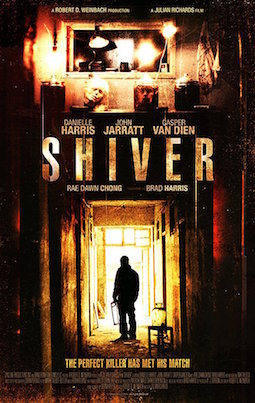
A couple of things: one-word titles can be confusing, and I need to start writing down where I get movie recommendations.  Trying to live reasonably on an editor’s salary, I can’t afford purchasing movies all the time, so I stream what’s free, now only when it’s on my list.  That’s how I had the misfortune of watching Shiver (2012).  I’m not sure it was the right movie, but I couldn’t find any others by that title near the top of IMDb and I couldn’t remember where I got the recommendation.  Although it uses many standard horror tropes, this flick veers a little too much into torture porn for my liking.  Also it’s very poorly written and many of the scenes are improbable (to put it mildly).  The police are totally incompetent (how many times can a serial killer’s intended victim be assured she’s safe by police when they can’t even get the perp to prison in good order?), almost to a Keystone degree.

And this isn’t some Hannibal Lector, either.  He’s kind of a psychopath that’s been making a living selling jewelry to his eventual victims.  Of course he’s a sexually frustrated guy who was bullied as a kid.  See, there are some moments of trying to establish some kind of social commentary, but the writing and most of the acting keep getting in the way.  The violence toward women goes unremarked, and that’s probably what most requires comment.  So I’m sitting here scratching my head trying to figure out who, or what, might’ve suggested this movie to me.  Or is there a different Shiver?  Did somebody leave the “s” off the end?  (I’ve already seen that one.)  I really do need to keep better records.

Bad movies come in many varieties.  This one was disturbing from any number of angles.  I don’t tend to watch serial killer movies.  Violence against women bothers me a lot.  Every main character had a bad childhood.  (One of the stories is simply told and then dropped.)  It’s a movie that might helpfully come with trigger warnings.  As I watched I wondered.  I wouldn’t been watching this if someone, or some respected publication, hadn’t recommended it to me.  Who and why?  Since I watch movies on weekend mornings, mostly, a bad one can start the day off on the wrong foot.  Someone, or some source, suggested Shiver.  Or maybe someone forgot a letter.  That’s the problem with one-word titles.


Horror Homework

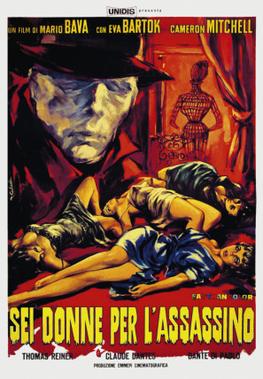
If you write about horror movies, you have to do your homework.  Of course, this means time away from house work (the weeds love all this rain and hot weather) and regular work (which can’t be compromised).  Mario Bava has often been cited as one of the influential horror auteurs, but until this year I’d not knowingly watched any of his films.  So, homework.  I saw a list of movies that made an impact, and one of them was Blood and Black Lace.  It’s horror of the giallo subspecies, never my favorite.  But it was free on a commercial streaming service, so, well that homework’s not going to do itself!  This isn’t generally considered Bava’ best work.  Besides, giallo is murder-mystery and I prefer monsters.  Who wouldn’t?

This film, with its lurid colors and stylistic cinematography, does make an impression.  The acting is poor and the script even worse—apparently it didn’t lose anything in translation.  A crooked couple run a fashion salon.  (There will be spoilers, so if you’re sixty years out of date, be warned.)  One of their fashion models is murdered, but when another discovers her diary the body count mounts.  The film lingers over the murders, which, I suppose, is one of the reasons it’s classified as horror.  With the film’s problems, however, at least this far removed, the whole thing begins to look rather silly.  The women have to die because of the first woman’s diary.  The police are singularly ineffectual, not even taking standard kinds of precautions.  Even with a run time of only 88 minutes it felt too long.

Horror in the sixties was still finding its way.  I’ve been watching a number of movies from that era—generally considered a dry spell for American-made horror—and the results have been interesting.  There are some gems tucked in amid the gravel.  What we’ve grown to appreciate in more contemporary horror cinema learned a lot of lessons from these early exemplars.  I could see foreshadowing of Suspiria here.  I’ll need to do more homework to find other direct descendants, though.  Blood and Black Lace suffers from having too few characters you get to know well enough.  The models, who all seem to have some secrets, die off before we get to know them.  Even the criminal pair behind the killings die in the end.  There’s a kind of nihilism to the story, and it’s all done for love of money.  The story could’ve been better, but you have to start somewhere when growing a genre.  And doing homework.


Lobo

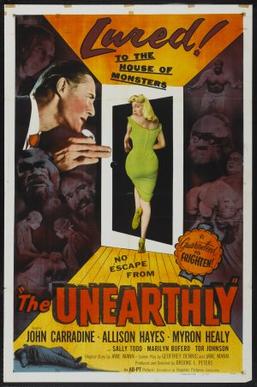
Tor Johnson—actually Karl Erik Tore Johansson—became famous but not rich.  Such was the fate of some early horror actors, including Bela Lugosi.  Johnson hung out, however, with the low-budget crowd, making the most of his size to take on a kind of “enforcer” role.  One of his recurring characters was “Lobo.”  Lobo served mad scientists and had very little of his own brain power.  He often had few, or no lines to learn.  Having watched The Beast of Yucca Flats, in which he starred, I decided to see if The Unearthly was any better.  The production values were certainly higher, but this was an earlier film by a different crew.  It’s more like the standard fare you expect for a late fifties horror show.  It features a mad scientist, and Lobo is, of course, the servant.

Dr. Charles Conway believes he has found the way to eternal life.  It’s attained by transplanting a new gland into a human being.  The problem is, it hasn’t worked so far.  Like a true mad scientist, Conway is convinced that it will work, it’s just a matter of try, try again.  And why advertise for willing subjects when you can have a local crooked doctor send you patients with various personality disorders, and no families, so that you can experiment on them?  With slow-moving Lobo as his only security system, Conway carries on until a sting operation catches him red-handed.  There’s really not much to this story.  It doesn’t have the inspired inanity of an Ed Wood production, but then, it hasn’t really grown a cult following.

My reason for watching was Tor Johnson.  Before I was born he’d attained the status of the model of a best-selling Halloween mask, based on his monster roles.  This seems to indicate that his oeuvre was well known, despite the kinds of movies he was in.  A large man who’d aged out of “professional wrestling,” Johnson had many uncredited movie roles before hooking up with Ed Wood.  He was featured in three of Wood’s films, including the infamous Plan 9 from Outer Space.  He’s part of a crowd surrounding the under-funded, independent filmmakers of an intriguing era before modern horror really came into its own.  The Unearthly, where his famous line “Time for go to bed” is spoken, suffers from banality and has become pretty obscure.  I personally wouldn’t have known to look for it had it not been for the fact that Johnson was in it, dragging it into the “must watch” category.  And that it was a freebie.


Yucca

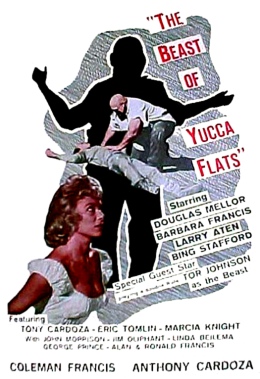
Yucca Flats isn’t the kind of place you’d like to vacation.  Not only is it highly irradiated by nuclear testing, it’s also a place where police shoot at innocent people.  The only salvation seems to be that they’re terrible shots.  Oh yes, and there’s a Russian scientist transformed into a beast by an atomic bomb blast.  As you can tell, I’ve just been to Yucca Flats.  In movie-land, of course.  The Beast of Yucca Flats, yet another candidate for the worst movie of all time, really worked hard to obtain that title.  The movie did make me curious about Coleman Francis, however.  Like Ed Wood, he tried to make his way in the rather unforgiving movie world with tiny budgets and even less native talent.  The number of scenes where guys had their butts to the camera alone raises all kinds of questions.

The numerous contradictions in such a short movie—less than an hour—and the long scenes that add nothing to the plot are signposts that we’ve entered the twilight zone of B movies.  Famously filmed without sound, the incongruous dialogue later added as voiceovers, adds to the surreal atmosphere.  The movie shares Tor Johnson with Ed Wood.  And also, apparently, a sincerity betrayed by lack of ability.  The cult status of movies like this signal hope for those who try to make their own way in a world enamored of big budgets and large crews.  It would help, though, if Francis had a clear story to tell.  He does seem to have Luddite tendencies, and he condemns violence even as he has a sheriff’s deputy literally “shoot first and ask questions later.” 

The movie has a couple of moments of cinematographic finesse.  The moment when Lois Radcliffe approaches the car, shot from the interior, when Hank lays his arm across the door, made me think something better might be coming.  Tor Johnson wasn’t the most gifted actor, but he always seems to have fun with his roles, being cast as a hulking monster.  It’s too bad he doesn’t have a bit more screen time in this, his last movie part.  He kinda makes me want to hunt down some of his other appearances beyond the Ed Wood films I’ve already seen.  There’s a story here, I expect, that really hasn’t been told.  There’s an entire world—a twilight zone—outside Hollywood where producers with no budgets but a passion for making movies plied their trade.  Their efforts, as paltry as the results may be, suggests there’s more to the movie world than it might seem.


Small Things Grow

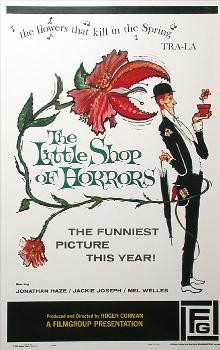
I’ve always been fascinated with origins.  I guess I’m a kid who never grew up.  Now that I’ve turned my attention to movies, I sometimes wonder about the origin of the story.  For example, The Little Shop of Horrors.  I first saw the musical movie version of 1986.  It was cute, and employed horror themes like the Rocky Horror Picture Show from the previous decade.  Then, when Roger Corman died, I read that he’d filmed the story back in 1960.  Curiosity compelled me to watch the original.  Like its remakes, it’s comedy horror, or horror comedy.  But beyond that it’s a literal farce.  Roger Corman was a showman, and that means he tried different things to entertain.  One of them was Little Shop.  The idea of the plot you probably know, but I couldn’t remember the ending as I sat down to view it.  After all, it’s not meant to be taken seriously.

I have to say that the music makes it better in the remake.  The endless malapropisms and burlesque humor are funny, but really in the original they are presented as low comedy.  The Jewish humor was early on I feared might be anti-semitic, although not intended that way.  I empathize with Corman.  It took him nine months to find a company to release the film.  Ironically, it attained cult status after being double-billed as the B movie with Black Sunday, which was a quite serious attempt at horror.  Camp has a way of living on in cult status.  Of course, the early bit part for Jack Nicholson didn’t hurt.  It isn’t bad for a bad movie.

The idea of people-eating plants is a reasonable approach for a horror story.  (I’ve used it myself.)  Plants move very slowly, however, which is one reason that the idea’s hard to accept.  Even The Land Unknown had used the idea three years earlier.  But the seed was planted.  The idea of the film lead to an Off-Broadway show, which led to the more famous movie.  Then it reopened off-Broadway and a reboot was planned (but currently seems to be on ice).  Not bad for a movie based on a desire to reuse a set that was scheduled to be torn down, and then shot in two days.  Classic Corman.  The result was a bad film that is still fun to watch all these years later.  I did miss the musical numbers, however.  When you plant seeds, you never know what might grow.


Monster of Aging

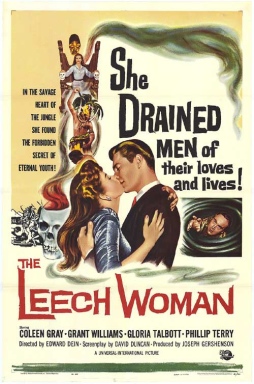
Movies with no likable characters, or none with any redeeming personality traits, are difficult to remain awake through.  At least on sleepy weekend afternoons.  The Leech Woman is one such movie.  It was difficult to get past the premise that an aging woman is cause for alarm among the overly entitled male characters.  Dr. Paul Talbot is disgusted by his older wife until he finds credible evidence of a concoction that will cause a person to grow young again.  Wanting her to be his experiment, he takes her to Africa where he witnesses the rejuvenating formula in person.  It requires, however, a murder to be effective.  For her victim, June chooses her husband.  The effects, however, are only temporary so June will need to keep on killing to remain young.  Each time the formula wears off she’s prematurely aged.

When she’s young again, the men around her feel it is their right to claim her, which, in a sense, provides her with a ready pool of victims.  On the other hand, it reflects attitudes beginning to die out as the sixties began.  Many of these movies from the fifties throw in a woman to provide little more than love interest.  Sometimes these women have a profession—reporter is one that shows up occasionally, or perhaps in a military role or as nurse—but mostly they are there to find a husband and become, ideally, a housewife.  Many unrealistic men today still think that should be the case, but few jobs earn enough for the possibility of being a one-income family.  Besides, did anyone ever think to ask the women what they wanted?

Aging isn’t the easiest thing to do.  This movie plays up the stereotype that men become “distinguished” with age while women don’t.  Such unreflective outlooks on aging completely overlook things like aching backs and forgetting things that are typical for just about anyone who makes it past a certain landmark.  In fact, aging is something we all face in common, and our attitudes toward it can make all the difference.  Fortunately since this movie came out, we’ve had many role models showing us that women do retain their worth and dignity as they age, even as men do.  We are an aging population.  One benefit, hopefully, to the passing years is the accumulation of wisdom.  And that applies, no matter gender or sex.  We reach a certain age and we look back and wish we’d known then what we know now.  That takes place with generations, too.  That way we can say Leech Woman is a period piece, but that still doesn’t make it a good horror movie.


Shifting Gears

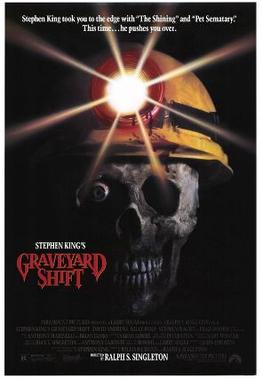
The question’s very basic: do you pay with cash, or by watching commercials.  When it’s the same three commercials the whole way through—for products you’d never buy—just paying the cash may seem the better option.  But it’s too late for that.  It’s the Graveyard Shift.  There’s no doubt  that Stephen King is responsible for the ideas for more horror movies than probably any other single individual.  I’d read his story, “Graveyard Shift,” many years ago.  I was warned, though, that this was one of the least favorite of his adaptations, and that’s a pretty low bar.  Still, it was just a matter of sitting through the same commercials over and over.  And one of them was more entertaining than the movie.  Of course, I don’t really watch for entertainment.  This is a learning opportunity.

Let’s start with the basics: You need at least one sympathetic character.  Okay, you kinda like Jane, because she shows basic humanitarian traits.  And Carmichael.  Then you want a plot that makes some sense—what is Warwick’s motivation?  The writing is particularly bad.  If there’d been a bit more intentional camp, this might’ve made a reasonable horror comedy.  I mean, you’ve already got the empty aluminum cans being fired by slingshot.  As it is, it’s played straight with an evil foreman, rats everywhere, and a giant bat in the basement.  By the end you’re kind of rooting for the bat.  And whose idea was it to use voiceovers of the sub-par dialogue over the closing credits?  Is this so bad that it’s good?  I’m having trouble deciding.

Although set around the fourth of July I wouldn’t call this holiday horror.  Nevertheless, there are some moments of religious imagery that pop out.  The graveyard sinking in the river has a listing statue of Jesus near the start of the film.  And the exterminator—the only real camp in the flick—narrates how in Vietnam they pinned victims down, like Jesus, to feed them to the rats.  The final couple of minutes—well earned, I assure you—have Hall fighting the wicked foreman with the jawbone of an animal (one has to assume an ass), inexplicably among human bones (some still in their coffins).  And his slingshot ultimately killing the giant (bat).  The references are to Samson and David, respectively.  Perhaps this movie’s an indictment of capitalism, since the basement cleanup is on Independence Day.  Or maybe it’s just tired horror tropes on a break.  (Having one of the characters reading Ben in the diner was a nice touch.)  It may become a holiday tradition after all.


A Land Forgotten

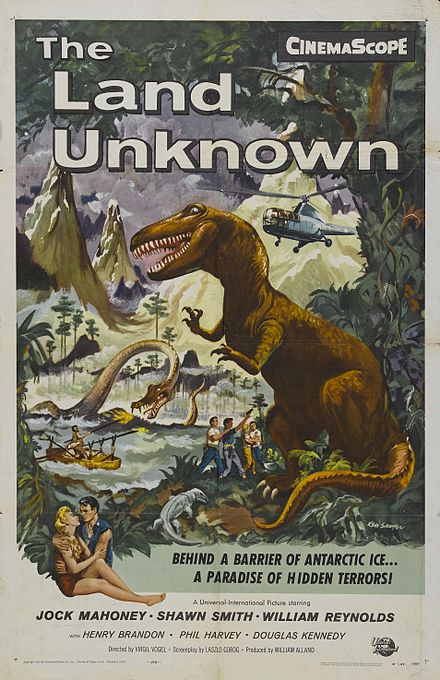
In case anyone’s noticed (which I doubt) that I’ve been discussing a spate of 1950s sci-fi/horror movies, I have a confession to make.  Several years ago I needed to see Tarantula.  (Anyone with similar headspace will know this need.)  The only place it was available at the time was in The Classic Sci-Fi Ultimate Collection.  Volumes 1 and 2 were sold together.  I did what I had to do.  Then I forgot I had the set before finishing volume 1.  Who knows what might’ve been going on in my life then?  Rediscovering it has been a budget-saving way to address my fix.  I had never heard of The Land Unknown before, and although it has one of the goofiest T-rexes ever, it is actually a good story.  Of course there are holes in the plot, but it is about the necessity of being humane, even when emotion dictates otherwise.

A helicopter crew on a South Pole expedition makes an emergency landing in a volcano that harbors prehistoric life in a hot spot in Antarctica.  The crew has a female reporter with them—these movies certainly have fifties attitudes about women!  Not having the parts to repair their copter, they try to survive among dinosaurs and an aggressive, giant monitor lizard.  There is another person there, the sole survivor of an earlier expedition, who’s become mostly feral.  The commander of the modern crew demands that they give him the dignity and fair treatment that all people deserve.  There’s a bit of drama around who will get the girl (again, the fifties), with the commander ultimately winning out.  How do our heroes escape this peril?  They’re able to repair the helicopter with parts from the earlier expedition’s crashed vehicle.

With its budget the special effects had to be cheap, but the story has redeeming value.  The message that we mustn’t let isolation drive us to bestiality is still as important as ever.  There are those who watch such movies solely to laugh at the special effects.  Hey, I laughed a bit too, but I’m only human!  There is, however, more to this movie than the dinosaurs, which drew audiences then just as the Jurassic Park franchisedoes now.  There’s even some serious talk about evolution, which was often present in these Universal creature features.  There are some slip-ups on the evolution part, but apparently the monitor lizards were meant to represent stegosauruses—did I mention the budget was tight?  I actually found the movie to be worth seeing for its intrinsic value.  Not bad for a forgotten set purchased mainly for one movie in a time unknown.


Praying for Mantis

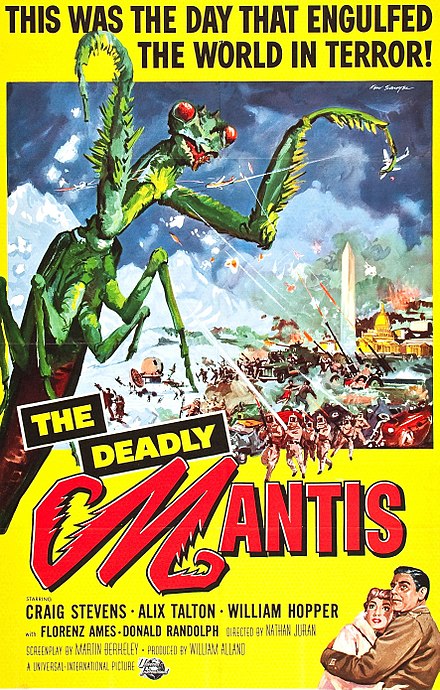
Now this is a Cold War movie.  And I mean “cold.”  The Deadly Mantis is one of those movies that hovers between “so bad it’s good” and just plain “so bad.”  I was kind of rooting for the mantis.  In any case, this was an ambitious movie for the time but it reflects the post-war paranoia in the United States.  It also makes very abundant use of stock footage, much of it military.  You almost expect a recruiting ad at the end.  (It does thank the Ground Observer Corps in the closing credits.)  Okay, so here’s the story.  A volcano in the south Atlantic causes the calving of an enormous Arctic iceberg near the North Pole.   That iceberg contains the frozen body of a 200-foot praying mantis from dinosaur times.  Even earlier.   Said frozen mantis, quite hungry after millions of years, begins attacking Arctic radar bases and flying south.  The Air Force calls in a paleontologist to help identify what they’re looking for.

The mantis is so big that it prefers people for food, although, one might note, a polar bear would’ve been easier prey.  In any case, given the technology limitations of the time, the military has trouble keeping track of the insect as it flies over the most populous part of the country.  They do get the cloudiness of the East Coast about right.  Eventually they shoot it down—actually a fighter jet crashing into it does the job—over Newark and the mortally wounded mantis crawls into the Lincoln Tunnel (called “The Manhattan Tunnel” in the film).  By this point the viewer is saying “just let the poor thing die in peace,” but they pump smoke into the tunnel, presumably to hide wires and other props, and commit a protracted insecticide.  

Now, I’m one of those people who hates to hurt any animal.  The death twitches of an insect are quite troubling, so I try to catch what I can indoors and release them.  I have trouble with the instructions to kill spotted lantern flies—it’s not their fault that they’re here.  The movie shows a bravado regarding the military and a machismo regarding the main female character that hearkens back to why it was so necessary to evolve out of the fifties.  Of course, we learned nothing from The Deadly Mantis and have catapulted back into a new Cold War and an even more robust military.  William Alland, the producer, had a real love of this genre of movie, and for that we have much to be grateful.  But even the big bug genre can produce a real groaner now and then.


An Interesting Prize

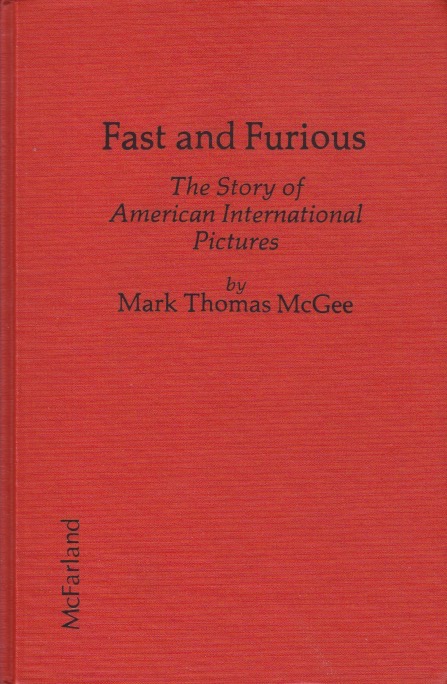
If you’re born without it, you get by any way that you can.  Capital, that is.  Those of us who inherit nothing but active minds don’t stand a chance, really.  Without connections or the cash to draw others in, we tend to be scrappy.  And cheap.  This is probably the reason I’m drawn to characters like Ed Wood, and those who started American International Pictures.  I get the sense that Mark Thomas McGee must be an interesting guy.  After all, he met some of his idols when he was young.  Fast and Furious: The Story of American International Pictures is available in a second edition, I know, but I tend to find first editions fresher.  They say what’s really on an author’s mind.  Besides, used books have their own charm.

Although American International Pictures (AIP) was early on known for fast shooting schedules and cheap effects, it eventually started to earn some mainstream respectability before the company being acquired by Filmways.  Along the way they engaged some famous champions of cheap, such as Roger Corman.  A number of films discussed in this book were part of my childhood.  And as someone who’s always had to live cheaply (I just don’t comprehend finance), I found this an extremely hopeful book.  Some of these folks never became famous in the lifetimes, but they left a legacy.  And that’s a worthy goal.  I suspect that for those of us who can’t break into mainstream publishing, blogging is about building a legacy.  What some of us want, however, is to appear in print.

And I mean in print.  The book is an object.  I bought this one used.  I sometimes find interesting things in used books.  The former owner of this one (a McFarland hardcover!) carefully glued postcards of AIP movie posters to the covers and endsheets.  They didn’t put their name in it, but they (in pencil) ticked off the movies, presumably that they’d seen, from the filmography.  This is a person after my own heart.  I tend not to write in most books anymore, realizing that someday someone will probably sell them and, hey, it’s hard enough to make money in the book business.  But this personalization is something you can’t find in an ebook.  No, a book is meant to be held and loved.  This one clearly was.  As publishers chase more and more after electronic and audio books (the latter of which are also electronic) and learning moves from reading to watching, we’re losing something.  They’re called books, and they bear their own meaning.


Digging Again

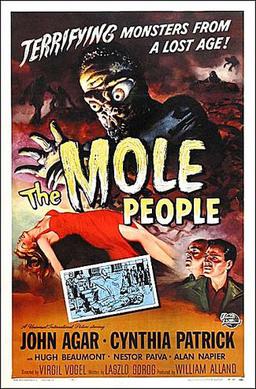
It’s one of those movies that I know I’ve watched before—probably on a sleepy Saturday afternoon—but couldn’t believe I had already seen.  While viewing The Mole People it looked completely new, but in retrospect some of it had seemed strangely familiar.  Had I bothered to check my own blog I’d have noted that I watched it a mere fourteen years ago.  Not that I’d have spared myself again.  I felt like watching monsters in rubbery suits.  Still, as I mentioned in my previous blog post on it, the antagonist are the underground Sumerians.  These Sumerians speak English—a fact that isn’t worthy of remark by the scientists—and express surprise that outsiders can understand them.  Assuming them to be gods because of their bright flashlight, this Gilliganesque story contains, perhaps unintended, social commentary.  The mole people are really the good ones and the “slave revolt” at the end saves our protagonists.

For about the first half of the film they refer to “the goddess of Ishtar” before finally apparently realizing Ishtar is the goddess’s name.  The “eye of Ishtar,” which looks suspiciously like a sideways Star Trek Federation logo, represents where the sun shines down on their ancient kingdom.  (They’ve become albinos from living without sunlight.)  The interesting thing here is that the monsters aren’t the scary part of the plot.  The high priest is.  Elinu is suspicious of the upper worlders immediately and it is he who plots their demise.  He’s also quite willing to depose the king, whom he sees as too weak in his foreign policy.  (In reality the interplay between religion and politics, historically, has been a tug-of-war over power.)  He succumbs to his own plans, however, and the viewer is glad to see the priest go the way of all flesh.

Sometimes billed as science fiction, this is more fantasy horror fare.  It’s literally swords and sandals among the the lackluster Sumerians.  The monsters make it horror, but they aren’t evil, although they do kill one of the protagonists.  To their credit these pre-Civil Rights Act Americans realize that the treatment of the eponymous mole people is unfair.  There is, at the same time, no regret expressed that these scientists have brought the five-thousand-year-old Sumerian civilization to an end.  The Mole People is one of those “so bad it’s good” movies.  Its plodding pace doesn’t make it idea for too sleepy an afternoon, but the story is different than a typical monster flick from the era.  And it is biblically based, as my previous post on it noted.  And a lot has happened in the intervening fourteen years.


No Demons

There’s a connoisseurship about it.  Making bad films, that is.  It’s a wonder that Night of the Demon—I should specify 1980 as the year—hasn’t really become a cult film of any standing.  You can tell the maker tried hard to shoot a reasonable film, but with a nearly Ed Woodsian level of incompetence.  It lacks Woods’ artistry, however.  For those just getting on the Bigfoot kick in the new millennium, it might help to know that Sasquatch was big in the seventies.  Yes, the first real efforts to sort this thing out came about when the psychedelic seventies were underway.  The documentary The Mysterious Monsters came out in 1976.  The first serious efforts to explain Bigfoot as not just a hoax began.  And James C. Wasson, Jim L. Ball, and Mike Williams took a shot at making a horror film of the hairy guy.

The acting is about the worst you’d care to see, and the script is abysmal.  The effects are anything but special, and the flashback scenes incongruous.  But it does have significance for religion and horror.  It goes like this: a professor and some students go to investigate a series of Sasquatch-related murders.  They’re led to “Crazy Wanda,” who lives alone in a remote cabin.  Wanda, when finally persuaded to talk, reveals that her crazed preacher of a father killed her Bigfoot-hybrid baby.  His followers still perform demonic rituals in the woods, worshipping the Sasquatch.  Wanda had burned her father to death in retaliation for killing her child—she kinda likes Bigfoot, it turns out.  The professor and students, naturally, fall victim to the beast.

Only the professor survives.  He’s assumed to be criminally insane and suspected of murdering his own students.  It’s almost painful to watch a movie where everyone is trying so hard to do it well, but just can’t seem to manage it.  The plot line about the cultists is immediately dropped after an intended rape ritual is interrupted by the professor.  Wanda’s preacher father, who seems to fit into no particular form of Christianity, has no motivation beyond avoiding Hell for himself.  At one point he seemingly admits killing her mother.  There’s even a scene where Bigfoot kills two Girl Scouts.  With all of this going for it, you might think it would’ve picked up a following.  It has some fans, I’m sure, but I’m not certain that it’s well enough known to make it onto lists of worst movies of all time.  More’s the pity since it would absolutely deserve it.


Not Murphy’s Mansion

One of the dangers of streaming is that you can be talked into a movie by the fact of its availability.  Curiosity drove me to Disney’s The Haunted Mansion movie and that led to the discovery that there had been a reboot.  I’m drawn to haunted houses but not to theme parks, but well, you wonder how they might’ve thought they could’ve done it better.  The original movie failed to rock the critics, so, as the saying goes, try, try again.  Last year’s Haunted Mansion is over the top.  The story is more complex, with an ensemble cast, and not really funny or scary.  Based on a sad premise—two families with deceased spouses—they’re drawn, with three other New Orleans outsiders, to a, well, haunted mansion.  The main ghost is looking for a soul to harvest but as the two hours wend on, the characters reveal their sadnesses (one doesn’t).  Perhaps the idea is catharsis, but there are too many subplots and too many abrupt shifts of mood.

A movie should know, it seems to me, what it wants to be.  You feel for the sadness and loss of the characters but  I know something about using horror cathartically, and this movie doesn’t do it.  There are jokes and running gags, but they’re not really funny.  There’s religion involved, but it turns out to be fake, with even a faked exorcism.  There are literally 100 ghosts.  And really only one bad guy among them.  There’s drinking to drown sorrows, murders, and even adult humor that is somehow deeply disturbing.  There are a few nods to the original movie but the plot is quite different and it leaves you feeling drained.

With a budget of about $150,000,000, stops were pulled out all over this organ.  It doesn’t, however, have a focus.  In the original film, the Evers family really has a need to reconnect.  The mansion does that for them, through its ghosts.  The reboot implies at the end that two broken families might heal each other and that evil leads to its own punishment.  Still it leaves open the question: what is this movie trying to be?  The more cynical might say it’s only for money (the worldwide gross didn’t reach covering its budget), but I have to think that those who make movies do so for more than just a buck.  Coping with death is a profound human need that begins when a pet or, more seriously, a family member dies.  I’m not sure that Disney is the best authority on the subject.  At least not for those of us who use horror as therapy.