Keeping Sentinel

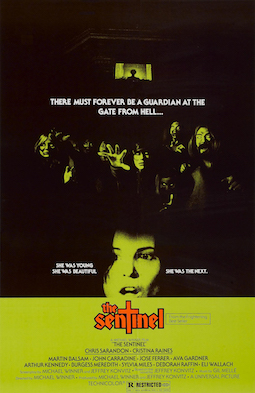
Not among the trinity of holy horrors from the late sixties and early seventies, The Sentinel takes its cues from religious horror but manages to fall into bad movie territory anyway.  While still cited from time to time, it’s largely forgotten among the films of the era.  It had a lot of competition in the seventies with The Exorcist, The Omen, and The Amityville Horror.  One of the reasons it seems to have fallen at the threshold is that it doesn’t understand the religion it tries to portray.  That religion is some form of Catholicism that involves a number of clerics who run around northern Italy wearing various liturgical vestments to oversee an apartment in Brooklyn Heights that’s actually the gateway to Hell.  They do this by way of an eponymous sentinel who lives in the apartment building that’s Hell’s portal.  The rest they, reasonably enough, rent out.

Alison Parker, a model, ends up renting the place while her boyfriend lawyer decides to have her killed—no particular motivation is given, although he had his first wife murdered too.  At the apartment Alison is disturbed by the other tenants, who are very strange.  And a mysterious priest lives in the apartment at the very top and never comes out.  (In case you haven’t gathered, the plot is pretty convoluted.)  It turns out that people who’ve formerly attempted suicide (like Parker) are targeted by the church to take over as sentinels to make up for their sin.  They have to “go missing” and reappear as a priest or nun and live in a particular apartment.  The strange neighbors, as you may have guessed, are demons trying to escape the watchful gaze of the sentinel.  Naturally, they stay in the same building.

The problem—or one of them, anyway—is that the Catholicism displayed doesn’t resemble Catholicism very much.  In the famous scene where the demonic entities are swarming on Alison and the dying sentinel she’s to replace, said sentinel carries a distinctly Protestant cross rather than a crucifix.  The mythology the film tries to construct is simply bizarre.  The classics of the period at least got the religion correct.  Catholicism in The Exorcist, Protestantism in The Omen, and, although fabricated, Satanism in Rosemary’s Baby.  Many filmmakers, it seems, think it’s easy to fake it when it comes to religion.  Looking at the movies that succeed on that front, however, and comparing them to those that become bad movies, it seems clear that doing your homework, or at least going to Sunday school, pays off.


Ghoulish Night

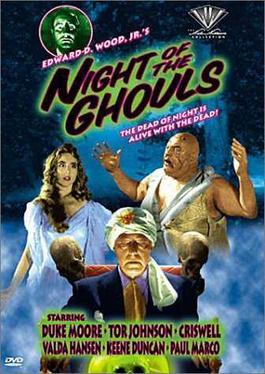
Night of the Ghouls, I like to think that even as a child I would have opined, is a bit silly.  It does show improvement over some of Ed Wood’s other films and the plot is really no more harebrained than some movies I did watch as a kid.  I’ve been trying to figure Wood out.  He was apparently incompetent, but he had no formal training and that could explain things a bit.  He was also creative.  This film is broadly a sequel to the worse Bride of the Monster.  Although only a couple of characters appear in both films, there is quite a bit of reference to the earlier story.  There was a mad scientist who made monsters.  The house burned down (actually an atomic explosion in the former), but someone—no-one knows who—rebuilt on the same location.

In a typically convoluted Wood plot (he wrote as well as directed the film), a bogus necromancer (who is actually, without knowing it, a really powerful necromancer) bilks clients out of their money by raising their dead loved ones for a few minutes.  He keeps the police and others away by having his young female assistant pretend to be a ghost outside the house.  But then she runs into an actual vampiric ghost who’s killing people who wander onto the property.  The police eventually decide to investigate and prove themselves as incompetent as the writing for the film.  They do manage to put an end to the fraudulent seances but it’s up to the real raised dead to put an end to Dr. Acula and his assistant.  At least there’s no atomic explosion at the finish.

The film, in Wood style, is black-and-white and the props are cheap and not really convincing.  A bit of the movie seems to have been intentional comic relief.  It doesn’t really work as a horror film because there’s nothing really scary about it.  Wood was a lifelong fan of horror movies, but fandom doesn’t always equal the ability to replicate the object of desire.  There are several possible horror atmospheres—Poe horror is quite different from Lovecraft horror, for example.  Wood seems to have been unable to strike a vein, however, that was close to an authentic horror feel.  The Scooby-Dooesque role of the necromancer doesn’t really help, I’m afraid.  Still, for fans this is vintage Ed Wood work.  I can’t claim to have figured him out, but if you’ve a hankering for a bad movie, this isn’t a horrible choice.


Earth Colors

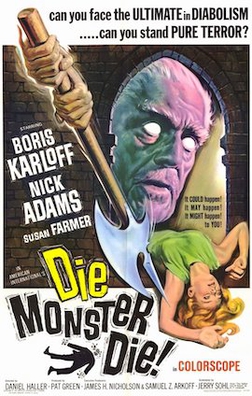
Bad movies can be therapeutic.  While trying to find hope it sometimes helps to see that others are even worse off.  This isn’t exactly Schadenfreude, but rather an awareness that your own efforts  at self-righting aren’t so bad.  Then there’s the hopeful monster theory, but that’s something different.  Already the title of Die, Monster, Die! warns the viewer that this won’t be Oscar-worthy material.  And despite his fame by 1965 Boris Karloff was still landing sub-par roles in such movies as this.  Both the directing and editing are noticeably lacking, evident even to an amateur.  A step backward may help; this movie is based one of my favorite H. P. Lovecraft stories, “The Colour out of Space.”  This is, to me, his most Poe-like tale and could well serve as the basis for a film.  Too much is changed here, however, to make it work.

Arkham is transplanted from its native New England to the old one.  The love theme manages to interrupt the mood of dread Lovecraft used in his story.  Nahum Witley’s use of the meteorite runs counter to the family’s reaction in the original.  The screenwriting doesn’t build much confidence either.  On the positive side, it feels like a fine little haunted house film from time to time, when the plodding plot doesn’t get in the way.  For a scientifically aware visitor, Stephen Reinhart has no concerns about lingering, unprotected, around a major source of radiation.  Although a few of the jump-startles work, the whole ends up feeling just a bit silly.  Of course, I was watching to escape, for a moment, what life throws at you.

Like reading poorly written books, watching bad movies can teach you mistakes not to make.  Movies can be an education rather than simply entertainment.  Cinema is one of the great myth-making vehicles for modern culture and, unfortunately, big budgets are often (but not always) necessary to make them believable.  Here is the hidden element of optimism, perhaps.  H. P. Lovecraft stories can sell films.  They also attach those who may be excluded from studio A-lists because, let’s face it, Lovecraft appeals only to a specific demographic.  The title of this particular film buries the lede, however.  No Lovecraft keywords (Dagon, Dunwich, Arkham, Cthulhu, or any of a host of others) clue readers in to what they might expect.  Learning the film business from Roger Corman might’ve steered director Daniel Haller is this direction, I suppose.  Whether he intended to or not, he produced a therapeutic result.


Hidden Wood

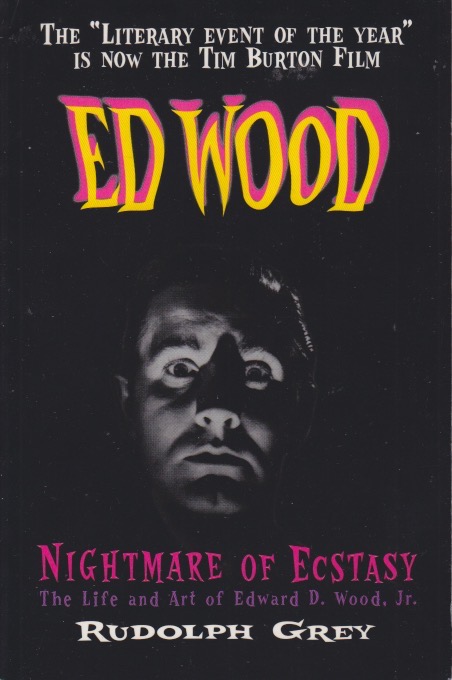
Fandom can lead to fame, even if it’s just cult fandom.  The nature of Ed Wood’s films is such that he could’ve been among those forgotten had he not posthumously developed a following.  Unfortunately it didn’t arise in time to ameliorate the tragic final years of his life when he died pretty much penniless, drinking away the pain.  Rudolph Grey’s Nightmare of Ecstasy: The Life and Work of Edward D. Wood, Jr. may have helped rescue him from obscurity.  Of course, Wood had gained a following earlier than the book, but nobody had really thought to document his life.  What I find so compelling is that Wood was like so many of us—trying hard to gain some recognition only to be shut out of what we love by a huge industry that calls the shots.  It’s difficult to get notice as an independent filmmaker, or even as a writer publishing with smaller presses.

Wood lived a most unusual life.  A straight transvestite, he fought as a Marine in World War Two.  He moved to California to try to break into filmmaking and wrote and directed several movies.  When this failed to make enough money to support him, he turned to writing pornographic novels and film scripts.  Wood had, interestingly, befriended a lonely and washed up Bela Lugosi.  His last two movies were Wood’s work.  Wood found camaraderie with other outsiders in Hollywood and he cast them in his low-budget productions.  He would try to shoot his films in less than a week.  Considering the constraints under which he operated, his movies really aren’t that bad.  They aren’t good by conventional standards, but they’re better than many other people could’ve made them in his circumstances.

This book isn’t a conventional biography.  There’s no narrative apart from the recollections culled from interviews of those who knew him and occasional letters and writings of Wood himself.  As with any biography there are gaps and lacunae.  From a writer’s point of view perhaps the saddest part of the story is how Wood and his wife were evicted from their final apartment and he had to leave his papers and manuscripts behind.  These were reportedly thrown into a dumpster and lost forever.  Although his movies may have been bad, Wood was a capable writer.  And like any writer he felt the loss of his work keenly.  He only lived about three more days after that.  His friends had largely abandoned him, alienated by his drinking and its effects on him.  Next year will mark the fiftieth anniversary of his death and, I hope, the commemorative watching of some bad movies that deserve to be remembered.


Movies about Movies

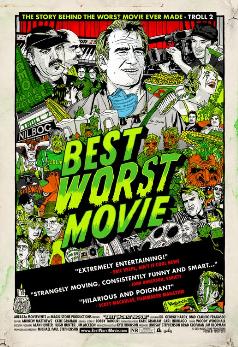
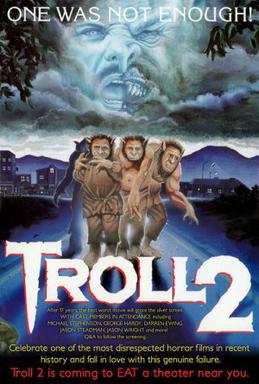
The category of movies so bad that they’re good sometimes spawns the phenomenon of a movie about the bad movie.  The Room, generally on the list of worst movies of all time, was followed by The Disaster Artist.  Not exactly a documentary, it was a movie about the making of the movie.  There’s a macabre fascination with films that dare to be so very bad.  They’re released nevertheless, and if they’re the right kind of bad they grow a following.  Ed Wood’s movies inspired Tim Burton’s movie Ed Wood—dramatized, but apparently not far from the truth.  Troll 2 was followed up by Best Worst Movie, directed by the child star of the original, Michael Stephenson.  Such movies are irresistible in their own right.  So when I finally saw Troll 2 I turned around and immediately watched Best Worst Movie.

A few things stood out in this documentary.  One is that being part of something larger, it’s not always clear what this larger thing will be.  Most of the people in the movie (which was released directly to video) found out about the release by accident.  Many of them never acted again but one thing they all knew: when they did see it, it was clear that it was a bad movie.  The one person in the documentary who doesn’t accept this is Claudio Fragasso, the director.  Fragasso is Italian and he still maintains that this is a great movie and everybody else is wrong about it.  He skulks around the tributes made to the movie and insists to both actors and viewers, that the movie isn’t bad.  They are wrong, he is right.

There’s nothing wrong with pride in achievement, of course.  Sometimes, however, it’s more graceful to admit that you simply got it wrong.  Best Worst Movie follows some of the actors to conferences where they expected huge lines and great attention, only to find a handful of disinterested spectators wondering what all the fuss was about.  At the same time, there are screenings of Troll 2 in major US cities that draw sell-out crowds.  Bad movies don’t appeal to everyone, of course.  They can, however, serve some good and might even add some enjoyment to life.  Best Worst Movie underscores that not all film fans have the same taste.  It also shows that those who enjoy traditionally bad movies aren’t alone.  There’s an aesthetic to being bad enough to be good, and even that can spin off sequels of its own.  And please, Mr. Fragasso, don’t make the sequel you’re touting—this kind of magic only comes once, unless you’re a genius like Ed Wood.


Bad Movie Therapy

I haven’t see Troll, but it doesn’t matter.  Troll 2 has nothing to do with it.  As a frequent contender for worst movie of all time, Troll 2 is an anti-vegetarian screed and campy horror film that’s impossible to take seriously.  It’s part of my bad movie therapy.  And it’s also an example of religion and horror.  But first, let’s set the scene.  The Waits family (Michael and Diana, and their kids Holly and Joshua) is doing a house exchange for a vacation.  Before they leave, however, Joshua’s dead grandfather appears to him to warn him about the goblins.  The goblins, who are vegetarians, make people eat/drink a special substance that turns them into plants so that they can eat them.  (Yes, it’s that bad.)  Ignoring Joshua’s concerns, the Waitses head for Nilbog (goblin backwards) and go ahead with the house exchange.

The locals (there are only 26 of them) can make themselves appear human and they try in vain to get the visitors to eat.  Joshua prevents his family from eating the plant food by peeing on it.  They go to bed hungry as the queen of the goblins plans her next move to get them floradated.  About midway through the film, we’re shown a church scene in which the minister preaches of the evil of the flesh.  Ironically, this is not far off from the teaching of some Christian denominations.   He tells the trolls what they already know—they have to get the visitors to eat so that they can eat them.  If nothing else, it will make you forget your troubles for ninety minutes, unless your trouble is that you’re being turned into a plant.

Any number of reasons have been offered for why the film is so bad.  While filmed in Utah, the crew was Italian, and most of them spoke no English.  The movie was low budget.  The acting is just plain bad.  All together, however, these features work symbiotically to grow a wonderfully therapeutic end result.  Some of the crew claimed that it was the intention all along to make this a funny film.  Comedy horror or horror comedy is a recognized genre, after all.  The only problem I have now, however, is where to go from here.  So how does the Waits family escape their peril?  I’ll need to offer a bit of a spoiler here.  The goblins are frightened away long enough by a double-decker bologna sandwich that the family can touch the magic stone and destroy the conspiracy.  What are you still doing here? Why aren’t you watching this already?


Hoppy Fourth

Today is the one of the relatively rare summer holidays.  Modern industrialized nations tend to take a more relaxed view toward summers without having to give out too many prescribed company holidays.  This seems to follow on from school schedules because the kids are out in summer and adults need some flexibility when work demands collide with family needs.  The internet has made work-life balance a little tricker to achieve since work is always just a click away.  Some more generous employers gave yesterday as part of an extended four-day weekend, which is rejuvenating in a way that’s easily forgotten until you start to feel it.  The sense of obligation takes a couple of days to wind down, and then on Monday you realize “I’ve still got another day off!”  It’s a sublime feeling.  Why not watch holiday horror on it?

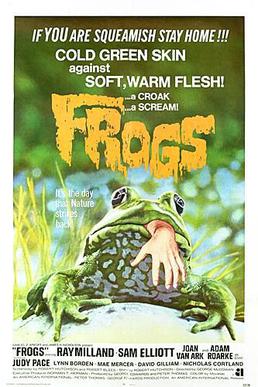
The Wicker Man is a holiday horror movie.  One of my arguments in the book is that holiday horror has to derive its energy from the holiday, and not just be set on it.  For example, I Know What You Did Last Summer and Return of the Living Dead are both set on or near Independence Day but the movies don’t really draw their horror from the holiday itself.  It falls into the same category.  Frogs?  Well, maybe.  Perhaps holiday horror, it’s definitely in bad movie territory.  A rich southern family is dominated by a Trump-like grandfather who controls the money and measures everyone by loyalty to him personally.  On his birthday, the fourth of July, nature revolts and his adult children and grandchildren (apart from one granddaughter), are killed by animals in this eco-revenge groaner.  But is it holiday horror?

One scene may suggest that perhaps it fits the category, but the real significance of that day is that grandpa won’t let it be celebrated any way other than by his prescribed plan.  Even as the estate is overrun by frogs (mostly), snakes, lizards, alligators,  tarantulas, and even some birds (thank you, Mr. Hitchcock), he insists that everyone do what they always do on the fourth of July/his birthday.  The only scene that suggests holiday horror is where the eponymous frogs hop onto a cake decorated like an American flag.  I normally like nature-revenge films, and this one starts out well but quickly goes downhill.  The environmental message is there, but underplayed.  There are some firecrackers and a number of dead rich folks, but otherwise the film seems to have no message at all.  It’s a bad movie.  Holiday horror?  Not really.  Something to watch for a day off work?  Definitely.


Good-Bad

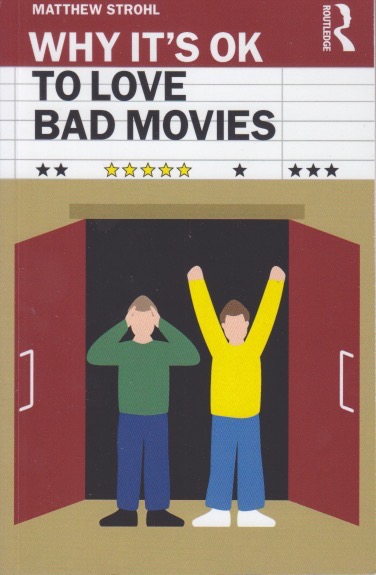
If anybody bothers to follow my movie viewing history, they’ll know that it includes a perhaps disproportionate number of “bad movies.”  In fact, I recently added that as a category for my blog posts.  In need of some reassurance, I read Matthew Strohl’s Why It’s OK To Love Bad Movies.  (As far as I can tell the Why It’s OK series was started by my old boss at Routledge—an inspired idea!)  Strohl is a philosopher, but one who admits to, and even advocates for, loving bad movies.  This book is fun but it does have a serious philosophical underpinning.  I can’t summarize it all here (you need to read the book anyway) but my main takeaways are that ridicule isn’t making the world a better place.  Movies that are so bad that they’re good are definitely a reality.  There’s a community built around it, but I haven’t had many visits from it in my lonely little corner of the internet here.

Strohl points out that not all bad movies are what he terms “good-bad.”  There are certain qualities—aesthetic qualities—that make a bad movie good.  And it doesn’t involve watching the movies to make fun of them.  One of the films that often tops the list is The Room.  When I first saw it I really couldn’t think of anything to write about it on this blog.  It was just another bad movie.  Now I want to see it again.  I do have to say that on my first viewing I didn’t feel like ridiculing.  I was more stunned than that.  And when I watched Plan 9 from Outer Space—another on the list—I felt inspired to learn more about Ed Wood, its famous director.  I’ve since watched a couple more of his movies and I appreciated them.  Now I have a better idea of why.

In addition to discussing the biggies, Strohl also takes forays into some collectives: the Twilight series, for example, and the movies of Nicholas Cage.  These are both often singled out for ridicule, but this book demonstrates that there’s an artistry to such things.  And Bad Movies underscores that not everyone likes the same bad movies.  Strohl also makes the salient point that if we only ever watch great movies we’d have no basis for comparison.  There’s a lot to like in this little book.  One thing it convinced me of (in addition to making me feel a bit better about myself) is that there’s a community out there that I’m missing out on.  Good books bring people together instead of dividing into factions.  This is a good book.


Not Dagon

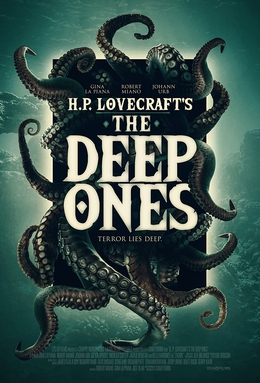
There’s an aesthetic to bad movies.  And when your production company is Crappy World Films you’ve got to wonder if it’s intentional.  Chad Ferrin’s H. P. Lovecraft’s The Deep Ones, which was released in 2020, isn’t a great movie.  It is kinda fun, though.  I’ve had a weakness for explicit Lovecraft films ever since Stuart Gordon’s very moody Dagon.  That film was clearly the inspiration for this one.  With the “low” budget of only a million dollars (it feels strange to write that), it nevertheless has a clean cinematography that shows some artistry.  The story just isn’t that good.  A young couple is seeking a getaway at an oceanfront AirBNB only to discover it’s part of a “gated” community.  Their hosts, who are living in the boat down at the marina, keep on stopping in, not leaving them much privacy.

The set-up is very much a Rosemary’s Baby scenario.  The community, as the title suggests, worship the Old Ones.  They introduce Cthulhu early on, but the young man of the couple has never heard of him (he obviously doesn’t spend much time on the internet).  Speaking of the internet, the film makes the point that everyone spends too much time on it, and there’s perhaps some truth to that, but, if you’re streaming the movie you’re also participating.  In any case, the community wants women to offer to Dagon—and the monster here is clearly low-budget—so they can bear more children for the Deep Ones.  Well, not so much bear children for them as to be pregnant with tentacles that can somehow convert newcomers.  Once you’ve been tentacled, it seems, you’re a member of the community.

There is a kind of Lovecraft vibe to the film despite the often wooden acting and throwaway dialogue.  One thing Lovecraft had learned from Poe was the consistency of mood.  It’s here that the movie runs into some trouble.  At times it’s a little scary, at times dramatic, but too much of it just feels silly.  The case could be made that Lovecraft’s writing tends toward the puerile and there’s some truth to that.  It is never silly, however.  Sometimes when translated to the screen the outlandishness of Lovecraft’s view of the world comes across as so weird as to be funny.  It takes an able director, and a strong writer, to adapt him to cinema successfully.  It’s no accident, then, that the movie is dedicated to Stuart Gordon, whose Dagon is still difficult for me to watch, so full of Lovecraft as it is.


Bad Movies

It’s embarrassing.  No, really it is.  The other day I was posting on yet another bad movie I’d watched and I realized that I should add a new Category (although I’m likely the only one who uses them) on this blog.  Now, it’s a pain to add a new Category to a blog with over 5,000 posts.  I reasoned that my bad movie watching, although a lifetime pursuit, really only appeared on this blog recently.  I had to scroll through the existing Category, “Movies,” to remind myself of what I’d posted on.  I found a few to add to my new Category, then a few more.  Finally the number grew to embarrassing portions.  I kept scrolling until it made me dizzy.  I couldn’t remember whether I’d posted on The Room or not.  It’s not a horror film, but it is very bad.  So bad I watched a parody of it.  Using the search function “The Room” brought up just too many hits and I was already woozy.  Maybe I didn’t want to admit to that one.

Photo by Denise Jans on Unsplash

There’s an aesthetic to watching bad movies.  In fact, there are books written justifying the practice.  I thought maybe I had started my bad movie watching posts with Ed Wood’s Plan 9 from Outer Space, but no.  No, it went back further than that.  As someone who writes books about movies (maybe bad books about movies?) I need to do my homework.  Not only do I write books on movies, I also write on them for Horror Homeroom on occasion.  I’m scheduled to teach a class on a movie this fall.  I’ve even presented on movies to church groups (they never invite me back to talk on that topic again, however).  I know the reason lies much deeper, though.

Part of it derives from a childhood of watching bad movies.  There’s nostalgia involved.  More than that, however, I grew up poor.  Unless you’re a rags-to-riches story (I’m not) that mentality stays with you your entire life.  I’m always trying to cut costs, but I love movies.  On weekends I look for what’s free, with or without ads, on Amazon Prime.  They cater to bad movies, it turns out.  And before long it becomes like an addiction.  There’s a fascination to watching something so obviously poor that nevertheless ended up in theaters.  In other words, hope glimmers through.  My books are far too expensive to sell well.  My name isn’t widely known.  There is, in other words, a validation in watching bad movies.  I’ve got a well-populated Category for them right here.


Spider Planet

Misnomers aren’t uncommon when it comes to click-bait.  I’ve fallen victim more than a few times.  But such misdirection is probably as old as humanity, and is perhaps part of consciousness itself.  (Some birds are known to practice deception, as are some other primates.)  Earth Vs. the Spider is drive-in-bait as a title.  In the 1958 horror-sci fi movie (also titled The Spider), the danger isn’t really to the earth but to one small town.  There is, however, a giant spider and somehow it’s not as scary as the real thing can be, writ small.  Occasionally, such as when a spider comes out into the open in the house, I ponder why this is such a deep-seated human fear.  I know spiders are beneficial to the ecosystem and that they pose very little danger, at least in places where I’ve lived.  So why are they so scary?

Scientists, including those of the mind, have proposed looking to our primate cousins for an answer.  They too are afraid of spiders, and it’s posited that since primates climb trees to escape danger and that spiders also climb, the phobia is hardwired.  For me it’s only certain body-plans that are scary.  I don’t mind the cute little jumping spiders that get in around the windows.  They don’t seem out to hurt anybody.  It’s the kind with long, grasping legs that bother me.  As a child I used to try to identify spiders with a picture book identification guide, but soon the guide started to scare me and I had to put it down.  I wasn’t cut out to be an arachnidologist, I guess.  The movie could’ve used one, however.  They kept calling the spider an insect.

The unblinking advocacy of DDT was the scariest part of the film.  Got a problem?  Spray chemicals all over it!  It gives me the same fear as when I see all those pallets of RoundUp every time I go to Lowes.  That stuff is deadly to the environment, and I’m kind of attached to the environment.  Spring arrived around here late this year, but it was spider season by the time I watched Earth Vs. the Spider as part of my minor quest to see the “so bad they’re good” movies.  They’re also part of the history of horror.  Apart from Psycho in 1960, horror was kind of on vacation for the fifties and into the late sixties.  Of course, movies kept being made.  It’s just that they couldn’t be taken seriously.  And even though drive-ins seem to be extinct, I still fall for drive-in bait from time to time. Even when watching alone.


More Water Monsters

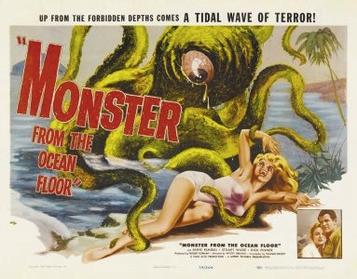
Monster from the Ocean Floor, one gets the sense, wouldn’t have merited a Wikipedia article were it not for the fact that it was the first film Roger Corman produced.  Despite its B-movie quality, there’s quite a lot to like about it.  First of all it has a strong female lead.  Julie Blair is the only gringo in Mexico to believe the locals that there’s a monster just off shore.  Steve Dunning, the scientist, is an avowed skeptic.  The plot is cheesy—the monster is an overgrown amoeba irradiated by the Bikini Island underwater nuclear tests, and it’s killed by getting a submarine in the eye—but there are some very effective cinematographic moments.  When the young boy talking to Julie in the opening turns to stare at the ocean where his father disappeared, the framing and emotion are perfect.

The theme music for the approach of the shark, and then the amoeba, anticipate Jaws by a couple of decades, and I have to wonder if John Williams hadn’t watched Monster from the Ocean Floor.  (I’m sure even cultured people watch the occasional B-movie.)  There’s also an unexpected religion angle.  A series of episodes in the film have a couple of locals trying to kill Julie as a sacrifice to the monster.  Despite the holes in the plot, it’s remarkable that in 1954 there could be dialogue suggesting that the Christian God (“the other god” according to a local woman) isn’t the God that Quetzalcoatl is.  All the same, the sacrifice is based on the folklore that the sacrifice of the “fairest” (Julie is, naturally, blonde) will appease the monster.  Maybe not the most solid theological basis, but still, not bad for a bad movie.

I’ve recently published a piece on Horror Homeroom about women and water monsters.  Having a strong woman in a 1954 film is especially remarkable.  Julie, despite the skepticism of the scientists, takes the initiative to dive right down and see the monster for herself.  It’s only when she comes up with physical proof that the men consider that she may be right (and in danger).  Of course, the men do have to rescue her—you can’t have it all.  Yes, it’s a cheaply made movie with a paper-thin plot but it was beginning to show that a woman could take the reins and with good motives (if nobody else will do something about the monster, she will).  Although she’s the love object of the movie, she’s so much more.  And a submarine in the eye—that’s gotta smart.


Mutant Madness

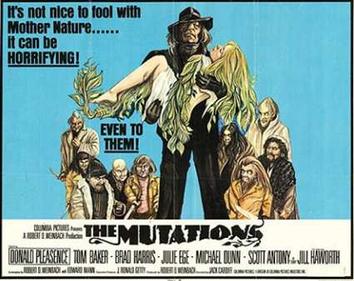
I’ve never seen Freaks, nor have I ever wanted to.  It’s an exploitation film of carnival actors that  Tod Browning, for some reason, thought might make a good follow-up to Dracula.  Most of us are aware that it’s bad enough exploiting  those with unfortunate deformities for money, and making a movie out of it doesn’t help.  I have to confess that I stumbled onto Jack Cardiff’s The Mutations thinking it was a creature feature, without realizing it was a seventies version of Freaks.  With a mad scientist thrown in for good measure.  Honestly, though, the carnies are the characters with the highest moral standards of anyone in the movie, so at least it has that going for it.  You’d have thought that by 1974, however, that people would’ve known better than to reprise a movie that wasn’t well accepted forty years before.

Professor Nolter, the mad scientist, is a university professor trying to force evolution’s hand by blending animals and plants.  So far, so good.  He uses his students as victims, which makes you wonder why their wealthy families don’t start any investigations when they go missing.  The professor is assisted in his experiments by one of the co-owners of the carnival, which allows for a presentation of the carnies in a most awkward piece of cinematography.  Two of his students are successfully made into plant hybrids, but one dies shortly afterward.  The other escapes, so he decides to replace him with yet another student.  Meanwhile, the carnies tire of their exploitation—rightfully so—and turn on the henchman/co-owner of the show.

The only real payoff here is the successful hybrid that turns into a student into a human Venus flytrap.  If he hugs you in his rubber-suited arms, you’re a goner.  And the film starts off with several minutes of time-lapse photography of plants growing, which is pretty cool, even amid the strangeness that’s to follow.  When I saw that the movie starred Donald Pleasence, and having Halloween on my mind,  I figured, “How bad can it be?”  It was, after all, free on Amazon Prime.  As with many exploitation movies, it’s poorly written and the props aren’t believable.  Some of the giant plant-animal hybrids are worth looking at, even though they’re never explained.  In the end the mad scientist’s creations kill him, as expected.  I would normally consider such information as a spoiler, however, considering that the movie spoils itself, I won’t worry too much about it.


Connecting Many Leagues

Much of movie viewing life is about making connections.  Many, many films have been made and I’m not the first to suggest that cinema is a form of modern mythology.  But those connections!  Pressed for time one busy weekend, I found the brief, low-budget The Phantom from 10,000 Leagues.  It was included with Amazon Prime and I had an obligation in about 90 minutes.  I could just squeeze it in.  As I’d anticipated, it was another of those poorly written, cheeky teen-magnets from the fifties.  The monster created by radiation, the threat to the world that the government sends only two guys to handle, and lots of lingering shots of men in business suits walking on the beach, it’s about what you’d expect.  It did well at the 1955 box office, though.

My first thought was that it was an attempted marriage between The Creature from the Black Lagoon and The Beast from 20,000 Fathoms.  Indeed, Black Lagoon had been released the year before, opening the realm of underwater filming for monster movies.  It, however, had a believable monster that wasn’t so monstrous.  The “phantom”—the name is never explained—is obviously a person in a cheap monster suit that can barely open its mouth.  It kills by holding people under water, or getting them into a radioactive beam, or preventing them from getting away from dynamite.  Oops, that last one’s a spoiler, I guess.  The Beast from 20,000 Fathoms came out a year before Black Lagoon.  The title of The Phantom from 10,000 Leagues title was obviously ripped off from it, and the atomic connection and undersea beast are common to both.  Connections.

The Beast had the benefit of a monster by the master, Ray Harryhausen.  And it was based on a story by Ray Bradbury.  That was a winning combination.  The Phantom claims to be based on a story by Dorys Lukather.  This movie is all she’s known for writing, God rest her soul.  Produced by the subtly named American Releasing Corporation, the production company would go on to become the respectable American International Pictures.  Interestingly, given the sexism of the era—reflected fairly clearly in the writing—the monster was played by a woman.  Norma Hanson, like Milicent Patrick, brought a monster to life only to be largely forgotten.  Patrick was rediscovered by Mallory O’Meara, but Hanson—one time a diving world-record holder—seems to have faded.  Had I but more time, I would enjoy diving those 10,000 leagues to bring another forgotten Hollywood monster woman to life.  And if I had the connections.


People of Slime

An old saying advises not to speak ill of the dead.  And I suspect this also applies to the living dead.  Night of the Living Dead (1968) is a classic horror film that represents the maturing of the genre.  Of course, it’s not the only horror film of the sixties, and I don’t mean to speak ill of it by suggesting that George Romero—who was used to working with a small budget—had seen The Slime People.  But I wonder if he had.  Directed by and starring Robert Hutton, The Slime People was released in 1963 and although it’s really bad, some of the scenes from this black-and-white groaner seem to have been borrowed five years later by the more able director.  The interviews by the newscasters and the driving country roads, and even the chasing of the angry mob could’ve served as direct inspirations.

The slime people are from subterranean earth, forced into action by underground nuclear testing.  Building a solid fog wall around Los Angeles, they take over the city while a pilot, a scientist and his two lovely daughters, and a marine, save the day.  Although the military had been fighting the monsters, they just couldn’t win.  The scientist really doesn’t help solve the issue but the pilot (Hutton) finds the creatures’ wall machine and the scientist is able to blow it up with a spear, saving the day.  This is one of those films so bad that it’s good.  The writing is poor and the plot makes little sense overall.  It doesn’t quite have the style of an Ed Wood film, but it participates in the aesthetic of watching bad movies.

Hutton isn’t a bad actor.  Hampered by a too-low budget (one of the signs that a movie might be one of the good bad ones), he couldn’t film the story he envisioned.  Much of the budget was reputedly spent on the slime people costumes, ensuring that Hutton drew no salary for his own role in his movie.  A couple of the other stars were veteran actors, and this prevents the movie from being a mere hack job.  I take some hope from the fact that many films like this eventually become cult classics.  Yes, sometimes it’s so that we can laugh at them, but I think there may be something deeper involved.  Those of us who watch bad movies might recognize something of ourselves in them.  We too struggle to tell our story, without big budgets and without studio support.  And yet we persist.