Wooden Translation?

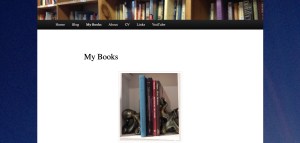
The summer got away from me, as it always seems to, leaving several boxes of things yet to be sorted.  Since these boxes are in the garage where there’s no heat, doing it during winter isn’t really feasible.  Still, I found myself in the garage storage area the other day and quickly tipped open a box or two to remind myself of what might be inside.  One of the treasures I found is actually from my wife’s family memorabilia.  Not exactly a family Bible, it’s a New Testament one of her grandfathers gave one of her grandmothers as a gift.  It’s a red-letter edition, but what makes it unusual is the binding.  It has olive wood covers from Jerusalem.  The front cover is embossed with a Jerusalem cross.

Bookbinding has long been an area of personal fascination.  Growing up when and how I did, most of my books are paperbacks.  The paperback was initially one of the responses to shortages introduced by wars.  Since they were cheaper to produce they could be priced down.  I have a few academic paperbacks from the twenties (I can’t make myself acknowledge that 1920 was a century ago) whose paper bindings are literally paper.  I fear to take them off the shelf, given the fragile nature of their bindings.  Prior to that books tended to be “hardbacks.”  A piece of cloth-covered cardboard was the preferred means of protecting the vulnerable leaves inside.  Before that leather was routinely used.  Those were the days when books were properly thought of as an investment.

I often think of how little I will leave behind, at least in terms of items of monetary value.  Books seldom maintain their cover price for long.  As someone who lurks on used book websites, however, I do know that the choice tome of either quirky fiction or nonfiction under-appreciated at the time can easily jump market values with predatory sellers.  Even for a paperback.  I am loath to confess how much I’ve paid for a book I really needed for research that mere public libraries simply can’t access.  (The university library is a place of wonder, and one of the resources I most often miss in having become secular.)  Just this past week I saw a sci-fi book from the sixties I wanted to read priced at over $500 on Amazon (used).  When I went to check on it this morning all copies were gone.  And to think the world considers books a poor investment.  The real key is to be obscure, no matter your binding material.


Truly Exceptional?

Exceptionalism seems to be in the air these days.  Most recently it’s become a plank in the Republican platform—America is God’s own chosen nation (despite what the Bible actually says).  It’s also been a trait of nearly all human endeavors.  Human exceptionalism, that is.  The idea, whether admitted or not, is based on the Bible.  Even those bespectacled scientists who make no time for religion insist that humans are different from other animals.  Why?  The Bible tells them so.  Evolution certainly doesn’t.  And so we go about thinking how superior we are to other lifeforms.  And not only that, but to other humans in other geographical locations.  It seems Homo sapiens sapiens could use an ego check every now and again.

Not only does our sense of superiority go downward over the animals, it also reaches to the very boundaries of this infinite but expanding universe.  We are alone, scientists declare.  The only intelligent life in a universe far beyond the ability of the human brain to comprehend.  There can’t be any alien visitations with (laughably) superior beings crawling out of their flying saucers.  No, we were the best that evolution could do.  And we elected Donald Trump to be our president four years ago.  What’s that about an ego check?  Especially since we’ve learned that there is water on the moon.  Almost certainly there was once liquid water on Mars.  There may even be traces of life in the atmosphere of Venus (although the earthly jury is still out on that one).  Only humans can make that declaration.

Photo credit: NASA

I have to wonder at this arrogance that comes along with consciousness.  Do we believe we’re the best simply because we learned to apply the laws of rationality to our gray matter?  Back when I was a seminarian the word “pantheism” was rather like a swear.  To suggest a universal connectivity (literally) was an offense against the deity portrayed in the Bible.  (I would hope that a God that big would encourage us to understand the implications of a universe so large.)  We humans have our good points, of course.  I love people and their foibles.  Were we not so dangerous we might even look cute in the cosmic eyes above, as well as the inferior eyes of our pets.  Exceptionalism, it seems to me, ought to be the dirty word.  It seems far more human and humane to throw the gates open wide and consider the possibilities.  I love people, but if we’re the best there is, the universe is in serious trouble.


Biblerama

Perhaps you’ve heard—the New Revised Standard Version is being updated.  Stop the presses!  I’m sure that everyone has been anticipating this as much as biblical scholars have!  If you’ve not been able to feel the buzz maybe it’s because you’re not in the Bible publishing business.  As the discussions have been going on (rights holders are of course consulting with publishers, because that’s where the money is) a great deal of energy goes into deciding what exactly to call it.  And since Christianity is so fragmented there have to be different versions of the versions.  Some include the apocrypha and others do not.  Some prefer British spelling and others American.  Imperial interests are important, even when it comes to Scriptures.  What may be overlooked in these developments is the connection to the most influential English translation, the King James.

The King James Version was not the first English translation of the Bible, but it was the version that captured the imagination of some as directly inspired by God.  Strangely enough, King James onlyists can seldom name the translators who apparently had the divine mouth to their ears, but never mind that.  The KJV held immense sway especially among literalists because it is so quotable.  In the 1950s it was revised.  (There are, by the way, several differing versions of the King James Version, and the original included the apocrypha.)  That first major revision came to be known as the Revised Standard Version.  Translators seldom begin their task with what original language manuscripts they can find; new translations are based on existing translations in families.  It’s okay, we’re all related.

Bible closet

When I was a kid the RSV (Revised Standard Version) was considered pretty good by many.  Hardly an overwhelming affirmation, but still, it’s something.  The real concern began when the New Revised Standard Version (NRSV) came out in the eighties.  The reason?  It used inclusive language!  See what happens when you allow women to read?  Ironically, the book that has been used for centuries to liberate white men is something you want to keep out of the hands of women and non-whites unless you make it clear that everyone from Adam to Jesus and Paul was a white man and this is his story.  Now the New Revised Standard Version is being updated.  Nobody’s quite yet sure how it will be denominated.  And this is only one family in a vast genealogy of Bible translations.  If you’re not in the Bible business, you’re missing all the excitement.


Arrival

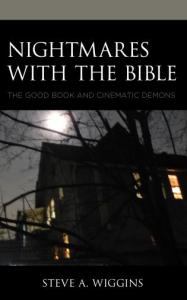
Excitement that comes during the work week gets sublimated.  Work, you see, is like a huge ship chugging ahead at about 30 knots.  It takes some time to stop, or even change direction.  So on Thursday, while I was still at my desk, Nightmares with the Bible arrived.  Since all work—even salaried—is measured by the clock by HR,  I couldn’t take off time to enjoy the birth.  I opened the box, cursorily flipped through a copy, and got back to the task for which I’m paid.  After work it’s time for supper and I can’t stay awake much beyond seven or eight, which meant I neglected my baby.  Friday was another work day, and although I wanted to do all the things marketers tell you to do, I had other duties.

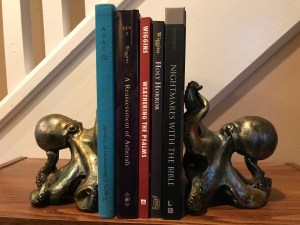
So now it’s Saturday and I can officially say Nightmares have been released.  I have a discount code flyer, about which nobody has yet emailed me, but the offer still stands.  You can get a discounted (but still expensive) copy by following the instructions below.  Feel free to share with your rich friends.  Better yet, have your library order a copy.  I’m hoping for a paperback on this one, but that’ll be a couple years and I know paperbacks seldom outsell hardcovers, even expensive ones.  Raising a child can be a costly venture, no?  Adding another book meant that my display copies had to move out of their cubby-hole onto a bookshelf.  Hopefully, if things go well, there will be more siblings.  Perhaps better priced.

A Reassessment of Asherah was published by a European academic press and put at the incredibly high price of $78 back in 1993.  Gorgias Press reissued it, with additional material, but made it even more expensive.  I can’t even afford to buy a copy.  Weathering the Psalms was only $22, but wasn’t a gripping topic for many.  Cascade Books, at least, know how to price things.  Holy Horror, at the shockingly high $45 for a paperback (McFarland), languished.  It missed its Halloween release and no reviews have appeared.  “Nightmares” might well capture my sense of the price for my second missed Halloween release.  There are other books in the works.  If any of them get completed I’ll be seeking an agent to try to bring the prices down.  Until then, Nightmares will be the final word.  It’s out there now, for those brave enough to engage with it.


Toilet Paper Redux

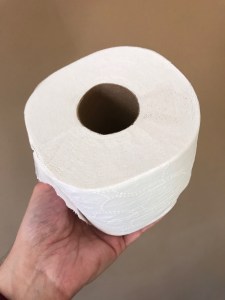
So we find ourselves needing to clean up again.  Maybe you’ve noticed it too.  Since the second wave of the Covid-19 outbreak has wiped across the nation toilet paper has once again become a hot commodity.  Not finding a single roll in Target, I decided to test the waters on Amazon.  Sure enough, many brands are now listed as “out of stock.”  Could it be a coincidence that Trump will be leaving office and we need a lot of toilet paper right now?  Inquiring minds want to know!  Capitalism is like that.  Supply (or lack thereof) and demand.  Instead of making sure people have access to the basic necessities, we would rather have panicky citizens with soiled underwear looking for leadership where none exists.  And voting for lack of leadership yet again.  Flush!

Still, you’ve got to wonder—why toilet paper?  What is it about thin paper on a roll that presses the fear factor?  If people can know to avoid embarrassing smells, why haven’t they plugged their noses when the breeze blows across Pennsylvania Avenue?  Logic fails here.  Have we educated a nation to fear for their backsides but not to see clear and president danger in front of them?  Now that we’re nearing two weeks since the results were announced, we have had nothing but pouting from the Oval Office.  That, and drilling in the Arctic Wildlife Refuge.  Seems like we’ve got to be dirtying the world somehow.  We could use some toilet paper.  Maybe America needs more fiber in its diet.

Those who still support Trump don’t seem to realize that his response (or lack thereof) is the main reason a quarter-million people have died in this country and the virus is completely out of control.  I guess it’s that way with messianic figures.  Ironically the Bible (printed on thin paper itself) warns of someone who acts messianic while lying all the time.  He’s called the Antichrist.  You can tell him because just about everything Jesus did, he does the opposite.  Welcome the foreigner?  Feed the hungry?  Heal the sick?  Talk about God and how to deepen your relationship with the divine all the time?  Have you got any boxes checked yet?  Or are you waiting for the Charmin supply truck to go rolling on by?  Perhaps it’s time to invest in paper.  We print our money on it and hope somehow it will save us.

White gold or pay dirt?


Black Bible

In such a bibliocentric culture, I wonder why we lack curiosity about the Bible.  Not only do we not study it much in religion classes, we often accept it as a fixed cultural object.  Saying that it’s the word of God, as if that explains anything, many Protestant groups take it as the 39 books of the “Old Testament” and the 27 of the New, ignoring the 66 total that stands like a warning sign of impending idolatry.  Roman Catholics and some Anglicans add the books of the Apocrypha, or Deuterocanon, bringing the number closer to 73 books.  I say “closer to” because some of these books seem to be expansions on other books already in the canon.  Over the years the National Council of Churches has added a few more books, considering various other groups (mostly Orthodox) that recognize some further works as canonical.

In this era of recognizing the importance of black lives and black culture, I’m amazed there’s so little curiosity about the Ethiopian Orthodox canon.  I’ve spoken to many biblical scholars who could care less that the fantastic books of Jubilees and 1 Enoch are in the canon of the Ethiopian and Eritrean Orthodox Churches.  It’s almost as if these groups simply don’t matter in the world of Christendom.  I note that biblical scholars I ask about this are usually Protestant or Catholic themselves.  It seems to me almost a racist slight not to include books that are recognized among some Christian groups, but not others.

What is the scientific criterion for determining a book is the word of God or not?  It surely can’t be fear of contradiction, for the Protestant Bible—the briefest in mainstream Christendom—has plenty of contradictions of its own.  The Bible itself famously does not name the books included.  Various authorities made decisions at various points about which books should be included and which should be left out.  It is such a very human process.  But when it comes to including the books of churches that total nearly 40 million members, suddenly people just aren’t that curious.  Those of us interested in demons have to take Jubilees and 1 Enoch seriously.  They are fascinating books.  And Biblical for millions of people.  The past several years have made me think quite seriously about the borders built around the Bible.  Whose choice is it not to include books already in the canon for their neighbors?  Or, as might be more accurate, who has the authority to cut out books that already belong for many African Christians?


Nightmares Awake!

According to Amazon, Nightmares with the Bible has now been published.  Authors are seldom the first to see copies of their own books, strangely enough.  I probably won’t have any physical copies for a couple of weeks yet.  Until then I’ll wait like an expectant mother.  I don’t actually read my own books after they’re published.  Like some other writers I know, I’m terrified of finding mistakes.  And the older I get the less certain I am about anything.  I’m not even sure if it’s officially published yet or not.  I choose to trust Amazon’s opinion on that.

Right now I’m caught up between four or five other book projects, each a good bit along.  Since writing is often a mood-based thing, what I do in the sleepy hours of pre-dawn is what I feel like writing on any given day.  Unless you have a book contract in hand, that’s not, I suppose, that unusual.  I’m trying to guess what might most get the attention of an agent.  Both Holy Horror and Nightmares with the Bible were written for general readers.  I don’t have the name-recognition to command any kind of attention (or affordable prices), so I need to find a topic that’ll do the work for me.  I personally find religion and horror a fascinating subject.  Many other academics do as well, but general readers not so much.  It’ll feel more like reality when I have a copy I can have and hold.  I still haven’t reconciled myself with ebooks.

What usually makes me stick with a project for the dash toward the finish line is a book getting close enough to see the ribbon ahead.  I write incessantly, so I have a backlog from which to draw.  I know my tastes are odd, which means it’s a challenge to get others onboard with my likes.  I know horror fans love to read about movies.  I suspect most of them don’t care much about the religious aspect of what they’re seeing.  That’s why I write about it.  People get information about religion from popular media.  Even if they deny their interest, writers and directors will slip it in regardless.  I’m just calling them like I see them.  The nice thing about movies is you can have instant replay.  And with a fair number of us now publishing books in this niche, hopefully conversation will follow.  Until then, I’ll just be waiting here until my first copy arrives.


Bible Lesson

I was recently reading the revised preface and “To the Reader” (in draft form) for the NRSVue.  In case alphabet soup’s not your thing, that’s the New Revised Standard Version updated edition.  Of the Bible.  As I read through these seldom referenced pages it occurred to me, not for the first time, the care and concern with which scholars approach the original text of the Bible.  No matter what Fundamentalists may say, we do not have the original text.  In some places the translations you read are the best guesses of those who’ve spent their lives trying to understand what an obviously corrupted copy was intended to reflect.  Such care reflects the widespread (but shrinking) sense that this text somehow magically informs daily lives and should lead to political action.  I’m sure Jesus would’ve arched an eyebrow over that.

Biblical scholarship is hampered by the fact that the manuscripts that have survived are copies of copies of copies (etc. etc.).  Translators—yes, including those of the King James Version and the New International Version—are making some informed guesses on an Urtext we simply don’t have.  Lives, however, are often sacrificed on the basis of the belief that we have here some object to be worshipped instead of read and understood.  I like to tell my skeptical friends that the Bible is actually full of really good things.  There’s some nasty stuff in there too, but we can learn from the parts that convey deep spiritual wisdom.  Listening to your elders is a good idea, but it’s not the same as worshipping them.

Humans have a deep desire to make things sacred.  Maybe it’s because after watching us muddle around down here we want to believe there’s something better out there.  It’s problematic, however, when we make an earthly object, put together by humans, into a deity.  There are those who get around this by claiming the Bible is from God in the original.  The point is we don’t have the original.  There are some words (especially in Hebrew) of which the connotation and denotation are unsure (for words have no inherent meaning).  Reading, we know, is a complex enterprise.  That’s why it takes years to master it and constant practice to maintain it.  Those who leave off reading after school may, I fear, fall back into literalism when they encounter a text.  Bible scholars take great care at trying to reconstruct the original, and all of that can be undone by a failure to just keep reading.


Another Turn

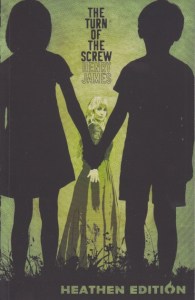
I have read The Turn of the Screw before.  Henry James’ most famous ghost story is a classic of ambiguity.  My previous reading, maybe a decade ago, was in an edition of James that insisted on stuffing other stories into the same binding, most of which I’ll probably never read.  I located a reasonably priced edition containing only the novella I wanted and it is published by Heathen Editions.  Obviously priding themselves on the unorthodox, Heathen Editions provides books with some little commentary, particularly pointing out unfamiliar words or explaining circumstances that many modern readers lack the training to spot.  The edition ends with James’ own afterword to the story, something my larger James volume lacks.  The story I remembered in part, but the notes also engaged me.

These notes aren’t numerous and they don’t distract.  In my case I understood the words defined, but I appreciated some of the historical or literary context supplied.  With so much literature available these days modern readers have to be drawn back into the classics.  James’ style tends toward the choice of more words than would be strictly necessary to tell the tale.  The fact that it was serialized helps to explain that.  Like Middlemarch and The Woman in White, both of which I’ve posted on in the past, being serialized encourages a kind of verbosity that modern publishers of fiction eschew.  At least in my limited experience.  For The Turn of the Screw the slow building to the climax requires spreading out.  The story itself could be summarized in a paragraph (which I won’t do, because you should read it yourself), but the feeling of dread has to grow as bits are slowly revealed.

One of the notes particularly caught my attention.  In an oblique reference to David and Saul, the editor expanded the footnote a bit.  The scene is when Saul is being tormented by an evil spirit sent by God and David is called in to help him with a kind of music therapy.  David plays his lyre and Saul’s demons temporarily leave him.  This is subtly referenced in chapter 18 of the Heathen Edition.  The note briefly explains Saul and David and then, for the only time in the book, goes on to provide a reception history of the reference by informing the reader that Leonard Cohen also refers to this episode in his song “Hallelujah.”  I’m sure the opening lines are familiar enough that I don’t need to risk violating copyright to quote them.  So it was that while reading a ghost story the Bible was introduced, which, of course has been my research agenda for a few years now.  A turn of the screw indeed.


War of Egos

As an author you have to believe in your book.  Experience has taught me that if you don’t, nobody will.  Still, there are ways of believing in your book while keeping your ego in check.  Given the ego we’ve seen along Pennsylvania Avenue these last few years it may come as little surprise that even some wannabe authors can nearly match it.  The line, as professionals draw it, is balancing between the importance of your work with the realism that few books sell well.  Your best approach, as author, is humility.  Many people don’t read the professionals.  You quickly learn this if you’re in an editorial role.  It is normal to receive emails from authors telling you how important their work is, some even claiming it as an even on a cosmic scale (I am not joking).

I often consider how much pain authors could spare themselves with just a tiny bit of research.  If a publisher has turned your book down twice already, don’t submit it a third time.  (You already crossed the line the second time you sent it.)  And don’t send your proposal with a list of demands.  What I’ve noted both on this blog and elsewhere is that editors value professionalism.  We don’t like turning down books.  We don’t want to ruin a prospective author’s day.  There are, however, safeguards you can use to prevent the worst kinds of disappointment.  Rule number one is check your ego at the door.  Do you know how many books have been published?  Do you know just how difficult it will be for your book to get noticed?  Take a reality check.

Also, scale your expectations.  How many bestsellers have come from university presses?  If you’re after bestseller status you need to aim for a trade publisher.  This is pretty basic stuff.  Those of us who publish in the academic world do believe our books are important, but many of us also know that they start only small conversations.  Biblical studies isn’t exactly a growth field.  We talk amongst each other, a collegial little group for the most part.  And to keep things on the collegial level it is helpful to remember that we’re not publishing for ego.  We’re publishing to try to move knowledge ahead, even if just by a micron or two.  Good writing, I was once told, is simply clear thinking.  Getting that writing published is part of a conversation and conversation only works if  we are willing to keep our egos on their leashes.


The Good of Others

On a recent trip to visit family in upstate New York, the Sunday we had to leave (for work Monday is an implacable law), we decided to have lunch in a local park.  The weather was fine and there was plenty of social distancing, given the size of the grounds.  After a nice picnic and stroll, we realized it was getting late to start out in order to get home by my oddly early retiring time.  We headed back to our hosts’ car only to find it wouldn’t start.  They had a new battery and so we popped the hood and hoped to find something obviously wrong as we waited for the long response time for AAA in a rural area on a weekend.  We were a little concerned because we still had a long drive and no real way to get back to our own car, parked at our hosts’ residence.  A stranger came up and asked if we were having trouble.  Listening to the symptoms he said, “Do you mind?”  Putting his head under the hood, he said, “I’m a mechanic.”  He had our host try again and the car started right up.  He refused to take payment and wouldn’t even give his name.

Despite the fear the Republican Party tries so hard to spread, it has been my experience that good Samaritans abound.  When I’ve had car trouble far from home, I’ve never waited long beside the road before a stranger has stopped and asked if they could help.  Technology may make us feel more self-sufficient (we have smartphones and can call for our own help), but it doesn’t always work that way.  My wife had accidentally left her phone at our hosts’ place, and I’d forgotten to charge mine so the battery was depleted.  Uber would require an active, charged phone and our hosts were using theirs to communicate with AAA.  If the stranger hadn’t stopped by we would’ve been stuck, likely for hours.

I oftenconsider how Calvinistic GOP thinking can be—assuming the “total depravity” of everyone and declaring that we must be kept in check by laws that maintain outdated concepts of both humanity and justice.  To be sure, there are dangerous individuals out there.  Would you want Trump to stop by if you were having car trouble?  What selfless behavior could you expect from that quarter?  Sucker!  In general, however, people are good.  They are motivated by what they think is right.  We’re in a pandemic.  The mechanic didn’t know us (we outnumbered him), he had no obligation to help.  Good Samaritans exist, and they are frequently found outside the yellowed leaves of Scripture.

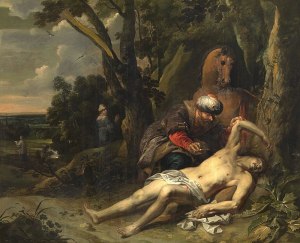
Balthasar van Cortbemde – The Good Samaritan, via Wikimedia Commons


Back to Tarrytown

The very name “Hollow” takes me there.  It’s a resonant geonym.  Near Franklin, Pennsylvania, my early hometown, runs a route called Deep Hollow Road.  For me, with its lush, thick trees and shadowed valley, it always exemplified what the term “Hollow” intended.  And of course, there was Sleepy Hollow.  Now that my article on various movies based on the Irving story has appeared in Horror Homeroom (it’s free), I’m again thinking about my dance with that particular story.  In fact, after I submitted the article I watched yet another version of the tale, Pierre Gang’s 1999 The Legend of Sleepy Hollow.  This film on Sci Fi (before it became SyFy) purports to follow the original closely.  It nevertheless has to pad out the story and does so with religion.

Religion—specifically the Bible—and the tale as represented in Fox’s four-season series Sleepy Hollow is what started me on the current leg of my journey.  I sent an article to the Journal of Religion and Popular Culture on the topic and when it was accepted I expanded the idea into the book Holy Horror.  So it is that I’ve tried to watch as many versions of the story as I can.  There have been many made-for-television renditions.  Some are available for free on the various services that draw from my pocket monthly.  Others cause me to debate whether I want to pay for seeing a sub-par effort for the sake of completeness.  The scholar’s heart still beats within me, I guess.  The Gang version expands the story with a church scene, not in the original tale.  To inculcate the Bible, however, Tim Burton’s film of the same year was necessary.

For me no story better encapsulates October.  Perhaps it’s the crucial role of the pumpkin.  Perhaps it’s the ambiguity of the headless horseman himself—is he a hoax or something more?  These kinds of questions are answered by various filmmakers but since the viewer ultimately decides the question is left up to us.  If I were still an academic my next book project would be clear.  Instead I’m trying to bask in the wonder that is October—the season of transition from bright blue skies and colorful leaves to long, chill nights and bare trees.  Our time outdoors becomes more focused so that we might get back to the warmth inside.  And if we’re looking for a tale to read that’s not really that scary, but which captures the ghosts of the American imagination, “The Legend of Sleepy Hollow” beckons.


Nightmares’ Progress

Ironically for someone who works in academic publishing, I have my own issues of how books are priced.  I understand why, however, because I can see sales trends.  When it comes to authoring my own books I’ve learned how to write for general readers.  Not all publishers know how to price for that.  Already I’ve had one friend blanch at the price of Nightmares with the Bible and the hope is that it does well enough in the library market to earn a paperback.  I also know paperback sales seldom reach the level of hardcover sales from academic presses.  Much of it is driven by demand.  If people know about the book and ask their libraries to buy it, and this is key—check it out—that has a way of sometimes snowballing enough to convince a publisher that there’s an individual market.

Since I’m plotting the progress on Nightmares here on this blog, I’ll point out that the book has its own page on my website (located here).  Actually, all my books have their own page, but since my website is in the low-rent district of the internet not many readers venture here.  Yesterday I added the back-cover blurbs to the page.  I did so with fear and trembling.  Life has taught me not to take well to compliments.  They make me uncomfortable, like strangers entering my house without masks on.  Since I have no institution backing me, however, I need the praise of colleagues to convince others to buy this book.  In my long-term thinking on the topic, I’m hoping Nightmares gets reviewed and people will get interested in Holy Horror, which didn’t get reviews but which is half the price.

In the biz we call this “platform building.”  Those with healthier egos than mine hire their own publicists who boost their number of Twitter followers and get their names out there on the internet.  My own platform building has been of the budget kind.  I’m active on Goodreads to get followers.  I’ll engage with any comments I get on social media.  But I’m also a working stiff hoping desperately not to lose my job during this pandemic.  The blurbs on Nightmares are very nice, and they note that I write for non-specialists.  This blog is open to all comers, after all.  Likes, shares, and comments all help.  My thanks to my endorsers—you know who you are!—you made my day with your kind words.


The Birth of Nightmares

It’s often said that it takes a village to raise a child.  A similar idea lies behind the writing of a book.  Sure, the lion’s share of the research and writing are done by the author—the person who gets credit for the work—but publishing is an industry.  That means other people’s livelihoods are based on the end result as well.  The author often doesn’t know what’s going on when the book is in production.  It was a pleasant surprise, then, to find the publisher’s website for my book is up.  You can see it here.  My own site for the book has been up for months (here; go ahead and take a look, there’s not much traffic).  Those who only read these posts on Facebook, Goodreads, or Twitter may not realize there’s a whole website out here that addresses things like books and articles.  (I think the CV part requires updating, though.)

In a writer’s experience, seeing a book’s website—receiving an ISBN—is like the quickening of a baby.  You’ve known for some time that it’s there, but the proof is in knowing that other people can find out.  I only learned of this because a friend wanted a link to the book page.  If you google the title without quotation marks you’ll find lots of websites about Christians and nightmares.  (Who knew?)  People of my generation still often don’t realize that, much of the time, searches with quotations marks are increasing necessary on a very, very full internet.  I’m still not sure of a publication date for Nightmares with the Bible, but you can preorder it.  (Sorry about the price.)

Once a friend asked me why we do it.  Writers, I mean.  Unless you’re one of the few who are very successful you don’t make much money off the project that has taken years of your life to complete.  I’ve never earned enough in royalties even to pay for the books I had to purchase to research the topics on which I write.  It’s not an earning thing, although that would be nice.  For some it’s an expectation of their job.  For some of us where it’s not, writing books is perhaps best thought of as monument building, a long and intensive “Kilroy was here.”  You notice something you think other people might find interesting, and so you write it down.  Chances are the number of other interested people will be small.  Family (maybe) and a few dedicated friends will lay down the cash for an academic book.  But still, there’s a village behind it, and I need to thank them here.


Etymological Serpents

Snakes get a bad rap.  There are biological, evolutionary reasons people tend to fear them (some are dangerous and the way they move is literally creepy), but snakes are a necessary part of our ecosystem and very successful reptilian forms.  Nevertheless they get associated with evil.  The other day I was consulting a book of Christian symbolism.  This was actually a book I’ve had since my childhood.  My eye fell upon the entry for serpent and the book gave the etymology as from Latin for “sin.”  I’d never heard this before and as I thought about it, “serpent” has the same ending as “repent,” so I wondered if the terms might indeed be related.  That most authoritative of lexicons, the Oxford English Dictionary, soon set me straight.  The etymology of serpent is from Latin (at least partially) but not for the word “sin” but from the word “creeping.”

Given what serpents do, that name origin makes sense.  The idea of sin being attached to snakes is a biblical one.  The Garden of Eden oh so long ago, and a serpent wrapped around a fruit tree.  That story has become one of the most influential in western culture, played and endlessly replayed with some combination of apple, woman, and serpent.  Genesis, of course, doesn’t specify the tree as an apple tree.  That association seems to come again from the Latin.  The word “apple” is malum, which may also be used for evil.  In Latin they have different vowel lengths and only become homophones in the languages of non-native speakers.  The serpent, on the scene at the primordial fruit tree, becomes associated with sin because of this story, not by its etymology.

The biblical view of snakes is not a positive one.  By the time of Revelation the serpent is associated with Satan.  It’s also called a dragon, which, as modern fantasy aficionados can tell you, is quite a different thing.  The dragon becomes associated with evil because of the Good Book also.  The reptile order generally doesn’t fare too well in the biblical world.  There do seem to be Sumerian prototypes for the story of the snake and the tree.  It’s not completely original with Genesis.  Still, you’d like to think that if someone is going to write a book about symbols they might take extra care with the etymologies.  People tend to fear snakes.  It’s hardwired into our primate biology.  That’s no reason to make them the bad guys, though.  All you need is a good dictionary to clear things up.