Good Book Selling

A few weeks back, probably several now actually, the New York Times ran a story about the Bible.  In this age of declining interest in the Good Book such things catch my attention.  Of course, the reason that the story ran was because of the money involved.  Let me explain.  Or at least give the headline: “Oldest Nearly Complete Hebrew Bible Sells for $38.1 Million.”  Money talks, even when it comes to Scripture.  The story was about the auction of the Codex Sassoon, which went to a museum.  Most regular Bible readers aren’t aware of the textual criticism behind their favorite translations—yes, even the good ol’ King James.  You see, no original biblical manuscripts survive.  Not by a long shot.  Every biblical manuscript in the world is a copy of a copy of a copy, etc.  And these copies differ from one another.  Often quite a bit.
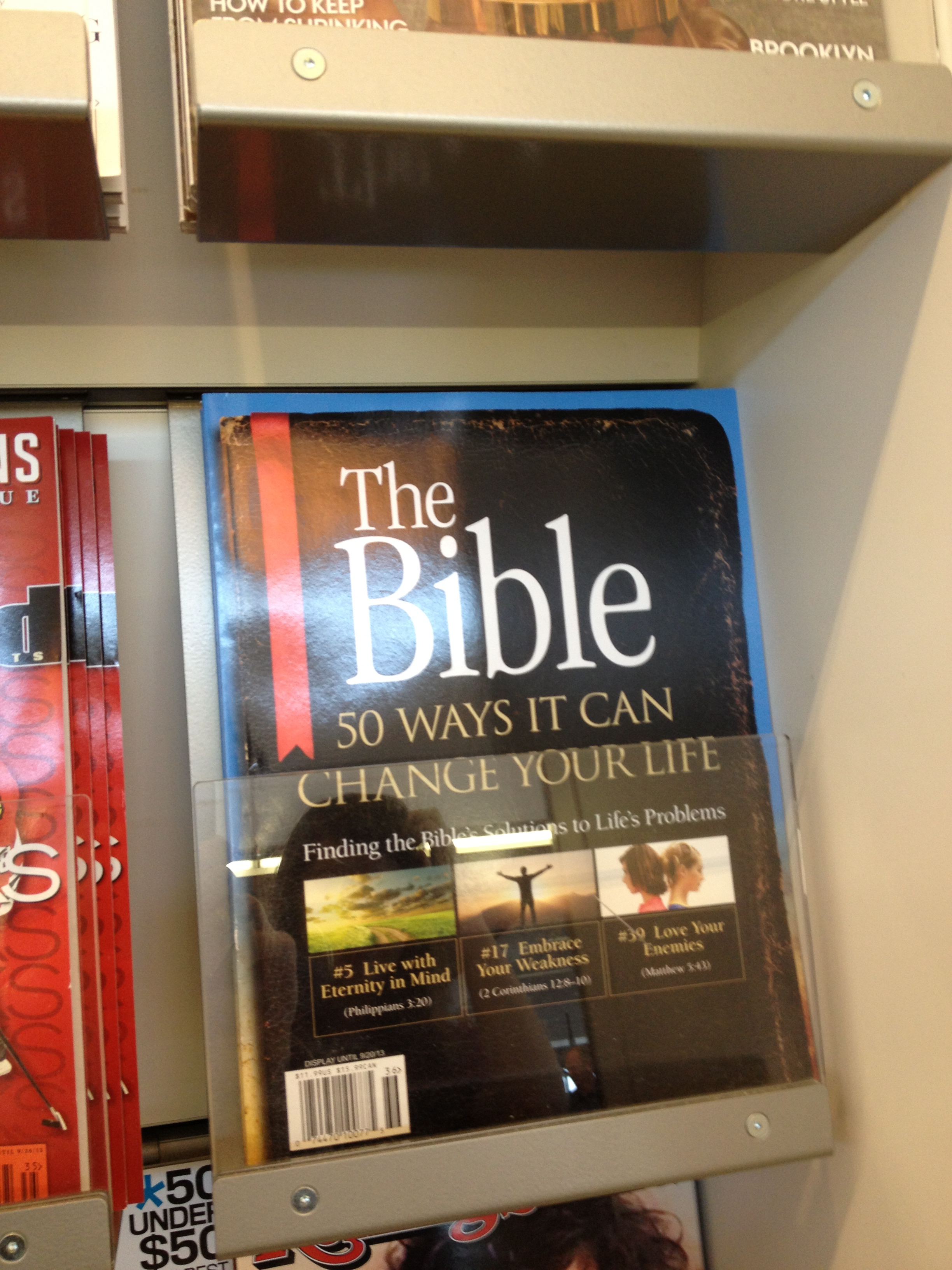
Textual criticism is the job of comparing manuscripts and using scientific—yes, scientific—principles to determine which one better reflects what was likely original.  Since we don’t actually have the original we can’t say.  Those who hold views of extreme reverence for one translation or another have to resort to divine guidance of the textual critics to make the case.  For example, they might argue that God inspired the translators of the King James to follow one manuscript rather than another.  The King James was based on manuscripts known at the time (only about six of them) and far older manuscripts—inherently more likely to reflect earlier views and potentially closer to the original—have been discovered since then.  And are still discovered.  That was one of the reasons behind all the fuss over the Dead Sea Scrolls.  They represent some of the earliest biblical manuscripts ever found.

The Bible is an identity-generating book.  In this secular age, the failure of “the educated” to realize this simple fact often leads to underestimation of the importance of religion.  It motivates the largest majority of people in the world.  We should pay attention to it.  It doesn’t make headlines too often, though.  Instead, politicians who pretend they respect the Bible but live lives about as far from its precepts as possible, gather the limelight.  When money gets involved the Bible becomes interesting again.  We think about that thirty-eight-million.  What we might do with that kind of money.  How we might be able to pay somebody to paint that fence that desperately needs it, or better, to help those in desperate need.  The many victims of capitalism.  Where their heart is, there their treasure will be also.


The Skinny on Asherah

After being removed from academia, my work on Asherah started to receive notice.  You see, I’m not part of some academic dynasty and I never landed that prestigious job that would convince people I had something worthwhile to contribute.  Besides, it turned out that several other scholars were writing books on Asherah at the same time I was.  The subject, however, has proven “evergreen.”  Asherah holds a lot of explanatory power, it seems.  She solves mysteries like an antique Holmes or Dupin.  And the Bible is full of mysteries.  The other day I saw an article by Raanan Eichler suggesting that Aaron’s rod might’ve been an asherah.  This is an intriguing idea.  In case your Exodus is a bit rusty, there are two staffs (or staves, if you prefer) that feature in, well, the exodus.  One belongs to Moses and the other to Aaron.  (Keep in mind that they were octogenarians when they began the trek.) Their stories continue through Deuteronomy.

Tova Beck-Friedman ‘s “Excerpts of a Lost Forest: Homage to Ashera,” Grounds for Sculpture

In the narrative sometimes the stick is Aaron’s and sometimes it belongs to Moses.  It transforms into a snake, it turns dust into biting gnats, it divides the Reed Sea.  In short, it’s the kind of staff you’d see advertised as a miracle-working purchase on infomercials these days.  One of its many features is that it produces water from a rock when it strikes said stone.  The problem is God had told Moses to be a stone-whisperer, not a stone-striker.  Because he hits the rock with the staff he’s barred from entering the promised land.  It seems like harsh punishment for a bit of dramatic flair and I suspect that’s why Eichler suggested that the staff was an asherah.  

Of course, the biblical account doesn’t use the word “asherah” for the staff at all.  Although it accompanies the Israelites through the wilderness, and in some accounts is placed inside the ark of the covenant, it isn’t called an “asherah.”  But being in the ark puts it into the tent of meeting, and therefore later the temple.  And we do find an asherah in the temple later in the biblical story.  The thing about asherim is that they’re never defined in the Good Book.  We simply don’t know what they were.  They were made of wood and they could’ve been poles.  They might’ve been trees or statues.  A rod or staff seems to be a slimmed-down version of a full-blown pillar, so who knows?  Maybe an asherah accompanied Israel from the beginning.  Of course, being outside the academy (my own promised land), I’ll never know for sure.


Half Full

Is the glass half full or half empty?  Perhaps trite, this is the textbook example of optimism.  In times when hope is important—and that may be always, but at times it’s really much more keenly felt—we need to see the glass filling again.  Emily Dickinson famously wrote “‘Hope’ is the thing with feathers.”  Although published posthumously, many refer to this poem when the glass starts to look empty.  Recently a friend pointed us to a more realistic version of this by the contemporary poet Caitlin Seida titled “Hope Is Not a Bird, Emily, It’s a Sewer Rat.”  It’s easily found with a web search but I’m hoping to buy Seida’s book because most poets have a difficult time of things.  The gist of it is that hope is a scrappy, gritty rodent that knows how to survive in a dark, noisome world.

Of course, the Bible has a lot to say about hope as well.  Sometimes we tend to see the half-empty glass of the judgment verses, but what truly makes it Scripture is the hope.  In fact, hope is all around if we look for it.  For example, I recently had to get a new set of glasses.  I really liked my old frames and they had stopped being produced.  I had to try something new.  This pair, instead of screw-hinges holding the arms on, has a mechanism that uses tension between the two pieces of metal so they retain their shape but can also be folded.  The end result is they don’t have a solid fixed “normal” position, but one which can be slightly adjusted because they’re more pliable than fixed screws (it’s clear why I’m not a technical writer).  In any case, their ability to adjust is a sign of hope. If things don’t look right, literally, a nudge can fix it.  You can find resilience even in your eyeglasses.

In times of difficulty doubt can be the thing with feathers.  What we need is one of those water-drinking birds.  You know, the kind that’s made of glass filled with a red liquid that bobs its head up and down into a glass of water.  (It turns out they have their own Wikipedia article under the title “Drinking bird.”)  Here is the ultimate symbol of hope that spans both Seida and Scripture.  The bobbing head always dips into the glass even though it can’t actually drink.  We might be tempted to say it’s a foolish waste of time.  With the correct perspective, however, it shows the glass to be half full. At least when seen through the lenses of hope.

This bird knows hope! Photo by Matt Flores on Unsplash

Optimism

On the homepage of my website (of which this blog is a part) is the statement that jaded optimism lurks here.  I’ve been thinking a lot about optimism and hope lately.  Trying to change the way you think is difficult.  Musing with my wife the other day I realized—and this should’ve been obvious—that my optimism became “jaded” when I lost my job at Nashotah House.  You see, our lives have been uncertain since then.  The steady income of an academic job with a retirement plan, a future mapped out (at least a little) with summers free for research and travel, the flexibility to have time to contemplate; all of this fits my neurodivergent way of thinking.  Having suddenly to cope with finding an apartment, finding jobs (not vocations), losing retirement options, all of this has led to a turmoil that has lasted going on two decades now.

I need to challenge my jaded optimism into becoming real.  I keep coming back to Mark 9.24, “Lord, I believe; help thou mine unbelief.”  I’m not a materialist, although academia led me close to it a time or two.  The universe, however, is an untamed place.  We don’t know the trillionth of it, let alone the half.  We’ve figured out a good bit of the physics of this world and think that it applies the same everywhere in this infinite, expanding space-time.  Then we discovered quantum physics and quantum entanglement which looks more like religion than science.  It seems to me that optimism—hope—lies in a combination of what science tells us and what is traditionally called religion tells us.  You may call it “belief,” “intuition,” or “hope.”  Yes, when Pandora’s box was opened, only hope remained.

John William Waterhouse, Pandora (1896), public domain, via Wikimedia commons

There’s a parable in the story of Pandora.  As told by Hesiod, Pandora’s jar contained the gifts of the gods which escaped when Pandora opened it.  Thereby evil entered the world.  Yet one gift of the gods remained for humankind, and that was hope.  Arguably the most valuable gift of them all.  I have been letting my career malfunction at Nashotah House dominate and drive my outlook for far too long.  It will never cease to hurt, I know, but it’s time I learned the meaning of what the Pandora myth teaches us.  Myth, please understand, functions like religion.  It provides insight and guidance.  And the tale of Pandora, especially when things turn unexpectedly frightening, reminds us that hope is the only necessary gift of the gods.


Baptist to the Future

Setting aside their smartphones and MAGA hats for a moment, the Southern Baptist Convention voted to exclude women pastors this week.  The photos seem to show a rather dour delegate pool that seems ready to head to the apothecary for some leeches to take care of this headache.  The conservative mind is a curious place.  I can understand wanting to slow change down—it is moving at a scary pace, leaving many of us concerned and confused.  Yet the idea that nothing has changed in two millennia isn’t only demonstrably wrong, it’s something that history demonstrates is a relatively recent, and reactionary, idea.  The fundamentalist brand of religion that elevates the Bible to godhood has only been around for about a century.  It’s a reaction to a hundred-year-old modernism that, in spite of all the evidence, closes its eyes.

Fear is natural enough.  Some of us actually watch horror movies voluntarily, after all.  But when fear overtly drives your religion isn’t it time to stop and ask what you’re doing?  The Southern Baptist Convention ejected its largest church, Saddleback, which had achieved national influence under Rick Warren.  According to the New York Times, Warren himself addressed the Convention citing none other than Billy Graham in his defense of women pastors.  The convention overwhelmingly voted to excise its most successful church for fear of that dreaded slippery slope of liberalism.  We’re fixated at some sexual level, it seems, and afraid of what might happen if we admit that even as AI is taking over our world, things may have changed.  At least a little.

The Bible is a sacred document with a context.  That context was patriarchal and it held considerable sway for about two millennia.  Power is difficult to relinquish.  When you get to call all the shots you don’t want to be reminded that those shots are wounding and killing innocent people.  “It was just better that way,” people think, ignoring the very Bible they worship.  It’s a point of view I understand, having grown up in it.  I remember reading with the juvenile furrowed brow of some tender twenty years how C. S. Lewis simply couldn’t see how women could be priests.  And then noticed how Baptists and other Protestants embraced Lewis although they condemned his idolatrous Anglicanism.  Sometimes it’s difficult to believe we’re actually in the twenty-first century with AI knocking at the door.  And we still can’t get over women wanting to be in the pulpit.

What would Roger Williams say?

The Idea of Scripture

Although the academic field of biblical studies is slowly dying—this is something I wrote about a long while back on this blog—the Bible and its kin nevertheless continue to shape and control society.  I was recently reading that Islam takes quite a different view of the Qur’an than Christianity does of the Bible.  It’s also clear that Judaism has yet another way of looking at Scripture.  What underlies these Abrahamic faiths is, however, the idea of sacred texts.  They don’t have to be understood, let alone read, in order to alter perceptions of reality.  The idea that God wrote a book, combined with the idea that God doesn’t show Godself or intervene in the world for good in any obvious way, has transferred a kind of godhood onto sacred scripture.

People desire the second coming because of a deep-seated need for God to part the clouds and demonstrate that their way of looking at things is the correct way.  It may be influenced by Scripture or politics or a favorite news channel, but the result is the same—they want divine intervention and since it’s not forthcoming, their sacred texts become the rallying point around which they gather.  Like many people I’m puzzled how a man like Trump, known for his proud womanizing and lack of care for anyone other than himself, came to be seen as a messiah.  Perhaps the key is that moment he gassed American citizens for a photo op holding up a Bible he never reads.  How this comes to be interpreted as a kind of divine moment only makes sense when we realize it’s the idea of Scripture that becomes the reality of many.

I’ve read through the Bible many times.  I have to confess that trying to get through the Qur’an is a struggle for me, but I suspect quite a lot of that is cultural.  I’ve read a few other sacred texts over the years, and have found some wisdom in all of them.  It’s when they become divinities in their own rights that society begins to pay the price.  If a non-interventionist God remains invisible, that identity will be transferred to the divine surrogate—Scripture.  People will coalesce around the idol they can see rather than the invisible one they can’t, right Elijah?  These sacred books have survived partially because they contain old wisdom, and old wisdom is often better than new knowledge.  But they also survive because they have become, in some sense, gods.


Kenyan Mourning

We ignore religion at our peril.  I may be a voice crying in the wilderness here, but just because church numbers are declining it doesn’t mean religion still can’t motivate.  And in large numbers.  A New York Times story tells how 179 Kenyans starved themselves to death because their preacher told them they’d meet Jesus that way.  It’s amazing how many demons pose as angels of light, even if well-meaning.  All it takes is to hold up a Bible.  People are religious by nature and they tend to believe what they’re told.  Jonestown and Waco taught us nothing about religion.  Universities continue to hack away at its study, declaring it no longer of importance.  Meanwhile useless deaths still occur because of something that “doesn’t matter.”  Religion is so easily weaponized you’d think the Pentagon might want to get in on the action.

How am I to read without an interpreter?

Our world is increasingly secular but that may not mean what it seems to.  Belief, whether in traditional religions or not, is still belief.  We may believe we know certain things, but knowledge is a lot rarer than we often suppose.  Religion evolved—co-evolved, more accurately—with our species.  We need it, even if its gods have lost their divine luster.  And if we don’t have people who can teach us about it without resorting to mere metrics we may be on our way to perdition.  You see, here in America we tend to be a pretty literalist bunch.  I don’t know what it is about our culture, but we’re uncomfortable with metaphor.  Even so we believe in all kinds of things and then deny that we do.

My mind keeps going back to those Kenyans who, trustfully believing, starved themselves to death.  No doubt the introduction of the Bible, without proper instruction, into their culture, meant that such interpretations would eventually arise.  Perhaps inevitably.  Religious thinking isn’t a bad thing, but taking sacred texts from thousands of years ago as roadmaps for today is.  We so want answers in black and white—we want someone to tell us that life isn’t this complex and that “it’s all really quite simple.”  But it’s not.  Religion does help us get through this complex world.  Even though he was a Transcendentalist, Henry David Thoreau tried the monastic approach.  It works for a while, but if we all did it there’d be untold suffering in the world.  In other words, there’s no easy answer.  There never likely will be.  Until such a time as that, we should be studying religion more, not less.  And trying to make lives better, not worse.


Cat Nipped

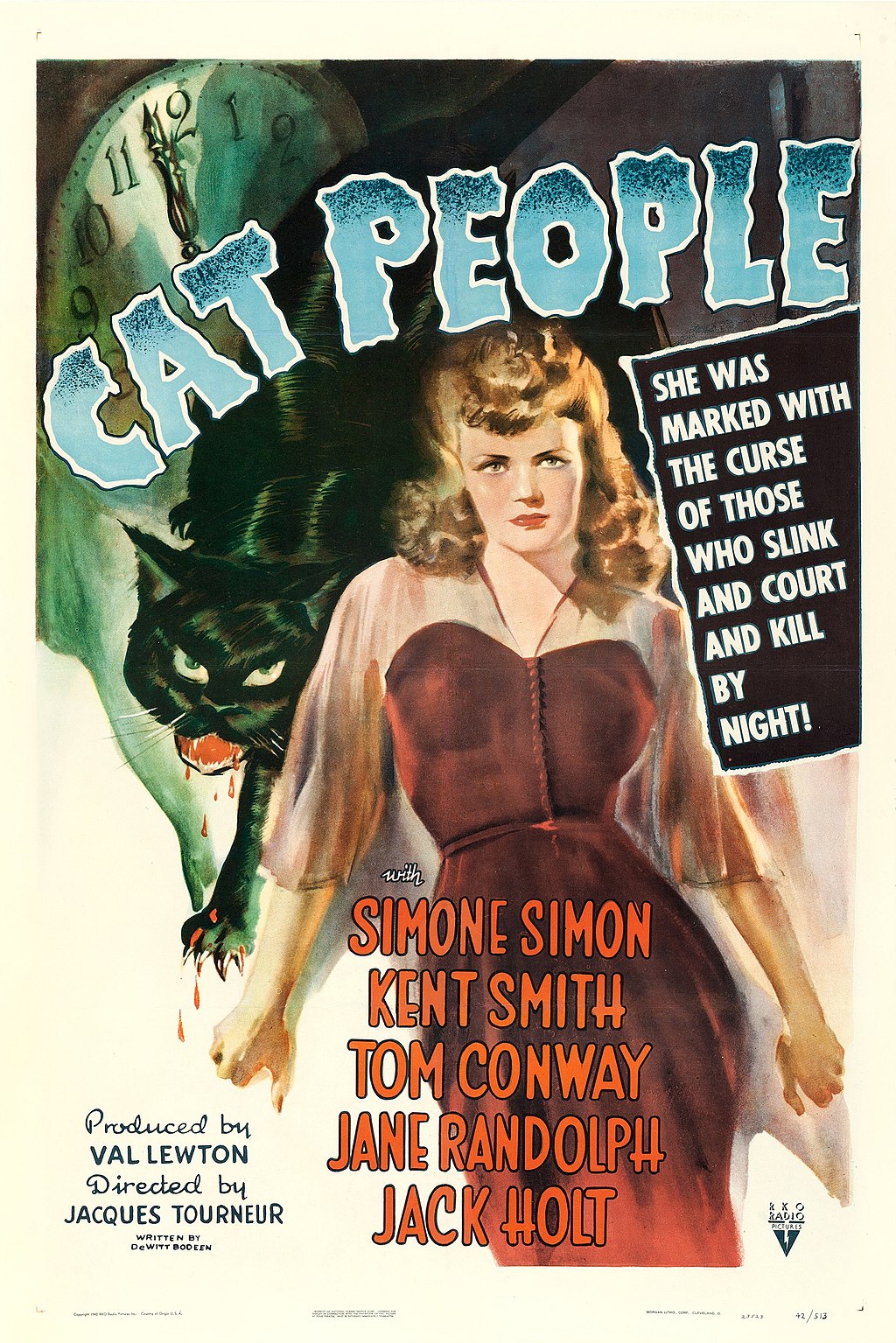
Holy Horror began with movies from 1960 on.  You see, I had watched the 1982 remake of Cat People without ever watching the original from 1942.  The remake has Paul Gallier, the brother of Irena, as a religious leader.  He doesn’t cite the Bible, so the movie fell outside the limits I set for that particular book.  I recently watched the 40-year older original version and was surprised to find not only the religion intact, but also the Bible as part of the story.  Both versions integrate religion and horror and some of the scenes are very close between the two.  The original centers around Irena Dubrovna, a Serbian immigrant.  In addition to originating the The Lewton Bus technique, the film also introduced a religious origin for the horror.  When Irena meets Oliver Reed, she explains to him that in Serbia, in her home village, some witches were driven out into the woods of the surrounding mountains by the Christians.  There they formulated a curse leading to becoming cat people when aroused.

Irena, fearing sexual arousal, spends time apart from Oliver after they marry, mainly watching the black leopard at the zoo.  One of the custodians warns her it’s an evil animal, a monster as described in the book of Revelation, which he quotes.  Of course, this leopard is an ordinary big cat, and the woman to whom he quotes Scripture is a cat woman.  Irena knows inside that she’s one of the cat people, but nobody will believe her.  The film also makes use of a quote from John Donne regarding sin.  Indeed, the film makes it clear, even after Irena dies, that she had never lied.  While she’s stalking Oliver and Alice in their office one night, Oliver pulls down a T-square, the shadow of which forms a cross on the wall, and he abjures her, in the name of God, to leave them alone.  Religion, the clash of religions, makes the monster.

Cat People, despite having had a mixed reception, was an influential movie.  Like much of early horror, it’s tame by today’s standards.  And yet it’s aged well.  I didn’t expect to be drawn in as much as I ended up being.  After all, I’d seen the remake first.  America at the time had a fear of the Balkan region, where mysterious eastern Europeans still had tales of vampires, werewolves, and cat people.  Of course, the last of these was invented for the film.  The director, writer, and producer wanted to create an intelligent horror film, which they did.  Moody, atmospheric, and based on religious tension, it is worthy of a Holy Horror sequel.


Young Reading

It was more the lede line than the story.  Melissa Kirsch’s “The books we read when we’re young help shape the adults we become in ways we don’t always grasp” caught my attention.  My own current rereading of Dark Shadows books certainly reflects that.  As my You Tube video on Dark Shadows considers, it was the books more than the television show that shaped my young mind.  Consciously, I know that’s probably the main reason I’ve always wanted to live in Maine.  It may seem strange to some to want to move where a vampire frequently visits, but there was more going on in those stories than I realized.  It would be enough to make me tremble were I a young persons’ fiction writer.  They have so much influence.  Spending my younger years searching for a father took me some strange places.

My other young reading was, naturally, the Bible.  I can’t remember how young I was when I began to try to read through the King James.  Eventually I did get through, and then I started all over again.  Clearly my entire life has been impacted by that early fear of Hell that drove me to the Scriptures.  Perhaps that combination of Bible and Dark Shadows novels led to Holy Horror and its aftermath.  In other words, my youthful reading led to what has become a vocation, of sorts.  That elusive university, or college job in Maine never came to fruition.  I tried many times to get a toehold there, Bible in hand.  I’ve ended up back in Pennsylvania, where I started.  And I’m still reading.

I’ve read a good number of good books, but it has been some time since one set my life off on a different trajectory.  Some books have lead me to write books, and books I read often suggest even more books.  Whether I die today or thirty years from now, books will have defined my life.  I grew up reading them and wanting to write them, with no real idea how to do the latter.  One of those childhood books convinced me that a career outside the church was one not worth having.  Indeed, were I clergy now my enjoyment of horror would certainly garner more attention than it does in my current role as “some guy.”  I am, however, that person who grew from a worried-looking kid who’d not yet figured out that my reading choices would lead to a life measured by books.

The ultimate adventure…

Coronation Bible

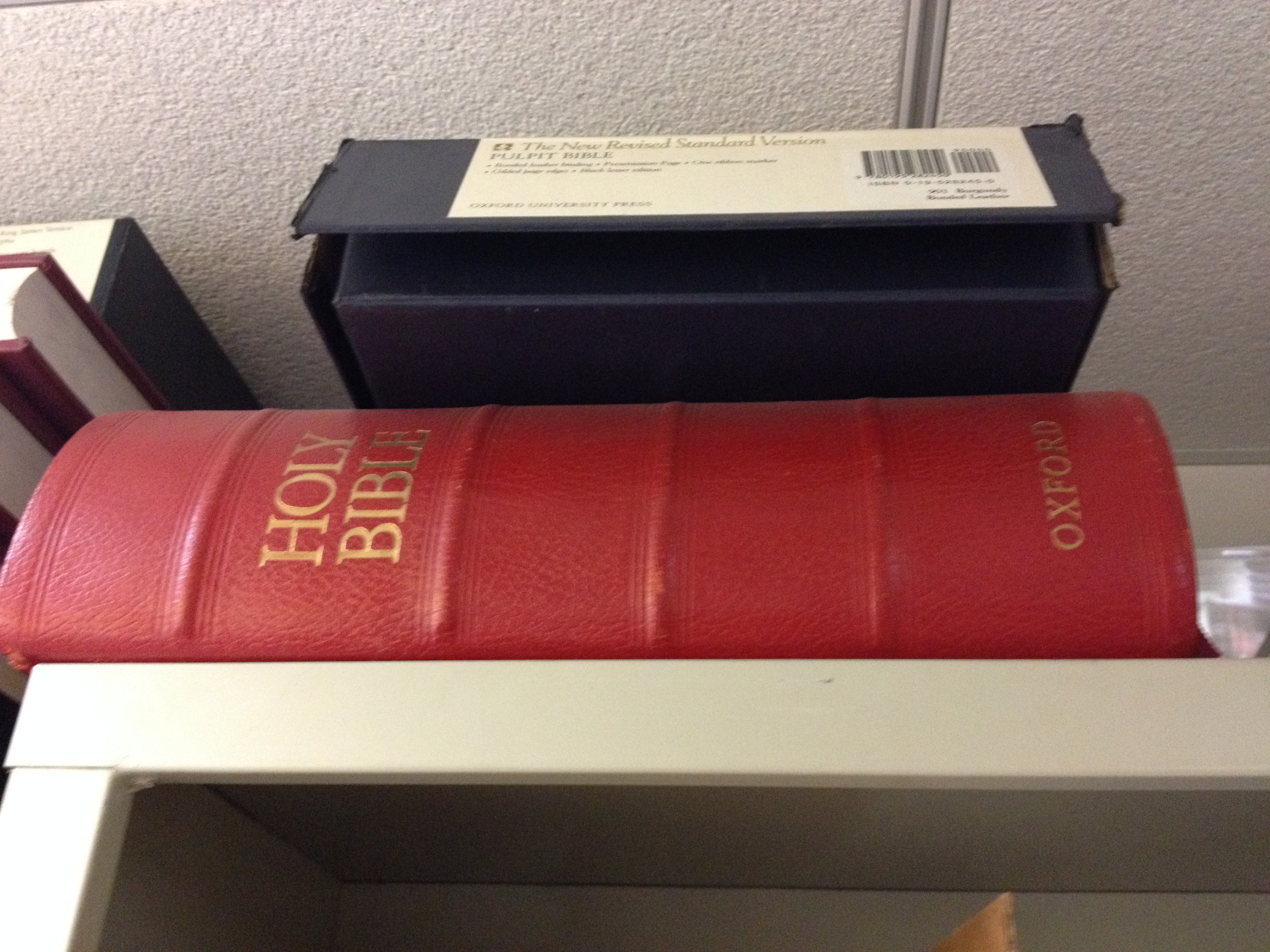
The scene from The King’s Speech doesn’t show it at all, but there was even more drama around the coronation of George VI than the movie reveals.  It may not be obvious, especially to Americans, but there is a great deal of prestige in being the supplier of a coronation Bible.  The two ancient presses in the United Kingdom, Cambridge and Oxford, vie for that honor.  In 1937 Oxford had won out.  Coronation Bibles are works of art and are extremely rare.  You’ll never find one at your local library’s used book sale.  As a recent Oxford University Press blog post indicates, the Bible at George VI’s ceremony was a last-minute replacement.  What could possibly go wrong with a ceremonial Bible, of all things?  Quite a lot, but this one had to do with an aging cleric.

Despite being the eve of war time, an elaborate Bible had been designed and manufactured.  Symbolism is important.  Britain faced not only the aggression of Hitler, but also the abdication of Edward VIII.  Instability was in the air.  In such times, as we’ve seen in American politics, leaders look to the Bible for support.  Printed on special paper, chased with gold on its cover, the coronation Bible was a work of art.  However, the Bishop of Norwich, Bertram Pollock, couldn’t lift it.  At 73 he wasn’t in the best of health, and he had a role in the ceremony.  At the last minute a lighter, replacement Bible was sent.  According to the OUP blog post, the Archbishop of Canterbury issued a rare apology to the press, but also noted “I cannot but wish that you had given some more consideration to the physical infirmities of those who would have to carry it.”

A big Bible

Swearing on the Bible is an archaism that seems likely to persist into the foreseeable future.  The future of the British monarchy (which I do not follow) itself seems in doubt, but to quote the Good Book, “The grass withereth, the flower fadeth: but the word of our God shall stand for ever.”  As long as many people believe this, such swearing will persist.  Even if such belief fades, the solemnity of swearing on a Bible is likely to continue.  The Bible has, in its tangible way, become a stand-in for God.  And as another archaism, a king, is sworn in today, it is to be hoped that the bishops involved have kept their muscle tone intact.  At least to heft, for a little while, a ceremonial Bible.


Spiritual Alterations

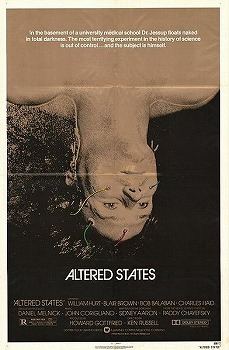
I’d been meaning to watch Altered States for quite a few years.  I suspect the reason (it’s been long enough that I can’t recall for sure) is that I knew it had a story line tied in with religion.  The tale follows Edward Jessup, a psychopathologist, who is attempting to understand schizophrenia.  He’s particularly taken by the religious nature of some schizophrenic delusions, and he uses sensory deprivation on himself to trigger something similar.  A trip among tribal Mexicans leads him to a psychoactive substance that he decides to combine with sensory deprivation to enhance the effects.  Along the way he explains to his girlfriend, and eventual wife, that his father was religious but died a horrible death.  He therefore became irreligious but his altered states of consciousness are often full of images from Revelation.

While the Bible theme eventually gives way to biological regression to pre-Homo sapiens, one of Jessup’s experiences has him coming to his dying father again and dropping a Bible on him which turns into the veil of St. Veronica on his face, which he then rips off and throws, flaming, to the floor.  Another instance of the Bible in horror, the film also uses crucifixes and hellish images to demonstrate the religious nature of these alternative states.  Jessup’s goal is to regress to the original thought, to encounter, as he puts it “God.”  This desire, combined with the potent Mexican drug, transforms him physically, and, in the end, emotionally.  Instead of being dissociated from his wife (whom he is planning to divorce), he realizes that love is the only thing that can save him from the terror of his experiences.

This is some profound stuff.  Paced like a movie from 1980, it has a quality not unlike 2001: A Space Odyssey.  The message seems to be sound—the need for encountering the “divine” ends up convincing Jessup (that may autocorrect keeps changing to “Jesus”) that love is really what it’s all about.  The transformation scenes, while not shown in the detail of An American Werewolf in London, are nevertheless convincing enough.  It’s a rare movie that treats religion respectfully.  Here Ivy-League scientists are motivated to understand it.  In real life, alternative states of consciousness are quite real, if poorly understood.  They’ve been part of religious practice from the beginning and are a far cry from sitting in the pew and singing anodyne hymns week after week.  The more movies I see, the more it seems that a sequel to Holy Horror will be necessary some day.  


Curses

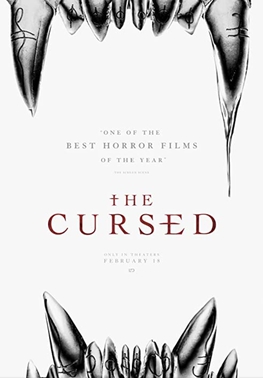
Once again I’m reminded that Holy Horror was never intended to be comprehensive.  I recently watched The Cursed (the 2021 one, directed by Sean Ellis).  This appeared after Holy Horror was published, but it’s a good example of religion (and the Bible) and horror.  It’s artfully done but rather gruesome and difficult to watch.  I suspect such aspects as gruesomeness are why many people dislike horror.  That certainly isn’t my favorite part either.  I watch for the story.  The lesson learned.  The moral delivered.  And also to get a sense of what’s going on in the wider culture.  People tell disturbing stories for a reason.  And quite a lot can be learned from them.  The Cursed has a complex story that was, I suspect, influenced by the historical incident of the Gilles Garnier killings in early modern France.

Set in France, this movie focuses on disputed land and the inappropriately extreme measures wealthy landowners will take to keep it.  A group of Romani (“gypsies”) have laid claim to some aristocratic lands.  Seamus Laurent, a local baron, decides (with the advice of the clergy) to kill them off.  Foreseeing this, one of the women had a set of silver teeth made and put a curse on them.  After she’s killed, the teeth are found by the children of the town and the teeth make monsters.  There’s some confused imagery here, but the story-line is clear.  The monster is revenge for the cruel treatment of and land theft from the Romani.  They may be dead, but betrayal leads to revenge.

That’s where the Bible comes in.  Apart from the locals fleeing to the church for safety, it turns out that the silver was from the thirty pieces given to Judas to betray Jesus.  One of the murder victims had a page torn from the Bible with Ezekiel 22.22 highlighted.  Unlike Pulp Fiction, this quote from Ezekiel isn’t made up and the “prophecy” is taken to refer to the beast conjured by the injustice done to the rightful owners of the land.  This film is subdued, moody, and gothic.  The story is sincere and well told.  It leaves enough gaps for discussion.  It also shows, once again, how religion and horror benefit from each other’s presence.  Stealing land is a biblical crime.  Although the church doesn’t ultimately protect, the absent God in this movie is on the side of those oppressed and tortured by the wealthy.  Maybe it’s time for a sequel.


Addenda

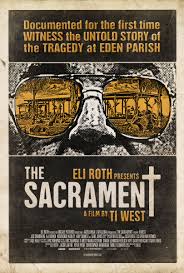
In retrospect, I suppose I wrote Holy Horror a bit prematurely.  Back when I started writing it, I had thought that the Bible in horror wasn’t as common as I’ve since found it to be.  I still stand by what I wrote, but I could’ve included a lot more movies that I’ve watched over the years since.  The Sacrament is one of them.  Based on the Jonestown massacre, the film sets the movie in the early twenty-tens.  A reporter for VICE is going to find his sister who’s joined a religious commune in some unspecified country.  In an effort to get him to join, she invited him to visit.  She was unaware, however, that he brought another journalist and cameraman with him.  The movie gives creepy vibes right away since they’re greeted at the helicopter landing site by men with guns.  Eventually they’re allowed to enter.

“Father,” the leader of the commune bears a resemblance to Jim Jones and soon it’s clear where this is going.  Along the way, however, Scripture gets quoted to justify their communal lifestyle.  There are many fictional aspects thrown in—the young women seduce the journalist whose sister invited him.  She makes no bones about saying they do it to convince him to stay.  The camera crew is almost convinced that this is the paradise it claims to be, but they start getting requests for help.  The writers clearly did their research on Jonestown since several details of the final weeks of the Peoples Temple are fictionalized here.  The mass suicide is shown in graphic detail.  The number of the dead, however, is only about a fifth of those who actually died in Guyana in 1978.

The movie clearly shows that the commune is problematic, but it also raises uneasy questions.  If it weren’t for the murder of Leo Ryan, would Jonestown ever have happened?  Probably, but the film shows “Father” making the point that nobody was being harmed.  That’s belied by the introduction of an abused girl and the number of people who want to leave.  It’s true of Jonestown that mind-control tactics were used and people weren’t permitted to leave, especially as Jones’ paranoia grew.  The movie leaves the viewer wondering whether utopian communes can ever work, people being what they are.  We crave our freedom, even when things look great.  The movie condemns the exercise, but not so much that it leaves lingering doubts about whether, had things been different, it might’ve worked.  And it would’ve worked, had I seen it earlier, for Holy Horror.


Glen Da

My current fascination with Ed Wood is, strangely, related to waking up too early.  I’ve tried for years to calibrate my schedule to more like a normal one—I’ve always been an early riser—but have had difficulty doing so.  Weekends at home, therefore, include afternoons when I’m always too sleepy to read, so I watch free movies.  I’d heard about Plan 9 from Outer Space for years before I finally watched it, and it was an epiphany.  Ed Wood, the hapless director, became posthumously famous for his poorly made films, and I’ve been catching as many of those as I can.  While Glen or Glenda wasn’t Wood’s first film, it is the one that kicked off his notoriety.  Considering that it was made in 1953 it is also way ahead of its time.  It is very cheaply made and contains what would eventually become many Wood hallmarks.

Ed Wood was a heterosexual transvestite.  Even today, some seventy years later, this is a category that often confuses hoi polloi.  That’s largely because sex and gender are often misunderstood as the same thing.  Gender is a societally ascribed role—men do this, women do that—based on often unconsidered stereotypes.  Today men dressing as women and vice versa is often played for laughs, or, if serious, is mistaken as an indicative sign of homosexuality.  Glen or Glenda is sometimes classified as a docudrama that attempts to explain this distinction.  Wood, who also stars in the movie, was an actual transvestite, something that wasn’t accepted in the button-down fifties.  After all, one command in the Bible prohibits cross-dressing (likely confusing it with assumed sexual behavior).

None of this makes Glen or Glenda a great movie.  Way ahead of its time, yes, but a strange mix of things nevertheless.  Star billing goes to Bela Lugosi, washed up by this point in his life.  His role as a scientist—often presented as “God”—is unclear.  The devil also appears in the movie, as do several vignettes, reportedly added by the producer, to make this more an exploitation film.  What comes through clearly is that this was a deeply personal film for Wood.  He was trying, as directors and authors often do, to explain himself to the world.  The most successful tend to do this with panache and style, and, let’s be honest, big budgets.  Hollywood, like the publishing industry, is unkind to those who don’t come with well-lined pockets.  It doesn’t mean that the rest of us don’t have stories to tell.  Ed Wood persisted in telling his and, as Glen or Glenda shows, being way ahead of the curve.


Love’s Life

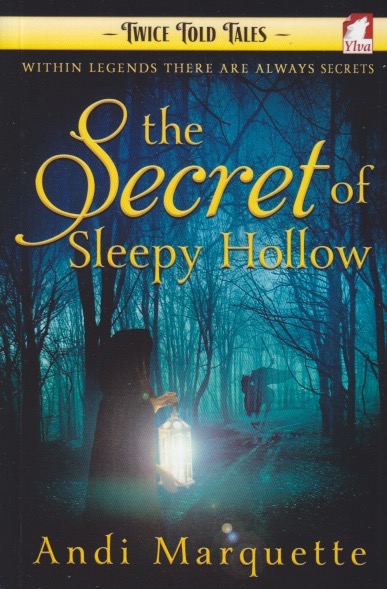
One of the things about literary classics is they open themselves to reinterpretation.  It’s often a lot of fun to trace these.  Andi Marquette is obviously an educated writer.  Her The Secret of Sleepy Hollow is one of those reinterpretations that has a unique take on the tale.  Set in modern times and featuring a member of the Crane family—Abby—as a graduate student, this story brings the tale into a contemporary context.  Abby meets another graduate student—Katie—in Sleepy Hollow and the two fall in love.  It turns out that Katie is a member of the Van Tassel family, thus bringing the two main families of Washington Irving’s “Legend of Sleepy Hollow” together again.  There’s even a headless horseman.

Like the biblical book of Ruth, this is a gentle tale of women’s love.  There’s no overt violence, no heads get chopped, but two women love and care for one another.  Many of the more modern repackaged versions of Sleepy Hollow tend to go for the violent, sometimes drug-fueled tales of bored youth in a small town facing an angry ghost.  Here the interest is more literary, a gothic romance.  The fact that it’s a lesbian love story makes me wonder why so many people have trouble with others’ love lives.  People are prone to curiosity about sex—that’s a simple fact.  What isn’t so simple is that mores based on culturally specific ideas from millennia ago don’t stand the test of time and yet cause misery in modern lives because they can’t accept what we now know—sex and love are anything but simple.

Marquette’s book is marked by that anxiety.  When people discover a love that’s often misunderstood, they face ridicule or worse.  The book of Ruth provides a good guide here—the acceptance of a normally forbidden love can bring good and happiness to people in what is often a difficult world.  There’s trouble enough—there are headless horsemen out there—that we don’t need to be causing more by judging the loves of others.  Even a cisgender heterosexual can understand that.  Life is complicated and we all try to find our way through.  Love is one of those things that can help to make it more bearable.  I found The Secret of Sleepy Hollow compelling in that way.  It may not be a literary classic—few books are—but it takes on a complex topic intelligently and with heart.  It’s a new take on an old story that still fits the modern world.